
Lesson 10 2 3 D Views of Solid
- Slides: 9
Lesson 10 -2 3 -D Views of Solid Figures Lesson 10 -2: 3 -D Views of Solid Figures 1
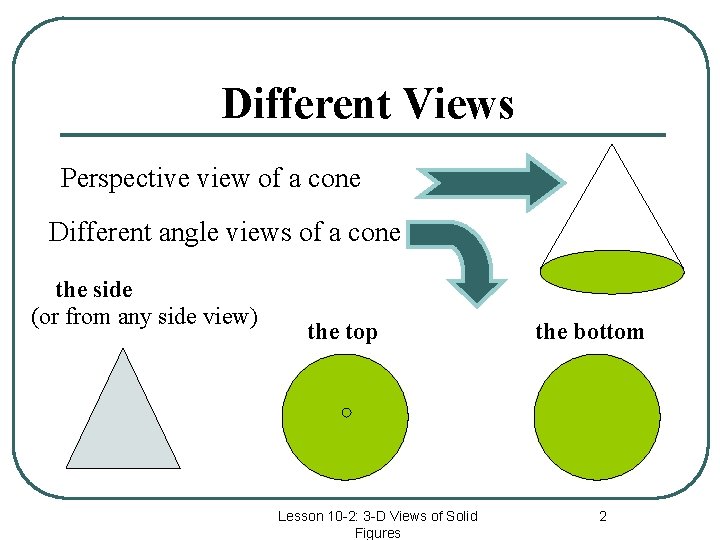
Different Views Perspective view of a cone Different angle views of a cone the side (or from any side view) the top Lesson 10 -2: 3 -D Views of Solid Figures the bottom 2
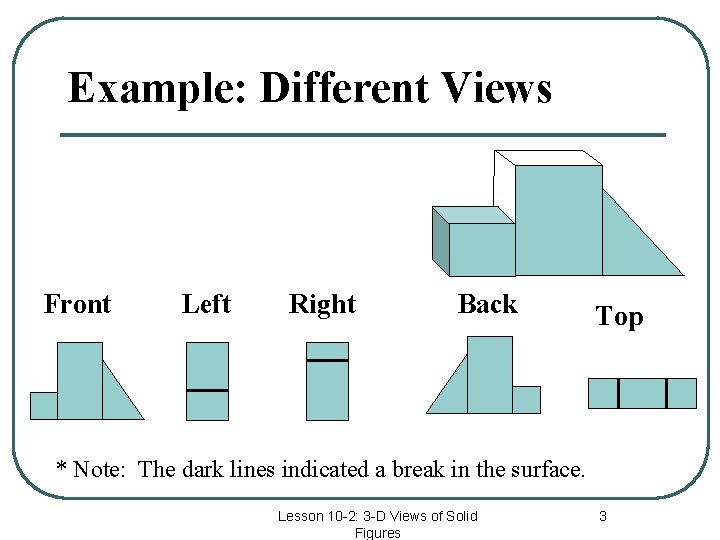
Example: Different Views Front Left Right Back Top * Note: The dark lines indicated a break in the surface. Lesson 10 -2: 3 -D Views of Solid Figures 3
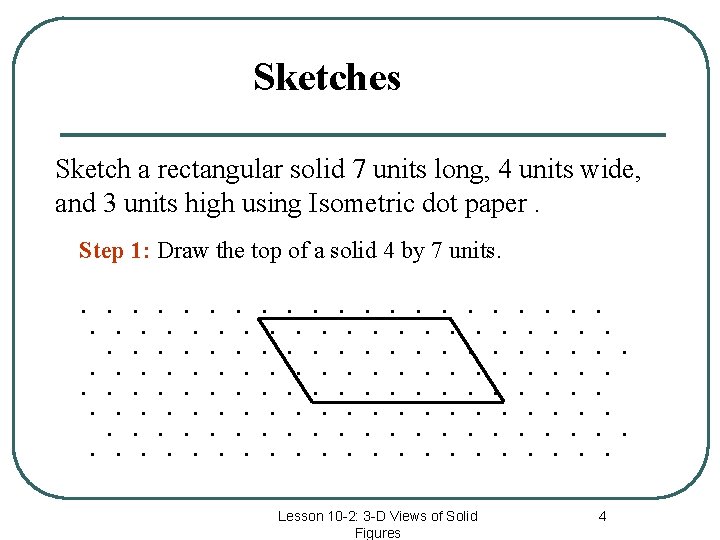
Sketches Sketch a rectangular solid 7 units long, 4 units wide, and 3 units high using Isometric dot paper. Step 1: Draw the top of a solid 4 by 7 units. . . . . . . . . . . Lesson 10 -2: 3 -D Views of Solid Figures 4
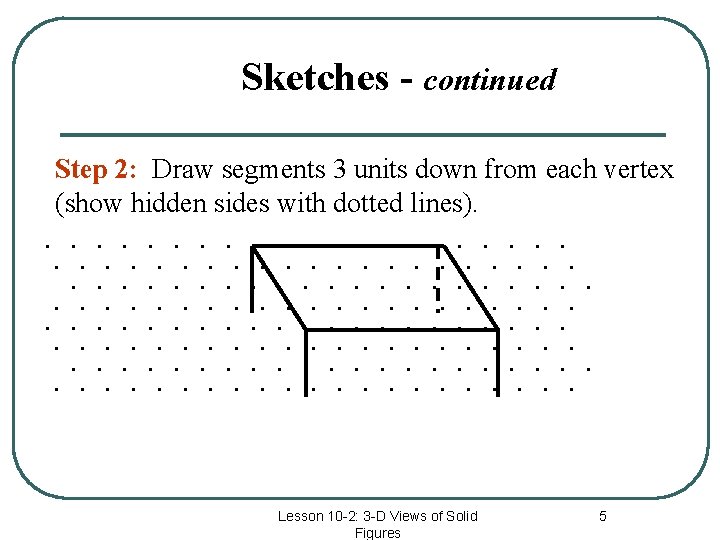
Sketches - continued Step 2: Draw segments 3 units down from each vertex (show hidden sides with dotted lines). . . . . . . . . . . Lesson 10 -2: 3 -D Views of Solid Figures 5
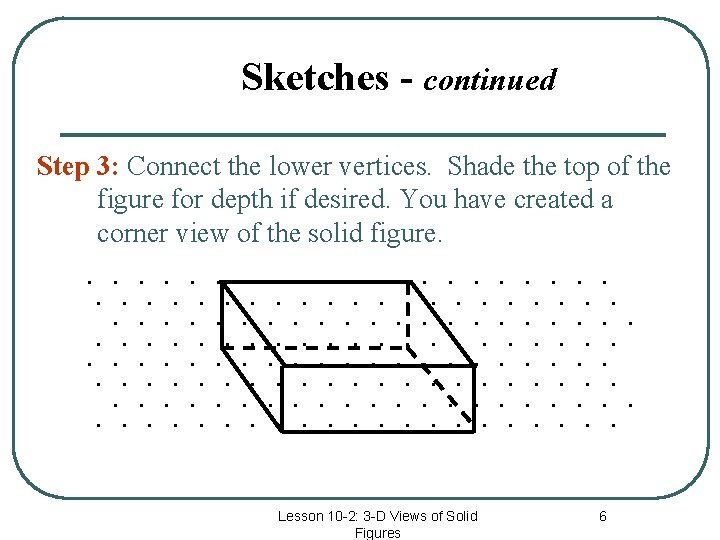
Sketches - continued Step 3: Connect the lower vertices. Shade the top of the figure for depth if desired. You have created a corner view of the solid figure. . . . . . . . . . . Lesson 10 -2: 3 -D Views of Solid Figures 6
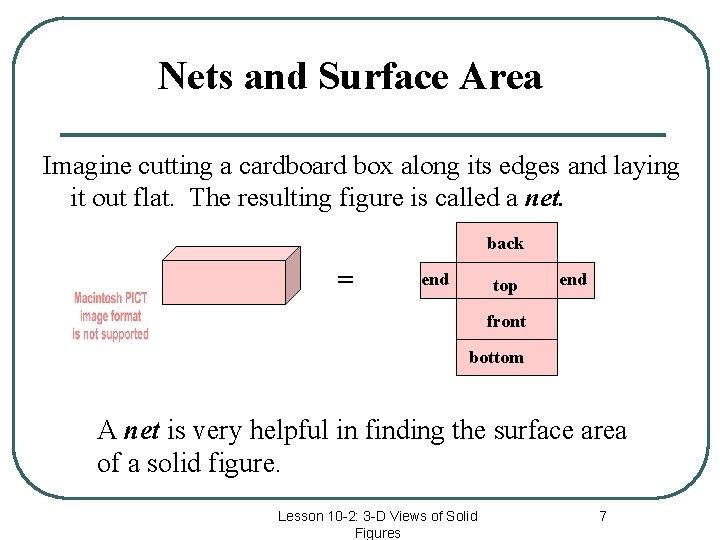
Nets and Surface Area Imagine cutting a cardboard box along its edges and laying it out flat. The resulting figure is called a net. back = end top end front bottom A net is very helpful in finding the surface area of a solid figure. Lesson 10 -2: 3 -D Views of Solid Figures 7
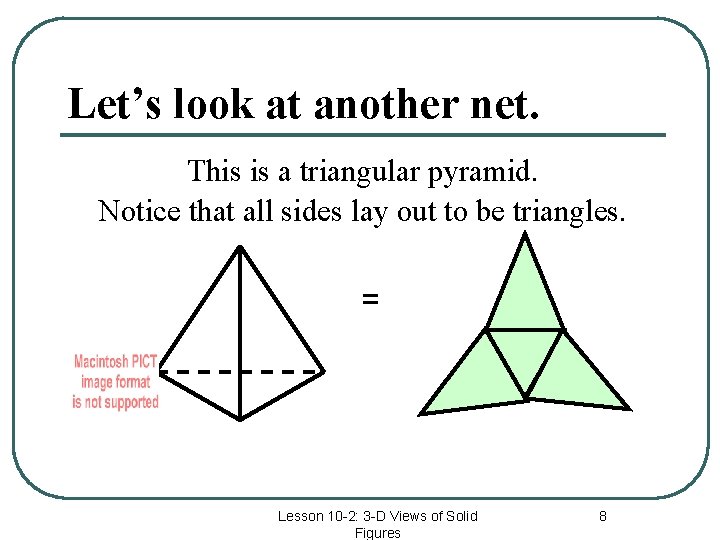
Let’s look at another net. This is a triangular pyramid. Notice that all sides lay out to be triangles. = Lesson 10 -2: 3 -D Views of Solid Figures 8
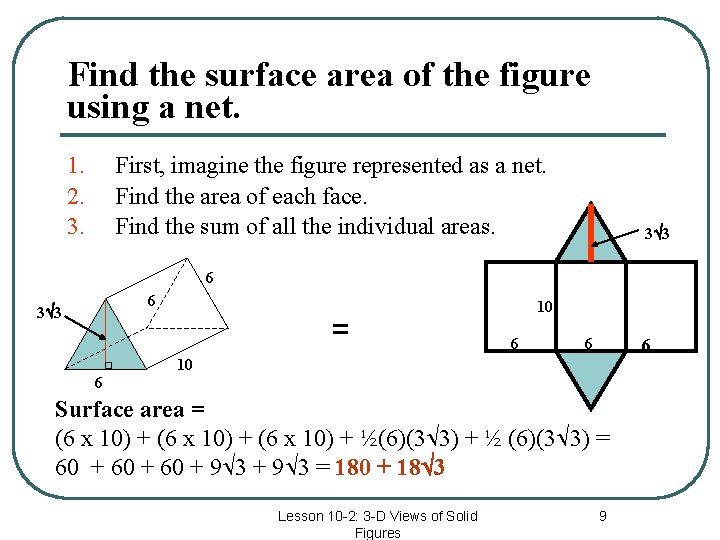
Find the surface area of the figure using a net. 1. 2. 3. First, imagine the figure represented as a net. Find the area of each face. Find the sum of all the individual areas. 3 3 6 6 3 3 = 6 10 6 6 6 10 Surface area = (6 x 10) + ½(6)(3 3) + ½ (6)(3 3) = 60 + 9 3 = 180 + 18 3 Lesson 10 -2: 3 -D Views of Solid Figures 9