
Lesson 10 1 Sample Spaces and Probability Learning
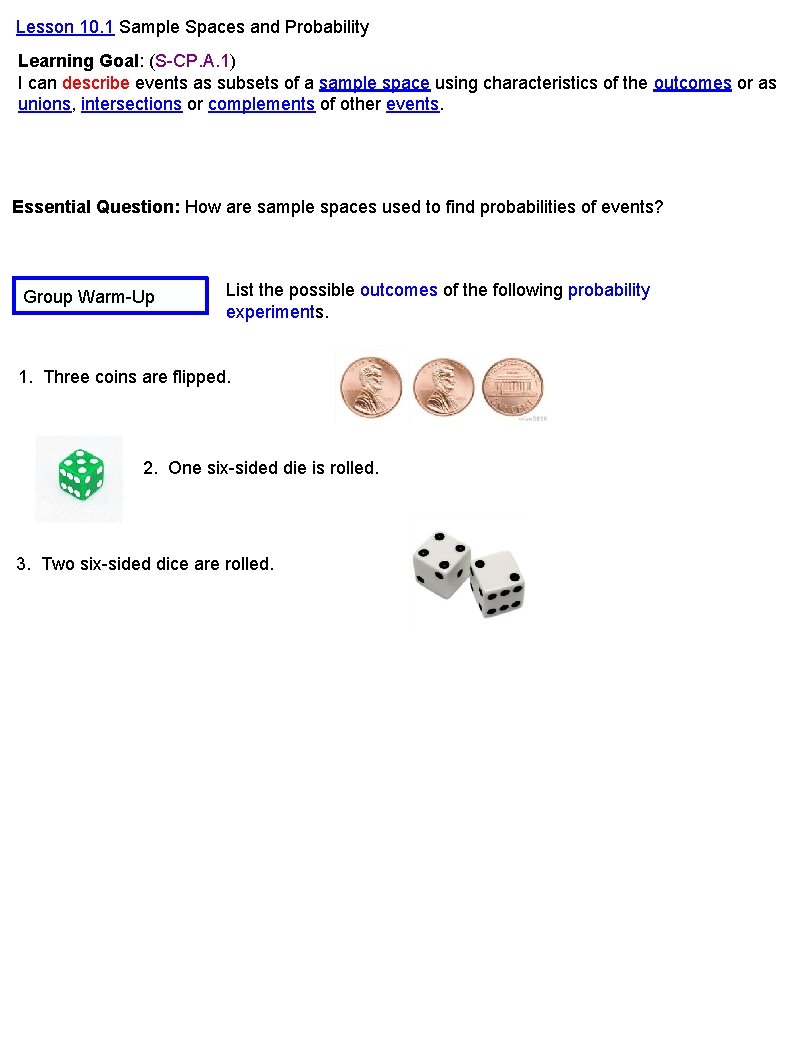
Lesson 10. 1 Sample Spaces and Probability Learning Goal: (S-CP. A. 1) I can describe events as subsets of a sample space using characteristics of the outcomes or as unions, intersections or complements of other events. Essential Question: How are sample spaces used to find probabilities of events? Group Warm-Up List the possible outcomes of the following probability experiments. 1. Three coins are flipped. 2. One six-sided die is rolled. 3. Two six-sided dice are rolled.
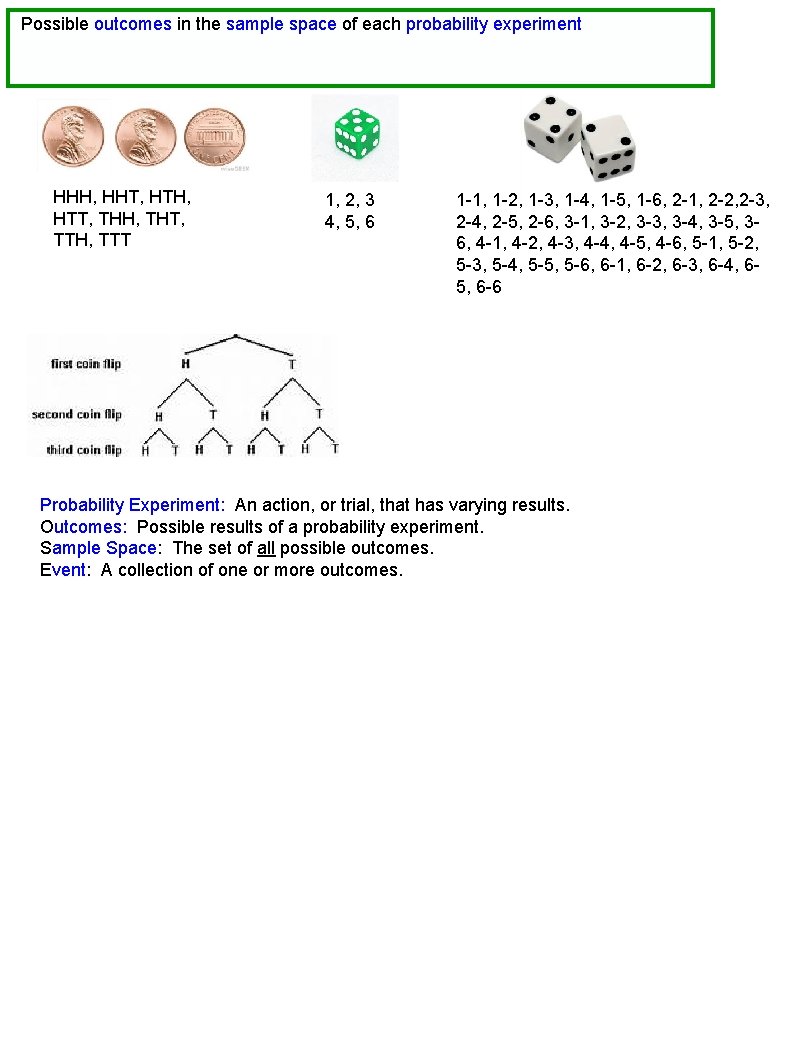
Possible outcomes in the sample space of each probability experiment HHH, HHT, HTH, HTT, THH, THT, TTH, TTT 1, 2, 3 4, 5, 6 1 -1, 1 -2, 1 -3, 1 -4, 1 -5, 1 -6, 2 -1, 2 -2, 2 -3, 2 -4, 2 -5, 2 -6, 3 -1, 3 -2, 3 -3, 3 -4, 3 -5, 36, 4 -1, 4 -2, 4 -3, 4 -4, 4 -5, 4 -6, 5 -1, 5 -2, 5 -3, 5 -4, 5 -5, 5 -6, 6 -1, 6 -2, 6 -3, 6 -4, 65, 6 -6 Probability Experiment: An action, or trial, that has varying results. Outcomes: Possible results of a probability experiment. Sample Space: The set of all possible outcomes. Event: A collection of one or more outcomes.
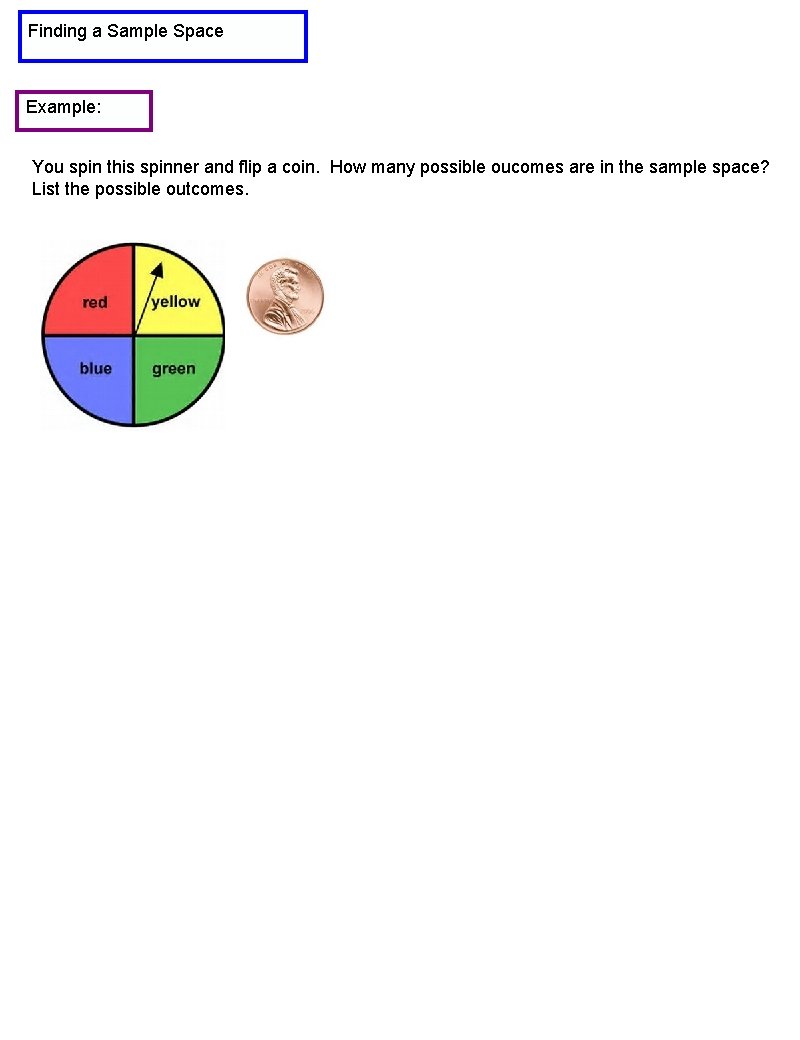
Finding a Sample Space Example: You spin this spinner and flip a coin. How many possible oucomes are in the sample space? List the possible outcomes.
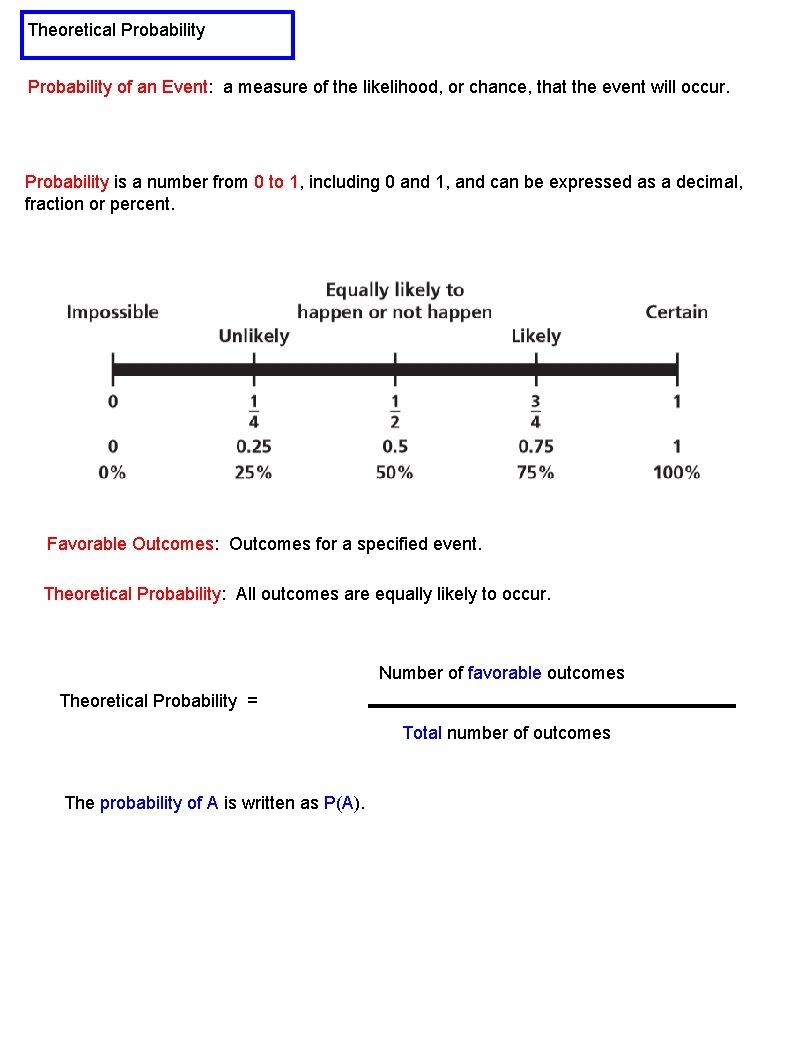
Theoretical Probability of an Event: a measure of the likelihood, or chance, that the event will occur. Probability is a number from 0 to 1, including 0 and 1, and can be expressed as a decimal, fraction or percent. Favorable Outcomes: Outcomes for a specified event. Theoretical Probability: All outcomes are equally likely to occur. Number of favorable outcomes Theoretical Probability = Total number of outcomes The probability of A is written as P(A).
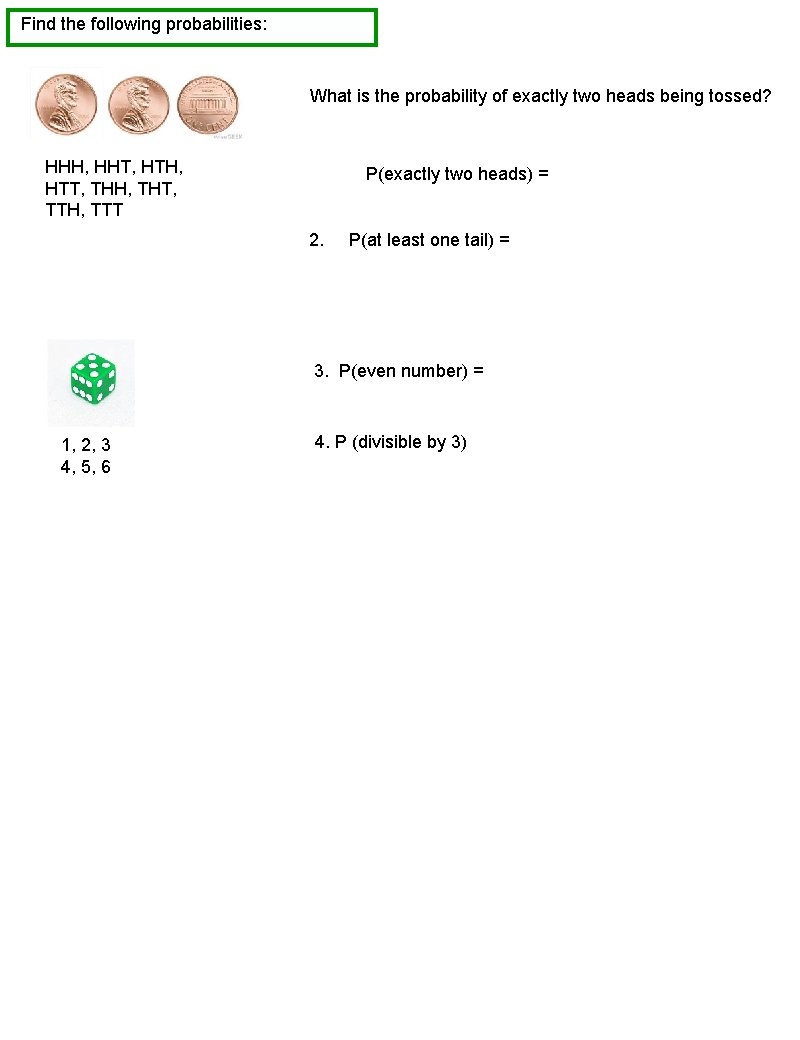
Find the following probabilities: What is the probability of exactly two heads being tossed? HHH, HHT, HTH, HTT, THH, THT, TTH, TTT P(exactly two heads) = 2. P(at least one tail) = 3. P(even number) = 1, 2, 3 4, 5, 6 4. P (divisible by 3)
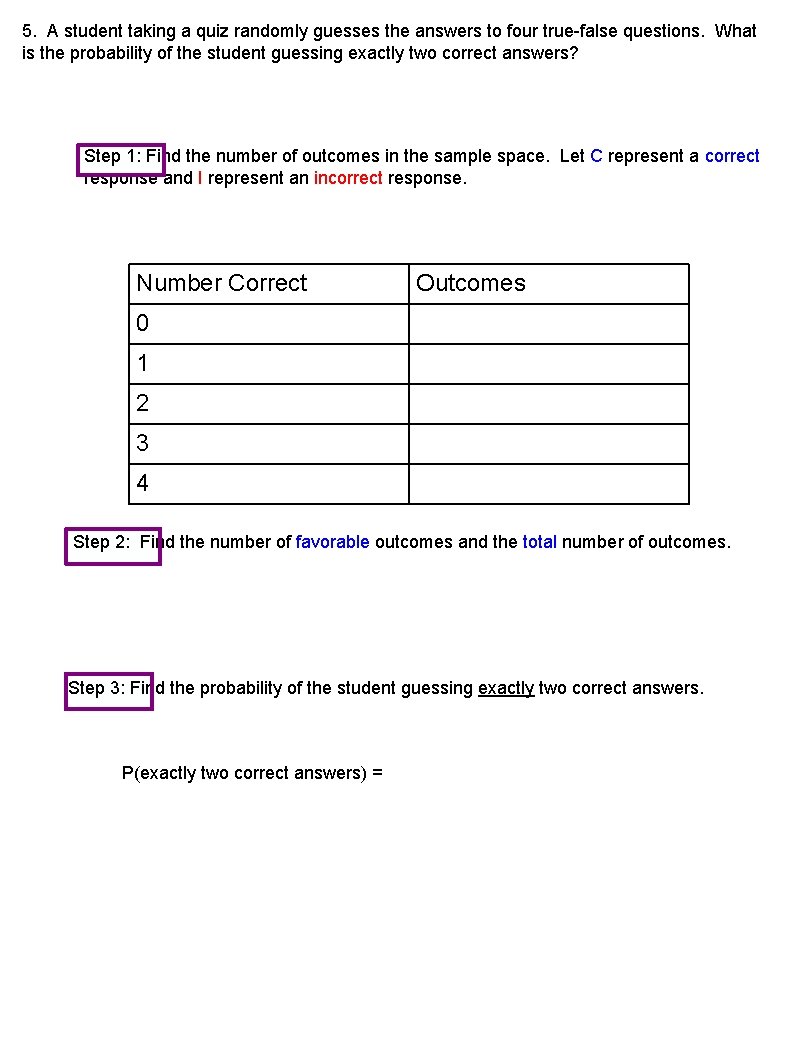
5. A student taking a quiz randomly guesses the answers to four true-false questions. What is the probability of the student guessing exactly two correct answers? Step 1: Find the number of outcomes in the sample space. Let C represent a correct response and I represent an incorrect response. Number Correct Outcomes 0 1 2 3 4 Step 2: Find the number of favorable outcomes and the total number of outcomes. Step 3: Find the probability of the student guessing exactly two correct answers. P(exactly two correct answers) =
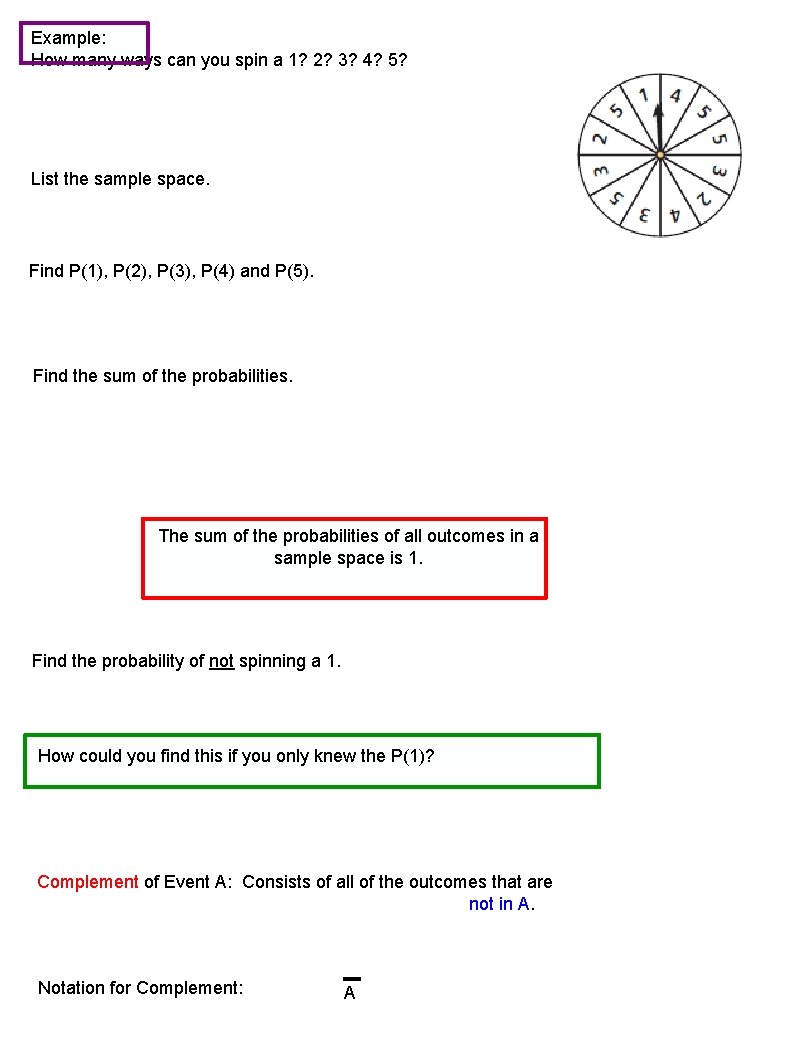
Example: How many ways can you spin a 1? 2? 3? 4? 5? List the sample space. Find P(1), P(2), P(3), P(4) and P(5). Find the sum of the probabilities. The sum of the probabilities of all outcomes in a sample space is 1. Find the probability of not spinning a 1. How could you find this if you only knew the P(1)? Complement of Event A: Consists of all of the outcomes that are not in A. Notation for Complement: A

Probability of the Complement of an Event P( A ) = 1 - P(A) Example: When two six-sided dice are rolled, there are 36 possible outcomes, as shown. Find the probability of each event. a. The sum is not 6. P(sum not 6) = 1 - P(sum 6) = b. The sum is less than or equal to 9. P(sum is ≤ 9) = 1 - P(sum is > 9) = 1 -1, 1 -2, 1 -3, 1 -4, 1 -5, 1 -6, 2 -1, 2 -2, 2 -3, 2 -4, 2 -5, 2 -6, 3 -1, 3 -2, 3 -3, 3 -4, 3 -5, 36, 4 -1, 4 -2, 4 -3, 4 -4, 4 -5, 4 -6, 5 -1, 5 -2, 5 -3, 5 -4, 5 -5, 5 -6, 6 -1, 6 -2, 6 -3, 6 -4, 65, 6 -6
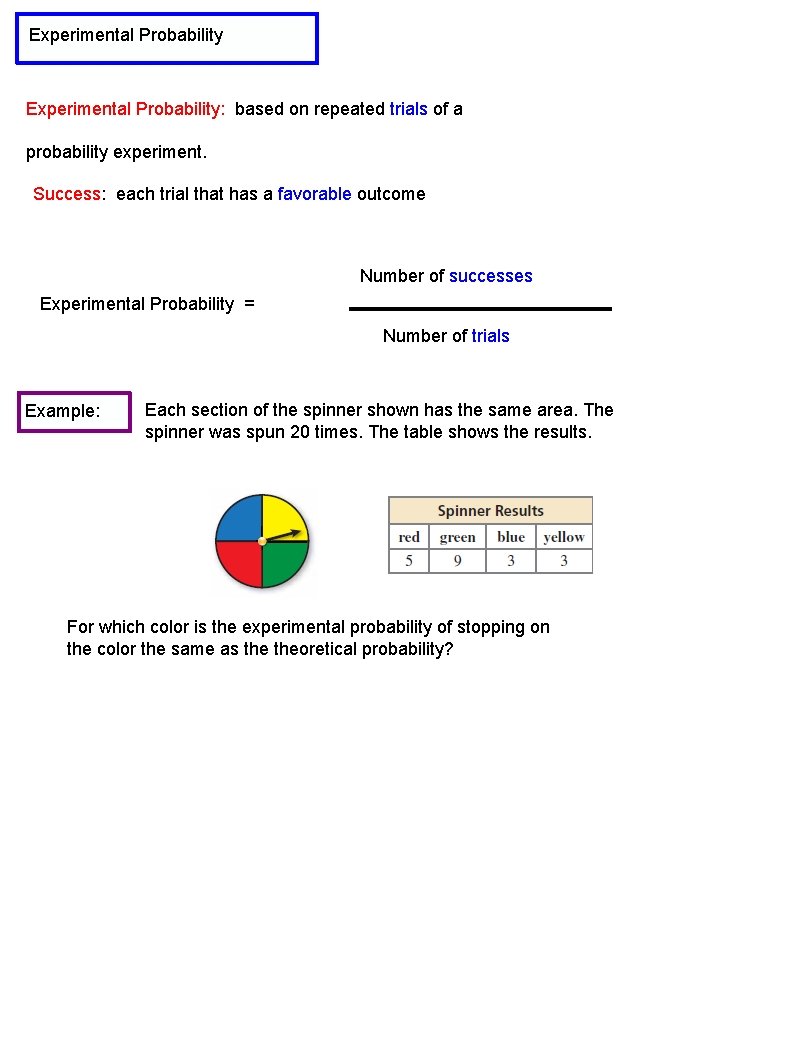
Experimental Probability: based on repeated trials of a probability experiment. Success: each trial that has a favorable outcome Number of successes Experimental Probability = Number of trials Example: Each section of the spinner shown has the same area. The spinner was spun 20 times. The table shows the results. For which color is the experimental probability of stopping on the color the same as theoretical probability?
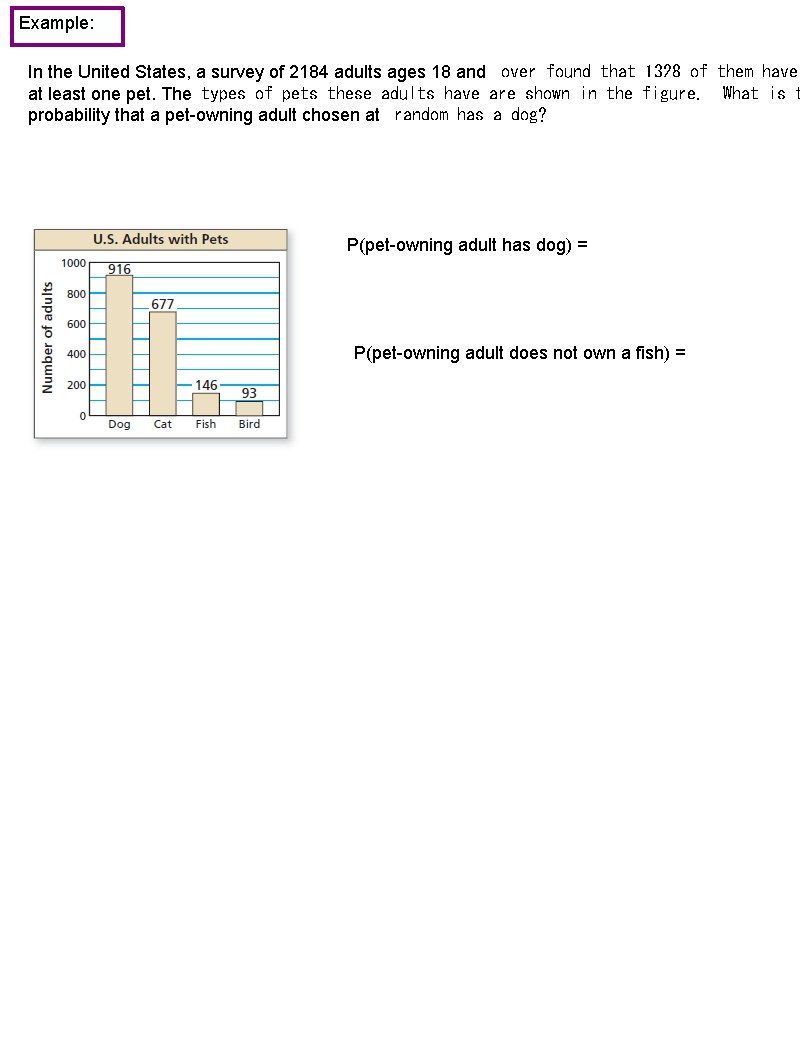
Example: In the United States, a survey of 2184 adults ages 18 and over found that 1328 of them have at least one pet. The types of pets these adults have are shown in the figure. What is t probability that a pet-owning adult chosen at random has a dog? P(pet-owning adult has dog) = P(pet-owning adult does not own a fish) =
Exit Question: How are sample spaces used to find probabilities of events? Practice to Strengthen Understanding Hmwk # 14 BI p 542 #5 -11 odd, 15 -19 odd
- Slides: 11