
Lesson 1 Welcome Back to drama What to
Lesson 1
Welcome Back to drama! What to do whilst at home! • Follow the power point, slide by slide. • Some activities require you to watch youtube clips, you may watch them as many times you wish! • Some activities are practical, have a go! • Most activities are written. • Use the word document to complete work. • Save your work! • Once you have finished your work email to me at ahall@ttsonline. net • You must email the completed work by 3. 15 pm the same day.
Learning Purpose By the end of this lesson I will be able to……. LO 1 -To understand what is meant by protagonist and antagonist. LO 2 -To be introduced to the character of Charlie and understand his thoughts and feelings. LO 3 -Explore improvisation and understand the rules. Future Learning: • Further develop improvisation skills. • Understand the difference between a story and a play. • Understand how to use a script. Subject Specific Vocabulary: Freeze Frame, Role Play, Skills, Techniques, Thought-Tracking, Split Screen, Character, Narrator, Flash back, Plot, Facial Expression, Gesture, Script, Dialogue, Theme, Slow Motion, Cast.
Recap! What is a skill? A tool an actor uses to perform. Can you guess some vocal skills you could use? Can you remember the 4 physical skills we learnt previously? - Facial Expression - Levels -Projection (being heard) -Volume (how loud or quiet you speak) -Pace (how fast or slow you speak) -Tone (adding expression to your voice) - Gesture - Body Language What is a technique? A device you use in a performance to help tell the story Write the work up in the word document!
LO 1 -To understand what is meant by protagonist and antagonist. Protagonist: The main character in a drama. The story normally focuses on this character’s experiences. Antagonist: Is the main character’s chief opponent. Usually depicted as the bad guy. Who is the PROTAGONIST in Charlie and the Chocolate factory? Write it up!
LO 2 -To be introduced to the character of Charlie and understand his thoughts and feelings. Using the information about Charlie bucket have a go at creating a still image. Success Criteria: - Facial Expressions to show character emotions - Gestures - Body Language - Levels Bring this scene to life for 1 minute. Your performance must start with your still images to clearly summarise the character of Charlie Bucket Charlie comes from a poor family and lives in a wooden house with his parents and grandparents. Charlie is a very small boy with ragged clothes because he is so poor he can’t afford to eat very much or buy new clothes. He loves chocolate but only gets one chocolate bar per year for his birthday. He is very close to his grandparents and enjoys listening to their stories. Charlie is very selfless and is always thinking of others.
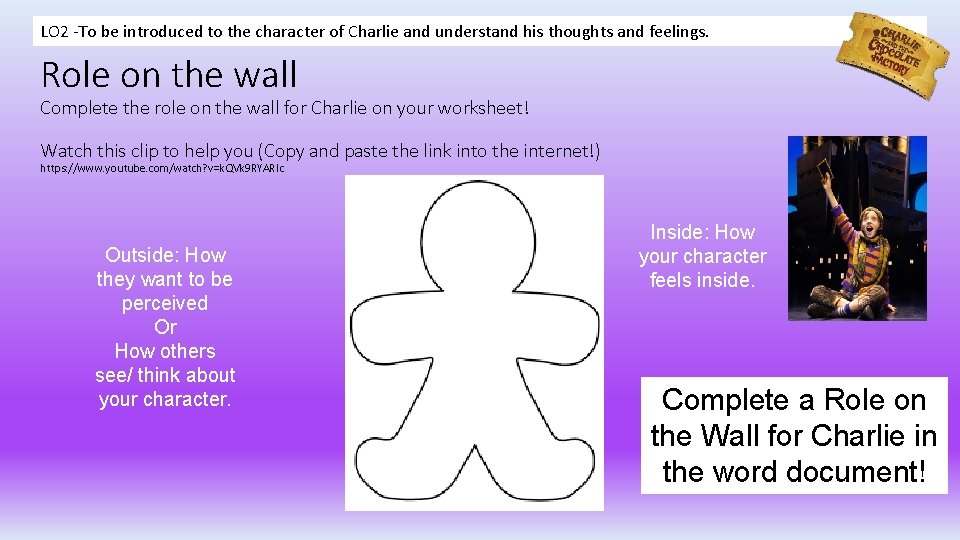
LO 2 -To be introduced to the character of Charlie and understand his thoughts and feelings. Role on the wall Complete the role on the wall for Charlie on your worksheet! Watch this clip to help you (Copy and paste the link into the internet!) https: //www. youtube. com/watch? v=k. QVk 9 RYARIc Outside: How they want to be perceived Or How others see/ think about your character. Inside: How your character feels inside. Complete a Role on the Wall for Charlie in the word document!
LO 3 -Explore improvisation and understand the rules. Charlie finds some money on the street! What do you think Charlie should do? (Use your knowledge taken from Role on the Wall to decide). Should Charlie: - Pick it up and spend it - Leave it be as someone will retrace their steps to find the missing money - Hand it in at the nearest shop Watch the clip below to see what he decides! https: //www. youtube. com/watch? v=KR 8 Psc. R 6 N 2 s
LO 3 -Explore improvisation and understand the rules. Charlie decides to take the money and buy another chocolate bar. Mime (Communicating without talking) Mime Charlie slowly and carefully unwrapping the chocolate bar. Do this slowly, so you can build up tension. You should mime Charlie finding the golden ticket and freeze to highlight his feelings. Add a thought track to show Charlie’s thoughts! Perform this to someone at home and ask them for feedback on your performance!
LO 3 -Explore improvisation and understand the rules. Improvisation This is making it up on the spot! You have just completed this! Spontaneous Improvisation - All improvisation is spontaneous to a degree, in that it’s not scripted! - This style of improvisation means that there has been no discussion or planning about what that scene may contain. - The actors act and react to one another in role and ‘see what happens’. - Often really interesting work arises, particularly in rehearsal. Not all of it may be useful or relevant but working in this way can generate ideas and dialogue worth keeping. - It forces the actor to think on their feet and often throws up some surprises. Write the work up in the word document!
Don’t forget to email the work to me by 3. 15 pm! If your work is outstanding you will receive a golden ticket! Collect them to be in with a chance to win a chocolate prize! Have a good day! Miss Hall
- Slides: 11