
Lesson 1 Types of Muscles Characteristics Power Point
- Slides: 116
Lesson 1 - Types of Muscles - Characteristics
Power. Point® Lecture Slide Presentation by Patty Bostwick-Taylor, Florence-Darlington Technical College The Muscular System 6 PART A Copyright © 2009 Pearson Education, Inc. , publishing as Benjamin Cummings
The Muscular System § Muscles are responsible for all types of body movement § Three basic muscle types are found in the body § Skeletal muscle § Cardiac muscle § Smooth muscle Copyright © 2009 Pearson Education, Inc. , publishing as Benjamin Cummings
Characteristics of Muscles § Skeletal and smooth muscle cells are elongated (muscle cell = muscle fiber) § Contraction of muscles is due to the movement of microfilaments § All muscles share some terminology § Prefixes myo and mys refer to “muscle” § Prefix sarco refers to “flesh” Copyright © 2009 Pearson Education, Inc. , publishing as Benjamin Cummings
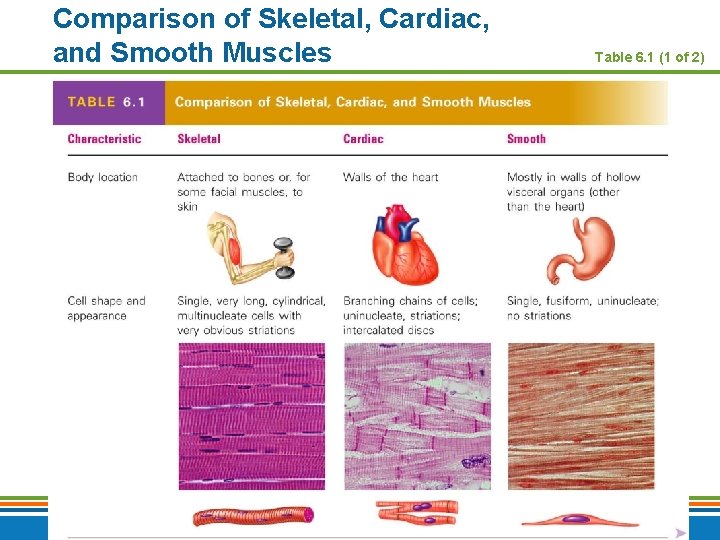
Comparison of Skeletal, Cardiac, and Smooth Muscles Copyright © 2009 Pearson Education, Inc. , publishing as Benjamin Cummings Table 6. 1 (1 of 2)
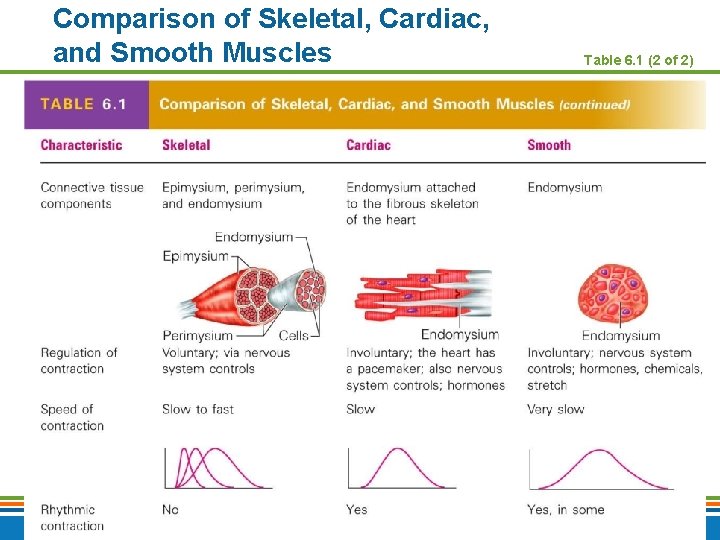
Comparison of Skeletal, Cardiac, and Smooth Muscles Copyright © 2009 Pearson Education, Inc. , publishing as Benjamin Cummings Table 6. 1 (2 of 2)
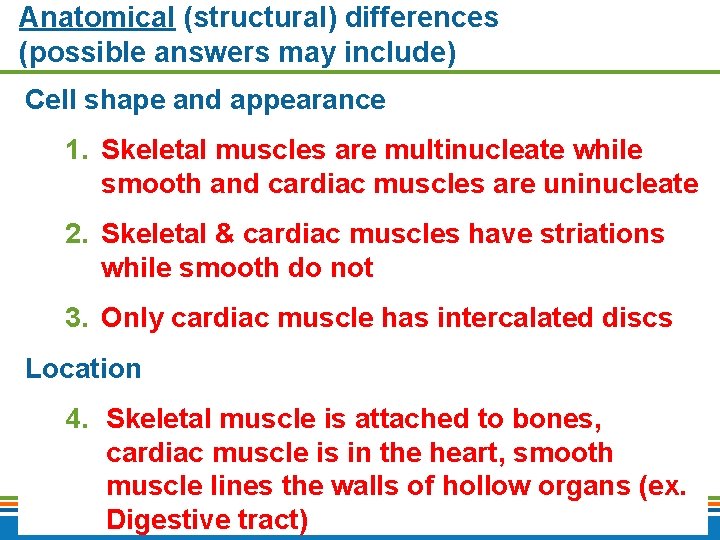
Anatomical (structural) differences (possible answers may include) Cell shape and appearance 1. Skeletal muscles are multinucleate while smooth and cardiac muscles are uninucleate 2. Skeletal & cardiac muscles have striations while smooth do not 3. Only cardiac muscle has intercalated discs Location 4. Skeletal muscle is attached to bones, cardiac muscle is in the heart, smooth muscle lines the walls of hollow organs (ex. Digestive tract) Copyright © 2009 Pearson Education, Inc. , publishing as Benjamin Cummings
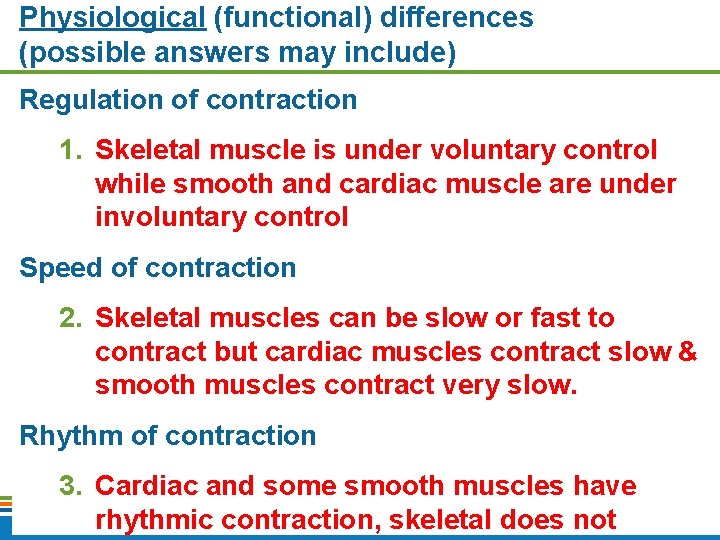
Physiological (functional) differences (possible answers may include) Regulation of contraction 1. Skeletal muscle is under voluntary control while smooth and cardiac muscle are under involuntary control Speed of contraction 2. Skeletal muscles can be slow or fast to contract but cardiac muscles contract slow & smooth muscles contract very slow. Rhythm of contraction 3. Cardiac and some smooth muscles have rhythmic contraction, skeletal does not Copyright © 2009 Pearson Education, Inc. , publishing as Benjamin Cummings
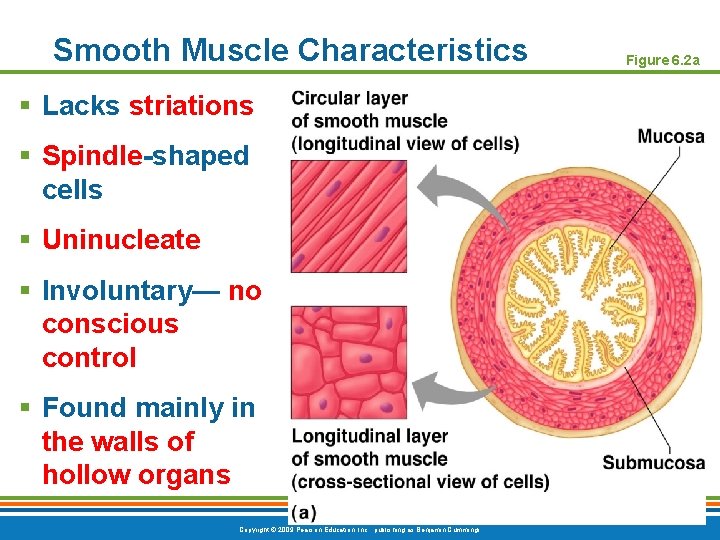
Smooth Muscle Characteristics § Lacks striations § Spindle-shaped cells § Uninucleate § Involuntary— no conscious control § Found mainly in the walls of hollow organs Copyright © 2009 Pearson Education, Inc. , publishing as Benjamin Cummings Figure 6. 2 a
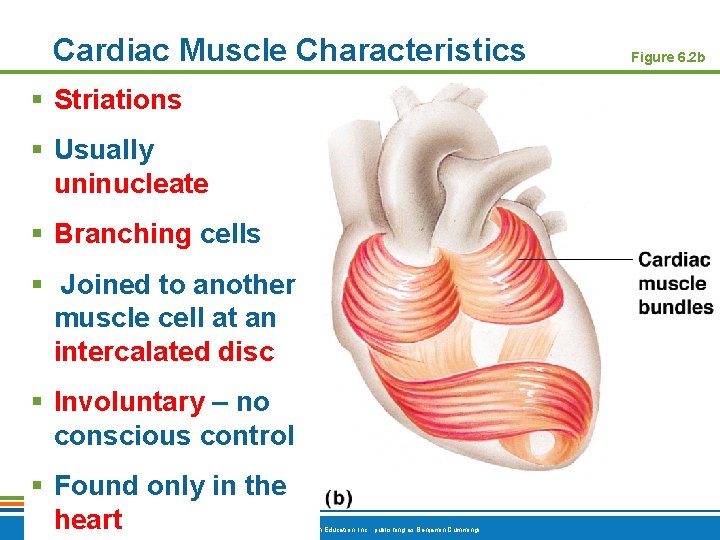
Cardiac Muscle Characteristics § Striations § Usually uninucleate § Branching cells § Joined to another muscle cell at an intercalated disc § Involuntary – no conscious control § Found only in the heart Copyright © 2009 Pearson Education, Inc. , publishing as Benjamin Cummings Figure 6. 2 b
Skeletal Muscle Characteristics § Most are attached by tendons to bones § Cells are multinucleate § Striated — have visible banding § Voluntary — subject to conscious control Copyright © 2009 Pearson Education, Inc. , publishing as Benjamin Cummings
Skeletal Muscle Attachments § Epimysium blends into a connective tissue attachment § Tendons—cord-like structures that connect muscle to bone § Mostly collagen fibers § Often cross a joint due to toughness and small size § Aponeuroses—sheet-like structures § Attach muscles indirectly to bones, cartilages, or connective tissue coverings Copyright © 2009 Pearson Education, Inc. , publishing as Benjamin Cummings
Skeletal Muscle Attachments § Sites of muscle attachment § Bones § Cartilages § Connective tissue coverings Copyright © 2009 Pearson Education, Inc. , publishing as Benjamin Cummings
Skeletal Muscle Functions § Produce movement § Maintain posture § Stabilize joints § Generate heat Copyright © 2009 Pearson Education, Inc. , publishing as Benjamin Cummings
Lesson 2 - Skeletal Muscle Structure - connective tissue wrappings
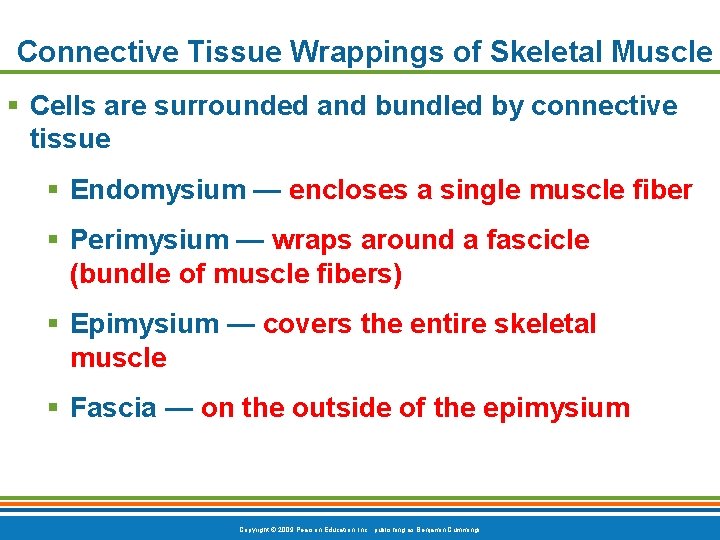
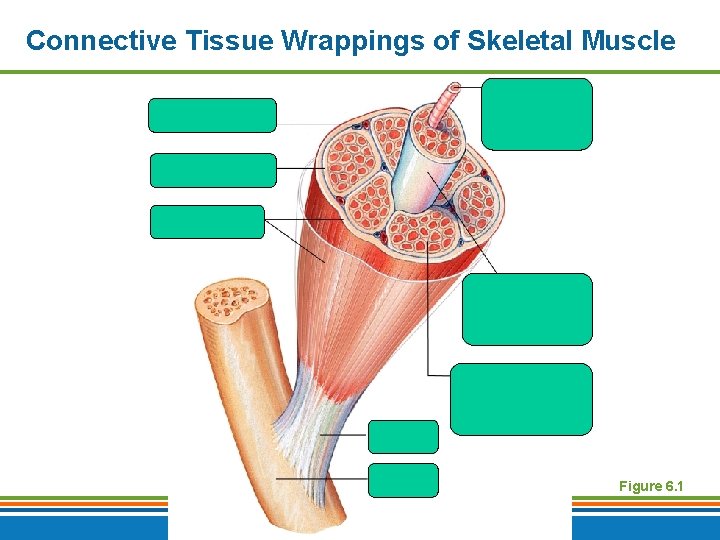
Connective Tissue Wrappings of Skeletal Muscle § Cells are surrounded and bundled by connective tissue § Endomysium — encloses a single muscle fiber § Perimysium — wraps around a fascicle (bundle of muscle fibers) § Epimysium — covers the entire skeletal muscle § Fascia — on the outside of the epimysium Copyright © 2009 Pearson Education, Inc. , publishing as Benjamin Cummings
Connective Tissue Wrappings of Skeletal Muscle Figure 6. 1 Copyright © 2009 Pearson Education, Inc. , publishing as Benjamin Cummings
Lesson 3 - Muscle Stimulation - stimulation & contraction - nerve stimulus & action potential - transmission of impulse to muscle - sliding filament theory
Stimulation and Contraction of Single Skeletal Muscle Cells § Excitability (also called responsiveness or irritability)—ability to receive and respond to a stimulus § Contractility—ability to shorten when an adequate stimulus is received § Extensibility—ability of muscle cells to be stretched § Elasticity—ability to recoil and resume resting length after stretching Copyright © 2009 Pearson Education, Inc. , publishing as Benjamin Cummings
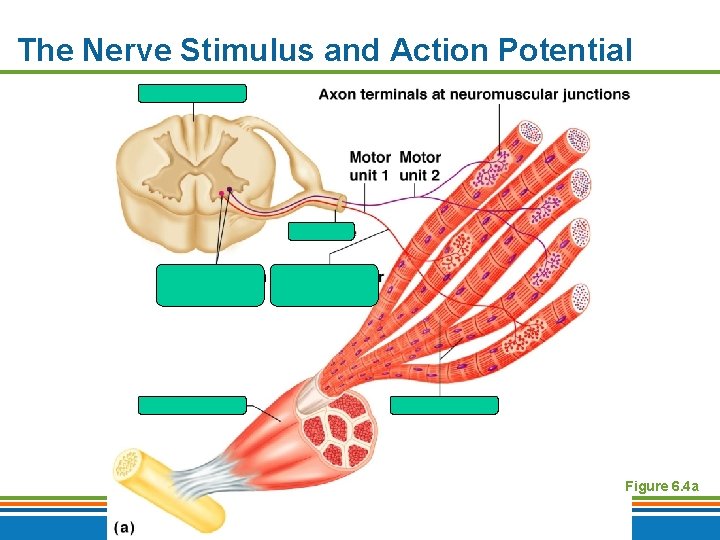
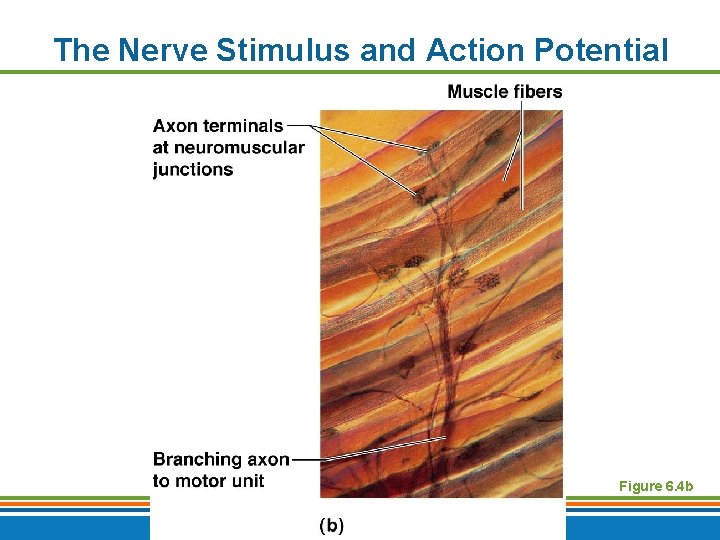
The Nerve Stimulus and Action Potential § Skeletal muscles must be stimulated by a motor neuron (nerve cell) to contract § Motor unit— one motor neuron and all the skeletal muscle cells stimulated by that neuron Copyright © 2009 Pearson Education, Inc. , publishing as Benjamin Cummings
The Nerve Stimulus and Action Potential Figure 6. 4 a Copyright © 2009 Pearson Education, Inc. , publishing as Benjamin Cummings
The Nerve Stimulus and Action Potential Figure 6. 4 b Copyright © 2009 Pearson Education, Inc. , publishing as Benjamin Cummings
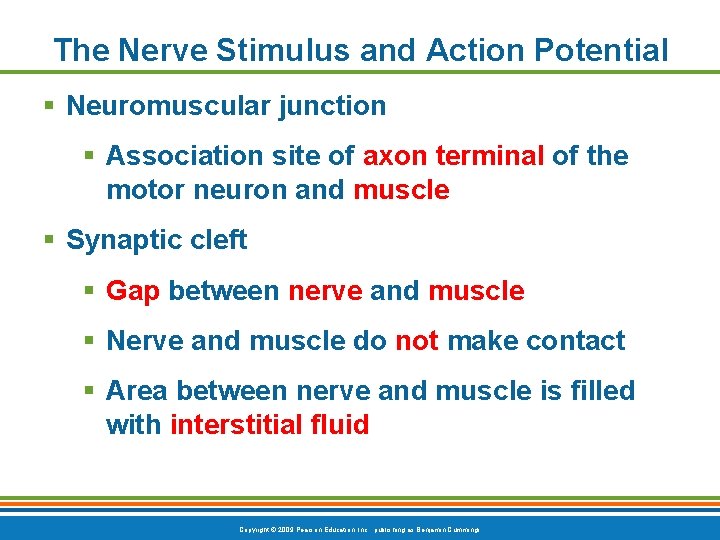
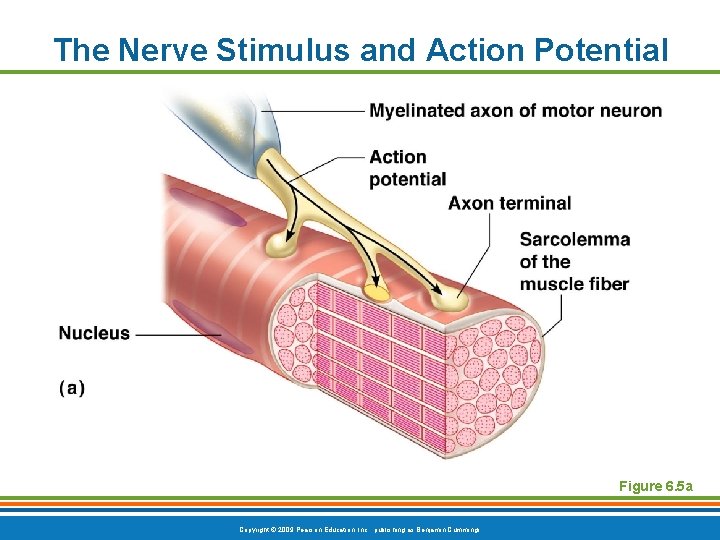
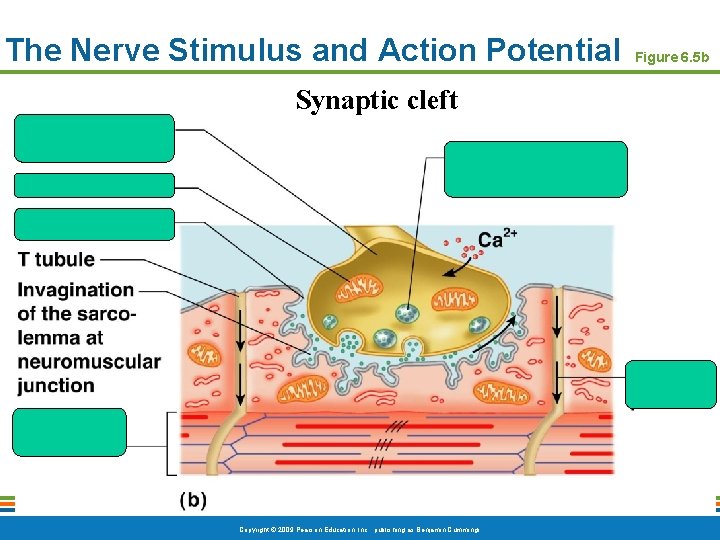
The Nerve Stimulus and Action Potential § Neuromuscular junction § Association site of axon terminal of the motor neuron and muscle § Synaptic cleft § Gap between nerve and muscle § Nerve and muscle do not make contact § Area between nerve and muscle is filled with interstitial fluid Copyright © 2009 Pearson Education, Inc. , publishing as Benjamin Cummings
The Nerve Stimulus and Action Potential Figure 6. 5 a Copyright © 2009 Pearson Education, Inc. , publishing as Benjamin Cummings
The Nerve Stimulus and Action Potential Synaptic cleft Copyright © 2009 Pearson Education, Inc. , publishing as Benjamin Cummings Figure 6. 5 b
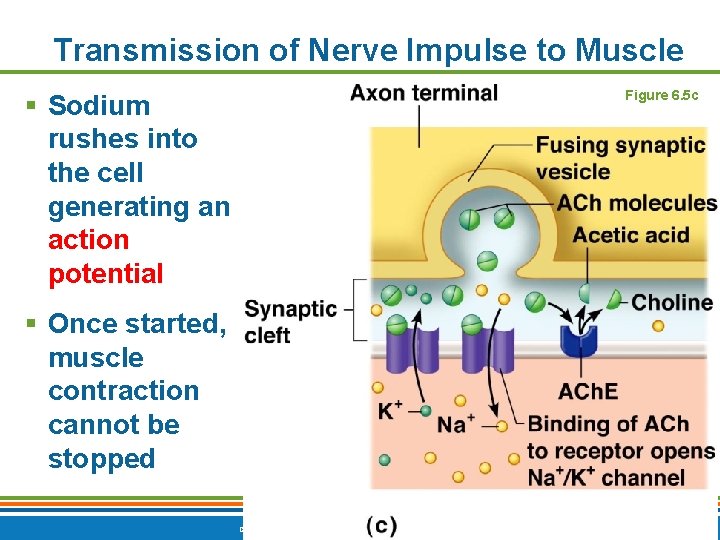
Transmission of Nerve Impulse to Muscle § Neurotransmitter—chemical released by nerve upon arrival of nerve impulse § Carries the impulse across the synaptic cleft § The neurotransmitter for skeletal muscle is acetylcholine (ACh) § Acetylcholine attaches to receptors on the sarcolemma of the muscle cells § Sarcolemma becomes permeable to sodium (Na+) Copyright © 2009 Pearson Education, Inc. , publishing as Benjamin Cummings
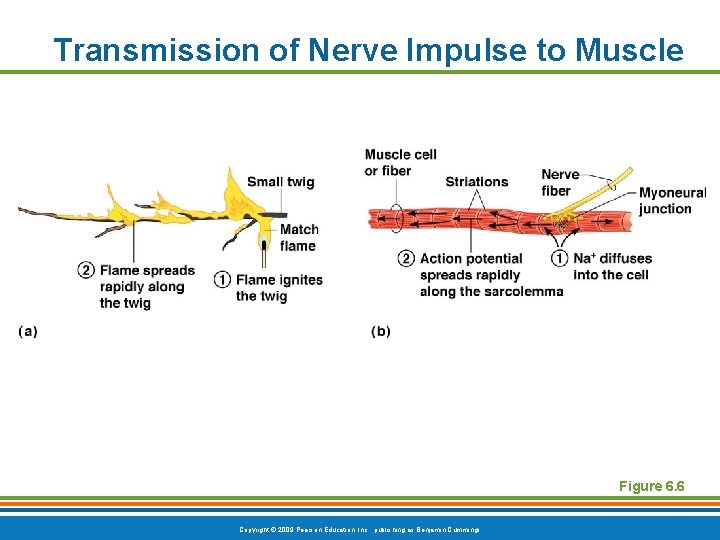
Transmission of Nerve Impulse to Muscle Figure 6. 5 c § Sodium rushes into the cell generating an action potential § Once started, muscle contraction cannot be stopped Copyright © 2009 Pearson Education, Inc. , publishing as Benjamin Cummings
Transmission of Nerve Impulse to Muscle Figure 6. 6 Copyright © 2009 Pearson Education, Inc. , publishing as Benjamin Cummings
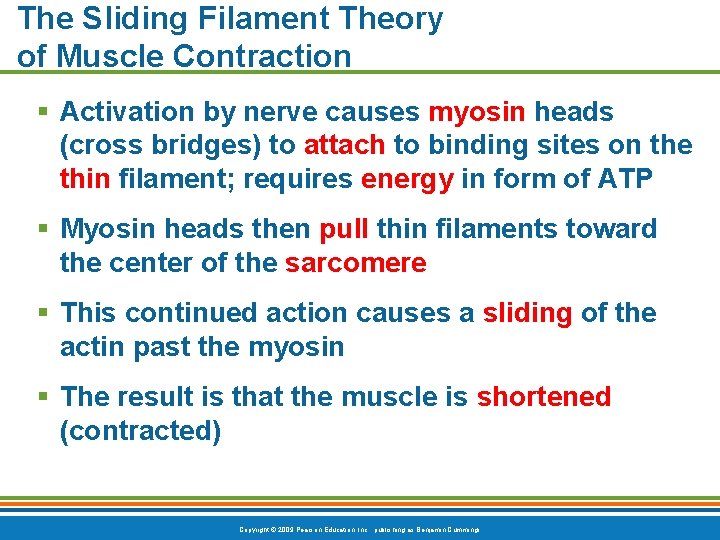
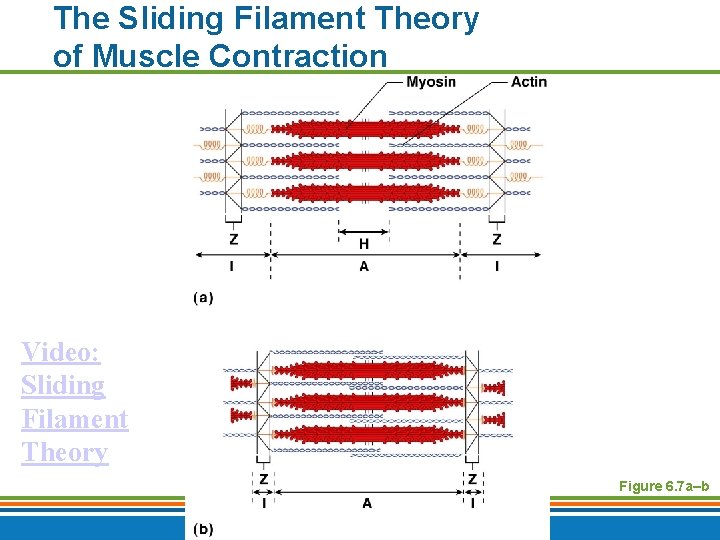
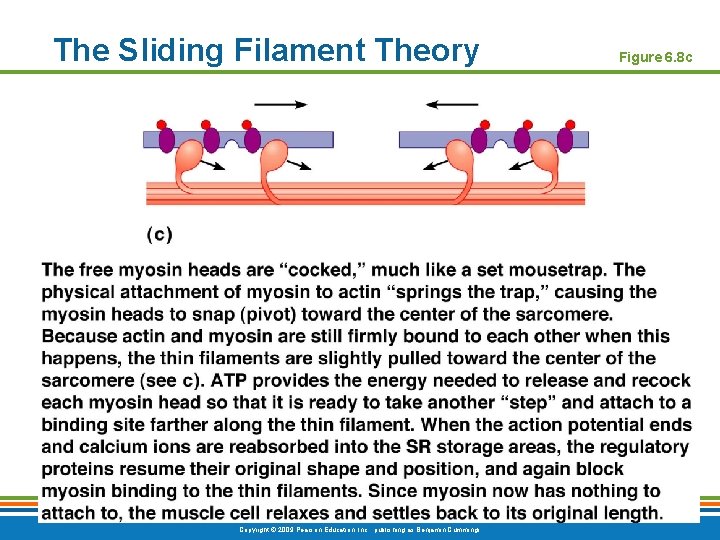
The Sliding Filament Theory of Muscle Contraction § Activation by nerve causes myosin heads (cross bridges) to attach to binding sites on the thin filament; requires energy in form of ATP § Myosin heads then pull thin filaments toward the center of the sarcomere § This continued action causes a sliding of the actin past the myosin § The result is that the muscle is shortened (contracted) Copyright © 2009 Pearson Education, Inc. , publishing as Benjamin Cummings
The Sliding Filament Theory of Muscle Contraction Video: Sliding Filament Theory Figure 6. 7 a–b Copyright © 2009 Pearson Education, Inc. , publishing as Benjamin Cummings
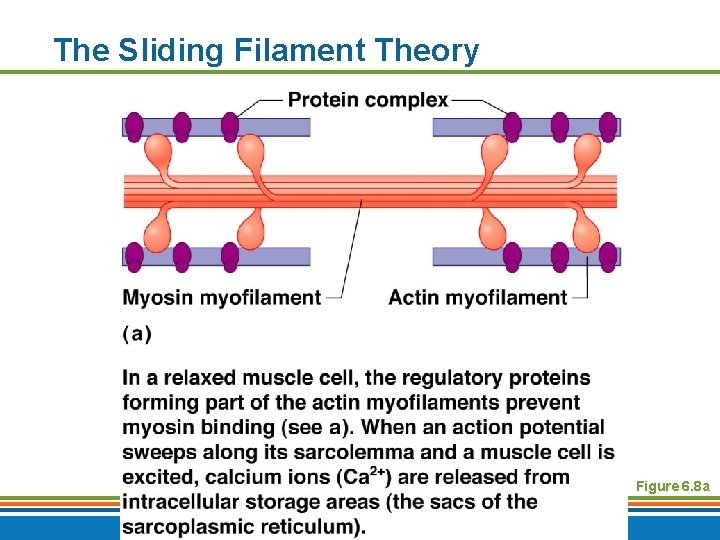
The Sliding Filament Theory Figure 6. 8 a Copyright © 2009 Pearson Education, Inc. , publishing as Benjamin Cummings
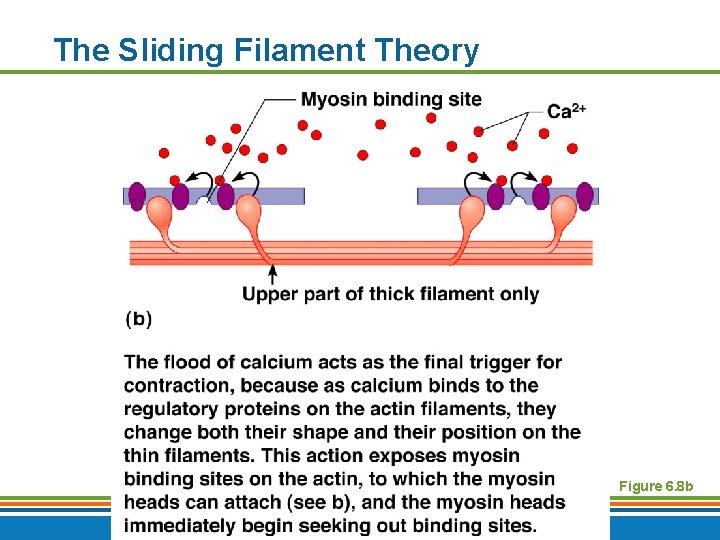
The Sliding Filament Theory Figure 6. 8 b Copyright © 2009 Pearson Education, Inc. , publishing as Benjamin Cummings
The Sliding Filament Theory Copyright © 2009 Pearson Education, Inc. , publishing as Benjamin Cummings Figure 6. 8 c
Lesson 4 Contraction of Skeletal Muscle Graded responses Energy sources
Contraction of Skeletal Muscle § Muscle fiber contraction is “all or none” § Within a skeletal muscle, not all fibers may be stimulated during the same interval § Different combinations of muscle fiber contractions may give differing responses § Graded responses—different degrees of skeletal muscle shortening Copyright © 2009 Pearson Education, Inc. , publishing as Benjamin Cummings
Contraction of Skeletal Muscle § Graded responses can be produced by changing: § The frequency of muscle stimulation § The number of muscle cells being stimulated at one time Copyright © 2009 Pearson Education, Inc. , publishing as Benjamin Cummings
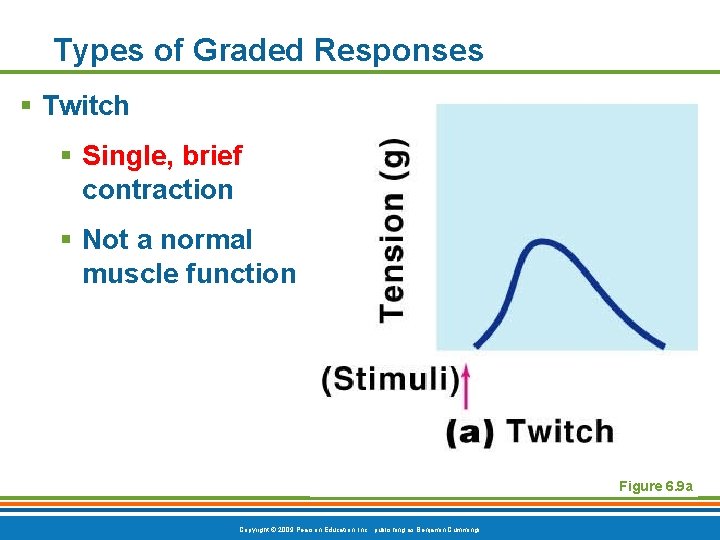
Types of Graded Responses § Twitch § Single, brief contraction § Not a normal muscle function Figure 6. 9 a Copyright © 2009 Pearson Education, Inc. , publishing as Benjamin Cummings
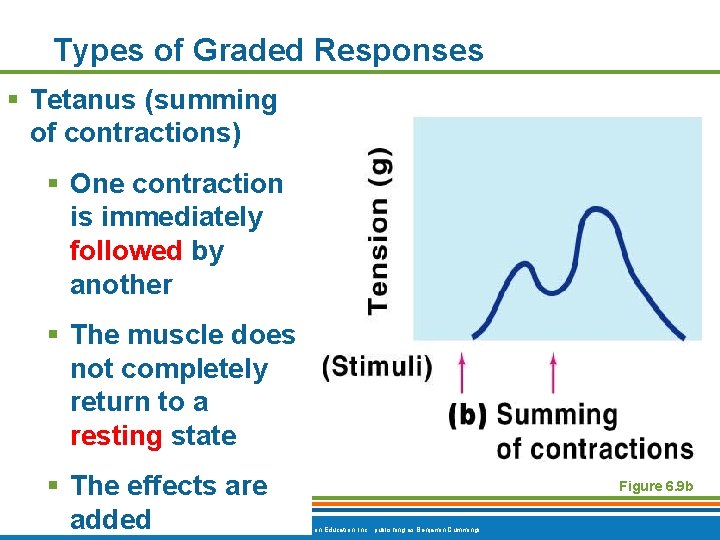
Types of Graded Responses § Tetanus (summing of contractions) § One contraction is immediately followed by another § The muscle does not completely return to a resting state § The effects are added Copyright © 2009 Pearson Education, Inc. , publishing as Benjamin Cummings Figure 6. 9 b
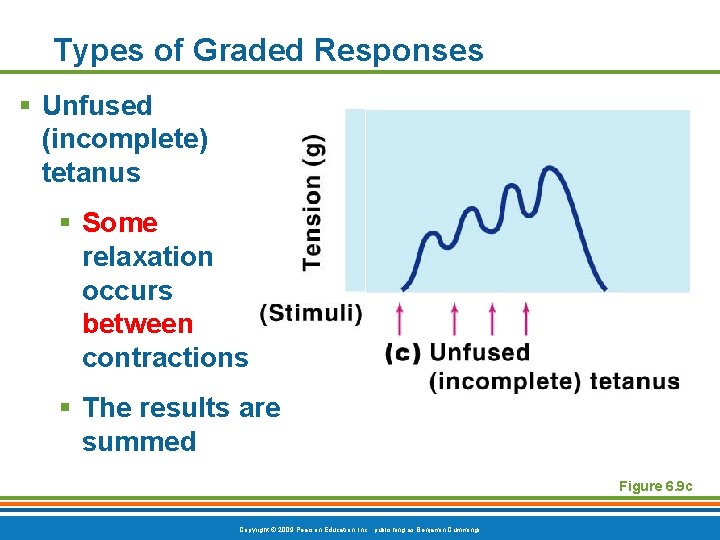
Types of Graded Responses § Unfused (incomplete) tetanus § Some relaxation occurs between contractions § The results are summed Figure 6. 9 c Copyright © 2009 Pearson Education, Inc. , publishing as Benjamin Cummings
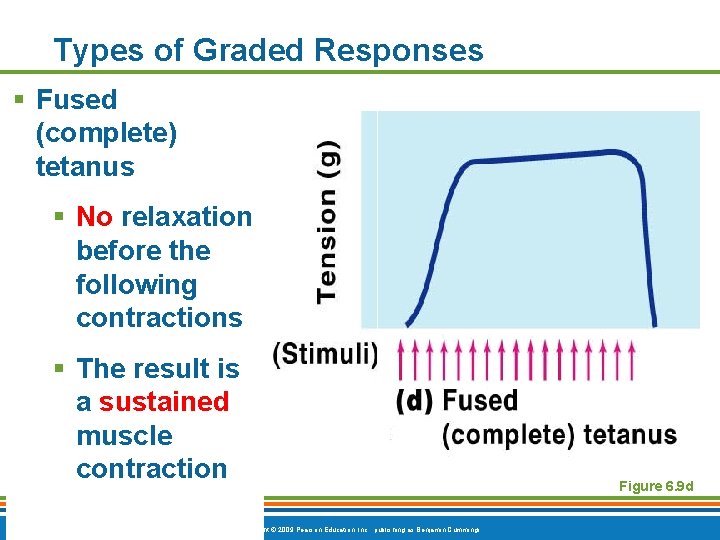
Types of Graded Responses § Fused (complete) tetanus § No relaxation before the following contractions § The result is a sustained muscle contraction Copyright © 2009 Pearson Education, Inc. , publishing as Benjamin Cummings Figure 6. 9 d
Muscle Response to Strong Stimuli § Muscle force depends upon the number of fibers stimulated § More fibers contracting results in greater muscle tension § Muscles can continue to contract unless they run out of energy Copyright © 2009 Pearson Education, Inc. , publishing as Benjamin Cummings
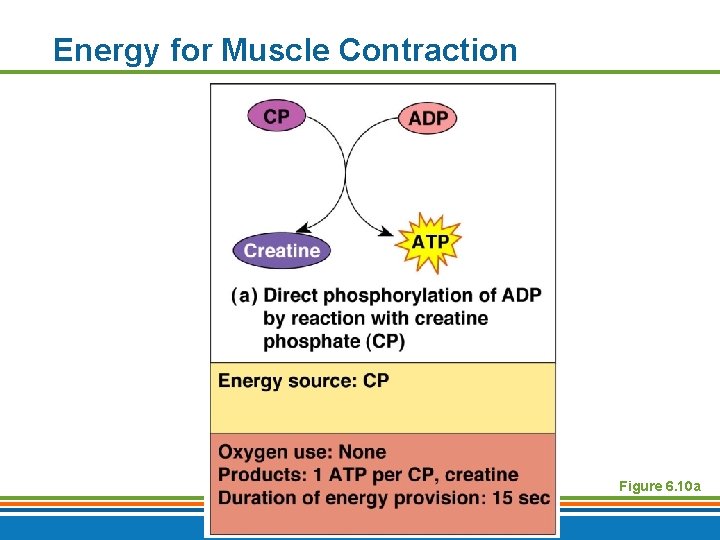
Energy for Muscle Contraction § Initially, muscles use stored ATP for energy § ATP bonds are broken to release energy § Only 4– 6 seconds worth of ATP is stored by muscles § After this initial time, other pathways must be utilized to produce ATP Copyright © 2009 Pearson Education, Inc. , publishing as Benjamin Cummings
Energy for Muscle Contraction Figure 6. 10 a Copyright © 2009 Pearson Education, Inc. , publishing as Benjamin Cummings
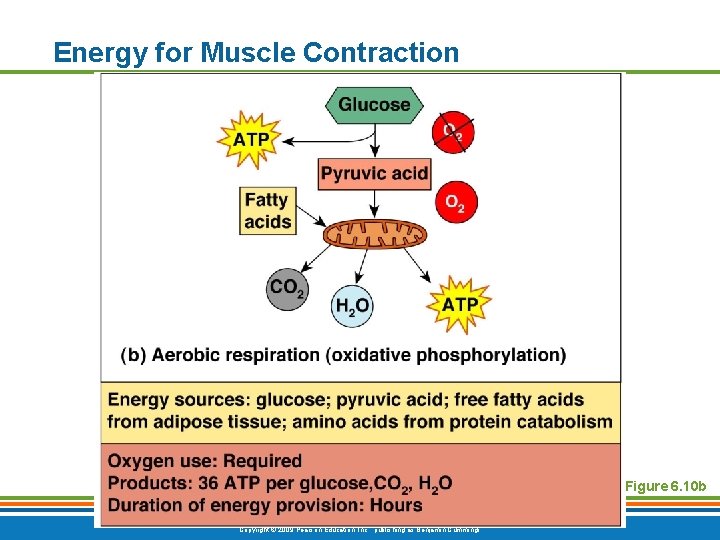
Energy for Muscle Contraction § Aerobic respiration § Glucose is broken down to carbon dioxide and water, releasing energy (ATP) § This is a slower reaction that requires continuous oxygen § A series of metabolic pathways occur in the cell’s mitochondria Copyright © 2009 Pearson Education, Inc. , publishing as Benjamin Cummings
Energy for Muscle Contraction Figure 6. 10 b Copyright © 2009 Pearson Education, Inc. , publishing as Benjamin Cummings
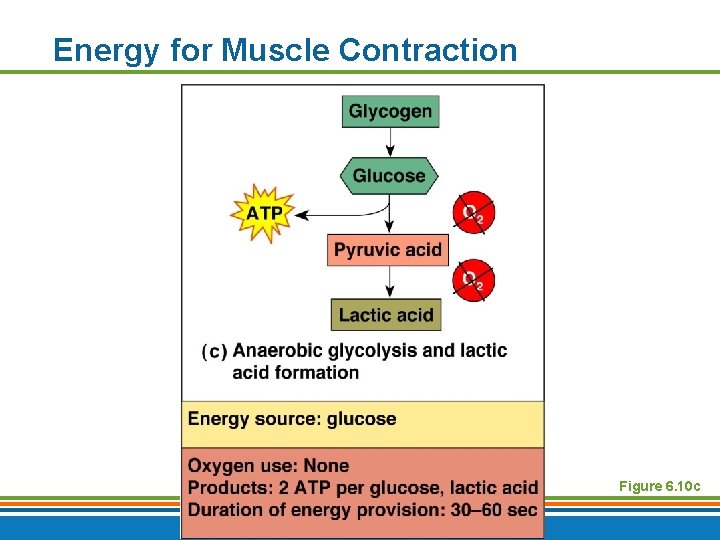
Energy for Muscle Contraction § Anaerobic glycolysis and lactic acid formation § Reaction that breaks down glucose without oxygen § Glucose is broken down to pyruvic acid to produce a small amount of ATP § Pyruvic acid is converted to lactic acid § This reaction is not as efficient, but is fast § Huge amounts of glucose are needed § Lactic acid produces muscle fatigue Copyright © 2009 Pearson Education, Inc. , publishing as Benjamin Cummings
Energy for Muscle Contraction Figure 6. 10 c Copyright © 2009 Pearson Education, Inc. , publishing as Benjamin Cummings
Muscle Fatigue and Oxygen Deficit § When a muscle is fatigued, it is unable to contract even with a stimulus § Common cause for muscle fatigue is oxygen debt § Oxygen is required to get rid of accumulated lactic acid § Increasing acidity (from lactic acid) and lack of ATP causes the muscle to contract less Copyright © 2009 Pearson Education, Inc. , publishing as Benjamin Cummings
Lesson 5 Types of Movement - Effect of Exercise on Muscles - Muscles & Body Movements - Types of Ordinary & Special Movements
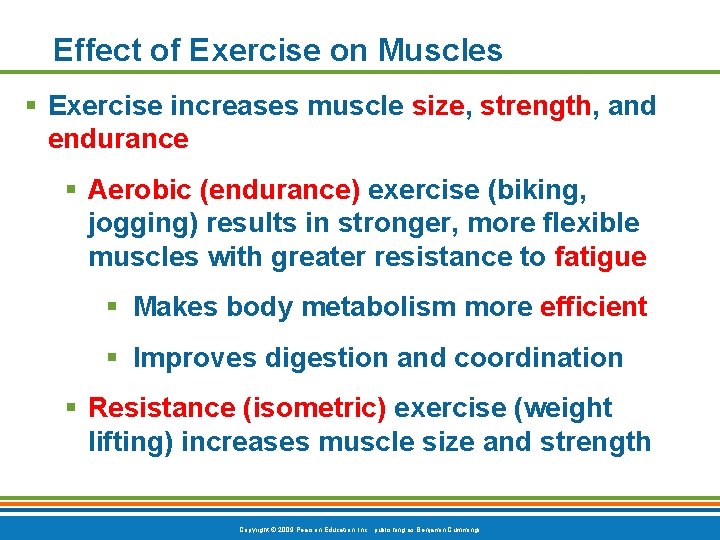
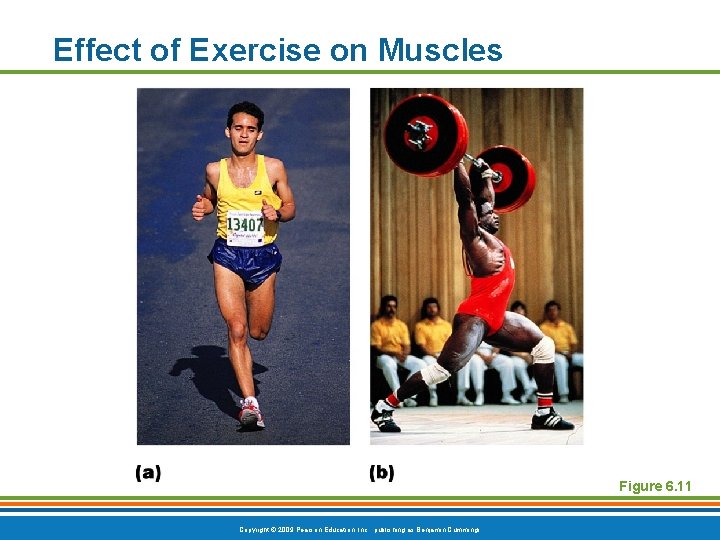
Effect of Exercise on Muscles § Exercise increases muscle size, strength, and endurance § Aerobic (endurance) exercise (biking, jogging) results in stronger, more flexible muscles with greater resistance to fatigue § Makes body metabolism more efficient § Improves digestion and coordination § Resistance (isometric) exercise (weight lifting) increases muscle size and strength Copyright © 2009 Pearson Education, Inc. , publishing as Benjamin Cummings
Effect of Exercise on Muscles Figure 6. 11 Copyright © 2009 Pearson Education, Inc. , publishing as Benjamin Cummings
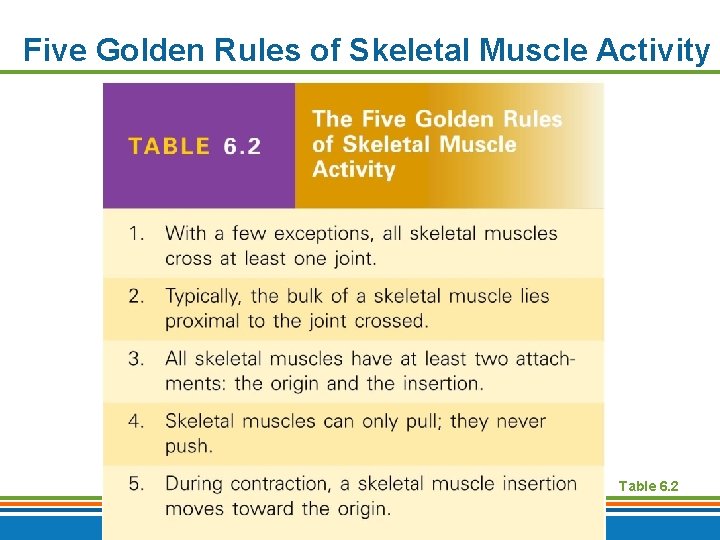
Five Golden Rules of Skeletal Muscle Activity Table 6. 2 Copyright © 2009 Pearson Education, Inc. , publishing as Benjamin Cummings
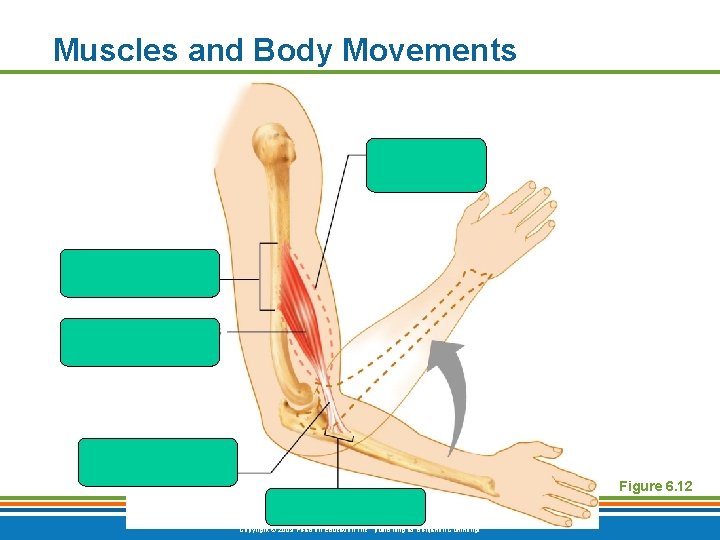
Muscles and Body Movements § Movement is due to a muscle pulling an attached bone § Muscles are attached to at least two points § Origin § Attachment to a moveable bone § Insertion § Attachment to an immovable / less moveable bone Copyright © 2009 Pearson Education, Inc. , publishing as Benjamin Cummings
Muscles and Body Movements Figure 6. 12 Copyright © 2009 Pearson Education, Inc. , publishing as Benjamin Cummings
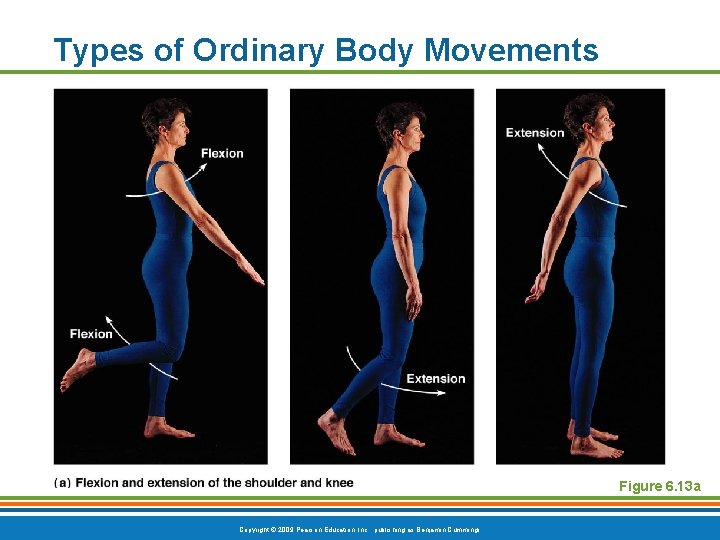
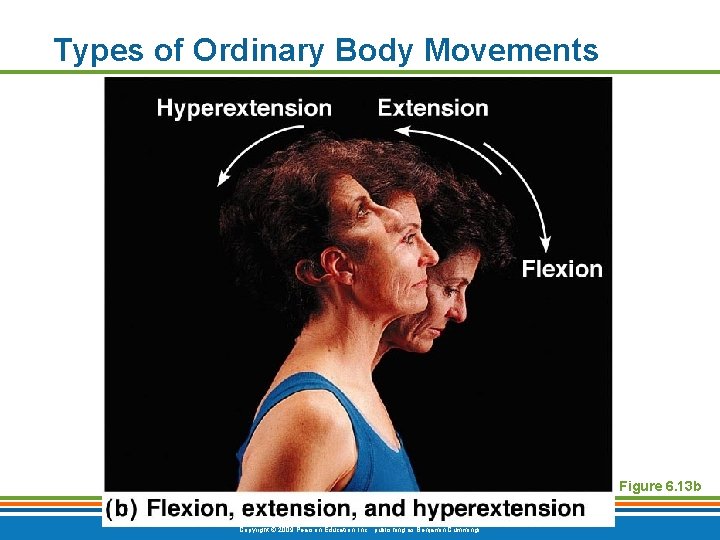
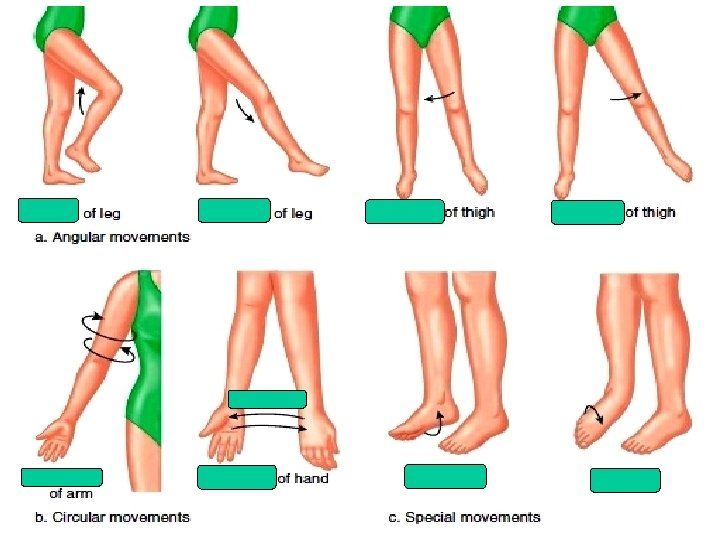
Types of Ordinary Body Movements § Flexion § Decreases the angle of the joint § Brings two bones closer together § Typical of hinge joints like knee and elbow § Extension § Opposite of flexion § Increases angle between two bones § Hyperextension: increases angle of a joint more than 180 degrees Copyright © 2009 Pearson Education, Inc. , publishing as Benjamin Cummings
Types of Ordinary Body Movements Figure 6. 13 a Copyright © 2009 Pearson Education, Inc. , publishing as Benjamin Cummings
Types of Ordinary Body Movements Figure 6. 13 b Copyright © 2009 Pearson Education, Inc. , publishing as Benjamin Cummings
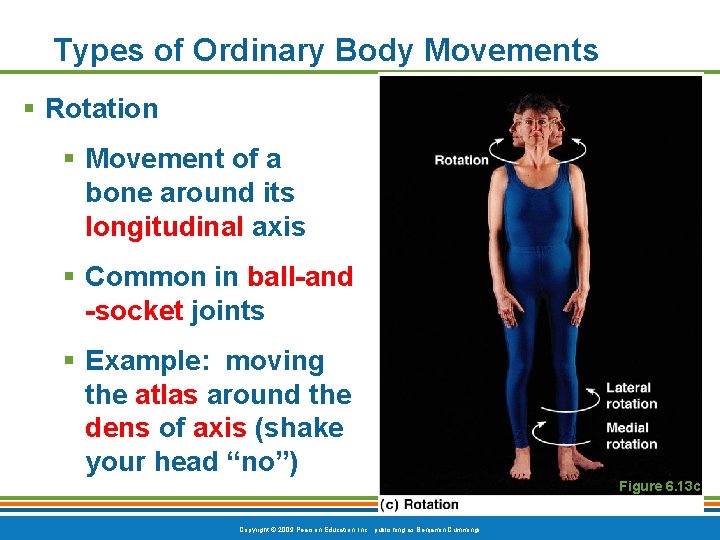
Types of Ordinary Body Movements § Rotation § Movement of a bone around its longitudinal axis § Common in ball-and -socket joints § Example: moving the atlas around the dens of axis (shake your head “no”) Figure 6. 13 c Copyright © 2009 Pearson Education, Inc. , publishing as Benjamin Cummings
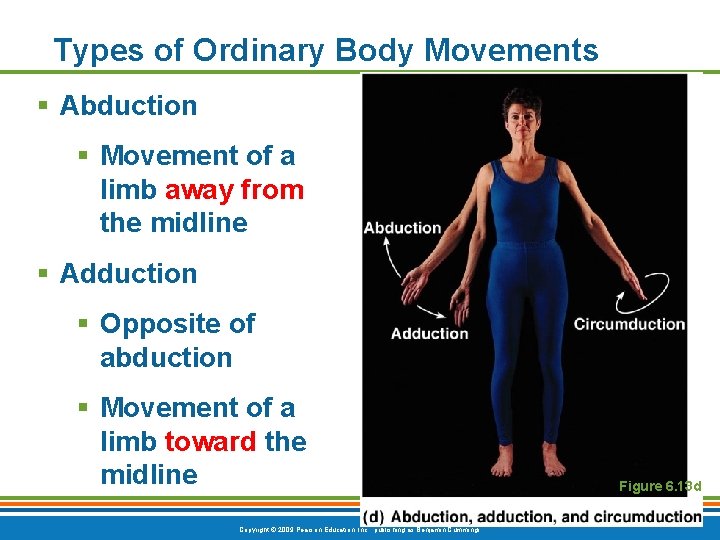
Types of Ordinary Body Movements § Abduction § Movement of a limb away from the midline § Adduction § Opposite of abduction § Movement of a limb toward the midline Copyright © 2009 Pearson Education, Inc. , publishing as Benjamin Cummings Figure 6. 13 d
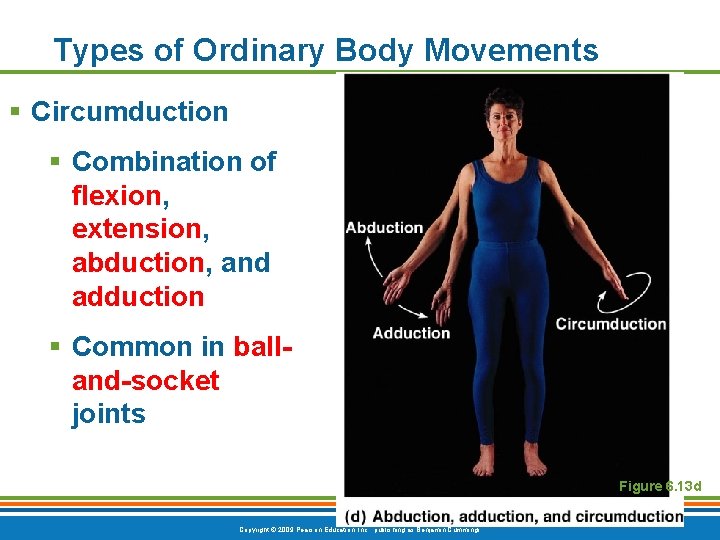
Types of Ordinary Body Movements § Circumduction § Combination of flexion, extension, abduction, and adduction § Common in balland-socket joints Figure 6. 13 d Copyright © 2009 Pearson Education, Inc. , publishing as Benjamin Cummings
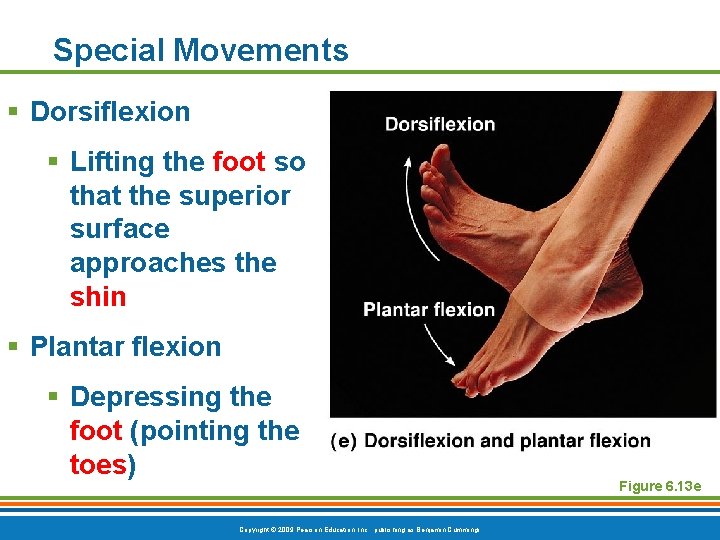
Special Movements § Dorsiflexion § Lifting the foot so that the superior surface approaches the shin § Plantar flexion § Depressing the foot (pointing the toes) Copyright © 2009 Pearson Education, Inc. , publishing as Benjamin Cummings Figure 6. 13 e
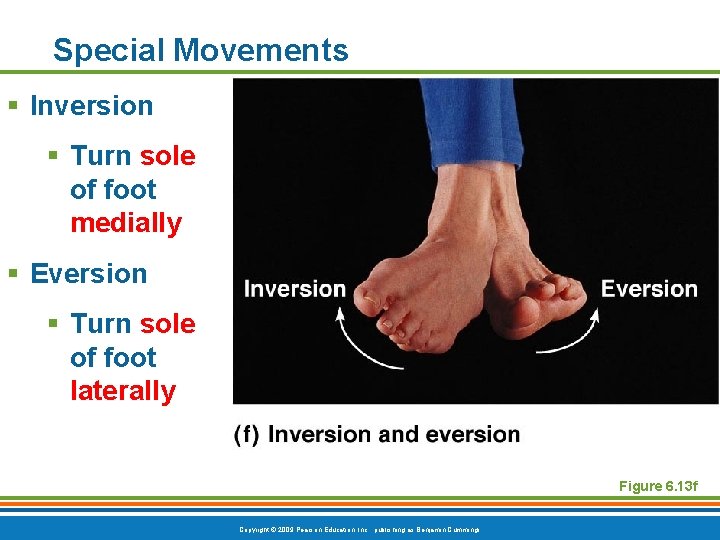
Special Movements § Inversion § Turn sole of foot medially § Eversion § Turn sole of foot laterally Figure 6. 13 f Copyright © 2009 Pearson Education, Inc. , publishing as Benjamin Cummings
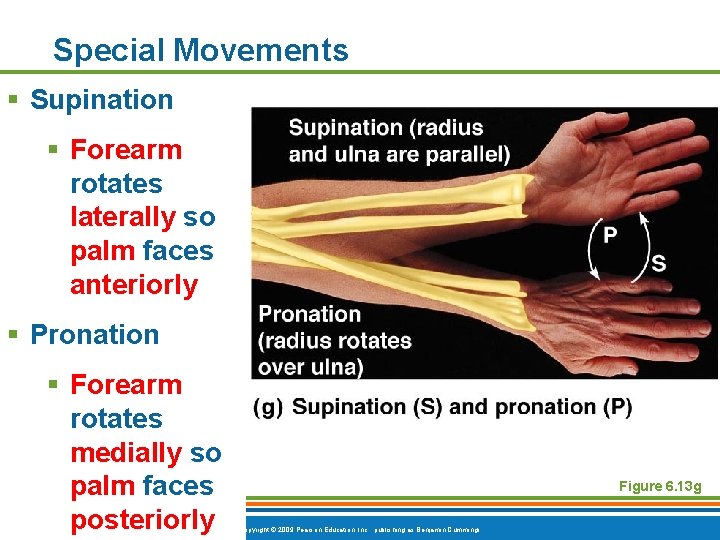
Special Movements § Supination § Forearm rotates laterally so palm faces anteriorly § Pronation § Forearm rotates medially so palm faces posteriorly Figure 6. 13 g Copyright © 2009 Pearson Education, Inc. , publishing as Benjamin Cummings
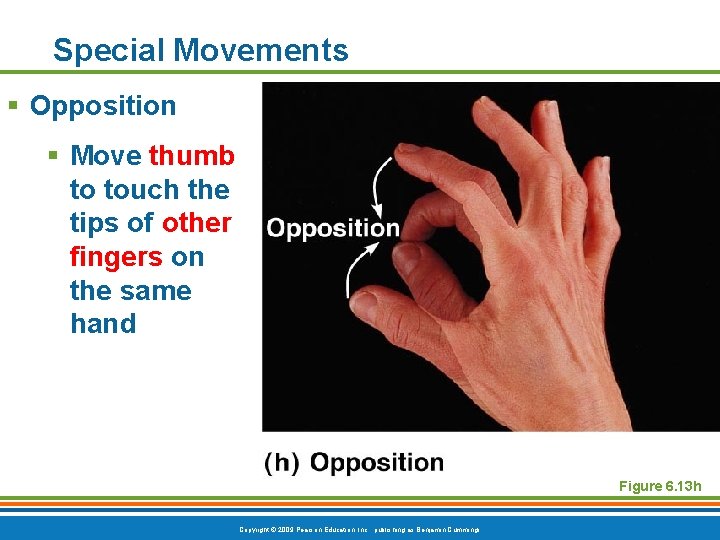
Special Movements § Opposition § Move thumb to touch the tips of other fingers on the same hand Figure 6. 13 h Copyright © 2009 Pearson Education, Inc. , publishing as Benjamin Cummings
Lesson 6 Naming Skeletal Muscles - Types of Muscles - Naming Muscles - Head and Neck Muscles
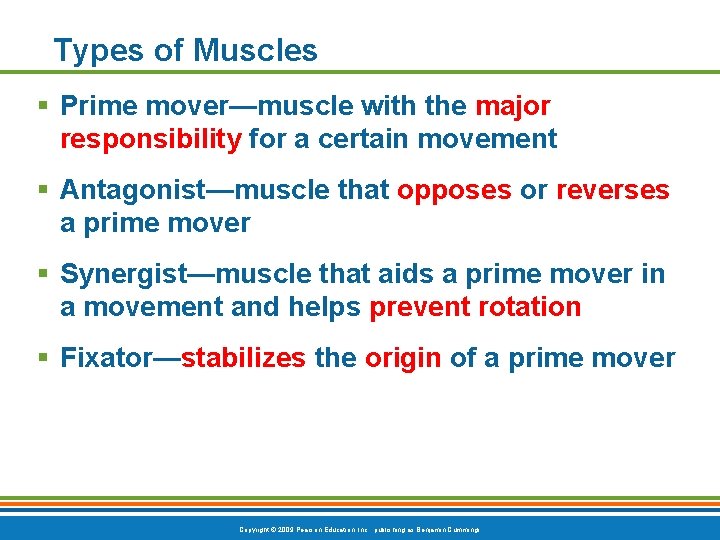
Types of Muscles § Prime mover—muscle with the major responsibility for a certain movement § Antagonist—muscle that opposes or reverses a prime mover § Synergist—muscle that aids a prime mover in a movement and helps prevent rotation § Fixator—stabilizes the origin of a prime mover Copyright © 2009 Pearson Education, Inc. , publishing as Benjamin Cummings
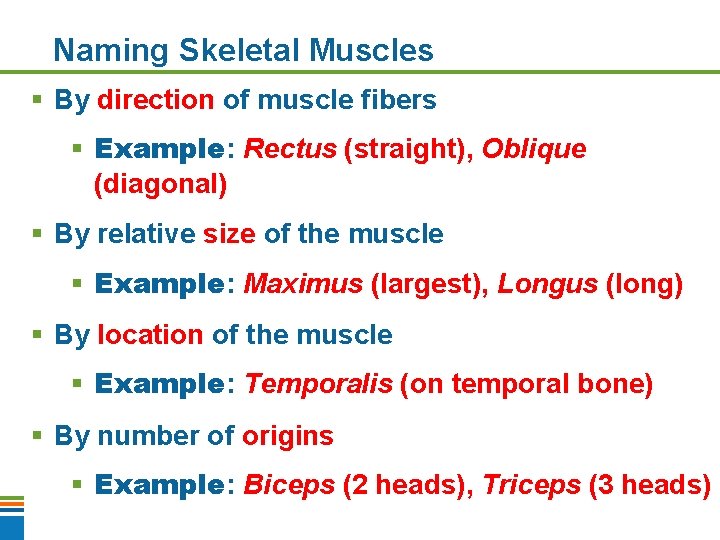
Naming Skeletal Muscles § By direction of muscle fibers § Example: Rectus (straight), Oblique (diagonal) § By relative size of the muscle § Example: Maximus (largest), Longus (long) § By location of the muscle § Example: Temporalis (on temporal bone) § By number of origins § Example: Biceps (2 heads), Triceps (3 heads) Copyright © 2009 Pearson Education, Inc. , publishing as Benjamin Cummings
Naming Skeletal Muscles § By location of the muscle’s origin and insertion § Example: Sternocleidomastoid (on the sternum, clavicle, and mastoid process) § By shape of the muscle § Example: Deltoid (triangular) § By action of the muscle § Example: Flexor and extensor (flexes or extends a bone) Copyright © 2009 Pearson Education, Inc. , publishing as Benjamin Cummings
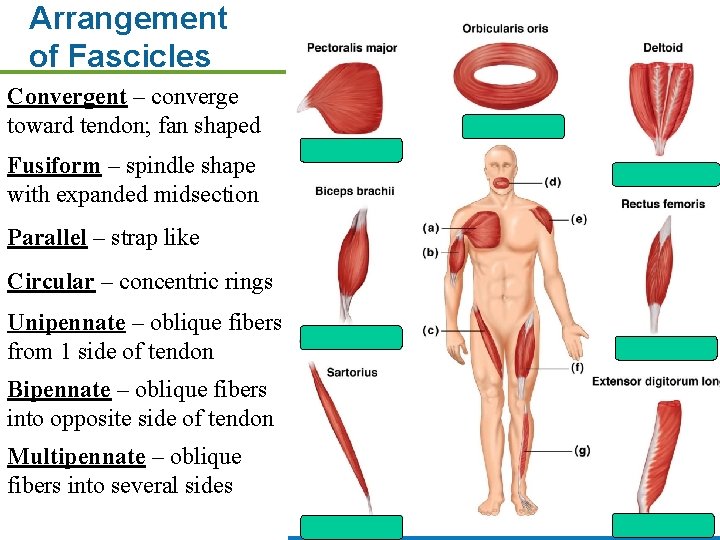
Arrangement of Fascicles Convergent – converge toward tendon; fan shaped Fusiform – spindle shape with expanded midsection Parallel – strap like Circular – concentric rings Unipennate – oblique fibers from 1 side of tendon Bipennate – oblique fibers into opposite side of tendon Multipennate – oblique Figure 6. 14 fibers into several sides Copyright © 2009 Pearson Education, Inc. , publishing as Benjamin Cummings
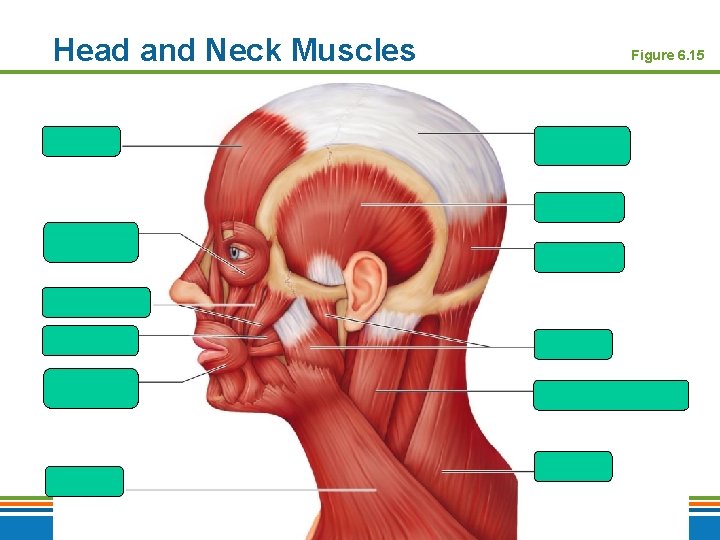
Head and Neck Muscles § Facial muscles § Frontalis— raises eyebrows § Orbicularis oculi— closes eyes, squints, blinks, winks § Orbicularis oris— closes mouth and protrudes the lips § Buccinator— flattens the cheek, chews § Zygomaticus— raises corners of the mouth Copyright © 2009 Pearson Education, Inc. , publishing as Benjamin Cummings
Head and Neck Muscles § Chewing muscles § Masseter— closes the jaw raising the mandible § Temporalis— synergist of the masseter, aids in closing the jaw § Neck muscles § Platysma— pulls the corners of the mouth inferiorly § Sternocleidomastoid—flexes the neck, rotates the head Copyright © 2009 Pearson Education, Inc. , publishing as Benjamin Cummings
Head and Neck Muscles Copyright © 2009 Pearson Education, Inc. , publishing as Benjamin Cummings Figure 6. 15
Lesson 7 Skeletal Muscles - Trunk Muscles
Muscles of Trunk, Shoulder, Arm § Anterior muscles § Pectoralis major— adducts and flexes the humerus § Intercostal muscles (rib cage) § External intercostals— raise rib cage during inhalation § Internal intercostals— depress the rib cage to move air out of the lungs during exhalation Copyright © 2009 Pearson Education, Inc. , publishing as Benjamin Cummings
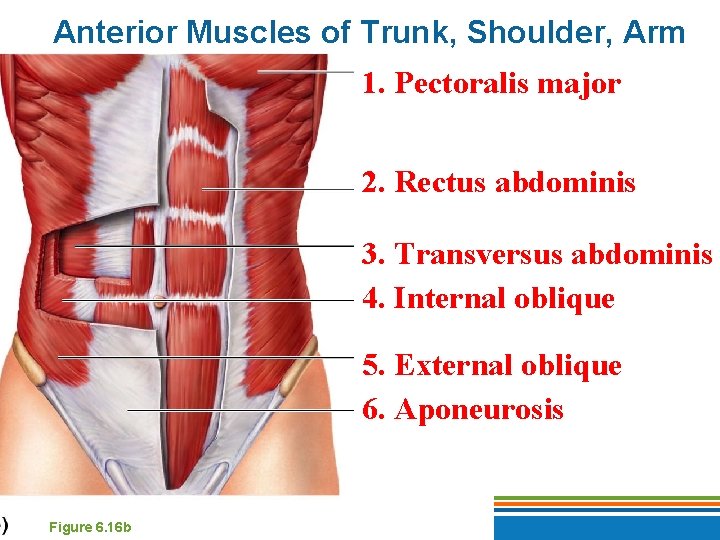
Muscles of Trunk, Shoulder, Arm § Muscles of the abdominal girdle § Rectus abdominis—flexes vertebral column and compresses abdominal contents (defecation, childbirth, forced breathing) § External and internal obliques—flex vertebral column; rotate trunk and bend it laterally § Transversus abdominis— compresses abdominal contents Copyright © 2009 Pearson Education, Inc. , publishing as Benjamin Cummings
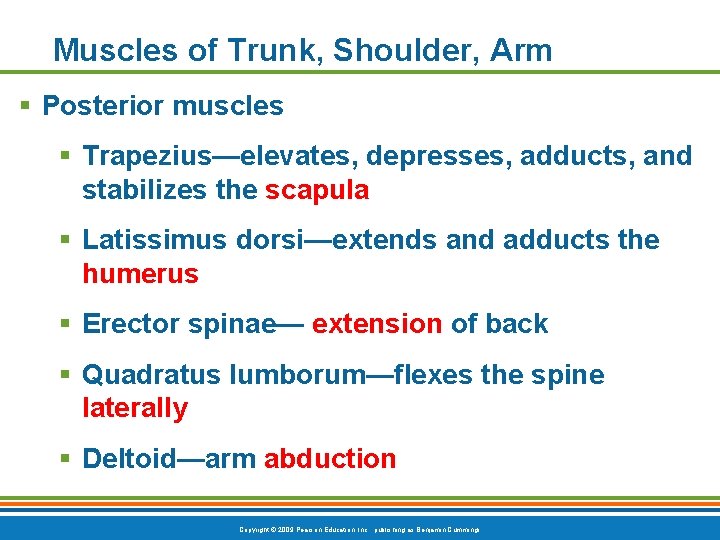
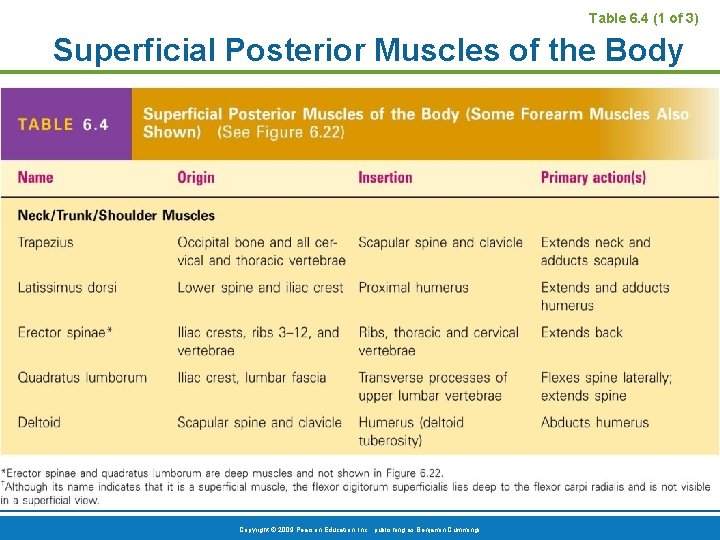
Muscles of Trunk, Shoulder, Arm § Posterior muscles § Trapezius—elevates, depresses, adducts, and stabilizes the scapula § Latissimus dorsi—extends and adducts the humerus § Erector spinae— extension of back § Quadratus lumborum—flexes the spine laterally § Deltoid—arm abduction Copyright © 2009 Pearson Education, Inc. , publishing as Benjamin Cummings
Anterior Muscles of Trunk, Shoulder, Arm 1. Pectoralis major 2. Rectus abdominis 3. Transversus abdominis 4. Internal oblique 5. External oblique 6. Aponeurosis Figure 6. 16 b Copyright © 2009 Pearson Education, Inc. , publishing as Benjamin Cummings
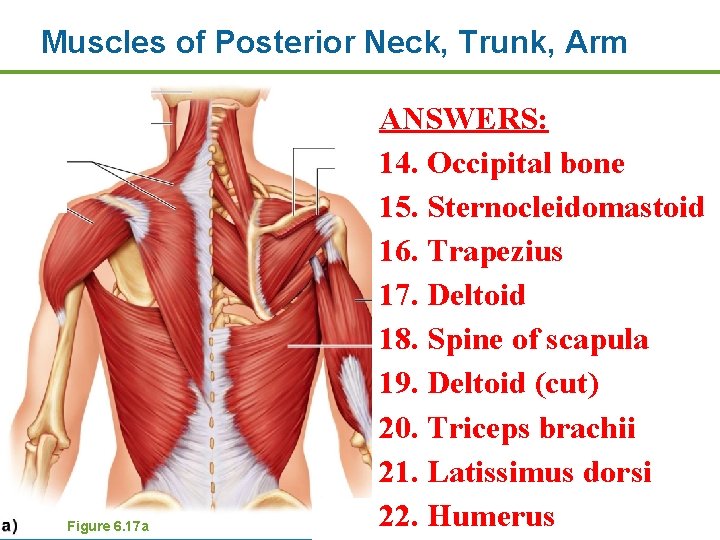
Muscles of Posterior Neck, Trunk, Arm Figure 6. 17 a ANSWERS: 14. Occipital bone 15. Sternocleidomastoid 16. Trapezius 17. Deltoid 18. Spine of scapula 19. Deltoid (cut) 20. Triceps brachii 21. Latissimus dorsi 22. Humerus Copyright © 2009 Pearson Education, Inc. , publishing as Benjamin Cummings
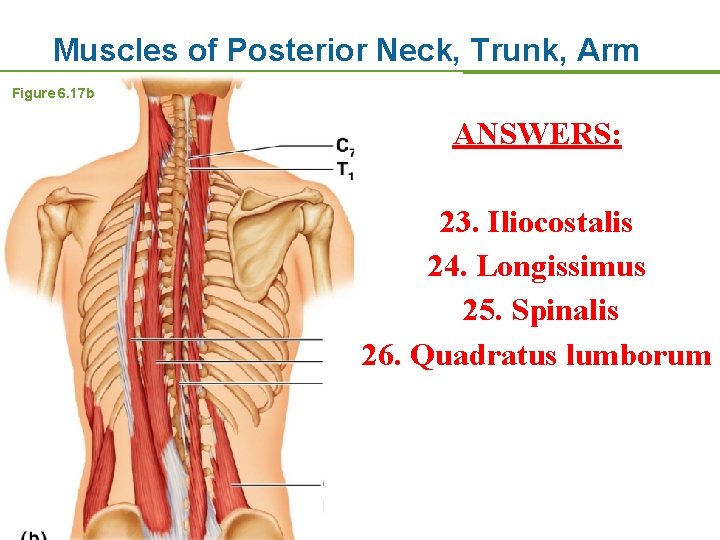
Muscles of Posterior Neck, Trunk, Arm Figure 6. 17 b ANSWERS: 23. Iliocostalis 24. Longissimus 25. Spinalis 26. Quadratus lumborum Copyright © 2009 Pearson Education, Inc. , publishing as Benjamin Cummings
Lesson 8 Skeletal Muscles - Limb Muscles
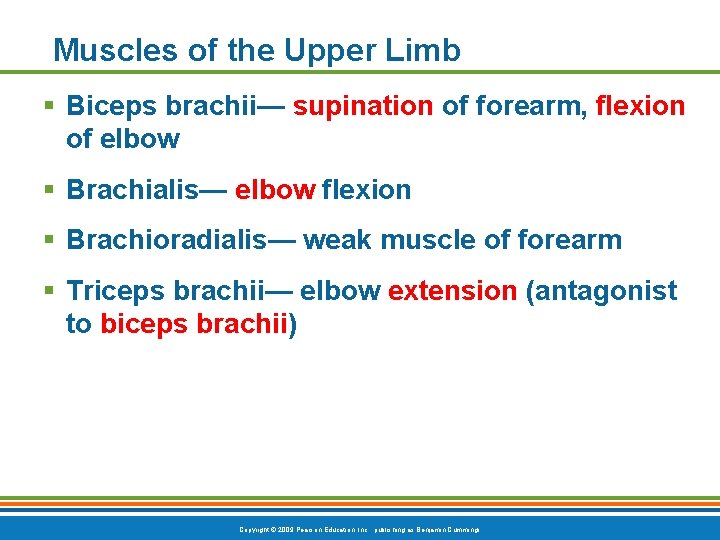
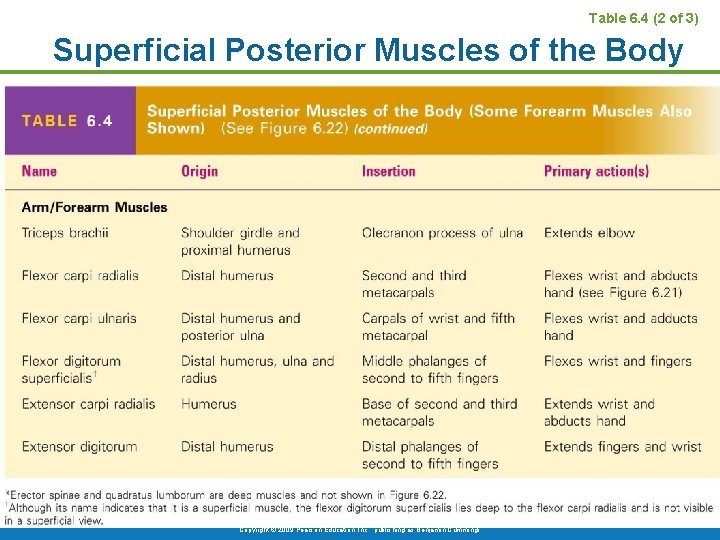
Muscles of the Upper Limb § Biceps brachii— supination of forearm, flexion of elbow § Brachialis— elbow flexion § Brachioradialis— weak muscle of forearm § Triceps brachii— elbow extension (antagonist to biceps brachii) Copyright © 2009 Pearson Education, Inc. , publishing as Benjamin Cummings
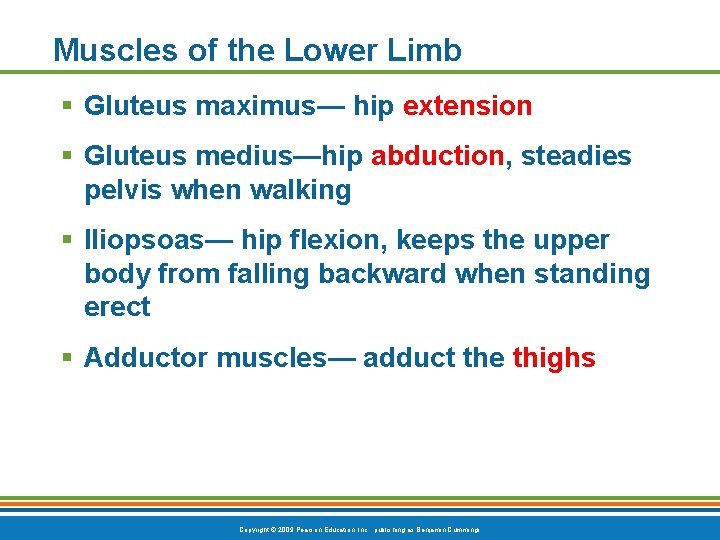
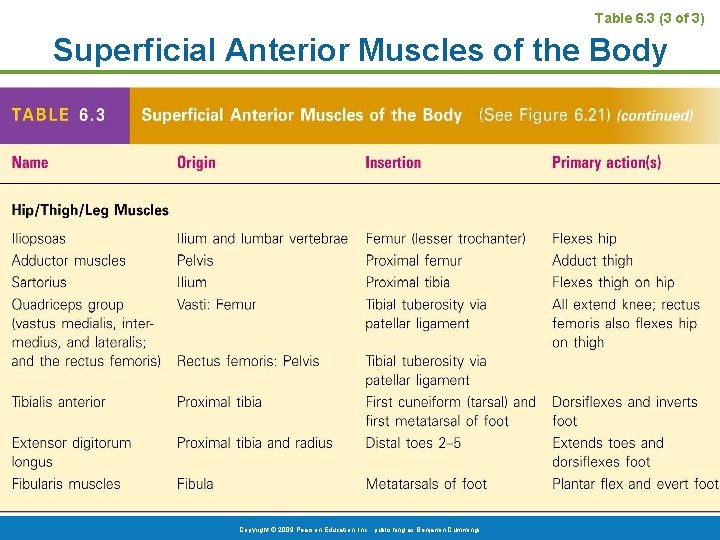
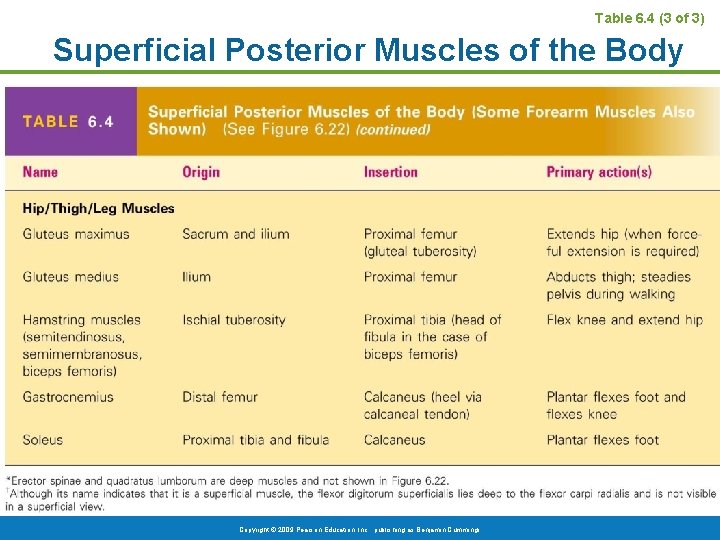
Muscles of the Lower Limb § Gluteus maximus— hip extension § Gluteus medius—hip abduction, steadies pelvis when walking § Iliopsoas— hip flexion, keeps the upper body from falling backward when standing erect § Adductor muscles— adduct the thighs Copyright © 2009 Pearson Education, Inc. , publishing as Benjamin Cummings
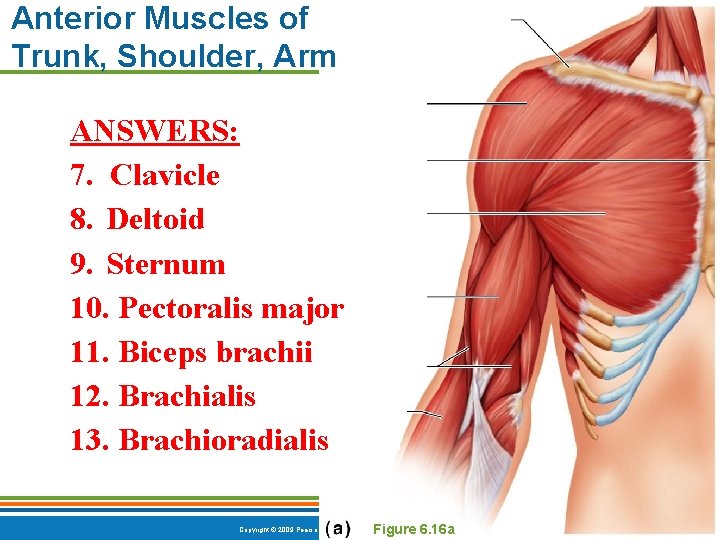
Anterior Muscles of Trunk, Shoulder, Arm ANSWERS: 7. Clavicle 8. Deltoid 9. Sternum 10. Pectoralis major 11. Biceps brachii 12. Brachialis 13. Brachioradialis Figure 6. 16 a Copyright © 2009 Pearson Education, Inc. , publishing as Benjamin Cummings
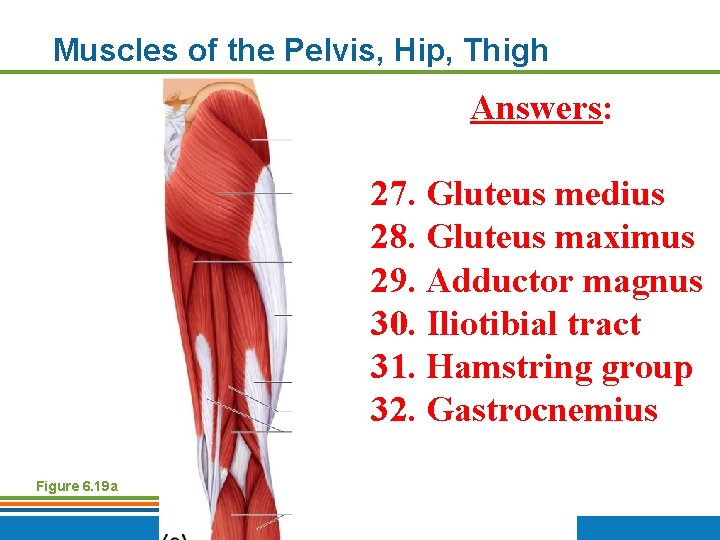
Muscles of the Pelvis, Hip, Thigh Answers: 27. Gluteus medius 28. Gluteus maximus 29. Adductor magnus 30. Iliotibial tract 31. Hamstring group 32. Gastrocnemius Figure 6. 19 a Copyright © 2009 Pearson Education, Inc. , publishing as Benjamin Cummings
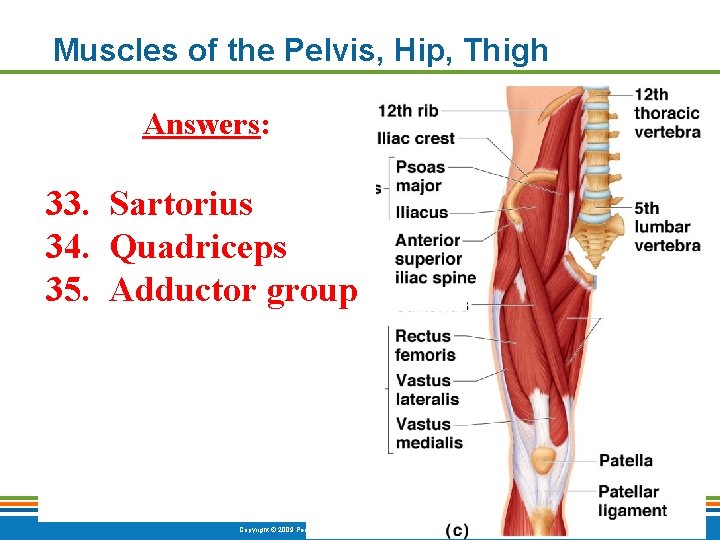
Muscles of the Pelvis, Hip, Thigh Answers: 33. Sartorius 34. Quadriceps 35. Adductor group Figure 6. 19 c Copyright © 2009 Pearson Education, Inc. , publishing as Benjamin Cummings
Muscles of the Lower Limb § Muscles causing movement at the knee joint § Hamstring group—thigh extension and knee flexion § Biceps femoris § Semimembranosus § Semitendinosus Copyright © 2009 Pearson Education, Inc. , publishing as Benjamin Cummings
Muscles of the Lower Limb § Muscles causing movement at the knee joint § Sartorius—flexes the thigh § Quadriceps group—extends the knee § Rectus femoris (also flexes hip on thigh) § Vastus muscles (three) § Vastus medialis § Vastus lateralis § Vastus intermedius Copyright © 2009 Pearson Education, Inc. , publishing as Benjamin Cummings
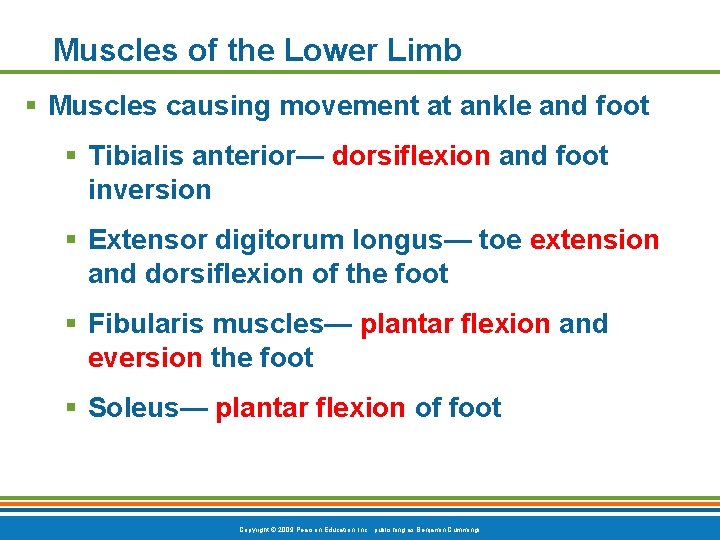
Muscles of the Lower Limb § Muscles causing movement at ankle and foot § Tibialis anterior— dorsiflexion and foot inversion § Extensor digitorum longus— toe extension and dorsiflexion of the foot § Fibularis muscles— plantar flexion and eversion the foot § Soleus— plantar flexion of foot Copyright © 2009 Pearson Education, Inc. , publishing as Benjamin Cummings
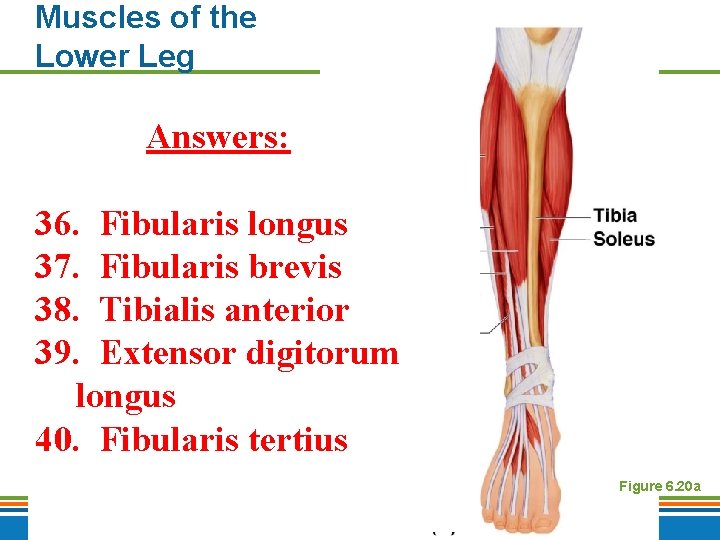
Muscles of the Lower Leg Answers: 36. Fibularis longus 37. Fibularis brevis 38. Tibialis anterior 39. Extensor digitorum longus 40. Fibularis tertius Figure 6. 20 a Copyright © 2009 Pearson Education, Inc. , publishing as Benjamin Cummings
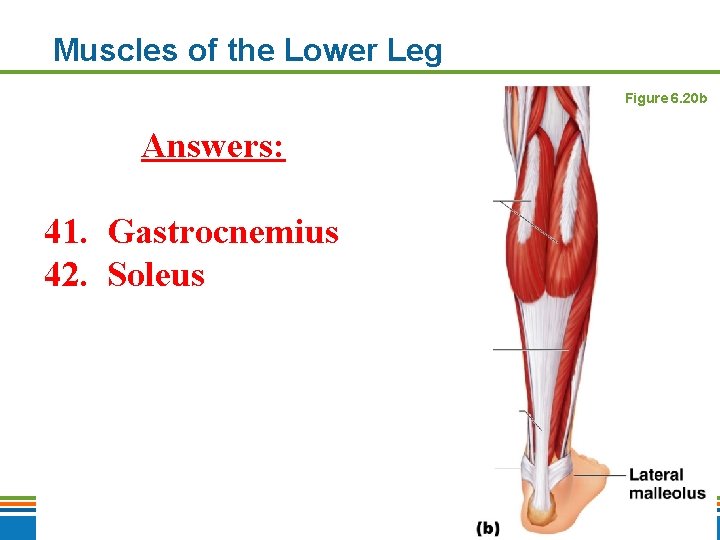
Muscles of the Lower Leg Figure 6. 20 b Answers: 41. Gastrocnemius 42. Soleus Copyright © 2009 Pearson Education, Inc. , publishing as Benjamin Cummings
Lesson 9 Skeletal Muscles - Overview of all Superficial Muscles
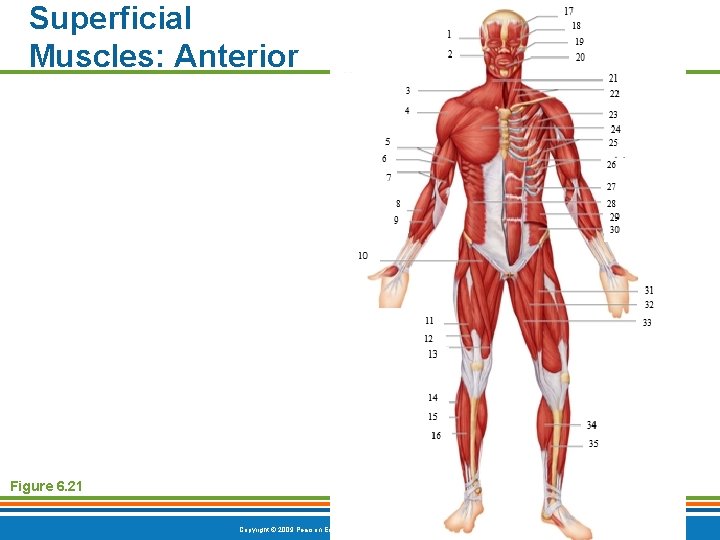
Superficial Muscles: Anterior Figure 6. 21 Copyright © 2009 Pearson Education, Inc. , publishing as Benjamin Cummings
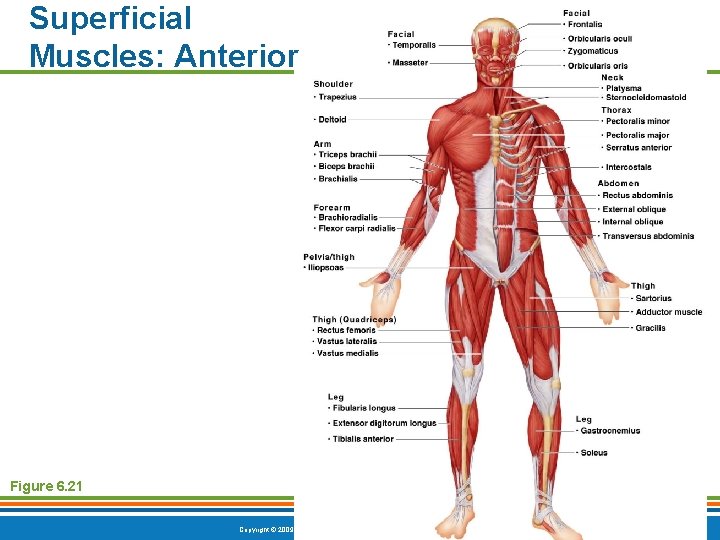
Superficial Muscles: Anterior Figure 6. 21 Copyright © 2009 Pearson Education, Inc. , publishing as Benjamin Cummings
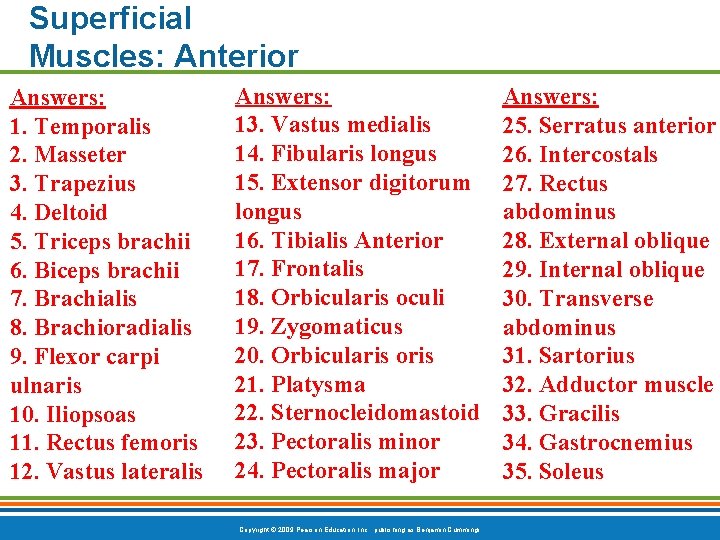
Superficial Muscles: Anterior Answers: 1. Temporalis 2. Masseter 3. Trapezius 4. Deltoid 5. Triceps brachii 6. Biceps brachii 7. Brachialis 8. Brachioradialis 9. Flexor carpi ulnaris 10. Iliopsoas 11. Rectus femoris 12. Vastus lateralis Answers: 13. Vastus medialis 14. Fibularis longus 15. Extensor digitorum longus 16. Tibialis Anterior 17. Frontalis 18. Orbicularis oculi 19. Zygomaticus 20. Orbicularis oris 21. Platysma 22. Sternocleidomastoid 23. Pectoralis minor 24. Pectoralis major Copyright © 2009 Pearson Education, Inc. , publishing as Benjamin Cummings Answers: 25. Serratus anterior 26. Intercostals 27. Rectus abdominus 28. External oblique 29. Internal oblique 30. Transverse abdominus 31. Sartorius 32. Adductor muscle 33. Gracilis 34. Gastrocnemius 35. Soleus
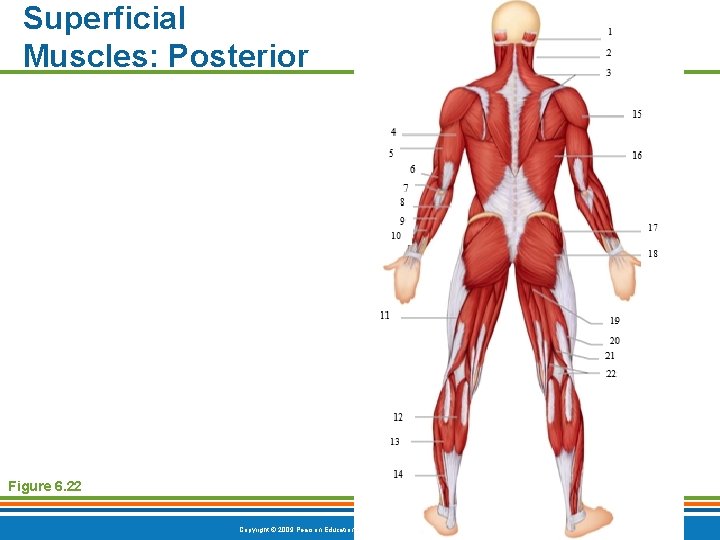
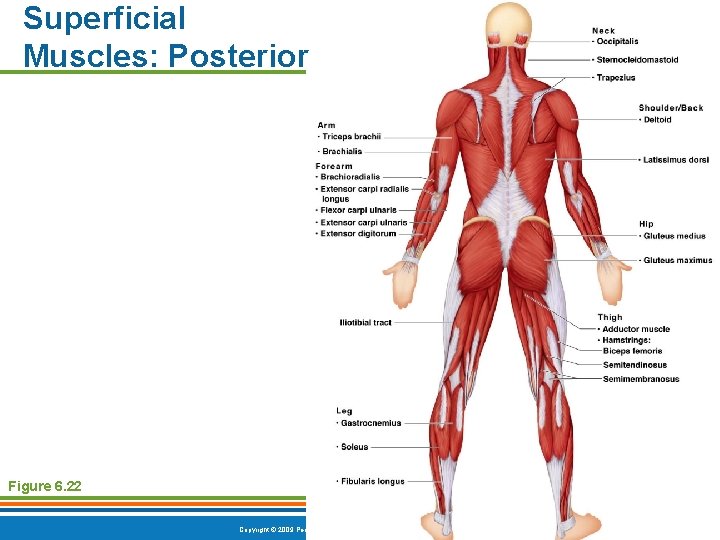
Superficial Muscles: Posterior Figure 6. 22 Copyright © 2009 Pearson Education, Inc. , publishing as Benjamin Cummings
Superficial Muscles: Posterior Figure 6. 22 Copyright © 2009 Pearson Education, Inc. , publishing as Benjamin Cummings
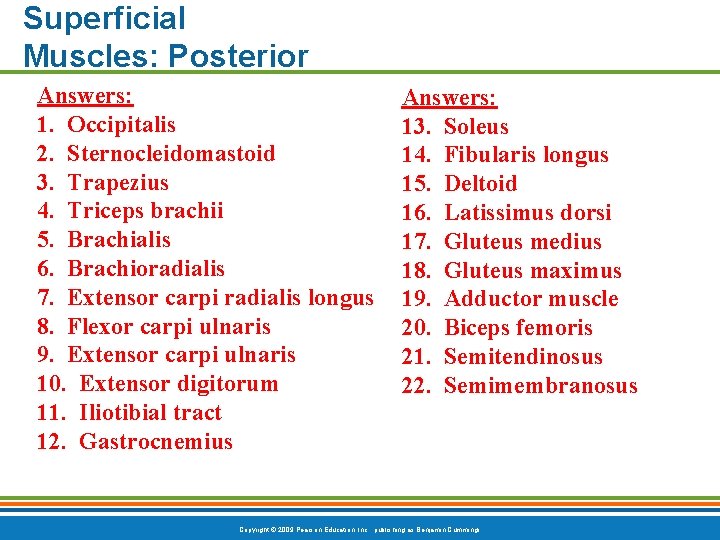
Superficial Muscles: Posterior Answers: 1. Occipitalis 2. Sternocleidomastoid 3. Trapezius 4. Triceps brachii 5. Brachialis 6. Brachioradialis 7. Extensor carpi radialis longus 8. Flexor carpi ulnaris 9. Extensor carpi ulnaris 10. Extensor digitorum 11. Iliotibial tract 12. Gastrocnemius Answers: 13. Soleus 14. Fibularis longus 15. Deltoid 16. Latissimus dorsi 17. Gluteus medius 18. Gluteus maximus 19. Adductor muscle 20. Biceps femoris 21. Semitendinosus 22. Semimembranosus Copyright © 2009 Pearson Education, Inc. , publishing as Benjamin Cummings
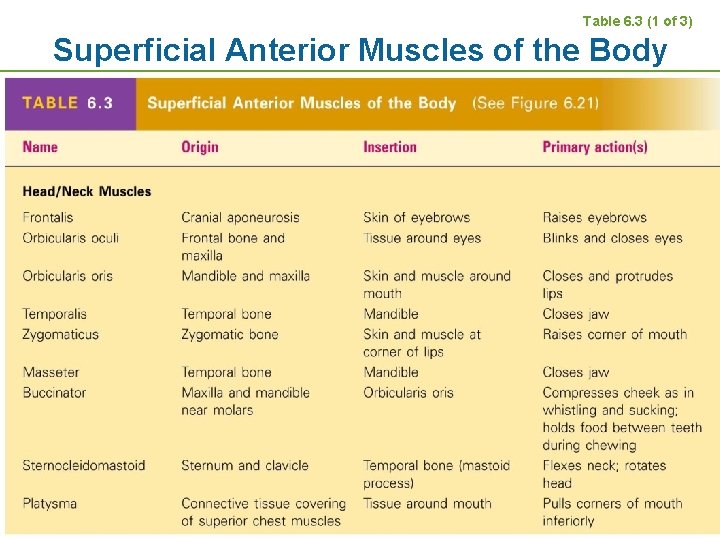
Table 6. 3 (1 of 3) Superficial Anterior Muscles of the Body Copyright © 2009 Pearson Education, Inc. , publishing as Benjamin Cummings
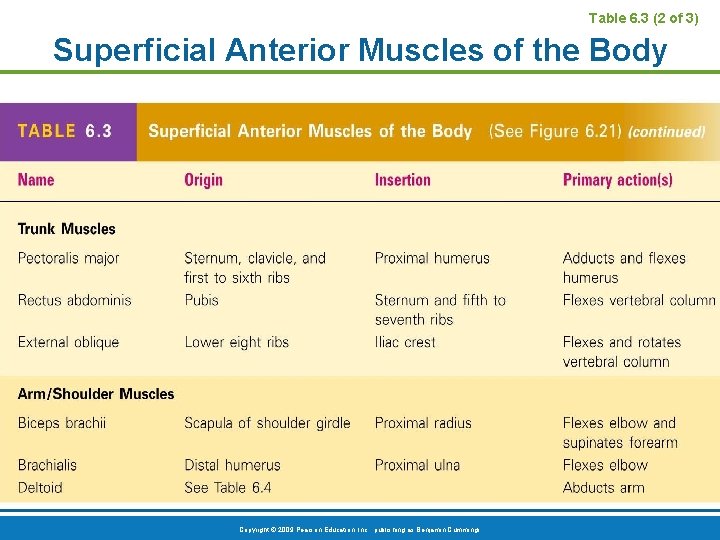
Table 6. 3 (2 of 3) Superficial Anterior Muscles of the Body Copyright © 2009 Pearson Education, Inc. , publishing as Benjamin Cummings
Table 6. 3 (3 of 3) Superficial Anterior Muscles of the Body Copyright © 2009 Pearson Education, Inc. , publishing as Benjamin Cummings
Table 6. 4 (1 of 3) Superficial Posterior Muscles of the Body Copyright © 2009 Pearson Education, Inc. , publishing as Benjamin Cummings
Table 6. 4 (2 of 3) Superficial Posterior Muscles of the Body Copyright © 2009 Pearson Education, Inc. , publishing as Benjamin Cummings
Table 6. 4 (3 of 3) Superficial Posterior Muscles of the Body Copyright © 2009 Pearson Education, Inc. , publishing as Benjamin Cummings
Lesson 10 Developmental Aspects - Muscle development - Homeostatic Imbalances
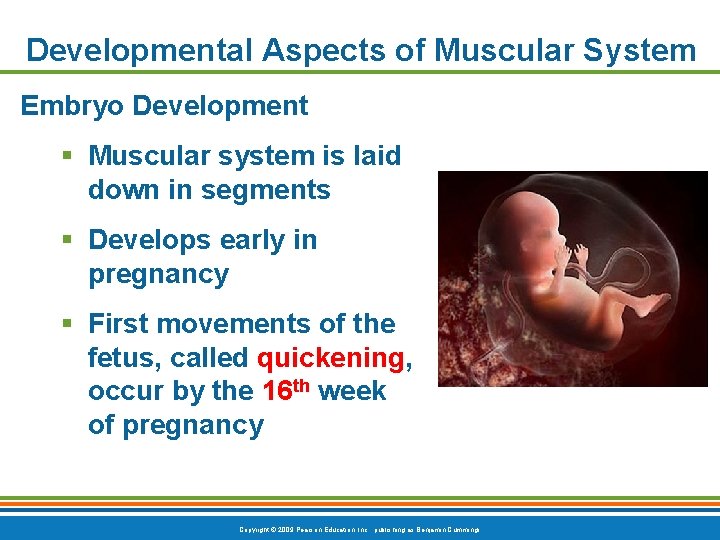
Developmental Aspects of Muscular System Embryo Development § Muscular system is laid down in segments § Develops early in pregnancy § First movements of the fetus, called quickening, occur by the 16 th week of pregnancy Copyright © 2009 Pearson Education, Inc. , publishing as Benjamin Cummings
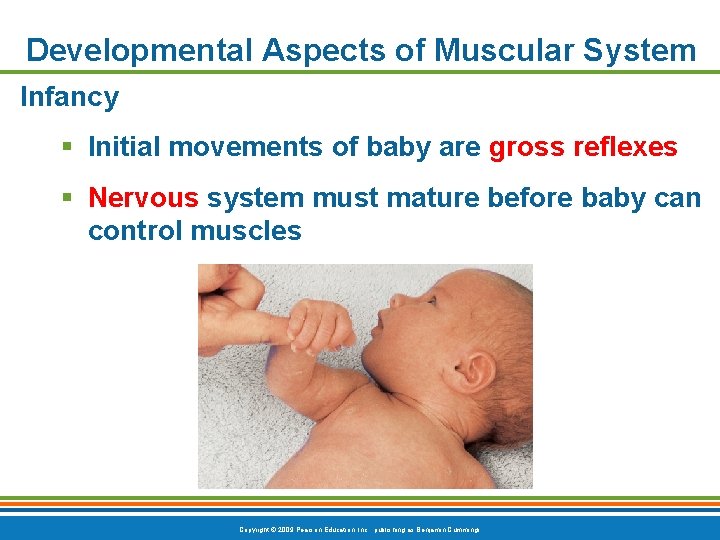
Developmental Aspects of Muscular System Infancy § Initial movements of baby are gross reflexes § Nervous system must mature before baby can control muscles Copyright © 2009 Pearson Education, Inc. , publishing as Benjamin Cummings
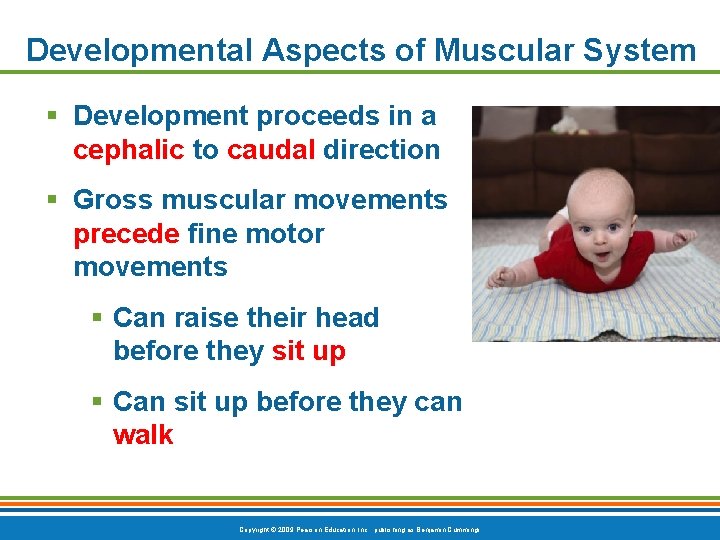
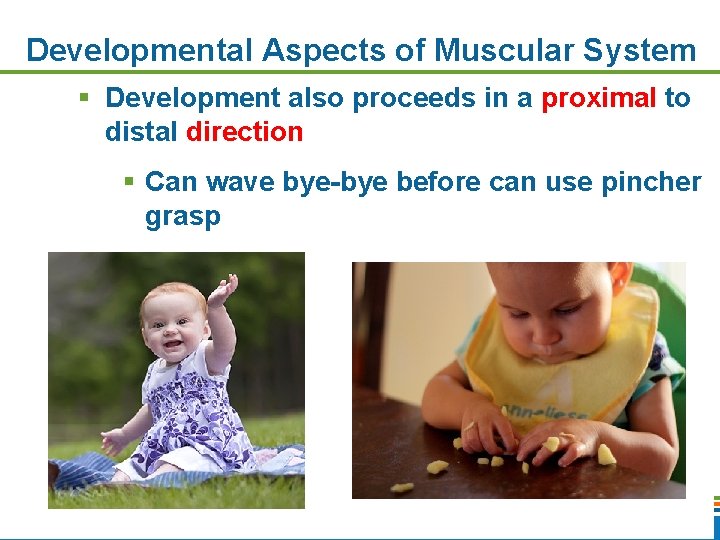
Developmental Aspects of Muscular System § Development proceeds in a cephalic to caudal direction § Gross muscular movements precede fine motor movements § Can raise their head before they sit up § Can sit up before they can walk Copyright © 2009 Pearson Education, Inc. , publishing as Benjamin Cummings
Developmental Aspects of Muscular System § Development also proceeds in a proximal to distal direction § Can wave bye-bye before can use pincher grasp Copyright © 2009 Pearson Education, Inc. , publishing as Benjamin Cummings
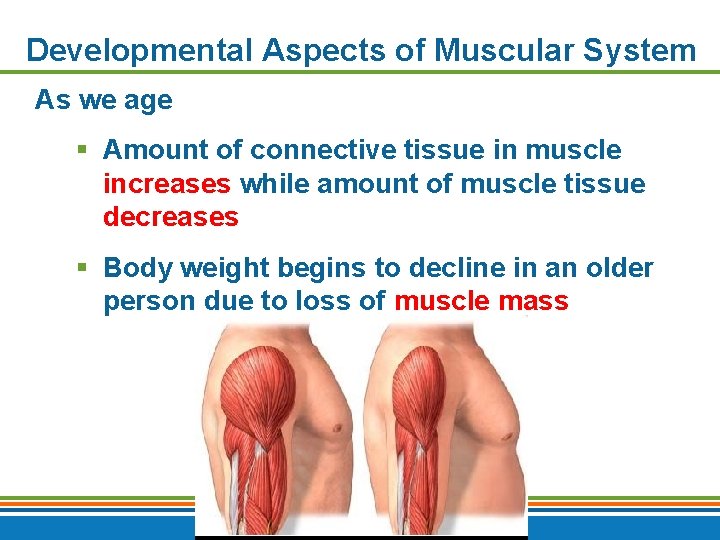
Developmental Aspects of Muscular System As we age § Amount of connective tissue in muscle increases while amount of muscle tissue decreases § Body weight begins to decline in an older person due to loss of muscle mass Copyright © 2009 Pearson Education, Inc. , publishing as Benjamin Cummings
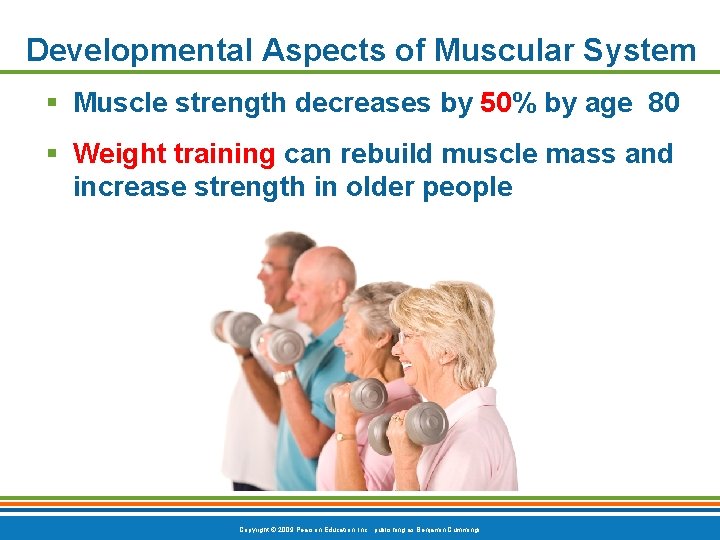
Developmental Aspects of Muscular System § Muscle strength decreases by 50% by age 80 § Weight training can rebuild muscle mass and increase strength in older people Copyright © 2009 Pearson Education, Inc. , publishing as Benjamin Cummings
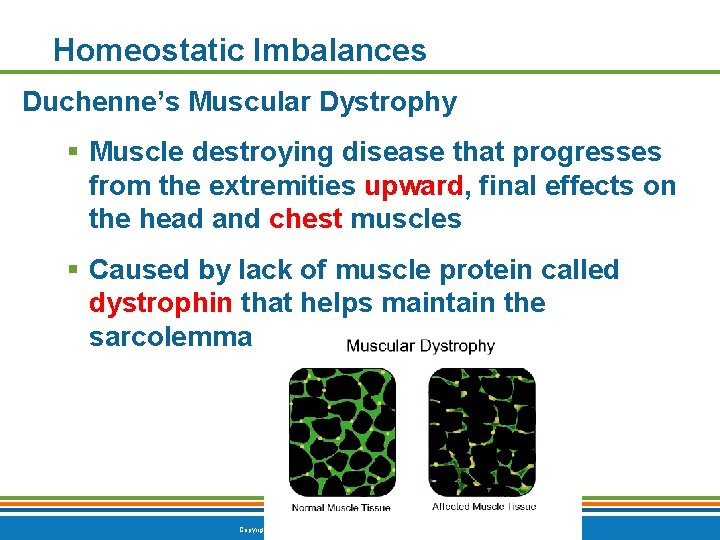
Homeostatic Imbalances Duchenne’s Muscular Dystrophy § Muscle destroying disease that progresses from the extremities upward, final effects on the head and chest muscles § Caused by lack of muscle protein called dystrophin that helps maintain the sarcolemma Copyright © 2009 Pearson Education, Inc. , publishing as Benjamin Cummings
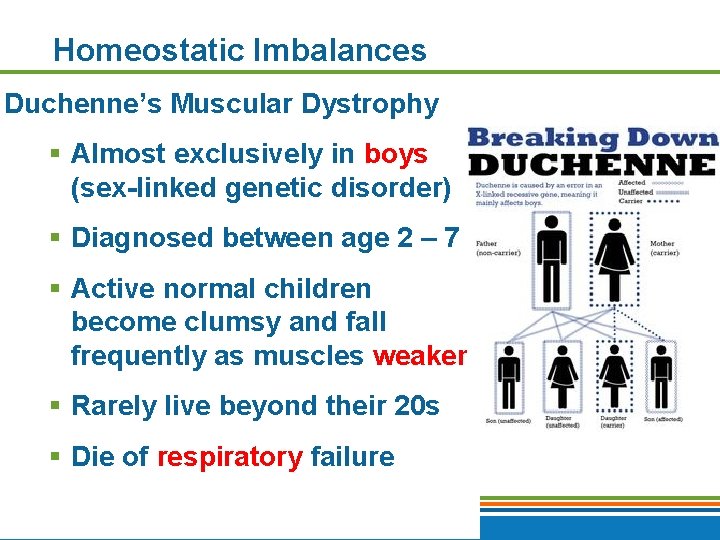
Homeostatic Imbalances Duchenne’s Muscular Dystrophy § Almost exclusively in boys (sex-linked genetic disorder) § Diagnosed between age 2 – 7 § Active normal children become clumsy and fall frequently as muscles weaken § Rarely live beyond their 20 s § Die of respiratory failure Copyright © 2009 Pearson Education, Inc. , publishing as Benjamin Cummings
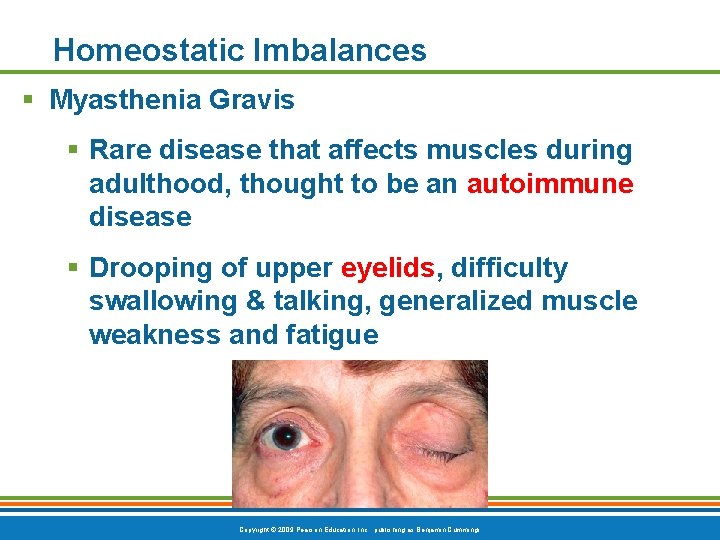
Homeostatic Imbalances § Myasthenia Gravis § Rare disease that affects muscles during adulthood, thought to be an autoimmune disease § Drooping of upper eyelids, difficulty swallowing & talking, generalized muscle weakness and fatigue Copyright © 2009 Pearson Education, Inc. , publishing as Benjamin Cummings
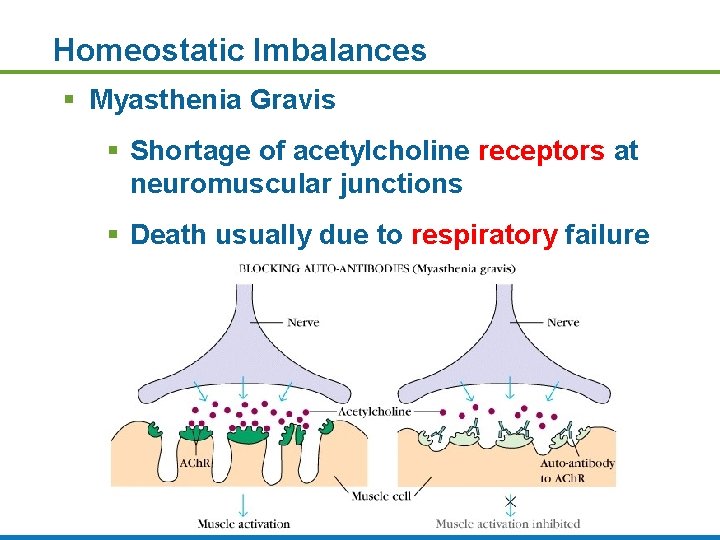
Homeostatic Imbalances § Myasthenia Gravis § Shortage of acetylcholine receptors at neuromuscular junctions § Death usually due to respiratory failure Copyright © 2009 Pearson Education, Inc. , publishing as Benjamin Cummings
Lesson 11 Review Lesson 12 Exam