
Lesson 1 Terminating and Repeating Decimals Lesson 1
- Slides: 28
Lesson 1 Terminating and Repeating Decimals
Lesson 1: Terminating and Repeating Decimals Objective: SWBAT write fractions as decimals and decimals as fractions. Do Now: Worksheet #1 - 7
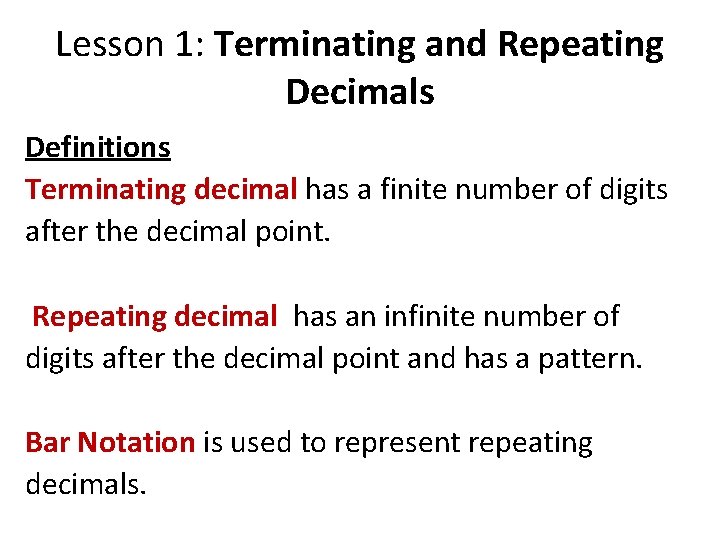
Lesson 1: Terminating and Repeating Decimals Definitions Terminating decimal has a finite number of digits after the decimal point. Repeating decimal has an infinite number of digits after the decimal point and has a pattern. Bar Notation is used to represent repeating decimals.
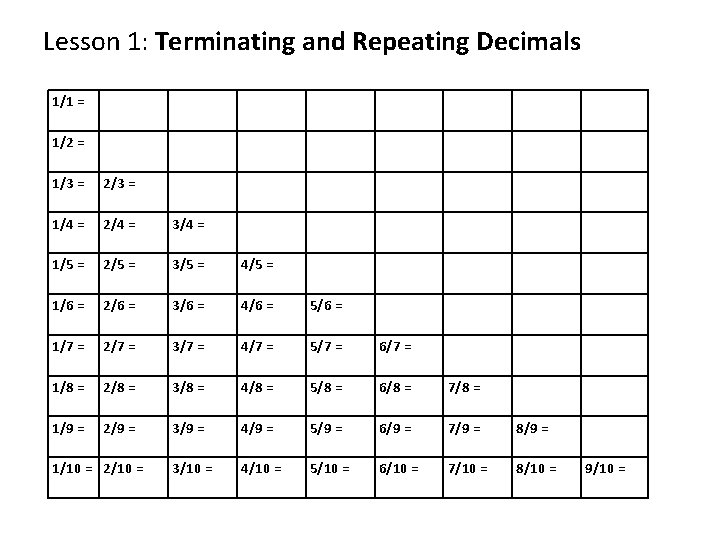
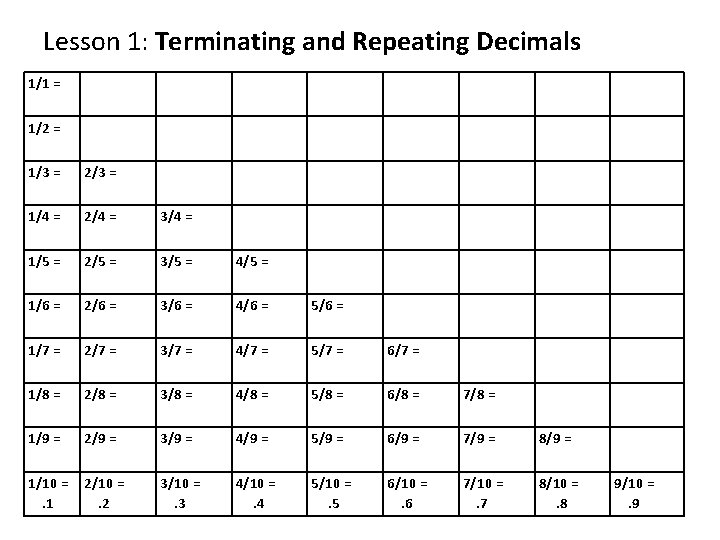
Lesson 1: Terminating and Repeating Decimals 1/1 = 1/2 = 1/3 = 2/3 = 1/4 = 2/4 = 3/4 = 1/5 = 2/5 = 3/5 = 4/5 = 1/6 = 2/6 = 3/6 = 4/6 = 5/6 = 1/7 = 2/7 = 3/7 = 4/7 = 5/7 = 6/7 = 1/8 = 2/8 = 3/8 = 4/8 = 5/8 = 6/8 = 7/8 = 1/9 = 2/9 = 3/9 = 4/9 = 5/9 = 6/9 = 7/9 = 8/9 = 3/10 = 4/10 = 5/10 = 6/10 = 7/10 = 8/10 = 1/10 = 2/10 = 9/10 =
Lesson 1: Terminating and Repeating Decimals 1/1 = 1/2 = 1/3 = 2/3 = 1/4 = 2/4 = 3/4 = 1/5 = 2/5 = 3/5 = 4/5 = 1/6 = 2/6 = 3/6 = 4/6 = 5/6 = 1/7 = 2/7 = 3/7 = 4/7 = 5/7 = 6/7 = 1/8 = 2/8 = 3/8 = 4/8 = 5/8 = 6/8 = 7/8 = 1/9 = 2/9 = 3/9 = 4/9 = 5/9 = 6/9 = 7/9 = 8/9 = 1/10 =. 1 2/10 =. 2 3/10 =. 3 4/10 =. 4 5/10 =. 5 6/10 =. 6 7/10 =. 7 8/10 =. 8 9/10 =. 9
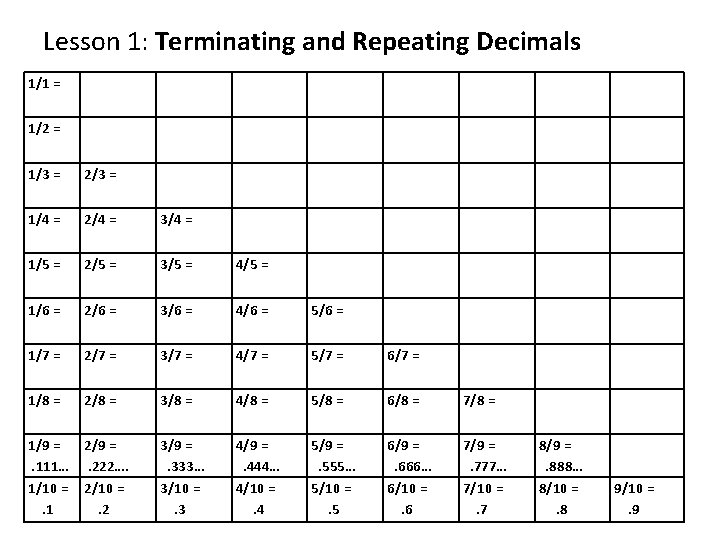
Lesson 1: Terminating and Repeating Decimals 1/1 = 1/2 = 1/3 = 2/3 = 1/4 = 2/4 = 3/4 = 1/5 = 2/5 = 3/5 = 4/5 = 1/6 = 2/6 = 3/6 = 4/6 = 5/6 = 1/7 = 2/7 = 3/7 = 4/7 = 5/7 = 6/7 = 1/8 = 2/8 = 3/8 = 4/8 = 5/8 = 6/8 = 7/8 = 1/9 =. 111… 1/10 =. 1 2/9 =. 222…. 2/10 =. 2 3/9 =. 333… 3/10 =. 3 4/9 =. 444… 4/10 =. 4 5/9 =. 555… 5/10 =. 5 6/9 =. 666… 6/10 =. 6 7/9 =. 777… 7/10 =. 7 8/9 =. 888… 8/10 =. 8 9/10 =. 9
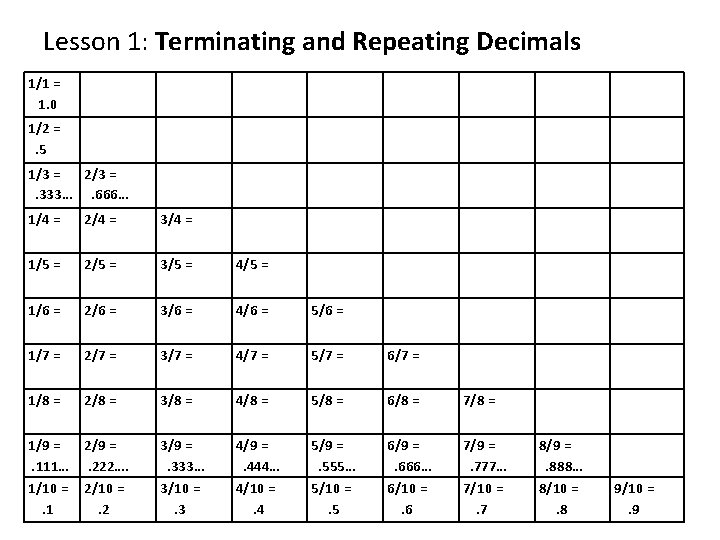
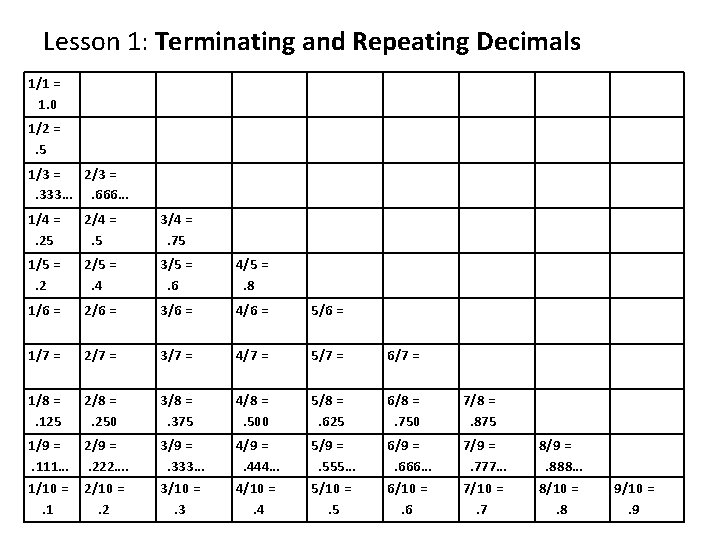
Lesson 1: Terminating and Repeating Decimals 1/1 = 1. 0 1/2 =. 5 1/3 = 2/3 =. 333…. 666… 1/4 = 2/4 = 3/4 = 1/5 = 2/5 = 3/5 = 4/5 = 1/6 = 2/6 = 3/6 = 4/6 = 5/6 = 1/7 = 2/7 = 3/7 = 4/7 = 5/7 = 6/7 = 1/8 = 2/8 = 3/8 = 4/8 = 5/8 = 6/8 = 7/8 = 1/9 =. 111… 1/10 =. 1 2/9 =. 222…. 2/10 =. 2 3/9 =. 333… 3/10 =. 3 4/9 =. 444… 4/10 =. 4 5/9 =. 555… 5/10 =. 5 6/9 =. 666… 6/10 =. 6 7/9 =. 777… 7/10 =. 7 8/9 =. 888… 8/10 =. 8 9/10 =. 9
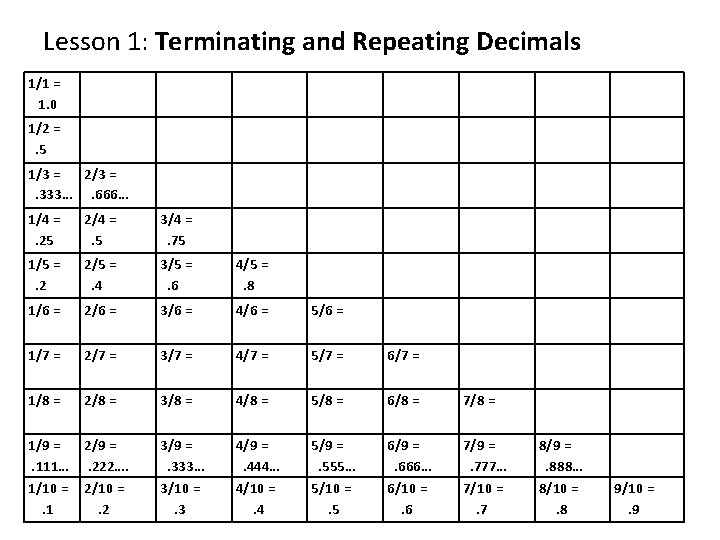
Lesson 1: Terminating and Repeating Decimals 1/1 = 1. 0 1/2 =. 5 1/3 = 2/3 =. 333…. 666… 1/4 =. 25 2/4 =. 5 3/4 =. 75 1/5 =. 2 2/5 =. 4 3/5 =. 6 4/5 =. 8 1/6 = 2/6 = 3/6 = 4/6 = 5/6 = 1/7 = 2/7 = 3/7 = 4/7 = 5/7 = 6/7 = 1/8 = 2/8 = 3/8 = 4/8 = 5/8 = 6/8 = 7/8 = 1/9 =. 111… 1/10 =. 1 2/9 =. 222…. 2/10 =. 2 3/9 =. 333… 3/10 =. 3 4/9 =. 444… 4/10 =. 4 5/9 =. 555… 5/10 =. 5 6/9 =. 666… 6/10 =. 6 7/9 =. 777… 7/10 =. 7 8/9 =. 888… 8/10 =. 8 9/10 =. 9
Lesson 1: Terminating and Repeating Decimals 1/1 = 1. 0 1/2 =. 5 1/3 = 2/3 =. 333…. 666… 1/4 =. 25 2/4 =. 5 3/4 =. 75 1/5 =. 2 2/5 =. 4 3/5 =. 6 4/5 =. 8 1/6 = 2/6 = 3/6 = 4/6 = 5/6 = 1/7 = 2/7 = 3/7 = 4/7 = 5/7 = 6/7 = 1/8 =. 125 2/8 =. 250 3/8 =. 375 4/8 =. 500 5/8 =. 625 6/8 =. 750 7/8 =. 875 1/9 =. 111… 1/10 =. 1 2/9 =. 222…. 2/10 =. 2 3/9 =. 333… 3/10 =. 3 4/9 =. 444… 4/10 =. 4 5/9 =. 555… 5/10 =. 5 6/9 =. 666… 6/10 =. 6 7/9 =. 777… 7/10 =. 7 8/9 =. 888… 8/10 =. 8 9/10 =. 9
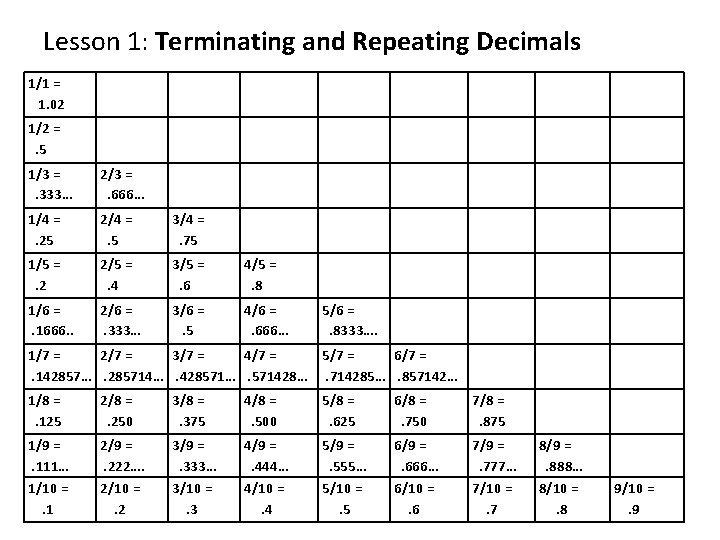
Lesson 1: Terminating and Repeating Decimals 1/1 = 1. 02 1/2 =. 5 1/3 =. 333… 2/3 =. 666… 1/4 =. 25 2/4 =. 5 3/4 =. 75 1/5 =. 2 2/5 =. 4 3/5 =. 6 4/5 =. 8 1/6 =. 1666. . 2/6 =. 333… 3/6 =. 5 4/6 =. 666… 5/6 =. 8333…. 1/7 = 2/7 = 3/7 = 4/7 = 5/7 = 6/7 =. 142857…. 285714…. 428571…. 571428…. 714285…. 857142… 1/8 =. 125 2/8 =. 250 3/8 =. 375 4/8 =. 500 5/8 =. 625 6/8 =. 750 7/8 =. 875 1/9 =. 111… 1/10 =. 1 2/9 =. 222…. 2/10 =. 2 3/9 =. 333… 3/10 =. 3 4/9 =. 444… 4/10 =. 4 5/9 =. 555… 5/10 =. 5 6/9 =. 666… 6/10 =. 6 7/9 =. 777… 7/10 =. 7 8/9 =. 888… 8/10 =. 8 9/10 =. 9
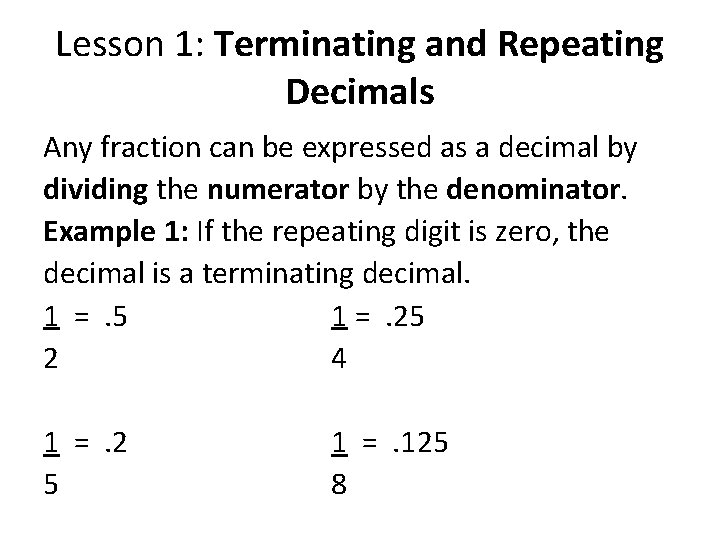
Lesson 1: Terminating and Repeating Decimals Any fraction can be expressed as a decimal by dividing the numerator by the denominator. Example 1: If the repeating digit is zero, the decimal is a terminating decimal. 1 =. 5 1 =. 25 2 4 1 =. 2 5 1 =. 125 8
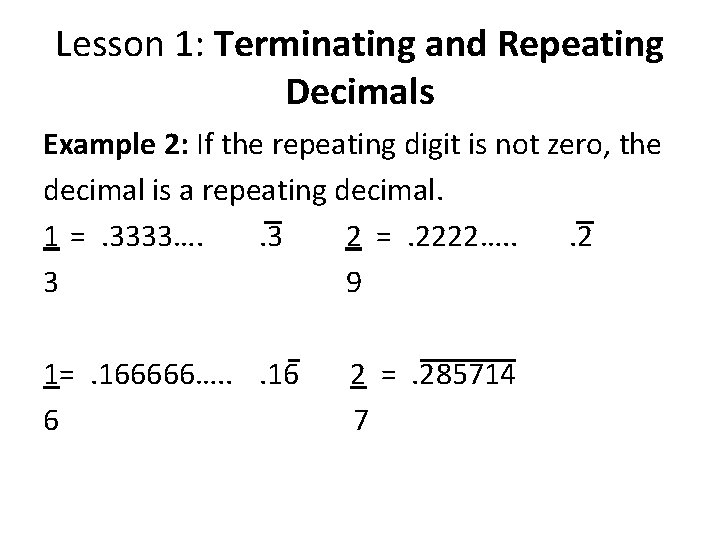
Lesson 1: Terminating and Repeating Decimals Example 2: If the repeating digit is not zero, the decimal is a repeating decimal. 1 =. 3333…. . 3 2 =. 2222…. . . 2 3 9 1=. 166666…. . . 16 6 2 =. 285714 7
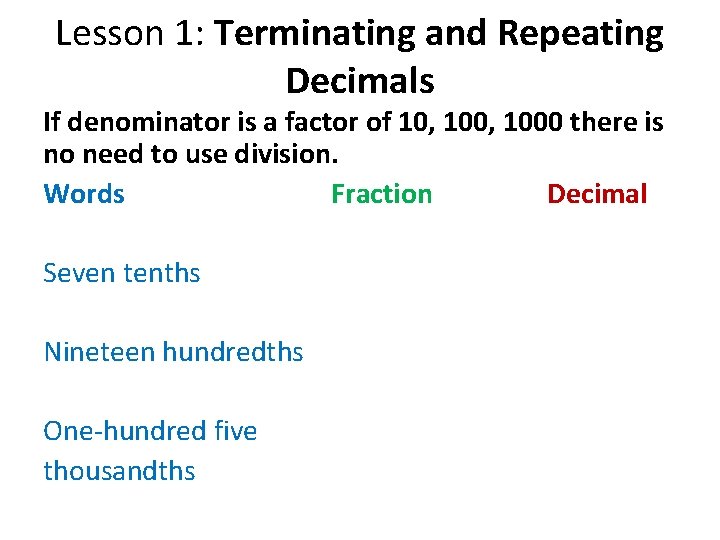
Lesson 1: Terminating and Repeating Decimals If denominator is a factor of 10, 1000 there is no need to use division. Words Fraction Decimal Seven tenths Nineteen hundredths One-hundred five thousandths
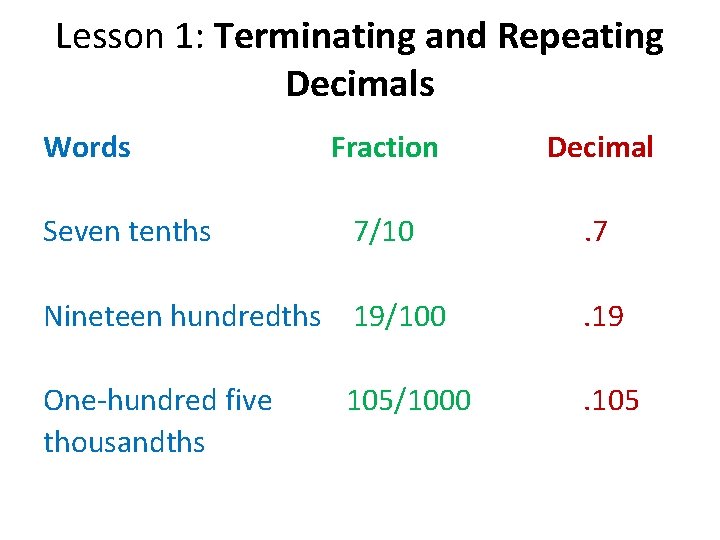
Lesson 1: Terminating and Repeating Decimals Words Seven tenths Fraction Decimal 7/10 . 7 Nineteen hundredths 19/100 . 19 One-hundred five thousandths . 105/1000
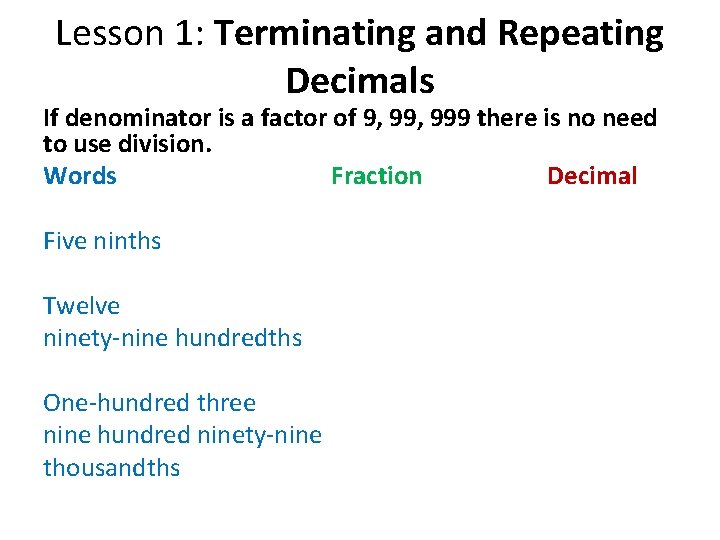
Lesson 1: Terminating and Repeating Decimals If denominator is a factor of 9, 999 there is no need to use division. Words Fraction Decimal Five ninths Twelve ninety-nine hundredths One-hundred three nine hundred ninety-nine thousandths
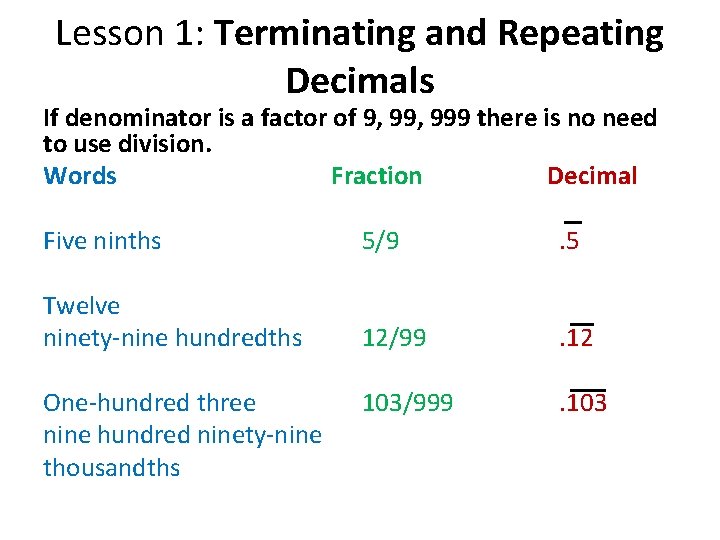
Lesson 1: Terminating and Repeating Decimals If denominator is a factor of 9, 999 there is no need to use division. Words Fraction Decimal Five ninths 5/9 . 5 Twelve ninety-nine hundredths 12/99 . 12 103/999 . 103 One-hundred three nine hundred ninety-nine thousandths
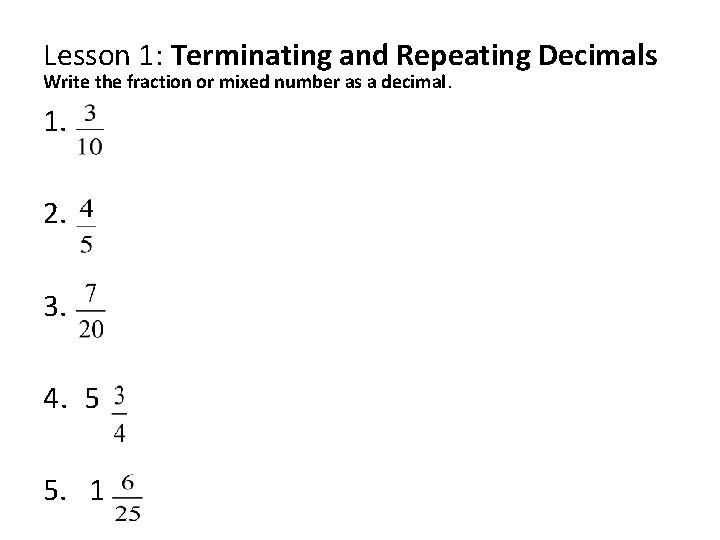
Lesson 1: Terminating and Repeating Decimals Write the fraction or mixed number as a decimal. 1. 2. 3. 4. 5 5. 1
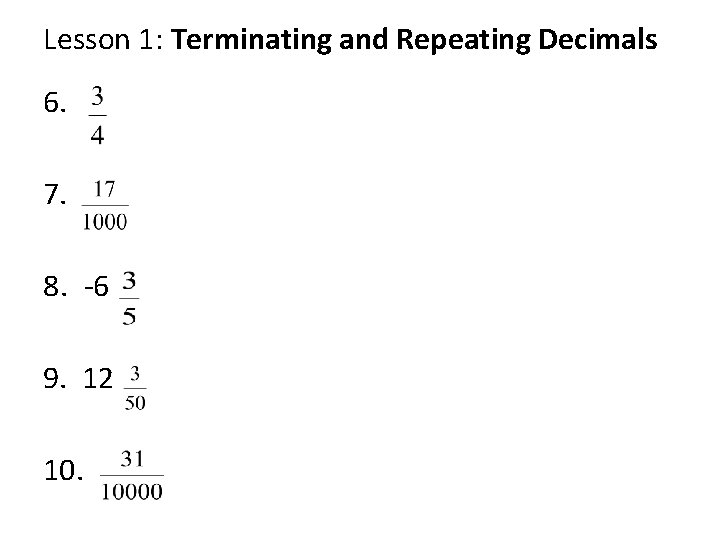
Lesson 1: Terminating and Repeating Decimals 6. 7. 8. -6 9. 12 10.
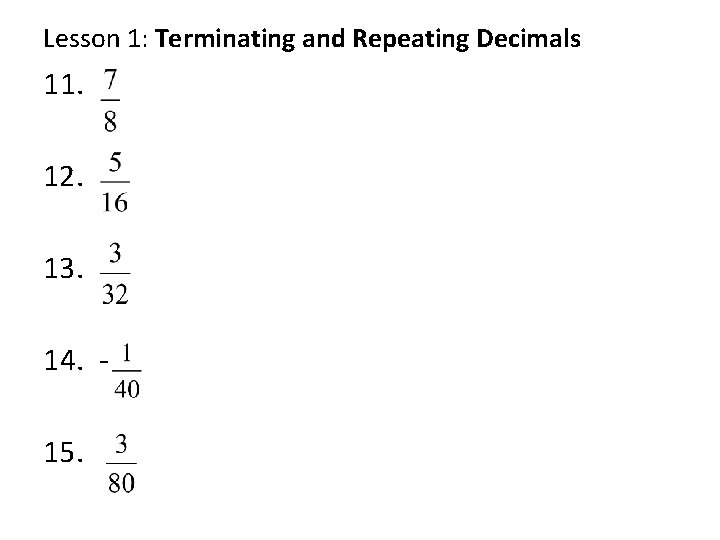
Lesson 1: Terminating and Repeating Decimals 11. 12. 13. 14. 15.
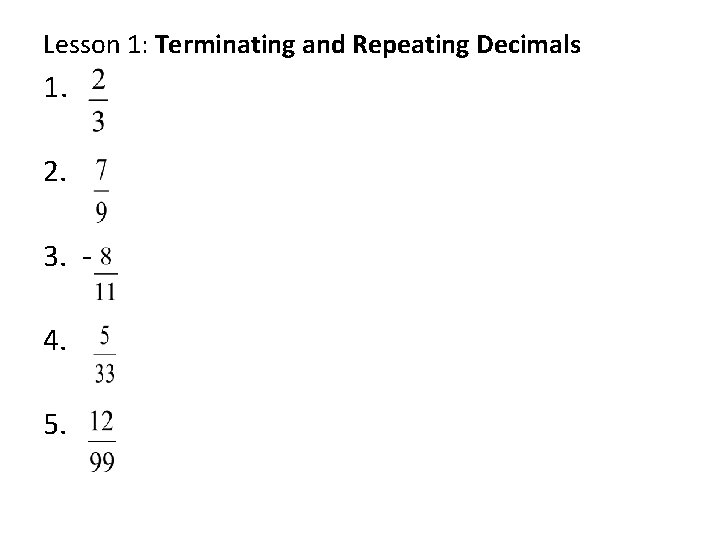
Lesson 1: Terminating and Repeating Decimals 1. 2. 3. 4. 5.
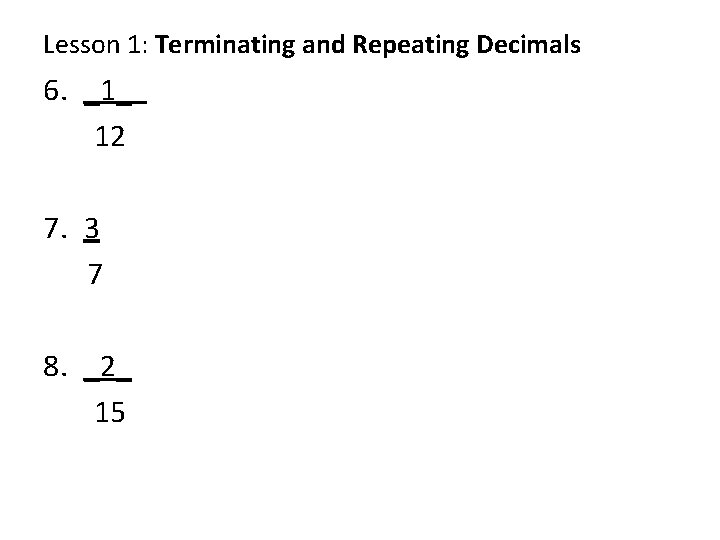
Lesson 1: Terminating and Repeating Decimals 6. _1_ 12 7. 3 7 8. _2_ 15
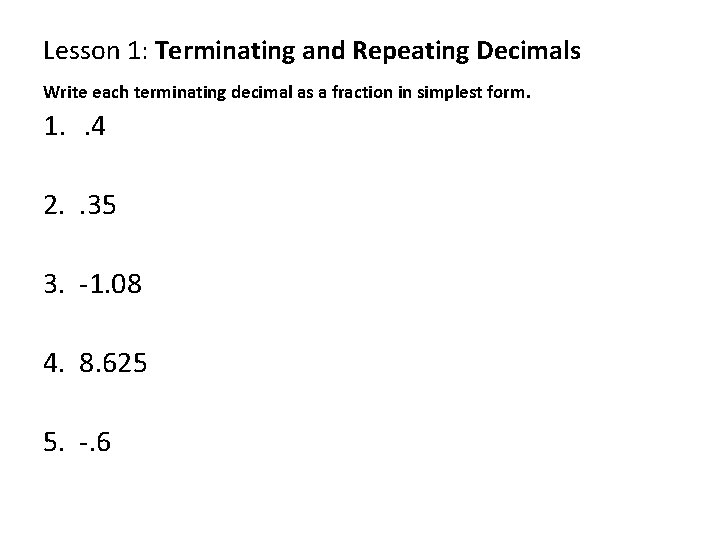
Lesson 1: Terminating and Repeating Decimals Write each terminating decimal as a fraction in simplest form. 1. . 4 2. . 35 3. -1. 08 4. 8. 625 5. -. 6
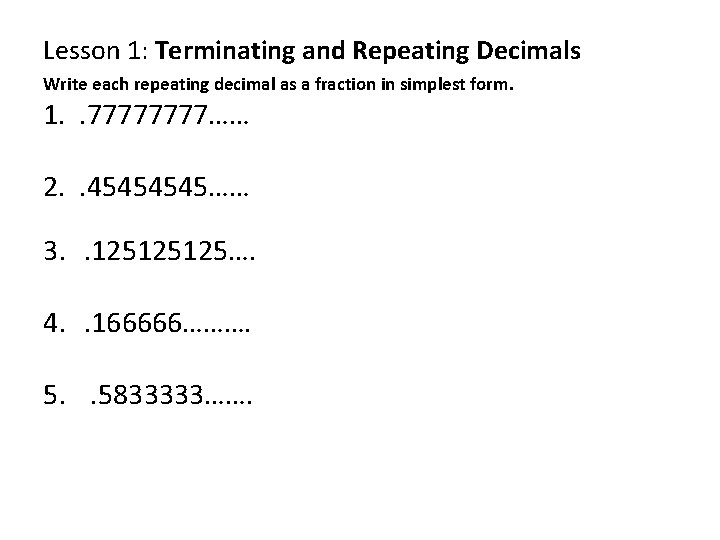
Lesson 1: Terminating and Repeating Decimals Write each repeating decimal as a fraction in simplest form. 1. . 7777…… 2. . 4545…… 3. . 125125125…. 4. . 166666………. 5. . 5833333…….
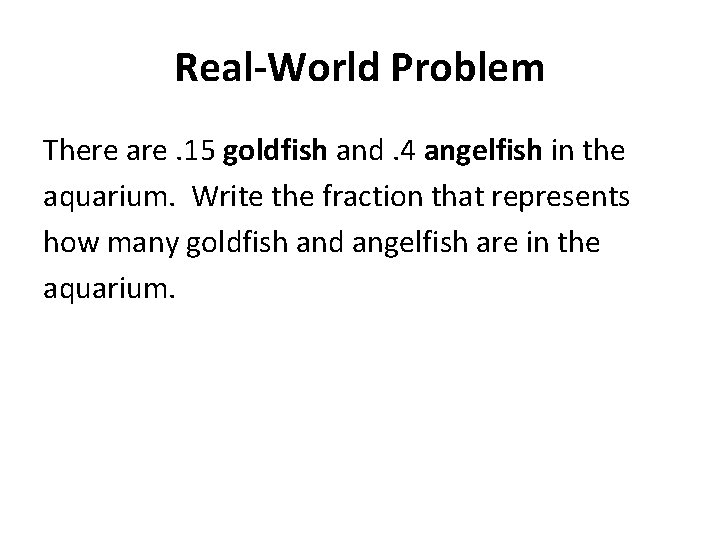
Real-World Problem There are. 15 goldfish and. 4 angelfish in the aquarium. Write the fraction that represents how many goldfish and angelfish are in the aquarium.
Classwork • Guided Practice #1 -5 • Independent Practice #1 -17 • Problem Solving Practice # 1 - 6
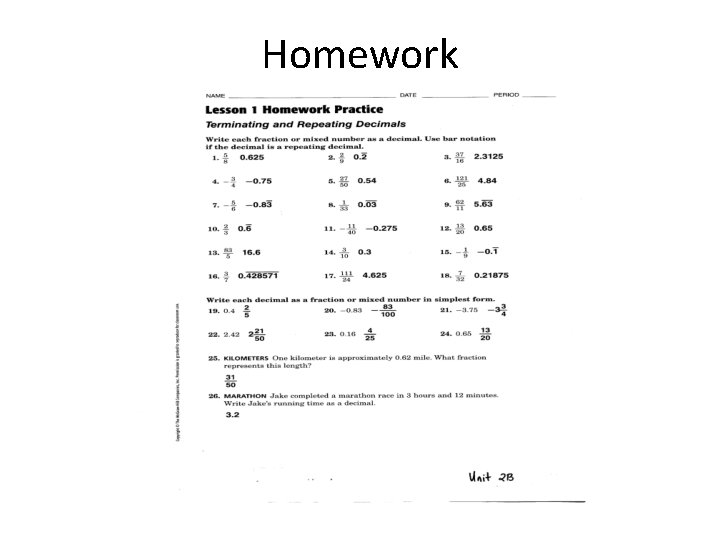
Closure Question: What number do you use in the denominator when writing terminating and repeating decimals to fractions? Exit Ticket Homework: Practice #1 -26
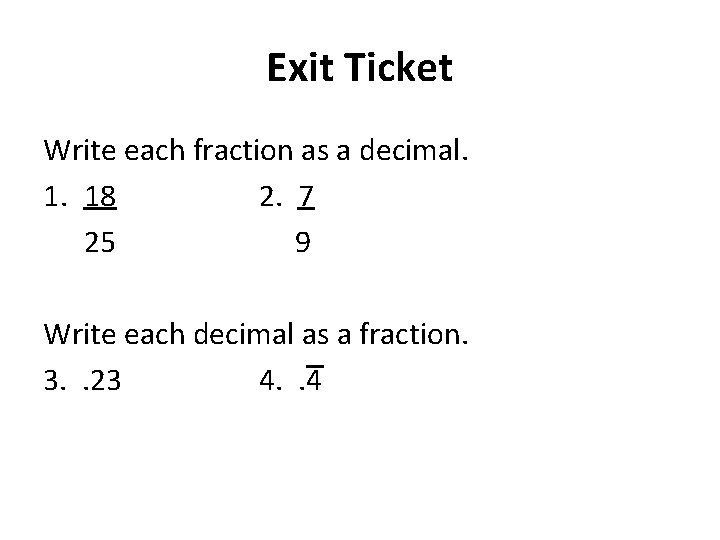
Exit Ticket Write each fraction as a decimal. 1. 18 2. 7 25 9 Write each decimal as a fraction. 3. . 23 4. . 4
Homework