
Lesson 1 Reading Comprehension Preparation Running To be
Lesson 1 Reading Comprehension Preparation Running • To be able to explore a character by their actions. • To be able to use my knowledge of synonyms to understand the text. • To be able to use thinking skills to consolidate knowledge of the text. DNA: This was it! Surely, this was where the hoard had been hidden. With mounting excitement, they clawed away at the soil on the ground directly below the portrait of Count Vasser. Soon their fingers found a square slab about half a metre across. As they blew away the remaining dirt, an inscription was revealed, carved into the stone. ‘To the thieves that seek to steal what is mine, remember this: when it comes to gold and jewels, nothing is beneath me!’ But the men simply laughed. They were not daunted by threats and curses from centuries ago. Using an iron bar as a lever, they carefully lifted the heavy trap door. Identify the content domain then answer the questions: 1. How was the inscription written on the slab? 2. How do you know that the men were not scared? Use evidence from the text to support your answer. 3. What do you predict that the men will find under the slab? Use evidence from the text to support your answer
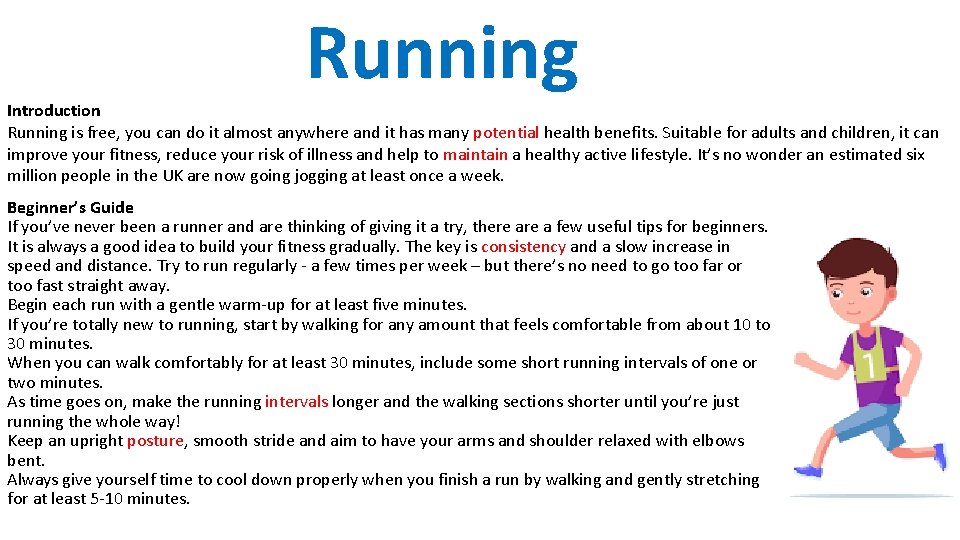
Running Introduction Running is free, you can do it almost anywhere and it has many potential health benefits. Suitable for adults and children, it can improve your fitness, reduce your risk of illness and help to maintain a healthy active lifestyle. It’s no wonder an estimated six million people in the UK are now going jogging at least once a week. Beginner’s Guide If you’ve never been a runner and are thinking of giving it a try, there a few useful tips for beginners. It is always a good idea to build your fitness gradually. The key is consistency and a slow increase in speed and distance. Try to run regularly - a few times per week – but there’s no need to go too far or too fast straight away. Begin each run with a gentle warm-up for at least five minutes. If you’re totally new to running, start by walking for any amount that feels comfortable from about 10 to 30 minutes. When you can walk comfortably for at least 30 minutes, include some short running intervals of one or two minutes. As time goes on, make the running intervals longer and the walking sections shorter until you’re just running the whole way! Keep an upright posture, smooth stride and aim to have your arms and shoulder relaxed with elbows bent. Always give yourself time to cool down properly when you finish a run by walking and gently stretching for at least 5 -10 minutes.
Staying Motivated Goals - Set yourself regular targets of either time, frequency or distance. You don’t need to be involved in a race to be in competition. Sometimes, competing with yourself can be just as much of an exciting challenge. Clubs and Company - Run with a friend or local group. Most clubs cater for all ages and ability levels, including beginners, and are usually a very friendly bunch. According to research, you’re more likely to stick with regular exercise if it’s a sociable activity that you do with someone else. Diary - Keep a training log of your runs. This could include as much or as little detail as you like. You could note your route, distance, time and how you felt. If you ever feel like you’re not making as much progress as you wanted, look back over your past achievements! Variety – Mix up your routes and distances to avoid the same old routine becoming boring. Doing other forms of exercise is known as cross-training. Swimming and cycling are other great ideas to support and improve your running, as well as being enjoyable exercise too. Specialist Gear and Gadgets Running doesn’t have to require much equipment but a good pair of running shoes are an essential investment in order to reduce the risk of injury. Specialist running retailers can give advice and fit running shoes to individual runners, based on your ability and goals. Running shoes should fit snugly to avoid slipping and sliding that can lead to blisters. A good design allows your foot to strike the ground properly, reducing the amount of shock that travels up your leg. They should be replaced over time, typically every 300 miles. When you get started, you can wear whatever feels comfortable to run in. After a while, you may choose some clothing with more technical sports fabric, which is designed to draw the sweat away from your body. As your running advances, you may decide to use a digital sports watch to record and monitor your runs or even a heart-rate monitor to check your effort level is where it should be.
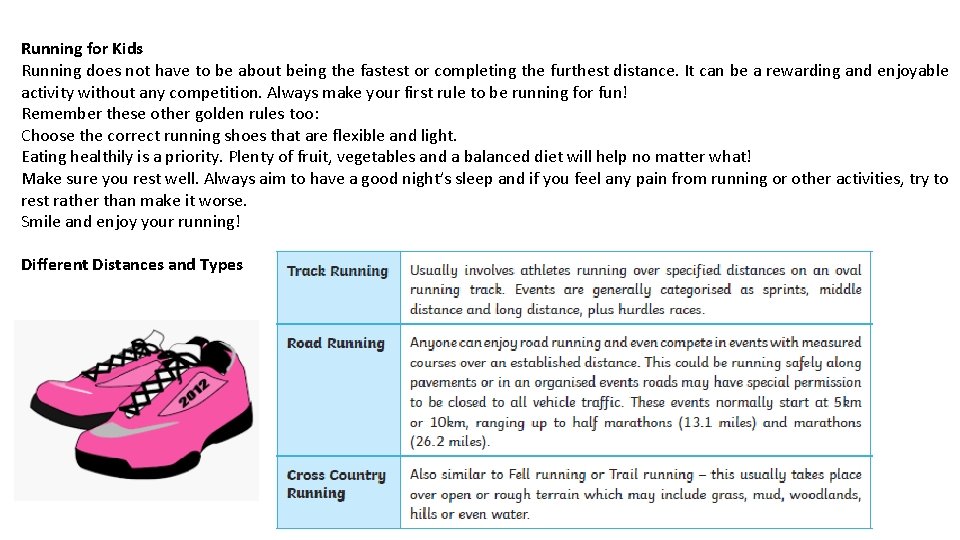
Running for Kids Running does not have to be about being the fastest or completing the furthest distance. It can be a rewarding and enjoyable activity without any competition. Always make your first rule to be running for fun! Remember these other golden rules too: Choose the correct running shoes that are flexible and light. Eating healthily is a priority. Plenty of fruit, vegetables and a balanced diet will help no matter what! Make sure you rest well. Always aim to have a good night’s sleep and if you feel any pain from running or other activities, try to rest rather than make it worse. Smile and enjoy your running! Different Distances and Types
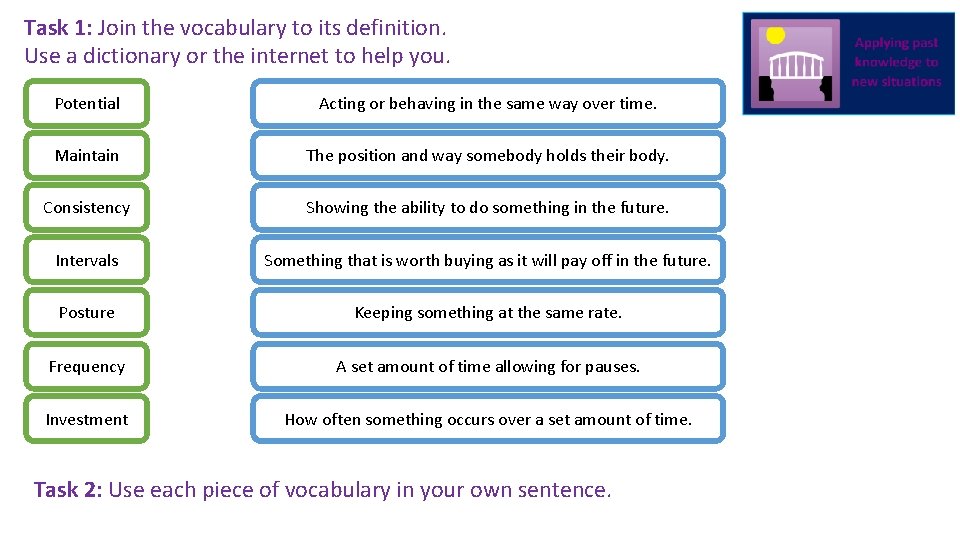
Task 1: Join the vocabulary to its definition. Use a dictionary or the internet to help you. Potential Acting or behaving in the same way over time. Maintain The position and way somebody holds their body. Consistency Showing the ability to do something in the future. Intervals Something that is worth buying as it will pay off in the future. Posture Keeping something at the same rate. Frequency A set amount of time allowing for pauses. Investment How often something occurs over a set amount of time. Task 2: Use each piece of vocabulary in your own sentence.
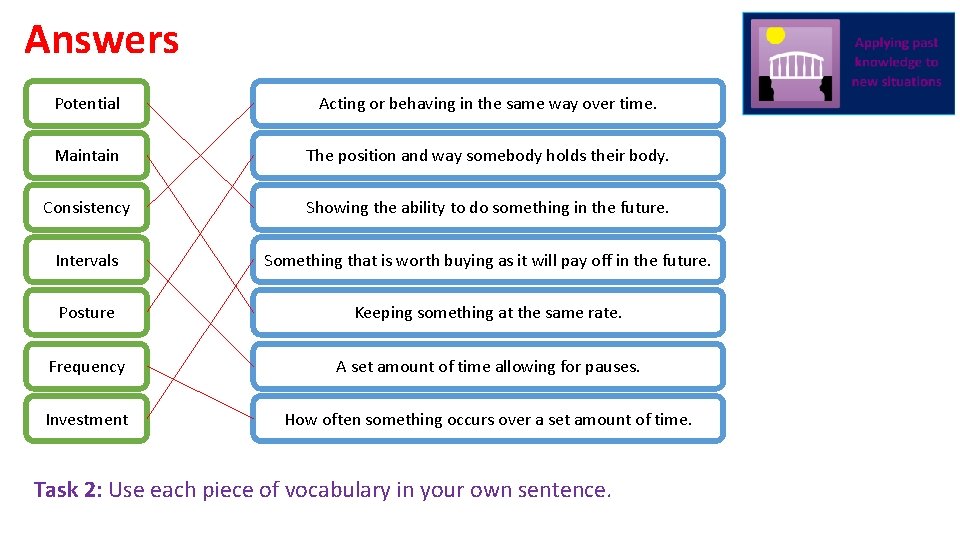
Answers Potential Acting or behaving in the same way over time. Maintain The position and way somebody holds their body. Consistency Showing the ability to do something in the future. Intervals Something that is worth buying as it will pay off in the future. Posture Keeping something at the same rate. Frequency A set amount of time allowing for pauses. Investment How often something occurs over a set amount of time. Task 2: Use each piece of vocabulary in your own sentence.
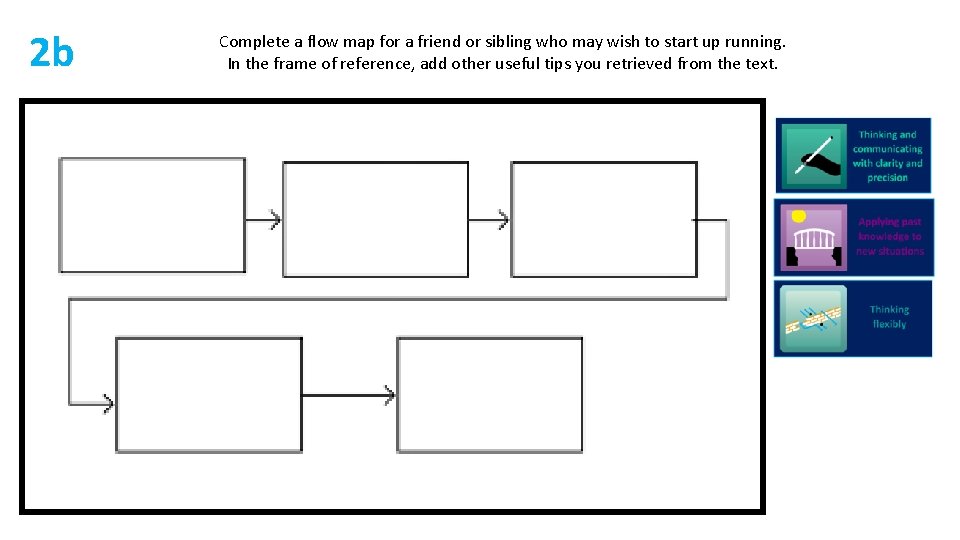
2 b Complete a flow map for a friend or sibling who may wish to start up running. In the frame of reference, add other useful tips you retrieved from the text.
Today I learned: I am going to use this when…
- Slides: 8