
Lesson 1 Personal Safety Are you safety conscious



- Slides: 30
Lesson 1 Personal Safety Are you safety conscious? Simple safety habits that you practice every day can decrease your exposure to risk.
Lesson 1 Lesson Objectives In this lesson, you will learn to: • Identify behaviors and strategies that enhance personal safety • Examine ways to avoid and reduce threatening situations • Discover strategies for safety at home and in the community
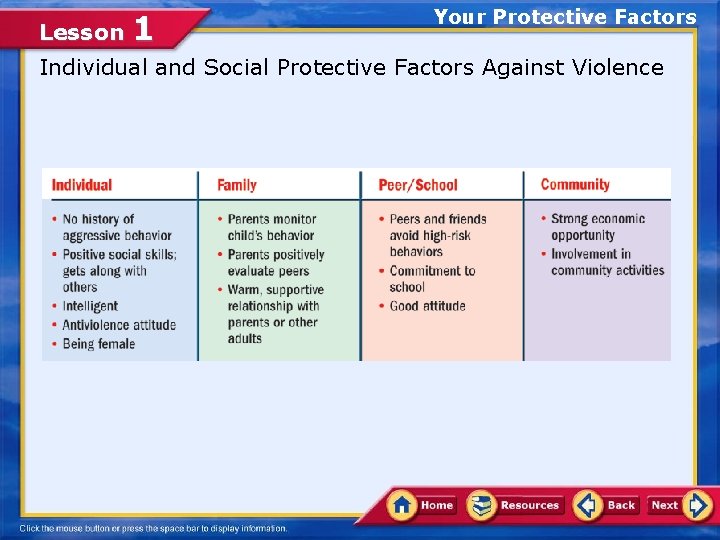
Lesson 1 Your Protective Factors Individual and Social Protective Factors Against Violence
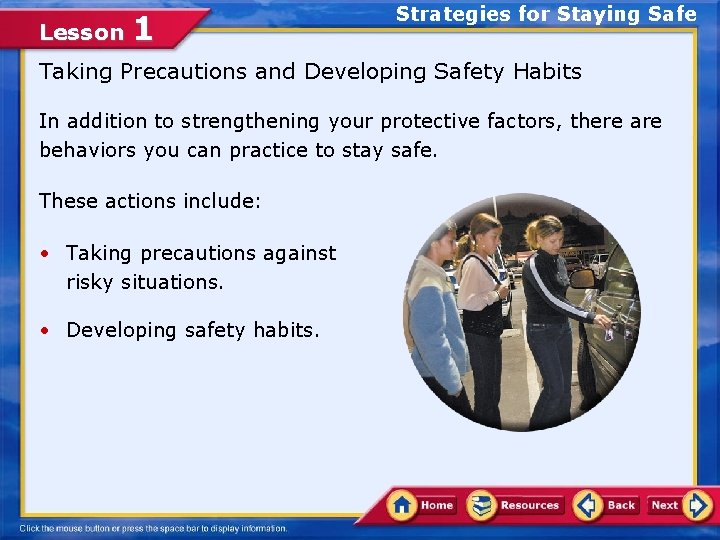
Lesson 1 Strategies for Staying Safe Taking Precautions and Developing Safety Habits In addition to strengthening your protective factors, there are behaviors you can practice to stay safe. These actions include: • Taking precautions against risky situations. • Developing safety habits.
Lesson 1 Strategies for Staying Safe Smart Precautions • Avoid unsafe areas. • Don’t carry your wallet or purse in a conspicuous, easy-tograb place. • Avoid walking alone at night in dark alleys. • Let your family know where you’re going and when you’ll return. • Do not get into an elevator alone with a stranger. • Do not hitchhike or give rides to hitchhikers.
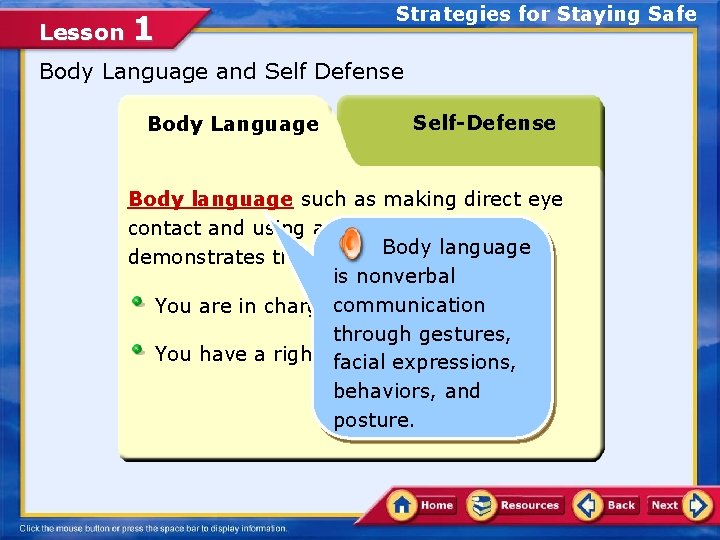
Lesson 1 Strategies for Staying Safe Body Language and Self Defense Body Language Self-Defense Body language such as making direct eye contact and using a strong voice demonstrates that: You are in charge of your safety. You have a right to be safe and secure.
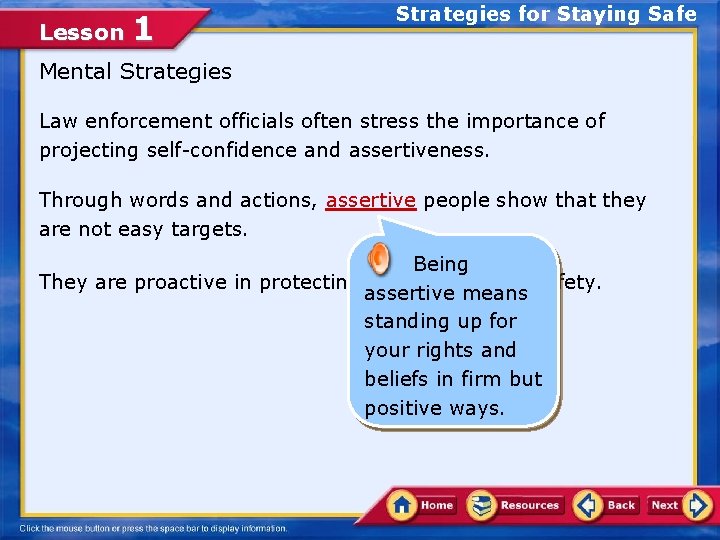
Lesson 1 Strategies for Staying Safe Mental Strategies Law enforcement officials often stress the importance of projecting self-confidence and assertiveness. Through words and actions, assertive people show that they are not easy targets. They are proactive in protecting their health and safety.
Lesson 1 Strategies for Staying Safe Keeping Homes Safe Lock doors with a bolt. Make sure windows have locks. Do not tell unknown callers that you are home alone. Never open the door to someone you don’t know or trust. Don’t let strangers use your phone. Do not give out personal information over the telephone or computer.
Lesson 1 Safety in the Community Making the Neighborhood Safer Increased police patrol After-school programs Neighborhood Watch programs Improved lighting in parks and playgrounds
Lesson 1 Quick Review Q. Which of the following are ways to keep your home safe? 1. Locking doors with a bolt 2. Making sure windows have locks 3. Never opening the door to someone you don’t know or trust 4. All of the above
Lesson A. 1 Quick Review - Answer 4. All of the above Ways to keep your home safe include locking doors with a bolt, making sure windows have locks, never opening the door to someone you don’t know or trust. Click Next to attempt another question.
Lesson 1 Quick Review Choose the appropriate option. Q. Being assertive means protecting your rights and beliefs in firm but positive ways. True False
Lesson Quick Review - Answer 1 A. True. Being assertive means protecting your rights and beliefs in firm but positive ways. Click Next to attempt another question.
Lesson 1 Quick Review Choose the appropriate option. Q. Body language is verbal and nonverbal communication through gestures, facial expressions, behaviors, and posture. True False
Lesson 1 Quick Review - Answer A. False. Body language is nonverbal communication through gestures, facial expressions, behaviors, and posture. Click Next to attempt another question.
Lesson 1 Quick Review Choose the appropriate option. Q. Involvement in community activities serves as a protective factor against violent behavior. True False
Lesson 1 Quick Review - Answer A. True. Involvement in community activities serves as a protective factor against violent behavior. Click Next to attempt another question.
Lesson 1 End of Lesson 1 Click Home to view the Main menu.
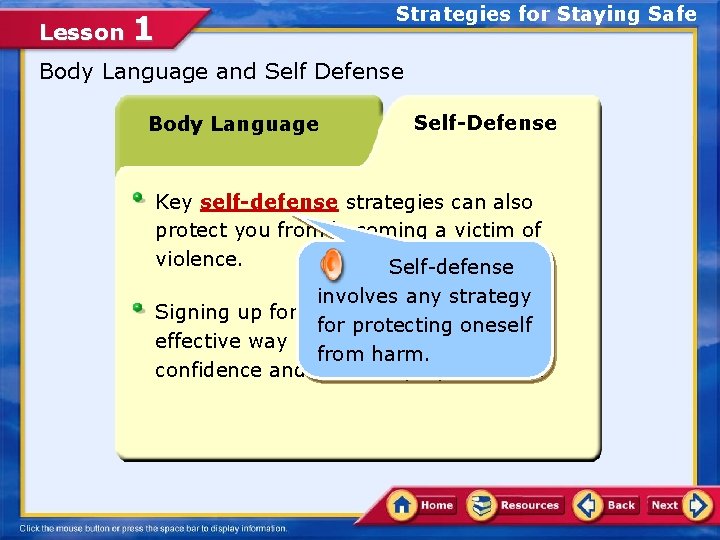
Lesson 1 Strategies for Staying Safe Body Language and Self Defense Body Language Self-Defense Key self-defense strategies can also protect you from becoming a victim of violence. Signing up for a self-defense class is an effective way to enhance your confidence and sense of preparedness.
Lesson 1 Strategies for Staying Safe Body Language and Self Defense Body Language Self-Defense Body language such as making direct eye contact and using a strong voice Body language demonstrates that: is nonverbal You are in charge communication of your safety. through gestures, You have a right to be safe and secure. facial expressions, behaviors, and posture.
Lesson 1 Strategies for Staying Safe Body Language and Self Defense Body Language Self-Defense Key self-defense strategies can also protect you from becoming a victim of violence. Self-defense involves any strategy Signing up for a self-defense class is an for protecting oneself effective way to enhance your from harm. confidence and sense of preparedness.
Lesson 1 Strategies for Staying Safe Mental Strategies Law enforcement officials often stress the importance of projecting self-confidence and assertiveness. Through words and actions, assertive people show that they are not easy targets. Being They are proactive in protecting their health and safety. assertive means standing up for your rights and beliefs in firm but positive ways.
Lesson 1 Quick Review - Answer A. Correct! Ways to keep your home safe include locking doors with a bolt, making sure windows have locks, never opening the door to someone you don’t know or trust. Click Next to attempt another question.
Lesson 1 Quick Review - Answer You have answered the question incorrectly. Go back to try again, or click Next to view the correct answer.
Lesson 1 Quick Review - Answer A. Correct! Being assertive means protecting your rights and beliefs in firm but positive ways. Click Next to attempt another question.
Lesson 1 Quick Review - Answer You have answered the question incorrectly. Go back to try again, or click Next to view the correct answer.
Lesson 1 Quick Review - Answer A. Correct! Body language is nonverbal communication through gestures, facial expressions, behaviors, and posture. Click Next to attempt another question.
Lesson 1 Quick Review - Answer You have answered the question incorrectly. Go back to try again, or click Next to view the correct answer.
Lesson 1 Quick Review - Answer A. Correct! Involvement in community activities serves as a protective factor against violent behavior. Click Next to attempt another question.
Lesson 1 Quick Review - Answer You have answered the question incorrectly. Go back to try again, or click Next to view the correct answer.