
Lesson 1 Personal Memoir How To Prepare Yourself
- Slides: 34
Lesson 1 Personal Memoir
How To Prepare Yourself To Tell Your Story To prepare to tell your personal story, or personal memoir, there a few things or truisms about storytelling that you must first realize.
When you see each truism about storytelling, raise your hand share your thoughts and feelings. Your sharing can include: • if you already realize a truism • if it is hard for you to believe one or more truisms • If you can offer any anecdotes ( miniature stories about yourself or others) that illustrate these truisms?
Truisms of Storytelling
Truisms of Storytelling 1. Everybody has a story to tell, not just famous people.
Truisms of Storytelling 1. Everybody has a story to tell, not just famous people. 2. When you share your stories with someone, you make connections with that person
Truisms of Storytelling 1. Everybody has a story to tell, not just famous people. 2. When you share your stories with someone, you make connections with that person 3. Stories bind us together
Truisms of Storytelling 1. Everybody has a story to tell, not just famous people. 2. When you share your stories with someone, you make connections with that person 3. Stories bind us together 4. There is an amazing power in the spoken word
Truisms of Storytelling 1. Everybody has a story to tell, not just famous people. 2. When you share your stories with someone, you make connections with that person 3. Stories bind us together 4. There is an amazing power in the spoken word 5. Our lives are a series of stories about triumphs and disasters
Truisms of Storytelling 1. Everybody has a story to tell, not just famous people. 2. When you share your stories with someone, you make connections with that person 3. Stories bind us together 4. There is an amazing power in the spoken word 5. Our lives are a series of stories about triumphs and disasters 6. Every person in your class has a unique story to tell
Truisms of Storytelling 1. Everybody has a story to tell, not just famous people. 2. When you share your stories with someone, you make connections with that person 3. Stories bind us together 4. There is an amazing power in the spoken word 5. Our lives are a series of stories about triumphs and disasters 6. Every person in your class has a unique story to tell 7. Sharing your story is a way of sharing part of yourself which is one way to strengthen a friendship
Review of the Parts of a Personal Memoir
Review of the Parts of a Personal Memoir Here are things you should include in your personal memoir.
1. Write a good hook that will attract your reader.
1. Write a good hook that will attract your reader. Possible hooks are: • A piece of Dialogue • A sound expressed as onomatopoeia (Kaboom, Screech) • A thought • An action
Raise your hand share an example of a hook that would attract YOU as a reader.
2. Use specific, detailed, and relevant details For example, when describing your feelings, do not use words like happy, sad, mad, because they are not specific.
3. Include all important characters and descriptions. You will be the most important character in your memoir but all of your readers my not know you so describe yourself and any other people in your memoir. Help your reader see everyone.
4. Include detailed descriptions of settings. Settings help set the mood of any story whether it is fiction or nonfiction. Be sure to include physical descriptions, sounds, smells, historical background, weather, and dates.
5. Use picture-worthy objects. The more objects your reader can picture, the more vivid your memoir will be. Don’t hurry past descriptions of objects especially if they are important to the narrative you are telling.
6. Inject suspense. Carefully spread out pieces of information about your memoir like breadcrumbs that your reader will follow because they want to know where they leave. Keep them wondering until he end.
7. Include a memorable conclusion. Keep the conclusion brief and let your reader draw the lesson that he or she should extract from your memoir. Endings can be expressed as: • A decision you made as a result of your experience • A Wish or hope that you have as a result of your experience • A memory that you revisit over and over again. • A feeling that you will always have because of your experience • An action that you took as a result of your experience
8. Include Honesty and Sincerity Don’t be afraid to include your weaknesses and flaws because everyone has them.
9. Use dialogue Even if you can’t remember exactly what someone said when your event really happened, come as close as you can.
10. Describe actions in details. Use descriptive action verbs and verbals whenever possible.
Since your life is a series of victories, defeats, and memorable moments, you will reflect on them to prepare to write a personal memoir. You will create a life diagram of YOUR life and then you will choose one of these victories, defeats, or memorable moments to turn into a personal memoir.
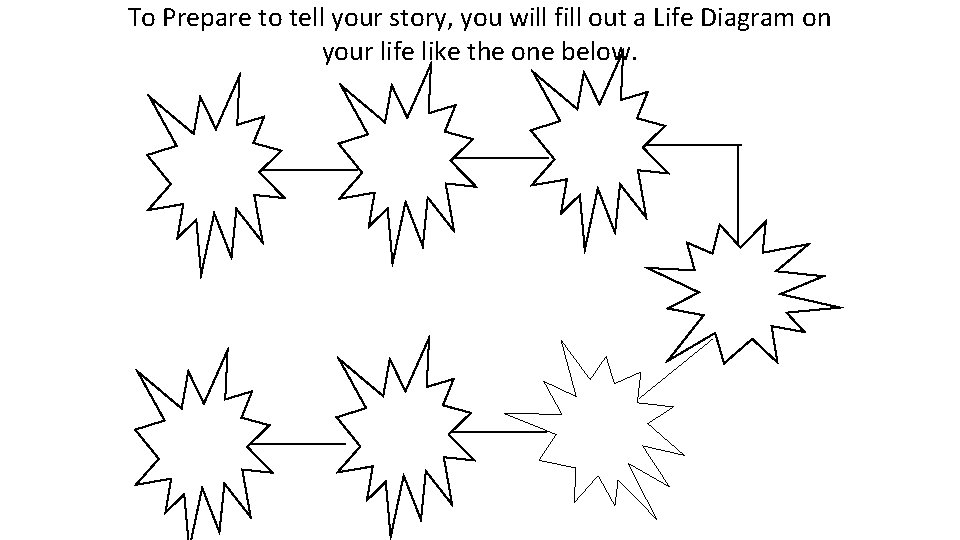
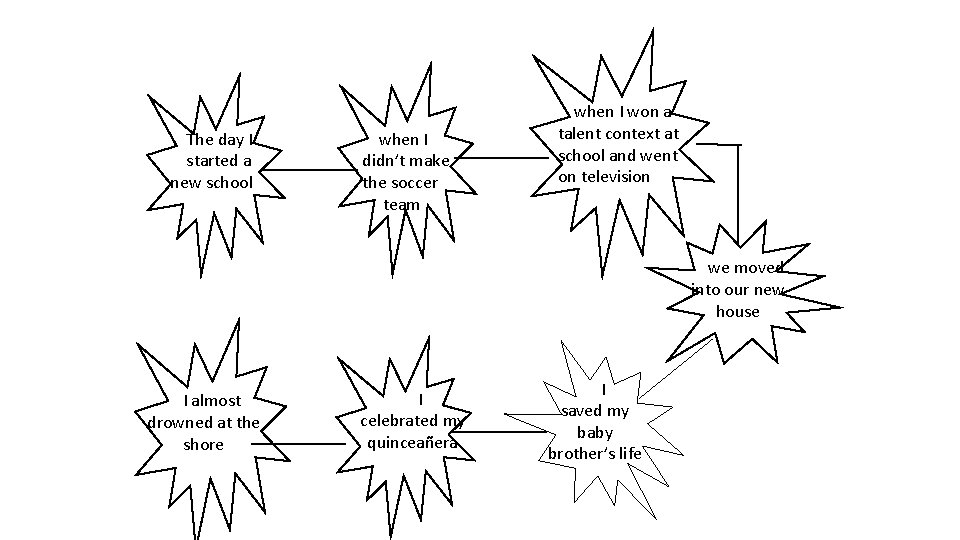
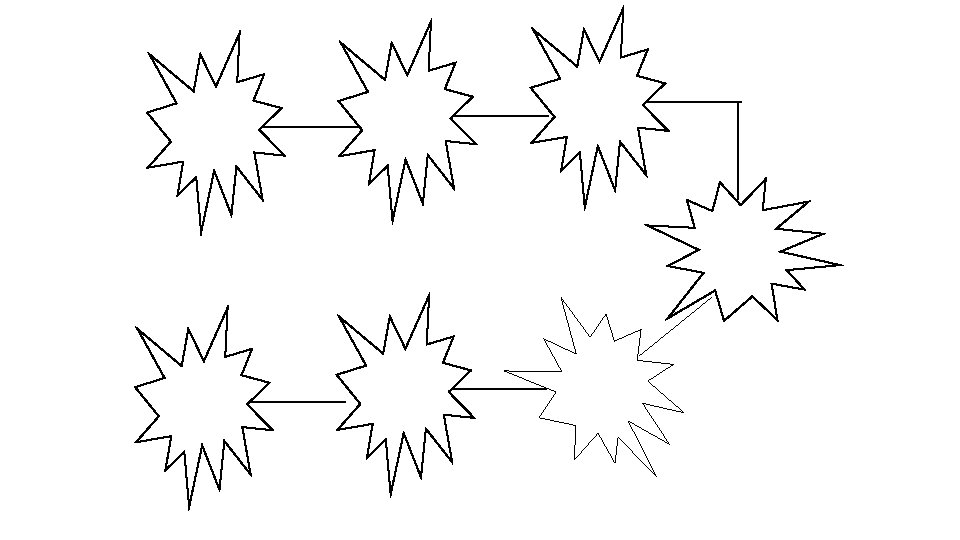
To Prepare to tell your story, you will fill out a Life Diagram on your life like the one below.
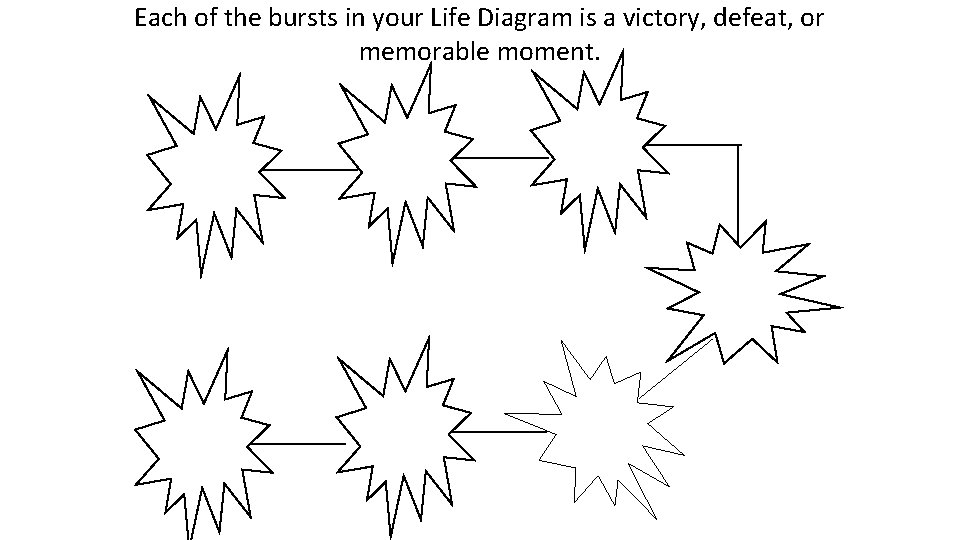
Each of the bursts in your Life Diagram is a victory, defeat, or memorable moment.
You will fill in each burst with a very short description of one of your victories, defeats, or memorable moments so it resembles the on the next slide.
The day I started a new school when I didn’t make the soccer team when I won a talent context at school and went on television we moved into our new house I almost drowned at the shore I celebrated my quinceañera I saved my baby brother’s life
When you have completed your life diagram, you will pick an incident in one of the bursts. Be sure to pick one that: • Will be interesting to others • Will not offend anyone • Shows some conflict • You remember in great detail
Some guidelines in making a good selection include: A specific event that happened to you The best event that happened to you An event that taught you something An event that enhanced your understanding of someone • An event that clarified some aspect of your life • An event that created an emotional response in you • •
• A particular time period of your life that was troublesome • The impact on your life by an outside event • A struggle that you overcame. • A time when you were victimized or treated unfairly