Lesson 1 LO To understand the term fraction
- Slides: 4
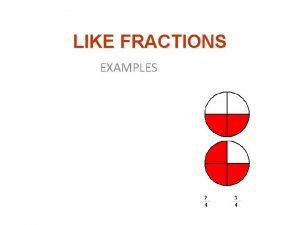
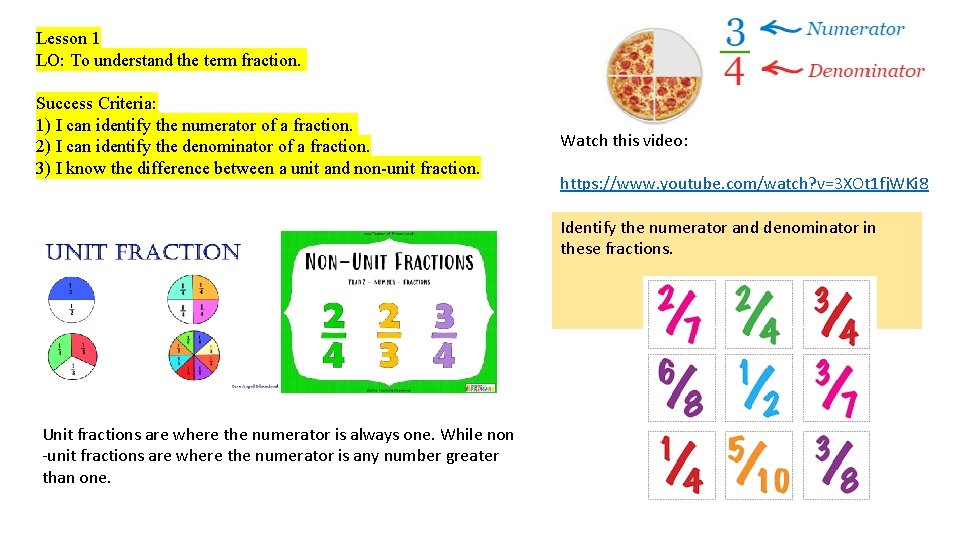
Lesson 1 LO: To understand the term fraction. Success Criteria: 1) I can identify the numerator of a fraction. 2) I can identify the denominator of a fraction. 3) I know the difference between a unit and non-unit fraction. Watch this video: https: //www. youtube. com/watch? v=3 XOt 1 fj. WKi 8 Identify the numerator and denominator in these fractions. Unit fractions are where the numerator is always one. While non -unit fractions are where the numerator is any number greater than one.
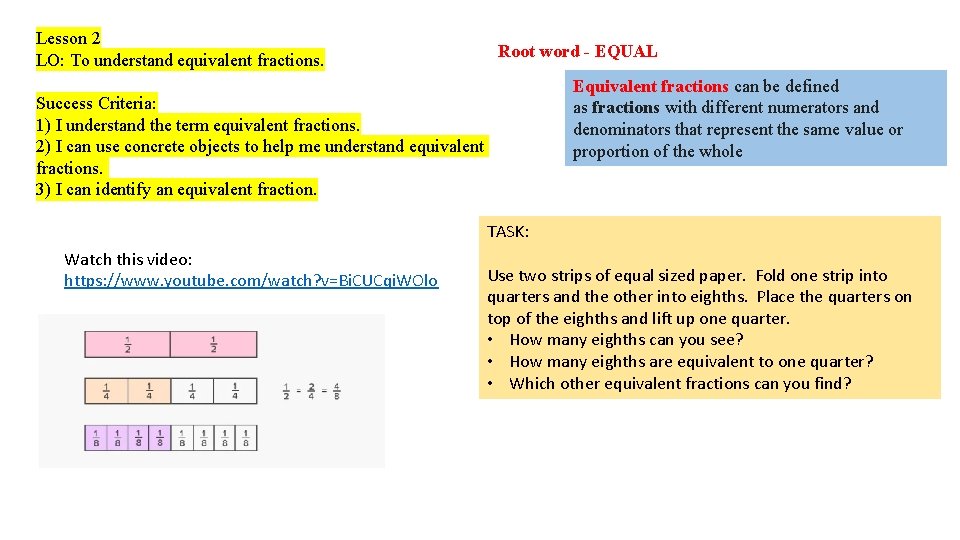
Lesson 2 LO: To understand equivalent fractions. Root word - EQUAL Success Criteria: 1) I understand the term equivalent fractions. 2) I can use concrete objects to help me understand equivalent fractions. 3) I can identify an equivalent fraction. Equivalent fractions can be defined as fractions with different numerators and denominators that represent the same value or proportion of the whole TASK: Watch this video: https: //www. youtube. com/watch? v=Bi. CUCqi. WOlo Use two strips of equal sized paper. Fold one strip into quarters and the other into eighths. Place the quarters on top of the eighths and lift up one quarter. • How many eighths can you see? • How many eighths are equivalent to one quarter? • Which other equivalent fractions can you find?
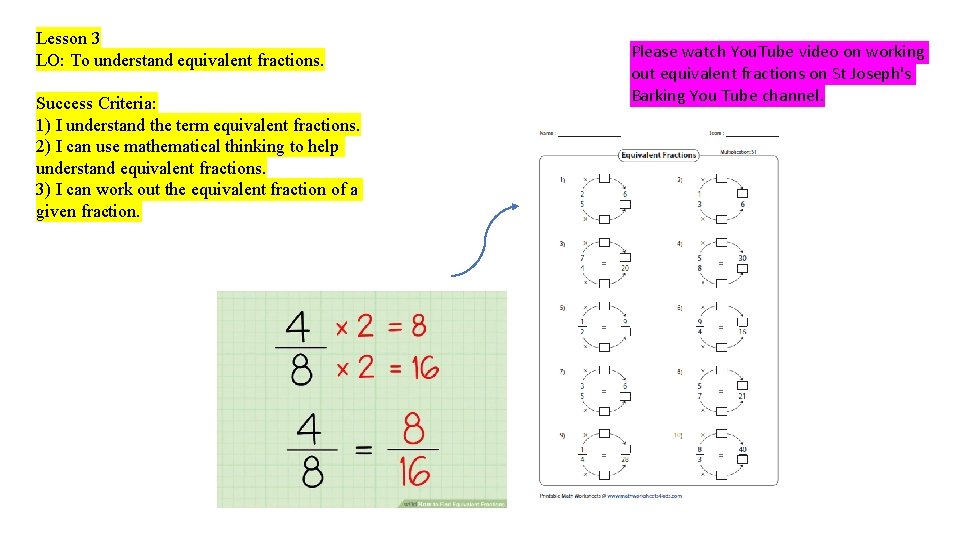
Lesson 3 LO: To understand equivalent fractions. Success Criteria: 1) I understand the term equivalent fractions. 2) I can use mathematical thinking to help understand equivalent fractions. 3) I can work out the equivalent fraction of a given fraction. Please watch You. Tube video on working out equivalent fractions on St Joseph's Barking You Tube channel.
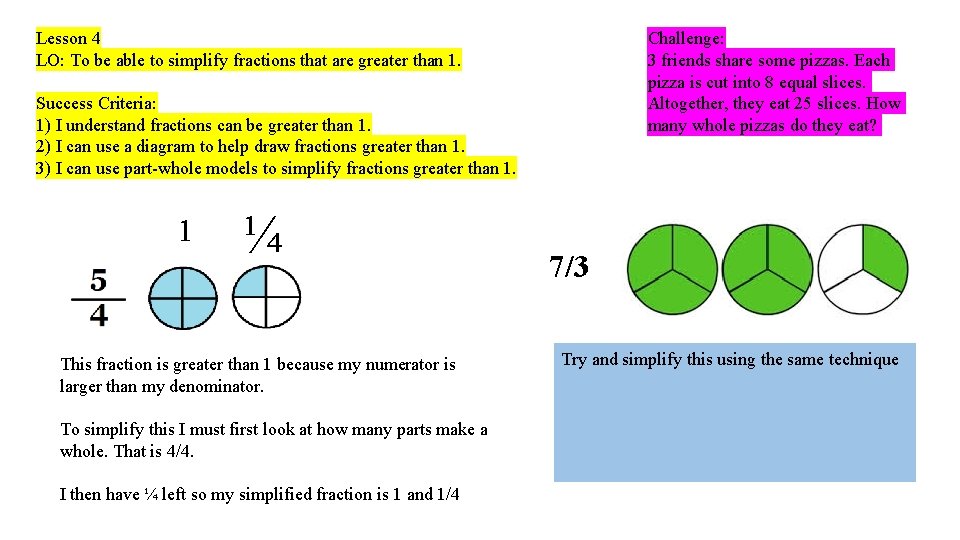
Lesson 4 LO: To be able to simplify fractions that are greater than 1. Challenge: 3 friends share some pizzas. Each pizza is cut into 8 equal slices. Altogether, they eat 25 slices. How many whole pizzas do they eat? Success Criteria: 1) I understand fractions can be greater than 1. 2) I can use a diagram to help draw fractions greater than 1. 3) I can use part-whole models to simplify fractions greater than 1. 1 ¼ This fraction is greater than 1 because my numerator is larger than my denominator. To simplify this I must first look at how many parts make a whole. That is 4/4. I then have ¼ left so my simplified fraction is 1 and 1/4 7/3 Try and simplify this using the same technique