
Lesson 1 Lesson Objectives Understand the terms wave
Lesson 1 Lesson Objectives • Understand the terms ‘wave’ and ‘wave motion’
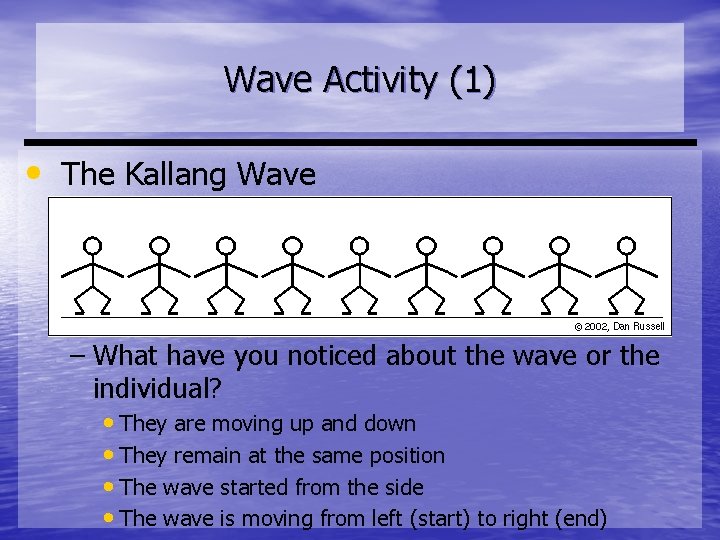
Wave Activity (1) • The Kallang Wave – What have you noticed about the wave or the individual? • They are moving up and down • They remain at the same position • The wave started from the side • The wave is moving from left (start) to right (end)
What have we gathered… • A wave is created… – By a vibration or oscillation • A wave is the… – Spreading of disturbance from one point to another
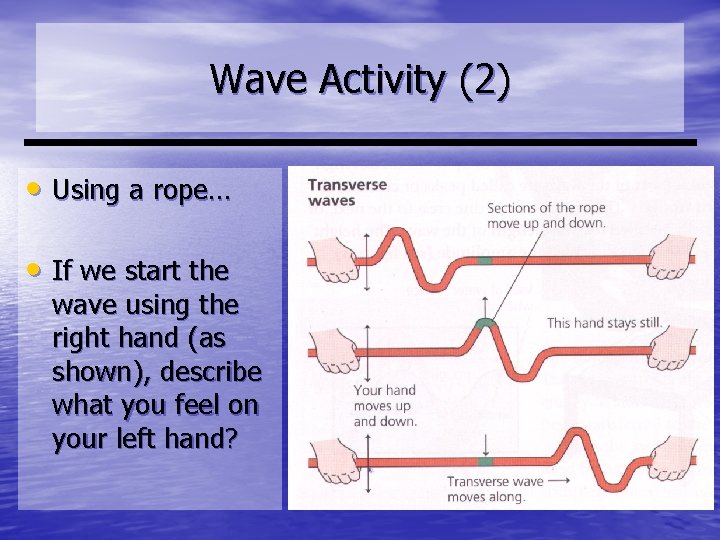
Wave Activity (2) • Using a rope… • If we start the wave using the right hand (as shown), describe what you feel on your left hand?
What have we gathered… • Do you feel this is on left hand? – A force from the rope, trying to move the left hand up and down together the wave… • How can we explain this? – The wave motion is a mechanism for the transfer of energy from one point to another (Without the transfer of the medium)
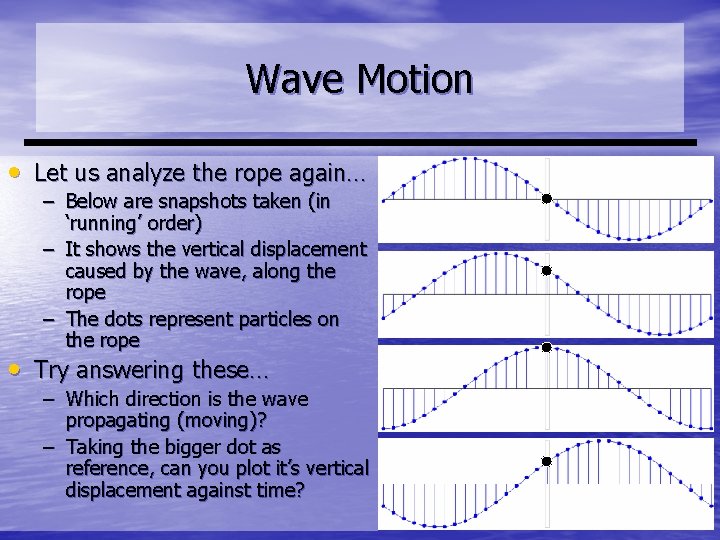
Wave Motion • Let us analyze the rope again… – Below are snapshots taken (in ‘running’ order) – It shows the vertical displacement caused by the wave, along the rope – The dots represent particles on the rope • Try answering these… – Which direction is the wave propagating (moving)? – Taking the bigger dot as reference, can you plot it’s vertical displacement against time?
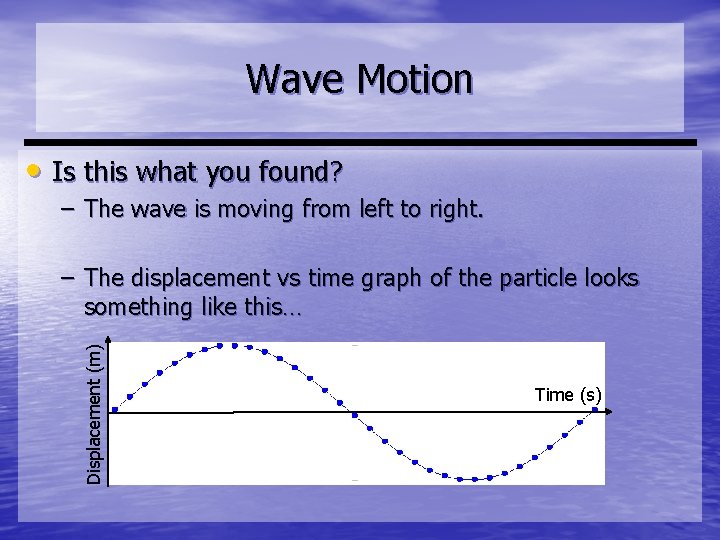
Wave Motion • Is this what you found? – The wave is moving from left to right. Displacement (m) – The displacement vs time graph of the particle looks something like this… Time (s)
Questions? • Self Check – From the waveform, can I Identify the wave motion and direction?
Lesson 2 Lesson Objectives • Identifying the transverse wave – Its Properties
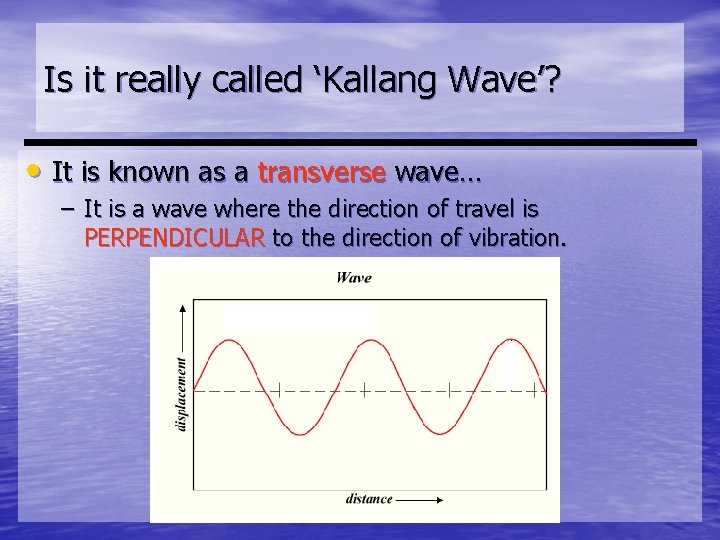
Is it really called ‘Kallang Wave’? • It is known as a transverse wave… – It is a wave where the direction of travel is PERPENDICULAR to the direction of vibration.
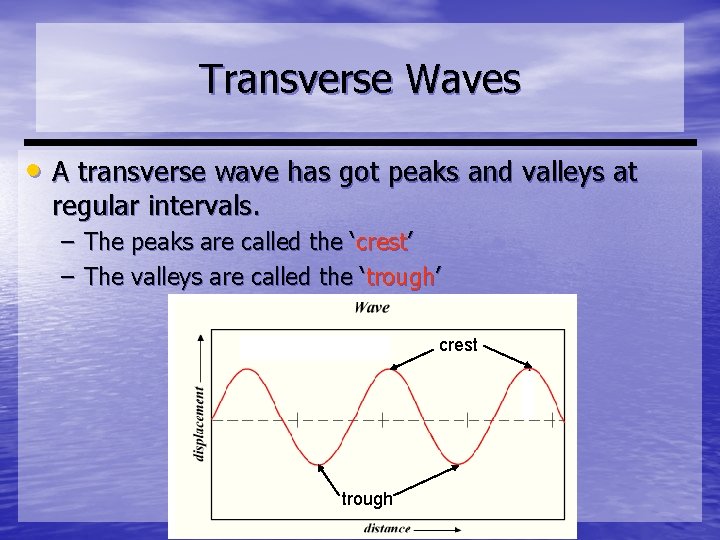
Transverse Waves • A transverse wave has got peaks and valleys at regular intervals. – The peaks are called the ‘crest’ – The valleys are called the ‘trough’ crest trough

Is that all? NO ! • Apart from understanding the wave, the wave motion, we must also be able to read, analyze and even draw the waveform. • We are also required to understand interpret the following terms used. Eg: • Amplitude • Phase • Wavelength • Frequency • Period • Wave Speed
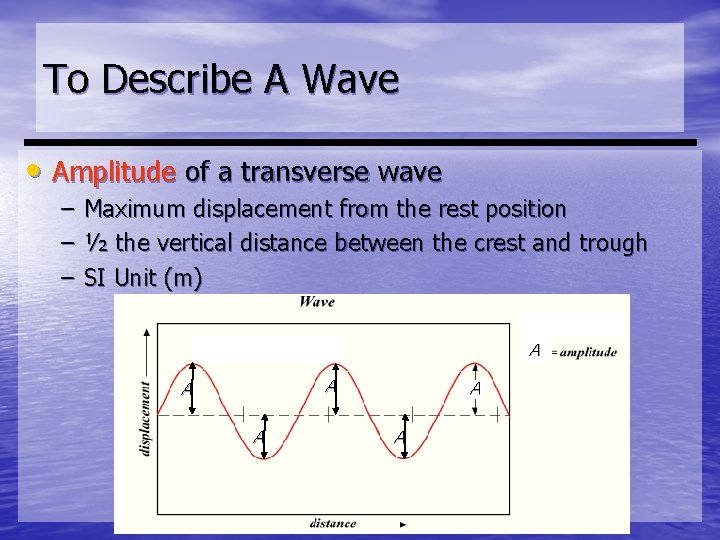
To Describe A Wave • Amplitude of a transverse wave – – – Maximum displacement from the rest position ½ the vertical distance between the crest and trough SI Unit (m) A A A
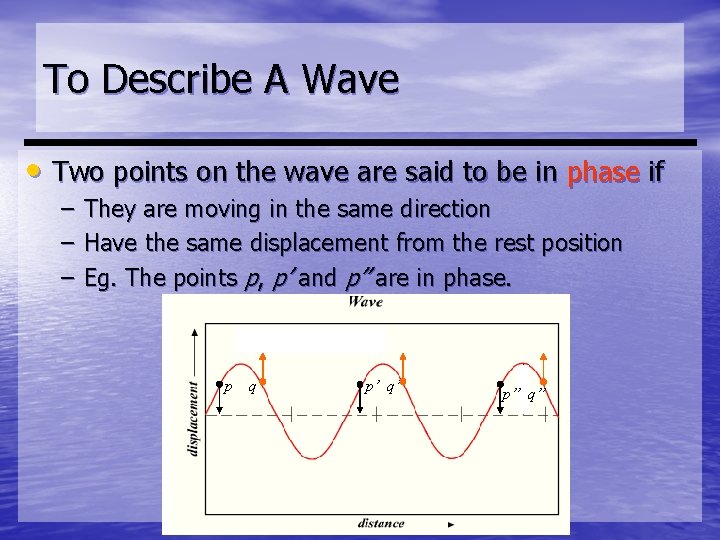
To Describe A Wave • Two points on the wave are said to be in phase if – – – They are moving in the same direction Have the same displacement from the rest position Eg. The points p, p’ and p” are in phase. p q p’ q’ p” q”

To Describe A Wave • Wavelength, – Distance between 2 successive crests or troughs – Shortest distance between any 2 points that are in phase – SI Unit (m)
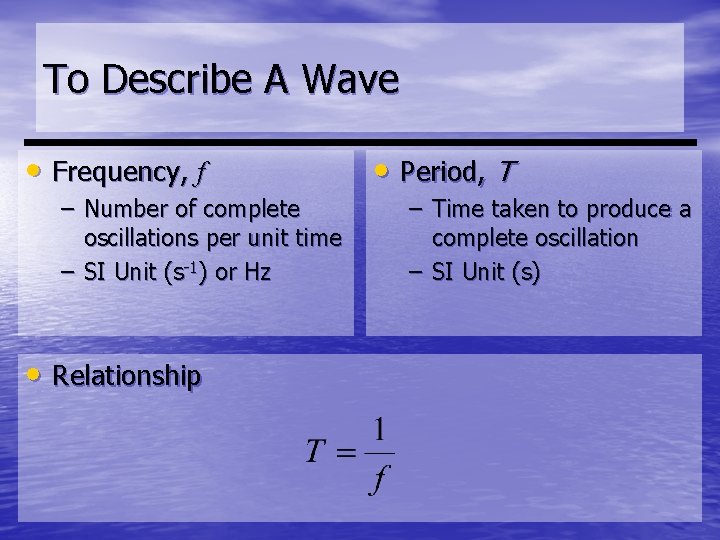
To Describe A Wave • Frequency, f – Number of complete oscillations per unit time – SI Unit (s-1) or Hz • Relationship • Period, T – Time taken to produce a complete oscillation – SI Unit (s)
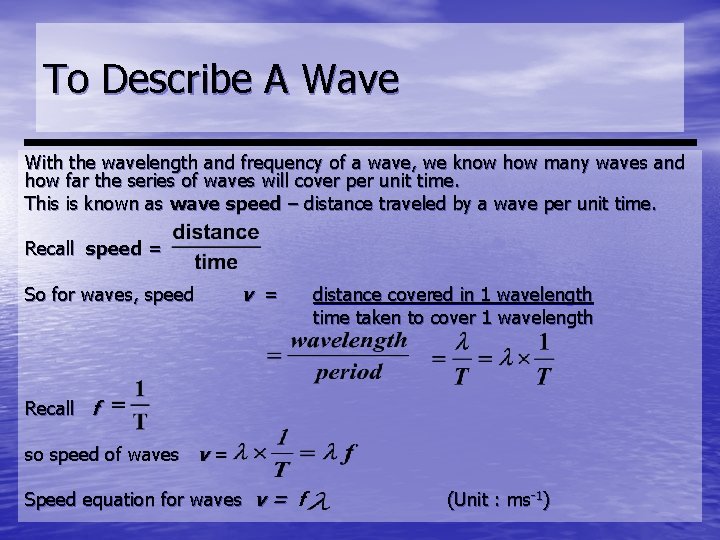
To Describe A Wave With the wavelength and frequency of a wave, we know how many waves and how far the series of waves will cover per unit time. This is known as wave speed – distance traveled by a wave per unit time. Recall speed = So for waves, speed v = distance covered in 1 wavelength time taken to cover 1 wavelength Recall f so speed of waves v = Speed equation for waves v = f (Unit : ms-1)
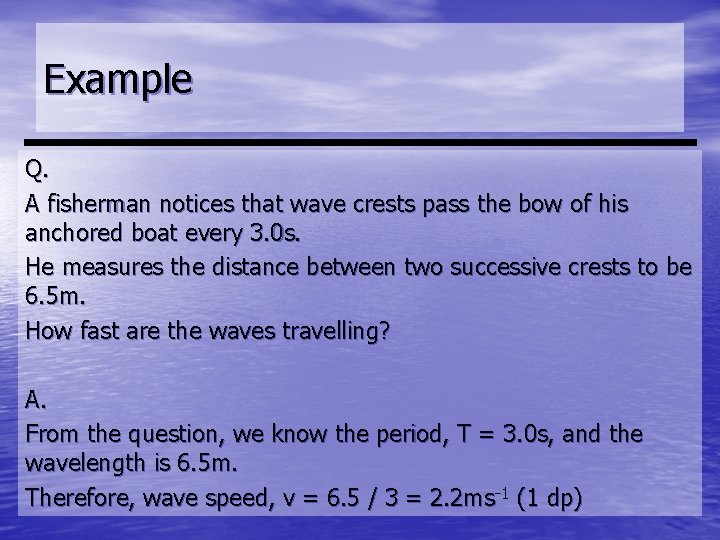
Example Q. A fisherman notices that wave crests pass the bow of his anchored boat every 3. 0 s. He measures the distance between two successive crests to be 6. 5 m. How fast are the waves travelling? A. From the question, we know the period, T = 3. 0 s, and the wavelength is 6. 5 m. Therefore, wave speed, v = 6. 5 / 3 = 2. 2 ms-1 (1 dp)
Transverse Waves • Examples of transverse waves – Water Waves – Electromagnetic Waves
Questions? • Self Check – – – What are the properties I learnt? What do each property tell me about the wave? How many properties do I need to draw a waveform? How many properties can I identify given the waveform? Name some transverse waves.
Lesson 3 Lesson Objectives • The phenomenon called ‘wavefront’ • Introduction to Longitudinal Wave
Lunch Time Prelude… • Using a pail or basin with a large surface area… – Try tapping your finger on the calm water surface – What do you notice? • Do you see ‘circular’ waves being formed? • What is this imaginary ‘circular’ line we see?
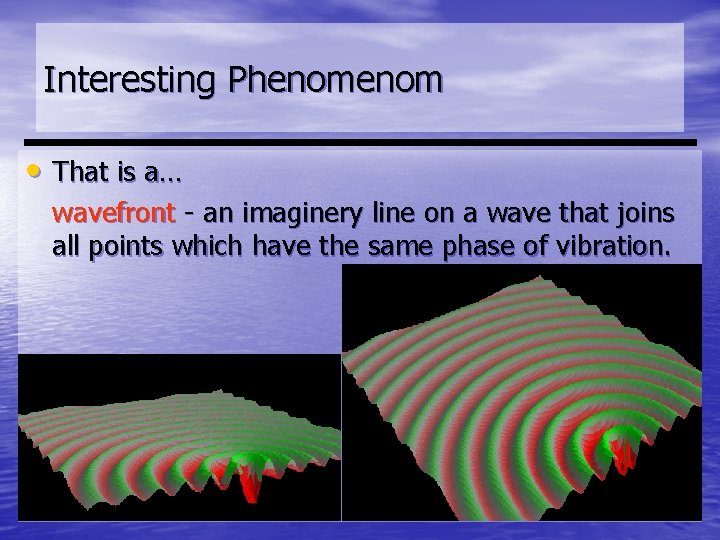
Interesting Phenom • That is a… wavefront - an imaginery line on a wave that joins all points which have the same phase of vibration.
The other type of wave called… … Longitudinal Wave… • What is a longitudinal wave? – A wave where the direction of travel is parallel to the direction of vibration.
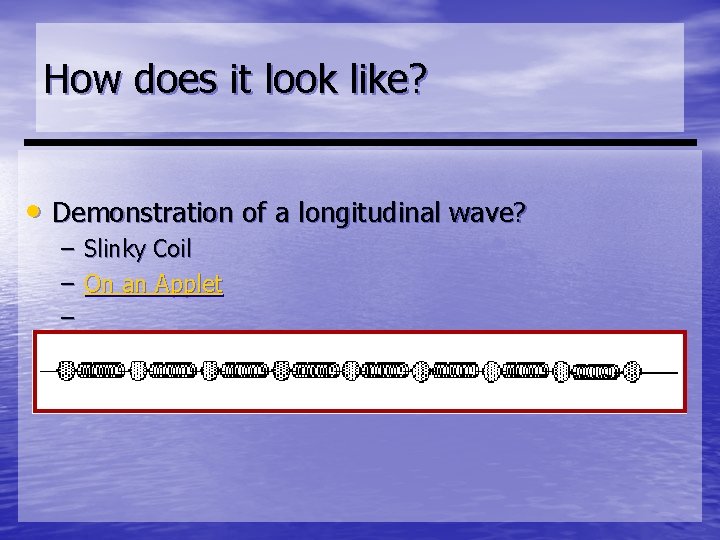
How does it look like? • Demonstration of a longitudinal wave? – Slinky Coil – On an Applet –
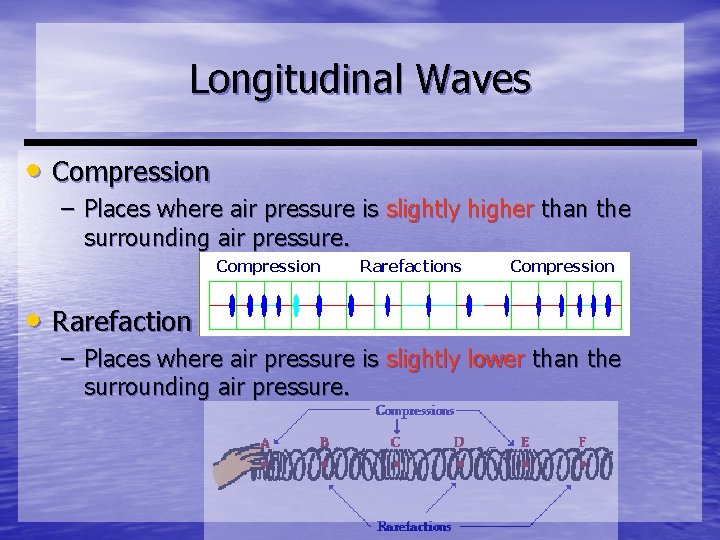
Longitudinal Waves • Compression – Places where air pressure is slightly higher than the surrounding air pressure. Compression Rarefactions Compression • Rarefaction – Places where air pressure is slightly lower than the surrounding air pressure.
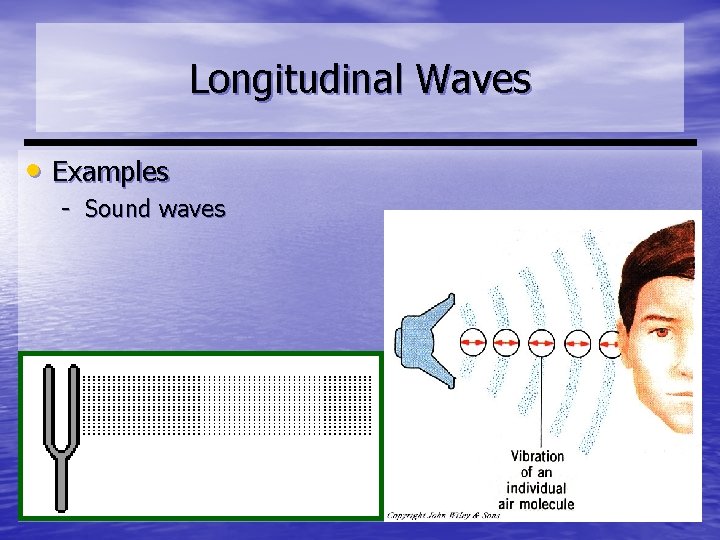
Longitudinal Waves • Examples - Sound waves
Longitudinal Waves • In your pairs now… – How would you determine the wavelength, period, and frequency of a longitudinal wave? – Is there an amplitude in this case?
Example Q. A sound wave in air has a frequency of 262 Hz and travels with a speed of 343 m/s. How far apart are the wave compressions? A. Given f = 262 Hz and v = 343 m/s, Distance between wave compression = wavelength = v / f = 1. 3 m (1 dp)
Questions? • Self Check – What is a longitudinal wave? – How do we determine the different properties of this wave? – Can you list down some of the similarities and differences between the 2 types of waves?
Lesson 4 Lesson Objectives • Summarize what we have learnt so far • To differentiate between a transverse and longitudinal wave • To explain the stroboscope demonstration in terms of frequency and phase
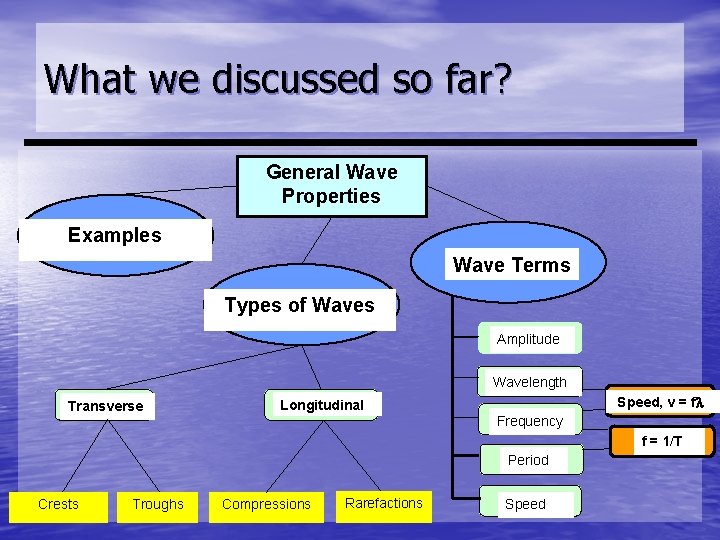
What we discussed so far? General Wave Properties Examples Wave Terms Types of Waves Amplitude Wavelength Transverse Speed, v = fl Longitudinal Frequency f = 1/T Period Crests Troughs Compressions Rarefactions Speed
Transverse Vs Longitudinal Waves • Similarities – Created by a source of vibration or oscillation – The spreading of disturbance from one point to another • Differences – Different direction of travel
Stroboscope and its Frequency (Optional) In our demonstration, we shone the stroboscope on the ceiling fan, and noticed 3 different situations. In the 1 st case, with a suitable frequency on the stroboscope, the fan blade appears to be stationary. In the 2 nd case, by lowering the frequency of the stroboscope, the fan now appears to be turning anticlockwise (forward). Lastly, by increasing the frequency of the stroboscope, the fan blade appears to be turning clockwise (backwards). What actually happened?
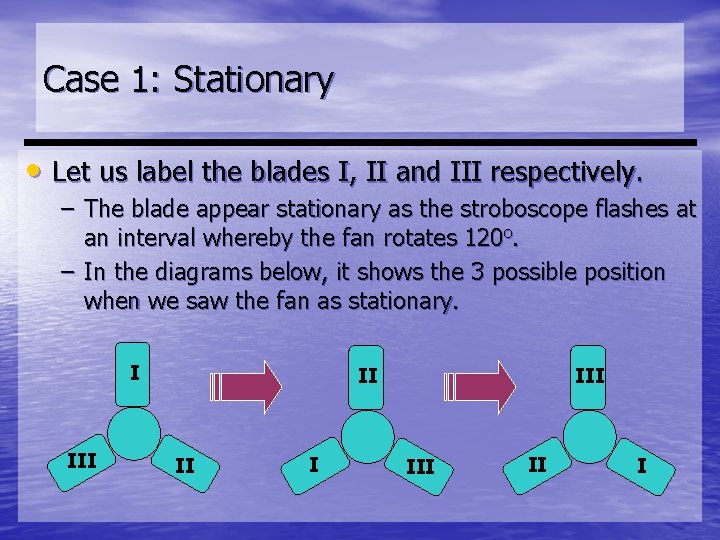
Case 1: Stationary • Let us label the blades I, II and III respectively. – The blade appear stationary as the stroboscope flashes at an interval whereby the fan rotates 120 o. – In the diagrams below, it shows the 3 possible position when we saw the fan as stationary. I II III II I
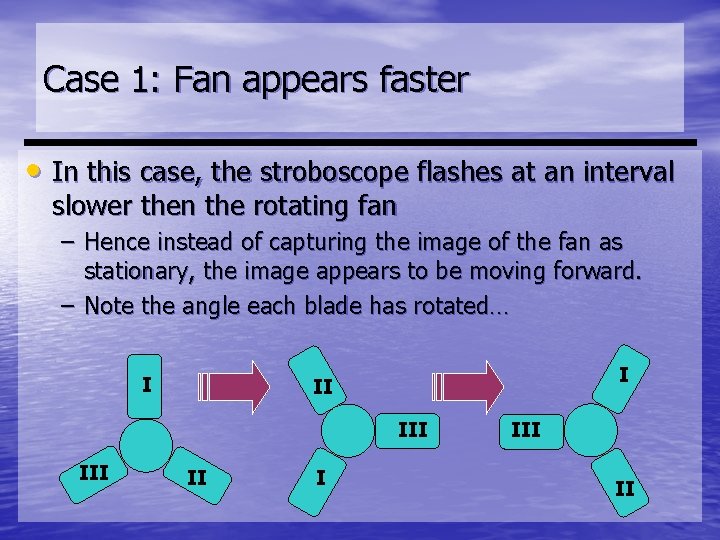
Case 1: Fan appears faster • In this case, the stroboscope flashes at an interval slower then the rotating fan – Hence instead of capturing the image of the fan as stationary, the image appears to be moving forward. – Note the angle each blade has rotated… I I II III II
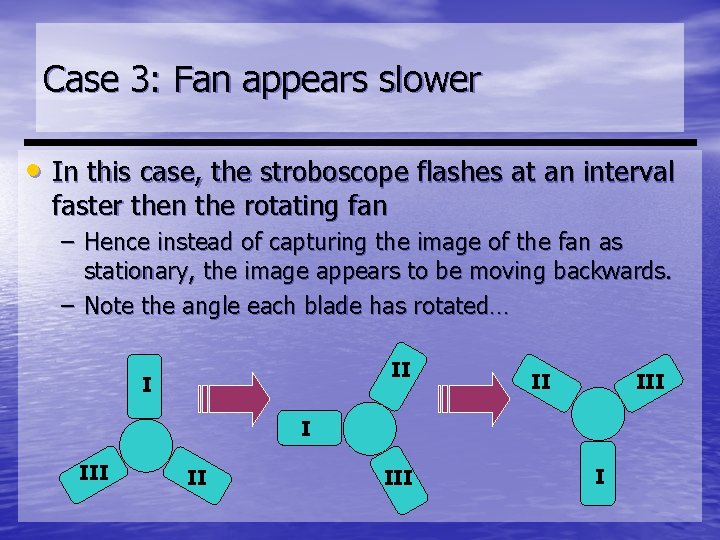
Case 3: Fan appears slower • In this case, the stroboscope flashes at an interval faster then the rotating fan – Hence instead of capturing the image of the fan as stationary, the image appears to be moving backwards. – Note the angle each blade has rotated… II III I
What does it mean? • When 2 points are in phase, they appear to be in ‘sync’ (do not use this in test or exams) • Similarly, the idea is like soldiers marching.
Questions? • Self Check – Make a comparison between the transverse and longitudinal wave? – What can you infer from the stroboscope regarding the term ‘phase’?
Lesson 5 Lesson Objectives • To observe the production of different waves pattern • Understand what happens when the speed of a wave reduces • To see and understand what happens when waves are reflected • To see and understand what happens when waves are refracted
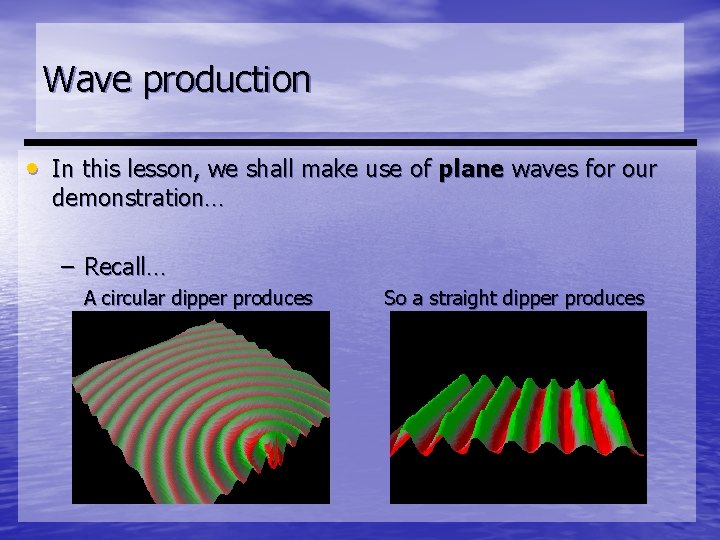
Wave production • In this lesson, we shall make use of plane waves for our demonstration… – Recall… A circular dipper produces So a straight dipper produces
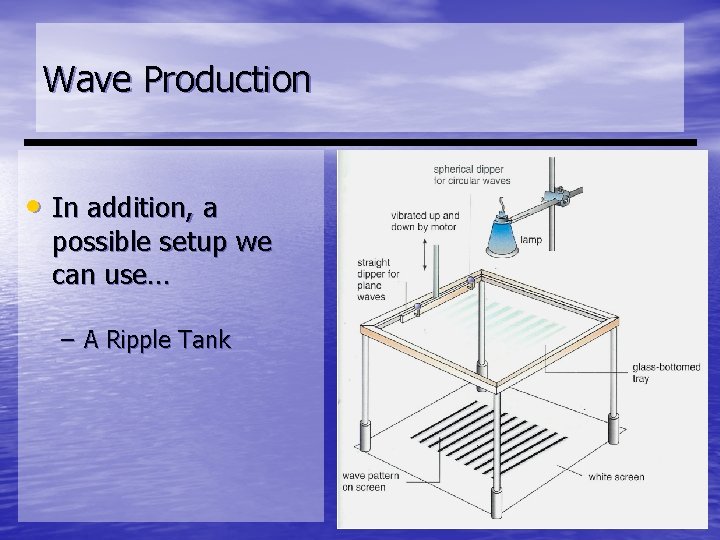
Wave Production • In addition, a possible setup we can use… – A Ripple Tank
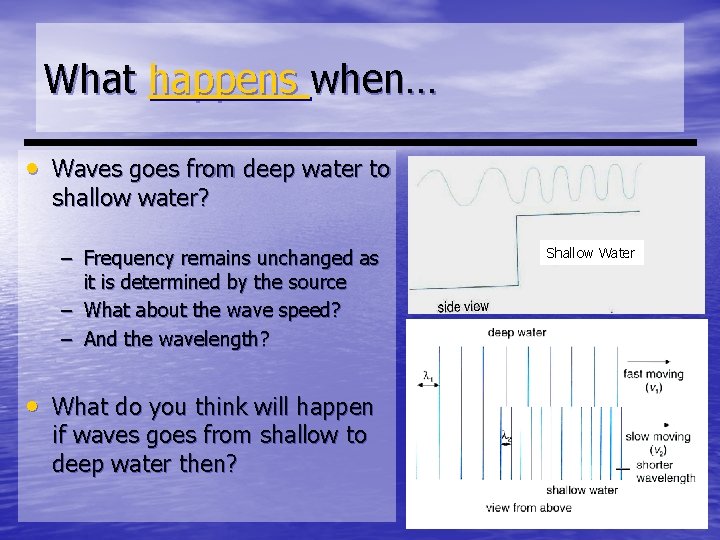
What happens when… • Waves goes from deep water to shallow water? – Frequency remains unchanged as it is determined by the source – What about the wave speed? – And the wavelength? • What do you think will happen if waves goes from shallow to deep water then? Shallow Water
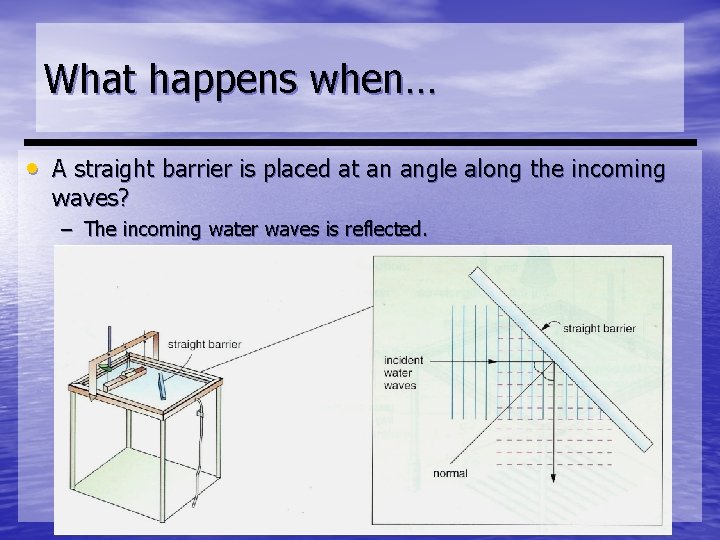
What happens when… • A straight barrier is placed at an angle along the incoming waves? – The incoming water waves is reflected.
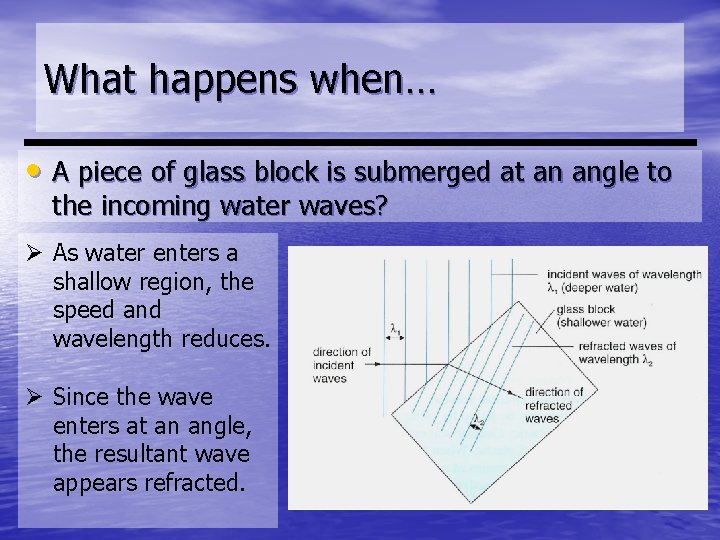
What happens when… • A piece of glass block is submerged at an angle to the incoming water waves? Ø As water enters a shallow region, the speed and wavelength reduces. Ø Since the wave enters at an angle, the resultant wave appears refracted.
Questions? • Self Check – Can you explain the ‘piling-up’ effect, as in how the tsunami rose to such great heights? – Did the wavelength change during reflection or refraction of water waves?
Lesson 6 Lesson Objectives • Introduction to Electromagnetic Waves for Peer Teaching
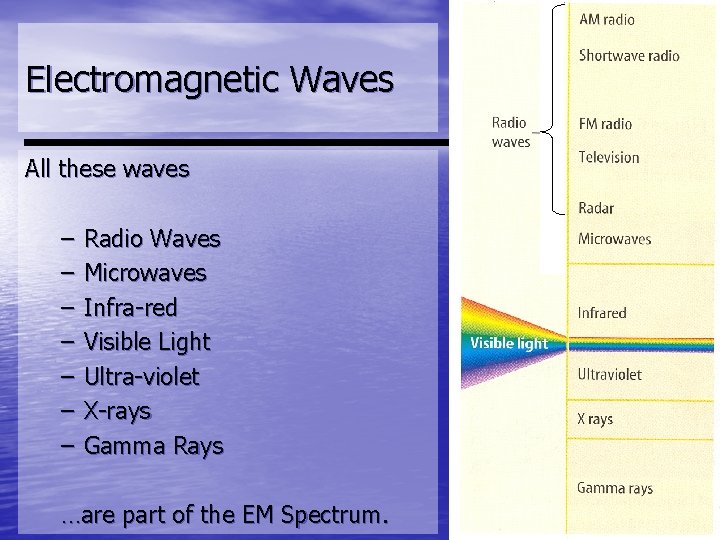
Electromagnetic Waves All these waves – – – – Radio Waves Microwaves Infra-red Visible Light Ultra-violet X-rays Gamma Rays …are part of the EM Spectrum.
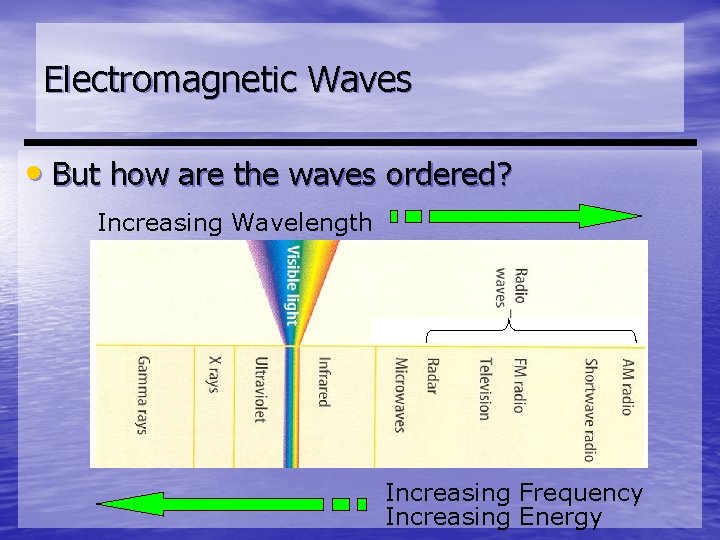
Electromagnetic Waves • But how are the waves ordered? Increasing Wavelength Increasing Frequency Increasing Energy
Electromagnetic Waves • What do EM waves have in common? – – – – – They are all transverse waves. They all travel at a speed of 3 x 10⁸ ms-1 in vacuo. They are all electromagnetic radiation, which can be used to transfer energy. Do not need a medium to propagate. They obey the laws of reflection and refraction. They can be emitted and absorbed by matter. Their frequencies do not change when they enter from one medium to another. The wave equation v=fl is applicable to all these waves. * They carry no charge.
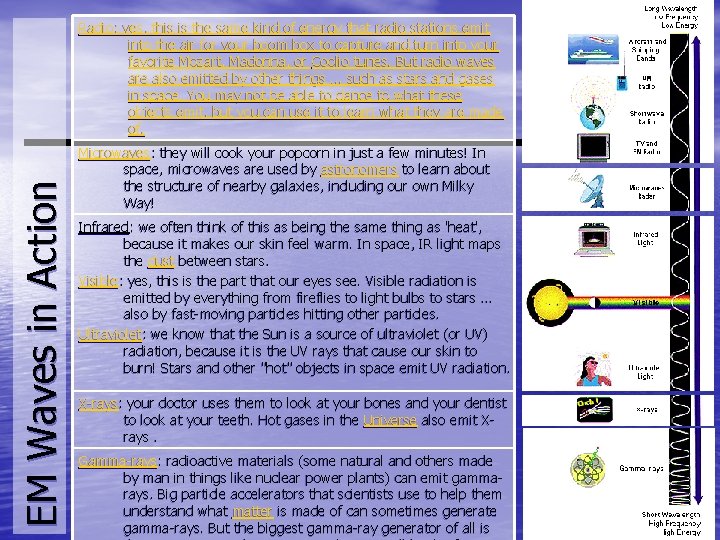
EM Waves in Action Radio: yes, this is the same kind of energy that radio stations emit into the air for your boom box to capture and turn into your favorite Mozart, Madonna, or Coolio tunes. But radio waves are also emitted by other things. . . such as stars and gases in space. You may not be able to dance to what these objects emit, but you can use it to learn what they are made of. Microwaves: they will cook your popcorn in just a few minutes! In space, microwaves are used by astronomers to learn about the structure of nearby galaxies, including our own Milky Way! Infrared: we often think of this as being the same thing as 'heat', because it makes our skin feel warm. In space, IR light maps the dust between stars. Visible: yes, this is the part that our eyes see. Visible radiation is emitted by everything from fireflies to light bulbs to stars. . . also by fast-moving particles hitting other particles. Ultraviolet: we know that the Sun is a source of ultraviolet (or UV) radiation, because it is the UV rays that cause our skin to burn! Stars and other "hot" objects in space emit UV radiation. X-rays: your doctor uses them to look at your bones and your dentist to look at your teeth. Hot gases in the Universe also emit Xrays. Gamma-rays: radioactive materials (some natural and others made by man in things like nuclear power plants) can emit gammarays. Big particle accelerators that scientists use to help them understand what matter is made of can sometimes generate gamma-rays. But the biggest gamma-ray generator of all is
- Slides: 51