
Lesson 1 Introduction to Shakespeare and Macbeth Objective

Lesson 1 Introduction to Shakespeare and Macbeth Objective: to comprehend how context informs the narrative. [Context] Everything that surrounds the subject (time, place, culture, politics, history)
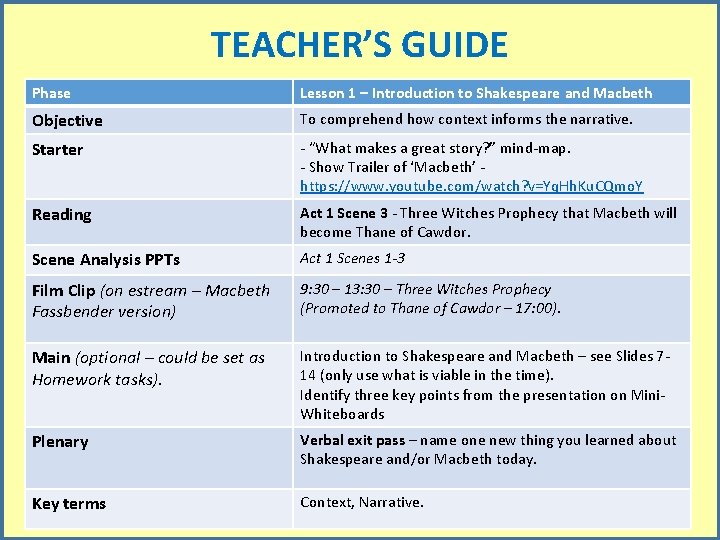
TEACHER’S GUIDE Phase Lesson 1 – Introduction to Shakespeare and Macbeth Objective To comprehend how context informs the narrative. Starter - “What makes a great story? ” mind-map. - Show Trailer of ‘Macbeth’ - https: //www. youtube. com/watch? v=Yq. Hh. Ku. CQmo. Y Reading Act 1 Scene 3 - Three Witches Prophecy that Macbeth will become Thane of Cawdor. Scene Analysis PPTs Act 1 Scenes 1 -3 Film Clip (on estream – Macbeth Fassbender version) 9: 30 – 13: 30 – Three Witches Prophecy (Promoted to Thane of Cawdor – 17: 00). Main (optional – could be set as Homework tasks). Introduction to Shakespeare and Macbeth – see Slides 714 (only use what is viable in the time). Identify three key points from the presentation on Mini. Whiteboards Plenary Verbal exit pass – name one new thing you learned about Shakespeare and/or Macbeth today. Key terms Context, Narrative.
What makes a great story? [5 MINUTE MIND-MAP TASK]
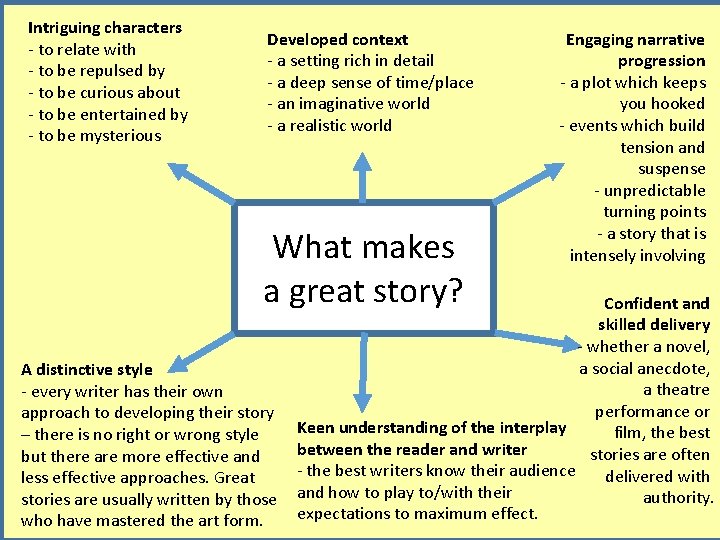
Intriguing characters - to relate with - to be repulsed by - to be curious about - to be entertained by - to be mysterious Developed context - a setting rich in detail - a deep sense of time/place - an imaginative world - a realistic world What makes a great story? Engaging narrative progression - a plot which keeps you hooked - events which build tension and suspense - unpredictable turning points - a story that is intensely involving Confident and skilled delivery - whether a novel, a social anecdote, A distinctive style a theatre - every writer has their own performance or approach to developing their story Keen understanding of the interplay film, the best – there is no right or wrong style between the reader and writer stories are often but there are more effective and - the best writers know their audience delivered with less effective approaches. Great authority. stories are usually written by those and how to play to/with their expectations to maximum effect. who have mastered the art form.
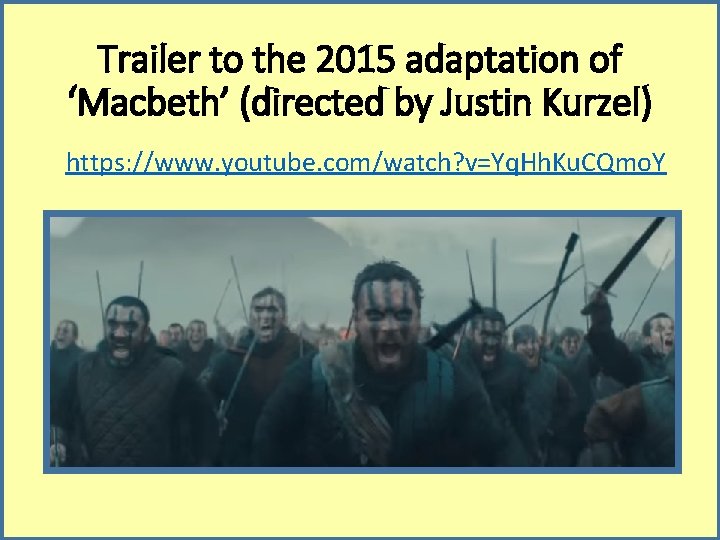
Trailer to the 2015 adaptation of ‘Macbeth’ (directed by Justin Kurzel) https: //www. youtube. com/watch? v=Yq. Hh. Ku. CQmo. Y
THINK – PAIR - SHARE Predict what this story might be about.
CLASS READING Act 1 Scene 3 Prophecy of the Three Witches
Useful research sheets (print out for pupils recommended) Shakespeare Biography and key information. Famous Shakespeare Quotations. Historical Context sheet Symbols relating to each Shakespeare play Character Profiles Scene Analysis: Act 1 Scenes 1 -3 HOMEWORK IDEA Pupils prepare a Power. Point presentation on Shakespeare’s biography, the historical context to ‘Macbeth’ and key features of each character in this tragedy.
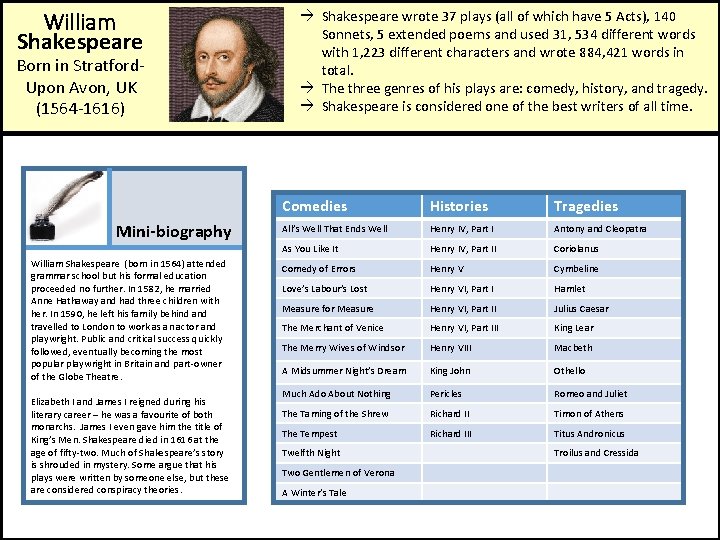
William Shakespeare Born in Stratford. Upon Avon, UK (1564 -1616) Mini-biography William Shakespeare (born in 1564) attended grammar school but his formal education proceeded no further. In 1582, he married Anne Hathaway and had three children with her. In 1590, he left his family behind and travelled to London to work as an actor and playwright. Public and critical success quickly followed, eventually becoming the most popular playwright in Britain and part-owner of the Globe Theatre. Elizabeth I and James I reigned during his literary career – he was a favourite of both monarchs. James I even gave him the title of King’s Men. Shakespeare died in 1616 at the age of fifty-two. Much of Shakespeare’s story is shrouded in mystery. Some argue that his plays were written by someone else, but these are considered conspiracy theories. à Shakespeare wrote 37 plays (all of which have 5 Acts), 140 Sonnets, 5 extended poems and used 31, 534 different words with 1, 223 different characters and wrote 884, 421 words in total. à The three genres of his plays are: comedy, history, and tragedy. à Shakespeare is considered one of the best writers of all time. Comedies Histories Tragedies All’s Well That Ends Well Henry IV, Part I Antony and Cleopatra As You Like It Henry IV, Part II Coriolanus Comedy of Errors Henry V Cymbeline Love’s Labour’s Lost Henry VI, Part I Hamlet Measure for Measure Henry VI, Part II Julius Caesar The Merchant of Venice Henry VI, Part III King Lear The Merry Wives of Windsor Henry VIII Macbeth A Midsummer Night’s Dream King John Othello Much Ado About Nothing Pericles Romeo and Juliet The Taming of the Shrew Richard II Timon of Athens The Tempest Richard III Titus Andronicus Twelfth Night Two Gentlemen of Verona A Winter’s Tale Troilus and Cressida
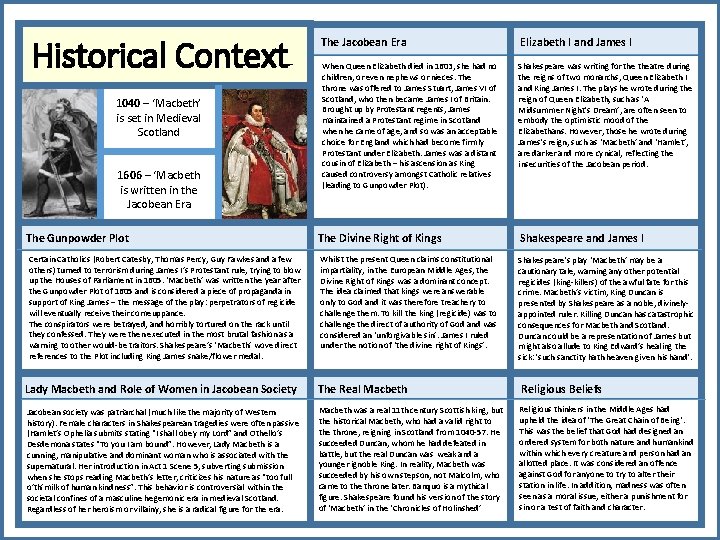
Historical Context 1040 – ‘Macbeth’ is set in Medieval Scotland 1606 – ‘Macbeth is written in the Jacobean Era The Gunpowder Plot Certain Catholics (Robert Catesby, Thomas Percy, Guy Fawkes and a few others) turned to terrorism during James I’s Protestant rule, trying to blow up the Houses of Parliament in 1605. ‘Macbeth’ was written the year after the Gunpowder Plot of 1605 and is considered a piece of propaganda in support of King James – the message of the play: perpetrators of regicide will eventually receive their comeuppance. The conspirators were betrayed, and horribly tortured on the rack until they confessed. They were then executed in the most brutal fashion as a warning to other would-be traitors. Shakespeare’s ‘Macbeth’ wove direct references to the Plot including King James snake/flower medal. The Jacobean Era Elizabeth I and James I When Queen Elizabeth died in 1603, she had no children, or even nephews or nieces. The throne was offered to James Stuart, James VI of Scotland, who then became James I of Britain. Brought up by Protestant regents, James maintained a Protestant regime in Scotland when he came of age, and so was an acceptable choice for England which had become firmly Protestant under Elizabeth. James was a distant cousin of Elizabeth – his ascension as King caused controversy amongst Catholic relatives (leading to Gunpowder Plot). Shakespeare was writing for theatre during the reigns of two monarchs, Queen Elizabeth I and King James I. The plays he wrote during the reign of Queen Elizabeth, such as ‘A Midsummer Night's Dream’, are often seen to embody the optimistic mood of the Elizabethans. However, those he wrote during James's reign, such as ‘Macbeth’ and ‘Hamlet’, are darker and more cynical, reflecting the insecurities of the Jacobean period. The Divine Right of Kings Shakespeare and James I Whilst the present Queen claims constitutional impartiality, in the European Middle Ages, the Divine Right of Kings was a dominant concept. The idea claimed that kings were answerable only to God and it was therefore treachery to challenge them. To kill the king (regicide) was to challenge the direct of authority of God and was considered an ‘unforgivable sin’. James I ruled under the notion of ‘the divine right of Kings’. Shakespeare's play ‘Macbeth’ may be a cautionary tale, warning any other potential regicides (king-killers) of the awful fate for this crime. Macbeth’s victim, King Duncan is presented by Shakespeare as a noble, divinelyappointed ruler. Killing Duncan has catastrophic consequences for Macbeth and Scotland. Duncan could be a representation of James but might also allude to King Edward’s healing the sick: 'such sanctity hath heaven given his hand'. Lady Macbeth and Role of Women in Jacobean Society The Real Macbeth Religious Beliefs Jacobean society was patriarchal (much like the majority of Western history). Female characters in Shakespearean tragedies were often passive (Hamlet’s Ophelia submits stating “I shall obey my Lord” and Othello’s Desdemona states “To you I am bound”. However, Lady Macbeth is a cunning, manipulative and dominant woman who is associated with the supernatural. Her introduction in Act 1 Scene 5, subverting submission when she stops reading Macbeth’s letter, criticizes his nature as “too full o’th’milk of human kindness”. This behavior is controversial within the societal confines of a masculine hegemonic era in medieval Scotland. Regardless of heroism or villainy, she is a radical figure for the era. Macbeth was a real 11 th century Scottish king, but the historical Macbeth, who had a valid right to the throne, reigning in Scotland from 1040 -57. He succeeded Duncan, whom he had defeated in battle, but the real Duncan was weak and a younger ignoble King. In reality, Macbeth was succeeded by his own stepson, not Malcolm, who came to the throne later. Banquo is a mythical figure. Shakespeare found his version of the story of ‘Macbeth’ in the ‘Chronicles of Holinshed’ Religious thinkers in the Middle Ages had upheld the idea of 'The Great Chain of Being'. This was the belief that God had designed an ordered system for both nature and humankind within which every creature and person had an allotted place. It was considered an offence against God for anyone to try to alter their station in life. In addition, madness was often seen as a moral issue, either a punishment for sin or a test of faith and character.
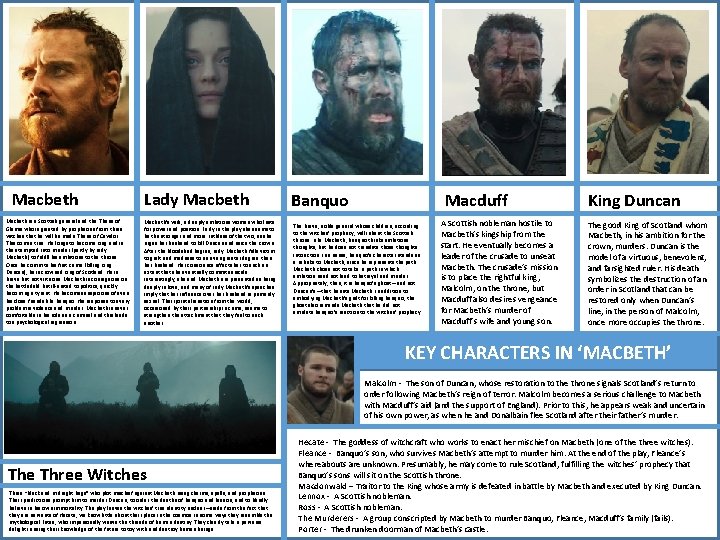
Macbeth is a Scottish general and the Thane of Glamis who is greeted by prophecies from three witches that he will be made Thane of Cawdor. This comes true. He longs to become King and is then tempted into murder (partly by Lady Macbeth) to fulfill his ambitions to the throne. Once he commits his first crime (killing King Duncan), he is crowned King of Scotland. He is brave but not virtuous. Macbeth is courageous on the battlefield but ill-suited to politics, quickly becoming a tyrant. He becomes suspicious of even his close friends like Banquo. His response to every problem is violence and murder. Macbeth is never comfortable in his role as a criminal and this leads to a psychological regression. Lady Macbeth’s wife, a deeply ambitious woman who lusts for power and position. Early in the play she seems to be the stronger and more ruthless of the two, as she urges her husband to kill Duncan and seize the crown. After the bloodshed begins, Lady Macbeth falls victim to guilt and madness to an even greater degree than her husband. Her conscience affects her to such an extent that she eventually commits suicide. Interestingly, she and Macbeth are presented as being deeply in love, and many of Lady Macbeth’s speeches imply that her influence over husband is primarily sexual. Their joint alienation from the world, occasioned by their partnership in crime, seems to strengthen the attachment that they feel to each another. Banquo Macduff The brave, noble general whose children, according to the witches’ prophecy, will inherit the Scottish throne. Like Macbeth, Banquo thinks ambitious thoughts, but he does not translate those thoughts into action. In a sense, Banquo’s character stands as a rebuke to Macbeth, since he represents the path Macbeth chose not to take: a path in which ambition need not lead to betrayal and murder. Appropriately, then, it is Banquo’s ghost—and not Duncan’s—that haunts Macbeth. In addition to embodying Macbeth’s guilt for killing Banquo, the ghost also reminds Macbeth that he did not emulate Banquo’s reaction to the witches’ prophecy. A Scottish nobleman hostile to Macbeth’s kingship from the start. He eventually becomes a leader of the crusade to unseat Macbeth. The crusade’s mission is to place the rightful king, Malcolm, on the throne, but Macduff also desires vengeance for Macbeth’s murder of Macduff’s wife and young son. King Duncan The good King of Scotland whom Macbeth, in his ambition for the crown, murders. Duncan is the model of a virtuous, benevolent, and farsighted ruler. His death symbolizes the destruction of an order in Scotland that can be restored only when Duncan’s line, in the person of Malcolm, once more occupies the throne. KEY CHARACTERS IN ‘MACBETH’ Malcolm - The son of Duncan, whose restoration to the throne signals Scotland’s return to order following Macbeth’s reign of terror. Malcolm becomes a serious challenge to Macbeth with Macduff’s aid (and the support of England). Prior to this, he appears weak and uncertain of his own power, as when he and Donalbain flee Scotland after their father’s murder. The Three Witches Three “black and midnight hags” who plot mischief against Macbeth using charms, spells, and prophecies. Their predictions prompt him to murder Duncan, to order the deaths of Banquo and his son, and to blindly believe in his own immortality. The play leaves the witches’ true identity unclear—aside from the fact that they are servants of Hecate, we know little about their place in the cosmos. In some ways they resemble the mythological Fates, who impersonally weave threads of human destiny. They clearly take a perverse delight in using their knowledge of the future to toy with and destroy human beings. Hecate - The goddess of witchcraft who works to enact her mischief on Macbeth (one of the three witches). Fleance - Banquo’s son, who survives Macbeth’s attempt to murder him. At the end of the play, Fleance’s whereabouts are unknown. Presumably, he may come to rule Scotland, fulfilling the witches’ prophecy that Banquo’s sons will sit on the Scottish throne. Macdonwald – Traitor to the King whose army is defeated in battle by Macbeth and executed by King Duncan. Lennox - A Scottish nobleman. Ross - A Scottish nobleman. The Murderers - A group conscripted by Macbeth to murder Banquo, Fleance, Macduff’s family (fails). Porter - The drunken doorman of Macbeth’s castle.
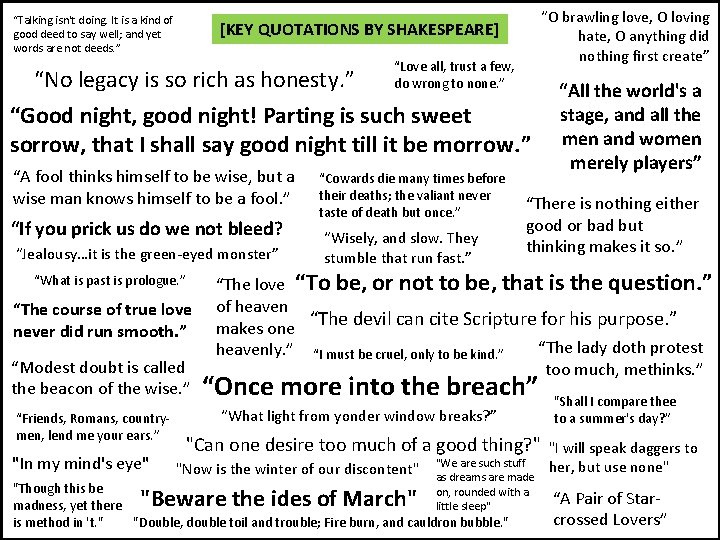
“Talking isn't doing. It is a kind of good deed to say well; and yet words are not deeds. ” “O brawling love, O loving hate, O anything did nothing first create” [KEY QUOTATIONS BY SHAKESPEARE] “No legacy is so rich as honesty. ” “Love all, trust a few, do wrong to none. ” “Good night, good night! Parting is such sweet sorrow, that I shall say good night till it be morrow. ” “A fool thinks himself to be wise, but a wise man knows himself to be a fool. ” “If you prick us do we not bleed? “Jealousy…it is the green-eyed monster” “What is past is prologue. ” “The course of true love never did run smooth. ” “Modest doubt is called the beacon of the wise. ” “Friends, Romans, countrymen, lend me your ears. ” "In my mind's eye" “Cowards die many times before their deaths; the valiant never taste of death but once. ” “Wisely, and slow. They stumble that run fast. ” “All the world's a stage, and all the men and women merely players” “There is nothing either good or bad but thinking makes it so. ” “The love “To be, or not to be, that is the question. ” of heaven makes one “The devil can cite Scripture for his purpose. ” “The lady doth protest heavenly. ” “I must be cruel, only to be kind. ” too much, methinks. ” “Once more into the breach” “What light from yonder window breaks? ” "Can one desire too much of a good thing? " "Now is the winter of our discontent" "We are such stuff as dreams are made on, rounded with a little sleep" "Though this be madness, yet there "Double, double toil and trouble; Fire burn, and cauldron bubble. " is method in 't. " "Beware the ides of March" "Shall I compare thee to a summer's day? ” "I will speak daggers to her, but use none" “A Pair of Starcrossed Lovers”
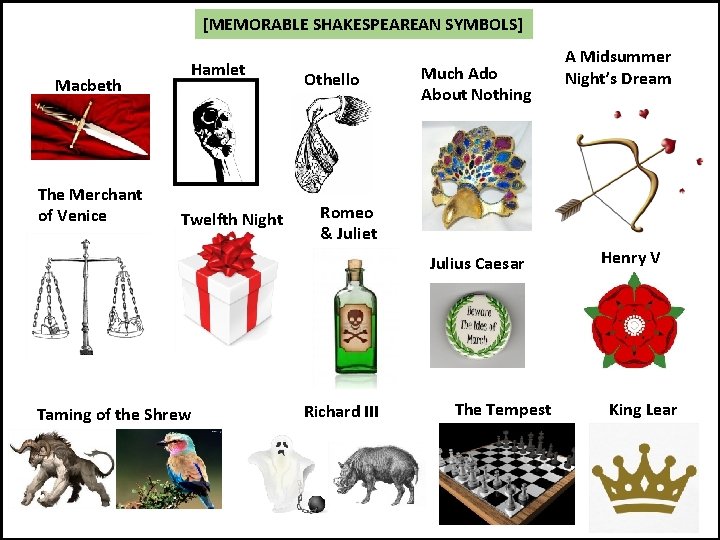
[MEMORABLE SHAKESPEAREAN SYMBOLS] Hamlet Macbeth The Merchant of Venice Twelfth Night Othello Much Ado About Nothing Romeo & Juliet Julius Caesar Taming of the Shrew A Midsummer Night’s Dream Richard III The Tempest Henry V King Lear
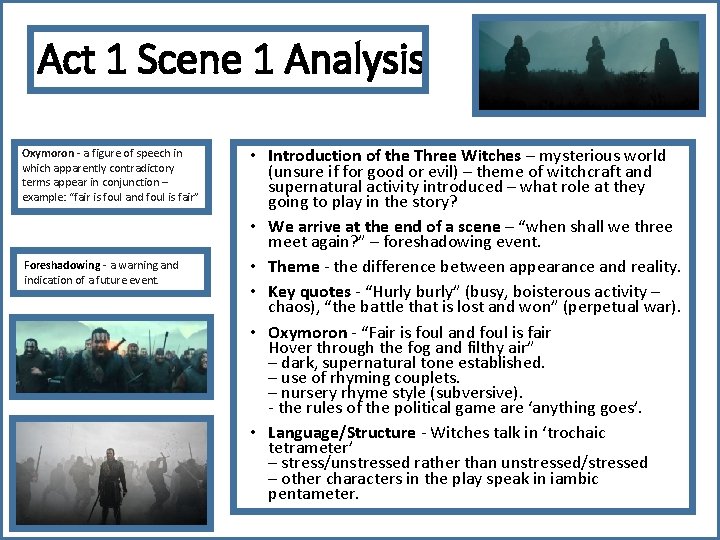
Act 1 Scene 1 Analysis Oxymoron - a figure of speech in which apparently contradictory terms appear in conjunction – example: “fair is foul and foul is fair” Foreshadowing - a warning and indication of a future event. • Introduction of the Three Witches – mysterious world (unsure if for good or evil) – theme of witchcraft and supernatural activity introduced – what role at they going to play in the story? • We arrive at the end of a scene – “when shall we three meet again? ” – foreshadowing event. • Theme - the difference between appearance and reality. • Key quotes - “Hurly burly” (busy, boisterous activity – chaos), “the battle that is lost and won” (perpetual war). • Oxymoron - “Fair is foul and foul is fair Hover through the fog and filthy air” – dark, supernatural tone established. – use of rhyming couplets. – nursery rhyme style (subversive). - the rules of the political game are ‘anything goes’. • Language/Structure - Witches talk in ‘trochaic tetrameter’ – stress/unstressed rather than unstressed/stressed – other characters in the play speak in iambic pentameter.
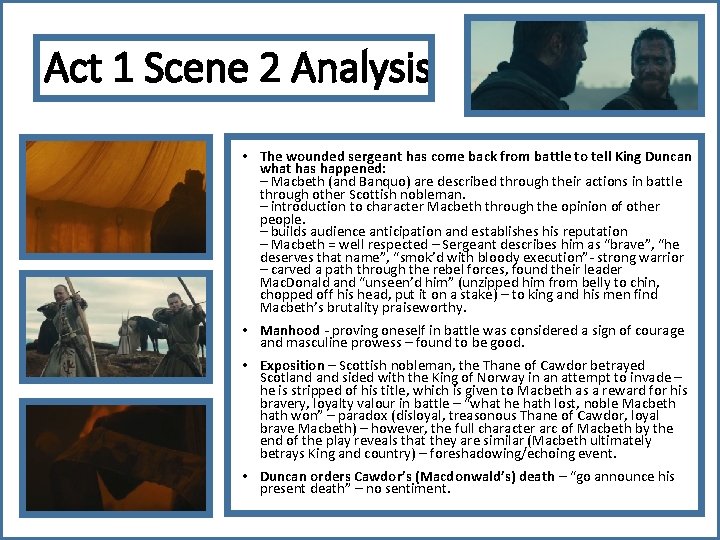
Act 1 Scene 2 Analysis • The wounded sergeant has come back from battle to tell King Duncan what has happened: – Macbeth (and Banquo) are described through their actions in battle through other Scottish nobleman. – introduction to character Macbeth through the opinion of other people. – builds audience anticipation and establishes his reputation – Macbeth = well respected – Sergeant describes him as “brave”, “he deserves that name”, “smok’d with bloody execution”- strong warrior – carved a path through the rebel forces, found their leader Mac. Donald and “unseen’d him” (unzipped him from belly to chin, chopped off his head, put it on a stake) – to king and his men find Macbeth’s brutality praiseworthy. • Manhood - proving oneself in battle was considered a sign of courage and masculine prowess – found to be good. • Exposition – Scottish nobleman, the Thane of Cawdor betrayed Scotland sided with the King of Norway in an attempt to invade – he is stripped of his title, which is given to Macbeth as a reward for his bravery, loyalty valour in battle – “what he hath lost, noble Macbeth hath won” – paradox (disloyal, treasonous Thane of Cawdor, loyal brave Macbeth) – however, the full character arc of Macbeth by the end of the play reveals that they are similar (Macbeth ultimately betrays King and country) – foreshadowing/echoing event. • Duncan orders Cawdor’s (Macdonwald’s) death – “go announce his present death” – no sentiment.
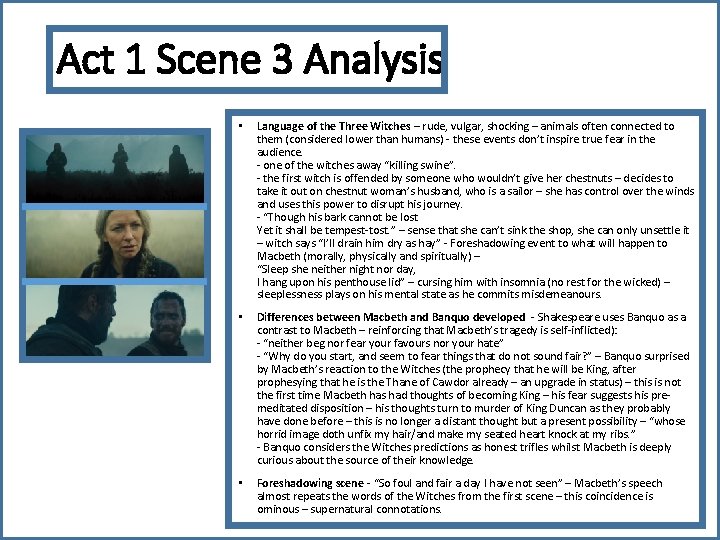
Act 1 Scene 3 Analysis • Language of the Three Witches – rude, vulgar, shocking – animals often connected to them (considered lower than humans) - these events don’t inspire true fear in the audience. - one of the witches away “killing swine”. - the first witch is offended by someone who wouldn’t give her chestnuts – decides to take it out on chestnut woman’s husband, who is a sailor – she has control over the winds and uses this power to disrupt his journey. - “Though his bark cannot be lost Yet it shall be tempest-tost. ” – sense that she can’t sink the shop, she can only unsettle it – witch says “I’ll drain him dry as hay” - Foreshadowing event to what will happen to Macbeth (morally, physically and spiritually) – “Sleep she neither night nor day, I hang upon his penthouse lid” – cursing him with insomnia (no rest for the wicked) – sleeplessness plays on his mental state as he commits misdemeanours. • Differences between Macbeth and Banquo developed - Shakespeare uses Banquo as a contrast to Macbeth – reinforcing that Macbeth’s tragedy is self-inflicted): - “neither beg nor fear your favours nor your hate” - “Why do you start, and seem to fear things that do not sound fair? ” – Banquo surprised by Macbeth’s reaction to the Witches (the prophecy that he will be King, after prophesying that he is the Thane of Cawdor already – an upgrade in status) – this is not the first time Macbeth has had thoughts of becoming King – his fear suggests his premeditated disposition – his thoughts turn to murder of King Duncan as they probably have done before – this is no longer a distant thought but a present possibility – “whose horrid image doth unfix my hair/and make my seated heart knock at my ribs. ” - Banquo considers the Witches predictions as honest trifles whilst Macbeth is deeply curious about the source of their knowledge. • Foreshadowing scene - “So foul and fair a day I have not seen” – Macbeth’s speech almost repeats the words of the Witches from the first scene – this coincidence is ominous – supernatural connotations.
Verbal exit pass Name one new thing you learned about Shakespeare and/or Macbeth today.
- Slides: 17