
Lesson 1 Introduction The Nature of Parables Greek

Lesson 1: Introduction
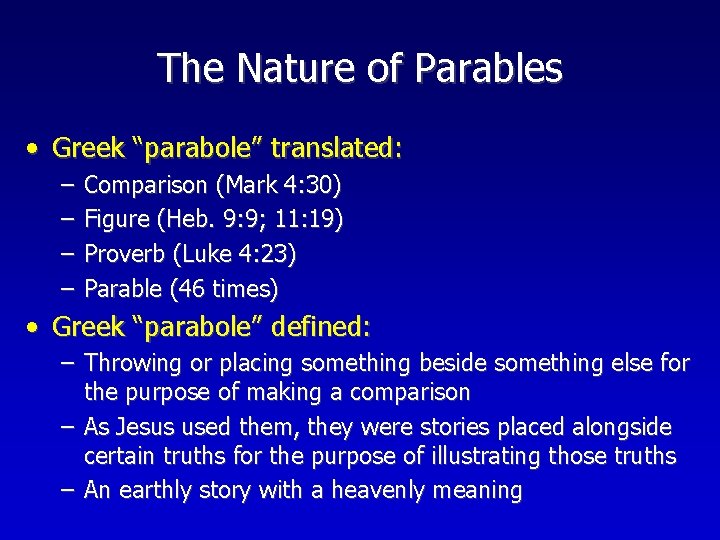
The Nature of Parables • Greek “parabole” translated: – – Comparison (Mark 4: 30) Figure (Heb. 9: 9; 11: 19) Proverb (Luke 4: 23) Parable (46 times) • Greek “parabole” defined: – Throwing or placing something beside something else for the purpose of making a comparison – As Jesus used them, they were stories placed alongside certain truths for the purpose of illustrating those truths – An earthly story with a heavenly meaning
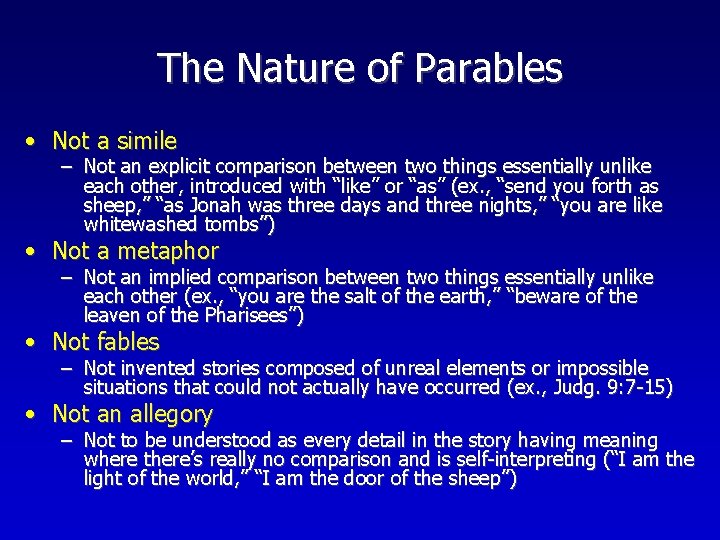
The Nature of Parables • Not a simile – Not an explicit comparison between two things essentially unlike each other, introduced with “like” or “as” (ex. , “send you forth as sheep, ” “as Jonah was three days and three nights, ” “you are like whitewashed tombs”) • Not a metaphor – Not an implied comparison between two things essentially unlike each other (ex. , “you are the salt of the earth, ” “beware of the leaven of the Pharisees”) • Not fables – Not invented stories composed of unreal elements or impossible situations that could not actually have occurred (ex. , Judg. 9: 7 -15) • Not an allegory – Not to be understood as every detail in the story having meaning where there’s really no comparison and is self-interpreting (“I am the light of the world, ” “I am the door of the sheep”)
The Nature of Parables • They were illustrations – Something real in life (something that could have happened) was used as a means of presenting a moral thought • Jesus used parables frequently – Estimated that 1/3 of verbal teaching was in parables
The Purpose of Jesus’ Use of Parables • Reveal spiritual truth clearly to those who were sincerely seeking the will of God (Matt. 13: 10 -11, 16) – To those disposed to know and accept the truth, the parables served to arouse attention and to excite inquiry. – If they did not at first apprehend the meaning, they would come and ask (cf. Matt. 13: 36; Mark 4: 10) – Effectively separated the truth-seekers from the non-seekers
The Purpose of Jesus’ Use of Parables • Conceal truth from those who were not really interested in learning it (Matt. 13: 12 -15) – The scribes and Pharisees were constantly attempting to twist the teaching of Jesus (cf. Matt. 13: 13 -15). – With no desire to know the truth, these did not come and make inquiry – It was not that Jesus did not want them to know the truth; the people themselves had shut their own eyes, ears and minds – “Perceived He spoke of them” (Matt. 21: 45; Luke 20: 19)
The Purpose of Jesus’ Use of Parables • Cause men to assent to the truth (get the people nodding their heads in agreement) before they realized its applicability to them personally when He revealed the points – In some cases, they would convict themselves before they knew the main point of His teaching (cf. Matt. 21: 33 -45; cf. 2 Sam. 12: 1 -7)
The Purpose of Jesus’ Use of Parables • Fulfill Old Testament prophecy – “I will open my mouth in a parable; I will utter dark sayings of old, Which we have heard and known, And our fathers have told us” (Psa. 78: 23). – “All these things Jesus spoke to the multitude in parables; and without a parable He did not speak to them, that it might be fulfilled which was spoken by the prophet, saying: ‘I will open My mouth in parables; I will utter things kept secret from the foundation of the world’” (Matt. 13: 3435).
The Purpose of Jesus’ Use of Parables • Many advantages resulting from this type of teaching – He spoke concerning things and circumstances with which the first-century Jews were very familiar and with which they could associate • Sower • Mustard seed • Leaven • Merchant • Net
The Purpose of Jesus’ Use of Parables • To convey “the mysteries of the kingdom of heaven” in a way that men would be prone to remember long after it had been given
- Slides: 10