
Lesson 1 Introduction Lesson 2 Main economic principles
- Slides: 11
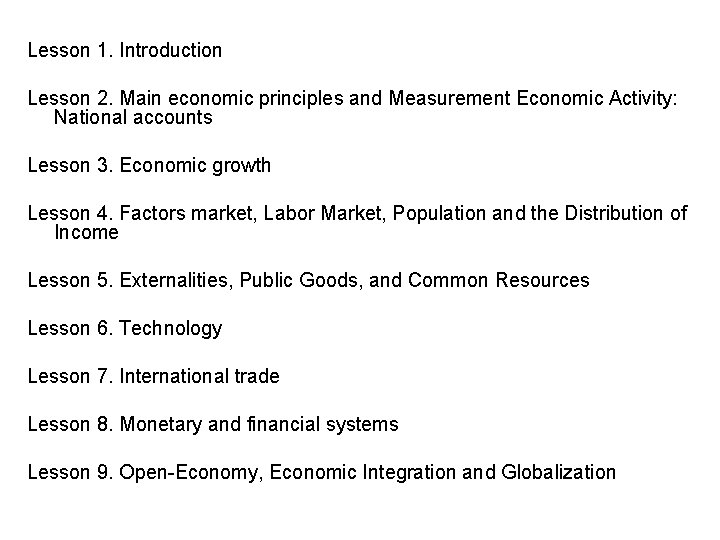
Lesson 1. Introduction Lesson 2. Main economic principles and Measurement Economic Activity: National accounts Lesson 3. Economic growth Lesson 4. Factors market, Labor Market, Population and the Distribution of Income Lesson 5. Externalities, Public Goods, and Common Resources Lesson 6. Technology Lesson 7. International trade Lesson 8. Monetary and financial systems Lesson 9. Open-Economy, Economic Integration and Globalization
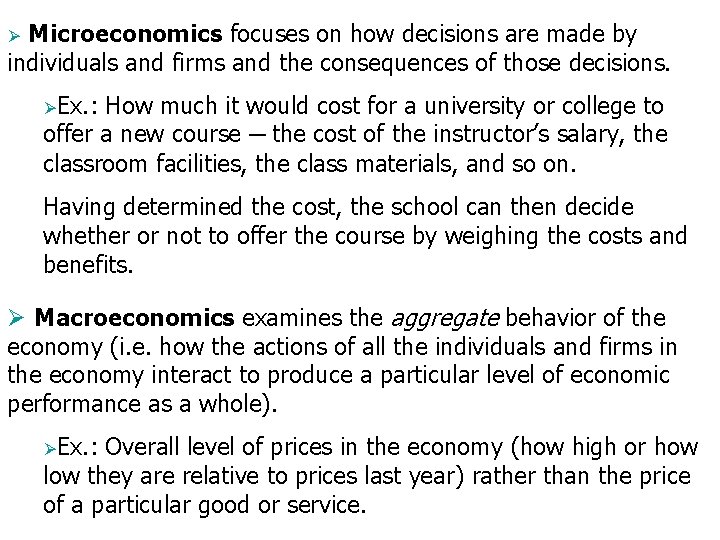
Microeconomics focuses on how decisions are made by individuals and firms and the consequences of those decisions. Ø ØEx. : How much it would cost for a university or college to offer a new course ─ the cost of the instructor’s salary, the classroom facilities, the class materials, and so on. Having determined the cost, the school can then decide whether or not to offer the course by weighing the costs and benefits. Ø Macroeconomics examines the aggregate behavior of the economy (i. e. how the actions of all the individuals and firms in the economy interact to produce a particular level of economic performance as a whole). ØEx. : Overall level of prices in the economy (how high or how low they are relative to prices last year) rather than the price of a particular good or service.
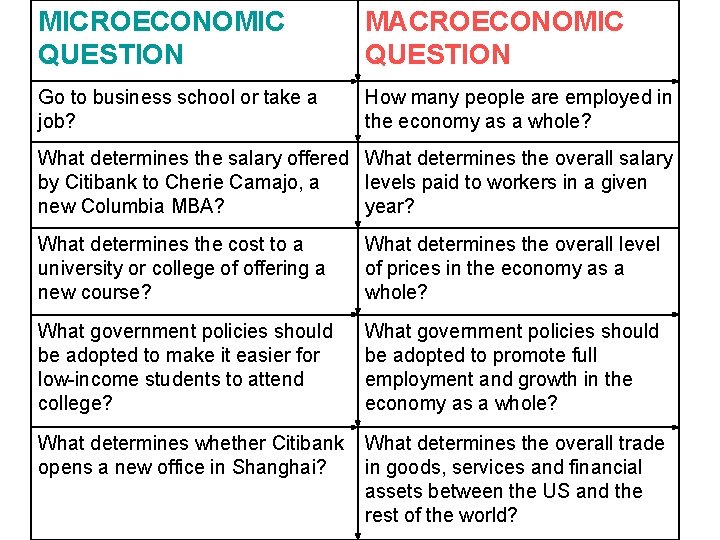
MICROECONOMIC QUESTION MACROECONOMIC QUESTION Go to business school or take a job? How many people are employed in the economy as a whole? What determines the salary offered What determines the overall salary by Citibank to Cherie Camajo, a levels paid to workers in a given new Columbia MBA? year? What determines the cost to a university or college of offering a new course? What determines the overall level of prices in the economy as a whole? What government policies should be adopted to make it easier for low-income students to attend college? What government policies should be adopted to promote full employment and growth in the economy as a whole? What determines whether Citibank opens a new office in Shanghai? What determines the overall trade in goods, services and financial assets between the US and the rest of the world?
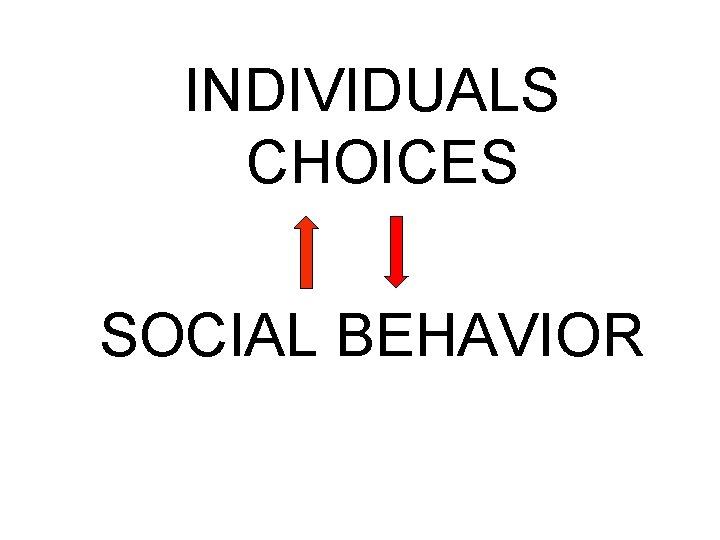
INDIVIDUALS CHOICES SOCIAL BEHAVIOR
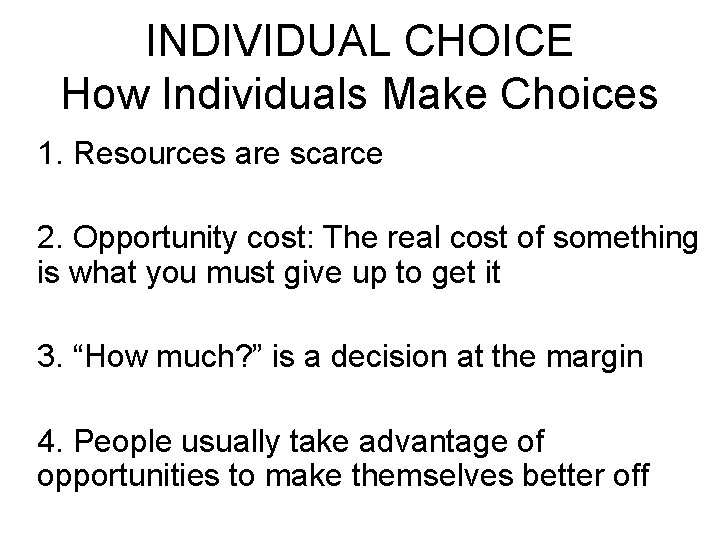
INDIVIDUAL CHOICE How Individuals Make Choices 1. Resources are scarce 2. Opportunity cost: The real cost of something is what you must give up to get it 3. “How much? ” is a decision at the margin 4. People usually take advantage of opportunities to make themselves better off
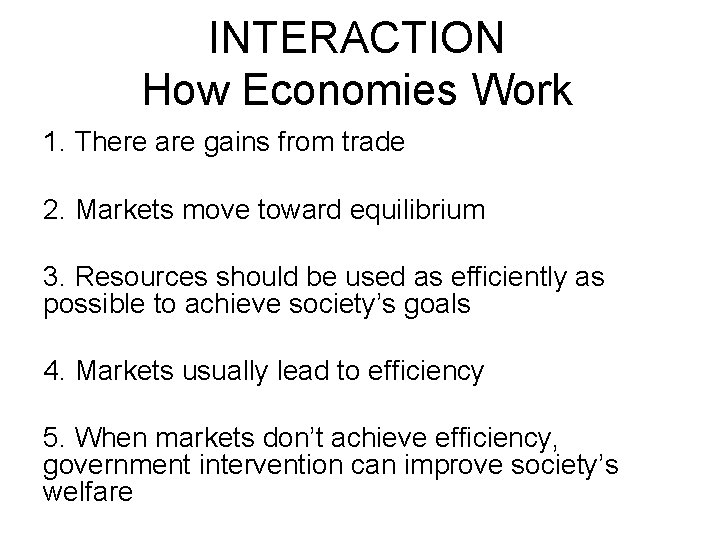
INTERACTION How Economies Work 1. There are gains from trade 2. Markets move toward equilibrium 3. Resources should be used as efficiently as possible to achieve society’s goals 4. Markets usually lead to efficiency 5. When markets don’t achieve efficiency, government intervention can improve society’s welfare
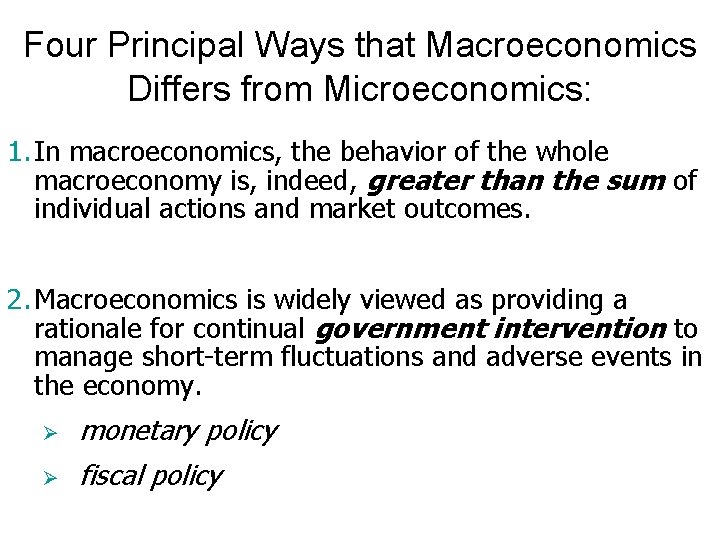
Four Principal Ways that Macroeconomics Differs from Microeconomics: 1. In macroeconomics, the behavior of the whole macroeconomy is, indeed, greater than the sum of individual actions and market outcomes. 2. Macroeconomics is widely viewed as providing a rationale for continual government intervention to manage short-term fluctuations and adverse events in the economy. Ø monetary policy Ø fiscal policy
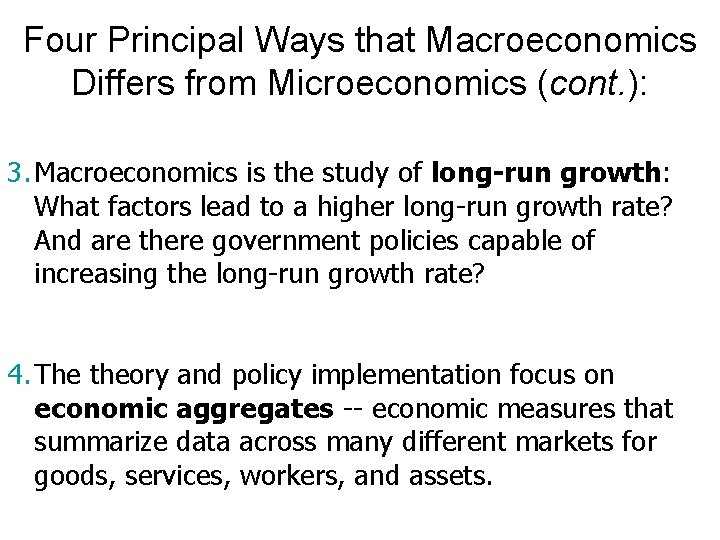
Four Principal Ways that Macroeconomics Differs from Microeconomics (cont. ): 3. Macroeconomics is the study of long-run growth: What factors lead to a higher long-run growth rate? And are there government policies capable of increasing the long-run growth rate? 4. The theory and policy implementation focus on economic aggregates -- economic measures that summarize data across many different markets for goods, services, workers, and assets.
The market • MARKET – What? – How? – For whom? • Coordination HOUSEHOLDS & FIRMS • Prices • Institutions
The state • “Market failures”: – Efficiency • Market power • Externalities – Equity – Stability • “State failures”
The firm • • • Firm as a production function Coase: transaction costs → firm ≠ market Inside the firm Entrepreneur: Schumpeter, Knight Technology and organization Institutional analysis