
Lesson 1 Functions Concepts and Notations IB Math
Lesson 1 - Functions: Concepts and Notations IB Math SL 1 - Santowski 12/19/2021 Math SL 1 - Santowski 1
Lesson Objectives n n n (a) Understand that relationships in data can be represented in multiple ways (b) Explain the difference between functions and relations (c) Understand the terms domain and range as used in describing functions (d) Understand work with the notations used with functions (e) Review graphing with the GDC 12/19/2021 Math SL 1 - Santowski 2
The BIG Picture n And we are studying this because. . ? n The topics within the SL 1 course will revolve around functions Functions will be a unifying theme throughout the course n n So a solid understanding of what functions are and why they are used and how they are used will be very important! 12/19/2021 Math SL 1 - Santowski 3
(A) Concept of Functions & Relations n In many subject areas, we see relationships that exist between one quantity and another quantity. q q q n ex. Galileo found that the distance an object falls is related to the time it falls. ex. distance traveled in car is related to its speed. ex. the amount of product you sell is related to the price you charge. All these relationships are classified mathematically as Relations. 12/19/2021 Math SL 1 - Santowski 4
(B) Representation of Functions & Relations n So, let’s work with Galileo findings that the distance an object falls is related to the time it falls. n So, in what ways/manners can we express/represent this relationship? ?
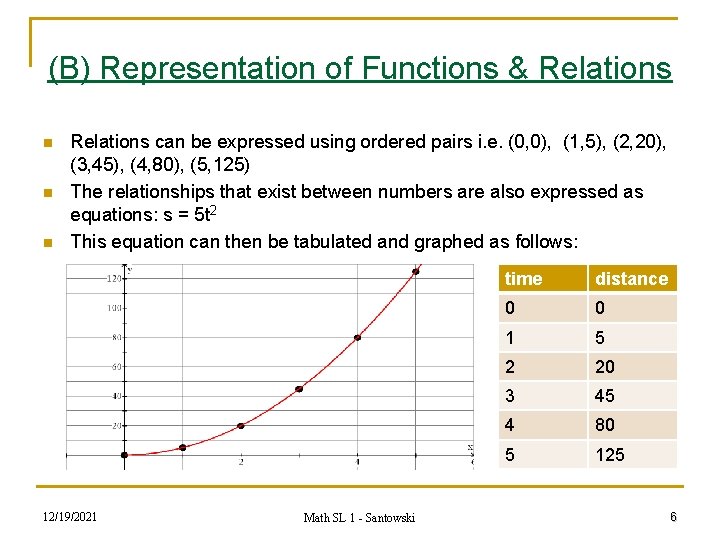
(B) Representation of Functions & Relations n n n Relations can be expressed using ordered pairs i. e. (0, 0), (1, 5), (2, 20), (3, 45), (4, 80), (5, 125) The relationships that exist between numbers are also expressed as equations: s = 5 t 2 This equation can then be tabulated and graphed as follows: 12/19/2021 Math SL 1 - Santowski time distance 0 0 1 5 2 20 3 45 4 80 5 125 6
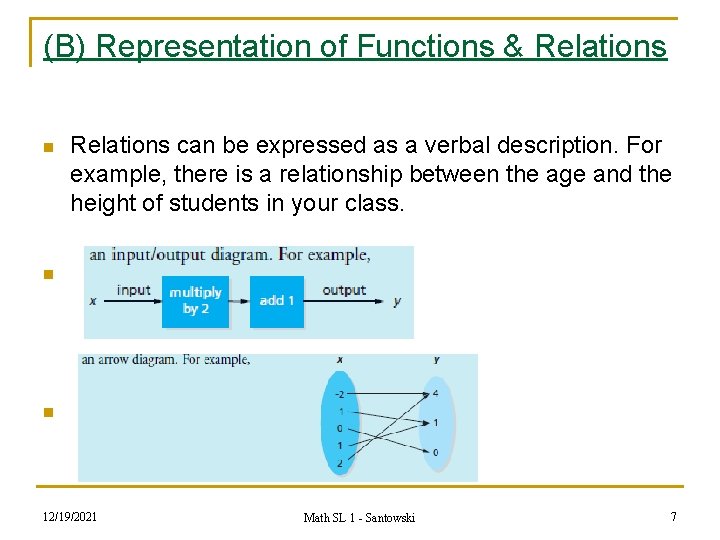
(B) Representation of Functions & Relations n Relations can be expressed as a verbal description. For example, there is a relationship between the age and the height of students in your class. n n 12/19/2021 Math SL 1 - Santowski 7
(C) Functions - The Concept n You have been introduced to the concept of functions in previous courses. n What do we mean by the term FUNCTIONS? ?
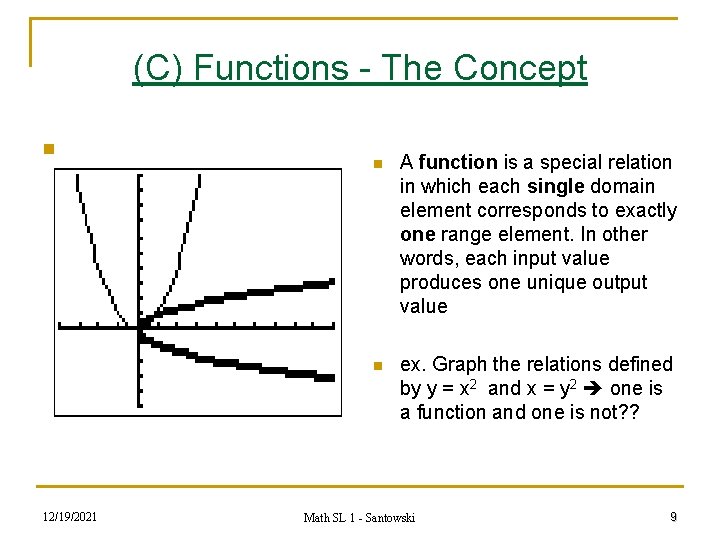
(C) Functions - The Concept n 12/19/2021 n A function is a special relation in which each single domain element corresponds to exactly one range element. In other words, each input value produces one unique output value n ex. Graph the relations defined by y = x 2 and x = y 2 one is a function and one is not? ? Math SL 1 - Santowski 9
(C) Functions - The Concept n Q? In what ways do the two graphs differ? n In the graph of y = x 2, notice that each value of x has one and only one corresponding value of y. n In the graph of x = y 2, notice that each value of x has two corresponding values of y. n We therefore distinguish between the two different kinds of relations by defining one of them as a function. So a function is special relation such that each value of x has one and only one value of y. 12/19/2021 Math SL 1 - Santowski 10
(C) Functions - The Concept Examples n Make a mapping diagram for the relation {(-2, 1), (-2, 3), (0, 3), (5, 4)} and determine whether or not the relation is a function. Give a reason for your answer. n Is the relation below a function? {(– 3, 5), (– 2, 5), (– 1, 5), (0, 5), (1, 5), (2, 5)} 12/19/2021 Math SL 1 - Santowski 11
(C) Functions - The Concept Examples n A relation, f, is defined by the set {(-1, 2), (3, 0), (5, 2)}. n (a) Sketch the set on a Cartesian plane and label the ordered pairs (b) Make a mapping diagram of this relation (c) Evaluate f(3) (d) Solve the equation f(x) = 2 (e) Is this relation a function? n n n (f) Are all relations functions? (g) Are all functions relations? 12/19/2021 Math SL 1 - Santowski 12
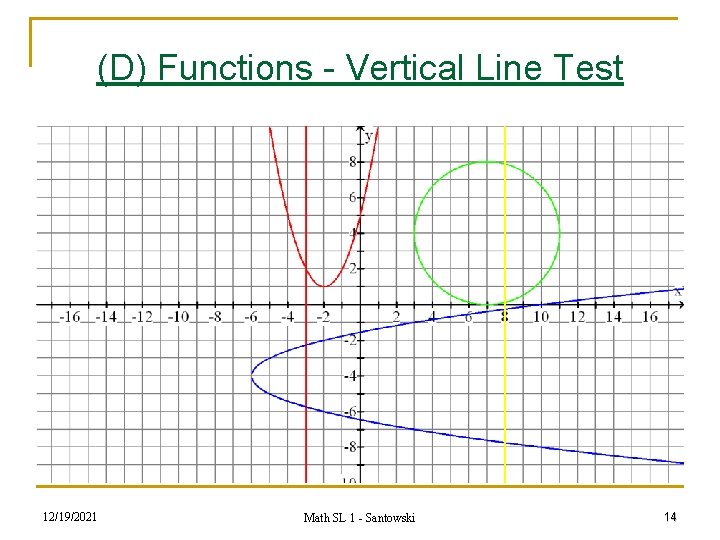
(D) Functions - Vertical Line Test n To determine whether or not a relation is in fact a function, we can draw a vertical line through the graph of the relation. n If the vertical line intersects the graph more than once, then that means the graph of the relation is not a function. n If the vertical line intersects the graph once then the graph shows that the relation is a function. n See the diagram on the next slide n WHY does the Vertical Line Test work? 12/19/2021 Math SL 1 - Santowski 13
(D) Functions - Vertical Line Test 12/19/2021 Math SL 1 - Santowski 14
(E) Functions - the Notation f(x) n We have written equations in the form y = 2 x + 5 or y = 3 x 2 - 4. n These equations describe the relationship between x and y, and so they describe relations since each x produced a unique y value, they are also functions n Therefore we have another notation or method of writing these equations of functions. n We can rewrite y = 2 x + 5 as f(x) = 2 x + 5 or f : x | 2 x + 5. We can rewrite y = 3 x 2 - 4 as g(x) = 3 x 2 – 4 or g : x | 3 x 2 - 4. n n Can you write the equation of a circle (x 2 + y 2 = 4) in function notation? 12/19/2021 Math SL 1 - Santowski 15
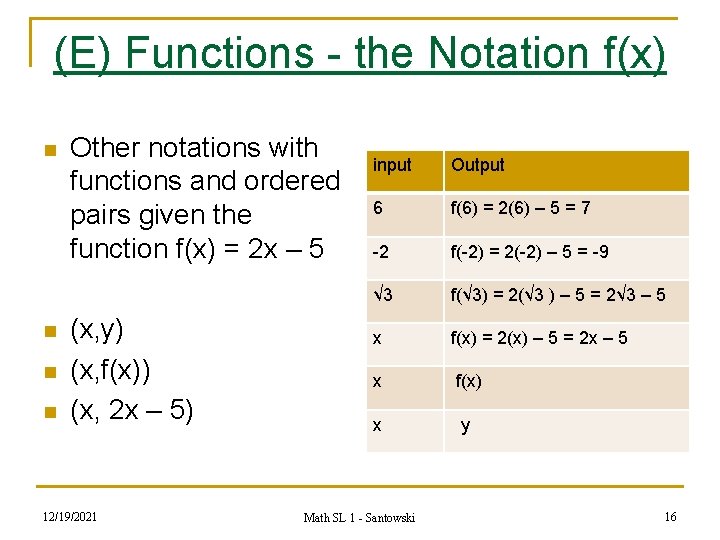
(E) Functions - the Notation f(x) n n Other notations with functions and ordered pairs given the function f(x) = 2 x – 5 (x, y) (x, f(x)) (x, 2 x – 5) 12/19/2021 input Output 6 f(6) = 2(6) – 5 = 7 -2 f(-2) = 2(-2) – 5 = -9 √ 3 f(√ 3) = 2(√ 3 ) – 5 = 2√ 3 – 5 x f(x) = 2(x) – 5 = 2 x – 5 x f(x) x y Math SL 1 - Santowski 16
(F) Working with Function Notation n For the function defined by f(t) = 3 t 2 - t + 4, evaluate f(4): 12/19/2021 Math SL 1 - Santowski 17
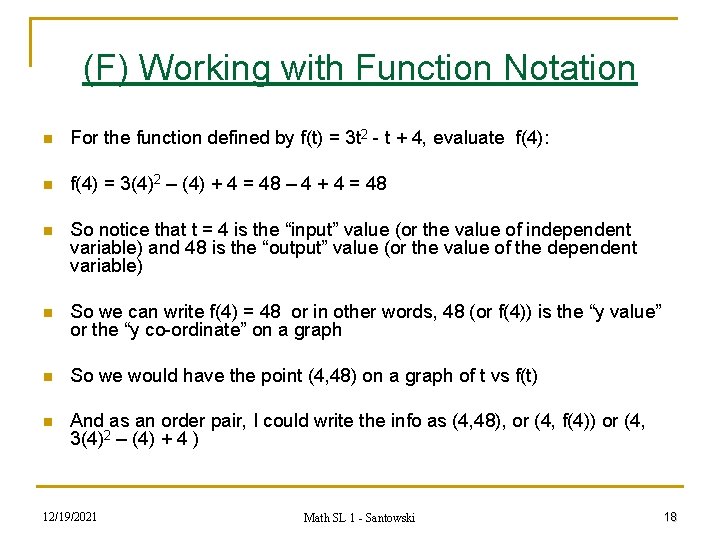
(F) Working with Function Notation n For the function defined by f(t) = 3 t 2 - t + 4, evaluate f(4): n f(4) = 3(4)2 – (4) + 4 = 48 – 4 + 4 = 48 n So notice that t = 4 is the “input” value (or the value of independent variable) and 48 is the “output” value (or the value of the dependent variable) n So we can write f(4) = 48 or in other words, 48 (or f(4)) is the “y value” or the “y co-ordinate” on a graph n So we would have the point (4, 48) on a graph of t vs f(t) n And as an order pair, I could write the info as (4, 48), or (4, f(4)) or (4, 3(4)2 – (4) + 4 ) 12/19/2021 Math SL 1 - Santowski 18
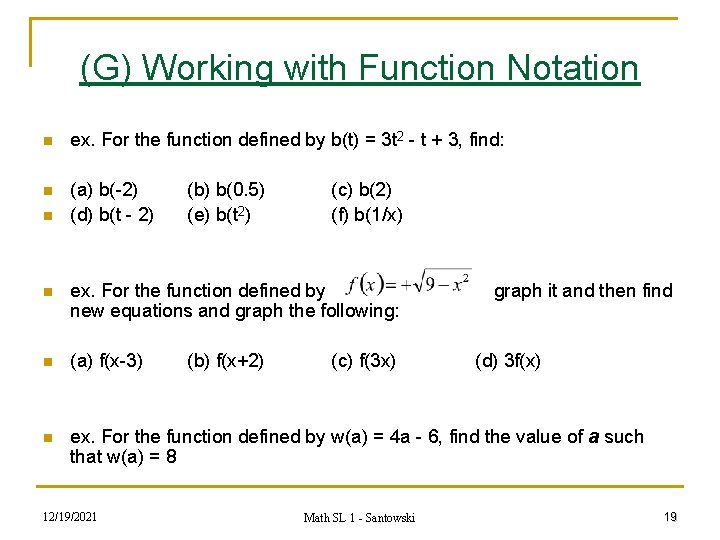
(G) Working with Function Notation n ex. For the function defined by b(t) = 3 t 2 - t + 3, find: n (a) b(-2) (d) b(t - 2) n (b) b(0. 5) (e) b(t 2) (c) b(2) (f) b(1/x) n ex. For the function defined by new equations and graph the following: n (a) f(x-3) n ex. For the function defined by w(a) = 4 a - 6, find the value of a such that w(a) = 8 12/19/2021 (b) f(x+2) (c) f(3 x) Math SL 1 - Santowski graph it and then find (d) 3 f(x) 19
(H) Introduction to Domain and Range n Two terms that we use to describe the relations are domain and range. n Domain refers to the set of all the first elements, input values, independent variable, etc. . of a relation. We will express domain in set notation and in interval notation n Range refers to the set of all the second elements, output values, dependent values, etc. . . of the relation. We will express the range in set notation and in interval notation 12/19/2021 Math SL 1 - Santowski 20
(H) Introduction to Domain and Range n What follows in the subsequent slides are some common functions with which you must become familiar. n Your initial investigation into these functions will be a graphic investigation to understand the domain and range. 12/19/2021 Math SL 1 - Santowski 21
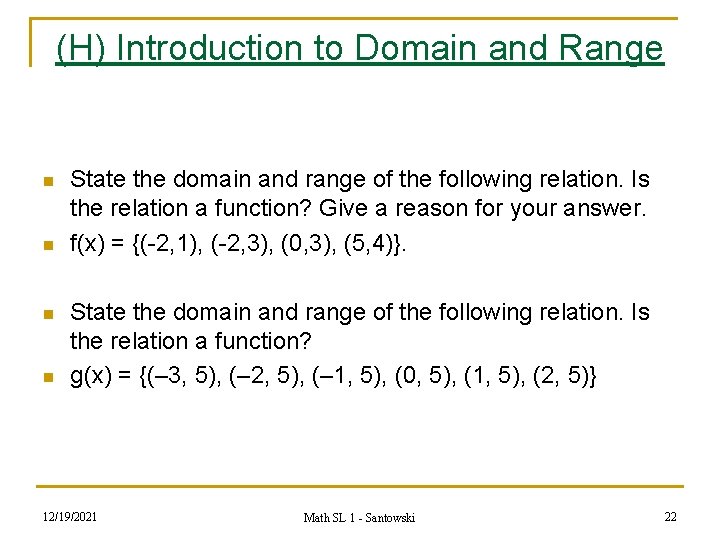
(H) Introduction to Domain and Range n n State the domain and range of the following relation. Is the relation a function? Give a reason for your answer. f(x) = {(-2, 1), (-2, 3), (0, 3), (5, 4)}. State the domain and range of the following relation. Is the relation a function? g(x) = {(– 3, 5), (– 2, 5), (– 1, 5), (0, 5), (1, 5), (2, 5)} 12/19/2021 Math SL 1 - Santowski 22
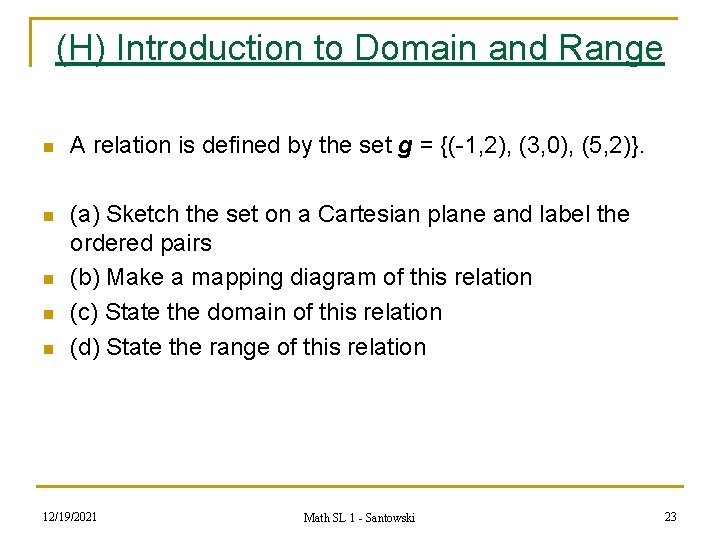
(H) Introduction to Domain and Range n A relation is defined by the set g = {(-1, 2), (3, 0), (5, 2)}. n (a) Sketch the set on a Cartesian plane and label the ordered pairs (b) Make a mapping diagram of this relation (c) State the domain of this relation (d) State the range of this relation n 12/19/2021 Math SL 1 - Santowski 23
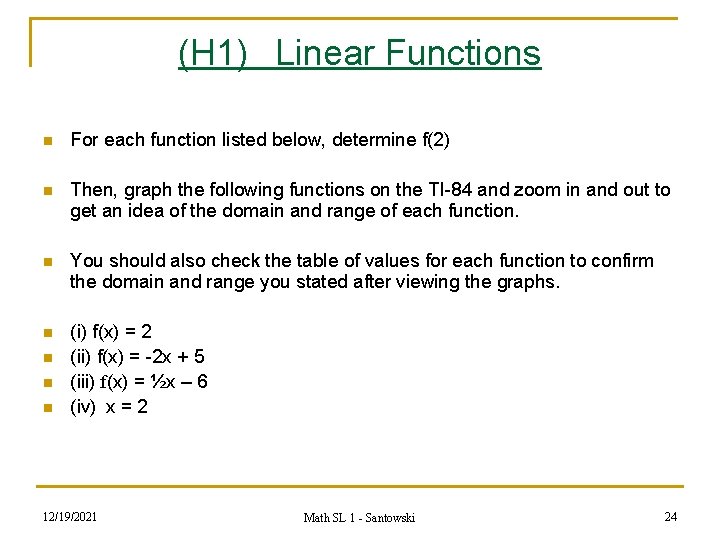
(H 1) Linear Functions n For each function listed below, determine f(2) n Then, graph the following functions on the TI-84 and zoom in and out to get an idea of the domain and range of each function. n You should also check the table of values for each function to confirm the domain and range you stated after viewing the graphs. n (i) f(x) = 2 (ii) f(x) = -2 x + 5 (iii) f(x) = ½x – 6 (iv) x = 2 n n n 12/19/2021 Math SL 1 - Santowski 24
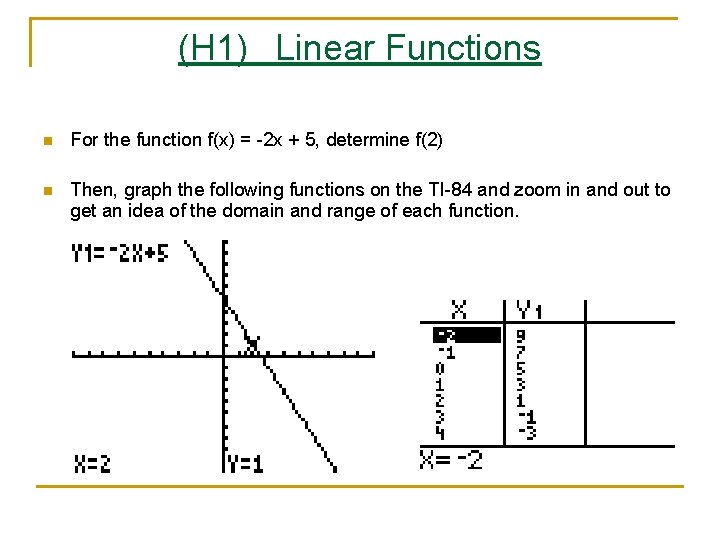
(H 1) Linear Functions n For the function f(x) = -2 x + 5, determine f(2) n Then, graph the following functions on the TI-84 and zoom in and out to get an idea of the domain and range of each function.
(H 2) Quadratic Functions n For each function listed below, determine g(2) n Then graph the following functions on the TI-84 and zoom in and out to get an idea of the domain and range of each function. n You should also check the table of values for each function to confirm the domain and range you stated after viewing the graphs. n What seems to be the key point on a quadratic function in terms of domain and range? n (i) g(x) = x 2 (iii) g(x) = -(x – 3)2 + 4 (v) g(x) = x 2 – 2 x + 6 n n 12/19/2021 (ii) g(x) = (x-3)2 + 4 (iv) g(x) = (2 x – 3)(3 - x) Math SL 1 - Santowski 26
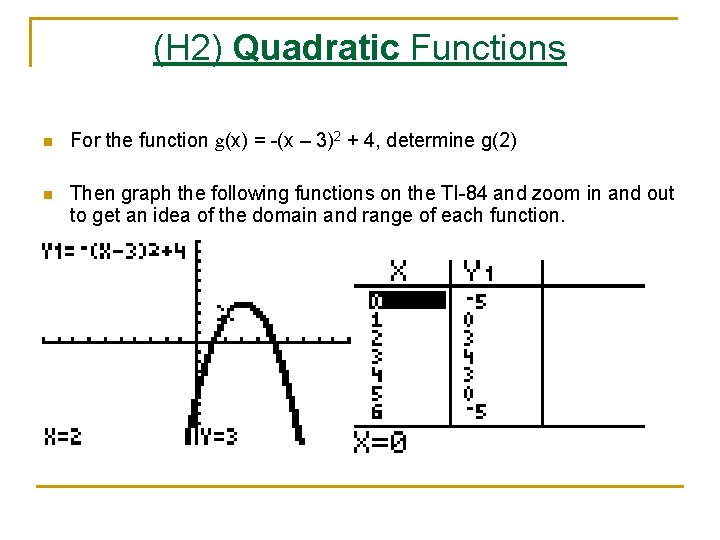
(H 2) Quadratic Functions n For the function g(x) = -(x – 3)2 + 4, determine g(2) n Then graph the following functions on the TI-84 and zoom in and out to get an idea of the domain and range of each function.
(H 3) Root Functions n For each function listed below, determine k(2) n Graph the following functions on the TI-84 and zoom in and out to get an idea of the domain and range of each function n You should also check the table of values for each function to confirm the domain and range you stated after viewing the graphs. n What seems to be the key point on root function in terms of domain and range? n n (i) k(x) = sqr(x) or (x) (ii) k(x) = (x – 2) + 4 (iii) k(x) = - (x + 1) – 3 (iv) k(x) = 2 (3 x) + 1 12/19/2021 Math SL 1 - Santowski 28
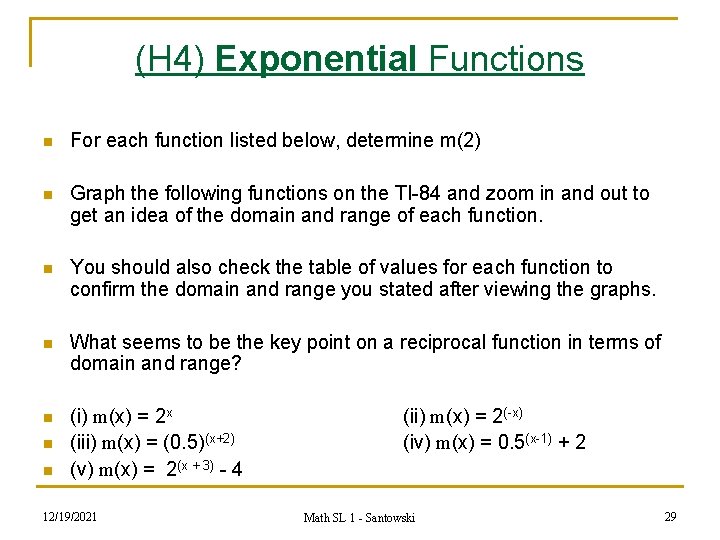
(H 4) Exponential Functions n For each function listed below, determine m(2) n Graph the following functions on the TI-84 and zoom in and out to get an idea of the domain and range of each function. n You should also check the table of values for each function to confirm the domain and range you stated after viewing the graphs. n What seems to be the key point on a reciprocal function in terms of domain and range? n (i) m(x) = 2 x (iii) m(x) = (0. 5)(x+2) (v) m(x) = 2(x + 3) - 4 n n 12/19/2021 (ii) m(x) = 2(-x) (iv) m(x) = 0. 5(x-1) + 2 Math SL 1 - Santowski 29
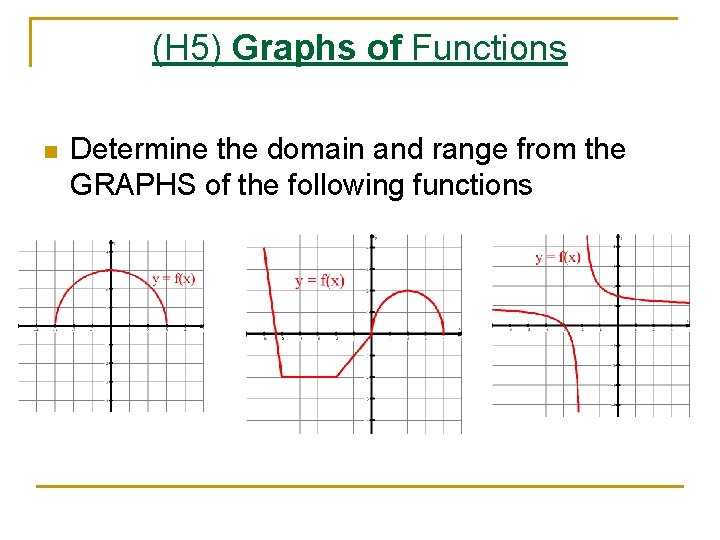
(H 5) Graphs of Functions n Determine the domain and range from the GRAPHS of the following functions
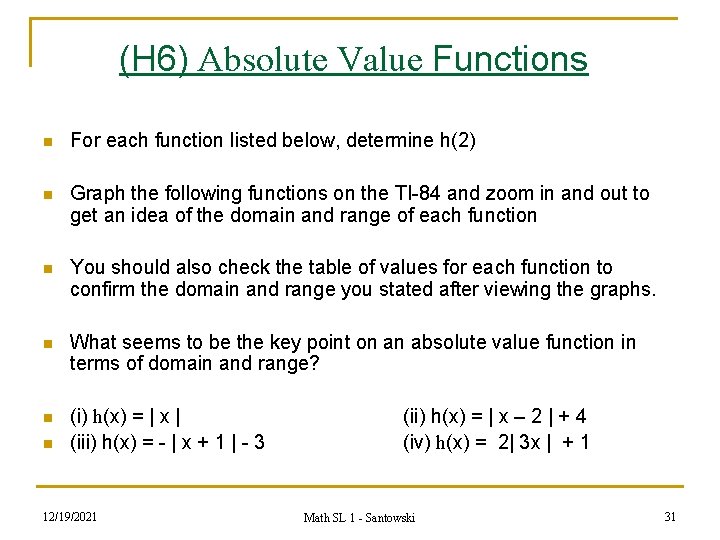
(H 6) Absolute Value Functions n For each function listed below, determine h(2) n Graph the following functions on the TI-84 and zoom in and out to get an idea of the domain and range of each function n You should also check the table of values for each function to confirm the domain and range you stated after viewing the graphs. n What seems to be the key point on an absolute value function in terms of domain and range? n (i) h(x) = | x | (iii) h(x) = - | x + 1 | - 3 n 12/19/2021 (ii) h(x) = | x – 2 | + 4 (iv) h(x) = 2| 3 x | + 1 Math SL 1 - Santowski 31
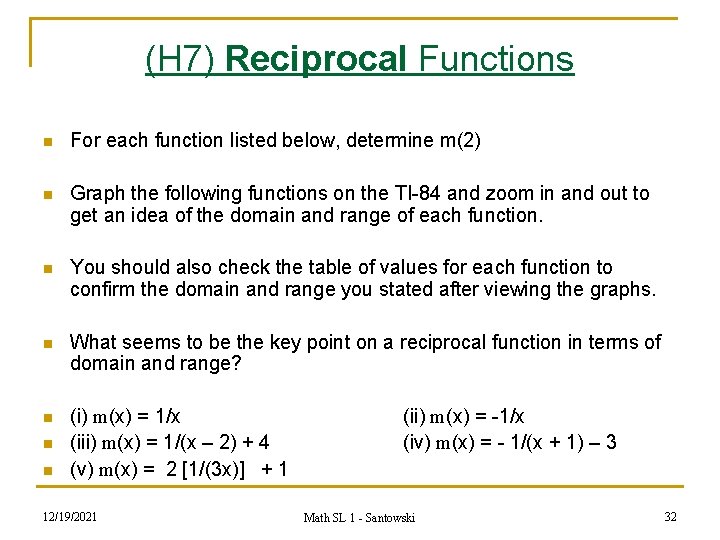
(H 7) Reciprocal Functions n For each function listed below, determine m(2) n Graph the following functions on the TI-84 and zoom in and out to get an idea of the domain and range of each function. n You should also check the table of values for each function to confirm the domain and range you stated after viewing the graphs. n What seems to be the key point on a reciprocal function in terms of domain and range? n (i) m(x) = 1/x (iii) m(x) = 1/(x – 2) + 4 (v) m(x) = 2 [1/(3 x)] + 1 n n 12/19/2021 (ii) m(x) = -1/x (iv) m(x) = - 1/(x + 1) – 3 Math SL 1 - Santowski 32
(I) Summary n Summarize your findings as you make a generalization about the domains and ranges of: n (1) Linear Functions (2) Quadratic Functions (3) Root Functions (4) Exponential Functions (5) Absolute value Functions n n n Now that you have seen some examples, go to the following link and work through the following on-line examples: Domains of Functions from Visual Calculus 12/19/2021 Math SL 1 - Santowski 33
(J) Internet Links n College Algebra Tutorial on Introduction to Functions West Texas A&M n College Algebra Tutorial on Graphs of Functions Part I from West Texas A&M n Functions Lesson - I from Purple. Math n Functions Lesson - Domain and Range from Purple. Math n Functions from Visual Calculus 12/19/2021 Math SL 1 - Santowski 34
(K) Homework n Complete slides H 1 to H 5 (H 6 & H 7 are optional, but recommended) Complete slide I n Complete Skills Quiz n 12/19/2021 Math SL 1 - Santowski 35
- Slides: 35