
Lesson 1 Fossil Evidence Fossils When organisms die
- Slides: 16
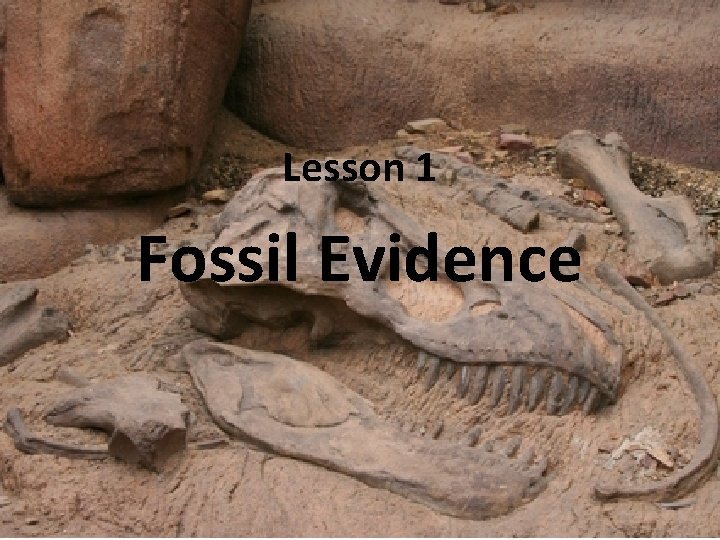
Lesson 1 Fossil Evidence
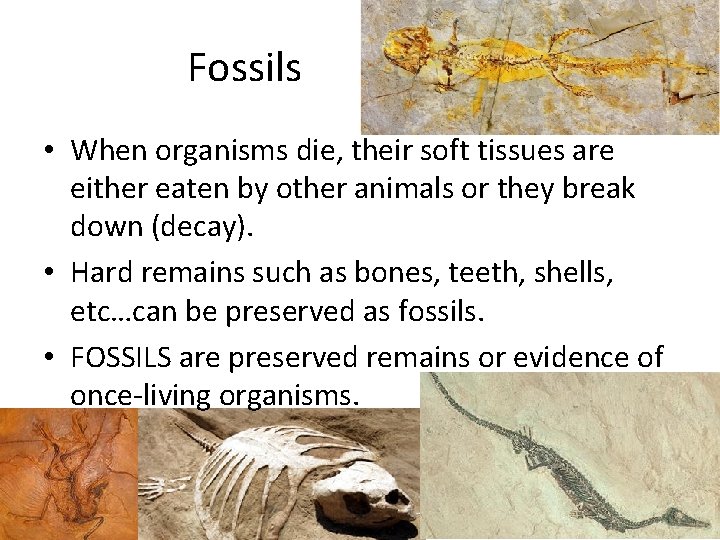
Fossils • When organisms die, their soft tissues are either eaten by other animals or they break down (decay). • Hard remains such as bones, teeth, shells, etc…can be preserved as fossils. • FOSSILS are preserved remains or evidence of once-living organisms.
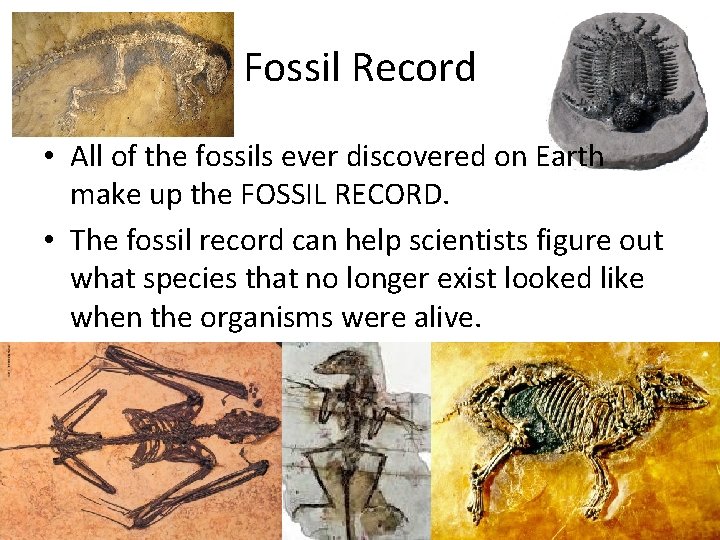
Fossil Record • All of the fossils ever discovered on Earth make up the FOSSIL RECORD. • The fossil record can help scientists figure out what species that no longer exist looked like when the organisms were alive.
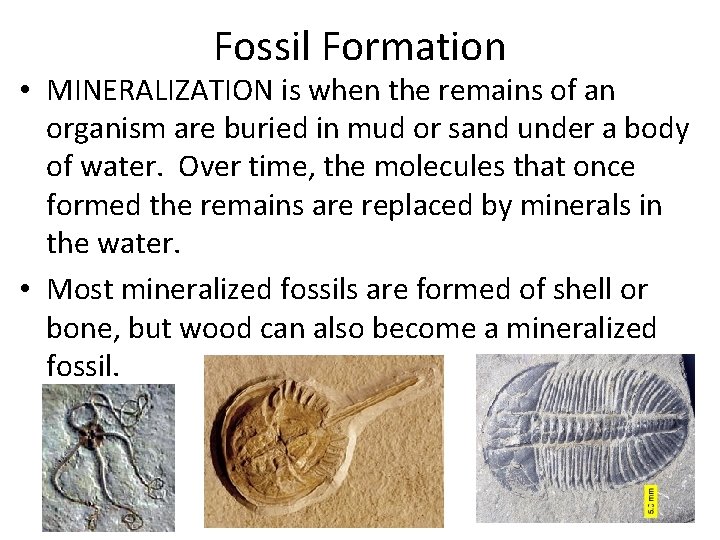
Fossil Formation • MINERALIZATION is when the remains of an organism are buried in mud or sand under a body of water. Over time, the molecules that once formed the remains are replaced by minerals in the water. • Most mineralized fossils are formed of shell or bone, but wood can also become a mineralized fossil.
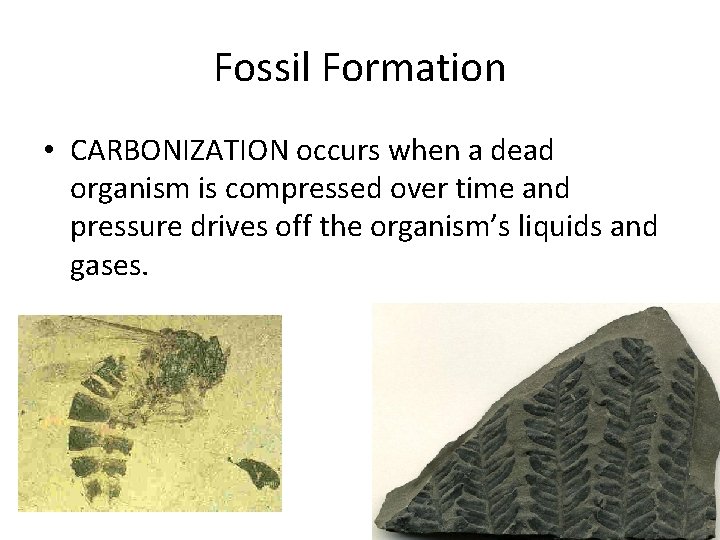
Fossil Formation • CARBONIZATION occurs when a dead organism is compressed over time and pressure drives off the organism’s liquids and gases.
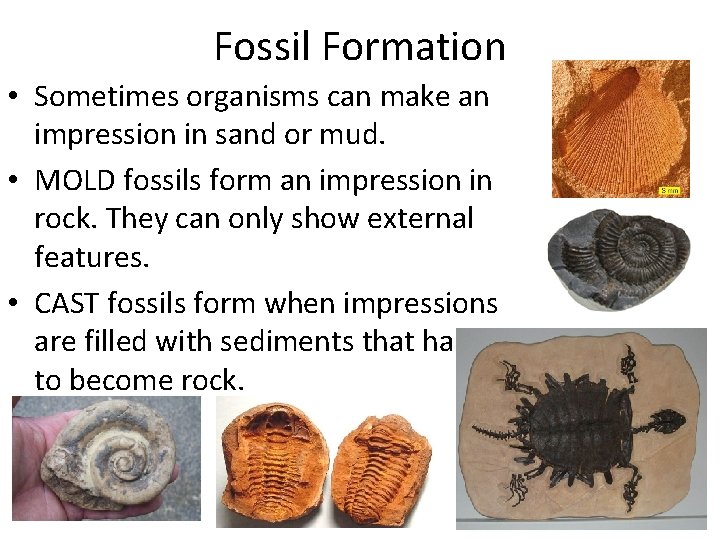
Fossil Formation • Sometimes organisms can make an impression in sand or mud. • MOLD fossils form an impression in rock. They can only show external features. • CAST fossils form when impressions are filled with sediments that harden to become rock.
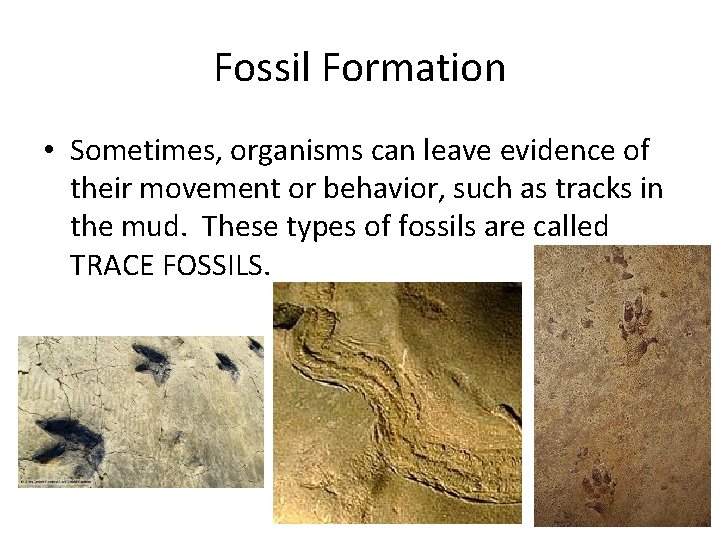
Fossil Formation • Sometimes, organisms can leave evidence of their movement or behavior, such as tracks in the mud. These types of fossils are called TRACE FOSSILS.
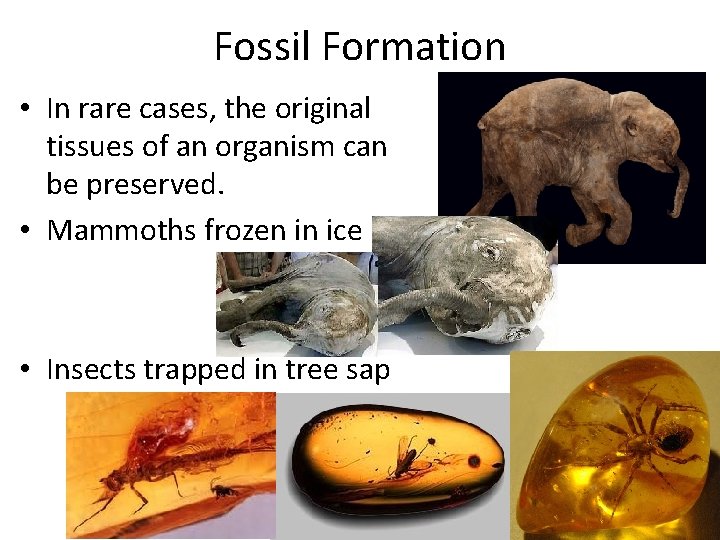
Fossil Formation • In rare cases, the original tissues of an organism can be preserved. • Mammoths frozen in ice • Insects trapped in tree sap
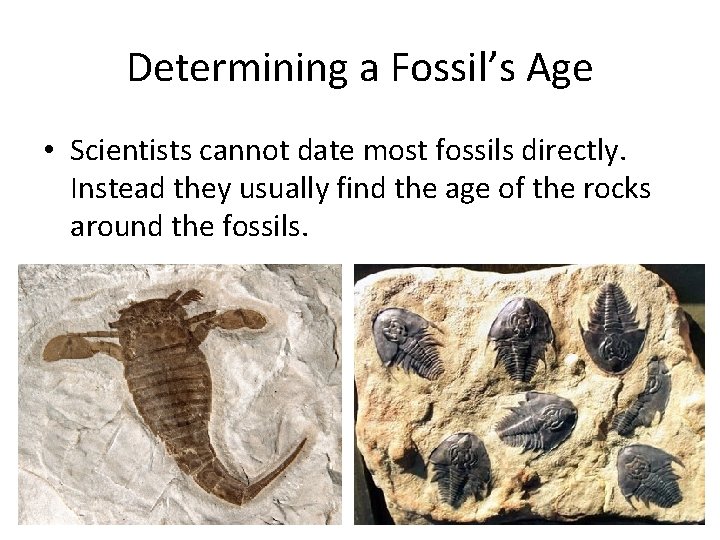
Determining a Fossil’s Age • Scientists cannot date most fossils directly. Instead they usually find the age of the rocks around the fossils.
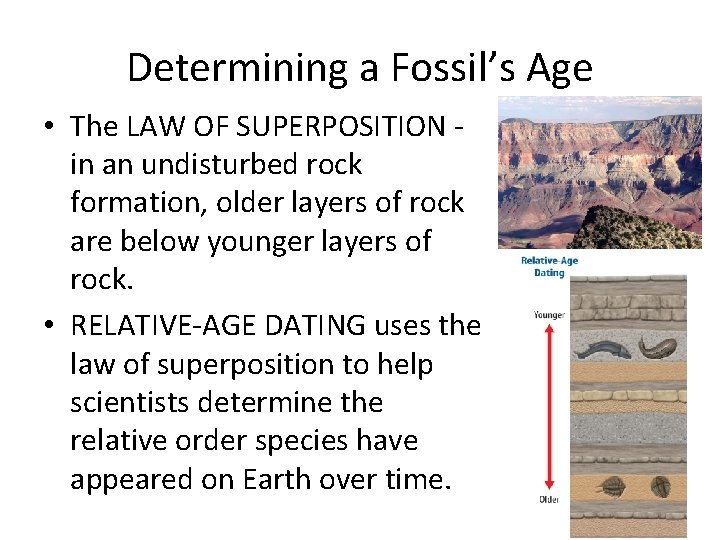
Determining a Fossil’s Age • The LAW OF SUPERPOSITION in an undisturbed rock formation, older layers of rock are below younger layers of rock. • RELATIVE-AGE DATING uses the law of superposition to help scientists determine the relative order species have appeared on Earth over time.
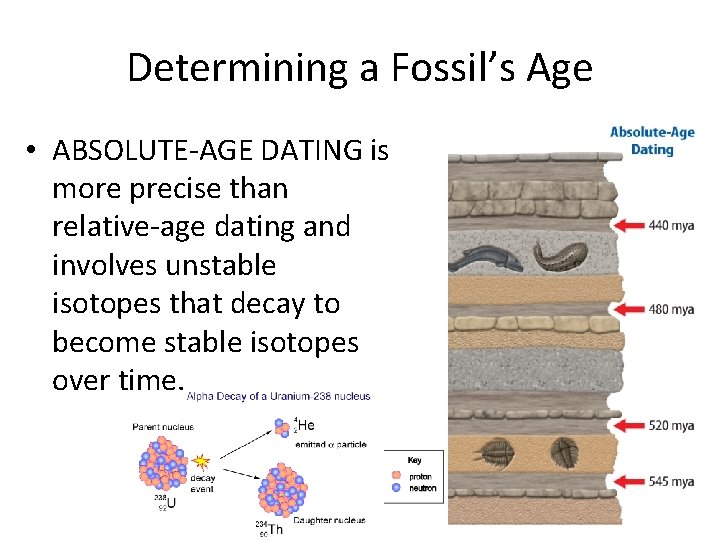
Determining a Fossil’s Age • ABSOLUTE-AGE DATING is more precise than relative-age dating and involves unstable isotopes that decay to become stable isotopes over time.
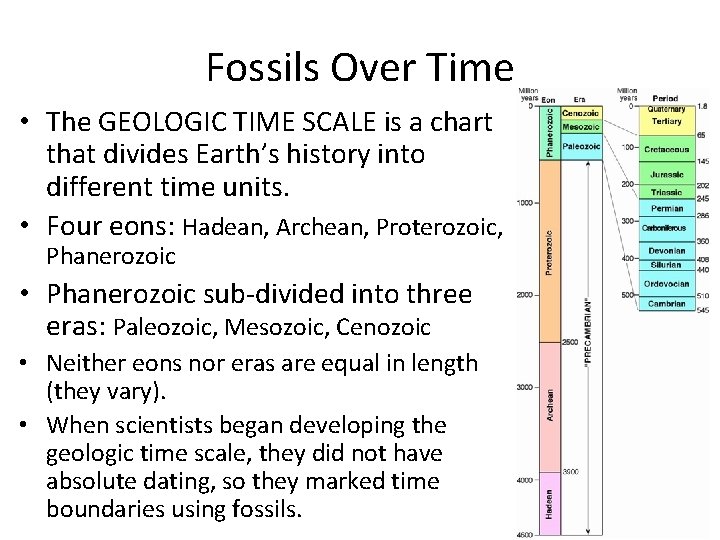
Fossils Over Time • The GEOLOGIC TIME SCALE is a chart that divides Earth’s history into different time units. • Four eons: Hadean, Archean, Proterozoic, Phanerozoic • Phanerozoic sub-divided into three eras: Paleozoic, Mesozoic, Cenozoic • Neither eons nor eras are equal in length (they vary). • When scientists began developing the geologic time scale, they did not have absolute dating, so they marked time boundaries using fossils.
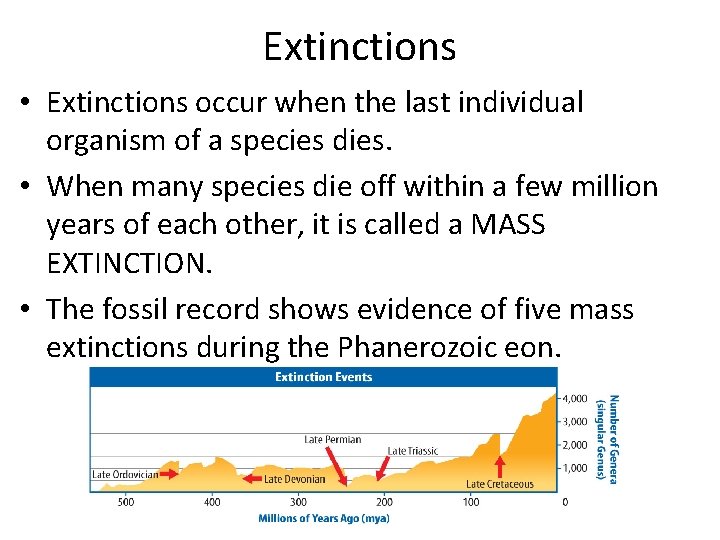
Extinctions • Extinctions occur when the last individual organism of a species dies. • When many species die off within a few million years of each other, it is called a MASS EXTINCTION. • The fossil record shows evidence of five mass extinctions during the Phanerozoic eon.
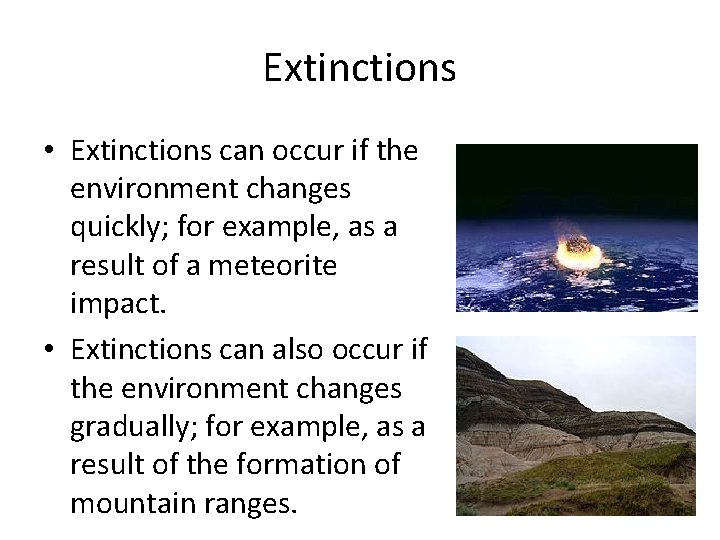
Extinctions • Extinctions can occur if the environment changes quickly; for example, as a result of a meteorite impact. • Extinctions can also occur if the environment changes gradually; for example, as a result of the formation of mountain ranges.
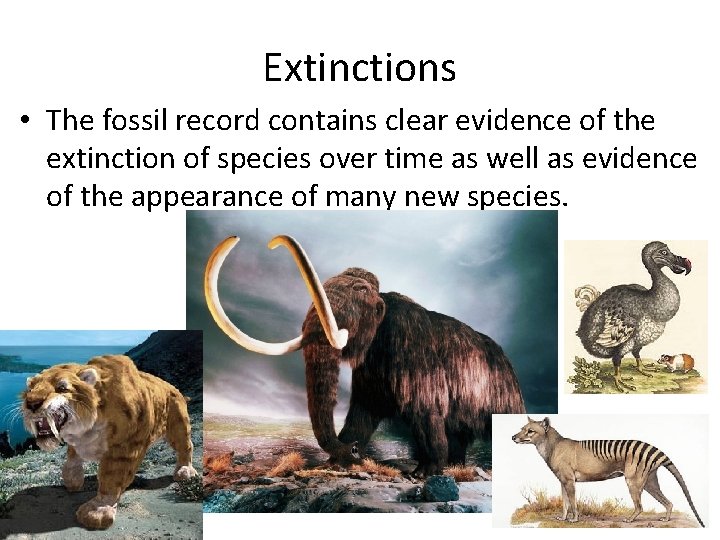
Extinctions • The fossil record contains clear evidence of the extinction of species over time as well as evidence of the appearance of many new species.
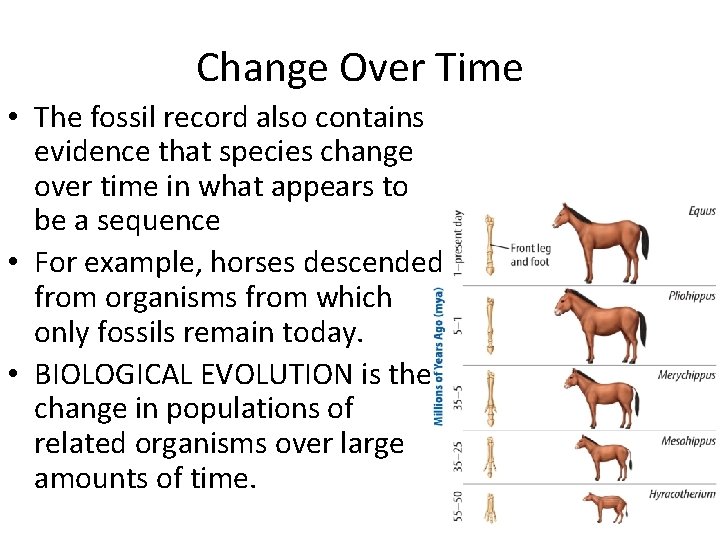
Change Over Time • The fossil record also contains evidence that species change over time in what appears to be a sequence • For example, horses descended from organisms from which only fossils remain today. • BIOLOGICAL EVOLUTION is the change in populations of related organisms over large amounts of time.