
Lesson 1 Chinese history and traditions Ancient Chinese
- Slides: 16
Lesson 1. Chinese history and traditions
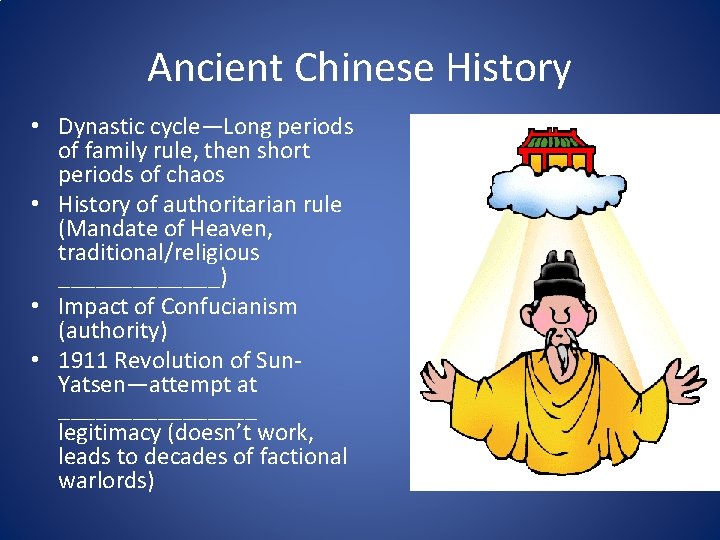
Ancient Chinese History • Dynastic cycle—Long periods of family rule, then short periods of chaos • History of authoritarian rule (Mandate of Heaven, traditional/religious _______) • Impact of Confucianism (authority) • 1911 Revolution of Sun. Yatsen—attempt at ________ legitimacy (doesn’t work, leads to decades of factional warlords)
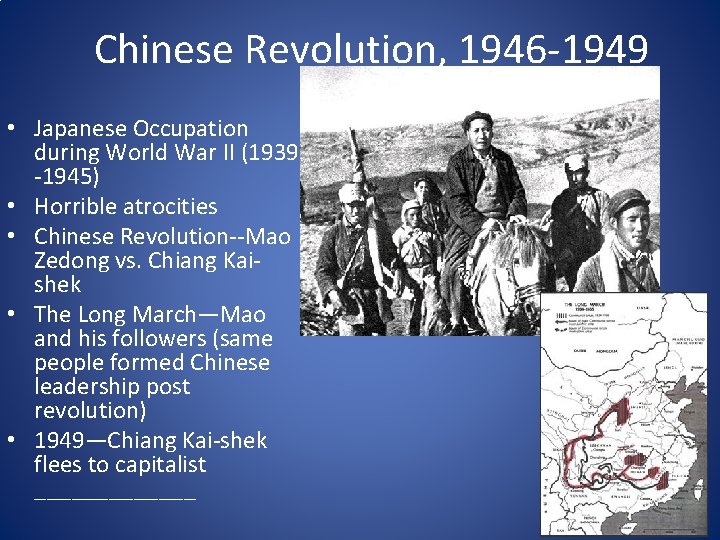
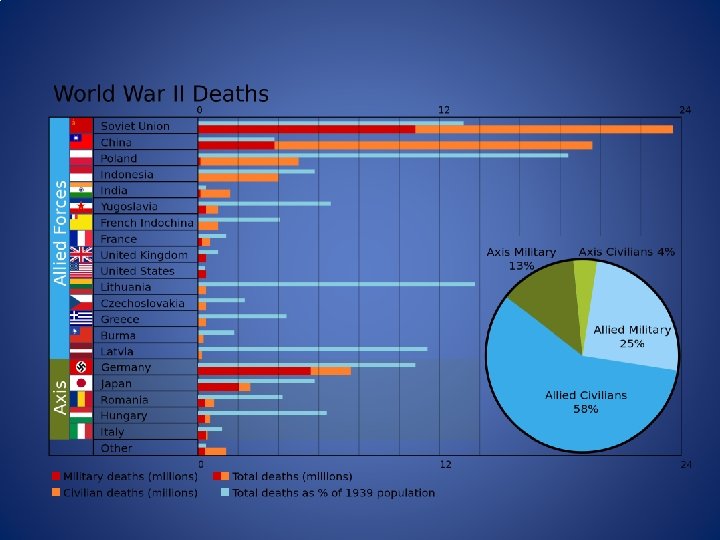
Chinese Revolution, 1946 -1949 • Japanese Occupation during World War II (1939 -1945) • Horrible atrocities • Chinese Revolution--Mao Zedong vs. Chiang Kaishek • The Long March—Mao and his followers (same people formed Chinese leadership post revolution) • 1949—Chiang Kai-shek flees to capitalist _______
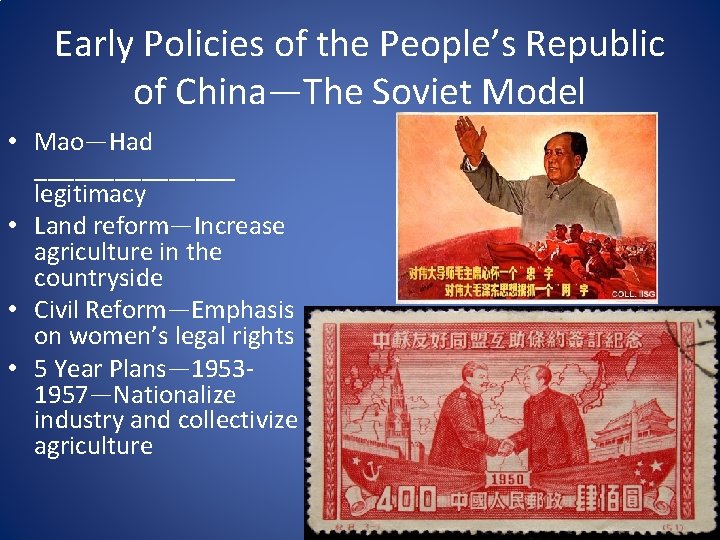
Early Policies of the People’s Republic of China—The Soviet Model • Mao—Had ________ legitimacy • Land reform—Increase agriculture in the countryside • Civil Reform—Emphasis on women’s legal rights • 5 Year Plans— 19531957—Nationalize industry and collectivize agriculture
• "In order to build a great socialist society it is of the utmost importance to arouse the broad masses of women to join in productive activity. Men and women must receive equal pay for equal work in production. Genuine equality between the sexes can only be realized in the process of the socialist transformation of society as a whole. "
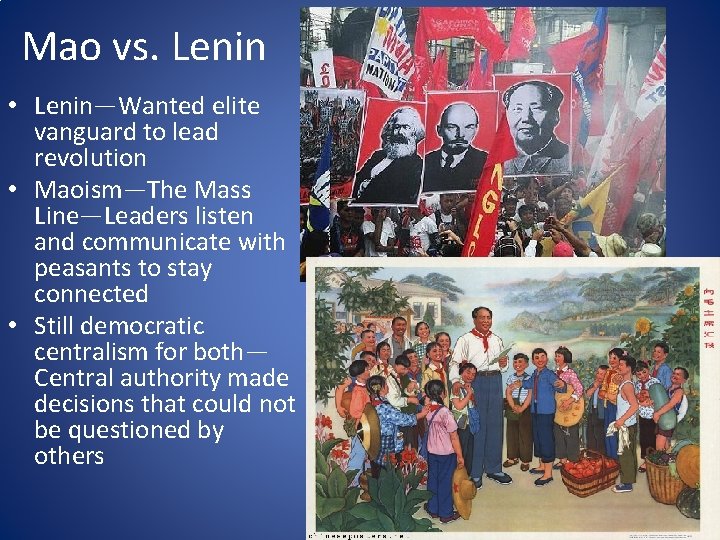
Mao vs. Lenin • Lenin—Wanted elite vanguard to lead revolution • Maoism—The Mass Line—Leaders listen and communicate with peasants to stay connected • Still democratic centralism for both— Central authority made decisions that could not be questioned by others
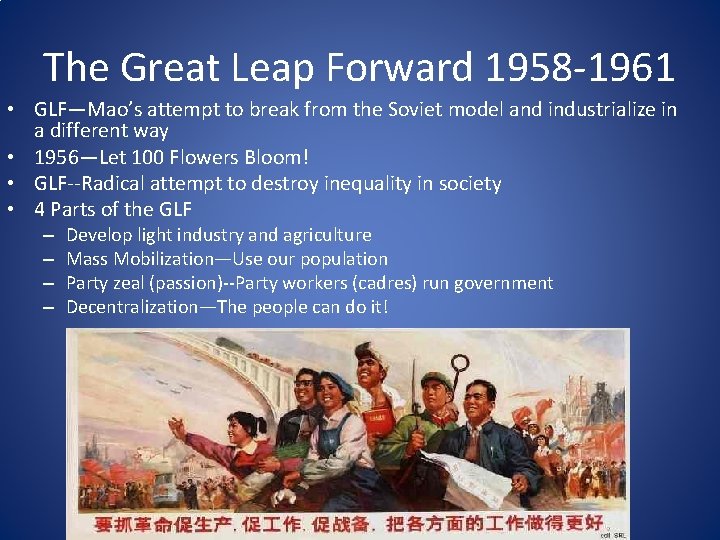
The Great Leap Forward 1958 -1961 • GLF—Mao’s attempt to break from the Soviet model and industrialize in a different way • 1956—Let 100 Flowers Bloom! • GLF--Radical attempt to destroy inequality in society • 4 Parts of the GLF – – Develop light industry and agriculture Mass Mobilization—Use our population Party zeal (passion)--Party workers (cadres) run government Decentralization—The people can do it!
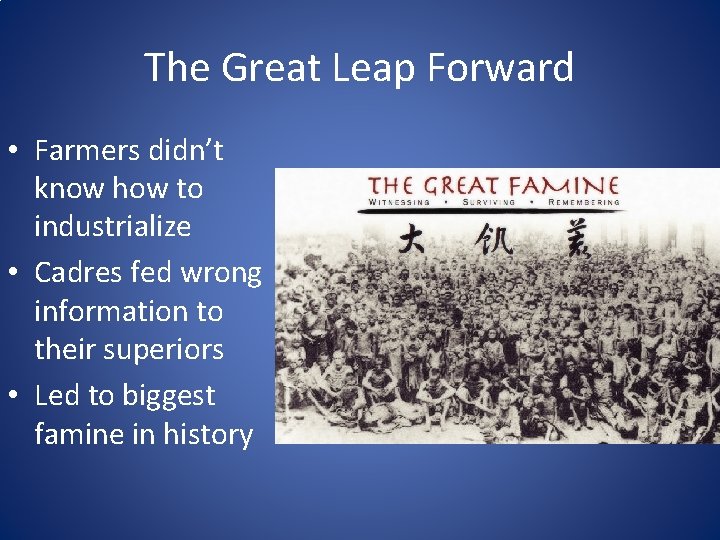
The Great Leap Forward • Farmers didn’t know how to industrialize • Cadres fed wrong information to their superiors • Led to biggest famine in history
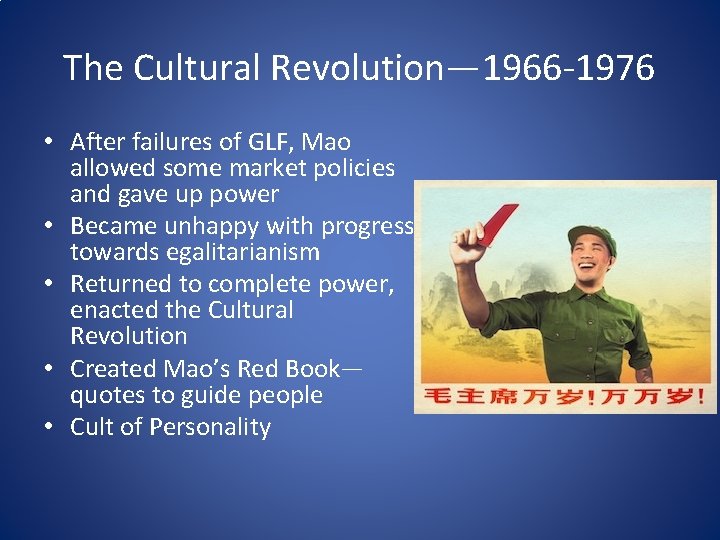
The Cultural Revolution— 1966 -1976 • After failures of GLF, Mao allowed some market policies and gave up power • Became unhappy with progress towards egalitarianism • Returned to complete power, enacted the Cultural Revolution • Created Mao’s Red Book— quotes to guide people • Cult of Personality
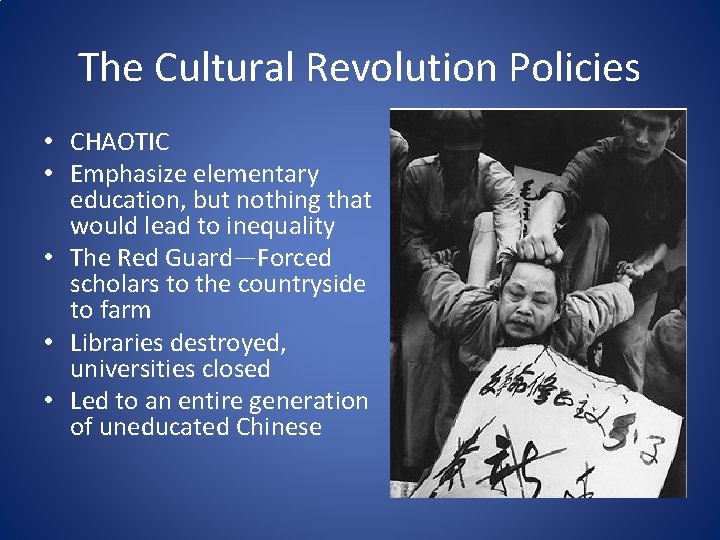
The Cultural Revolution Policies • CHAOTIC • Emphasize elementary education, but nothing that would lead to inequality • The Red Guard—Forced scholars to the countryside to farm • Libraries destroyed, universities closed • Led to an entire generation of uneducated Chinese
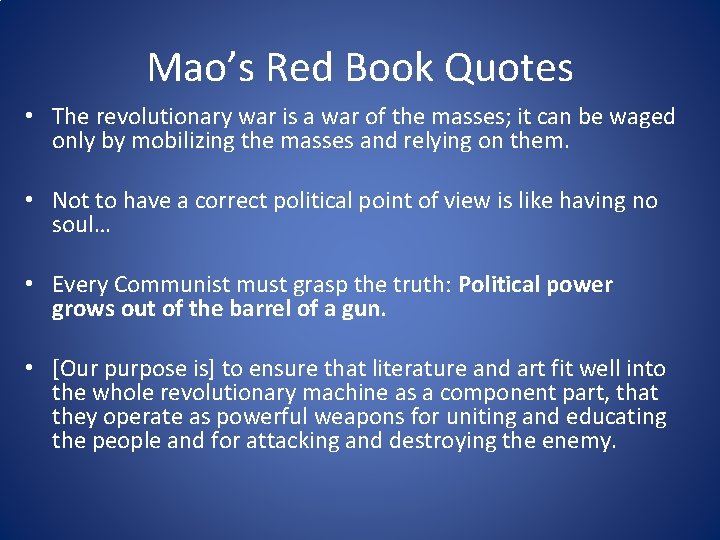
Mao’s Red Book Quotes • The revolutionary war is a war of the masses; it can be waged only by mobilizing the masses and relying on them. • Not to have a correct political point of view is like having no soul… • Every Communist must grasp the truth: Political power grows out of the barrel of a gun. • [Our purpose is] to ensure that literature and art fit well into the whole revolutionary machine as a component part, that they operate as powerful weapons for uniting and educating the people and for attacking and destroying the enemy.
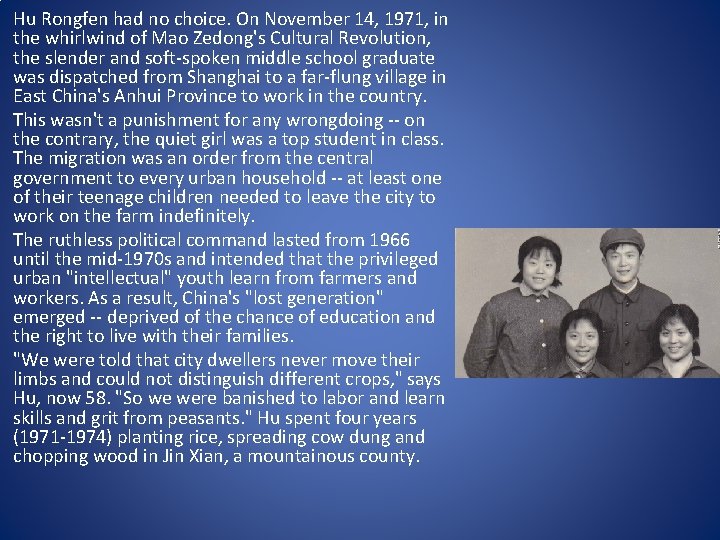
Hu Rongfen had no choice. On November 14, 1971, in the whirlwind of Mao Zedong's Cultural Revolution, the slender and soft-spoken middle school graduate was dispatched from Shanghai to a far-flung village in East China's Anhui Province to work in the country. This wasn't a punishment for any wrongdoing -- on the contrary, the quiet girl was a top student in class. The migration was an order from the central government to every urban household -- at least one of their teenage children needed to leave the city to work on the farm indefinitely. The ruthless political command lasted from 1966 until the mid-1970 s and intended that the privileged urban "intellectual" youth learn from farmers and workers. As a result, China's "lost generation" emerged -- deprived of the chance of education and the right to live with their families. "We were told that city dwellers never move their limbs and could not distinguish different crops, " says Hu, now 58. "So we were banished to labor and learn skills and grit from peasants. " Hu spent four years (1971 -1974) planting rice, spreading cow dung and chopping wood in Jin Xian, a mountainous county.
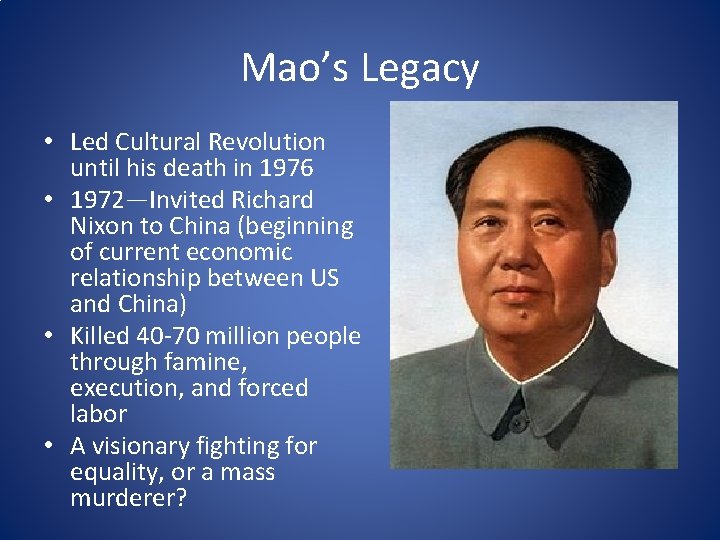
Mao’s Legacy • Led Cultural Revolution until his death in 1976 • 1972—Invited Richard Nixon to China (beginning of current economic relationship between US and China) • Killed 40 -70 million people through famine, execution, and forced labor • A visionary fighting for equality, or a mass murderer?
Pictionary Race! You have 5 minutes to make sure you know all the terms below! 1. 2. 3. 4. 5. 6. 7. 8. 9. 10. 11. 12. Mandate of Heaven Charismatic legitimacy 5 Year Plans The Mass Line Deng Xiaoping Special Economic Zones Political liberalization World Trade Organization 5 Generations Xi Jinping Politburo National People’s Congress 13. 14. 15. 16. 17. 18. 19. 20. 21. 22. 23. 24. Democratic Centralism Let 100 flowers bloom The Great Leap Forward Cadre Cultural Revolution Mao’s Red Book Ai Weiwei Princelings Economic liberalization 3 hierarchies Standing committee National Party Congress