
Lesson 1 Capital letters and full stops Capital
- Slides: 15
Lesson 1 Capital letters and full stops Capital letters are used at the beginning of a sentence. They are also used for proper nouns, when naming people, places, days of the week and months. Full stops are used at the end of a sentence. Watch this video about capital letters and full stops. Copy the link into your browser. https: //www. youtube. com/watch? v=gghv. LTSS-e. Q
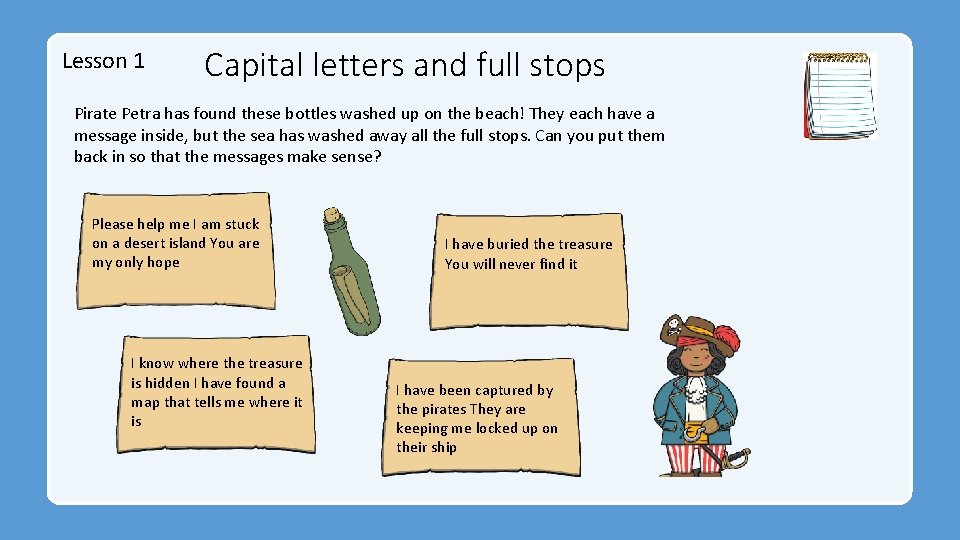
Lesson 1 Capital letters and full stops Pirate Petra has found these bottles washed up on the beach! They each have a message inside, but the sea has washed away all the full stops. Can you put them back in so that the messages make sense? Please help me I am stuck on a desert island You are my only hope II know where the treasure is hidden I where the treasure havehidden found a Imap thatfound tells me awhere is have it is that tells me where it map is II have buried the treasure You will buried the treasure never find it You will I have been captured by the pirates been captured by They are keeping. They me locked the pirates are up on their ship me locked up on keeping their ship
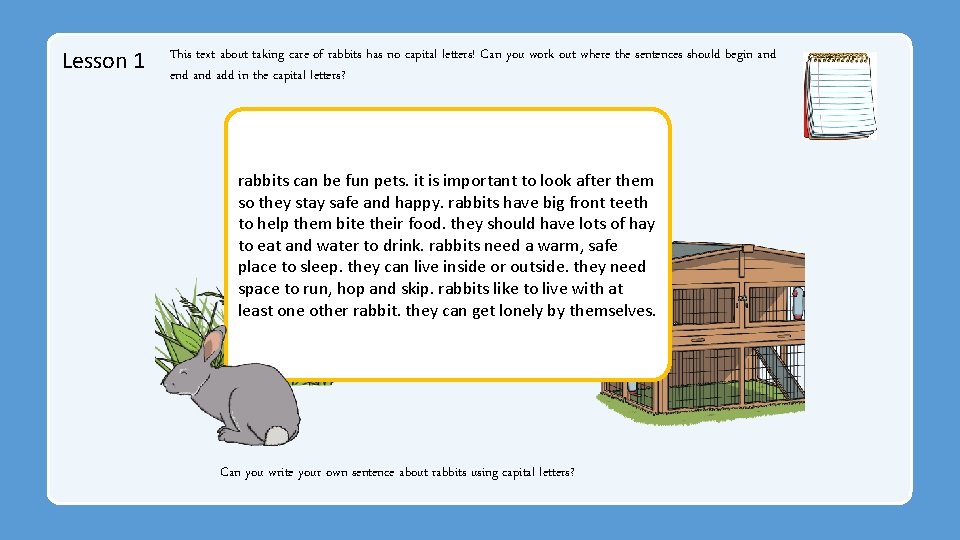
Lesson 1 This text about taking care of rabbits has no capital letters! Can you work out where the sentences should begin and end add in the capital letters? rabbits can be fun pets. it is important to look after them so they stay safe and happy. rabbits have big front teeth to help them bite their food. they should have lots of hay to eat and water to drink. rabbits need a warm, safe place to sleep. they can live inside or outside. they need space to run, hop and skip. rabbits like to live with at least one other rabbit. they can get lonely by themselves. Can you write your own sentence about rabbits using capital letters?
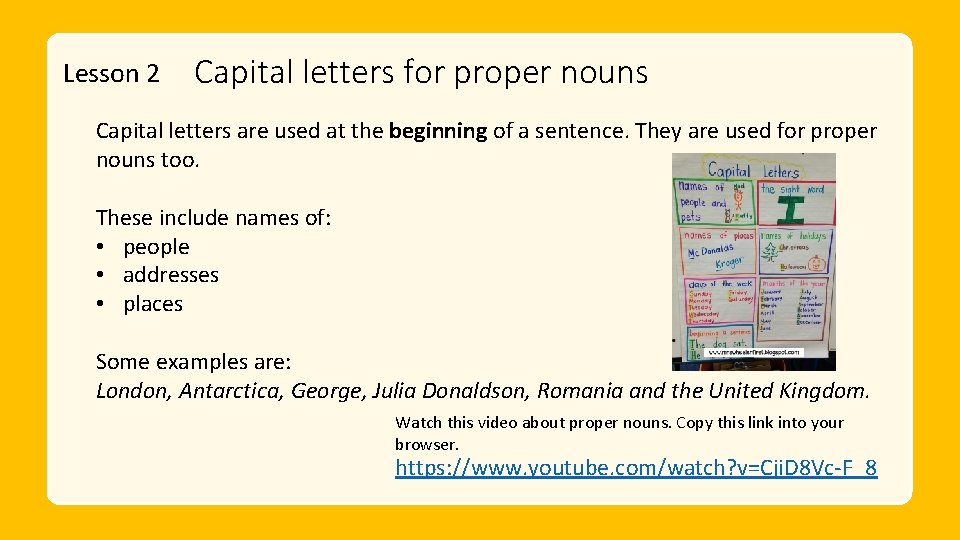
Lesson 2 Capital letters for proper nouns Capital letters are used at the beginning of a sentence. They are used for proper nouns too. These include names of: • people • addresses • places Some examples are: London, Antarctica, George, Julia Donaldson, Romania and the United Kingdom. Watch this video about proper nouns. Copy this link into your browser. https: //www. youtube. com/watch? v=Cji. D 8 Vc-F_8
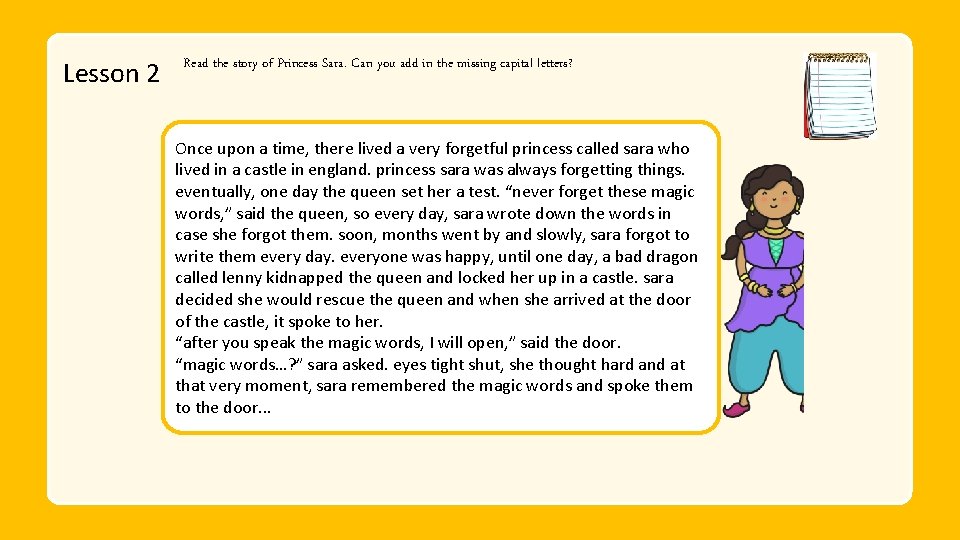
Lesson 2 Read the story of Princess Sara. Can you add in the missing capital letters? Once upon a time, there lived a very forgetful princess called sara who lived in a castle in england. princess sara was always forgetting things. eventually, one day the queen set her a test. “never forget these magic words, ” said the queen, so every day, sara wrote down the words in case she forgot them. soon, months went by and slowly, sara forgot to write them every day. everyone was happy, until one day, a bad dragon called lenny kidnapped the queen and locked her up in a castle. sara decided she would rescue the queen and when she arrived at the door of the castle, it spoke to her. “after you speak the magic words, I will open, ” said the door. “magic words…? ” sara asked. eyes tight shut, she thought hard and at that very moment, sara remembered the magic words and spoke them to the door. . .
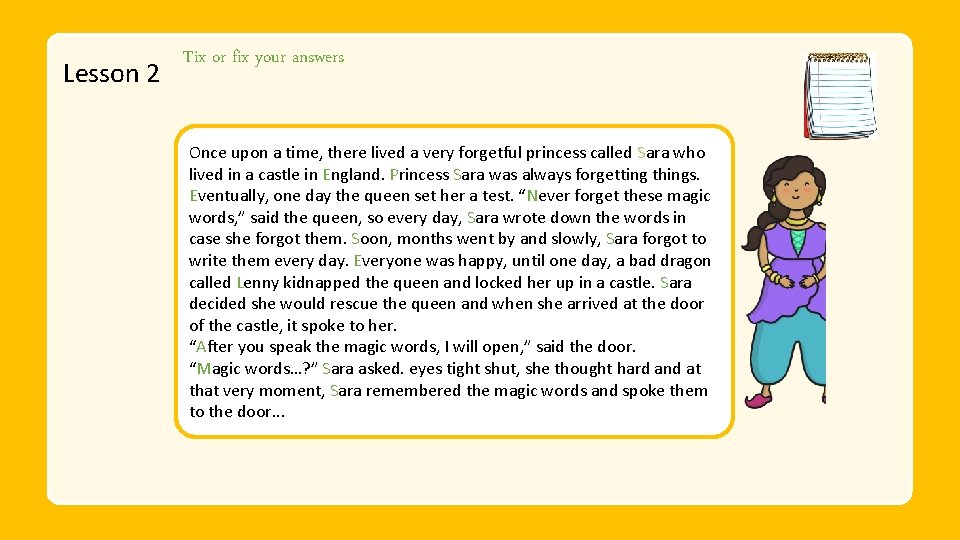
Lesson 2 Tix or fix your answers Once upon a time, there lived a very forgetful princess called Sara who lived in a castle in England. Princess Sara was always forgetting things. Eventually, one day the queen set her a test. “Never forget these magic words, ” said the queen, so every day, Sara wrote down the words in case she forgot them. Soon, months went by and slowly, Sara forgot to write them every day. Everyone was happy, until one day, a bad dragon called Lenny kidnapped the queen and locked her up in a castle. Sara decided she would rescue the queen and when she arrived at the door of the castle, it spoke to her. “After you speak the magic words, I will open, ” said the door. “Magic words…? ” Sara asked. eyes tight shut, she thought hard and at that very moment, Sara remembered the magic words and spoke them to the door. . .
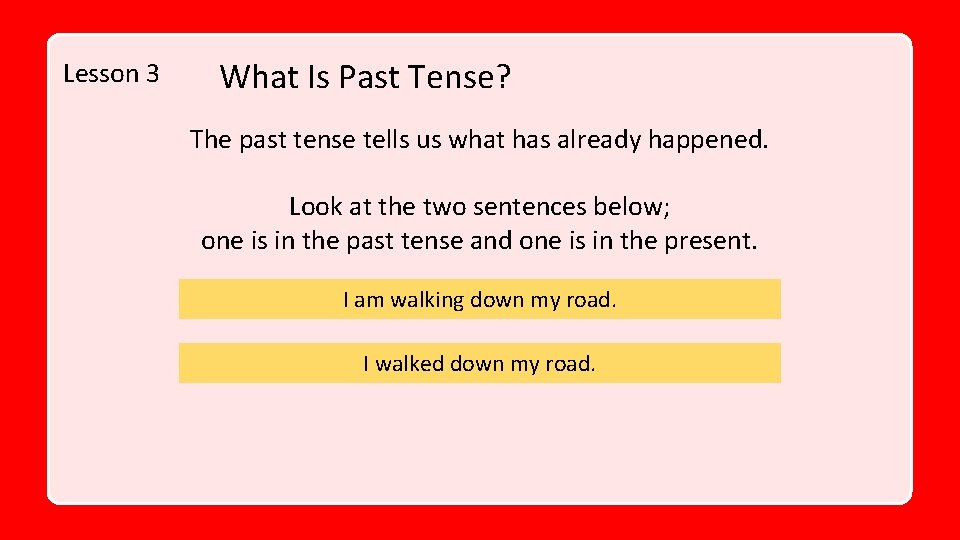
Lesson 3 What Is Past Tense? The past tense tells us what has already happened. Look at the two sentences below; one is in the past tense and one is in the present. I am walking down my road. I walked down my road.
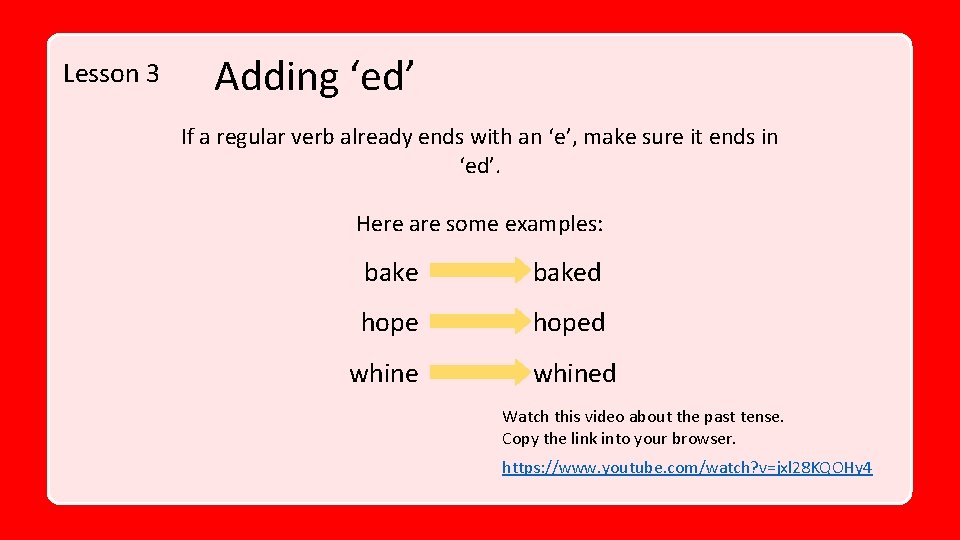
Lesson 3 Adding ‘ed’ If a regular verb already ends with an ‘e’, make sure it ends in ‘ed’. Here are some examples: baked hoped whined Watch this video about the past tense. Copy the link into your browser. https: //www. youtube. com/watch? v=jxl 28 KQOHy 4
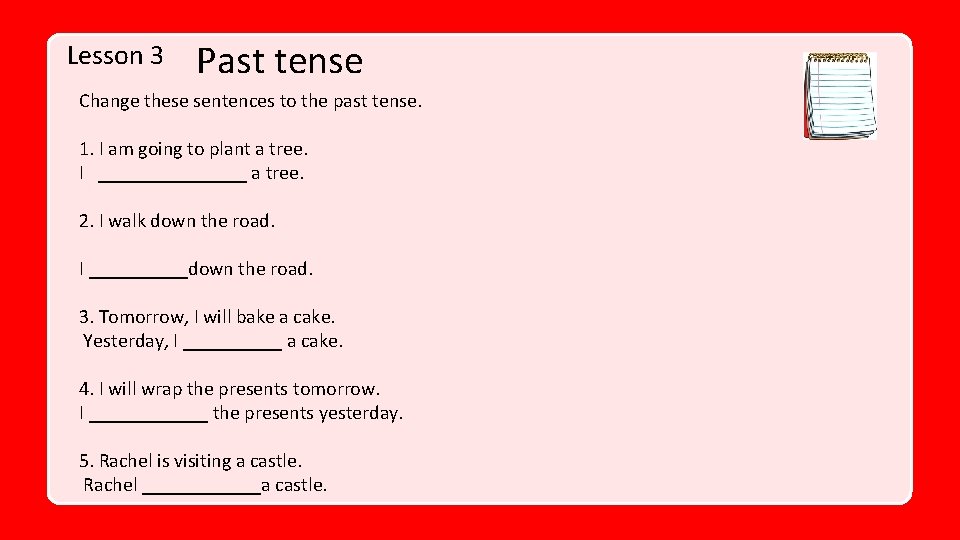
Lesson 3 Past tense Change these sentences to the past tense. 1. I am going to plant a tree. I ________ a tree. 2. I walk down the road. I _____down the road. 3. Tomorrow, I will bake a cake. Yesterday, I _____ a cake. 4. I will wrap the presents tomorrow. I ______ the presents yesterday. 5. Rachel is visiting a castle. Rachel ______a castle.
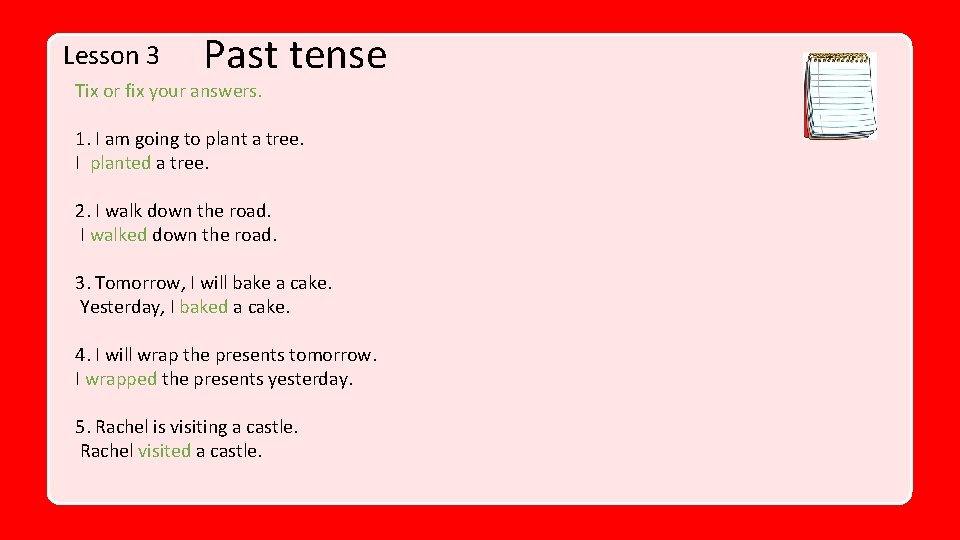
Lesson 3 Past tense Tix or fix your answers. 1. I am going to plant a tree. I planted a tree. 2. I walk down the road. I walked down the road. 3. Tomorrow, I will bake a cake. Yesterday, I baked a cake. 4. I will wrap the presents tomorrow. I wrapped the presents yesterday. 5. Rachel is visiting a castle. Rachel visited a castle.
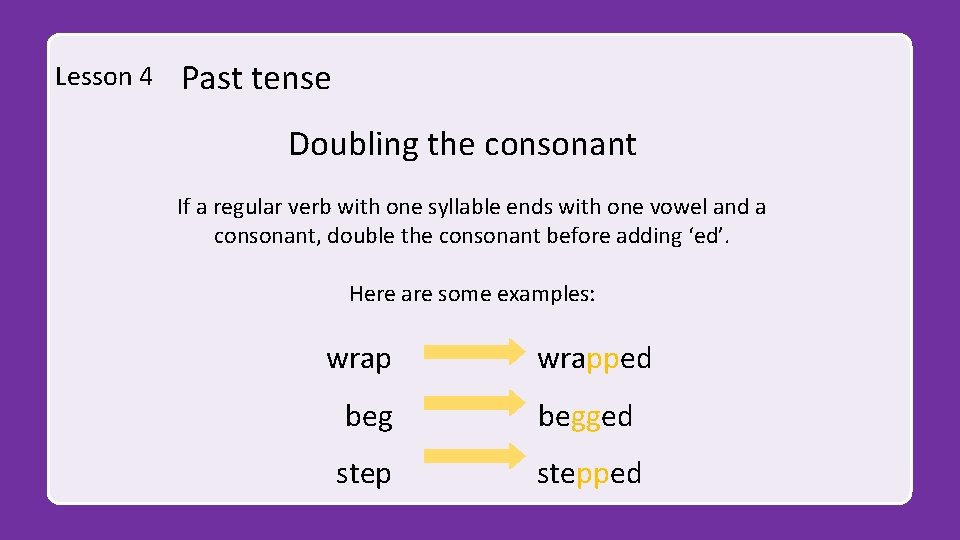
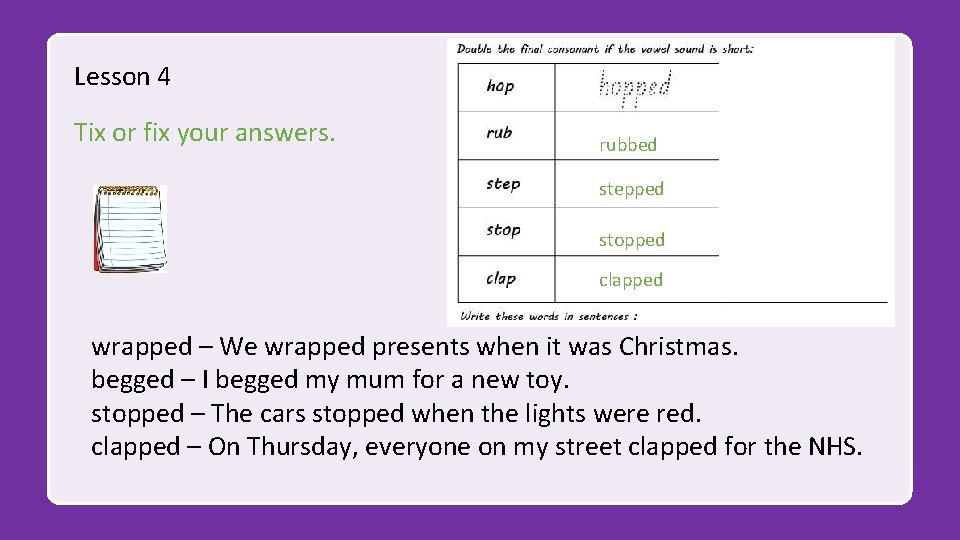
Lesson 4 Past tense Doubling the consonant If a regular verb with one syllable ends with one vowel and a consonant, double the consonant before adding ‘ed’. Here are some examples: wrapped begged stepped
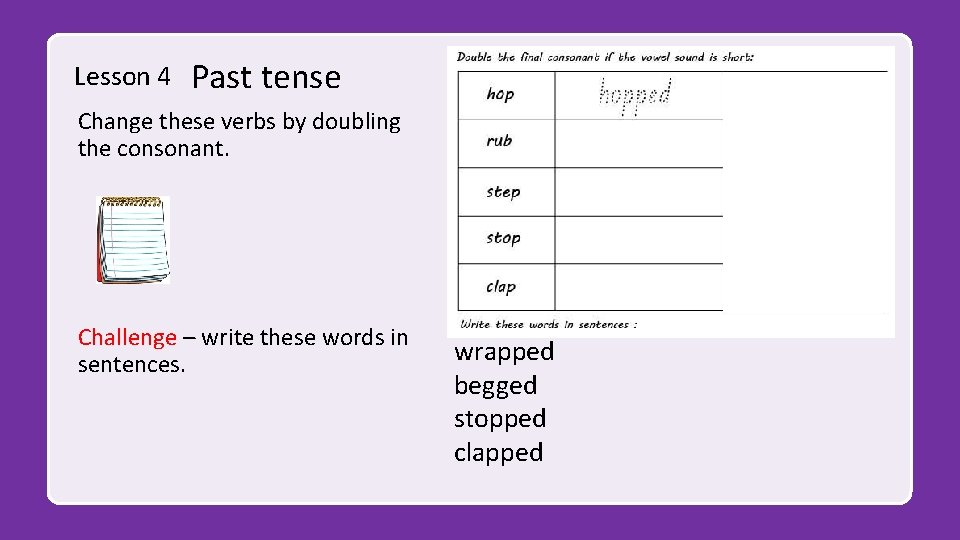
Lesson 4 Past tense Change these verbs by doubling the consonant. Challenge – write these words in sentences. wrapped begged stopped clapped
Lesson 4 Tix or fix your answers. rubbed stepped stopped clapped wrapped – We wrapped presents when it was Christmas. begged – I begged my mum for a new toy. stopped – The cars stopped when the lights were red. clapped – On Thursday, everyone on my street clapped for the NHS.
Lesson 5 Spelling quiz Listen here for our final quiz Today for your final lesson you will be completing a spelling quiz on all the words you have learnt this week! You will need: pencil brain paper
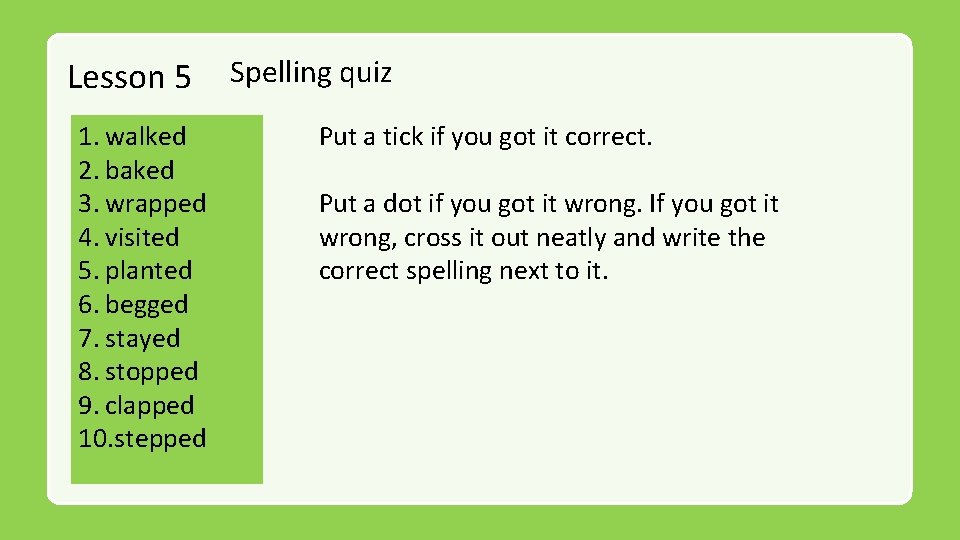
Lesson 5 1. walked 2. baked 3. wrapped 4. visited 5. planted 6. begged 7. stayed 8. stopped 9. clapped 10. stepped Spelling quiz Put a tick if you got it correct. Put a dot if you got it wrong. If you got it wrong, cross it out neatly and write the correct spelling next to it.