
LESSON 1 B 2 ADJECTIVE AGREEMENT Upon completing
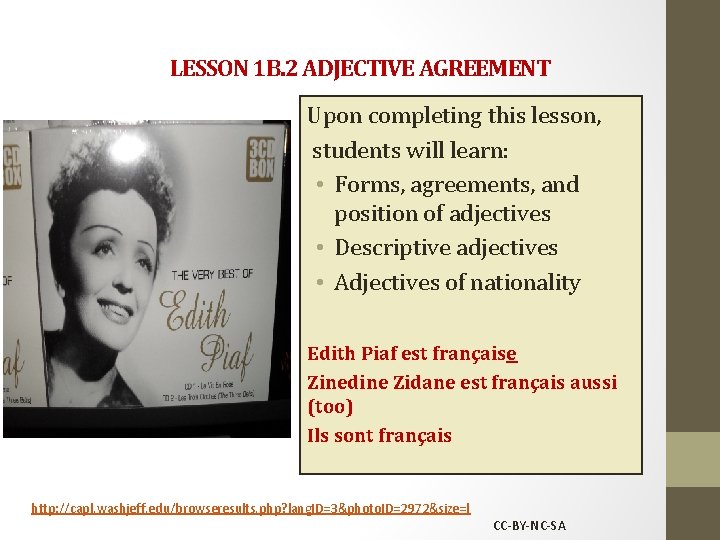
LESSON 1 B. 2 ADJECTIVE AGREEMENT Upon completing this lesson, students will learn: • Forms, agreements, and position of adjectives • Descriptive adjectives • Adjectives of nationality Edith Piaf est française Zinedine Zidane est français aussi (too) Ils sont français http: //capl. washjeff. edu/browseresults. php? lang. ID=3&photo. ID=2972&size=l CC-BY-NC-SA
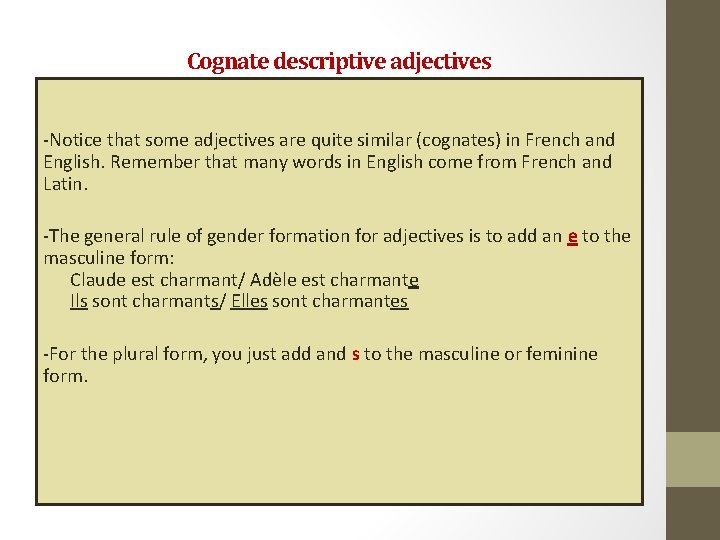
Cognate descriptive adjectives -Notice that some adjectives are quite similar (cognates) in French and English. Remember that many words in English come from French and Latin. -The general rule of gender formation for adjectives is to add an e to the masculine form: Claude est charmant/ Adèle est charmante Ils sont charmants/ Elles sont charmantes -For the plural form, you just add and s to the masculine or feminine form.
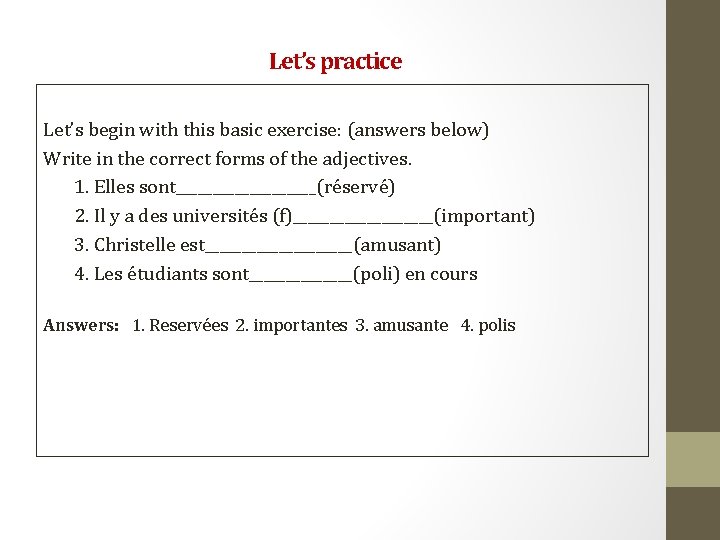
Let’s practice Let’s begin with this basic exercise: (answers below) Write in the correct forms of the adjectives. 1. Elles sont__________(réservé) 2. Il y a des universités (f)__________(important) 3. Christelle est__________(amusant) 4. Les étudiants sont_______(poli) en cours Answers: 1. Reservées 2. importantes 3. amusante 4. polis
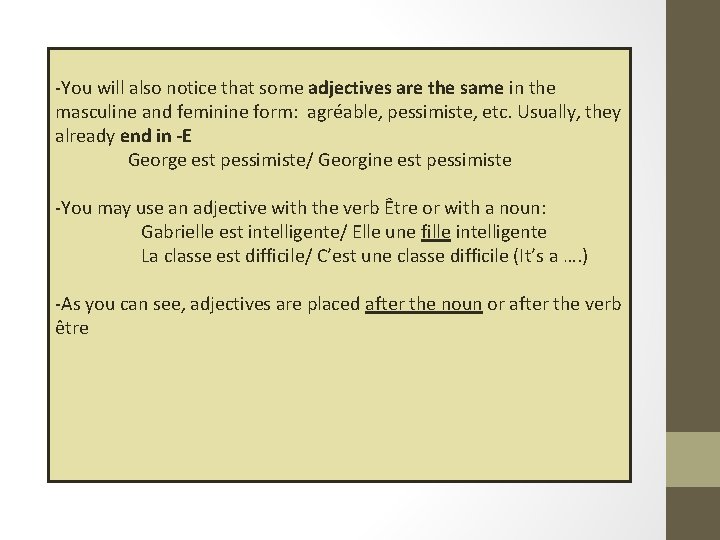
-You will also notice that some adjectives are the same in the masculine and feminine form: agréable, pessimiste, etc. Usually, they already end in -E George est pessimiste/ Georgine est pessimiste -You may use an adjective with the verb Être or with a noun: Gabrielle est intelligente/ Elle une fille intelligente La classe est difficile/ C’est une classe difficile (It’s a …. ) -As you can see, adjectives are placed after the noun or after the verb être
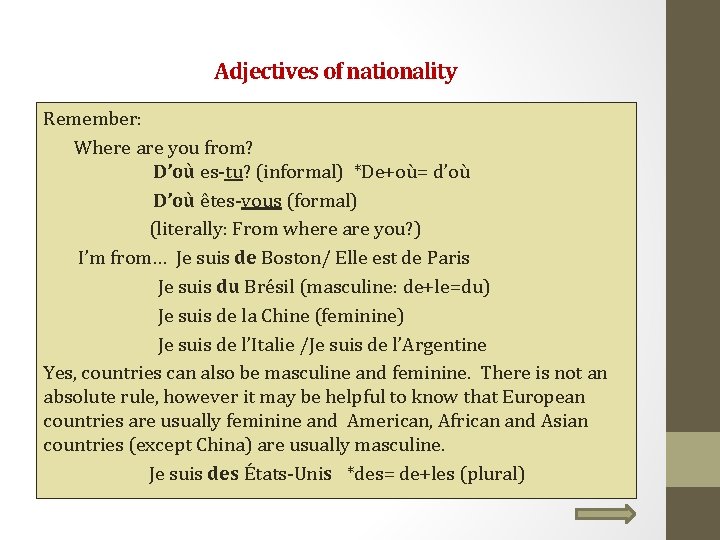
Adjectives of nationality Remember: Where are you from? D’où es-tu? (informal) *De+où= d’où D’où êtes-vous (formal) (literally: From where are you? ) I’m from… Je suis de Boston/ Elle est de Paris Je suis du Brésil (masculine: de+le=du) Je suis de la Chine (feminine) Je suis de l’Italie /Je suis de l’Argentine Yes, countries can also be masculine and feminine. There is not an absolute rule, however it may be helpful to know that European countries are usually feminine and American, African and Asian countries (except China) are usually masculine. Je suis des États-Unis *des= de+les (plural)
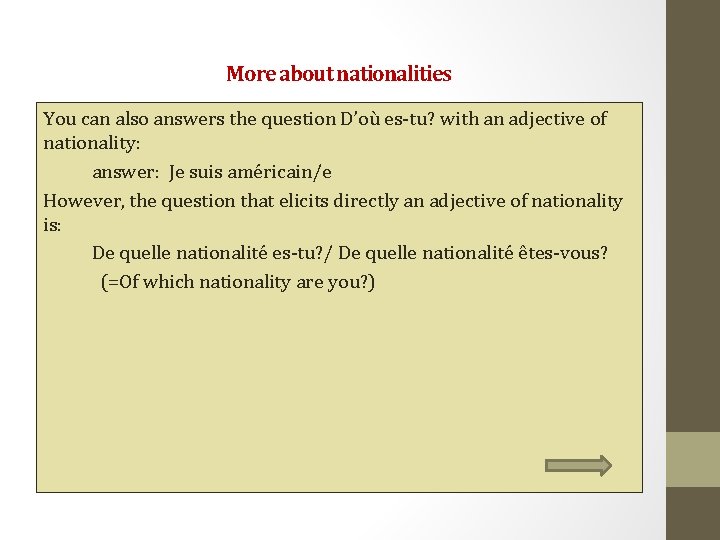
More about nationalities You can also answers the question D’où es-tu? with an adjective of nationality: answer: Je suis américain/e However, the question that elicits directly an adjective of nationality is: De quelle nationalité es-tu? / De quelle nationalité êtes-vous? (=Of which nationality are you? )
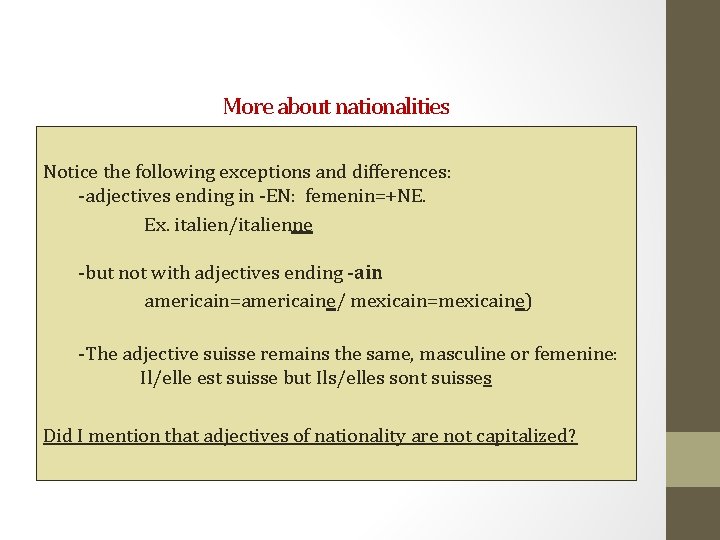
More about nationalities Notice the following exceptions and differences: -adjectives ending in -EN: femenin=+NE. Ex. italien/italienne -but not with adjectives ending -ain americain=americaine/ mexicain=mexicaine) -The adjective suisse remains the same, masculine or femenine: Il/elle est suisse but Ils/elles sont suisses Did I mention that adjectives of nationality are not capitalized?
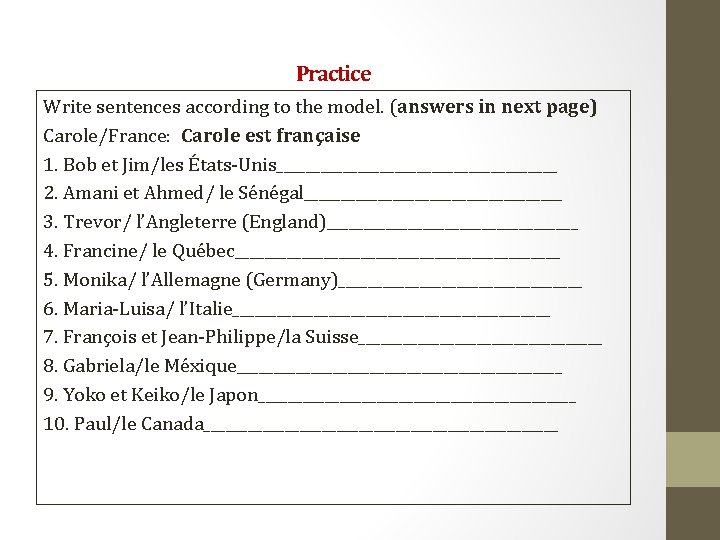
Practice Write sentences according to the model. (answers in next page) Carole/France: Carole est française 1. Bob et Jim/les États-Unis___________________ 2. Amani et Ahmed/ le Sénégal__________________ 3. Trevor/ l’Angleterre (England)_________________ 4. Francine/ le Québec______________________ 5. Monika/ l’Allemagne (Germany)_________________ 6. Maria-Luisa/ l’Italie______________________ 7. François et Jean-Philippe/la Suisse_________________ 8. Gabriela/le Méxique______________________ 9. Yoko et Keiko/le Japon______________________ 10. Paul/le Canada________________________
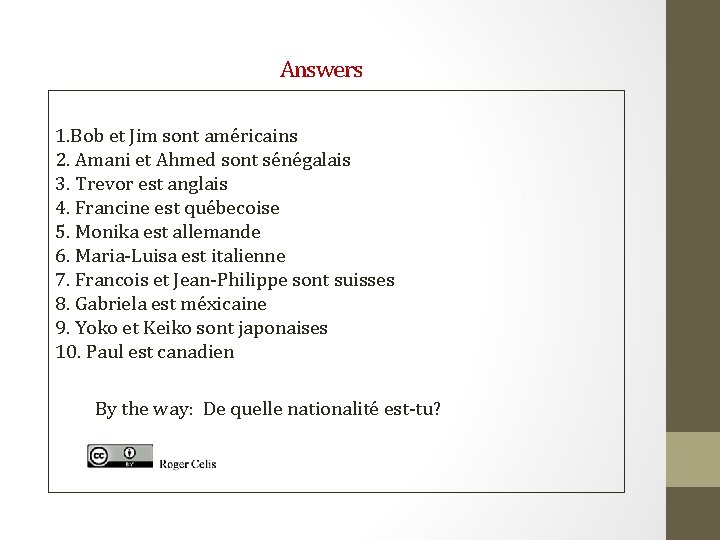
Answers 1. Bob et Jim sont américains 2. Amani et Ahmed sont sénégalais 3. Trevor est anglais 4. Francine est québecoise 5. Monika est allemande 6. Maria-Luisa est italienne 7. Francois et Jean-Philippe sont suisses 8. Gabriela est méxicaine 9. Yoko et Keiko sont japonaises 10. Paul est canadien By the way: De quelle nationalité est-tu?
- Slides: 9