
Lesson 1 4 Solving Inequalities Transitive Property IF
- Slides: 9
Lesson 1 -4 Solving Inequalities
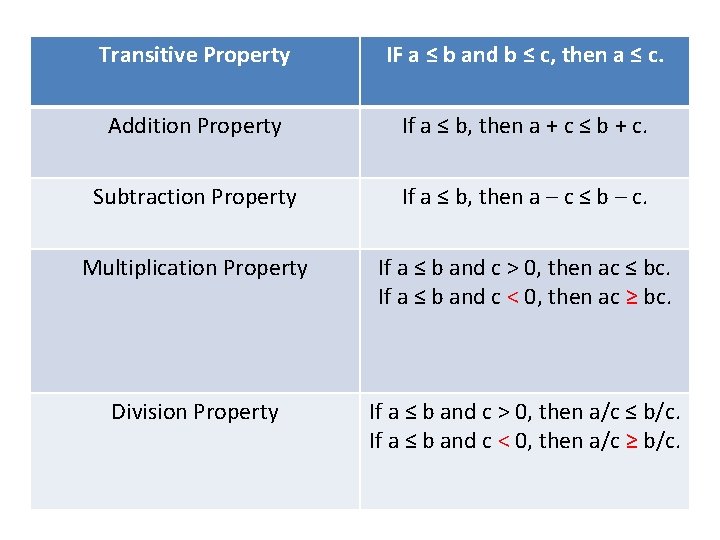
Transitive Property IF a ≤ b and b ≤ c, then a ≤ c. Addition Property If a ≤ b, then a + c ≤ b + c. Subtraction Property If a ≤ b, then a – c ≤ b – c. Multiplication Property If a ≤ b and c > 0, then ac ≤ bc. If a ≤ b and c < 0, then ac ≥ bc. Division Property If a ≤ b and c > 0, then a/c ≤ b/c. If a ≤ b and c < 0, then a/c ≥ b/c. Properties of Inequalities
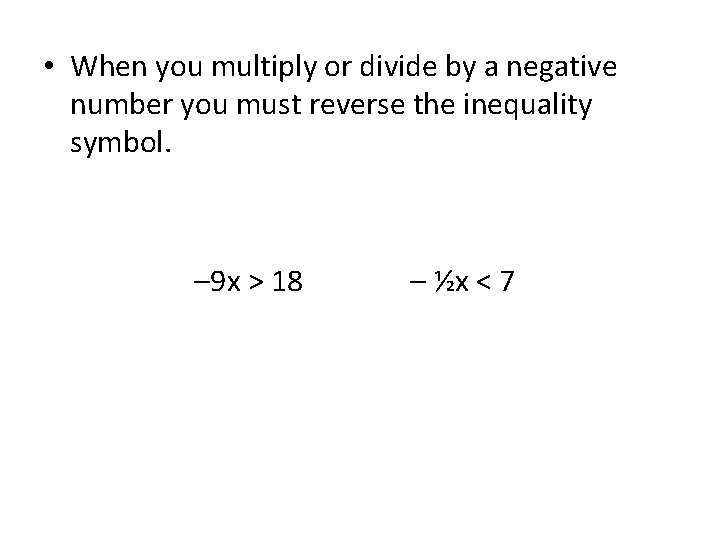
• When you multiply or divide by a negative number you must reverse the inequality symbol. – 9 x > 18 – ½x < 7
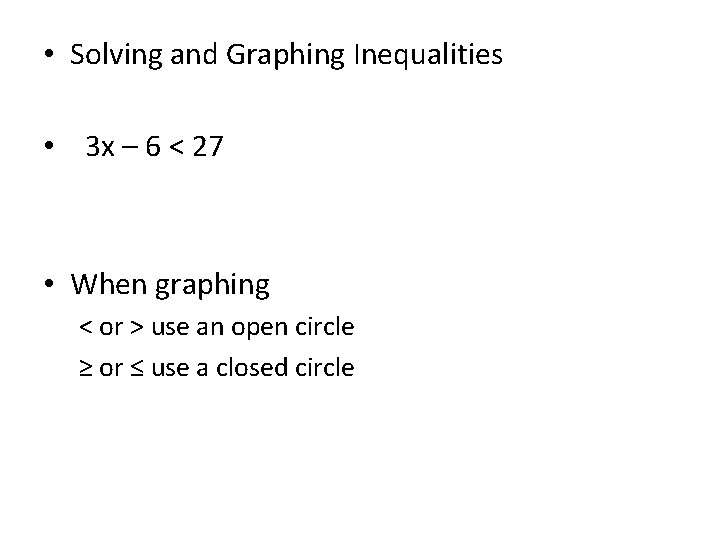
• Solving and Graphing Inequalities • 3 x – 6 < 27 • When graphing < or > use an open circle ≥ or ≤ use a closed circle
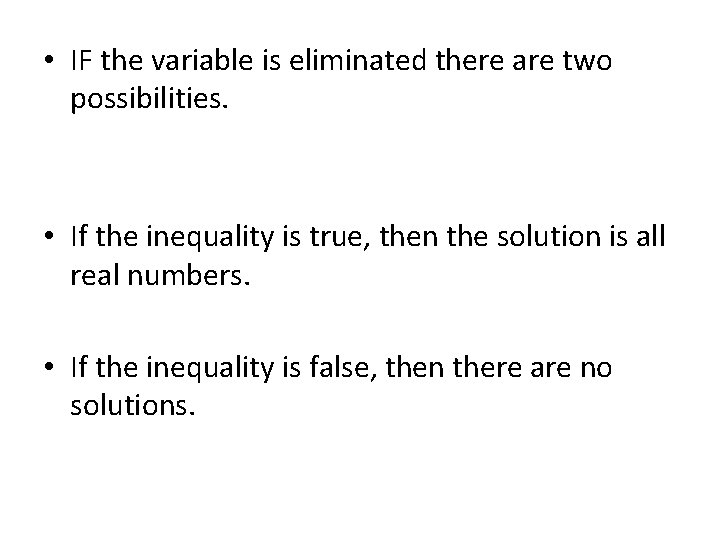
• IF the variable is eliminated there are two possibilities. • If the inequality is true, then the solution is all real numbers. • If the inequality is false, then there are no solutions.
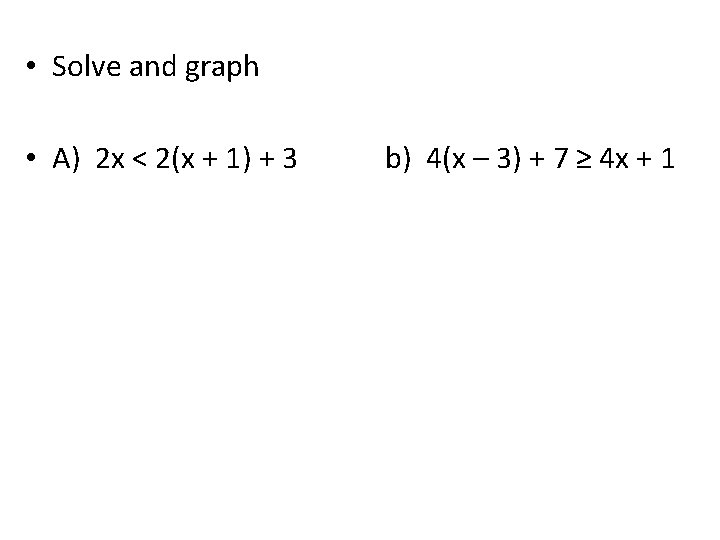
• Solve and graph • A) 2 x < 2(x + 1) + 3 b) 4(x – 3) + 7 ≥ 4 x + 1
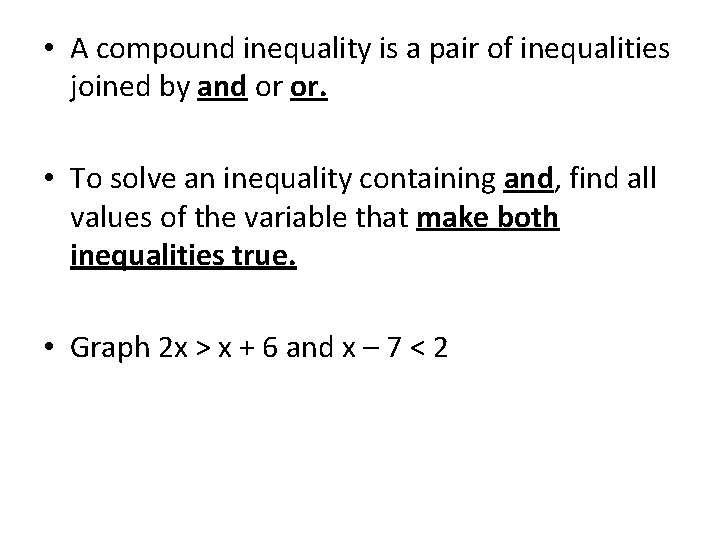
• A compound inequality is a pair of inequalities joined by and or or. • To solve an inequality containing and, find all values of the variable that make both inequalities true. • Graph 2 x > x + 6 and x – 7 < 2
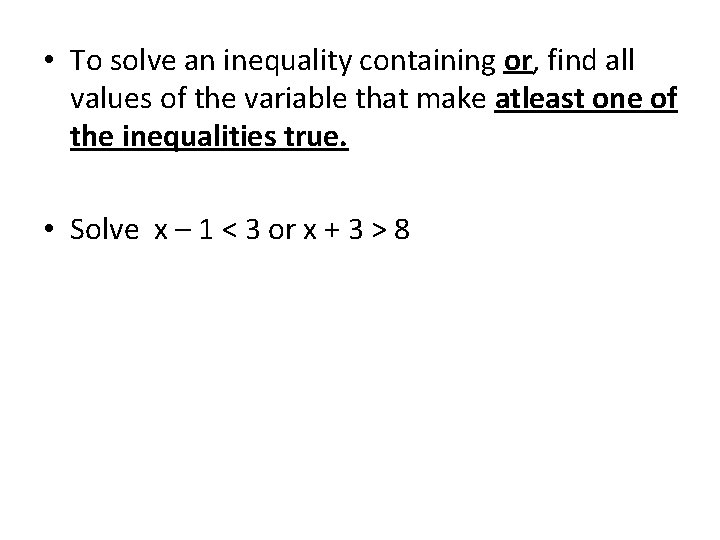
• To solve an inequality containing or, find all values of the variable that make atleast one of the inequalities true. • Solve x – 1 < 3 or x + 3 > 8
• Assignment: 2 – 34 even on pg 29 – 30.