
Lesotho Facts and Figures Full name The Kingdom





- Slides: 20
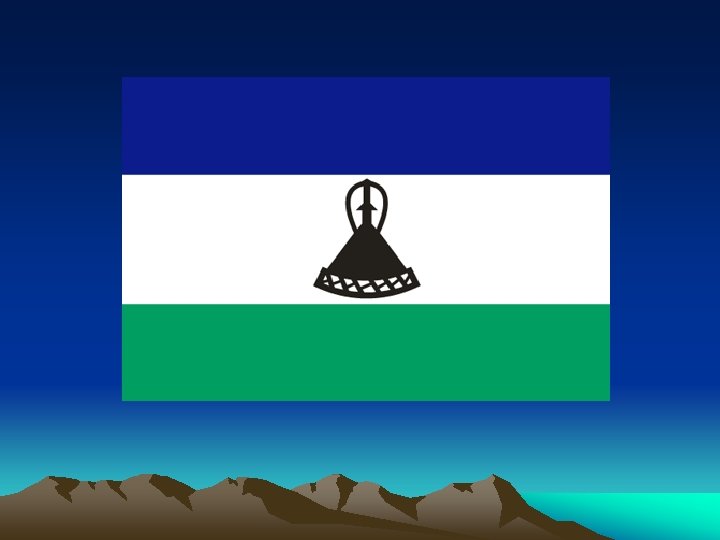
Lesotho Facts and Figures • • • Full name: The Kingdom of Lesotho Population: 1. 8 million (UN, 2005) Capital: Maseru Area: 30, 355 sq km (11, 720 sq miles) Major languages: Sesotho, English Major religion: Christianity Life expectancy: 35 years (men), 38 years (women) (UN) Monetary unit: 1 loti (L) = 100 lisente Main exports: Clothing, wool, mohair, food, livestock GNI per capita: US $960 (World Bank, 2006) UNDP HDI Rank - 149
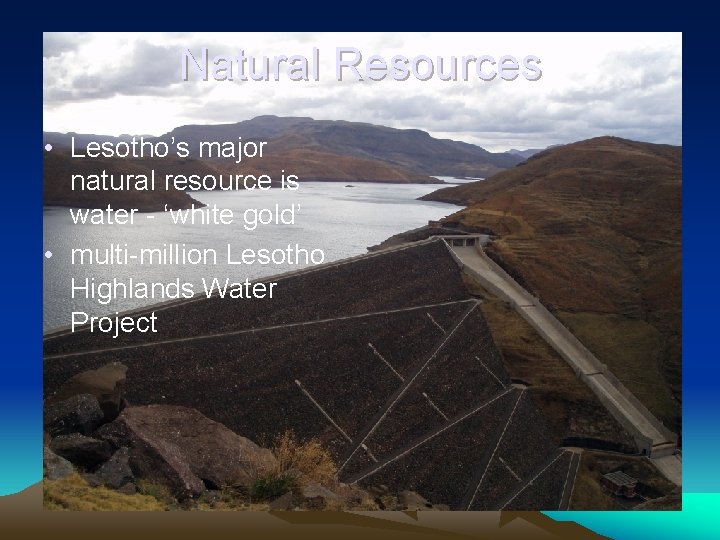
Natural Resources • Lesotho’s major natural resource is water - ‘white gold’ • multi-million Lesotho Highlands Water Project
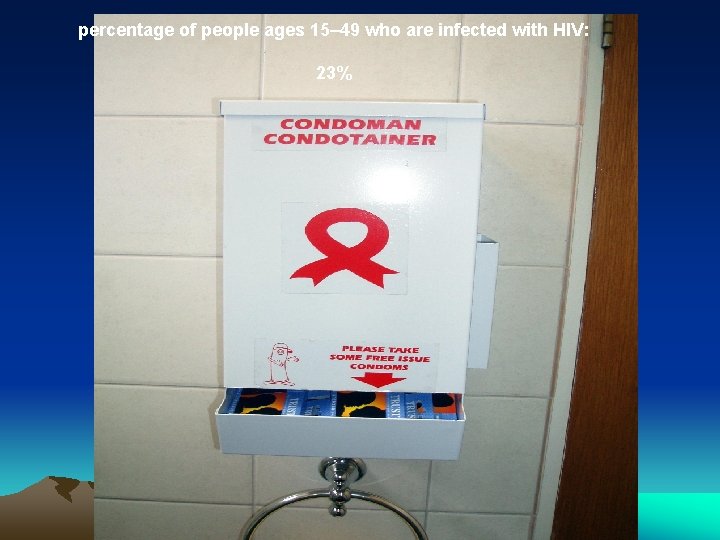
percentage of people ages 15– 49 who are infected with HIV: 23%
Economy • subsistence farming and animal husbandry, • small-scale industries - clothing, footwear, textiles, food processing and construction. • Small manufacturing base depends largely on farm products to support the milling, canning, leather and jute industries. • majority of households gain their livelihoods from subsistence farming and migrant labour, with a large portion of the adult male workforce employed in South African mines (Decreasing) • Unemployment remains high and is one of the most serious problems facing Lesotho, with poverty still severe.
Investment Opportunities • • • Clothing and blanket manufacture Furniture Footwear production Agro-industries, especially in processing of locally produced wool and mohair, establishment of mineral water bottling operations. Electrical or electronic consumer products - strategic partners to produce TV sets, video cassette recorders, electronic stoves, microwave ovens, refrigerators, washing machines and dryers, telecommunications equipment. A wide range of potential projects in the manufacturing, construction and services sectors connected to the Lesotho Highlands Water Project. Consulting engineering services for rehabilitation of rural hospitals. Hotels, lodges and other facilities catering for tourists. Road rehabilitation and maintenance. Health care equipment. Production of high quality rock-wool for insulation. Use of local clays for production of ceramic products such as sanitary ware, stoneware utensils, glazed advertising slabs.
MINISTRY OF EMPLOYMENT AND LABOUR • Vision To have an effective and efficient labour administration system that will ensure employment promotion, equality and HIV and AIDS competence within the labour force, promotion of social justice, industrial peace and harmony in accordance with international labour standards Mission To have strategies and mechanisms that promote non-discriminatory employment opportunities for all, good labour relations and social dialogue, HIV and AIDS competence within the labour force, social justice and enforcement of legal instruments and policies in accordance with international labour standards
ILO • Capacity building of social partners; • Training of trade unions / unity building efforts • Difficult to get beyond leadership. . • Importance of integrating HIV/AIDS into any work and onto CB agenda
Trade Unions • • LECODU: 14069 COLETU: 11479 LTUC: 1436 UNITY a big issue
Public Sector • civil servants prohibited from joining or forming unions but allowed to form staff associations • government regards all civil servants as essential employees so don’t enjoy the rights to strike or negotiate collectively
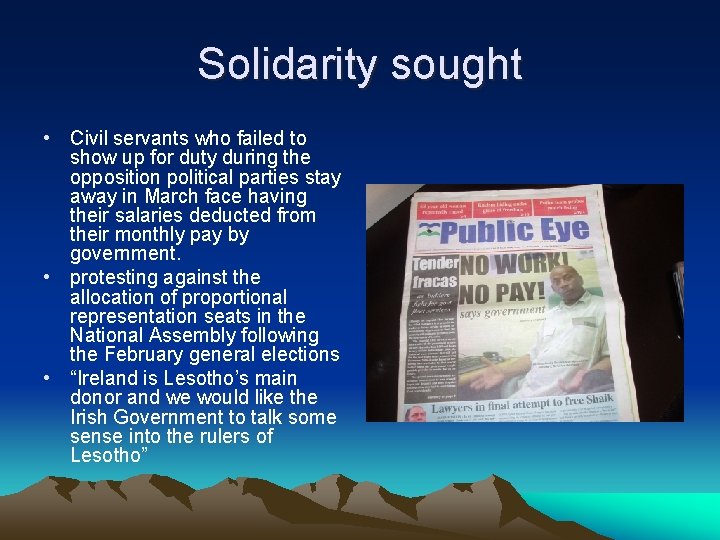
Solidarity sought • Civil servants who failed to show up for duty during the opposition political parties stay away in March face having their salaries deducted from their monthly pay by government. • protesting against the allocation of proportional representation seats in the National Assembly following the February general elections • “Ireland is Lesotho’s main donor and we would like the Irish Government to talk some sense into the rulers of Lesotho”
Garments and Textiles • ONE OF SUB-SAHARAN AFRICA’S LARGEST TEXTILE & CLOTHING INDUSTRIES • denim garments and garments made from cotton knit fabrics (mainly t-shirts, polo shirts, tracksuits & fleece) • 44 apparel firms make 90 million knitted garments, 26 million pairs of jeans per year • 45 889 employees, 85% women
Working Conditions • WAGES EARNED BY WORKERS IN LESOTHO’S TEXTILES & GARMENT INDUSTRY PLAY AN IMPORTANT ROLE IN POVERTY ALLEVIATION • Com. Mark currently estimates that Lesotho’s textile and apparel workers earn between M 450 and M 500 million (€ 50 m) a year. • Skilled garment workers monthly minimum wage of M 710 (€ 73), and unskilled workers a wage of M 660 (€ 68). • Lesotho’s labour laws enshrine all aspects of the ILO’s core conventions (no child / forced labour; non-discrimination; freedom of association), regulate maximum working hours (45 normal & 11 hours overtime per week); and minimum leave. • Regulated by the inspectorate of the Lesotho Ministry of Labour • Brands that source garments from Lesotho also monitor factory conditions. The GAP and Levis Strauss (in particular), but also Walmart, Jones Apparel, Sears, etc.
Exports • LARGEST SUB-SAHARAN EXPORTER OF GARMENTS TO THE USA (AGOA) • CONCERN THAT IT EXPORTS VIRTUALLY NOTHING TO THE EUROPEAN UNION • significant barrier to EU remains the restrictive Rules of Origin which do not allow for the use of 3 rd country fabrics – only fabrics procured locally (in Lesotho), or from other firms in African-Caribbean-Pacific (ACP) states, or which are made in the EU are acceptable. • vital for Lesotho to request that the EU (in the context of the proposed Economic Partnership Agreement (EPA) negotiations) to consider increased flexibility with regards apparel Ro. O so as to allow for the unrestricted use of 3 rd country fabrics.
Market Refocus? – In the medium to long term the expiry of the USA’s and the EU’s MFA China safeguards, and the likely success of the WTO’s NAMA discussions (i. e. “preference erosion”), will present Lesotho’s apparel manufacturers with significant challenges. – Lesotho’s apparel manufacturers stand a very real chance of loosing substantial market share unless these issues are confronted. • Com. Mark Proposals : – Stakeholders need to give urgent and careful consideration to these likely developments and to develop a sector strategy that will refocus Lesotho’s garment production to possibly : – supplying a greater proportion of its production to the RSA market place – allow Lesotho to position itself as the leading “African Brand” / “Made in Africa” supplier of garments to the USA and the EU markets (i. e. African made garments, made from African made fabrics, which have been made with African yarns, which have been made with African cotton). – pursue policies that would locate Lesotho as the destination of ethical choice (i. e. sound labour relations; observance of country’s labour laws; adherence to brand social compliance standards). – In addition Lesotho firms should attempt to champion the use of organic / fair trade and non-genetically modified cottons.
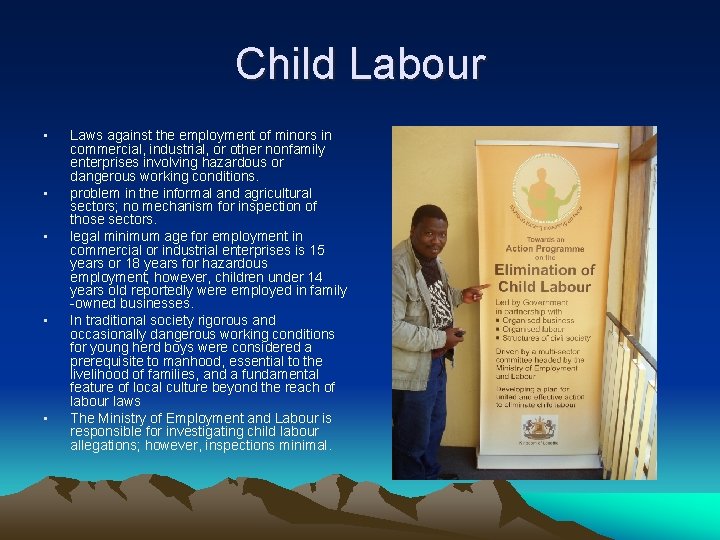
Child Labour • • • Laws against the employment of minors in commercial, industrial, or other nonfamily enterprises involving hazardous or dangerous working conditions. problem in the informal and agricultural sectors; no mechanism for inspection of those sectors. legal minimum age for employment in commercial or industrial enterprises is 15 years or 18 years for hazardous employment; however, children under 14 years old reportedly were employed in family -owned businesses. In traditional society rigorous and occasionally dangerous working conditions for young herd boys were considered a prerequisite to manhood, essential to the livelihood of families, and a fundamental feature of local culture beyond the reach of labour laws The Ministry of Employment and Labour is responsible for investigating child labour allegations; however, inspections minimal.
Irish Aid Support? • Civil Society Fund • Com. Mark interest? • Trade Union Support and involvement? • What will work in Lesotho? • Involvement of GUF’s?
Areas to be addressed? • Capacity Building in general: – LEPSSA – LECAWU/FAWU and Industrial Council – LECODU – a strong centre (training - IT, organising, HIV, negotiating skills, leadership etc. . )