
Leslie Model Day 1 Background Information Leslie Matrices
Leslie Model Day 1
Background Information Leslie Matrices are used for age specific growth. Why would we want to know about age specific growth? Wildlife management Urban policymakers P. H. Leslie of the Bureau of Animal Population of Oxford, England developed the model in 1945. The model uses age distribution of a population at a certain date, along with birth and survival rates for age specific groups to determine distributions of the survivors and descendents of the original population.
Definitions and Such Birthrate: the actual number of female births can be found by multiplying the birthrate by the # of females currently living within the age group. Survival rate: the probability that someone will survive and move to the next age group. Transition: the amount time in an age group. (Example age group is 0 -2 months, one transition = 2 months). Also called cycles. We only look at the female population with the Leslie model.
Woodland Mammal Example Age (months) Birthrate Survival Rate 0 -3 0 . 6 3 -6 . 3 . 9 6 -9 . 8 . 9 9 -12 . 7 . 8 12 -15 . 4 . 6 15 -18 0 0
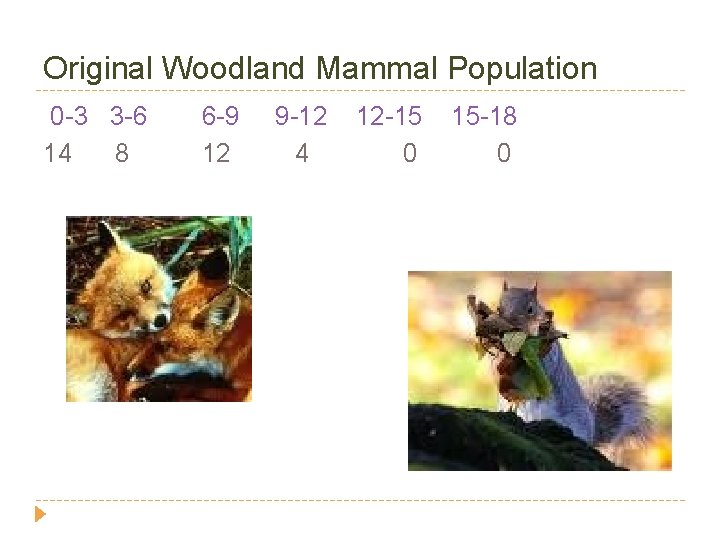
Original Woodland Mammal Population 0 -3 3 -6 14 8 6 -9 12 9 -12 4 12 -15 0 15 -18 0
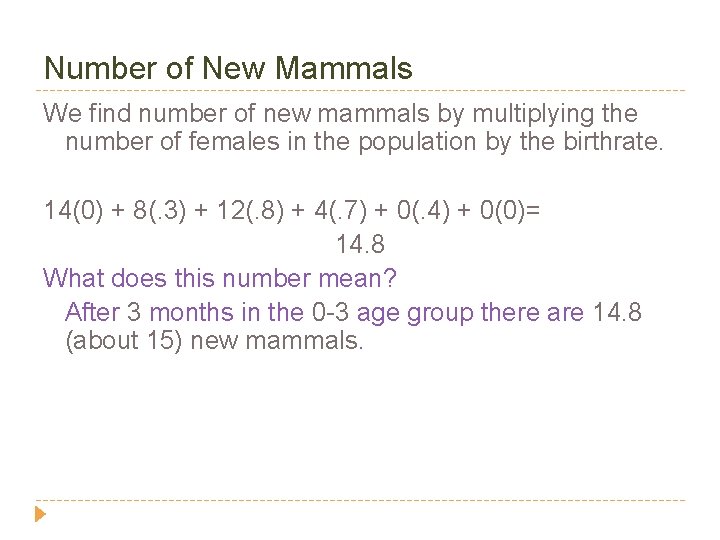
Number of New Mammals We find number of new mammals by multiplying the number of females in the population by the birthrate. 14(0) + 8(. 3) + 12(. 8) + 4(. 7) + 0(. 4) + 0(0)= 14. 8 What does this number mean? After 3 months in the 0 -3 age group there are 14. 8 (about 15) new mammals.
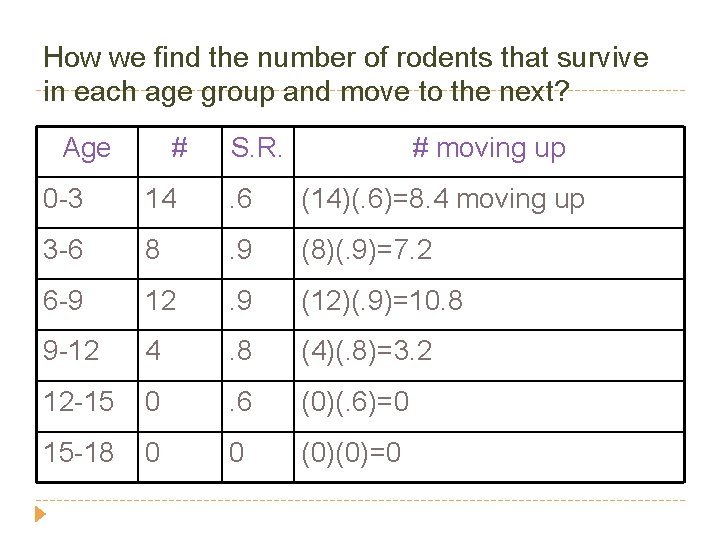
How we find the number of rodents that survive in each age group and move to the next? Age # S. R. # moving up 0 -3 14 . 6 (14)(. 6)=8. 4 moving up 3 -6 8 . 9 (8)(. 9)=7. 2 6 -9 12 . 9 (12)(. 9)=10. 8 9 -12 4 . 8 (4)(. 8)=3. 2 12 -15 0 . 6 (0)(. 6)=0 15 -18 0 0 (0)(0)=0
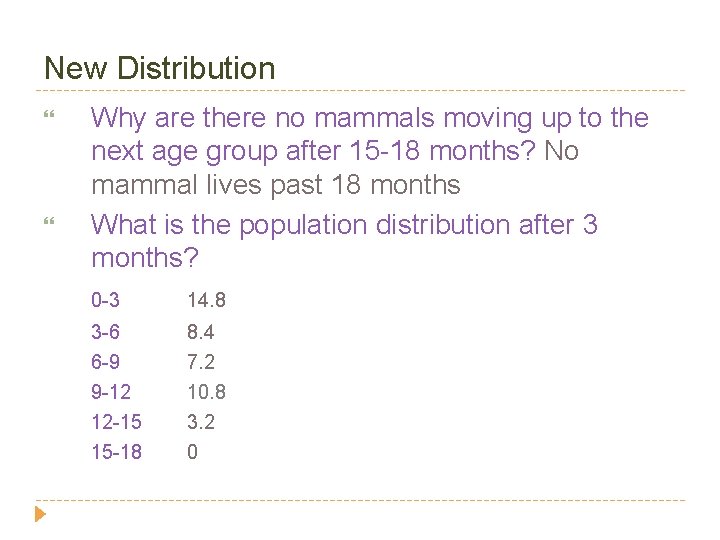
New Distribution Why are there no mammals moving up to the next age group after 15 -18 months? No mammal lives past 18 months What is the population distribution after 3 months? 0 -3 14. 8 3 -6 6 -9 9 -12 12 -15 15 -18 8. 4 7. 2 10. 8 3. 2 0
To find the population after 6 months… We do it all again! First find the number of mammals born from each age group. Then find how many move up. Now you can write the new distribution!
Population after 6 months… [17. 12 8. 88 7. 56 6. 48 8. 64 1. 92]
![Example 2 You try, then we will check answers! a)[0 21 0 0] b)](http://slidetodoc.com/presentation_image_h2/7adf7bc052b44ad5519c0ccc6bb27b72/image-11.jpg "Example 2 You try, then we will check answers! a)[0 21 0 0] b)")
Example 2 You try, then we will check answers! a)[0 21 0 0] b) [11 3 4. 5 4 3]
How long would we want to do this? Would we want to do this if we were interested in the rodent population after 6 years? NO! Let’s learn the Leslie Model, well tomorrow
Activity Create your own population! Be creative! Draw a picture of a member of your population. You will need an initial population, birth rate, and survival rate. Be creative here, too! Give interesting survival rates to see what happens. Give an explanation as to why the survival rate is the way it is!
- Slides: 13