
Leslie Deeb Success Coach Gabriela Brunner Career and

Leslie Deeb, Success Coach Gabriela Brunner, Career and Completion Coach Alex Berry, Director of Student Development and Title IX Coordinator
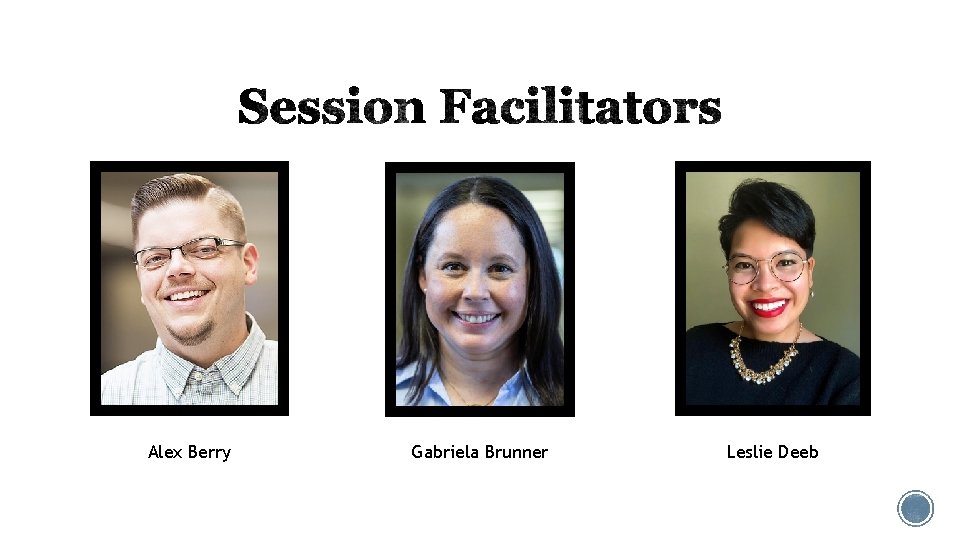
Alex Berry Gabriela Brunner Leslie Deeb
• What is "holding space"? • The "WHY" • Brave Spaces v. Safe Spaces • Comfort and Discomfort • Vulnerability • Language • Practical Tools and Approaches • Breakout Sessions • Reflective Action • Resource list
What does "holding space" mean to you? § Holding appointments or student POLL hours/office hours. § Fostering an open dialogue during class time. § I hold space in a different way than those listed. § I am not sure, but I am open to learning. L
Intentionally creating and fostering time for connection and reflection Understanding your student landscape or emotional "temperature" of your class Asking open-ended questions to encourage open dialogue Pausing and taking a mindful moment Acknowledging lived experiences and vicariously lived experiences impact individuals differently Humanizing the online experience No attempt to fix, offer solutions, or distract
§ Way to build faculty/student immediacy § Gives students a voice/decreases student/faculty power differential § Why not? A
§ Immediacy is verbal & nonverbal communication behaviors that enhance physical & psychological closeness (Mehrabian, 1969) § Frymier (2012) offers these suggestions to build immediacy§ Smiling, using students' names, referring to your class as "we" and "our" rather than "mine", engaging students in conversations § Immediate teachers are viewed as approachable, friendly, open, and responsive to student needs (Simonds, Wright, & Cooper, 2019) § In general, research findings indicate that teacher immediacy is associated with cognitive learning
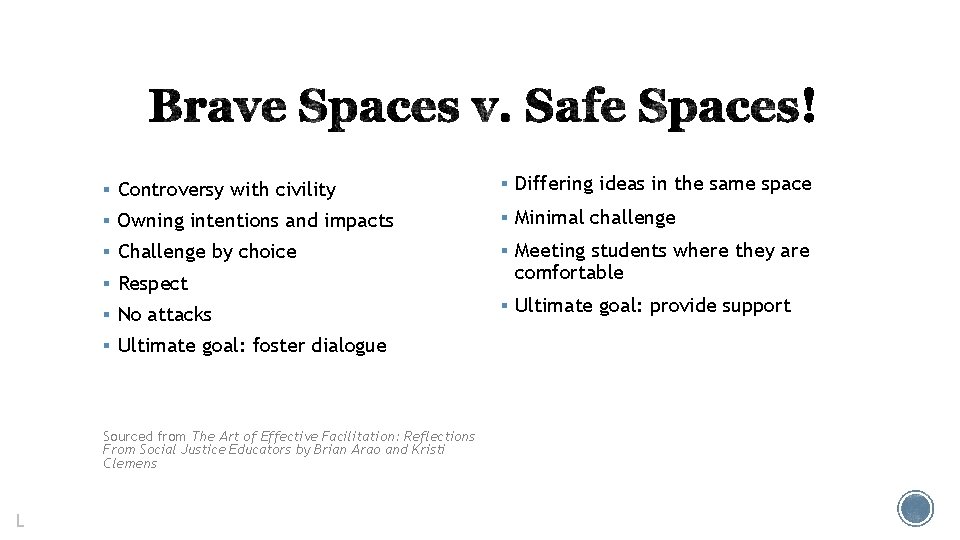
§ Controversy with civility § Differing ideas in the same space § Owning intentions and impacts § Minimal challenge § Challenge by choice § Meeting students where they are § Respect § No attacks § Ultimate goal: foster dialogue Sourced from The Art of Effective Facilitation: Reflections From Social Justice Educators by Brian Arao and Kristi Clemens L comfortable § Ultimate goal: provide support
• Why are you experiencing discomfort? Comfort & Discomfort G • Recognizing your "discomfort" zones – awareness around what the trigger is • Awareness is key: Subject Matter discomfort • Can you hold space now and learn about it later? • Can you hold space now and refer to a colleague? • Can you not hold space at all (vulnerability)? • "Empty Tank" discomfort • Can you hold any space at all? • If not, reschedule, refer. • Vulnerability discomfort • Are you willing to create courageous spaces? •
Vulnerability Defined "The definition of vulnerability is uncertainty, risk, and emotional exposure. But vulnerability is not weakness; it's our most accurate measure of courage. When the barrier is our belief about vulnerability, the question becomes: 'Are we willing to show up and be seen when we can't control the outcome? ' When the barrier to vulnerability is about safety, the question becomes: 'Are we willing to create courageous spaces so we can be fully seen? -Dr. Brene Brown, Braving the Wilderness: The Quest for True Belonging and the Courage to Stand Alone G
§ Deficit-Based Language § Places the blame on the student- "underprepared", "at-risk", etc. § Spends too much time focusing on what students don't have rather than what they do have § Whose knoweldge is valued in higher education? A
§ Reflection questions: § What about your communication to students show you are open to connecting with students? § How full is your cup? If low or empty, can you hold space or can you learn to mindfully pause? § What structures and rules are in place to ensure dialogue is constructive and civil, yet promote real learning and growth? § How do you invite all voices? § How do you equip students with tools to think, listen, and respond critically? § How do you respond when someone states an unpopular opinion? § Frameworks and approaches: § Well-intentioned v. Well-thought-out (intent vs. impact) § Holding space for a group v. holding space for an individual § Storytelling - be seen and heard § Tools: § Use Poll Everywhere for anonymous submissions § Invite students to meet 1 -1 or after class § Creating space by becoming aware of the breath § Becoming aware of your listening skills (listening v. hearing)
A
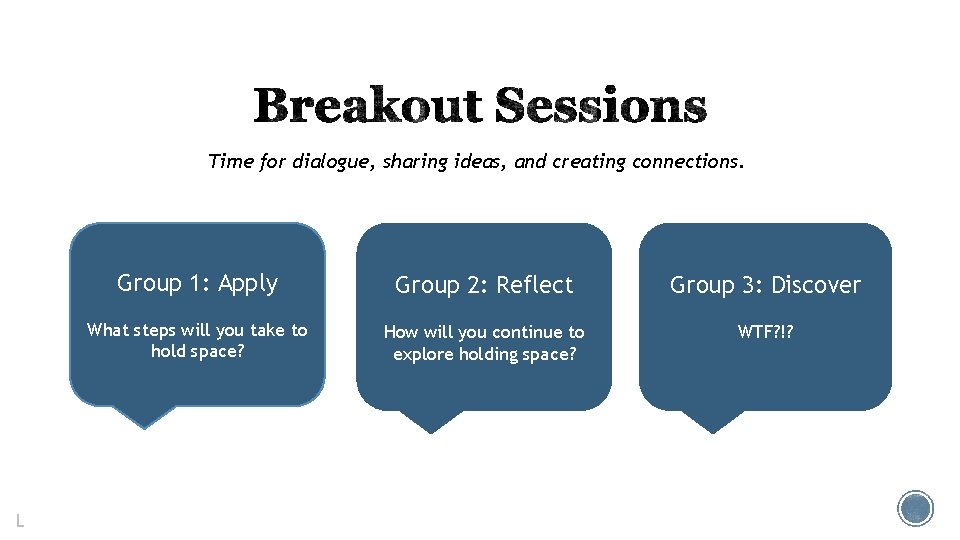
Time for dialogue, sharing ideas, and creating connections. L Group 1: Apply Group 2: Reflect Group 3: Discover What steps will you take to hold space? How will you continue to explore holding space? WTF? !?
§ Group Reflection: § Thoughts from today's session § Thoughts from breakout session § Reflective Action: § What steps will you take to hold space? § How will you continue to explore holding space? § Please complete session survey by Friday, October 30: § https: //www. surveymonkey. com/r/Holding. Space s L Reflective Action
§ Print § On Dialogue by David Bohm § Contemplative Practices in Higher Education by Daniel P Barbezat and Mirabai Bush § Online § Poll Everywhere: https: //blog. polleverywhere. com/10 -word-cloud-activities-classroom/ § Talking Across Divides: 10 Ways to Encourage Civil Classroom Conversation On Difficult § § Issues https: //www. nytimes. com/2016/09/28/learning/lesson-plans/talking-across-divides-10 -ways-to-encouragecivil-classroom-conversation-on-difficult-issues. html Humanizing the Online Experience: https: //docs. google. com/presentation/d/1 a. JXPV 8 Wbl. LKXJ 2 g. YBrk 5 b. KYwa 9 lpc 6 Yj. XA 4 LIb. T 7 rsw/edit#slid e=id. g 9 a 48170241_0_273 Safe Spaces and Brave Spaces: https: //www. naspa. org/images/uploads/main/Policy_and_Practice_No_2_Safe_Brave_Spaces. pdf It's Pronounced Metrosexual: https: //www. itspronouncedmetrosexual. com/ Why Storytelling is Powerful: https: //www. elephantjournal. com/2017/06/4 -reasons-why-storytelling-is-powerful/ § Connect with Us • Leslie Deeb, ldeeb@richland. edu • Gabriela Brunner, gbrunner@richland. edu • Alex Berry, aberry@richland. edu
- Slides: 16