
Les Numeros Les Jours Les Dates et Vocabulaire
Les Numeros, Les Jours, Les Dates et Vocabulaire
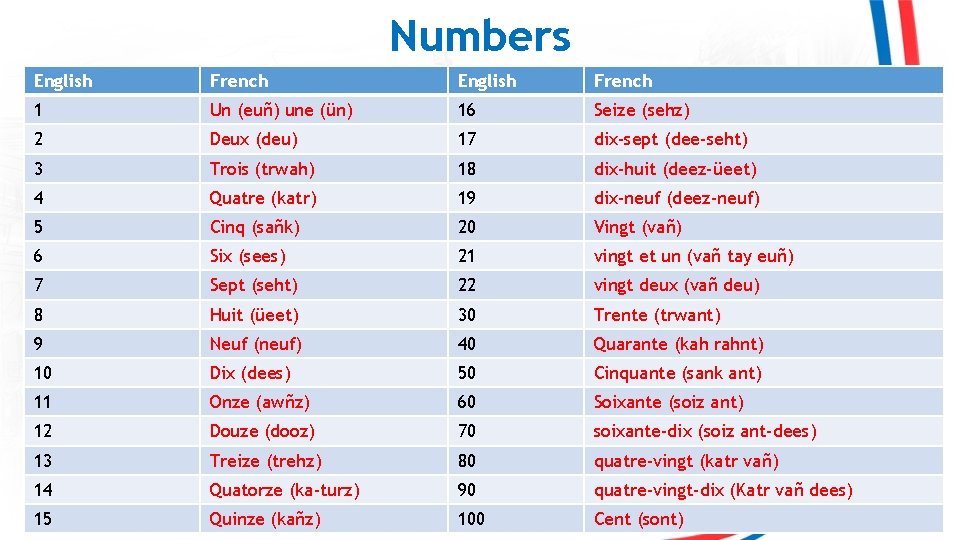
Numbers English French 1 Un (euñ) une (ün) 16 Seize (sehz) 2 Deux (deu) 17 dix-sept (dee-seht) 3 Trois (trwah) 18 dix-huit (deez-üeet) 4 Quatre (katr) 19 dix-neuf (deez-neuf) 5 Cinq (sañk) 20 Vingt (vañ) 6 Six (sees) 21 vingt et un (vañ tay euñ) 7 Sept (seht) 22 vingt deux (vañ deu) 8 Huit (üeet) 30 Trente (trwant) 9 Neuf (neuf) 40 Quarante (kah rahnt) 10 Dix (dees) 50 Cinquante (sank ant) 11 Onze (awñz) 60 Soixante (soiz ant) 12 Douze (dooz) 70 soixante-dix (soiz ant-dees) 13 Treize (trehz) 80 quatre-vingt (katr vañ) 14 Quatorze (ka-turz) 90 quatre-vingt-dix (Katr vañ dees) 15 Quinze (kañz) 100 Cent (sont)
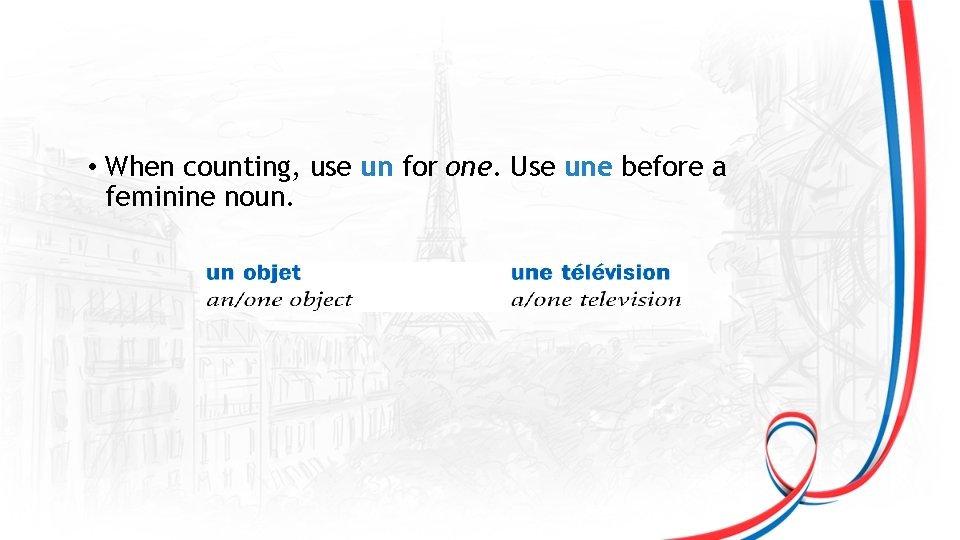
• When counting, use un for one. Use une before a feminine noun.
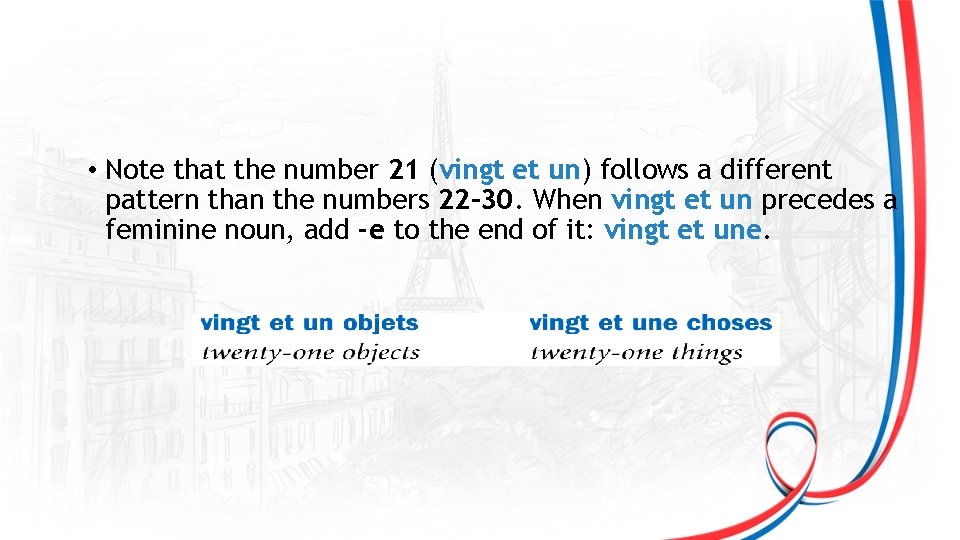
• Note that the number 21 (vingt et un) follows a different pattern than the numbers 22– 30. When vingt et un precedes a feminine noun, add -e to the end of it: vingt et une.
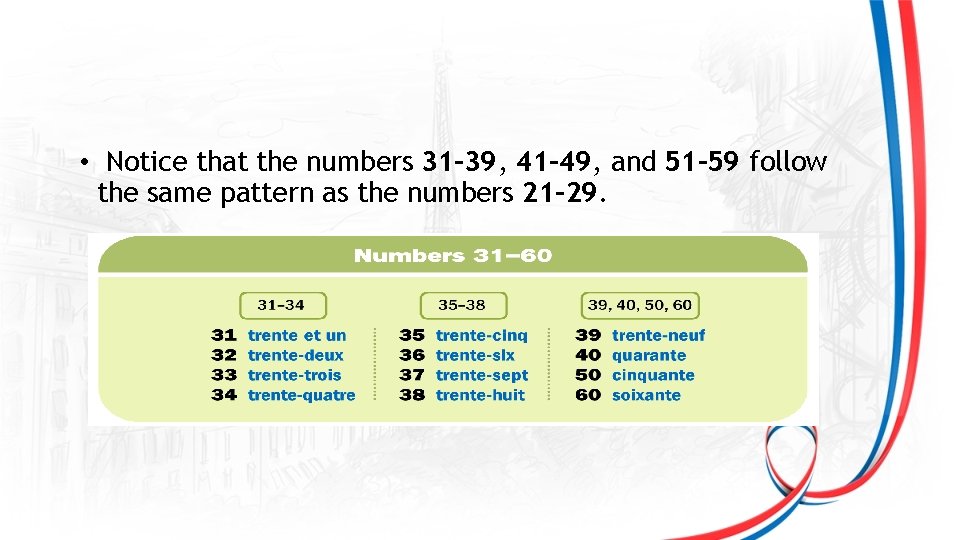
• Notice that the numbers 31– 39, 41– 49, and 51– 59 follow the same pattern as the numbers 21– 29.
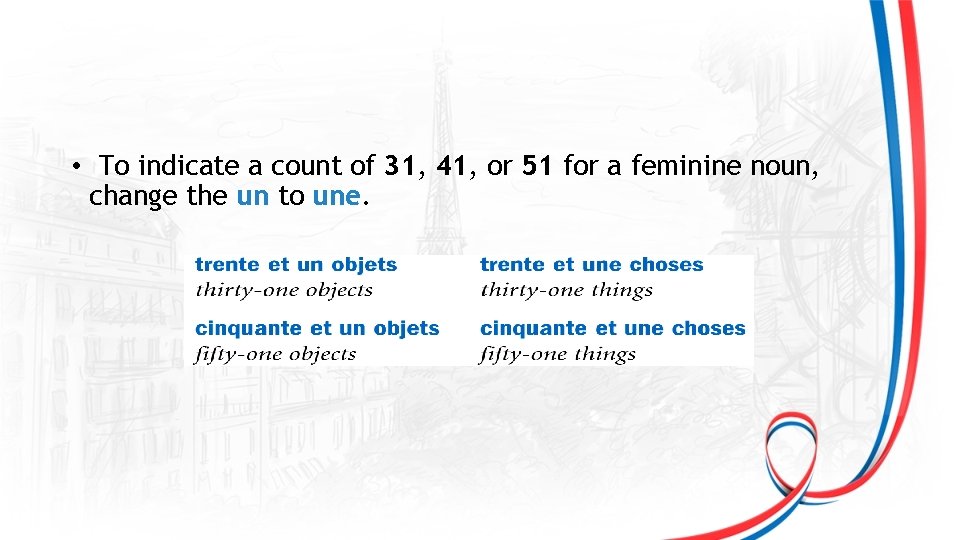
• To indicate a count of 31, 41, or 51 for a feminine noun, change the un to une.
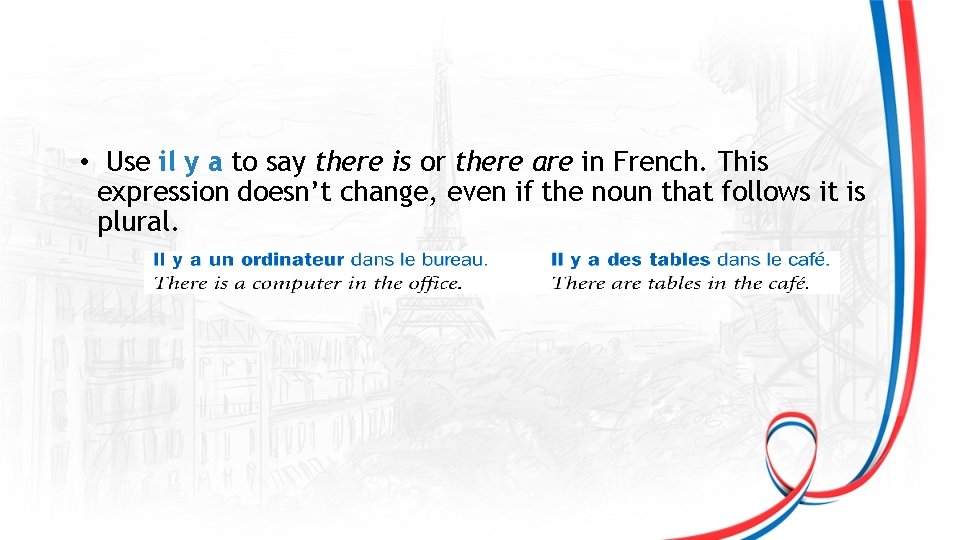
• Use il y a to say there is or there are in French. This expression doesn’t change, even if the noun that follows it is plural.
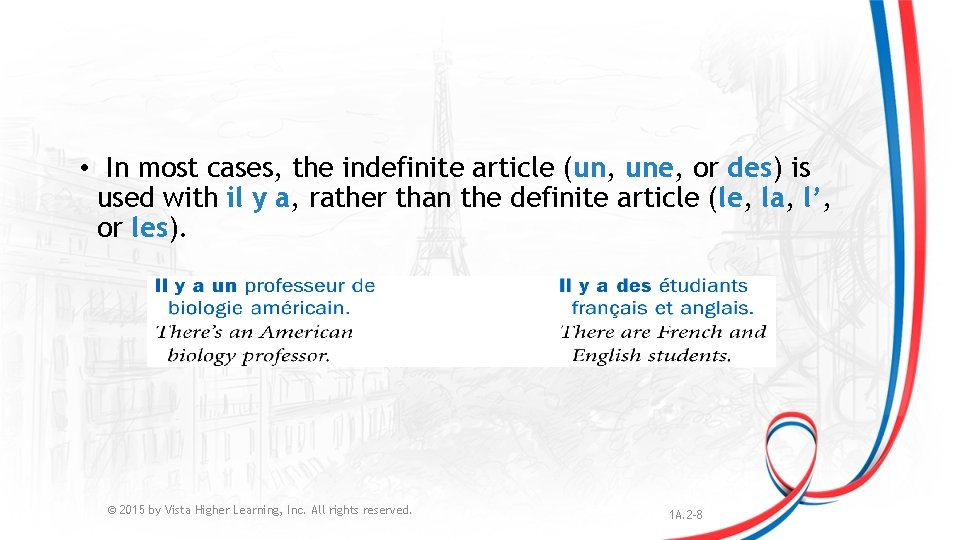
• In most cases, the indefinite article (un, une, or des) is used with il y a, rather than the definite article (le, la, l’, or les). © 2015 by Vista Higher Learning, Inc. All rights reserved. 1 A. 2 -8
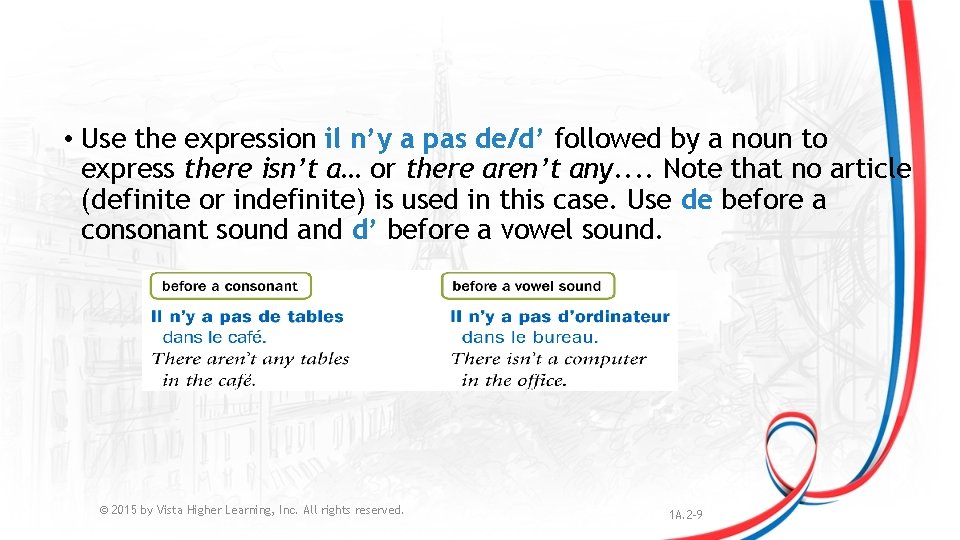
• Use the expression il n’y a pas de/d’ followed by a noun to express there isn’t a… or there aren’t any. . Note that no article (definite or indefinite) is used in this case. Use de before a consonant sound and d’ before a vowel sound. © 2015 by Vista Higher Learning, Inc. All rights reserved. 1 A. 2 -9
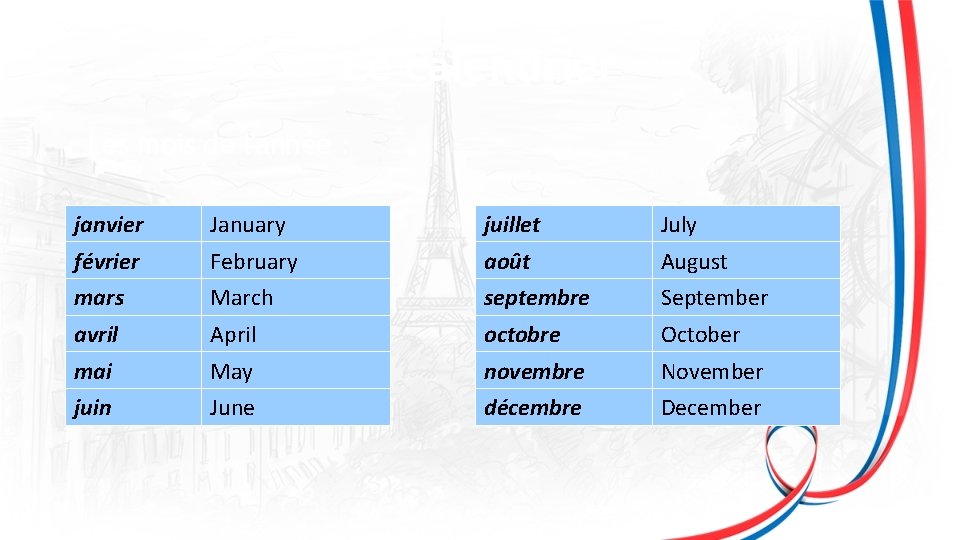
Le calendrier Les mois de l'année : janvier January juillet July février February août August mars March septembre September avril April octobre October mai May novembre November juin June décembre December
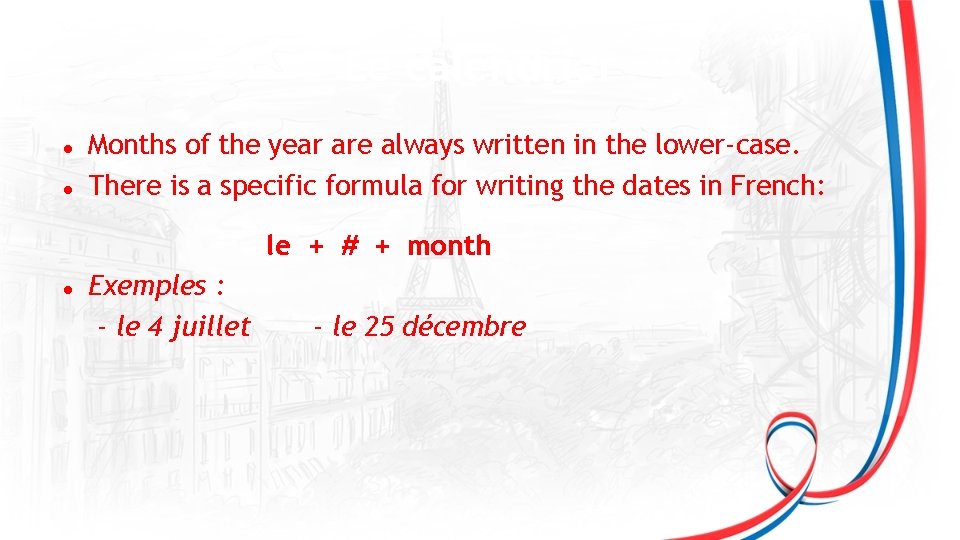
Le calendrier Months of the year are always written in the lower-case. There is a specific formula for writing the dates in French: le + # + month Exemples : - le 4 juillet - le 25 décembre
Le calendrier More rules concerning dates: Whenever it is the first of the month, such as le 1 septembre, we do not say “le un septembre”. We must use the ordinal number “first” in this instance, so we say “le premier septembre”.
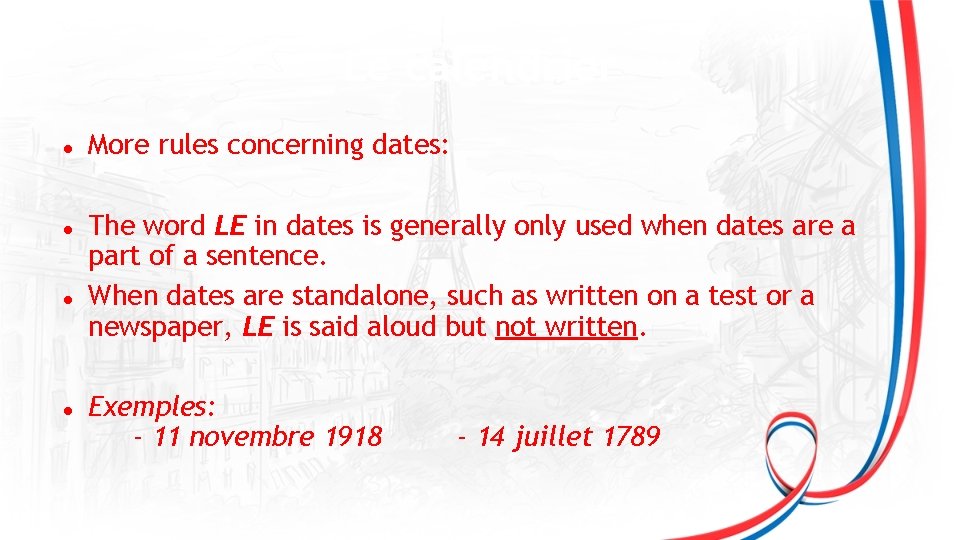
Le calendrier More rules concerning dates: The word LE in dates is generally only used when dates are a part of a sentence. When dates are standalone, such as written on a test or a newspaper, LE is said aloud but not written. Exemples: - 11 novembre 1918 - 14 juillet 1789
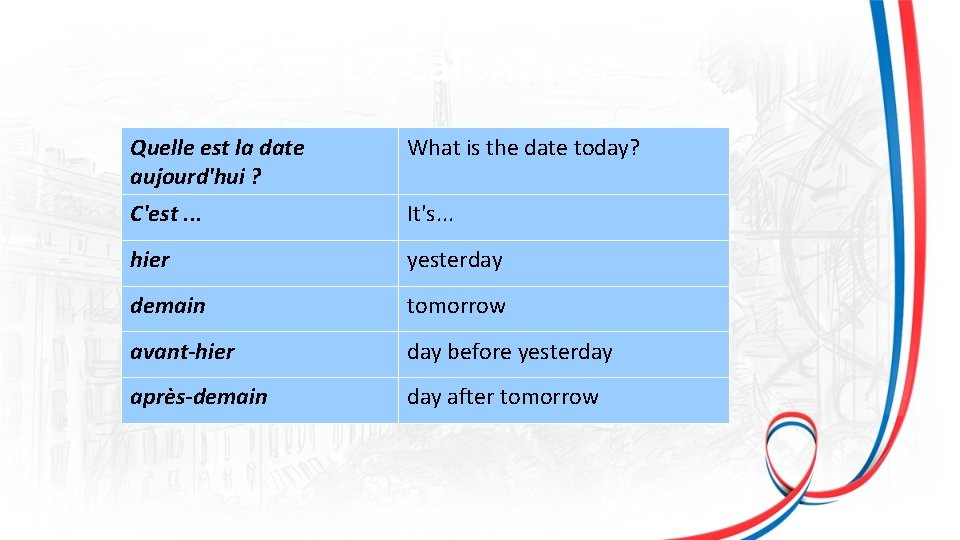
Le calendrier Quelle est la date aujourd'hui ? What is the date today? C'est. . . It's. . . hier yesterday demain tomorrow avant-hier day before yesterday après-demain day after tomorrow
Le calendrier Répondez aux petits tableaux : Quelle est la date. . . Aujourd'hui ? Hier ? Demain ? Avant-hier ? Après-demain ?
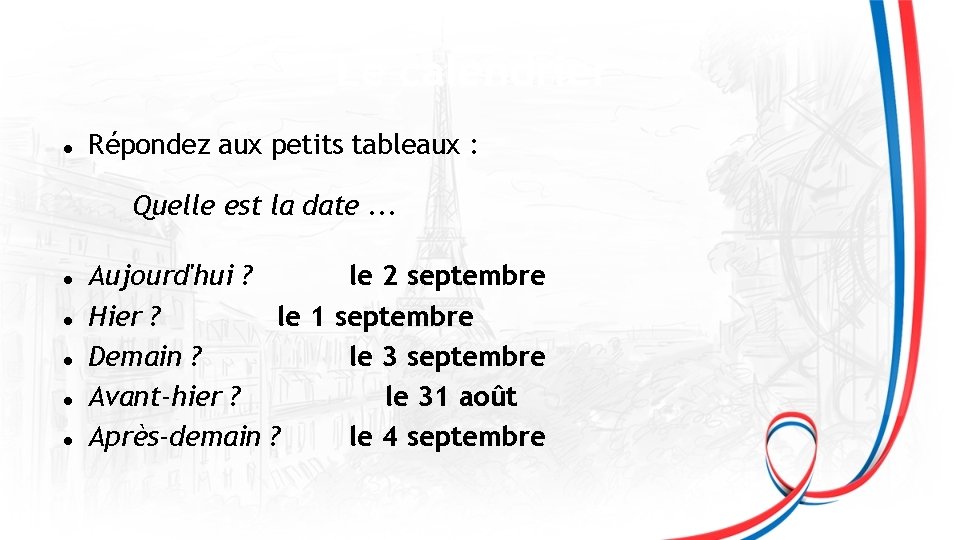
Le calendrier Répondez aux petits tableaux : Quelle est la date. . . Aujourd'hui ? le 2 septembre Hier ? le 1 septembre Demain ? le 3 septembre Avant-hier ? le 31 août Après-demain ? le 4 septembre
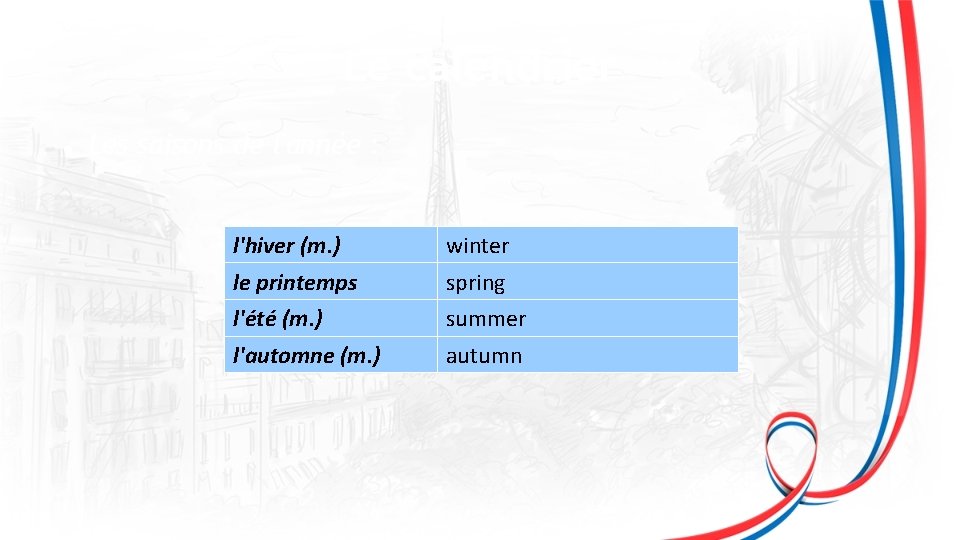
Le calendrier Les saisons de l'année : l'hiver (m. ) winter le printemps spring l'été (m. ) summer l'automne (m. ) autumn
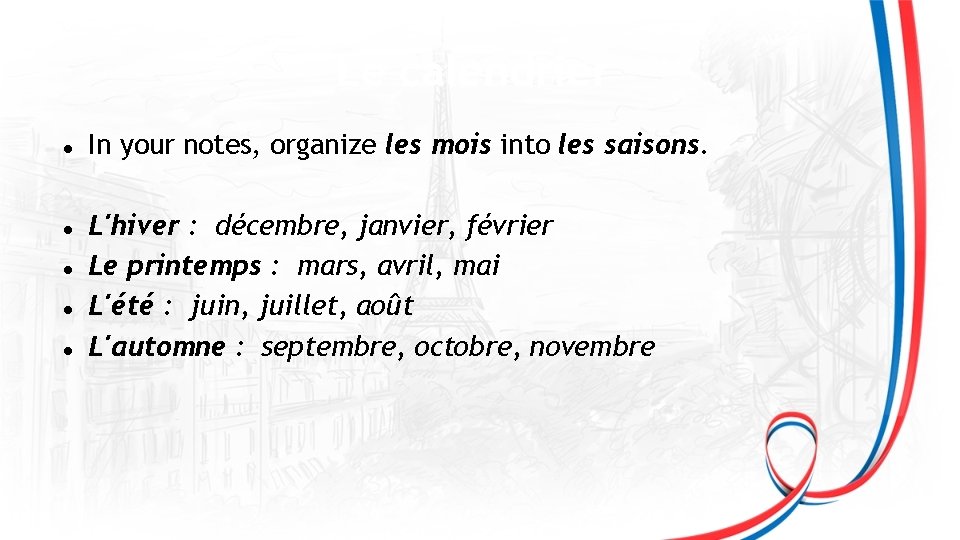
Le calendrier In your notes, organize les mois into les saisons. L'hiver : décembre, janvier, février Le printemps : mars, avril, mai L'été : juin, juillet, août L'automne : septembre, octobre, novembre
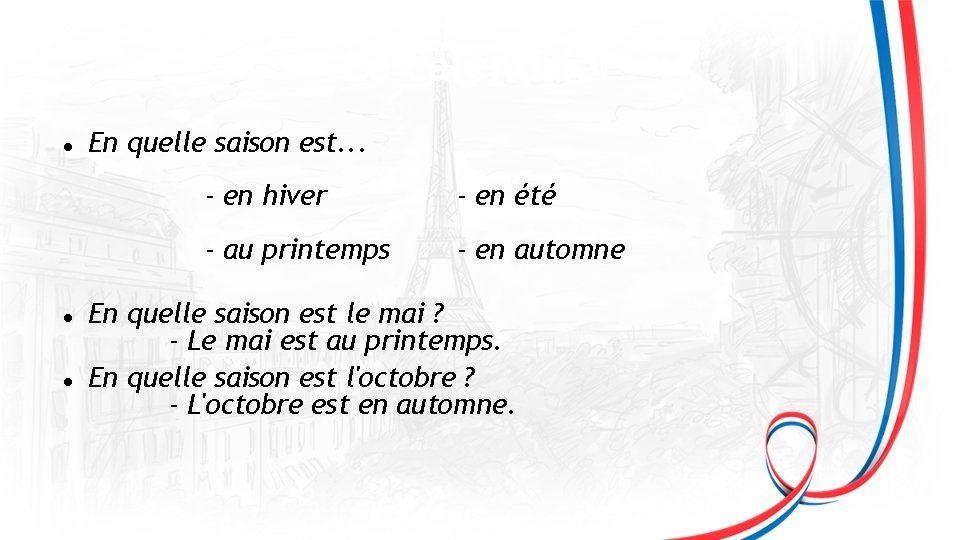
Le calendrier En quelle saison est. . . - en hiver - en été - au printemps - en automne En quelle saison est le mai ? - Le mai est au printemps. En quelle saison est l'octobre ? - L'octobre est en automne.
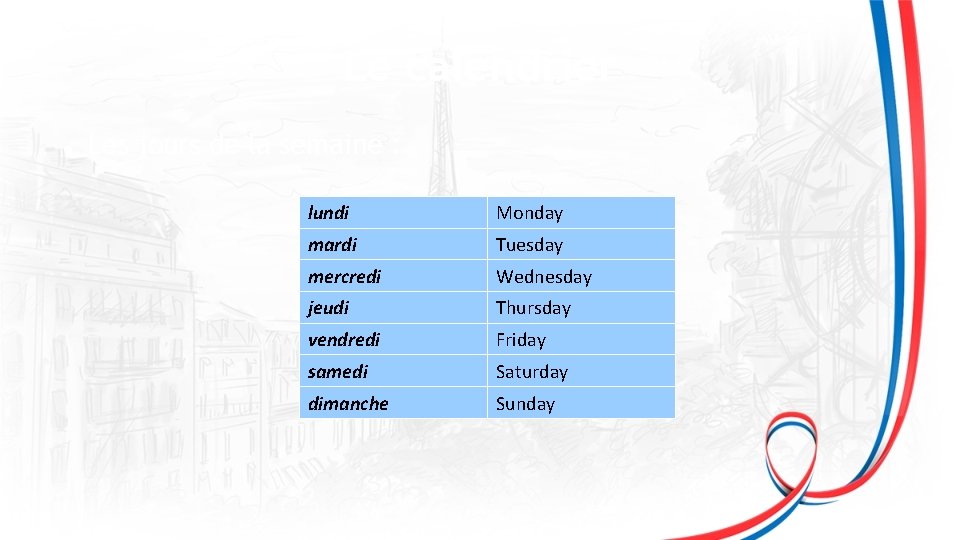
Le calendrier Les jours de la semaine : lundi Monday mardi Tuesday mercredi Wednesday jeudi Thursday vendredi Friday samedi Saturday dimanche Sunday
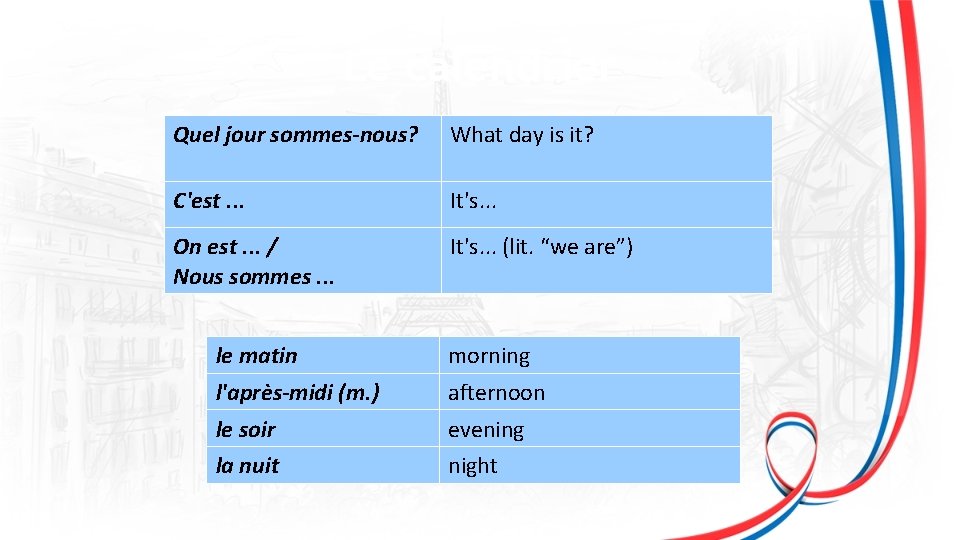
Le calendrier Quel jour sommes-nous? What day is it? C'est. . . It's. . . On est. . . / Nous sommes. . . It's. . . (lit. “we are”) le matin morning l'après-midi (m. ) afternoon le soir evening la nuit night
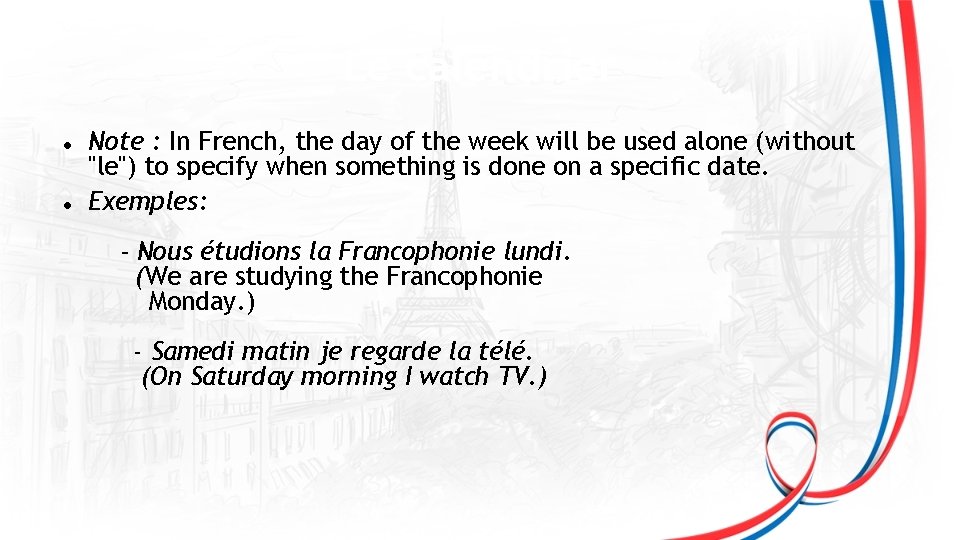
Le calendrier Note : In French, the day of the week will be used alone (without ''le'') to specify when something is done on a specific date. Exemples: - Nous étudions la Francophonie lundi. (We are studying the Francophonie Monday. ) - Samedi matin je regarde la télé. (On Saturday morning I watch TV. )
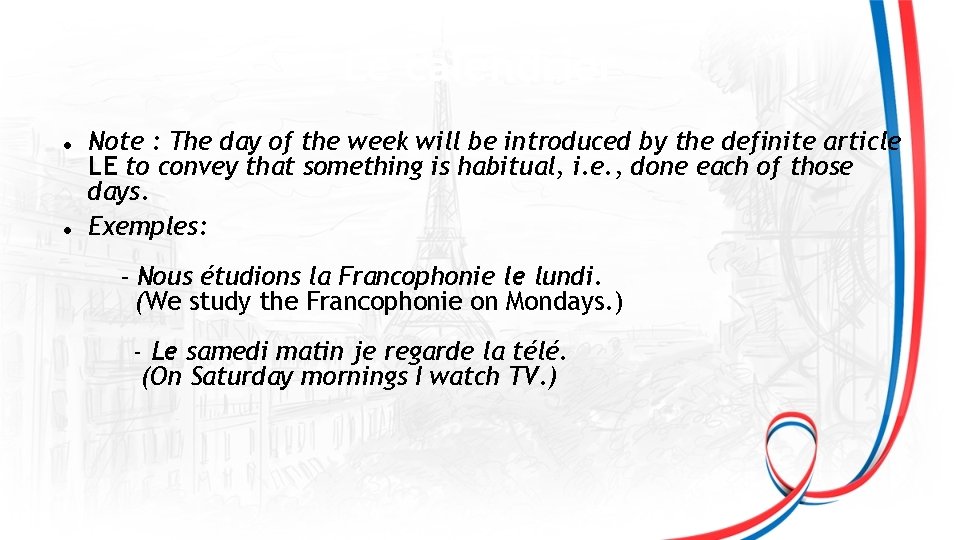
Le calendrier Note : The day of the week will be introduced by the definite article LE to convey that something is habitual, i. e. , done each of those days. Exemples: - Nous étudions la Francophonie le lundi. (We study the Francophonie on Mondays. ) - Le samedi matin je regarde la télé. (On Saturday mornings I watch TV. )
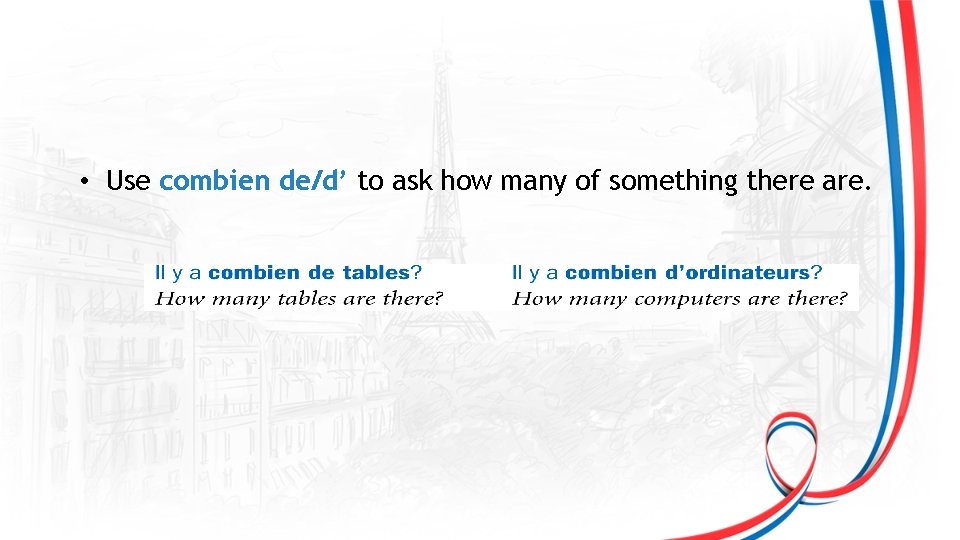
• Use combien de/d’ to ask how many of something there are.
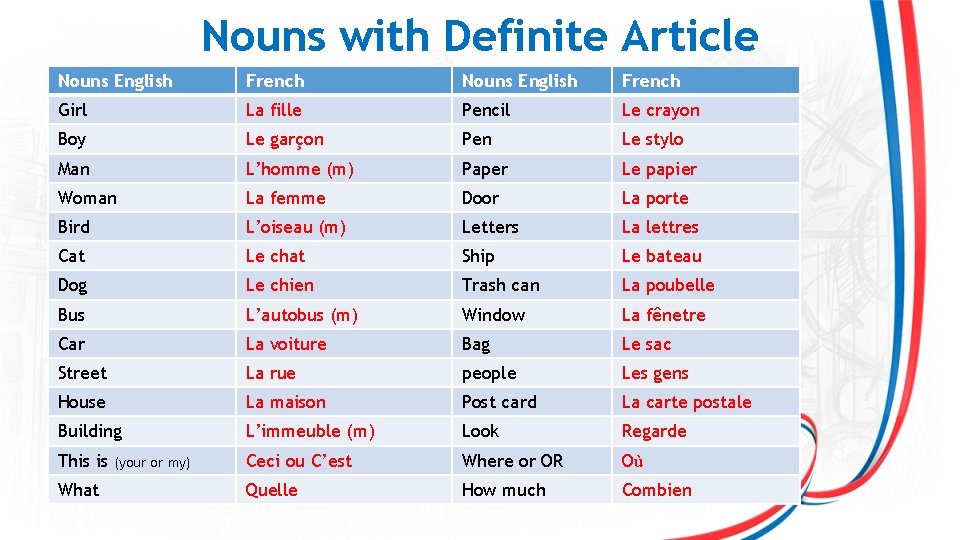
Nouns with Definite Article Nouns English French Girl La fille Pencil Le crayon Boy Le garçon Pen Le stylo Man L’homme (m) Paper Le papier Woman La femme Door La porte Bird L’oiseau (m) Letters La lettres Cat Le chat Ship Le bateau Dog Le chien Trash can La poubelle Bus L’autobus (m) Window La fênetre Car La voiture Bag Le sac Street La rue people Les gens House La maison Post card La carte postale Building L’immeuble (m) Look Regarde This is Ceci ou C’est Where or OR Où Quelle How much Combien What (your or my)
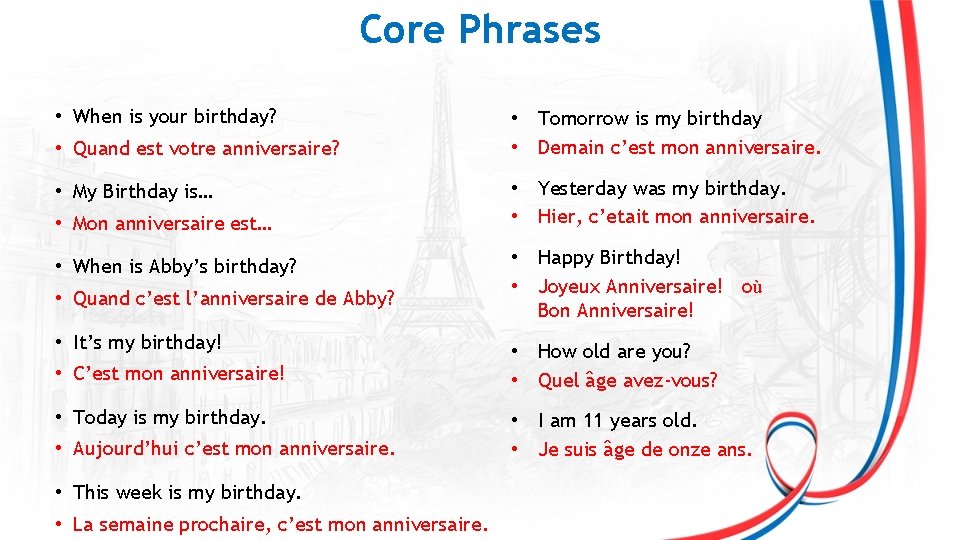
Core Phrases • When is your birthday? • Quand est votre anniversaire? • My Birthday is… • Mon anniversaire est… • When is Abby’s birthday? • Quand c’est l’anniversaire de Abby? • It’s my birthday! • C’est mon anniversaire! • Today is my birthday. • Aujourd’hui c’est mon anniversaire. • This week is my birthday. • La semaine prochaire, c’est mon anniversaire. • Tomorrow is my birthday • Demain c’est mon anniversaire. • Yesterday was my birthday. • Hier, c’etait mon anniversaire. • Happy Birthday! • Joyeux Anniversaire! où Bon Anniversaire! • How old are you? • Quel âge avez-vous? • I am 11 years old. • Je suis âge de onze ans.
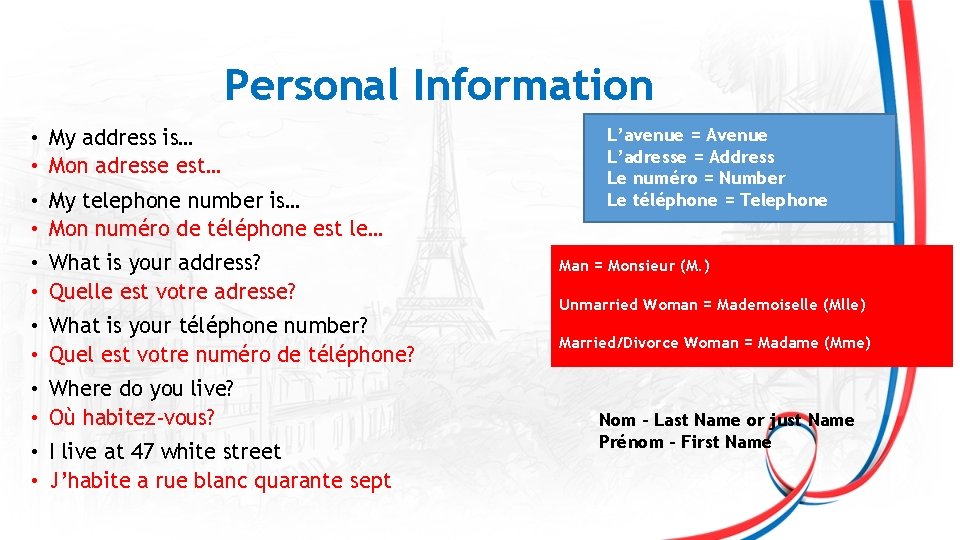
Personal Information • My address is… • Mon adresse est… • My telephone number is… • Mon numéro de téléphone est le… • What is your address? • Quelle est votre adresse? • What is your téléphone number? • Quel est votre numéro de téléphone? • Where do you live? • Où habitez-vous? • I live at 47 white street • J’habite a rue blanc quarante sept L’avenue = Avenue L’adresse = Address Le numéro = Number Le téléphone = Telephone Man = Monsieur (M. ) Unmarried Woman = Mademoiselle (Mlle) Married/Divorce Woman = Madame (Mme) Nom – Last Name or just Name Prénom – First Name
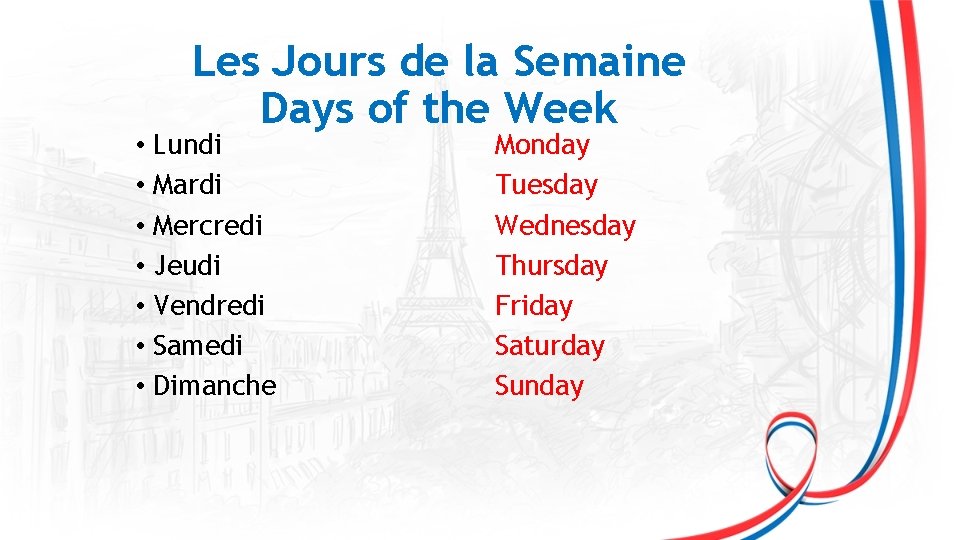
Les Jours de la Semaine Days of the Week • Lundi • Mardi • Mercredi • Jeudi • Vendredi • Samedi • Dimanche Monday Tuesday Wednesday Thursday Friday Saturday Sunday
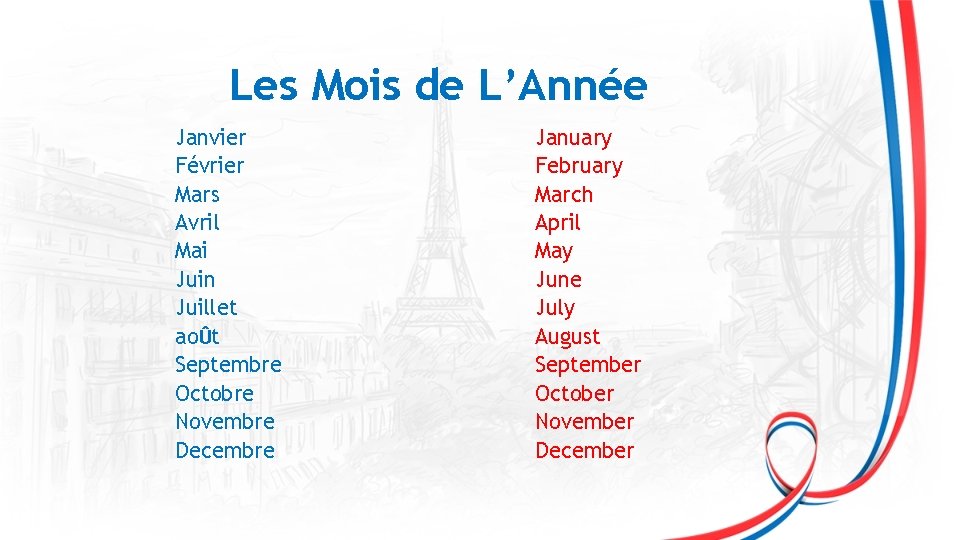
Les Mois de L’Année Janvier Février Mars Avril Mai Juin Juillet aoÛt Septembre Octobre Novembre Decembre January February March April May June July August September October November December
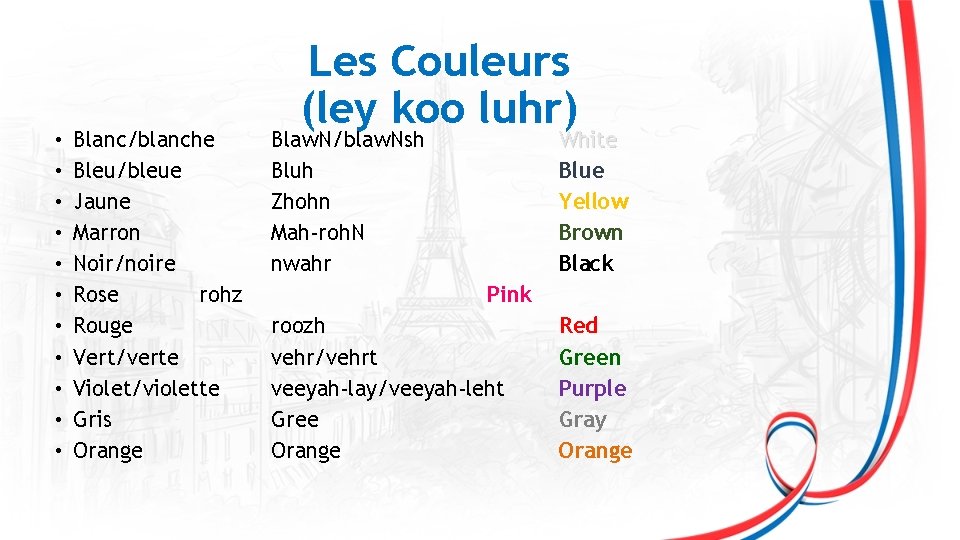
• • • Blanc/blanche Bleu/bleue Jaune Marron Noir/noire Rose rohz Rouge Vert/verte Violet/violette Gris Orange Les Couleurs (ley koo luhr) Blaw. N/blaw. Nsh Bluh Zhohn Mah-roh. N nwahr White Blue Yellow Brown Black Pink roozh vehr/vehrt veeyah-lay/veeyah-leht Gree Orange Red Green Purple Gray Orange
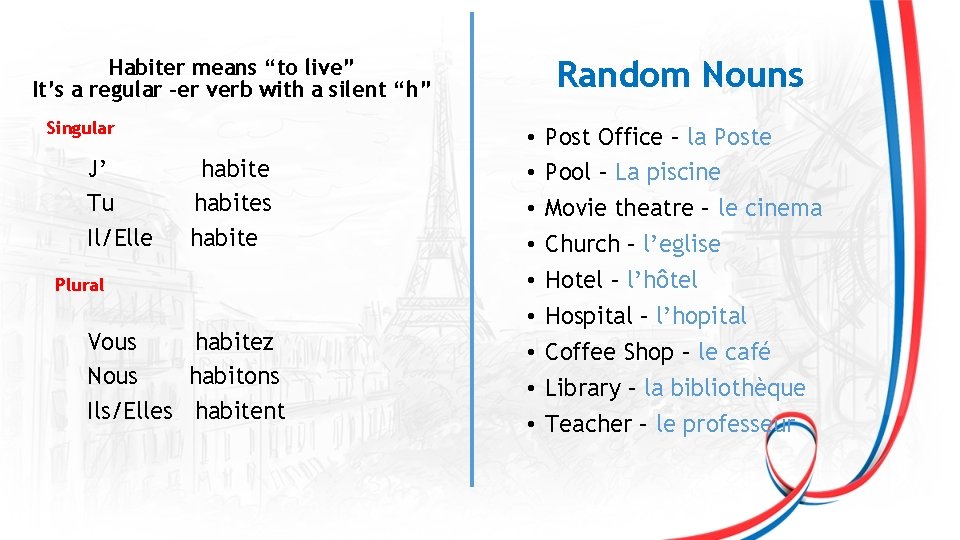
Random Nouns Habiter means “to live” It’s a regular –er verb with a silent “h” Singular J’ Tu Il/Elle habites habite Plural Vous habitez Nous habitons Ils/Elles habitent • • • Post Office – la Poste Pool – La piscine Movie theatre – le cinema Church – l’eglise Hotel – l’hôtel Hospital – l’hopital Coffee Shop – le café Library – la bibliothèque Teacher – le professeur
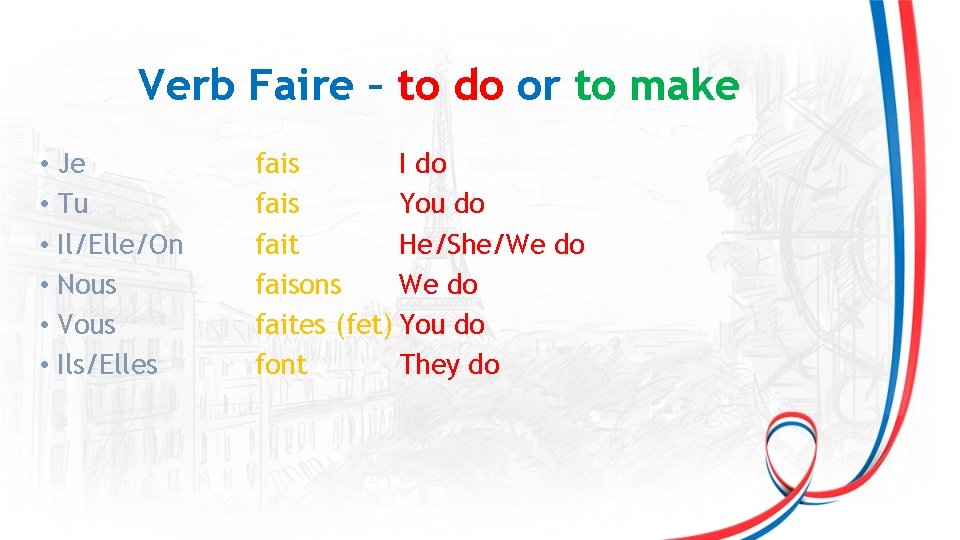
Verb Faire – to do or to make • Je • Tu • Il/Elle/On • Nous • Vous • Ils/Elles fais I do fais You do fait He/She/We do faisons We do faites (fet) You do font They do
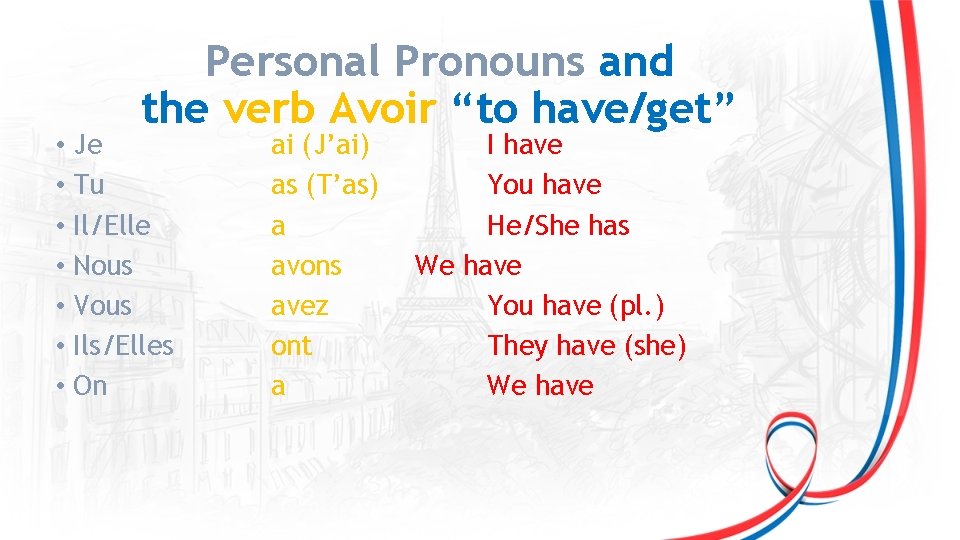
Personal Pronouns and the verb Avoir “to have/get” • Je • Tu • Il/Elle • Nous • Vous • Ils/Elles • On ai (J’ai) as (T’as) a avons avez ont a I have You have He/She has We have You have (pl. ) They have (she) We have
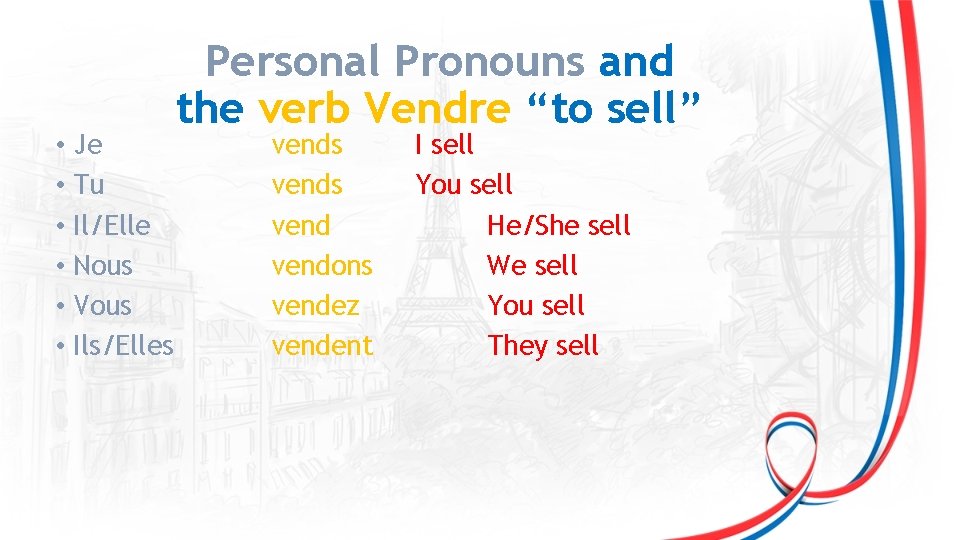
• Je • Tu • Il/Elle • Nous • Vous • Ils/Elles Personal Pronouns and the verb Vendre “to sell” vends vendons vendez vendent I sell You sell He/She sell We sell You sell They sell
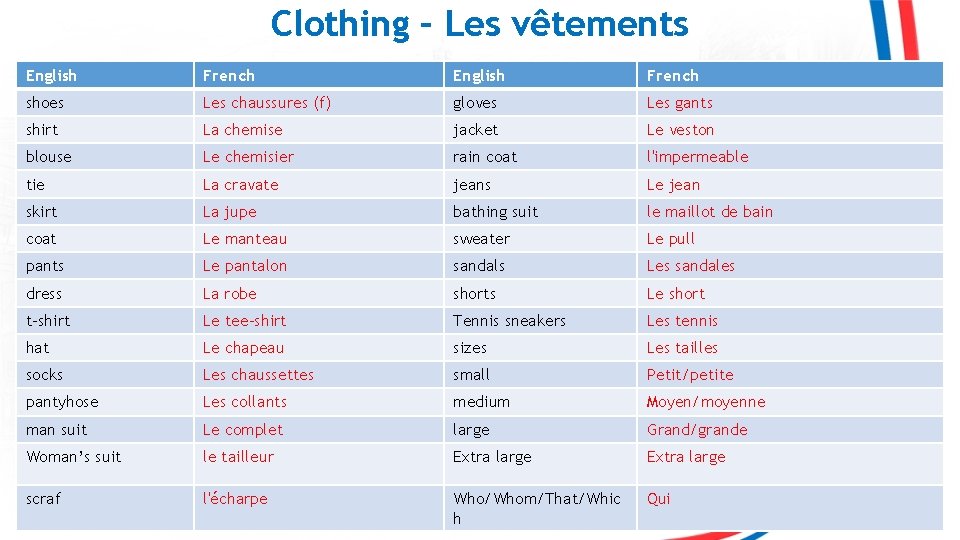
Clothing – Les vêtements English French shoes Les chaussures (f) gloves Les gants shirt La chemise jacket Le veston blouse Le chemisier rain coat l'impermeable tie La cravate jeans Le jean skirt La jupe bathing suit le maillot de bain coat Le manteau sweater Le pull pants Le pantalon sandals Les sandales dress La robe shorts Le short t-shirt Le tee-shirt Tennis sneakers Les tennis hat Le chapeau sizes Les tailles socks Les chaussettes small Petit/petite pantyhose Les collants medium Moyen/moyenne man suit Le complet large Grand/grande Woman’s suit le tailleur Extra large scraf l'écharpe Who/Whom/That/Whic h Qui
- Slides: 35