
Lepton Flavor Violation m 3 e PSI Uni


- Slides: 26
Lepton Flavor Violation m 3 e @ PSI Uni. GE @ PSI Lepton Flavor Violation The m 3 e experiment (m+ → e+e-e+) Sci-Fi To. F Tracker Uni. GE planned contributions Journée de réflexion DPNC 18 June ‘ 12 Alessandro Bravar
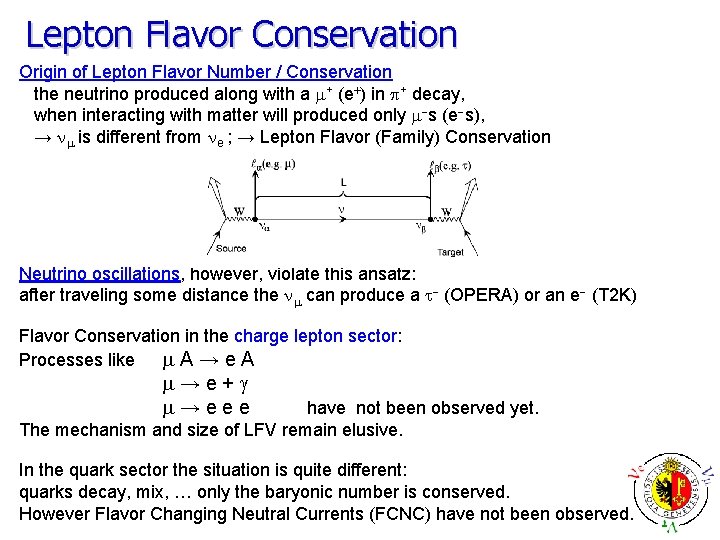
Lepton Flavor Conservation Origin of Lepton Flavor Number / Conservation the neutrino produced along with a m+ (e+) in p+ decay, when interacting with matter will produced only m-s (e-s), → nm is different from ne ; → Lepton Flavor (Family) Conservation Neutrino oscillations, however, violate this ansatz: after traveling some distance the nm can produce a t- (OPERA) or an e- (T 2 K) Flavor Conservation in the charge lepton sector: Processes like m. A→e. A m→e+g m→eee have not been observed yet. The mechanism and size of LFV remain elusive. In the quark sector the situation is quite different: quarks decay, mix, … only the baryonic number is conserved. However Flavor Changing Neutral Currents (FCNC) have not been observed.
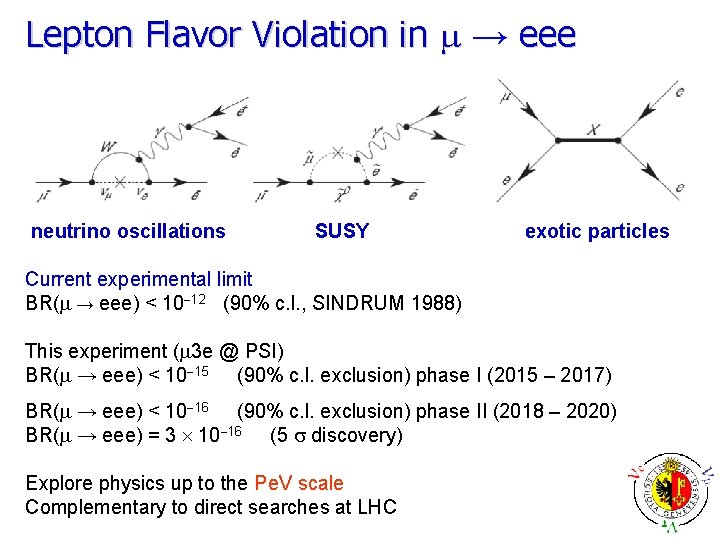
Lepton Flavor Violation in m → eee neutrino oscillations SUSY exotic particles Current experimental limit BR(m → eee) < 10 -12 (90% c. l. , SINDRUM 1988) This experiment (m 3 e @ PSI) BR(m → eee) < 10 -15 (90% c. l. exclusion) phase I (2015 – 2017) BR(m → eee) < 10 -16 (90% c. l. exclusion) phase II (2018 – 2020) BR(m → eee) = 3 ´ 10 -16 (5 s discovery) Explore physics up to the Pe. V scale Complementary to direct searches at LHC
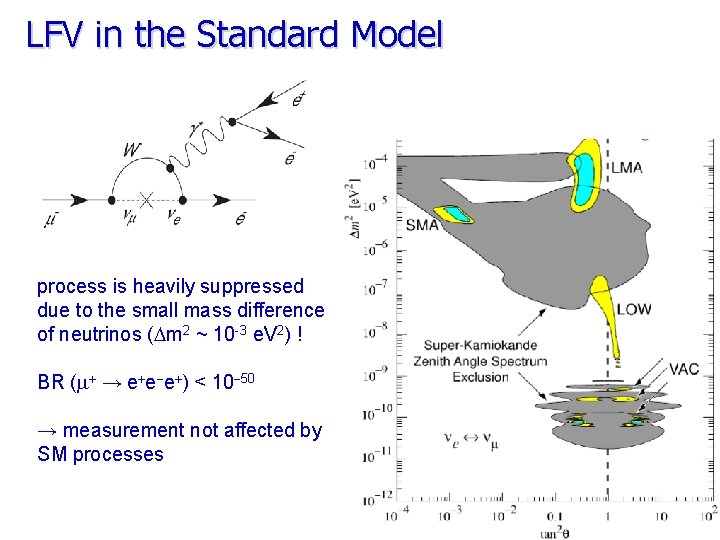
LFV in the Standard Model process is heavily suppressed due to the small mass difference of neutrinos (Dm 2 ~ 10 -3 e. V 2) ! BR (m+ → e+e-e+) < 10 -50 → measurement not affected by SM processes
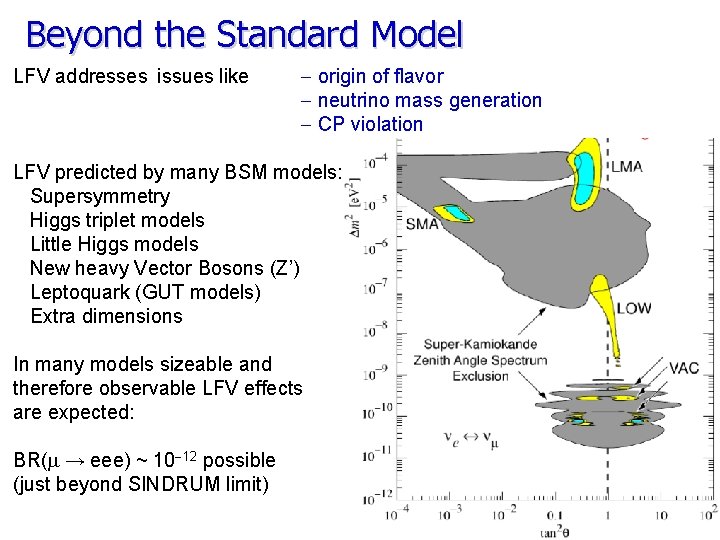
Beyond the Standard Model LFV addresses issues like - origin of flavor - neutrino mass generation - CP violation LFV predicted by many BSM models: Supersymmetry Higgs triplet models Little Higgs models New heavy Vector Bosons (Z’) Leptoquark (GUT models) Extra dimensions In many models sizeable and therefore observable LFV effects are expected: BR(m → eee) ~ 10 -12 possible (just beyond SINDRUM limit)
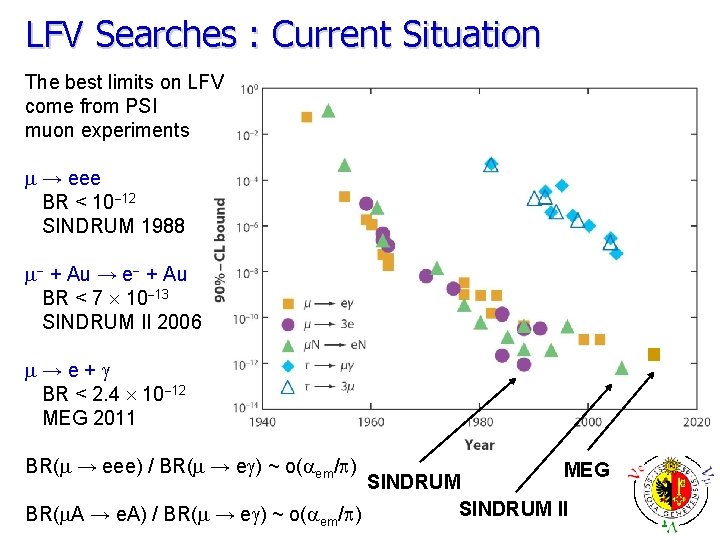
LFV Searches : Current Situation The best limits on LFV come from PSI muon experiments m → eee BR < 10 -12 SINDRUM 1988 m- + Au → e- + Au BR < 7 ´ 10 -13 SINDRUM II 2006 m→e+g BR < 2. 4 ´ 10 -12 MEG 2011 BR(m → eee) / BR(m → eg) ~ o(aem/p) MEG SINDRUM II BR(m. A → e. A) / BR(m → eg) ~ o(aem/p)
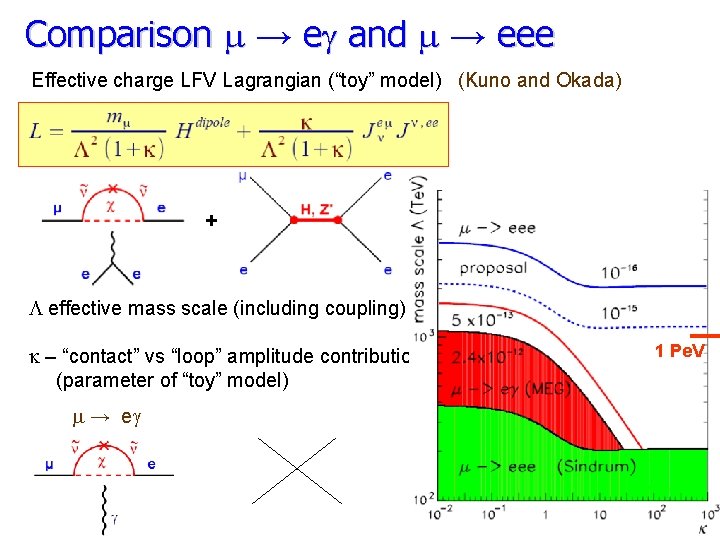
Comparison m → eg and m → eee Effective charge LFV Lagrangian (“toy” model) (Kuno and Okada) + L effective mass scale (including coupling) k – “contact” vs “loop” amplitude contribution (parameter of “toy” model) m → eg 1 Pe. V
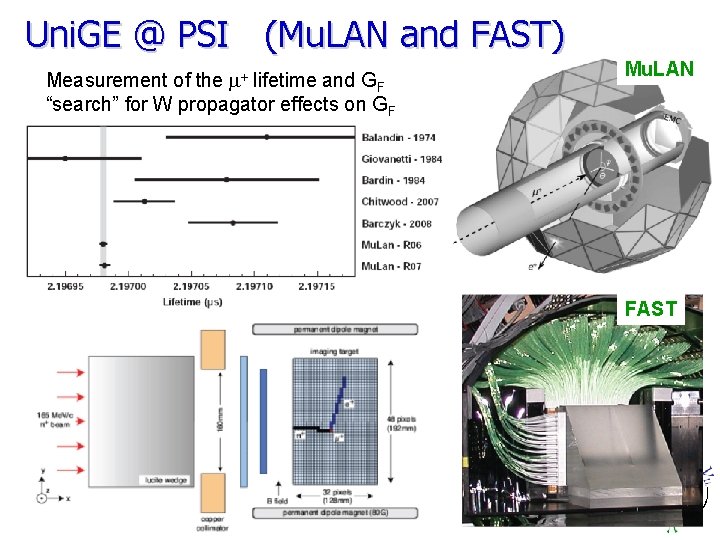
Uni. GE @ PSI (Mu. LAN and FAST) Measurement of the m+ lifetime and GF “search” for W propagator effects on GF Mu. LAN FAST
Mu 3 e @ PSI an experiment to search for Lepton Flavor Violation in m+ e+ e- e+ using the most intense surface muon beam (p ~ 28 Me. V/c) in the world sensitivity ~10 -16 (Pe. V scale !) observe ~1017 m decays (over a reasonable time scale) rate ~ 2 ´ 109 m decays / sec (1 y ~ p 107 sec) B~1– 2 T surface m p ~ 28 Me. V/c acceptance ~ 70% for m → eee decay (3 tracks!) 200 M HV-MAPS (Si pixels w/ embedded ampli. ) channels 10 k To. F channels
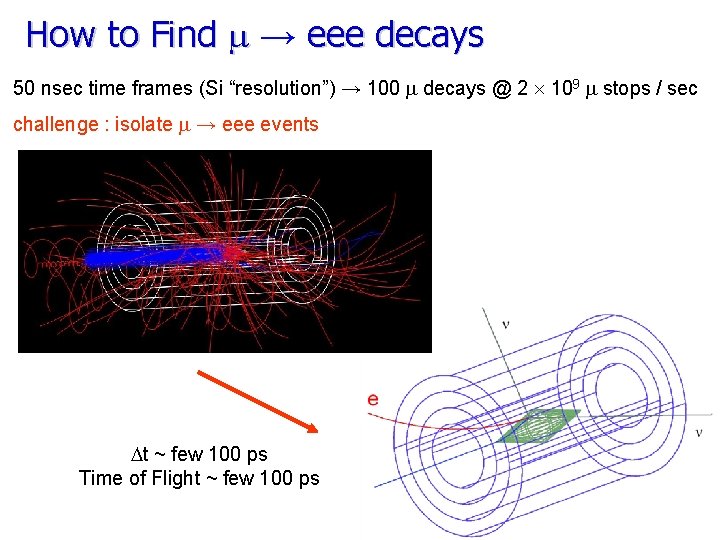
How to Find m → eee decays 50 nsec time frames (Si “resolution”) → 100 m decays @ 2 ´ 109 m stops / sec challenge : isolate m → eee events Dt ~ few 100 ps Time of Flight ~ few 100 ps
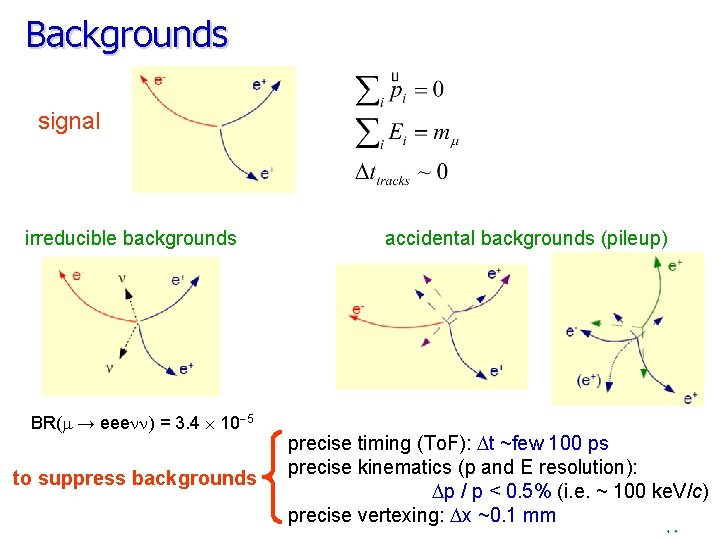
Backgrounds signal irreducible backgrounds BR(m → eeenn) = 3. 4 ´ 10 -5 to suppress backgrounds accidental backgrounds (pileup) precise timing (To. F): Dt ~few 100 ps precise kinematics (p and E resolution): Dp / p < 0. 5% (i. e. ~ 100 ke. V/c) precise vertexing: Dx ~0. 1 mm
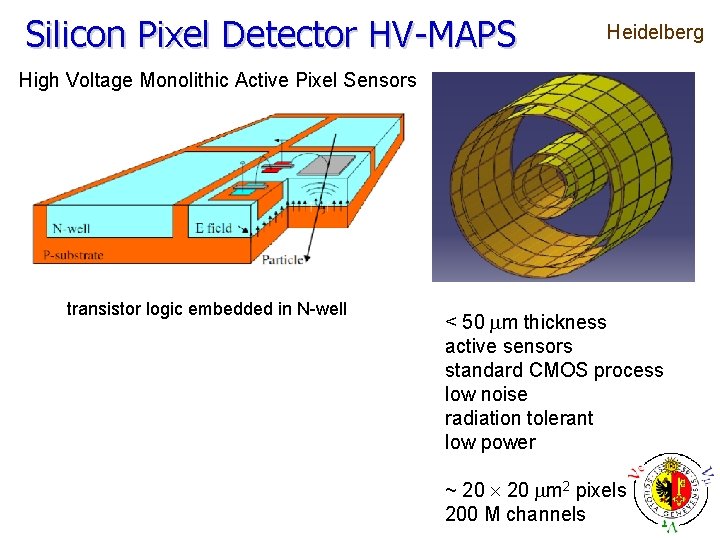
Silicon Pixel Detector HV-MAPS Heidelberg High Voltage Monolithic Active Pixel Sensors transistor logic embedded in N-well < 50 mm thickness active sensors standard CMOS process low noise radiation tolerant low power ~ 20 ´ 20 mm 2 pixels 200 M channels
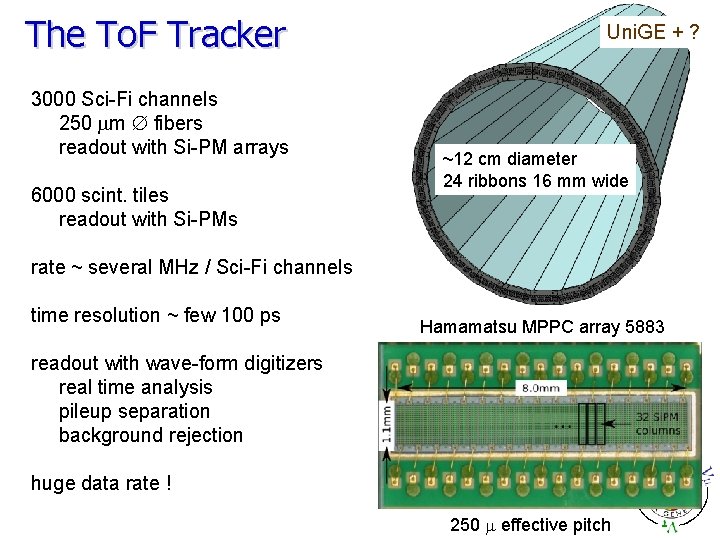
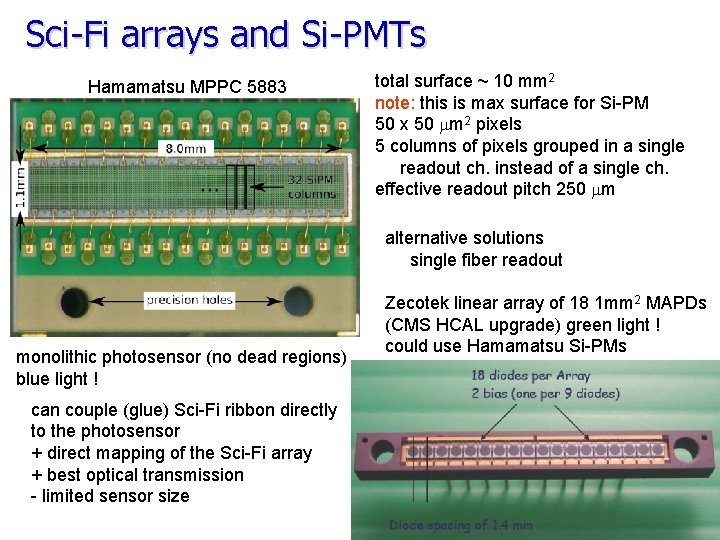
The To. F Tracker 3000 Sci-Fi channels 250 mm Æ fibers readout with Si-PM arrays 6000 scint. tiles readout with Si-PMs Uni. GE + ? ~12 cm diameter 24 ribbons 16 mm wide rate ~ several MHz / Sci-Fi channels time resolution ~ few 100 ps Hamamatsu MPPC array 5883 readout with wave-form digitizers real time analysis pileup separation background rejection huge data rate ! 250 m effective pitch
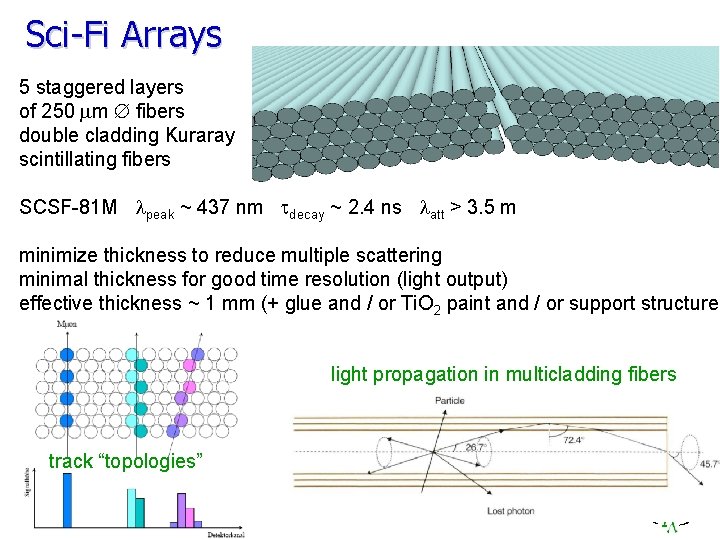
Sci-Fi Arrays 5 staggered layers of 250 mm Æ fibers double cladding Kuraray scintillating fibers SCSF-81 M lpeak ~ 437 nm tdecay ~ 2. 4 ns latt > 3. 5 m minimize thickness to reduce multiple scattering minimal thickness for good time resolution (light output) effective thickness ~ 1 mm (+ glue and / or Ti. O 2 paint and / or support structure) light propagation in multicladding fibers track “topologies”
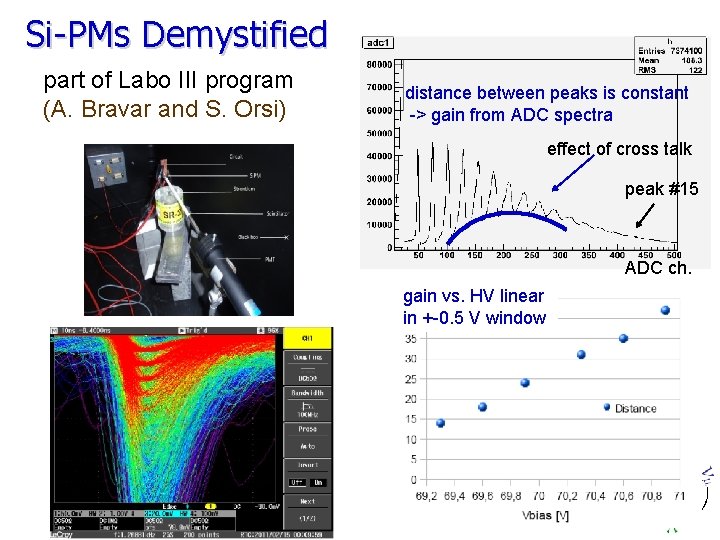
Si-PMs Demystified part of Labo III program (A. Bravar and S. Orsi) distance between peaks is constant -> gain from ADC spectra effect of cross talk peak #15 ADC ch. gain vs. HV linear in +-0. 5 V window
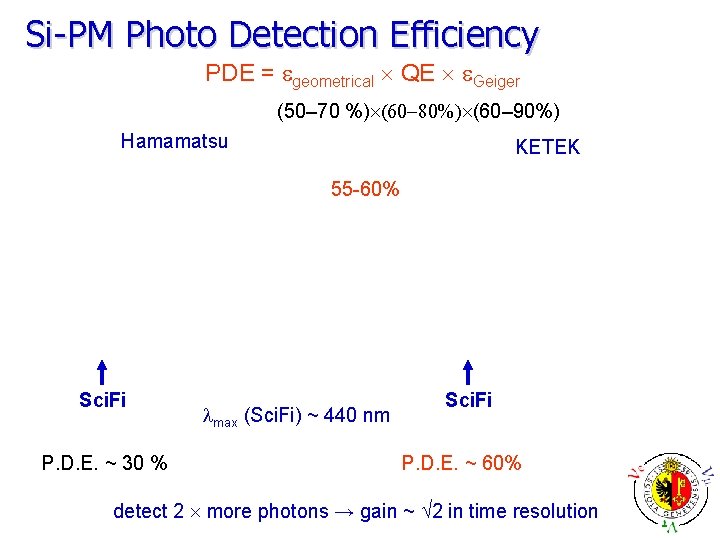
Si-PM Photo Detection Efficiency PDE = egeometrical ´ QE ´ e. Geiger (50– 70 %)´(60 -80%)´(60– 90%) Hamamatsu KETEK 55 -60% Sci. Fi P. D. E. ~ 30 % lmax (Sci. Fi) ~ 440 nm Sci. Fi P. D. E. ~ 60% detect 2 ´ more photons → gain ~ Ö 2 in time resolution
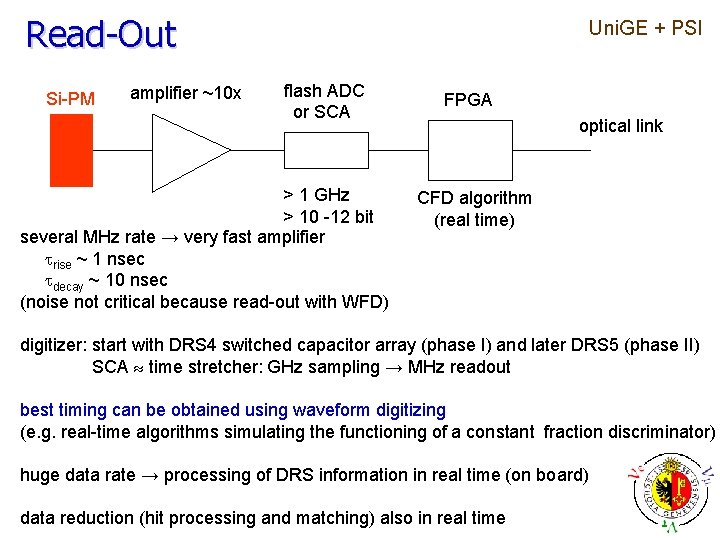
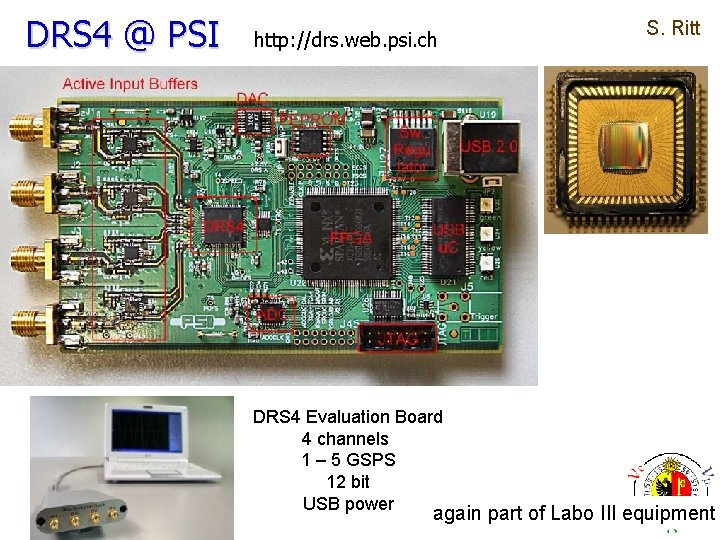
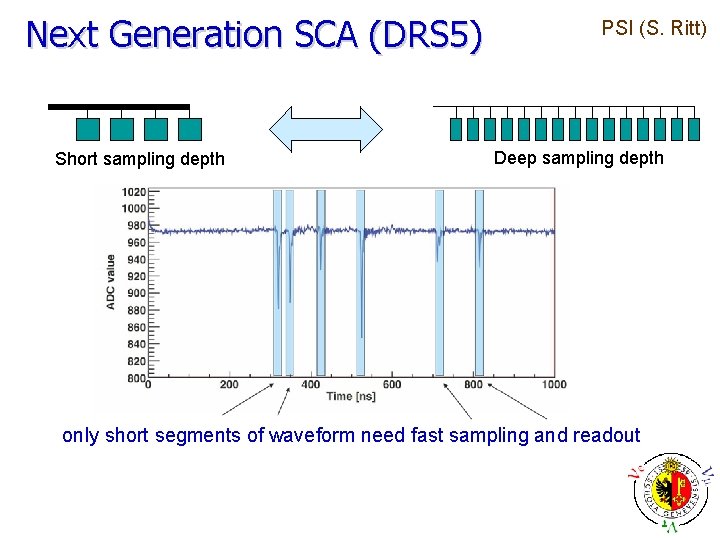
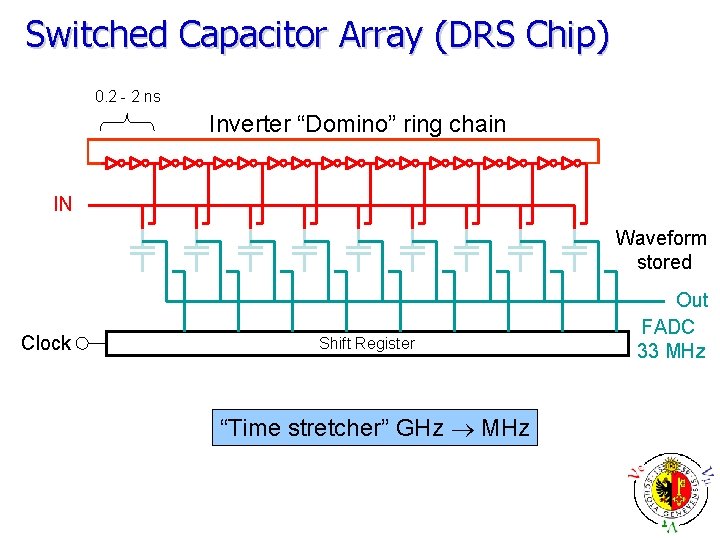
Read-Out Si-PM amplifier ~10 x Uni. GE + PSI flash ADC or SCA > 1 GHz > 10 -12 bit several MHz rate → very fast amplifier trise ~ 1 nsec tdecay ~ 10 nsec (noise not critical because read-out with WFD) FPGA optical link CFD algorithm (real time) digitizer: start with DRS 4 switched capacitor array (phase I) and later DRS 5 (phase II) SCA » time stretcher: GHz sampling → MHz readout best timing can be obtained using waveform digitizing (e. g. real-time algorithms simulating the functioning of a constant fraction discriminator) huge data rate → processing of DRS information in real time (on board) data reduction (hit processing and matching) also in real time
DRS 4 @ PSI http: //drs. web. psi. ch DRS 4 Evaluation Board 4 channels 1 – 5 GSPS 12 bit USB power S. Ritt again part of Labo III equipment
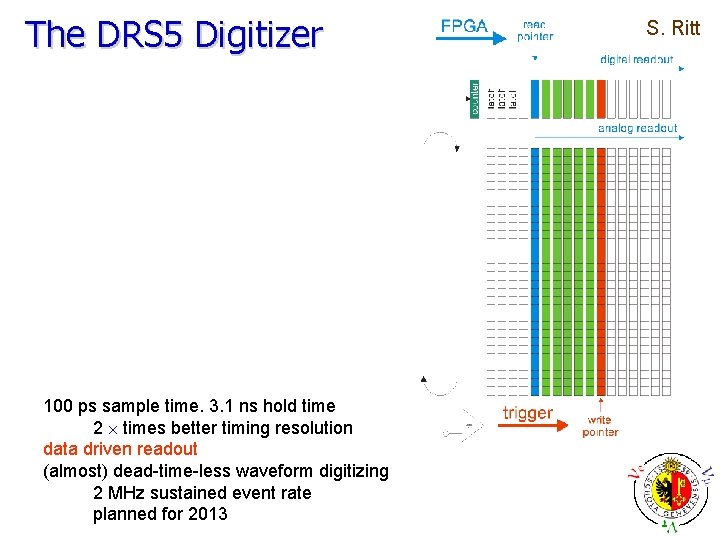
Next Generation SCA (DRS 5) Short sampling depth PSI (S. Ritt) Deep sampling depth only short segments of waveform need fast sampling and readout
Uni. GE plans Mu 3 e collaboration: Geneva, Heidelberg, PSI, Zurich, ETHZ, + … Develop To. F system (Sci. Fi and scintillating tiles) hardware (Sci. Fi ribbons, Si-PMs, …) in coll. with Uni. ZH electronics (amplifiers, DRS, firmware, …) in coll. with PSI digitizing electronics: possible synergy with NA 61 and AIDA Simulations and optimization of Mu 3 e detector, in particular To. F system in coll. with ALL More concrete (next 6 months) - build Sci. Fi array prototype and test / optimize for time resolution rate capabilities - develop fast amplifiers, readout based on commercial DRS electronics - develop (offline → real time) algorithms for DRS electronics - R&D on Si-PM PDE FNS request: 1 Post. Doc + 1 Can. Doc
ADDITIONAL TECHNICAL STUFF
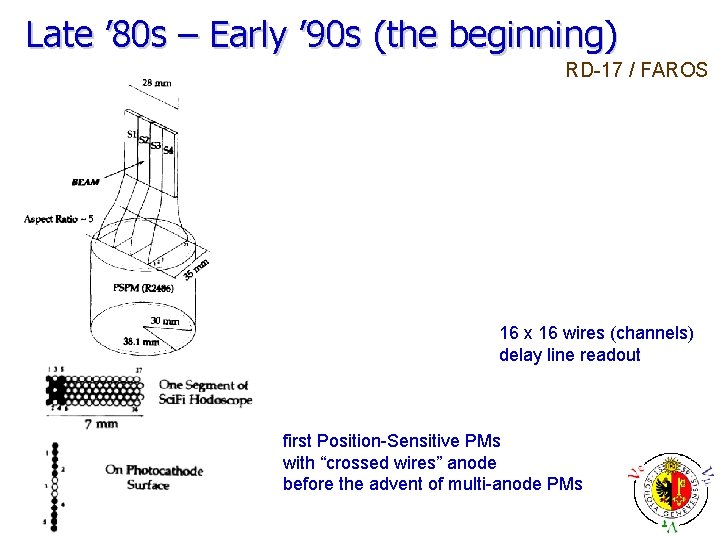
Late ’ 80 s – Early ’ 90 s (the beginning) RD-17 / FAROS 16 x 16 wires (channels) delay line readout first Position-Sensitive PMs with “crossed wires” anode before the advent of multi-anode PMs
Sci-Fi arrays and Si-PMTs Hamamatsu MPPC 5883 total surface ~ 10 mm 2 note: this is max surface for Si-PM 50 x 50 mm 2 pixels 5 columns of pixels grouped in a single readout ch. instead of a single ch. effective readout pitch 250 mm alternative solutions single fiber readout monolithic photosensor (no dead regions) blue light ! can couple (glue) Sci-Fi ribbon directly to the photosensor + direct mapping of the Sci-Fi array + best optical transmission - limited sensor size Zecotek linear array of 18 1 mm 2 MAPDs (CMS HCAL upgrade) green light ! could use Hamamatsu Si-PMs
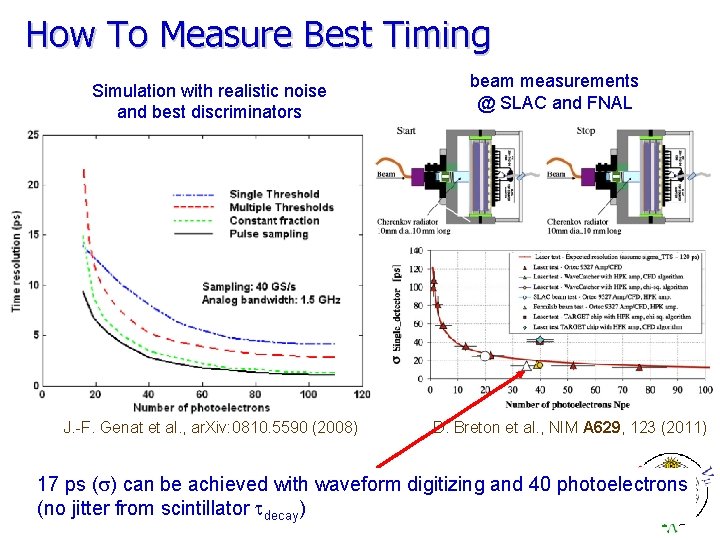
How To Measure Best Timing Simulation with realistic noise and best discriminators J. -F. Genat et al. , ar. Xiv: 0810. 5590 (2008) beam measurements @ SLAC and FNAL D. Breton et al. , NIM A 629, 123 (2011) 17 ps (s) can be achieved with waveform digitizing and 40 photoelectrons (no jitter from scintillator tdecay)
Switched Capacitor Array (DRS Chip) 0. 2 - 2 ns Inverter “Domino” ring chain IN Waveform stored Clock Shift Register “Time stretcher” GHz MHz Out FADC 33 MHz
The DRS 5 Digitizer 100 ps sample time. 3. 1 ns hold time 2 ´ times better timing resolution data driven readout (almost) dead-time-less waveform digitizing 2 MHz sustained event rate planned for 2013 S. Ritt