
Lepton fakes Attila Aranyi RMKIKFKI Budapest CMS SUSY
Lepton fakes Attila Aranyi RMKI-KFKI, Budapest CMS SUSY Group Weekly Budapest-Debrecen-CERN meeting Supported by NKTH and OTKA (NK 67974, 74153, H 07 -C 74281 ) 06/07/2009 Attila Aranyi : Lepton fakes RMKI-KFKI Weekly Hungarian meeting, 06/07/2009 1/ 34
Contents • Motivation • Muons • Electrons • Fake rate method • Useful docs • To Do Attila Aranyi : Lepton fakes RMKI-KFKI Weekly Hungarian meeting, 06/07/2009 2/ 34
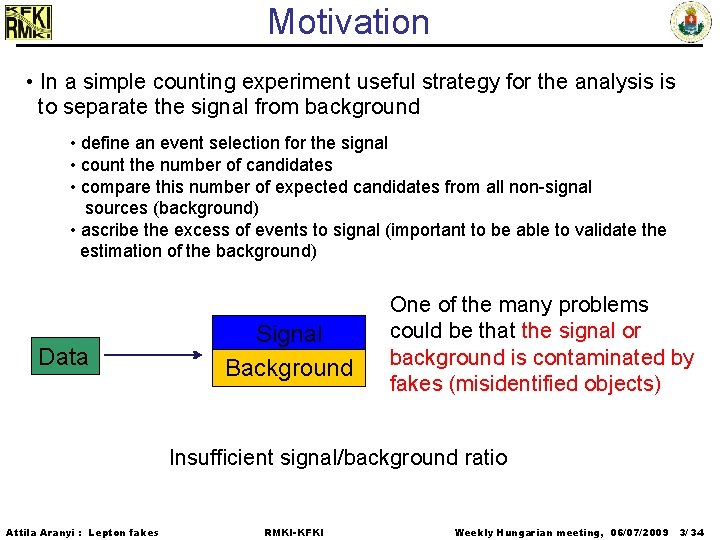
Motivation • In a simple counting experiment useful strategy for the analysis is to separate the signal from background • define an event selection for the signal • count the number of candidates • compare this number of expected candidates from all non-signal sources (background) • ascribe the excess of events to signal (important to be able to validate the estimation of the background) Data Signal Background One of the many problems could be that the signal or background is contaminated by fakes (misidentified objects) Insufficient signal/background ratio Attila Aranyi : Lepton fakes RMKI-KFKI Weekly Hungarian meeting, 06/07/2009 3/ 34
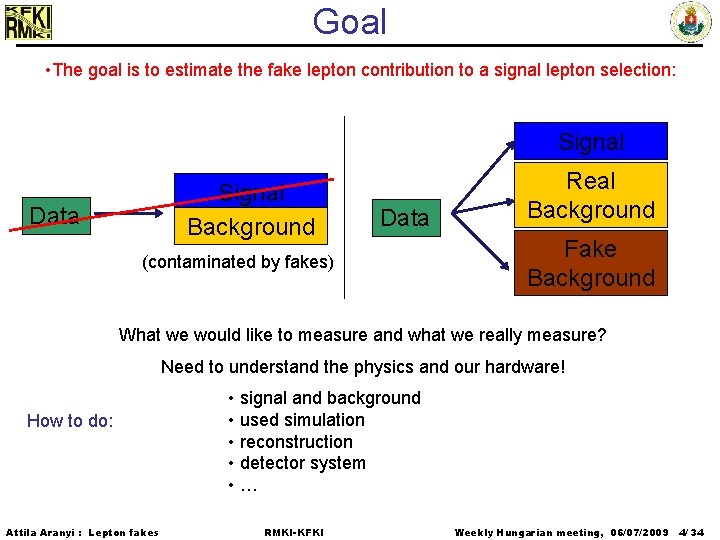
Goal • The goal is to estimate the fake lepton contribution to a signal lepton selection: Signal Background Data (contaminated by fakes) Real Background Fake Background What we would like to measure and what we really measure? Need to understand the physics and our hardware! How to do: Attila Aranyi : Lepton fakes • signal and background • used simulation • reconstruction • detector system • … RMKI-KFKI Weekly Hungarian meeting, 06/07/2009 4/ 34
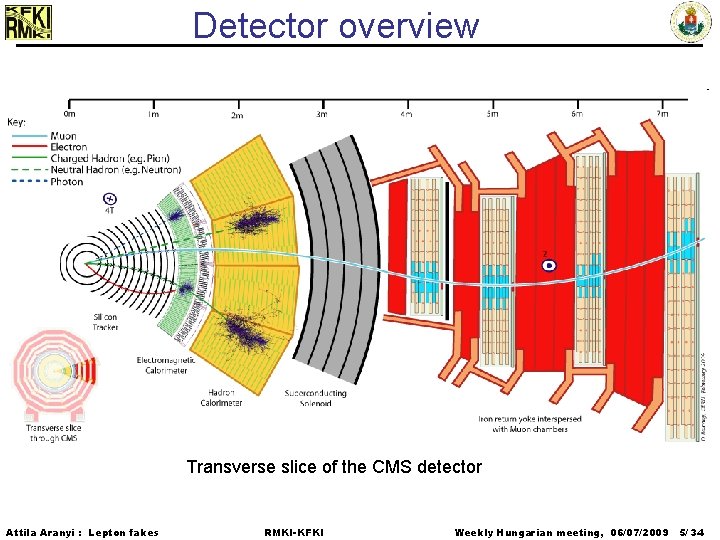
Detector overview Transverse slice of the CMS detector Attila Aranyi : Lepton fakes RMKI-KFKI Weekly Hungarian meeting, 06/07/2009 5/ 34
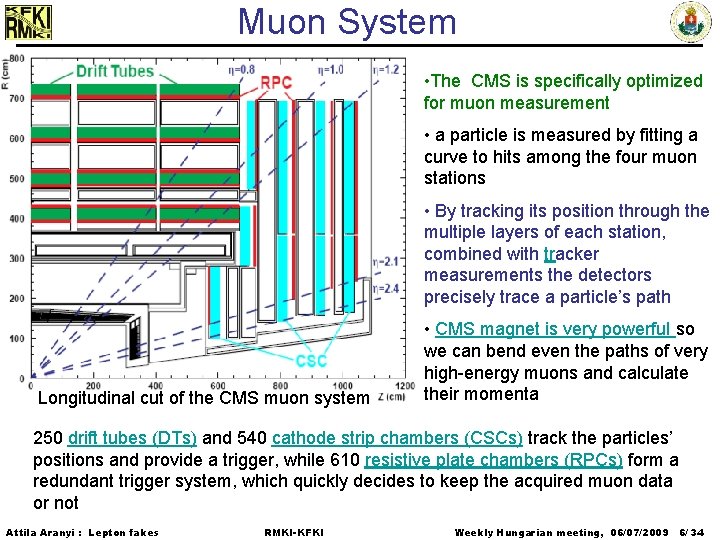
Muon System • The CMS is specifically optimized for muon measurement • a particle is measured by fitting a curve to hits among the four muon stations • By tracking its position through the multiple layers of each station, combined with tracker measurements the detectors precisely trace a particle’s path Longitudinal cut of the CMS muon system • CMS magnet is very powerful so we can bend even the paths of very high-energy muons and calculate their momenta 250 drift tubes (DTs) and 540 cathode strip chambers (CSCs) track the particles’ positions and provide a trigger, while 610 resistive plate chambers (RPCs) form a redundant trigger system, which quickly decides to keep the acquired muon data or not Attila Aranyi : Lepton fakes RMKI-KFKI Weekly Hungarian meeting, 06/07/2009 6/ 34
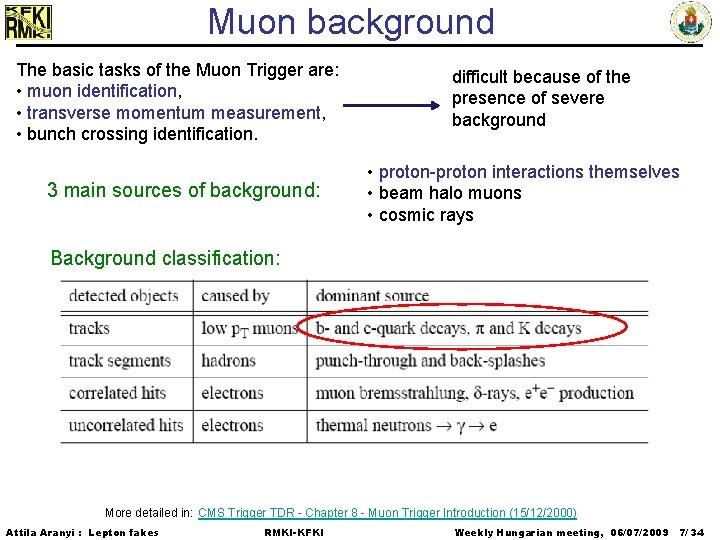
Muon background The basic tasks of the Muon Trigger are: • muon identification, • transverse momentum measurement, • bunch crossing identification. 3 main sources of background: difficult because of the presence of severe background • proton-proton interactions themselves • beam halo muons • cosmic rays Background classification: More detailed in: CMS Trigger TDR - Chapter 8 - Muon Trigger Introduction (15/12/2000) Attila Aranyi : Lepton fakes RMKI-KFKI Weekly Hungarian meeting, 06/07/2009 7/ 34
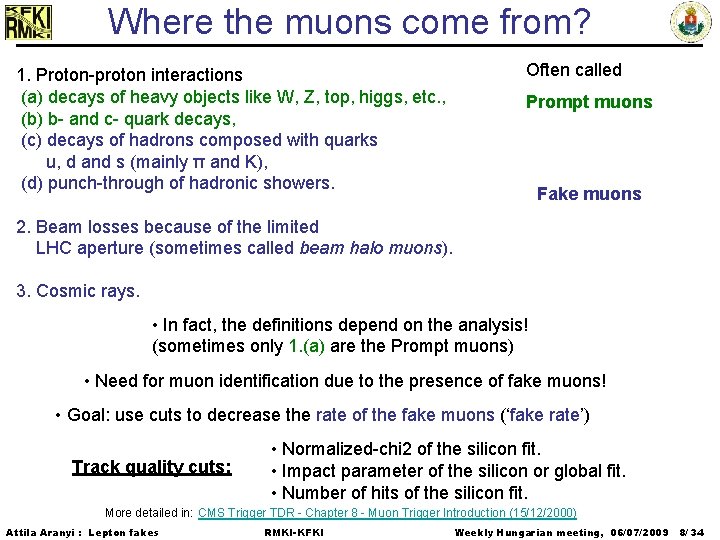
Where the muons come from? 1. Proton-proton interactions (a) decays of heavy objects like W, Z, top, higgs, etc. , (b) b- and c- quark decays, (c) decays of hadrons composed with quarks u, d and s (mainly π and K), (d) punch-through of hadronic showers. Often called Prompt muons Fake muons 2. Beam losses because of the limited LHC aperture (sometimes called beam halo muons). 3. Cosmic rays. • In fact, the definitions depend on the analysis! (sometimes only 1. (a) are the Prompt muons) • Need for muon identification due to the presence of fake muons! • Goal: use cuts to decrease the rate of the fake muons (‘fake rate’) Track quality cuts: • Normalized-chi 2 of the silicon fit. • Impact parameter of the silicon or global fit. • Number of hits of the silicon fit. More detailed in: CMS Trigger TDR - Chapter 8 - Muon Trigger Introduction (15/12/2000) Attila Aranyi : Lepton fakes RMKI-KFKI Weekly Hungarian meeting, 06/07/2009 8/ 34
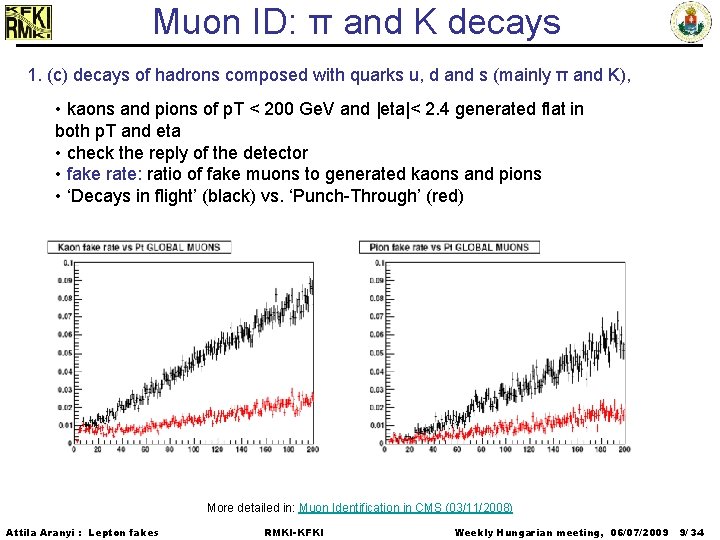
Muon ID: π and K decays 1. (c) decays of hadrons composed with quarks u, d and s (mainly π and K), • kaons and pions of p. T < 200 Ge. V and |eta|< 2. 4 generated flat in both p. T and eta • check the reply of the detector • fake rate: ratio of fake muons to generated kaons and pions • ‘Decays in flight’ (black) vs. ‘Punch-Through’ (red) More detailed in: Muon Identification in CMS (03/11/2008) Attila Aranyi : Lepton fakes RMKI-KFKI Weekly Hungarian meeting, 06/07/2009 9/ 34

Muon ID: normalized-chi^2 cut • Global muon normalized-chi^2 (of the track match) is a powerful tool to reject both decays in flight and punch through: decays in flight: red all reconstructed global muon: open Use cuts Use Normalized-chi 2 < 10 (blue) Normalized-chi^2 < 5 (purple) Normalized-chi 2 < 10 More detailed in: Muon Identification in CMS (03/11/2008), Muon Reconstruction in the CMS Detector (04/12/2008) Attila Aranyi : Lepton fakes RMKI-KFKI Weekly Hungarian meeting, 06/07/2009 10/ 34
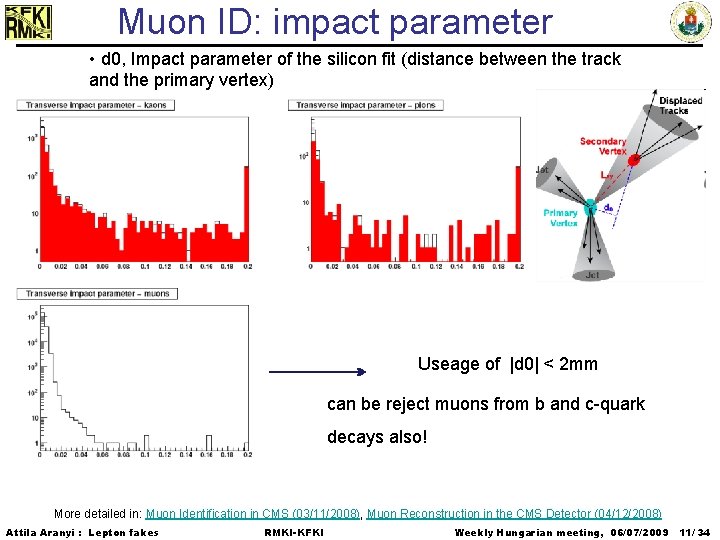
Muon ID: impact parameter • d 0, Impact parameter of the silicon fit (distance between the track and the primary vertex) Useage of |d 0| < 2 mm can be reject muons from b and c-quark decays also! More detailed in: Muon Identification in CMS (03/11/2008), Muon Reconstruction in the CMS Detector (04/12/2008) Attila Aranyi : Lepton fakes RMKI-KFKI Weekly Hungarian meeting, 06/07/2009 11/ 34

Muon ID: valid hits for the silicon fit • The number of valid hits also has discriminating power After apply previous cuts! Use N_hits>11 for loose cut More detailed in: Muon Identification in CMS (03/11/2008), Muon Reconstruction in the CMS Detector (04/12/2008) Attila Aranyi : Lepton fakes RMKI-KFKI Weekly Hungarian meeting, 06/07/2009 12/ 34
Muon isolation • Isolation criteria can be applied to the muon candidates to provide additional rejection • suppress non-prompt muons from b, c, π, and K decays. Three isolation techniques have been studied: • Calorimeter isolation: based on the standard technique of summing the calorimeter energy in a cone around the muon. (in HCAL+ECAL) • Pixel isolation: based on the partial reconstruction of tracks in the silicon pixel detector isolation is determined on the basis of the sum of the transverse momenta of the tracks in a cone around the muon. • Tracker isolation: ΣPΤ of tracks reconstructed in a cone around the direction of the muon, neglecting the contribution from the muon itself. Commonly used cut: let the relative isolation (or its reciprocal) above (below) a given threshold (Cal_Iso+Pixel_Iso+Tracker_Iso) /PΤ More detailed in: Technical Design Report, Volume 2: (15/12/2002) Attila Aranyi : Lepton fakes RMKI-KFKI Weekly Hungarian meeting, 06/07/2009 13/ 34
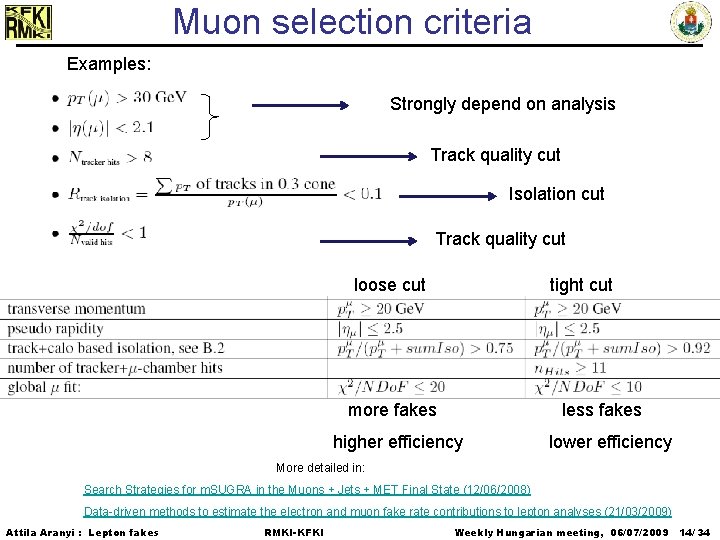
Muon selection criteria Examples: Strongly depend on analysis Track quality cut Isolation cut Track quality cut loose cut tight cut more fakes less fakes higher efficiency lower efficiency More detailed in: Search Strategies for m. SUGRA in the Muons + Jets + MET Final State (12/06/2008) Data-driven methods to estimate the electron and muon fake rate contributions to lepton analyses (21/03/2009) Attila Aranyi : Lepton fakes RMKI-KFKI Weekly Hungarian meeting, 06/07/2009 14/ 34
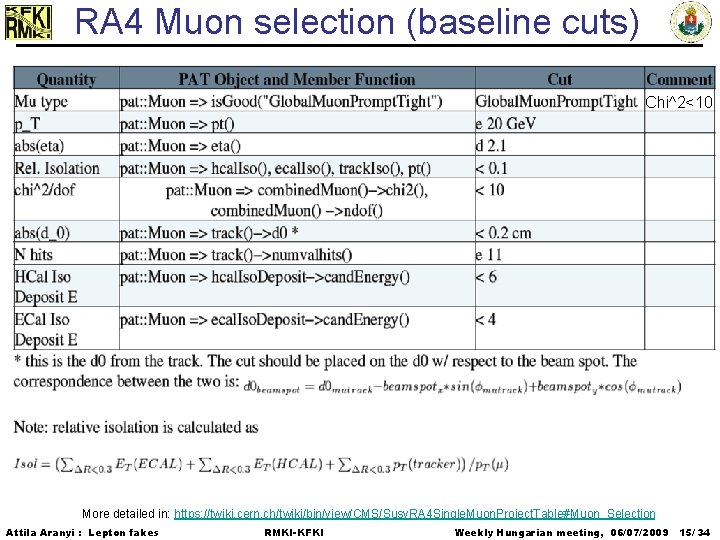
RA 4 Muon selection (baseline cuts) Chi^2<10 More detailed in: https: //twiki. cern. ch/twiki/bin/view/CMS/Susy. RA 4 Single. Muon. Project. Table#Muon_Selection Attila Aranyi : Lepton fakes RMKI-KFKI Weekly Hungarian meeting, 06/07/2009 15/ 34

RA 4 Muon selection (baseline cuts) Most recent talks about the Muon selection in RA 4 from Carsten Magass: Selection status report for SUSY Muon Id (12/02/2009) Baseline Muon Id for SUSY selection (26/02/2009) Study of Muon Id for RA 4 (07/05/2009) Muon Id for RA 4 – Follow up (02/07/2009) Attila Aranyi : Lepton fakes RMKI-KFKI Weekly Hungarian meeting, 06/07/2009 16/ 34
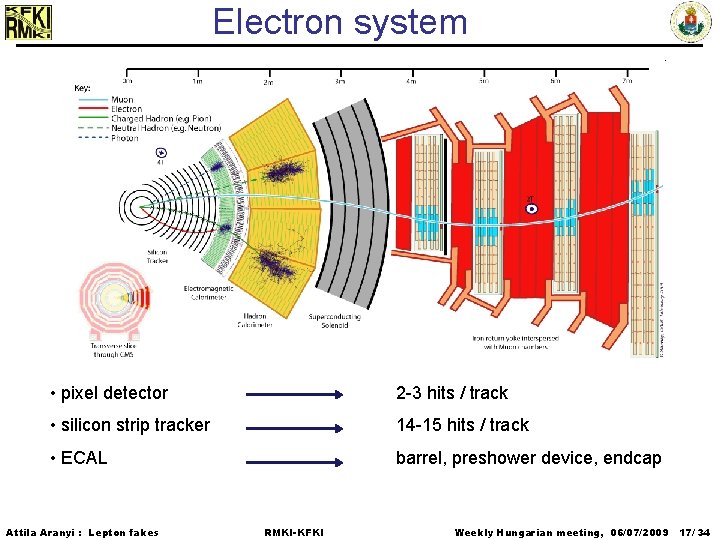
Electron system • pixel detector 2 -3 hits / track • silicon strip tracker 14 -15 hits / track • ECAL barrel, preshower device, endcap Attila Aranyi : Lepton fakes RMKI-KFKI Weekly Hungarian meeting, 06/07/2009 17/ 34
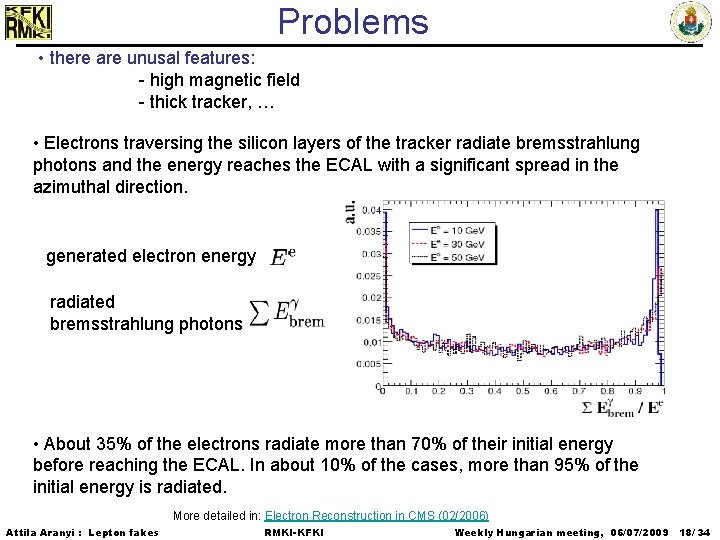
Problems • there are unusal features: - high magnetic field - thick tracker, … • Electrons traversing the silicon layers of the tracker radiate bremsstrahlung photons and the energy reaches the ECAL with a significant spread in the azimuthal direction. generated electron energy radiated bremsstrahlung photons • About 35% of the electrons radiate more than 70% of their initial energy before reaching the ECAL. In about 10% of the cases, more than 95% of the initial energy is radiated. More detailed in: Electron Reconstruction in CMS (02/2006) Attila Aranyi : Lepton fakes RMKI-KFKI Weekly Hungarian meeting, 06/07/2009 18/ 34
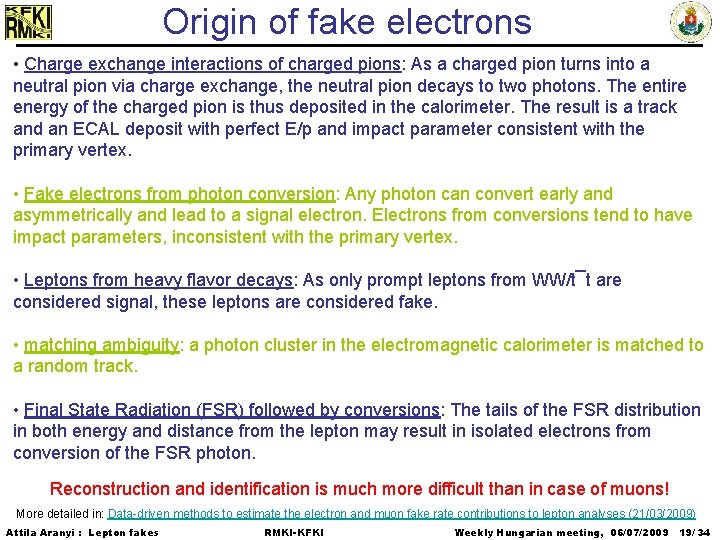
Origin of fake electrons • Charge exchange interactions of charged pions: As a charged pion turns into a neutral pion via charge exchange, the neutral pion decays to two photons. The entire energy of the charged pion is thus deposited in the calorimeter. The result is a track and an ECAL deposit with perfect E/p and impact parameter consistent with the primary vertex. • Fake electrons from photon conversion: Any photon can convert early and asymmetrically and lead to a signal electron. Electrons from conversions tend to have impact parameters, inconsistent with the primary vertex. • Leptons from heavy flavor decays: As only prompt leptons from WW/t¯t are considered signal, these leptons are considered fake. • matching ambiguity: a photon cluster in the electromagnetic calorimeter is matched to a random track. • Final State Radiation (FSR) followed by conversions: The tails of the FSR distribution in both energy and distance from the lepton may result in isolated electrons from conversion of the FSR photon. Reconstruction and identification is much more difficult than in case of muons! More detailed in: Data-driven methods to estimate the electron and muon fake rate contributions to lepton analyses (21/03/2009) Attila Aranyi : Lepton fakes RMKI-KFKI Weekly Hungarian meeting, 06/07/2009 19/ 34
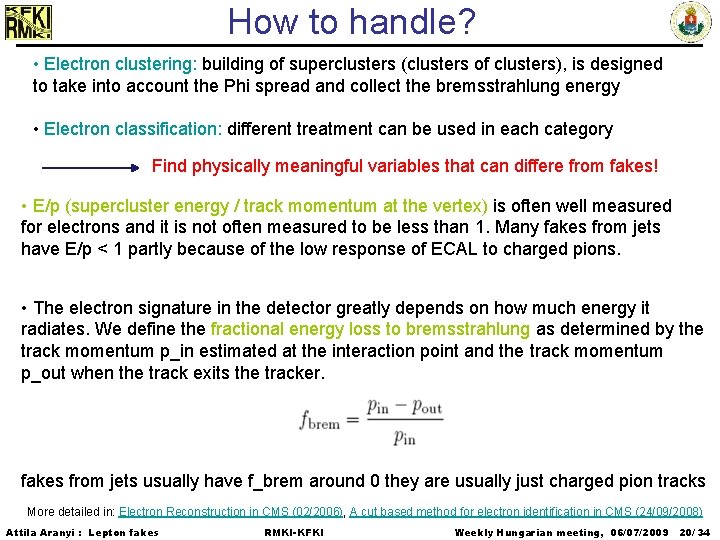
How to handle? • Electron clustering: building of superclusters (clusters of clusters), is designed to take into account the Phi spread and collect the bremsstrahlung energy • Electron classification: different treatment can be used in each category Find physically meaningful variables that can differe from fakes! • E/p (supercluster energy / track momentum at the vertex) is often well measured for electrons and it is not often measured to be less than 1. Many fakes from jets have E/p < 1 partly because of the low response of ECAL to charged pions. • The electron signature in the detector greatly depends on how much energy it radiates. We define the fractional energy loss to bremsstrahlung as determined by the track momentum p_in estimated at the interaction point and the track momentum p_out when the track exits the tracker. fakes from jets usually have f_brem around 0 they are usually just charged pion tracks More detailed in: Electron Reconstruction in CMS (02/2006), A cut based method for electron identification in CMS (24/09/2008) Attila Aranyi : Lepton fakes RMKI-KFKI Weekly Hungarian meeting, 06/07/2009 20/ 34
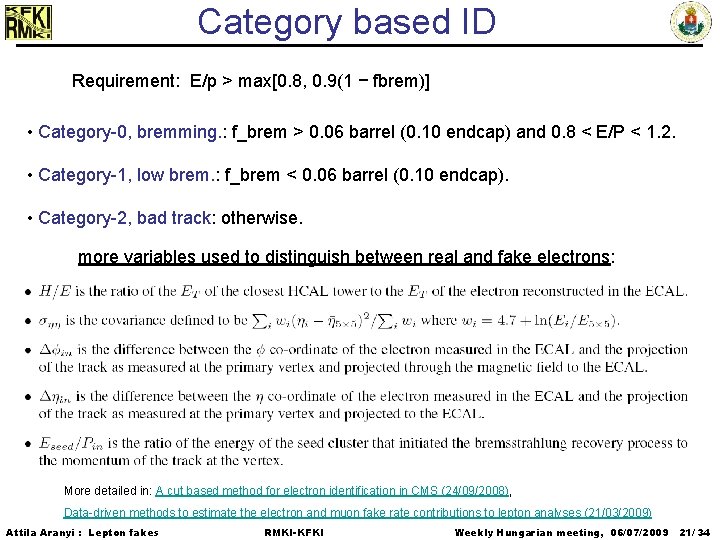
Category based ID Requirement: E/p > max[0. 8, 0. 9(1 − fbrem)] • Category-0, bremming. : f_brem > 0. 06 barrel (0. 10 endcap) and 0. 8 < E/P < 1. 2. • Category-1, low brem. : f_brem < 0. 06 barrel (0. 10 endcap). • Category-2, bad track: otherwise. more variables used to distinguish between real and fake electrons: More detailed in: A cut based method for electron identification in CMS (24/09/2008), Data-driven methods to estimate the electron and muon fake rate contributions to lepton analyses (21/03/2009) Attila Aranyi : Lepton fakes RMKI-KFKI Weekly Hungarian meeting, 06/07/2009 21/ 34

Loose electron ID • primarily designed to have enough fake rejection to clearly extract Z->ee signal from the QCD background. More detailed in: A cut based method for electron identification in CMS (24/09/2008) Attila Aranyi : Lepton fakes RMKI-KFKI Weekly Hungarian meeting, 06/07/2009 22/ 34
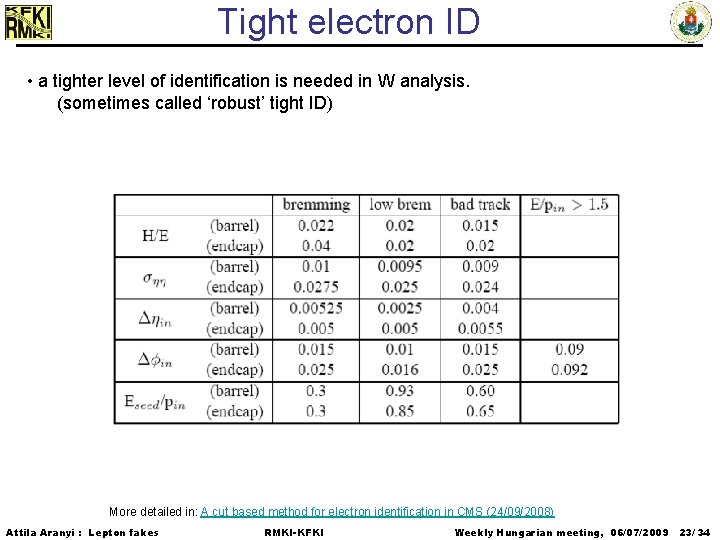
Tight electron ID • a tighter level of identification is needed in W analysis. (sometimes called ‘robust’ tight ID) More detailed in: A cut based method for electron identification in CMS (24/09/2008) Attila Aranyi : Lepton fakes RMKI-KFKI Weekly Hungarian meeting, 06/07/2009 23/ 34
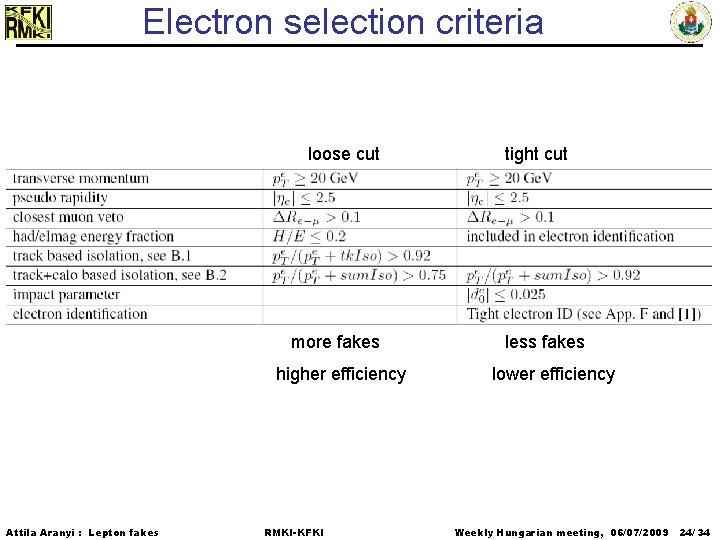
Electron selection criteria loose cut more fakes higher efficiency Attila Aranyi : Lepton fakes RMKI-KFKI tight cut less fakes lower efficiency Weekly Hungarian meeting, 06/07/2009 24/ 34
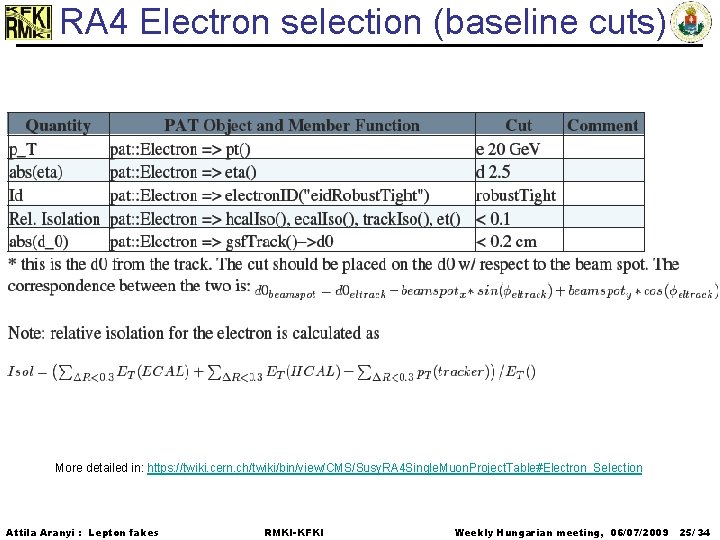
RA 4 Electron selection (baseline cuts) More detailed in: https: //twiki. cern. ch/twiki/bin/view/CMS/Susy. RA 4 Single. Muon. Project. Table#Electron_Selection Attila Aranyi : Lepton fakes RMKI-KFKI Weekly Hungarian meeting, 06/07/2009 25/ 34

Definition of fake leptons • ‘Prompt’: reconstructed leptons that are not from the primary decay of Z, W, hard interactions (DY), or new physics (SUSY) • ‘Fake’: not Prompt Jet deposits: large amount of energy in the ECAL that is matched to a single high-P_T track Heavy quark decays: kick from quark decay may be enough to knock electron out of the jet a bit, making it appear isolated Photon conversion: any photon can convert early and lead to a signal electron etc… • More detailed, sources of fakes in: AN-2009/041 How many fake leptons are out there? How to handle them? Need to predict lepton fake contribution to signal selection Attila Aranyi : Lepton fakes RMKI-KFKI Weekly Hungarian meeting, 06/07/2009 26/ 34
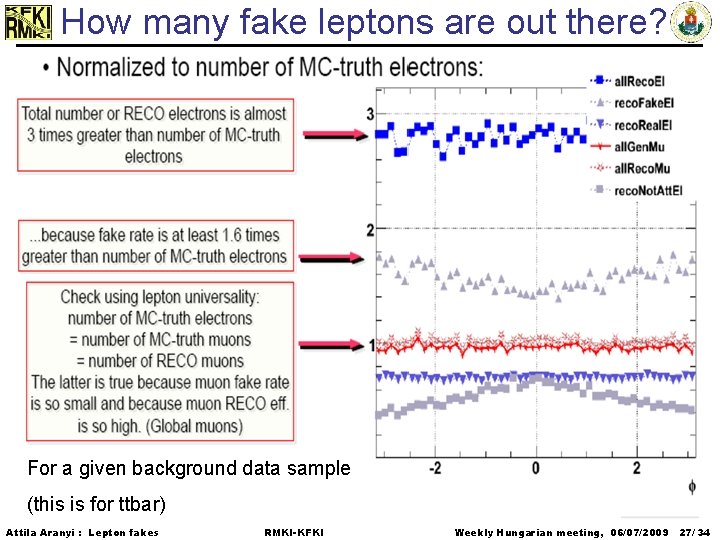
How many fake leptons are out there? For a given background data sample (this is for ttbar) Attila Aranyi : Lepton fakes RMKI-KFKI Weekly Hungarian meeting, 06/07/2009 27/ 34
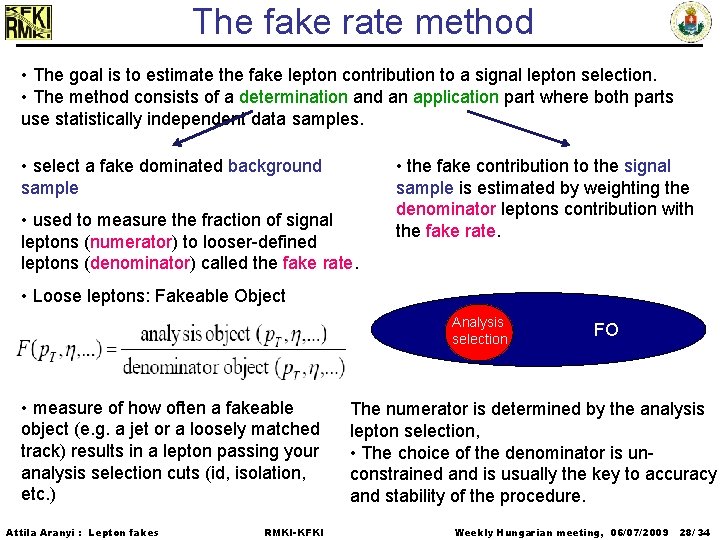
The fake rate method • The goal is to estimate the fake lepton contribution to a signal lepton selection. • The method consists of a determination and an application part where both parts use statistically independent data samples. • select a fake dominated background sample • used to measure the fraction of signal leptons (numerator) to looser-defined leptons (denominator) called the fake rate. • the fake contribution to the signal sample is estimated by weighting the denominator leptons contribution with the fake rate. • Loose leptons: Fakeable Object Analysis selection • measure of how often a fakeable object (e. g. a jet or a loosely matched track) results in a lepton passing your analysis selection cuts (id, isolation, etc. ) Attila Aranyi : Lepton fakes RMKI-KFKI FO The numerator is determined by the analysis lepton selection, • The choice of the denominator is unconstrained and is usually the key to accuracy and stability of the procedure. Weekly Hungarian meeting, 06/07/2009 28/ 34
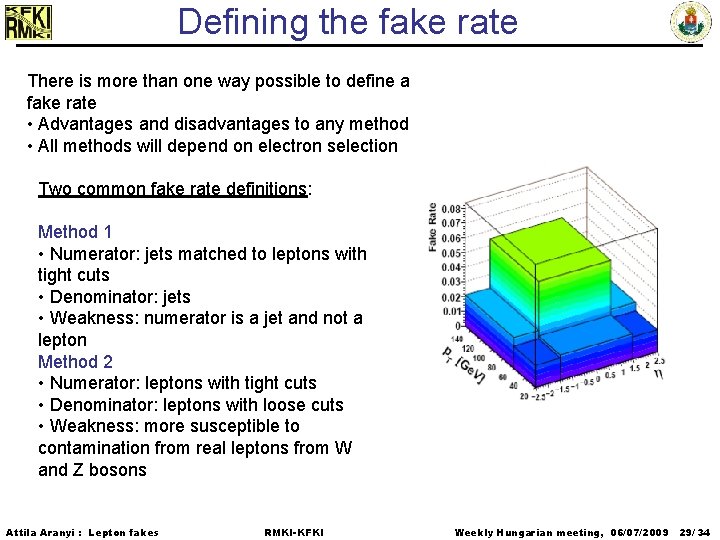
Defining the fake rate There is more than one way possible to define a fake rate • Advantages and disadvantages to any method • All methods will depend on electron selection Two common fake rate definitions: Method 1 • Numerator: jets matched to leptons with tight cuts • Denominator: jets • Weakness: numerator is a jet and not a lepton Method 2 • Numerator: leptons with tight cuts • Denominator: leptons with loose cuts • Weakness: more susceptible to contamination from real leptons from W and Z bosons Attila Aranyi : Lepton fakes RMKI-KFKI Weekly Hungarian meeting, 06/07/2009 29/ 34

Estimate QCD lepton fake contribution • WW with di-lepton final state • For this selection the W+jets process is the dominant source of “fake background” • one real lepton from W and one fake lepton from a jet Defining the fake rate: Fake rate determination from the QCD background Attila Aranyi : Lepton fakes RMKI-KFKI Weekly Hungarian meeting, 06/07/2009 30/ 34
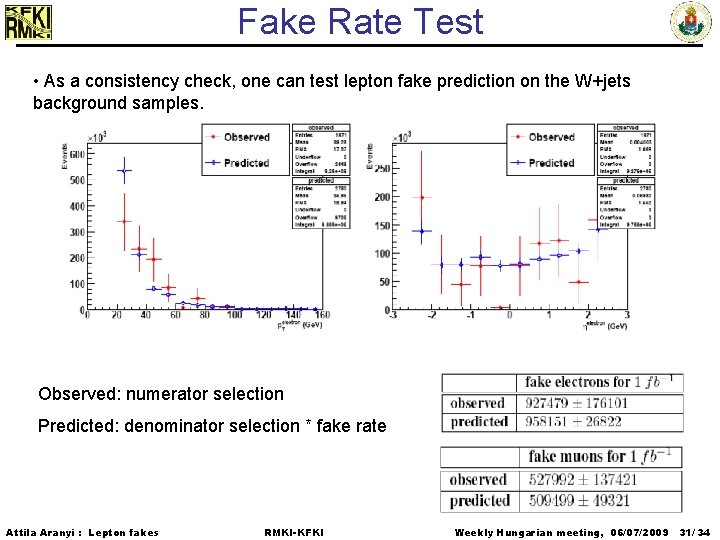
Fake Rate Test • As a consistency check, one can test lepton fake prediction on the W+jets background samples. Observed: numerator selection Predicted: denominator selection * fake rate Attila Aranyi : Lepton fakes RMKI-KFKI Weekly Hungarian meeting, 06/07/2009 31/ 34
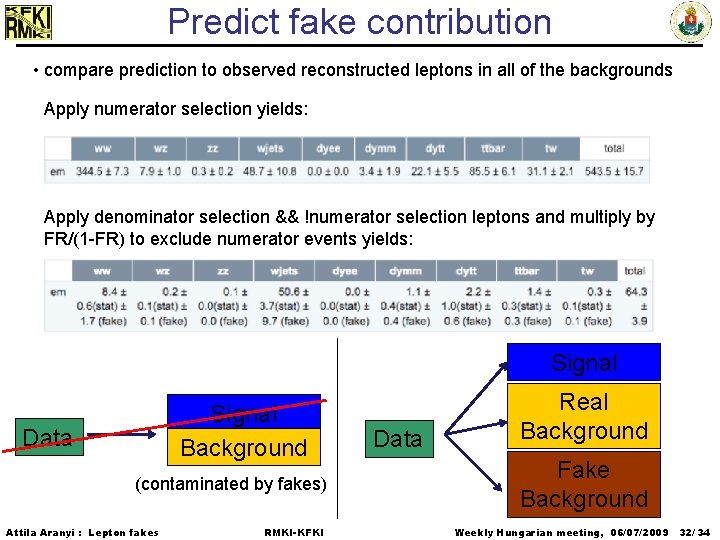
Predict fake contribution • compare prediction to observed reconstructed leptons in all of the backgrounds Apply numerator selection yields: Apply denominator selection && !numerator selection leptons and multiply by FR/(1 -FR) to exclude numerator events yields: Signal Background Data (contaminated by fakes) Attila Aranyi : Lepton fakes RMKI-KFKI Data Real Background Fake Background Weekly Hungarian meeting, 06/07/2009 32/ 34
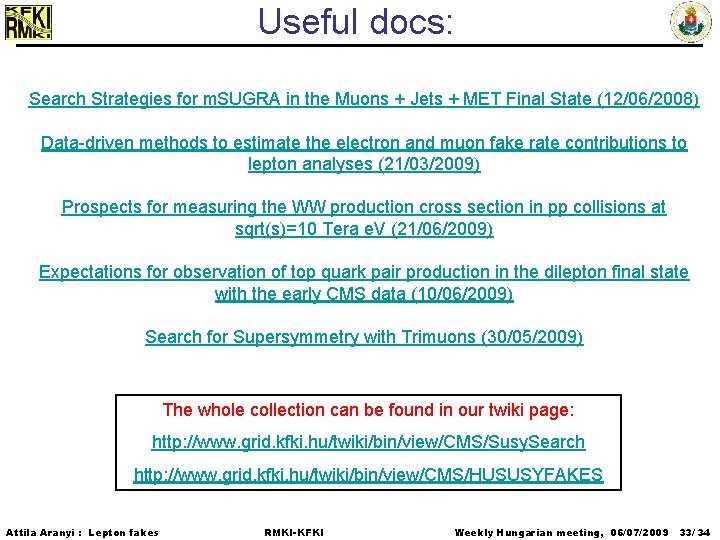
Useful docs: Search Strategies for m. SUGRA in the Muons + Jets + MET Final State (12/06/2008) Data-driven methods to estimate the electron and muon fake rate contributions to lepton analyses (21/03/2009) Prospects for measuring the WW production cross section in pp collisions at sqrt(s)=10 Tera e. V (21/06/2009) Expectations for observation of top quark pair production in the dilepton final state with the early CMS data (10/06/2009) Search for Supersymmetry with Trimuons (30/05/2009) The whole collection can be found in our twiki page: http: //www. grid. kfki. hu/twiki/bin/view/CMS/Susy. Search http: //www. grid. kfki. hu/twiki/bin/view/CMS/HUSUSYFAKES Attila Aranyi : Lepton fakes RMKI-KFKI Weekly Hungarian meeting, 06/07/2009 33/ 34

TO DO • upload relevant talks to the twiki page (this afternoon) • understand deeper the physics and methods • explore the RA 4 and top_stop signal • electrons or muons? • expecting advices… Attila Aranyi : Lepton fakes RMKI-KFKI Weekly Hungarian meeting, 06/07/2009 34/ 34
- Slides: 34