
LEPRA Dr Natalia Oli Department of Community Medicine
- Slides: 52
LEPRA Dr. Natalia Oli Department of Community Medicine
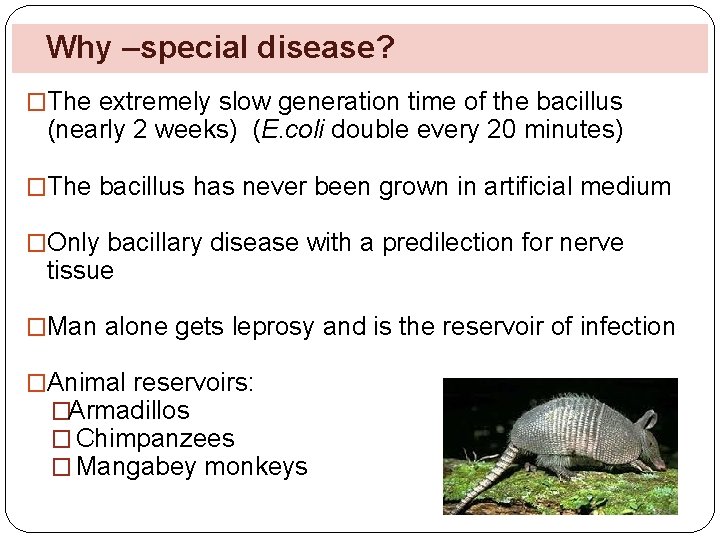
Why –special disease? �The extremely slow generation time of the bacillus (nearly 2 weeks) (E. coli double every 20 minutes) �The bacillus has never been grown in artificial medium �Only bacillary disease with a predilection for nerve tissue �Man alone gets leprosy and is the reservoir of infection �Animal reservoirs: �Armadillos � Chimpanzees � Mangabey monkeys
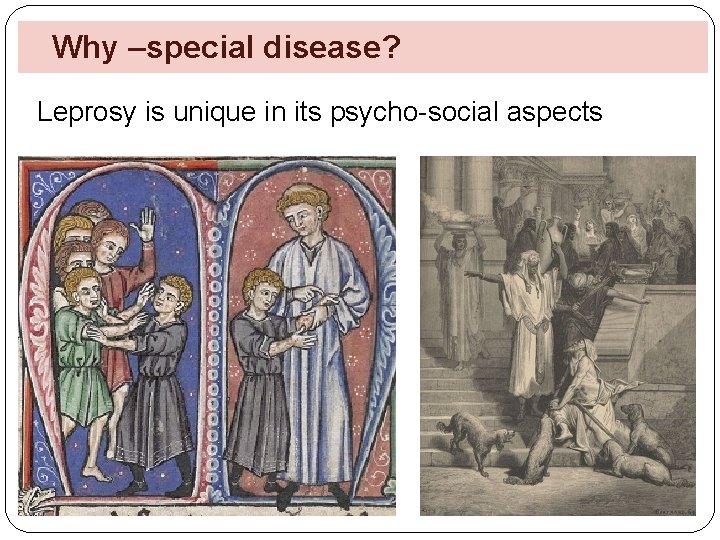
Why –special disease? Leprosy is unique in its psycho-social aspects
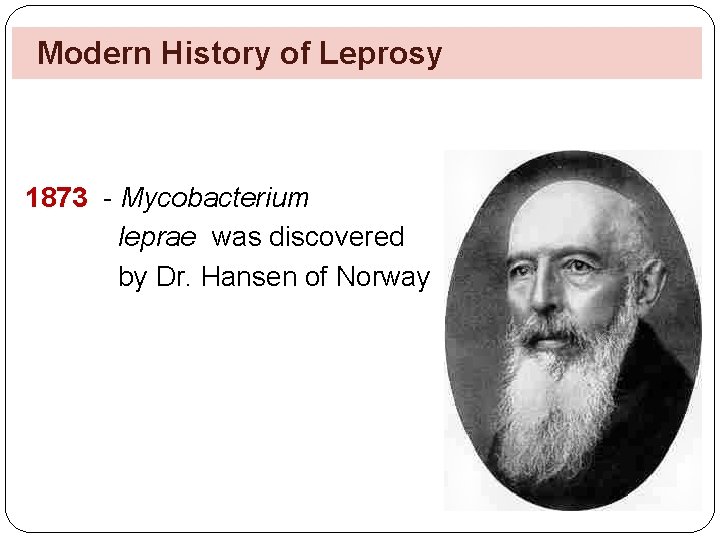
Modern History of Leprosy 1873 - Mycobacterium leprae was discovered by Dr. Hansen of Norway
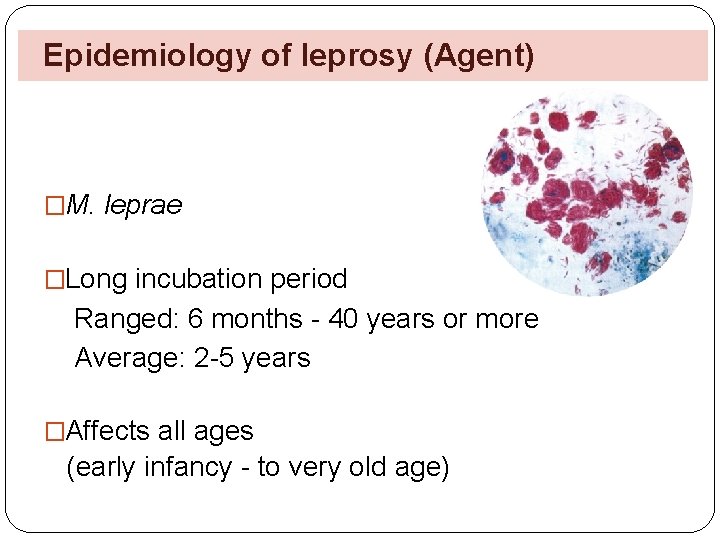
Epidemiology of leprosy (Agent) �M. leprae �Long incubation period Ranged: 6 months - 40 years or more Average: 2 -5 years �Affects all ages (early infancy - to very old age)
Epidemiology of leprosy (Environment) �Leprosy is associated with poverty and rural residence �Humidity favors survival of M. leprae in environment �M. leprae remain viable in: - Dried nasal secretions for 9 days - Moist soil at room temperature for 46 days �Overcrowding & lack of ventilation within households
Epidemiology of leprosy (Host) �Affects both sexes - Children: F=M - Adult: M > F 2: 1 � Unable to examine the female patients � Environmental or biological factors - Differing clothing habits - Greater mobility - Increase opportunities for contact in many population
Transmission of leprosy �Nasal droplet infection �Contact with infected people �Soil transmission
Transmission: Nasal droplet infection �Aerosolized M. leprae can cause infection in immunosuppressed mice �Majority of lepromatous patients showed leprosy bacilli in their nasal secretions as collected through nose blows.
Transmission: contact � 50% of leprosy patients - history of intimate contact with an infected person (often a household member) – in endemic countries �Household contact with an infected lepromatous case carries risk of disease acquisition: 10% in endemic areas 1% in non endemic locales �Contact with a tuberculoid case carries a very low risk
Transmission: soil transmission � In endemic countries (India), leprosy is primarily a rural disease. � M. leprae products reside in soil in endemic locales �Common sites of leprosy in children are the buttocks and thighs (microinoculation of infected soil may transmit the disease) �Direct dermal inoculation (e. g. , during tattooing) may transmit M. leprae
Classification �Tuberculoid (TT, BT) Leprosy �Borderline (BB, BL) Leprosy �Lepromatous (LL) Leprosy
Definitions �Who is a “case of Leprosy”? A person having a clinical/bacteriological signs of leprosy and not yet completed the Anti leprosy drugs (MDT) �Who is a “Leprosy affected people”? A person was completed anti leprosy drugs (MDT) after confirm diagnosis of leprosy and still may have residual signs (disability & deformity)
Clinical pathology �Majority - subclinical infection ( recover naturally without ever having symptoms or sings of disease) � Few people develop the disease-leprosy. �The clinical pattern of leprosy depends upon the response of the host to the organism �Cell mediated immunity is well developed-the pattern of disease - tuberculoid leprosy (tubercule) �Cell mediated immunity fails to develop - the pattern of disease - lepromatous leprosy (leproma)
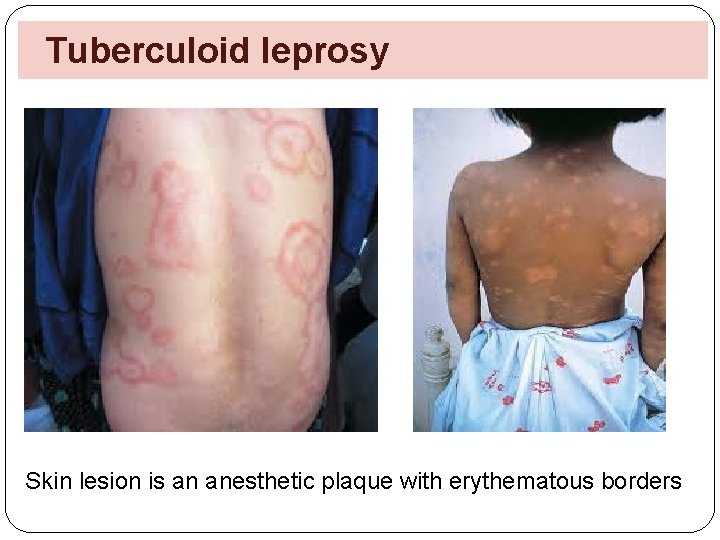
Tuberculoid leprosy Skin lesion is an anesthetic plaque with erythematous borders
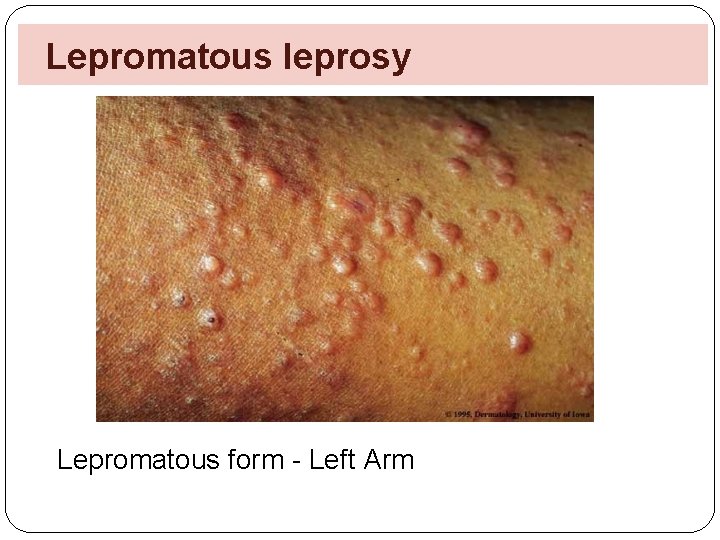
Lepromatous leprosy Lepromatous form - Left Arm
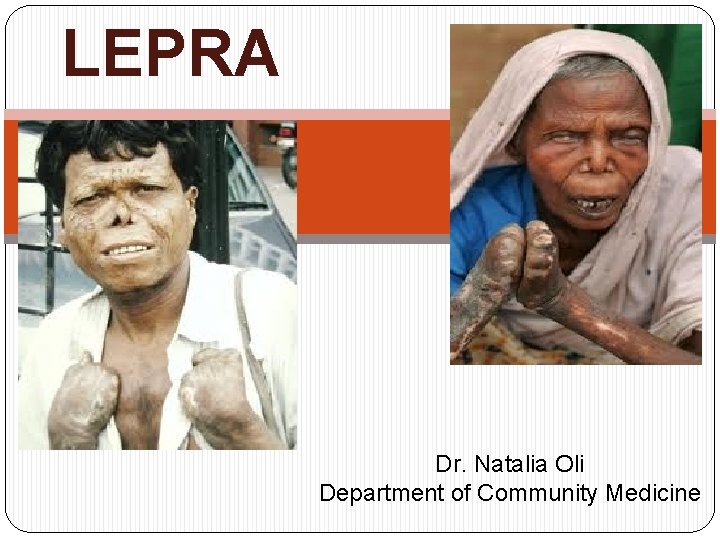
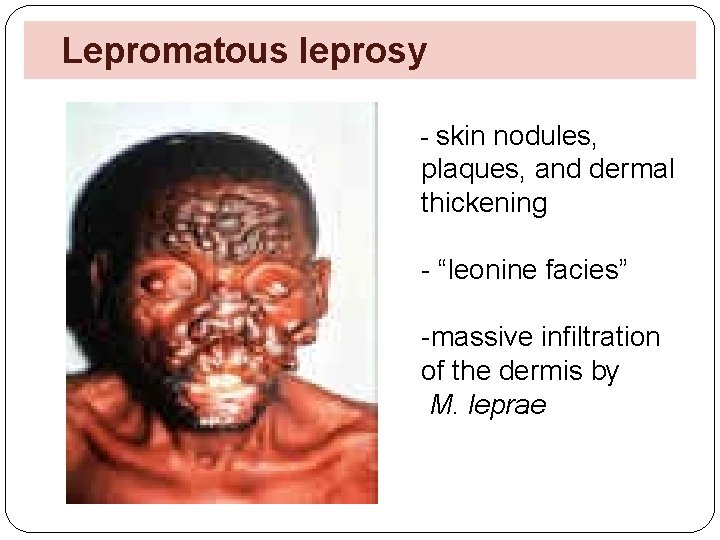
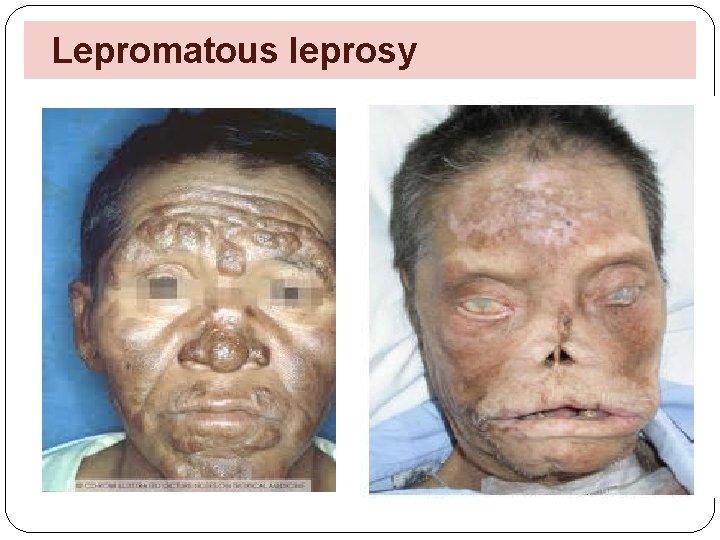
Lepromatous leprosy - skin nodules, plaques, and dermal thickening - “leonine facies” -massive infiltration of the dermis by M. leprae
Lepromatous leprosy
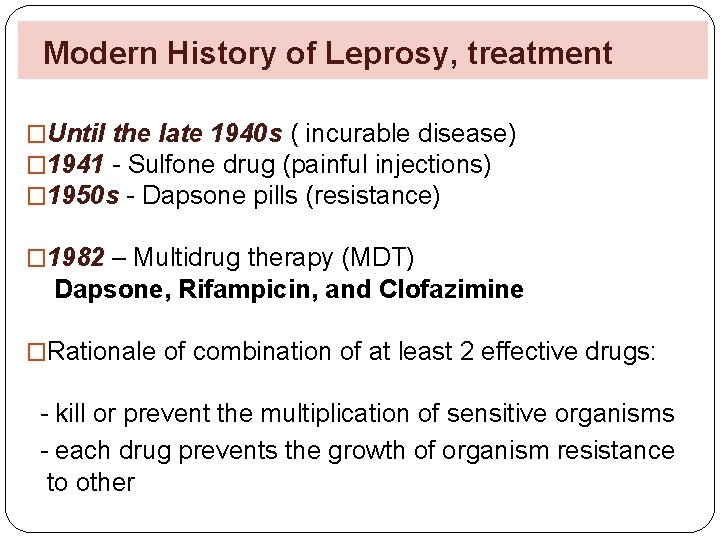
Modern History of Leprosy, treatment �Until the late 1940 s ( incurable disease) � 1941 - Sulfone drug (painful injections) � 1950 s - Dapsone pills (resistance) � 1982 – Multidrug therapy (MDT) Dapsone, Rifampicin, and Clofazimine �Rationale of combination of at least 2 effective drugs: - kill or prevent the multiplication of sensitive organisms - each drug prevents the growth of organism resistance to other
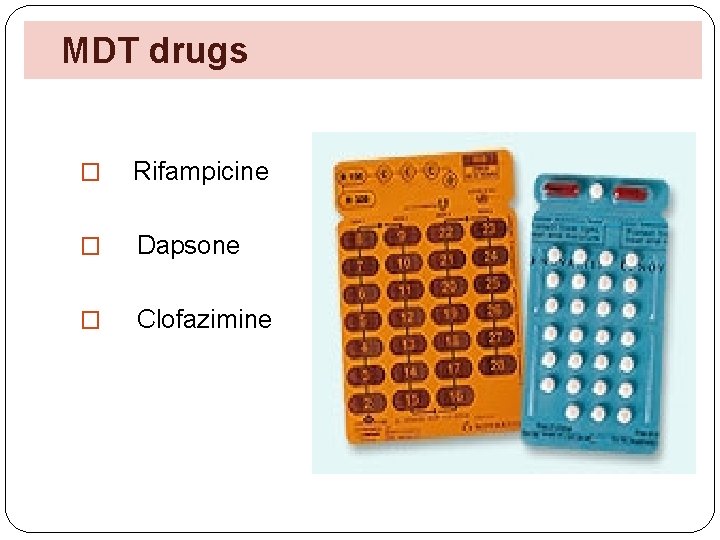
MDT drugs Rifampicine � Dapsone � � Clofazimine
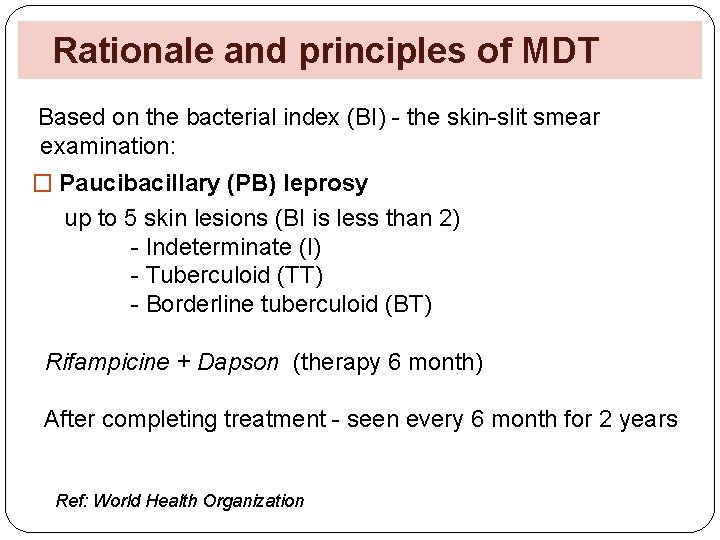
Rationale and principles of MDT Based on the bacterial index (BI) - the skin-slit smear examination: � Paucibacillary (PB) leprosy up to 5 skin lesions (BI is less than 2) - Indeterminate (I) - Tuberculoid (TT) - Borderline tuberculoid (BT) Rifampicine + Dapson (therapy 6 month) After completing treatment - seen every 6 month for 2 years Ref: World Health Organization
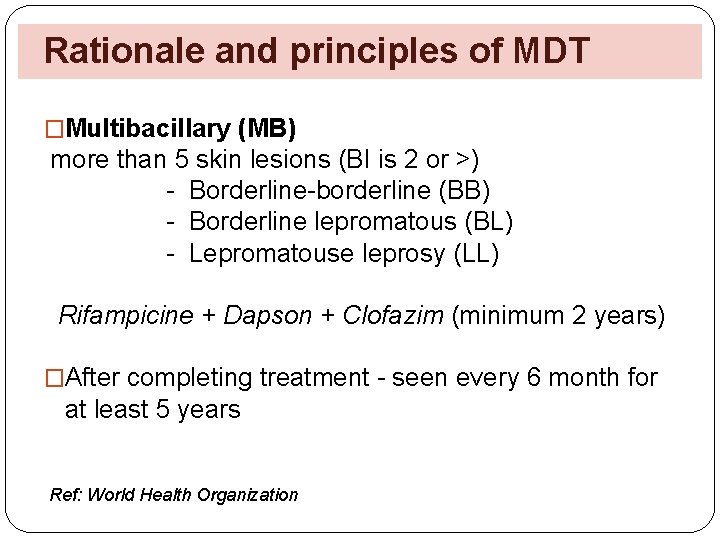
Rationale and principles of MDT �Multibacillary (MB) more than 5 skin lesions (BI is 2 or >) - Borderline-borderline (BB) - Borderline lepromatous (BL) - Lepromatouse leprosy (LL) Rifampicine + Dapson + Clofazim (minimum 2 years) �After completing treatment - seen every 6 month for at least 5 years Ref: World Health Organization
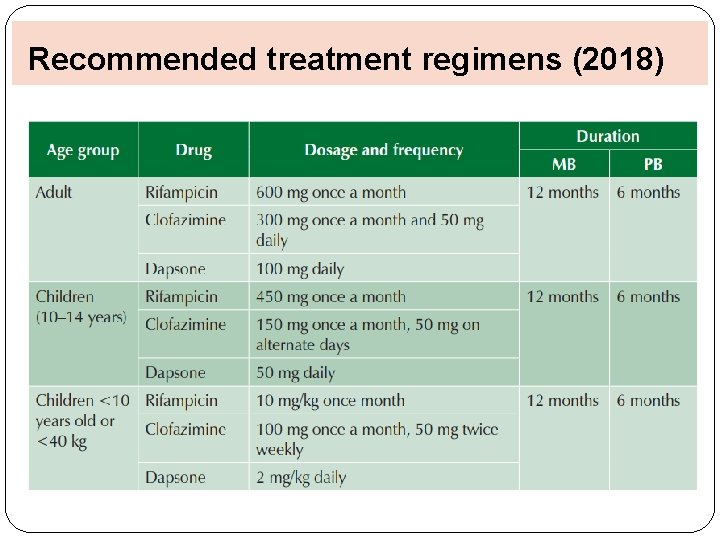
Recommended treatment regimens (2018)
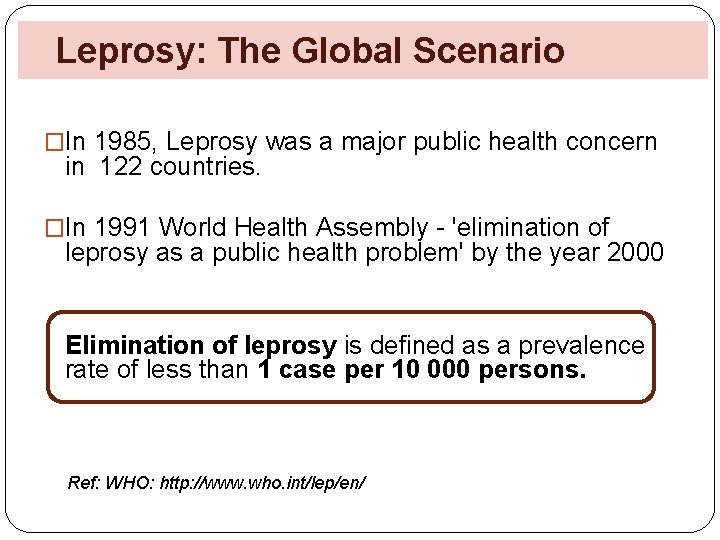
Leprosy: The Global Scenario �In 1985, Leprosy was a major public health concern in 122 countries. �In 1991 World Health Assembly - 'elimination of leprosy as a public health problem' by the year 2000 Elimination of leprosy is defined as a prevalence rate of less than 1 case per 10 000 persons. Ref: WHO: http: //www. who. int/lep/en/
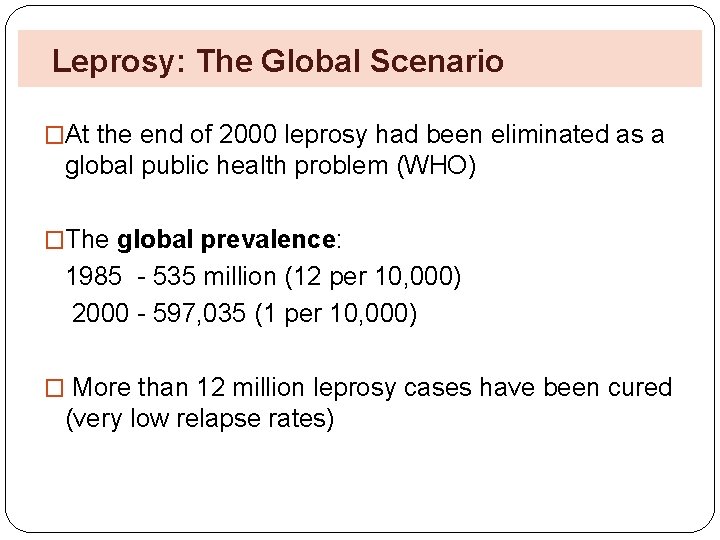
Leprosy: The Global Scenario �At the end of 2000 leprosy had been eliminated as a global public health problem (WHO) �The global prevalence: 1985 - 535 million (12 per 10, 000) 2000 - 597, 035 (1 per 10, 000) � More than 12 million leprosy cases have been cured (very low relapse rates)
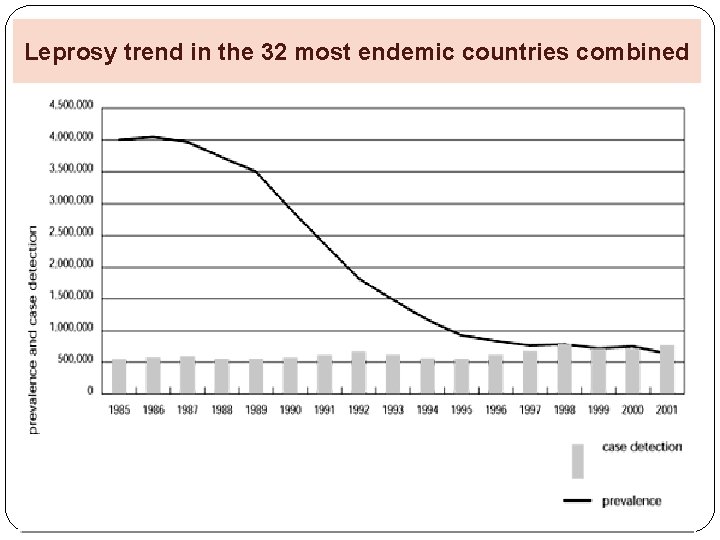
Leprosy trend in the 32 most endemic countries combined
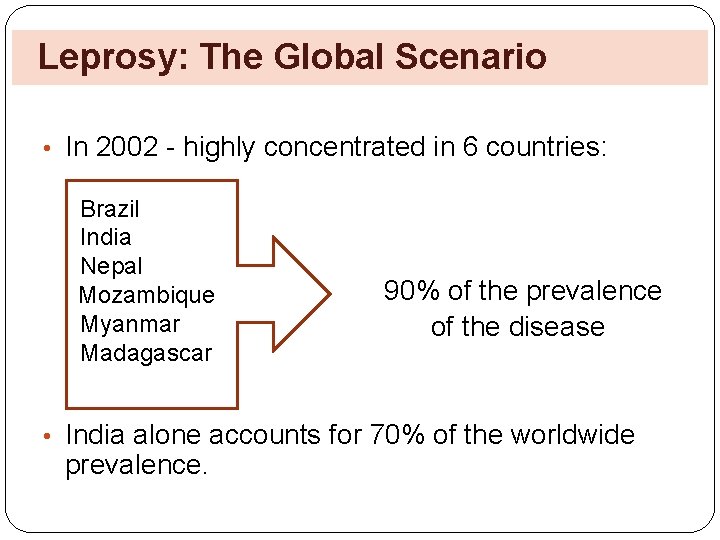
Leprosy: The Global Scenario • In 2002 - highly concentrated in 6 countries: Brazil India Nepal 90% of the prevalence Mozambique Myanmar of the disease Madagascar • India alone accounts for 70% of the worldwide prevalence.
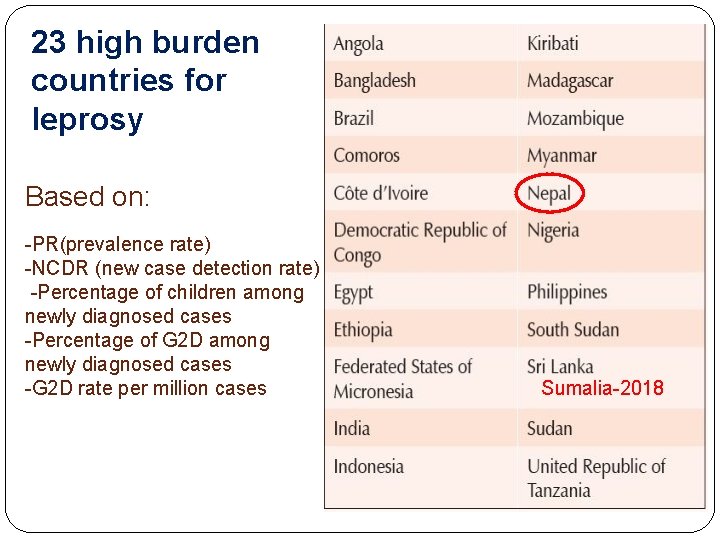
23 high burden countries for leprosy Based on: -PR(prevalence rate) -NCDR (new case detection rate) -Percentage of children among newly diagnosed cases -Percentage of G 2 D among newly diagnosed cases -G 2 D rate per million cases Sumalia-2018
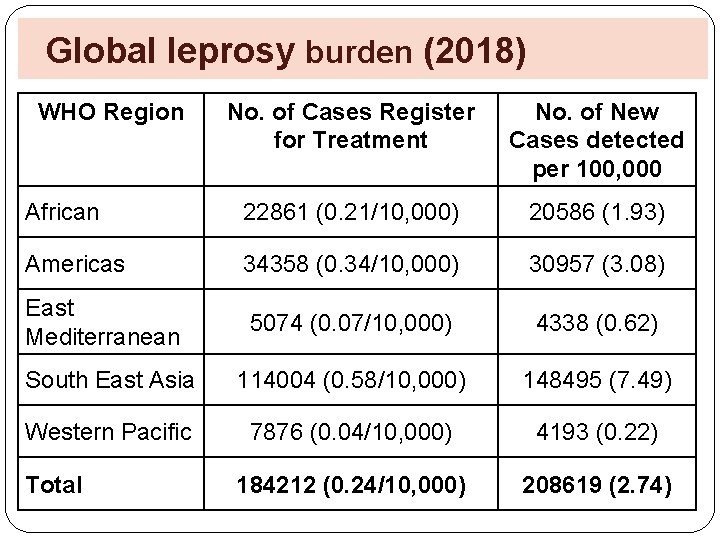
Global leprosy burden (2018) WHO Region No. of Cases Register for Treatment No. of New Cases detected per 100, 000 African 22861 (0. 21/10, 000) 20586 (1. 93) Americas 34358 (0. 34/10, 000) 30957 (3. 08) East Mediterranean 5074 (0. 07/10, 000) 4338 (0. 62) South East Asia 114004 (0. 58/10, 000) 148495 (7. 49) Western Pacific 7876 (0. 04/10, 000) 4193 (0. 22) 184212 (0. 24/10, 000) 208619 (2. 74) Total
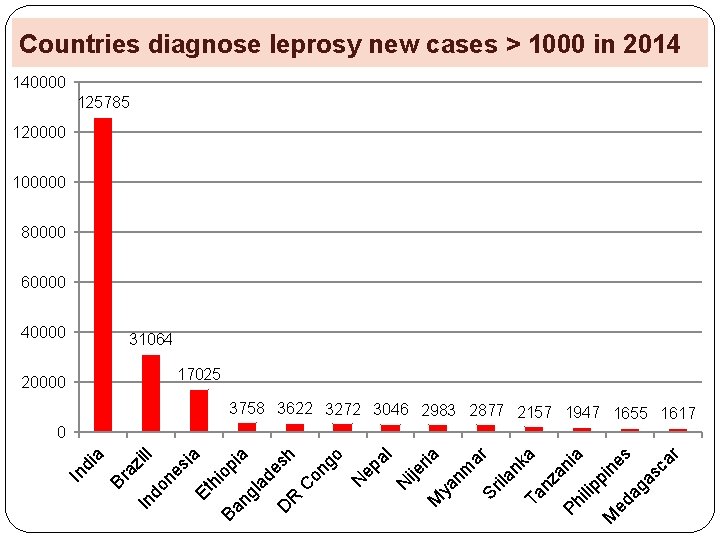
Countries diagnose leprosy new cases > 1000 in 2014 140000 125785 120000 100000 80000 60000 40000 31064 17025 20000 3758 3622 3272 3046 2983 2877 2157 1947 1655 1617 N ep al N ije ria M ya nm ar Sr ila nk a Ta nz an Ph ia ilip pi M ne ed s ag as ca r C on go sh D R ad e a ng l io pi Ba Et h es i a ll In do n az i Br In di a 0
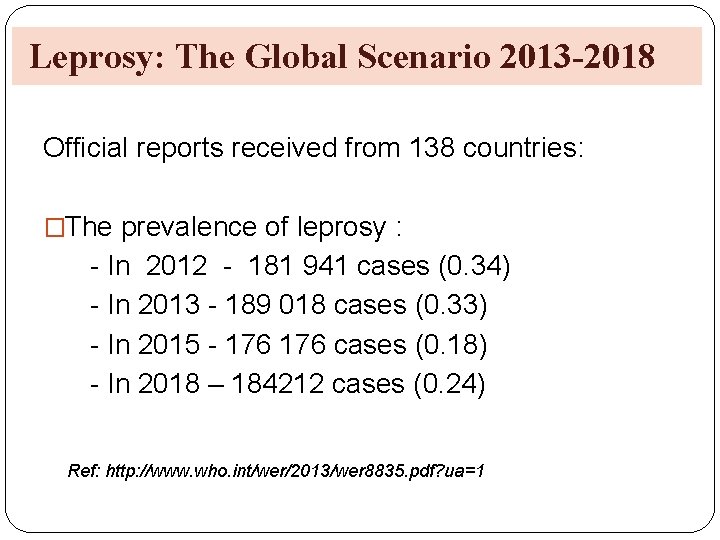
Leprosy: The Global Scenario 2013 -2018 Official reports received from 138 countries: �The prevalence of leprosy : - In 2012 - 181 941 cases (0. 34) - In 2013 - 189 018 cases (0. 33) - In 2015 - 176 cases (0. 18) - In 2018 – 184212 cases (0. 24) Ref: http: //www. who. int/wer/2013/wer 8835. pdf? ua=1
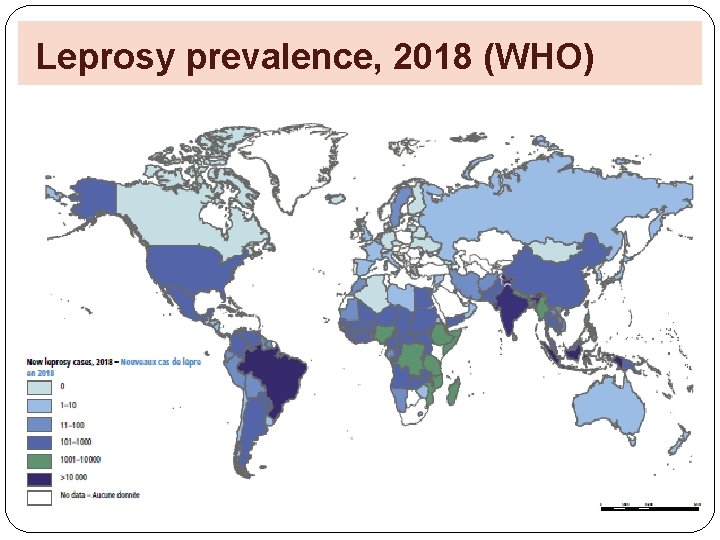
Leprosy prevalence, 2018 (WHO)
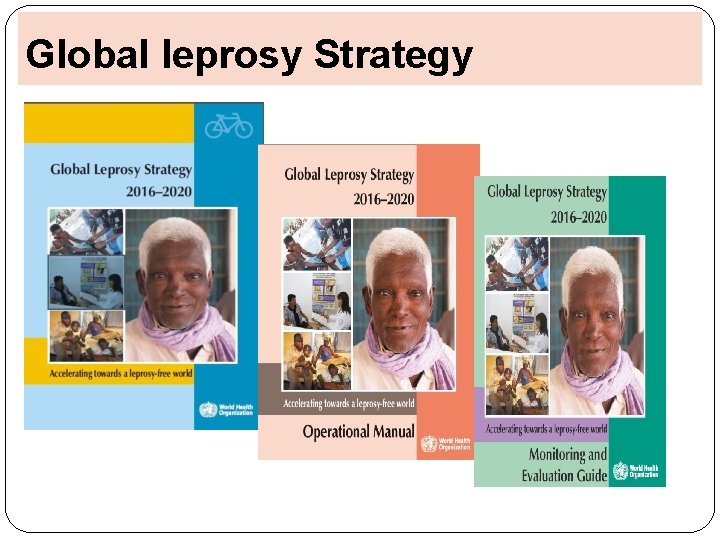
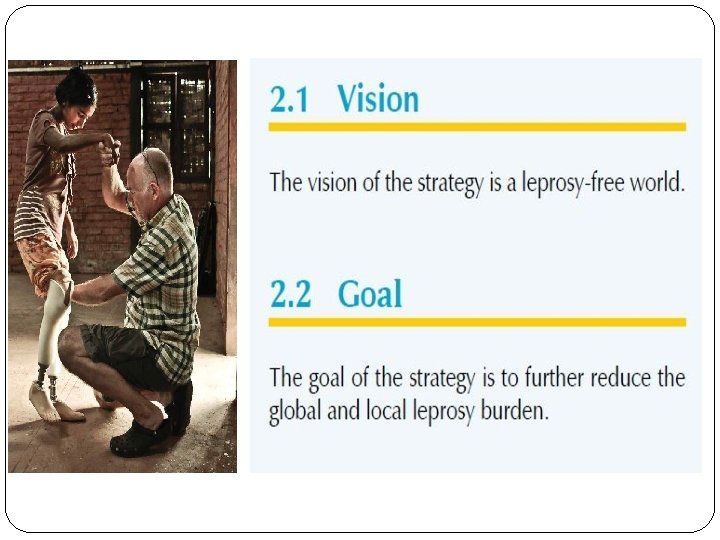
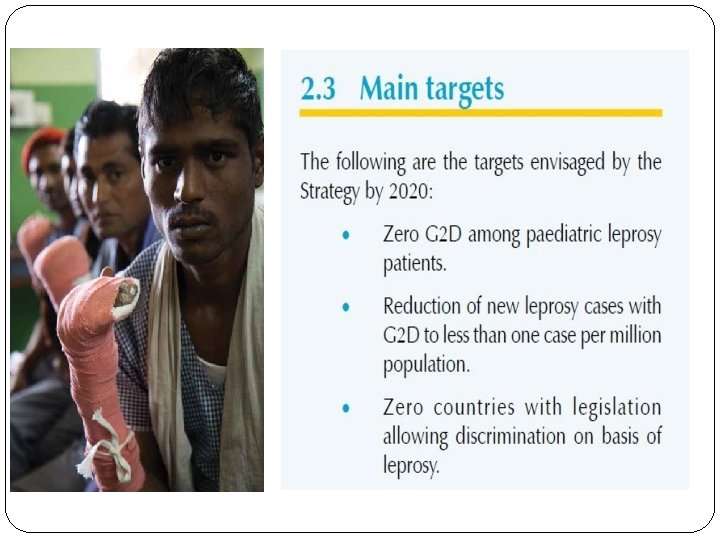
Global leprosy Strategy
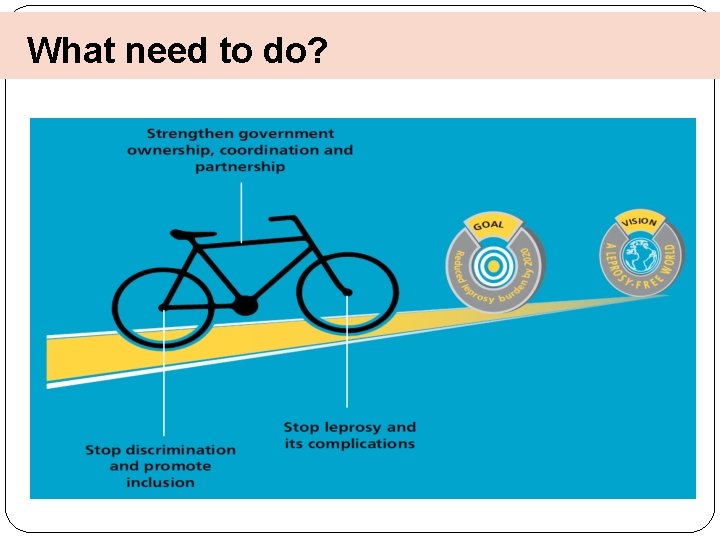
What need to do?
Working Principle under the 3 Main pillars � Focus on early case detection before visible deformity occur. (Special focus on children) � Target detection among higher risk groups through conducting campaigns � Develop national plans to ensure screening of all close contacts. � Promote steps to move towards the use of shorter uniform MDT � Incorporate specific interventions against stigma and discrimination due to leprosy
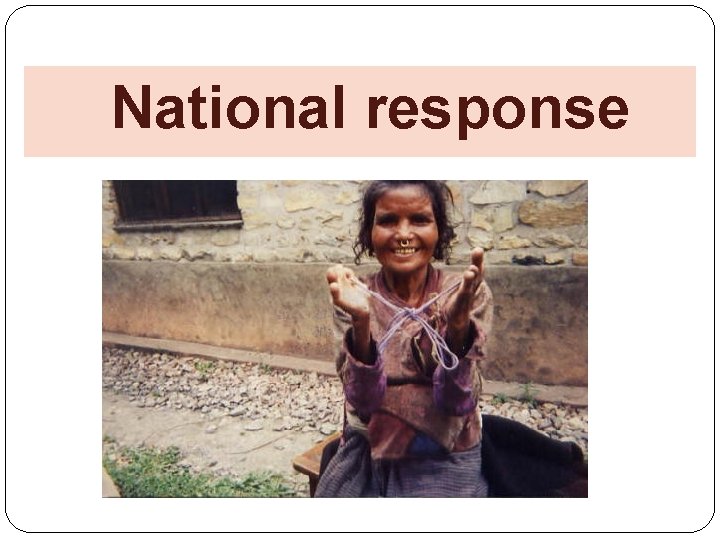
National response
History of elimination of leprosy � 1960 - Activities to control leprosy in an organized and planned manner were initiated � 1966 - Dapsone monotherapy treatment - as Pilot Project in the leprosy control program � 1982 – introduction of MDT (few selected areas) � 1991 - National leprosy elimination goal was set � 1996 - MDT service was expanded all the 75 districts � 2010 - Elimination at national level declared
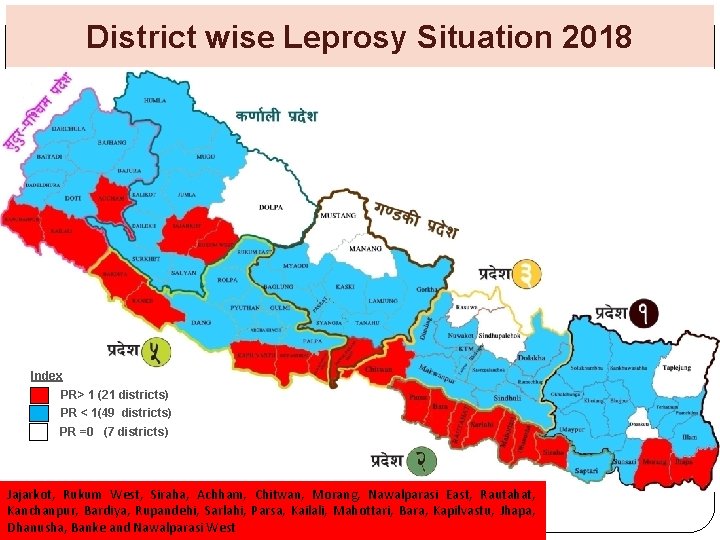
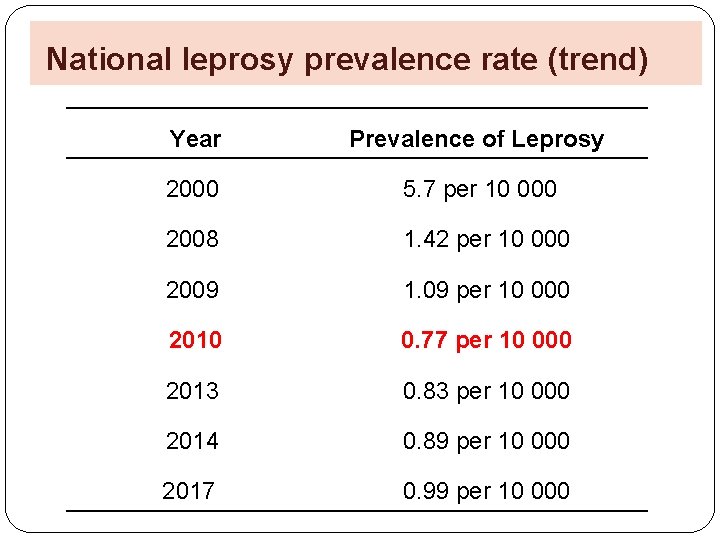
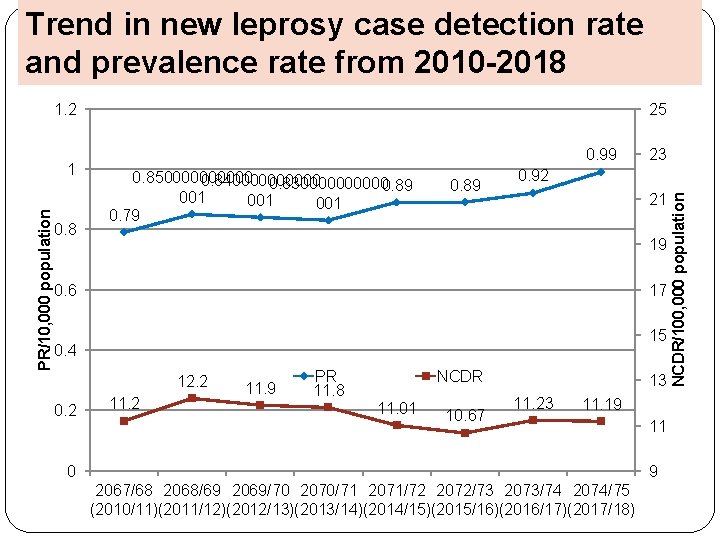
National situation � 2010 - Leprosy elimination declare from Nepal �Leprosy prevalence : June 2010 - 0. 77/10, 000 population 2013 -2014 - 0. 83/10, 000 populations 2014 -2015 - 0. 89/10, 000 populations 2016 -2017 – 0. 92/10, 000 population � 86% leprosy burden contributed by few Tarai Districts
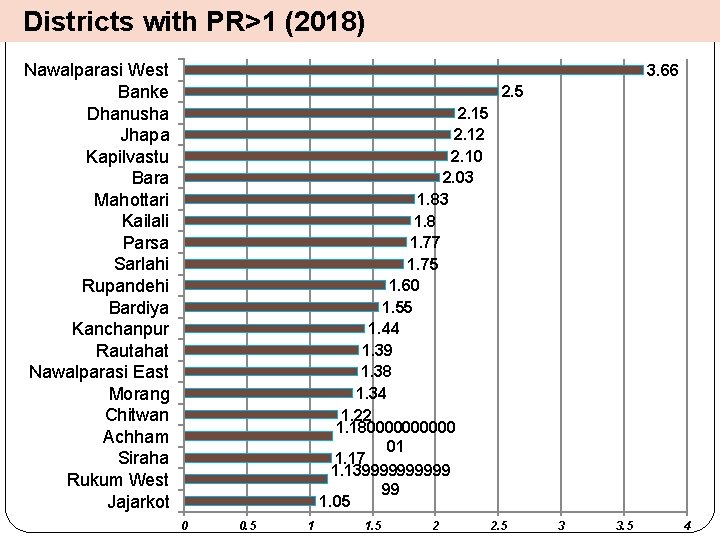
District wise Leprosy Situation 2018 Index PR> 1 (21 districts) PR < 1(49 districts) PR =0 (7 districts) Jajarkot, Rukum West, Siraha, Achham, Chitwan, Morang, Nawalparasi East, Rautahat, Kanchanpur, Bardiya, Rupandehi, Sarlahi, Parsa, Kailali, Mahottari, Bara, Kapilvastu, Jhapa, Dhanusha, Banke and Nawalparasi West
Districts with PR>1 (2018) Nawalparasi West Banke Dhanusha Jhapa Kapilvastu Bara Mahottari Kailali Parsa Sarlahi Rupandehi Bardiya Kanchanpur Rautahat Nawalparasi East Morang Chitwan Achham Siraha Rukum West Jajarkot 3. 66 2. 5 2. 12 2. 10 2. 03 1. 8 1. 77 1. 75 1. 60 1. 55 1. 44 1. 39 1. 38 1. 34 1. 22 1. 1800000 01 1. 17 1. 1399999 99 1. 05 0 0. 5 1 1. 5 2 2. 5 3 3. 5 4
National leprosy prevalence rate (trend) Year Prevalence of Leprosy 2000 5. 7 per 10 000 2008 1. 42 per 10 000 2009 1. 09 per 10 000 2010 0. 77 per 10 000 2013 0. 83 per 10 000 2014 0. 89 per 10 000 2017 0. 99 per 10 000
Trend in new leprosy case detection rate and prevalence rate from 2010 -2018 1. 2 0. 8 0. 99 0. 8500000 0. 8400000 0. 83000000. 89 001 001 0. 79 0. 89 0. 92 21 19 0. 6 17 15 0. 4 12. 2 0. 2 23 11. 2 11. 9 PR 11. 8 NCDR 11. 01 10. 67 13 11. 23 11. 19 0 11 9 2067/68 2068/69 2069/70 2070/71 2071/72 2072/73 2073/74 2074/75 (2010/11) (2011/12) (2012/13) (2013/14) (2014/15) (2015/16)(2016/17)(2017/18) NCDR/100, 000 population PR/10, 000 population 1 25
History of elimination of leprosy � Leprosy Control Division - guiding body for leprosy control activity in Nepal (now Leprosy Control Section under Epidemiology and Disease Control Division) � Initiatives are coordinated amongst the national, international and local non‐governmental organizations � Nepal - member country of Global Alliance for Elimination of Leprosy � All medical facilities provide MDT free of cost to all registered leprosy affected
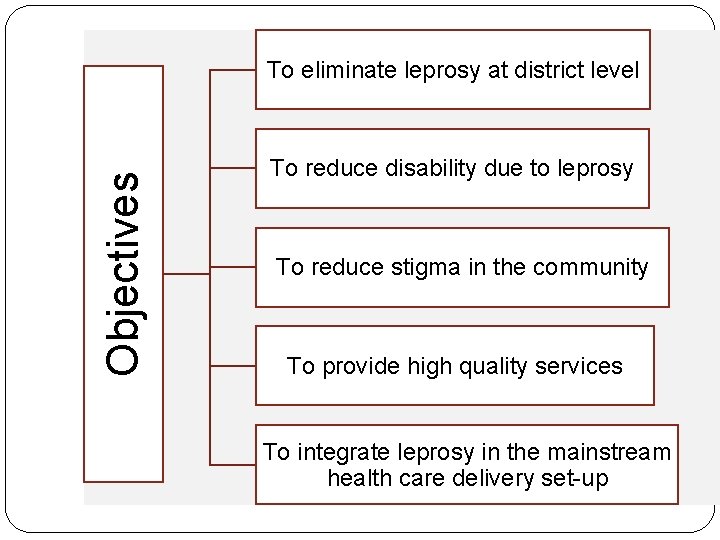
Objectives To eliminate leprosy at district level To reduce disability due to leprosy To reduce stigma in the community To provide high quality services To integrate leprosy in the mainstream health care delivery set-up
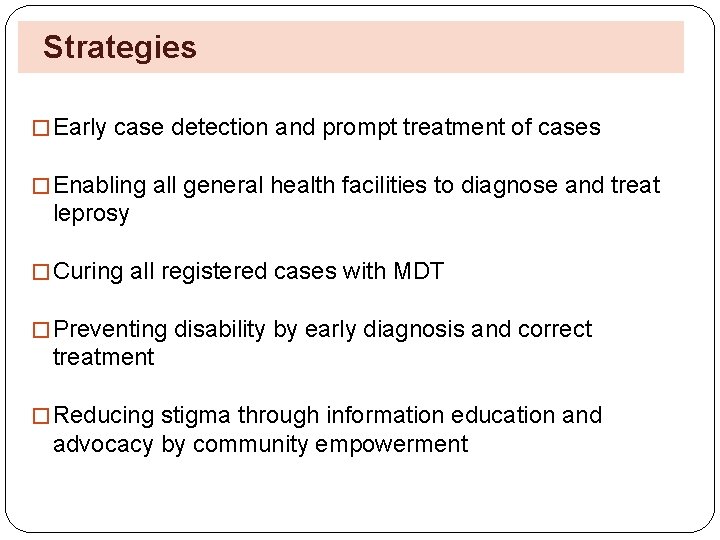
Strategies � Early case detection and prompt treatment of cases � Enabling all general health facilities to diagnose and treat leprosy � Curing all registered cases with MDT � Preventing disability by early diagnosis and correct treatment � Reducing stigma through information education and advocacy by community empowerment
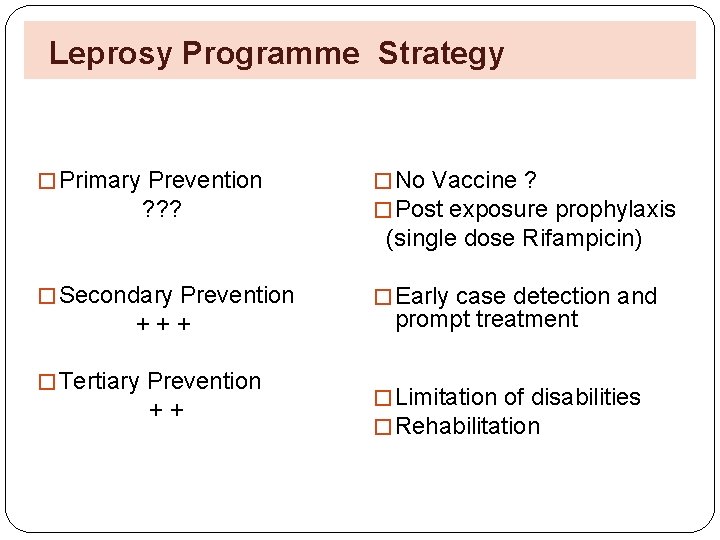
Leprosy Programme Strategy � Primary Prevention ? ? ? � No Vaccine ? � Post exposure prophylaxis (single dose Rifampicin) � Secondary Prevention + + + � Tertiary Prevention + + � Early case detection and prompt treatment � Limitation of disabilities � Rehabilitation
The Leprosy Mission International � Established in Ireland, 1873 �The Leprosy Mission International (TLMI) is a leading international Christian organization. � Head office: London, UK with Three Regional office �TLM is a worldwide partnership, active in over 50 countries, with a vision for a world without leprosy and a passion to eradicate the causes and consequences of leprosy.
Leprosy Mission Nepal (LMN) � Leprosy Mission Nepal (LMN) is a one of the local NGO registered in Lalitpur CDO office & directly supported by TLMI established in 2005. Establish: � LMN established as a Anandaban Leprosy Hospital in 1957 and start Other Project (Eg. Training, Research, ATS etc. ) by TLMI
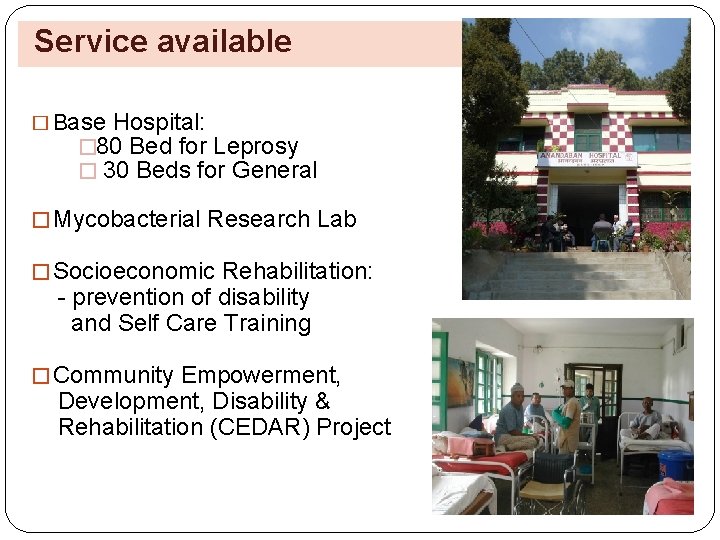
Service available � Base Hospital: � 80 Bed for Leprosy � 30 Beds for General � Mycobacterial Research Lab � Socioeconomic Rehabilitation: - prevention of disability and Self Care Training � Community Empowerment, Development, Disability & Rehabilitation (CEDAR) Project
Our goal is ‘Leprosy Free Nepal’