
Leon Trotsky HSC Modern History Personalities in the
- Slides: 26
Leon Trotsky HSC Modern History Personalities in the Twentieth Century Dr Michael Molkentin Shellharbour Anglican College & The University of New South Wales Canberra Get this Power. Point: http: //www. michaelmolkentin. com/resources/
Outline of lecture 1. The syllabus 2. The examination 3. Key features of Trotsky’s life 4. Evaluating Trotsky's life 5. Historiography
Principal focus: Through the study of Leon Trotsky, students gain an understanding of the role of this personality in a period of national or international history. Students learn to: • ask relevant historical questions • locate, select and organise information from different types of sources, including ICT, to describe and analyse relevant features and issues • assess the impact of the personality on twentieth-century history • analyse the contribution of the personality to the period in which they lived • account for and assess differing perspectives and interpretations of the personality • evaluate the usefulness and reliability of sources • present the findings of investigations on aspects of the personality, analysing and synthesising information from different types of sources • communicate an understanding of relevant concepts, features and issues using appropriate and well-structured oral and/or written and/or multimedia forms including ICT.
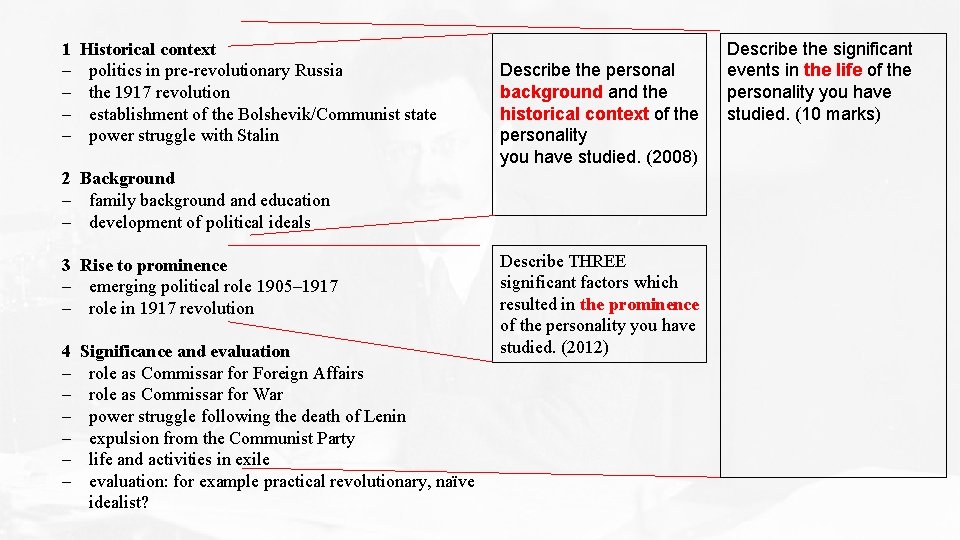
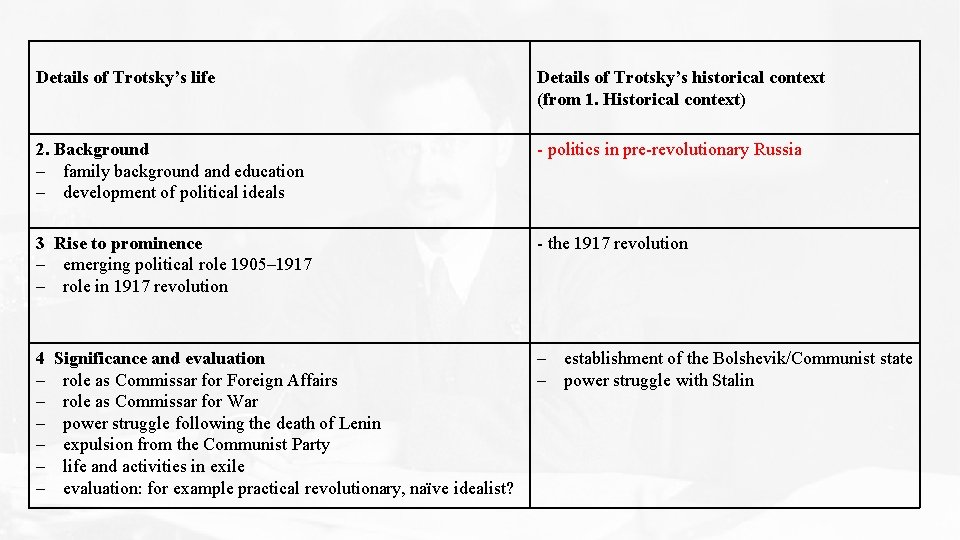
1 – – 2 – – 3 – – 4 – – – Historical context politics in pre-revolutionary Russia the 1917 revolution establishment of the Bolshevik/Communist state power struggle with Stalin Background family background and education development of political ideals Rise to prominence emerging political role 1905– 1917 role in 1917 revolution Significance and evaluation role as Commissar for Foreign Affairs role as Commissar for War power struggle following the death of Lenin expulsion from the Communist Party life and activities in exile evaluation: for example practical revolutionary, naïve idealist?
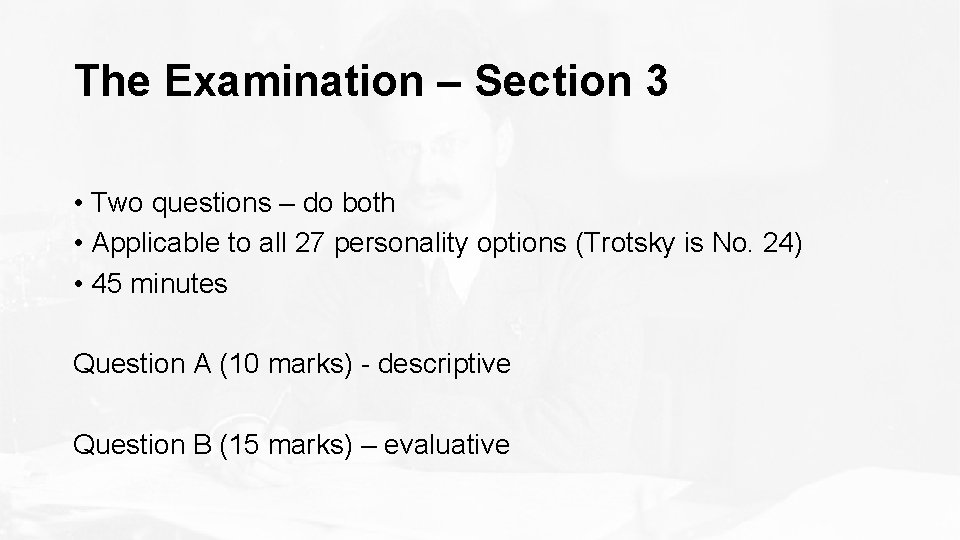
The Examination – Section 3 • Two questions – do both • Applicable to all 27 personality options (Trotsky is No. 24) • 45 minutes Question A (10 marks) - descriptive Question B (15 marks) – evaluative
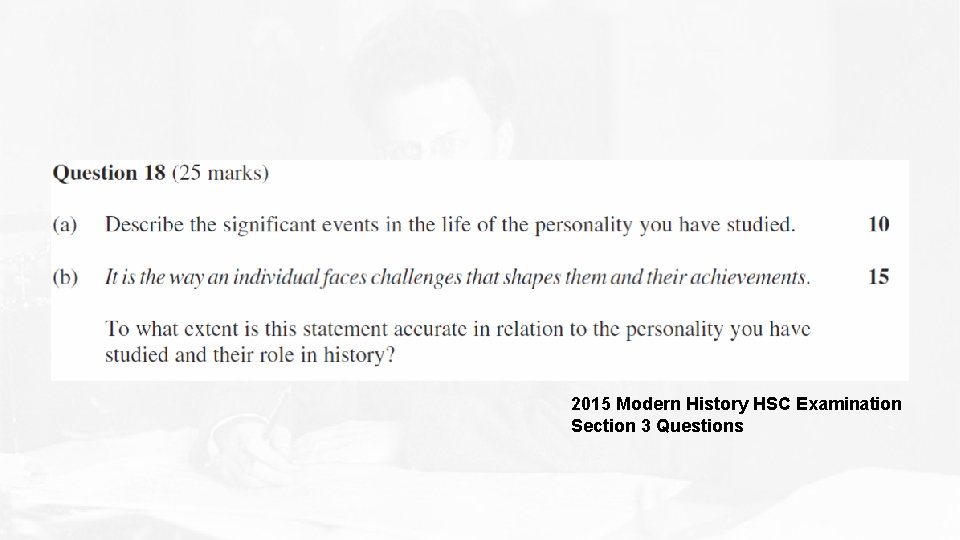
2015 Modern History HSC Examination Section 3 Questions
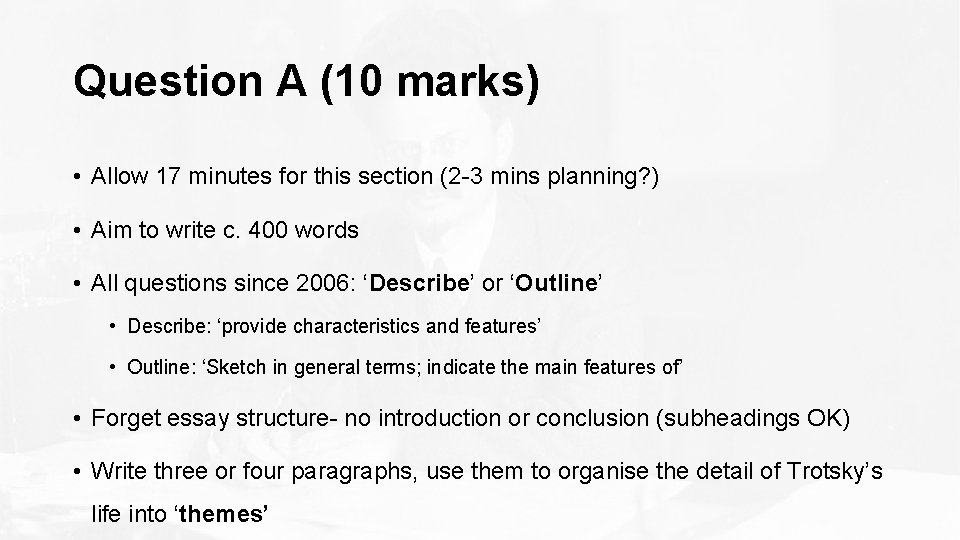
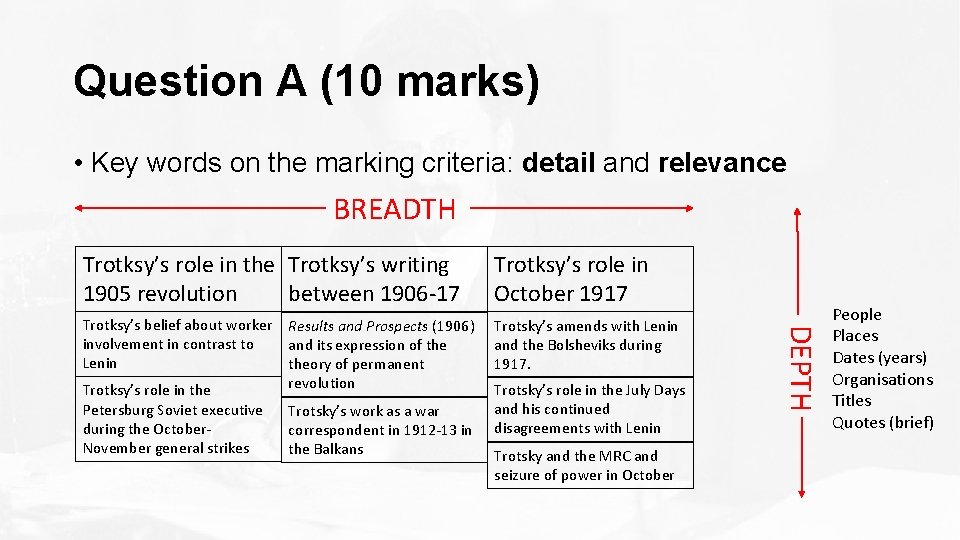
Question A (10 marks) • Allow 17 minutes for this section (2 -3 mins planning? ) • Aim to write c. 400 words • All questions since 2006: ‘Describe’ or ‘Outline’ • Describe: ‘provide characteristics and features’ • Outline: ‘Sketch in general terms; indicate the main features of’ • Forget essay structure- no introduction or conclusion (subheadings OK) • Write three or four paragraphs, use them to organise the detail of Trotsky’s life into ‘themes’
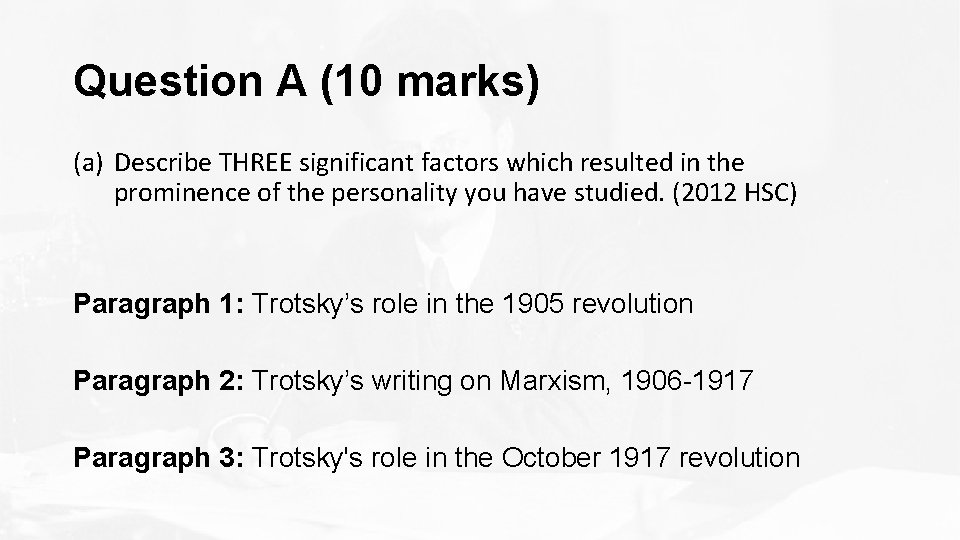
Question A (10 marks) (a) Describe THREE significant factors which resulted in the prominence of the personality you have studied. (2012 HSC) Paragraph 1: Trotsky’s role in the 1905 revolution Paragraph 2: Trotsky’s writing on Marxism, 1906 -1917 Paragraph 3: Trotsky's role in the October 1917 revolution
Question A (10 marks) • Key words on the marking criteria: detail and relevance BREADTH Trotksy’s role in October 1917 Trotksy’s belief about worker Results and Prospects (1906) involvement in contrast to and its expression of the Lenin theory of permanent revolution Trotksy’s role in the Trotsky’s amends with Lenin and the Bolsheviks during 1917. Petersburg Soviet executive during the October. November general strikes Trotsky’s work as a war correspondent in 1912 -13 in the Balkans Trotsky’s role in the July Days and his continued disagreements with Lenin Trotsky and the MRC and seizure of power in October DEPTH Trotksy’s role in the Trotksy’s writing between 1906 -17 1905 revolution People Places Dates (years) Organisations Titles Quotes (brief)
1 – – 2 – – 3 – – 4 – – – Historical context politics in pre-revolutionary Russia the 1917 revolution establishment of the Bolshevik/Communist state power struggle with Stalin Describe the personal background and the historical context of the personality you have studied. (2008) Background family background and education development of political ideals Rise to prominence emerging political role 1905– 1917 role in 1917 revolution Significance and evaluation role as Commissar for Foreign Affairs role as Commissar for War power struggle following the death of Lenin expulsion from the Communist Party life and activities in exile evaluation: for example practical revolutionary, naïve idealist? Describe THREE significant factors which resulted in the prominence of the personality you have studied. (2012) Describe the significant events in the life of the personality you have studied. (10 marks)
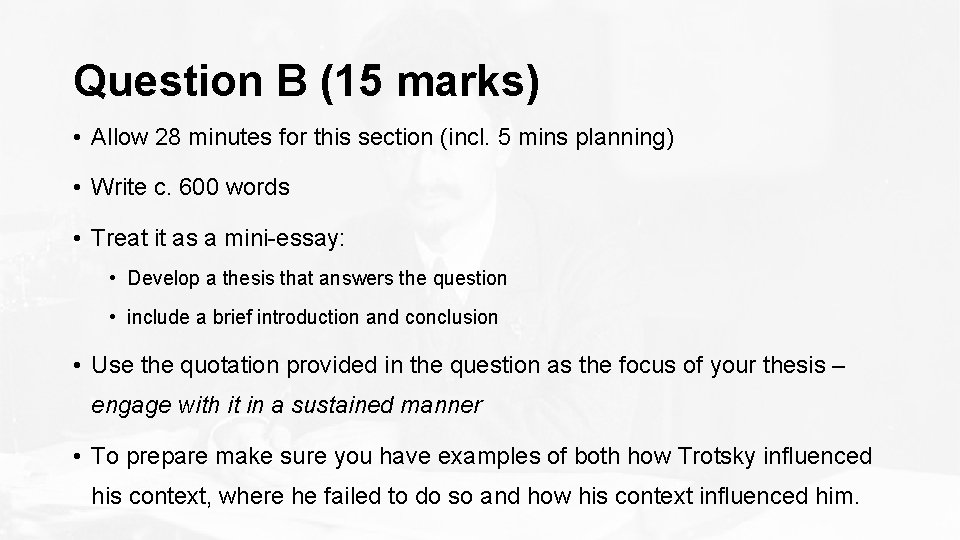
Question B (15 marks) • Allow 28 minutes for this section (incl. 5 mins planning) • Write c. 600 words • Treat it as a mini-essay: • Develop a thesis that answers the question • include a brief introduction and conclusion • Use the quotation provided in the question as the focus of your thesis – engage with it in a sustained manner • To prepare make sure you have examples of both how Trotsky influenced his context, where he failed to do so and how his context influenced him.
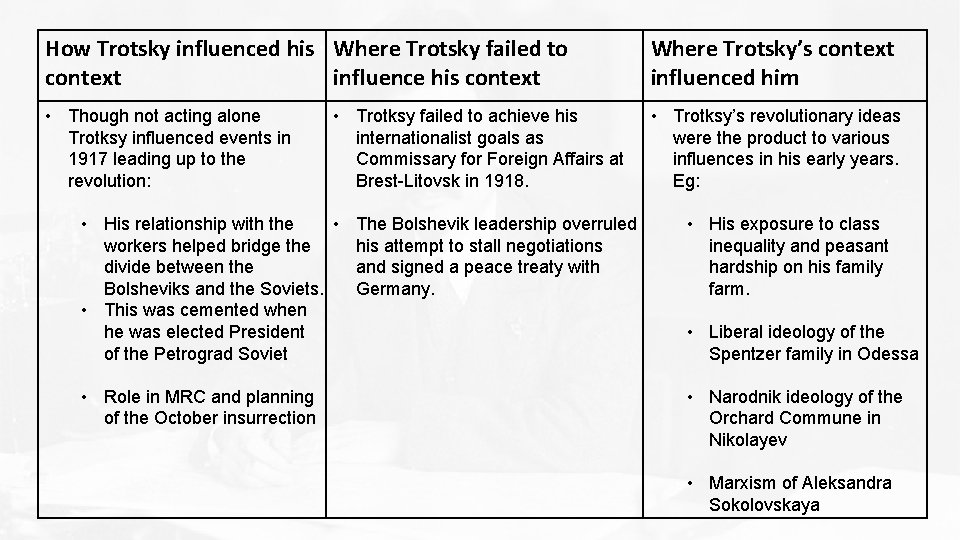
How Trotsky influenced his Where Trotsky failed to context influence his context Where Trotsky’s context influenced him • Though not acting alone Trotksy influenced events in 1917 leading up to the revolution: • Trotksy’s revolutionary ideas were the product to various influences in his early years. Eg: • Trotksy failed to achieve his internationalist goals as Commissary for Foreign Affairs at Brest-Litovsk in 1918. • His relationship with the • The Bolshevik leadership overruled workers helped bridge the his attempt to stall negotiations divide between the and signed a peace treaty with Bolsheviks and the Soviets. Germany. • This was cemented when he was elected President of the Petrograd Soviet • His exposure to class inequality and peasant hardship on his family farm. • Role in MRC and planning of the October insurrection • Narodnik ideology of the Orchard Commune in Nikolayev • Liberal ideology of the Spentzer family in Odessa • Marxism of Aleksandra Sokolovskaya
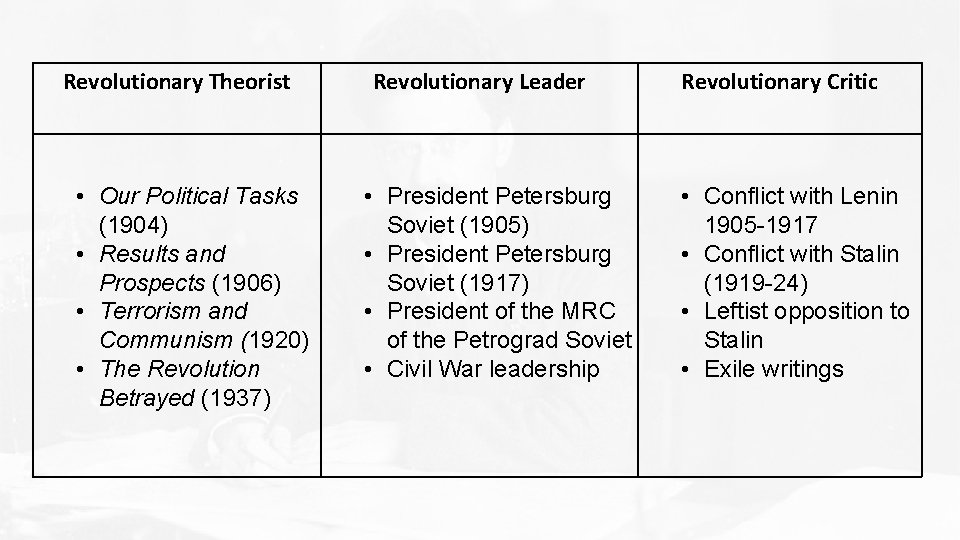
Revolutionary Theorist • Our Political Tasks (1904) • Results and Prospects (1906) • Terrorism and Communism (1920) • The Revolution Betrayed (1937) Revolutionary Leader • President Petersburg Soviet (1905) • President Petersburg Soviet (1917) • President of the MRC of the Petrograd Soviet • Civil War leadership Revolutionary Critic • Conflict with Lenin 1905 -1917 • Conflict with Stalin (1919 -24) • Leftist opposition to Stalin • Exile writings
Details of Trotsky’s life Details of Trotsky’s historical context (from 1. Historical context) 2. Background – family background and education – development of political ideals - politics in pre-revolutionary Russia 3 Rise to prominence – emerging political role 1905– 1917 – role in 1917 revolution - the 1917 revolution 4 – – – – establishment of the Bolshevik/Communist state – power struggle with Stalin Significance and evaluation role as Commissar for Foreign Affairs role as Commissar for War power struggle following the death of Lenin expulsion from the Communist Party life and activities in exile evaluation: for example practical revolutionary, naïve idealist?
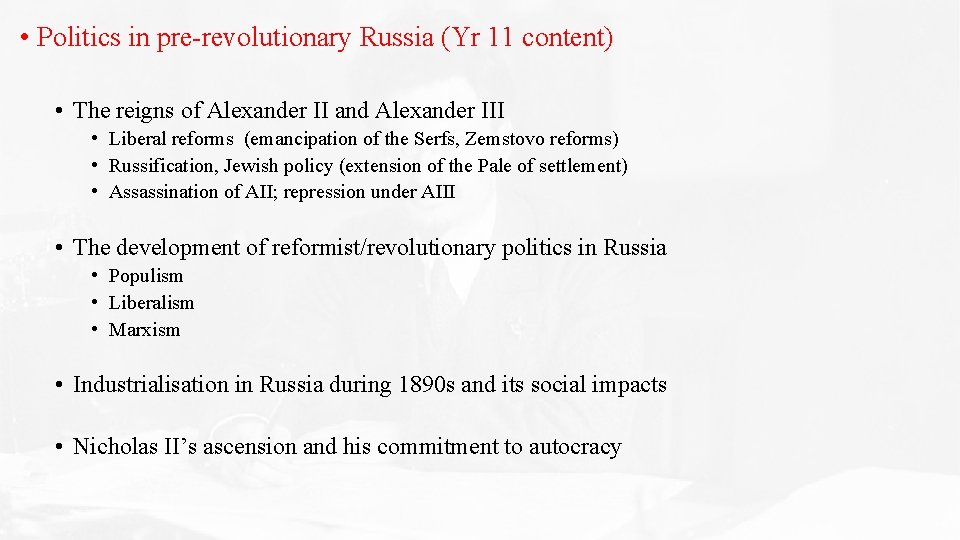
• Politics in pre-revolutionary Russia (Yr 11 content) • The reigns of Alexander II and Alexander III • Liberal reforms (emancipation of the Serfs, Zemstovo reforms) • Russification, Jewish policy (extension of the Pale of settlement) • Assassination of AII; repression under AIII • The development of reformist/revolutionary politics in Russia • Populism • Liberalism • Marxism • Industrialisation in Russia during 1890 s and its social impacts • Nicholas II’s ascension and his commitment to autocracy
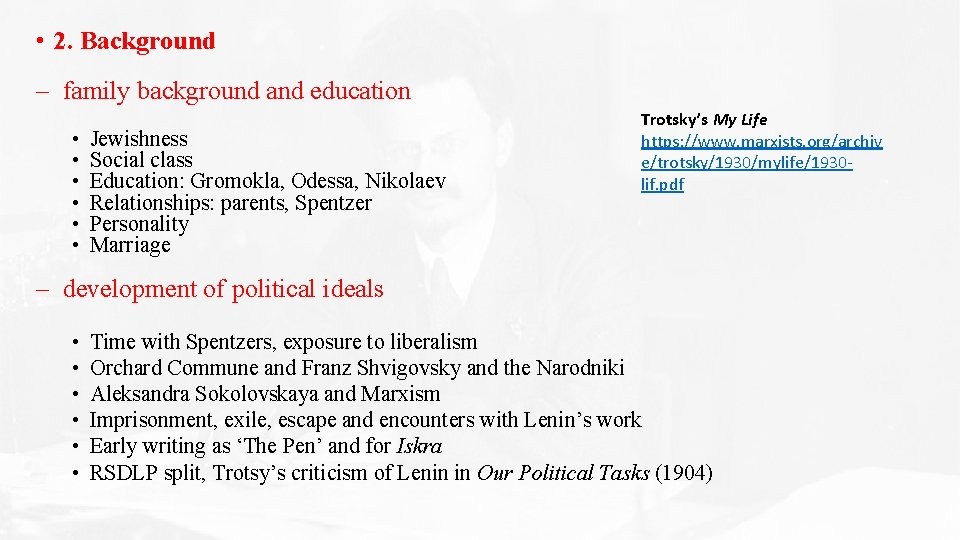
• 2. Background – family background and education • • • Jewishness Social class Education: Gromokla, Odessa, Nikolaev Relationships: parents, Spentzer Personality Marriage Trotsky’s My Life https: //www. marxists. org/archiv e/trotsky/1930/mylife/1930 lif. pdf – development of political ideals • • • Time with Spentzers, exposure to liberalism Orchard Commune and Franz Shvigovsky and the Narodniki Aleksandra Sokolovskaya and Marxism Imprisonment, exile, escape and encounters with Lenin’s work Early writing as ‘The Pen’ and for Iskra RSDLP split, Trotsy’s criticism of Lenin in Our Political Tasks (1904)
3 Rise to prominence – emerging political role 1905– 1917 • • • Relationship with Bolshevik and Menshevik factions Role in 1905 – Petersburg Soviet and arrest Results and Prospects (1906) • Permanent revolution • Anticipated conflict with the peasantry after a revolution occurs Failed attempts to re-unify RSDLP, conflict with Lenin War correspondent in the Balkans, Western Front – role in 1917 revolution • • Arrival in Petrograd May 1917 July Days, voluntary arrest and siding with Bolsheviks President of Petrograd Soviet (bridge between Bolsheviks and Soviets) President of Military Revolutionary Council, co-ordination of October revolution
4. Significance and evaluation – role as Commissar for Foreign Affairs • Role at Brest-Litovsk, conflict with Central Committee – role as Commissar for War • Establishment of the Red Army, use of ‘Military Specialists’ • Trotsky’s train • Crushing peasant uprisings (and Krondstadt) • War Communism and especially Labour Armies • Opposition to NEP and conflict with Central Committee – power struggle following the death of Lenin • Lenin’s testament • Socialism in One Country vs Permanent Revolution • Trotsky vs Stalin (strengths and weaknesses)
4. Significance and evaluation (continued) – expulsion from the Communist Party • The United Opposition (Trotsky, Kamenev and Zinoviev) • The Tenth Anniversary of the Bolshevik Revolution- support for Trotsky • Expulsion – life and activities in exile • Alma Ata (1927 -29) • European exile (1929 -1936) • My Life (1930) • Mexico (1937 -1940) • The Revolution Betrayed (1937) • The Fourth International • Assassination
– evaluation: for example practical revolutionary, naïve idealist? 1. The impact of something in Trotsky’s life on him (2015) 2. The extent of Trotsky’s agency: Trotsky vs his context- which influenced which? (2009, 2010, 2014) 3. The nature of Trotsky’s impact (2012) 4. The extent of Trotsky’s impact (2005, 2011, 2013) 5. The ways in which historians (and others? ) have interpreted Trotsky (2006, 2008)
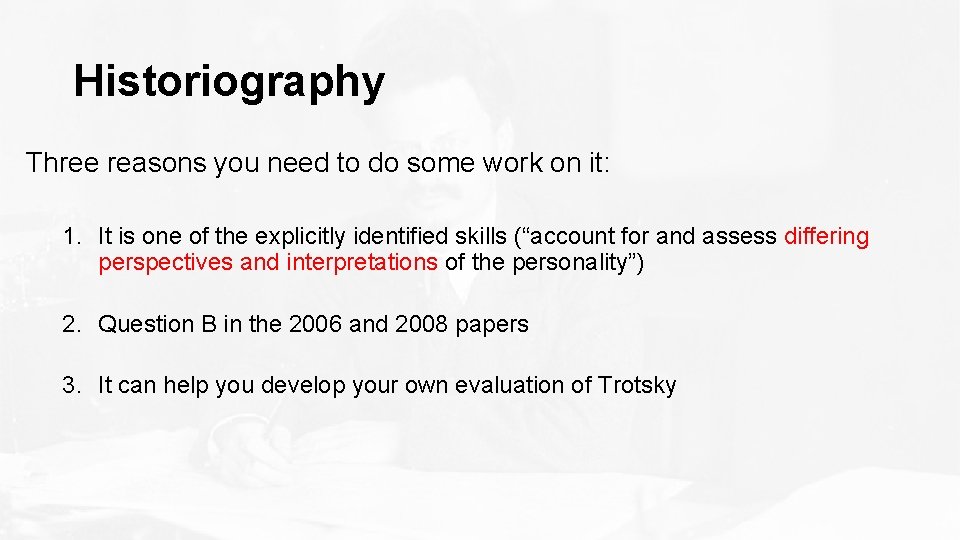
Historiography Three reasons you need to do some work on it: 1. It is one of the explicitly identified skills (“account for and assess differing perspectives and interpretations of the personality”) 2. Question B in the 2006 and 2008 papers 3. It can help you develop your own evaluation of Trotsky
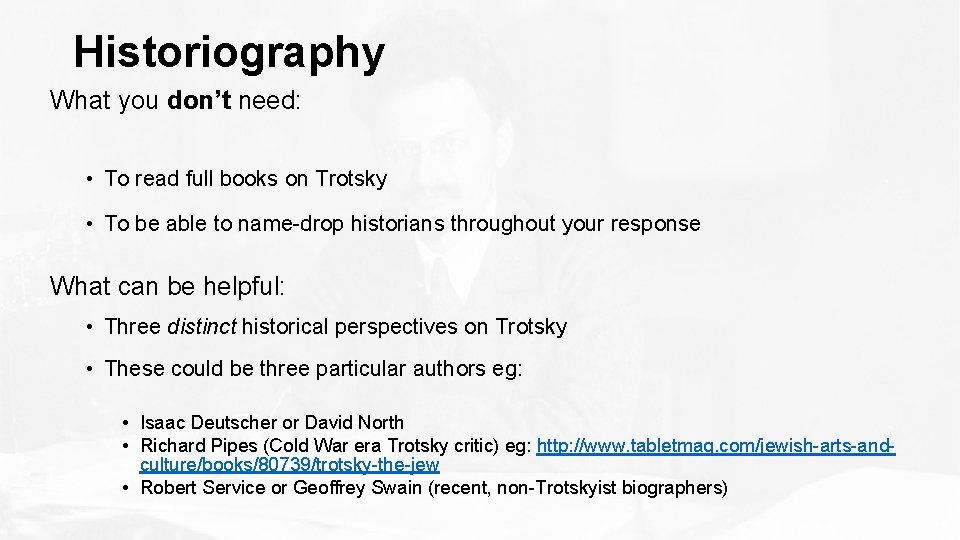
Historiography What you don’t need: • To read full books on Trotsky • To be able to name-drop historians throughout your response What can be helpful: • Three distinct historical perspectives on Trotsky • These could be three particular authors eg: • Isaac Deutscher or David North • Richard Pipes (Cold War era Trotsky critic) eg: http: //www. tabletmag. com/jewish-arts-andculture/books/80739/trotsky-the-jew • Robert Service or Geoffrey Swain (recent, non-Trotskyist biographers)
Historiography - strategies • Wikipedia and review websites for book/author summaries • The introductions and conclusions of books • Podcasts, interviews with authors (Hitchens vs Service: https: //www. youtube. com/watch? v=cuz. XR-5 w 4 Qk; Service on Trotsky: http: //www. econtalk. org/archives/2010/07/robert_service. html) • Literature reviews: Ken Webb, Leon Trotsky 1879 -1940, Get Smart Education, Mona Vale, 2011, pp. 83 -88. Ian D. Thatcher, Trotsky, Routledge, Milton Park, 2003, pp. 1 -22. Michael Cox, ‘Trotsky and his interpreters: or, will the real Leon Trotsky please stand up? ’, The Russian Review, vol. 51, no. 1, January 1992, pp. 84 -102.
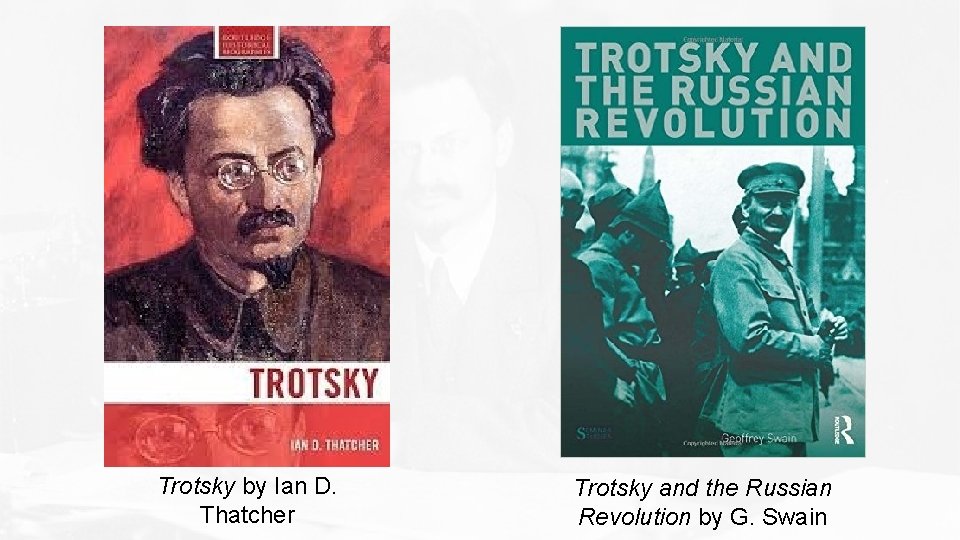
Trotsky by Ian D. Thatcher Trotsky and the Russian Revolution by G. Swain
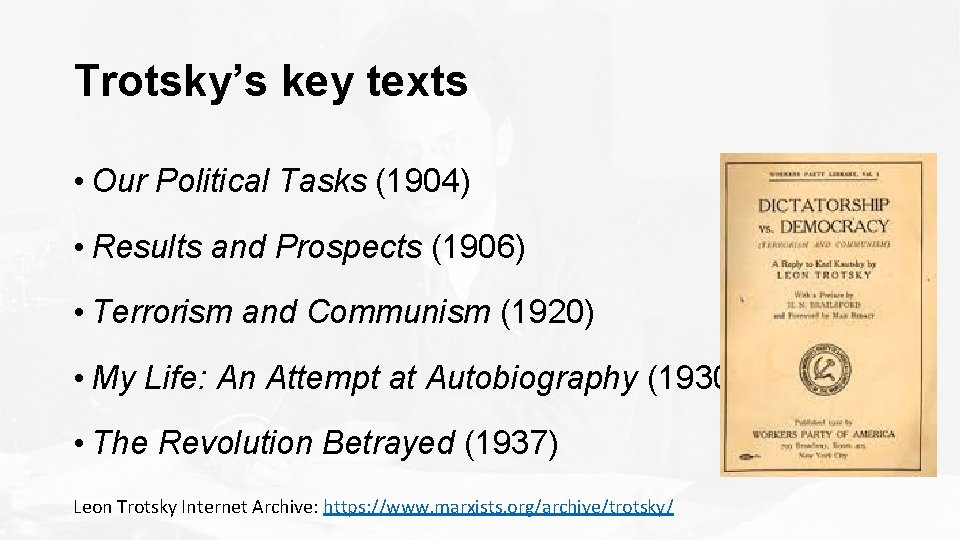
Trotsky’s key texts • Our Political Tasks (1904) • Results and Prospects (1906) • Terrorism and Communism (1920) • My Life: An Attempt at Autobiography (1930) • The Revolution Betrayed (1937) Leon Trotsky Internet Archive: https: //www. marxists. org/archive/trotsky/
Questions? www. michaelmolkentin. com/resources/