
LENSES Lyzinski Physics Light Speeds When traveling through
- Slides: 23
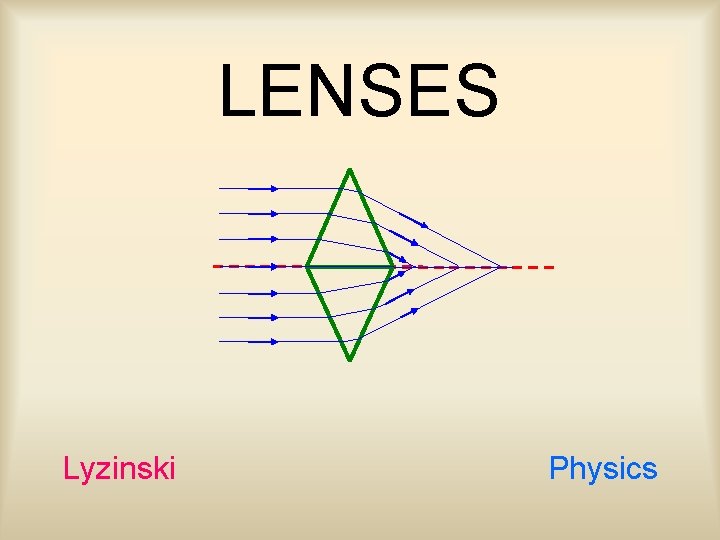
LENSES Lyzinski Physics
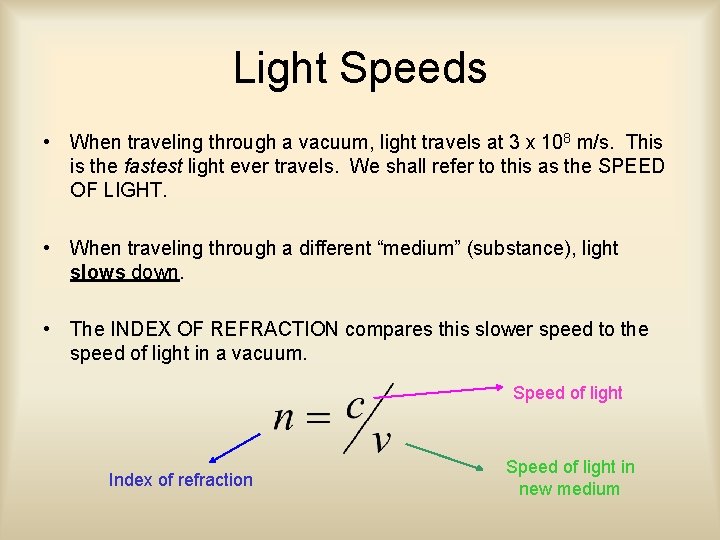
Light Speeds • When traveling through a vacuum, light travels at 3 x 10⁸ m/s. This is the fastest light ever travels. We shall refer to this as the SPEED OF LIGHT. • When traveling through a different “medium” (substance), light slows down. • The INDEX OF REFRACTION compares this slower speed to the speed of light in a vacuum. Speed of light Index of refraction Speed of light in new medium
The Index of Refraction • What does “refract” mean. It means “to bend”. When light travels from one medium to another it actually bends (thus causing it to either slow down or speed up) • The index of refraction is always GREATER THAN 1 (because the speed in a medium is always less than the speed of light). • Optically “DENSE” mediums have a higher index. We will call these mediums “HEAVY” • Optically “LESS DENSE” mediums will be called “LITE” (mis-spelled )
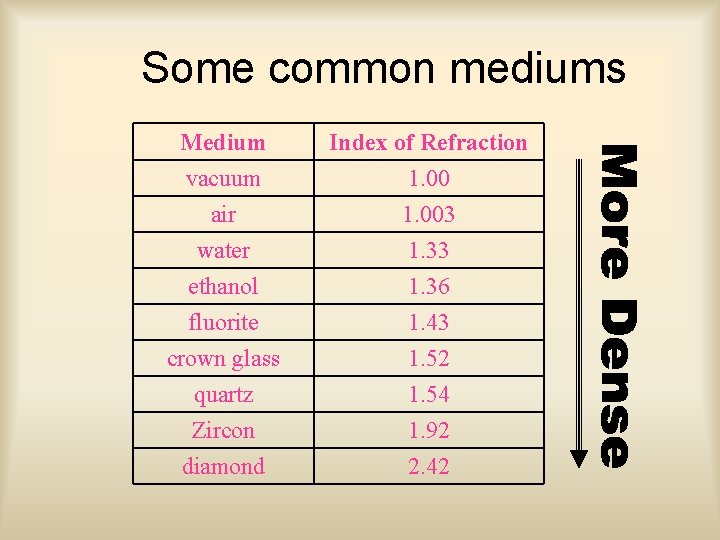
Some common mediums Medium Index of Refraction vacuum air water 1. 003 1. 33 ethanol fluorite crown glass quartz Zircon diamond 1. 36 1. 43 1. 52 1. 54 1. 92 2. 42
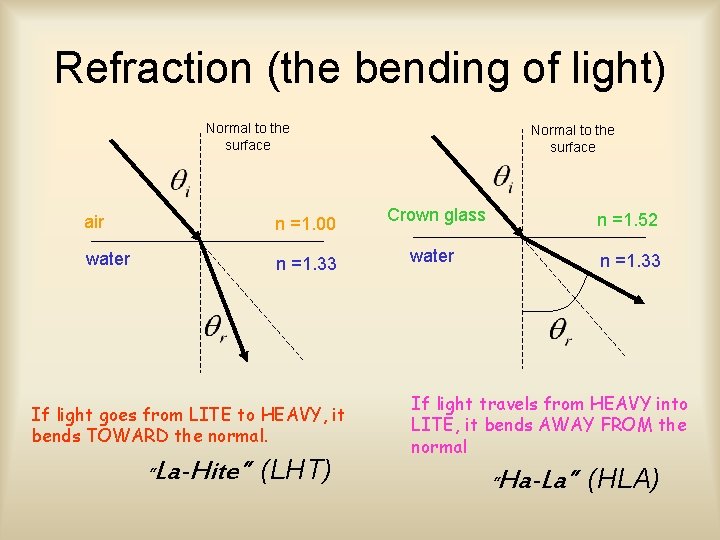
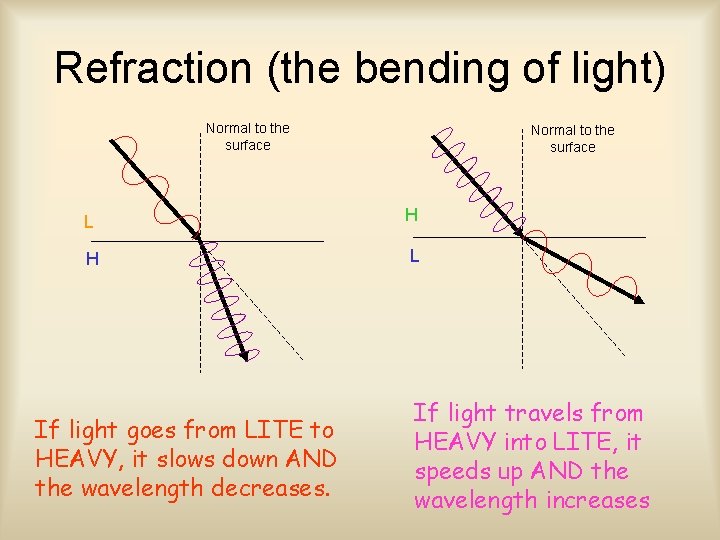
Refraction (the bending of light) Normal to the surface air n =1. 00 Crown glass n =1. 52 water n =1. 33 If light goes from LITE to HEAVY, it bends TOWARD the normal. “La-Hite” (LHT) If light travels from HEAVY into LITE, it bends AWAY FROM the normal “Ha-La” (HLA)
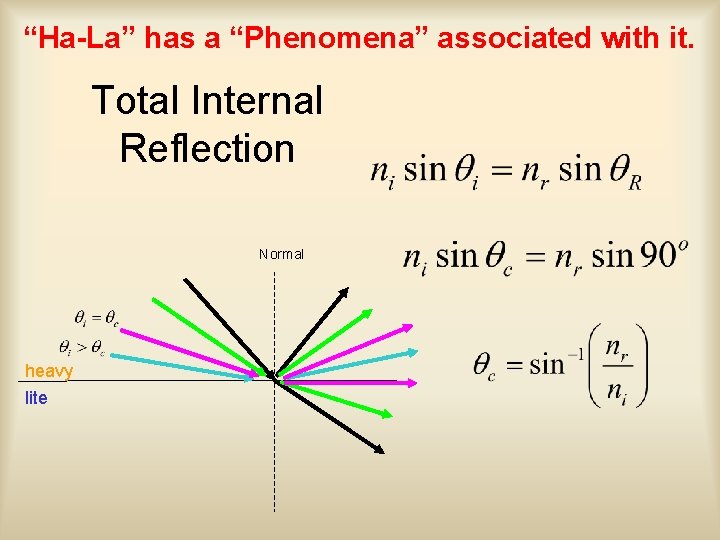
“Ha-La” has a “Phenomena” associated with it. Total Internal Reflection Normal heavy lite
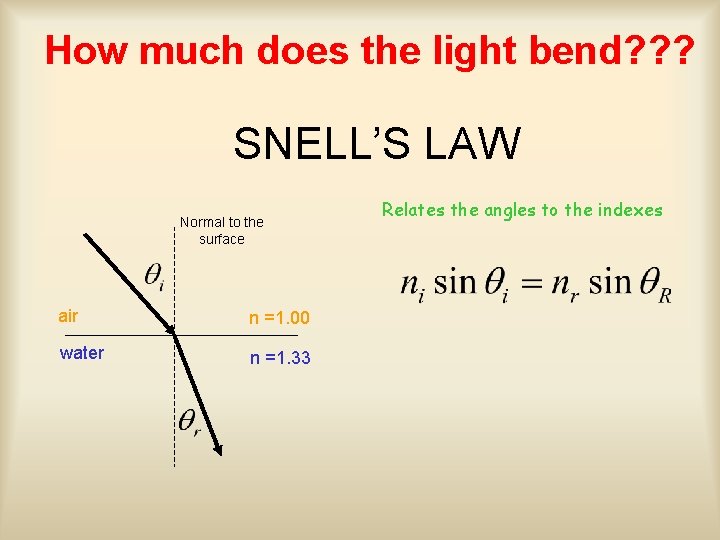
How much does the light bend? ? ? SNELL’S LAW Normal to the surface air n =1. 00 water n =1. 33 Relates the angles to the indexes
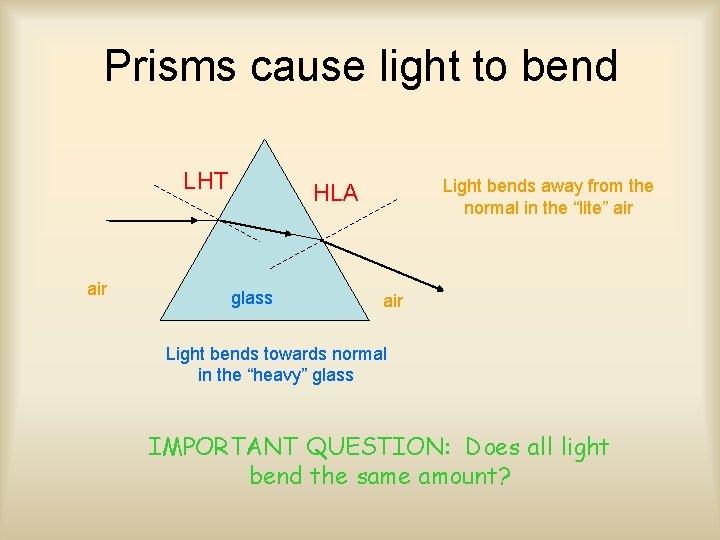
Prisms cause light to bend LHT air Light bends away from the normal in the “lite” air HLA glass air Light bends towards normal in the “heavy” glass IMPORTANT QUESTION: Does all light bend the same amount?
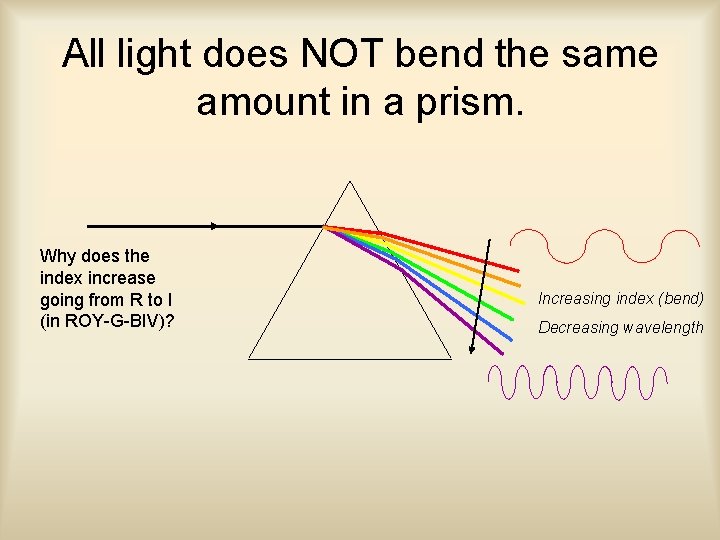
All light does NOT bend the same amount in a prism. Why does the index increase going from R to I (in ROY-G-BIV)? Increasing index (bend) Decreasing wavelength
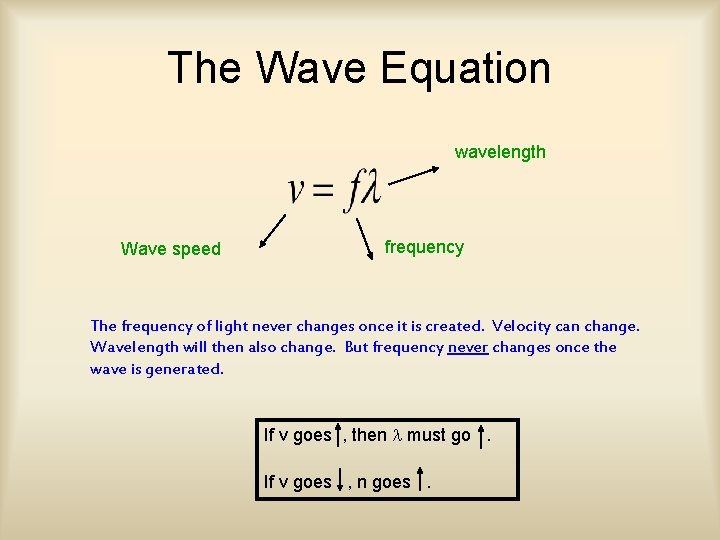
The Wave Equation wavelength Wave speed frequency The frequency of light never changes once it is created. Velocity can change. Wavelength will then also change. But frequency never changes once the wave is generated. If v goes , then l must go. If v goes , n goes.
Refraction (the bending of light) Normal to the surface L H H L If light goes from LITE to HEAVY, it slows down AND the wavelength decreases. If light travels from HEAVY into LITE, it speeds up AND the wavelength increases
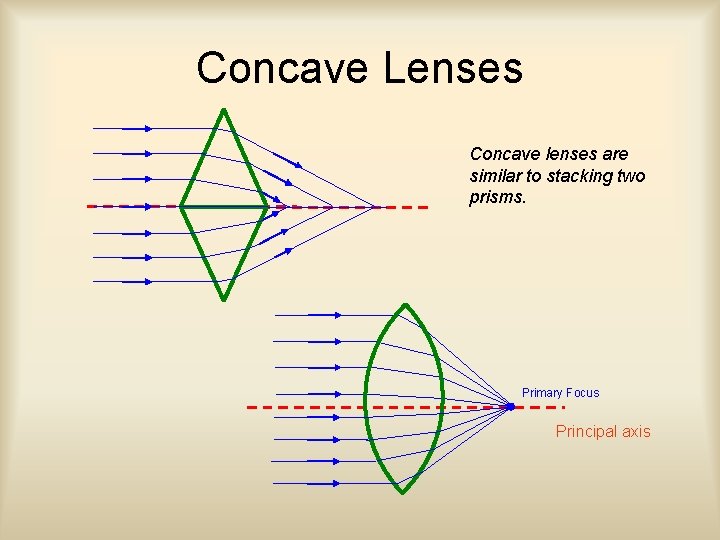
Concave Lenses Concave lenses are similar to stacking two prisms. Primary Focus Principal axis
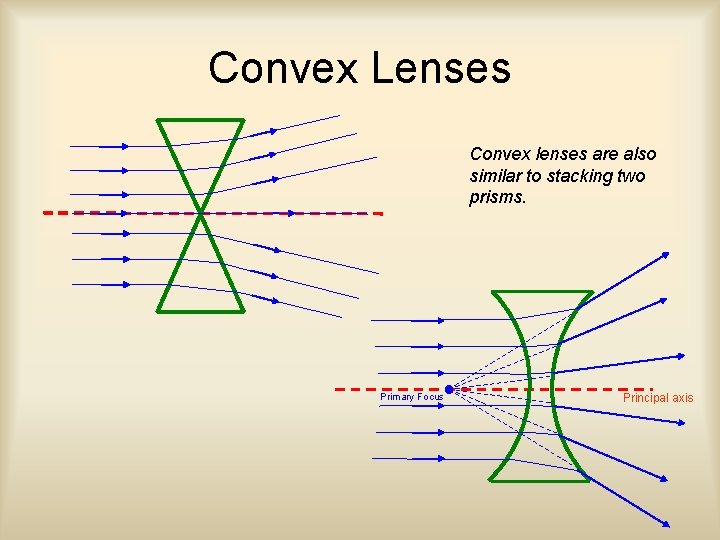
Convex Lenses Convex lenses are also similar to stacking two prisms. Primary Focus Principal axis
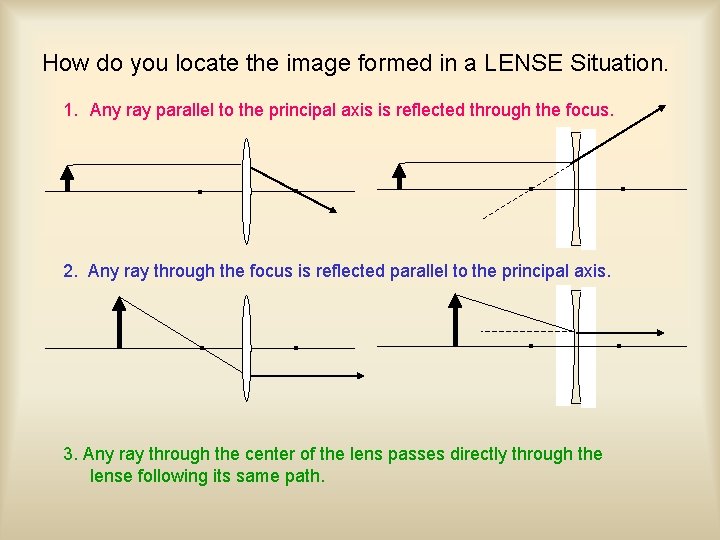
How do you locate the image formed in a LENSE Situation. 1. Any ray parallel to the principal axis is reflected through the focus. 2. Any ray through the focus is reflected parallel to the principal axis. 3. Any ray through the center of the lens passes directly through the lense following its same path.
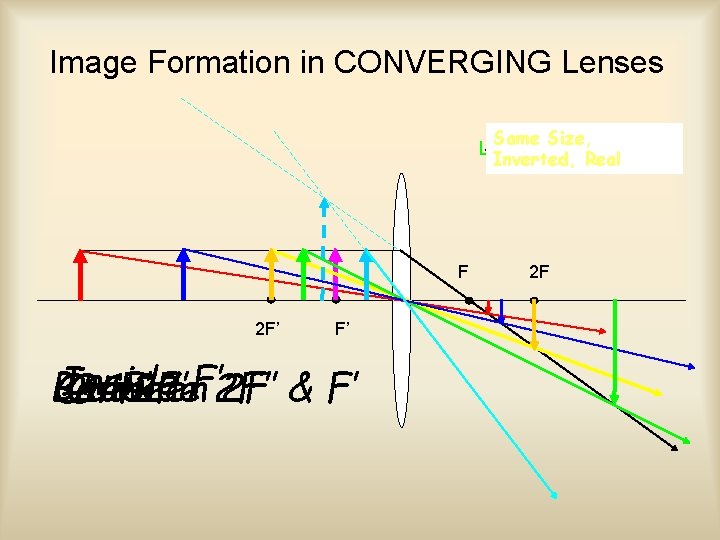
Image Formation in CONVERGING Lenses Same Size, NO VIRTUAL!!! IMAGE!!! Smaller, Inverted, Real LARGER, Inverted, Real F 2 F’ F’ Inside Between Outside On On. F’ 2 F’ 2 F’ & F’ 2 F
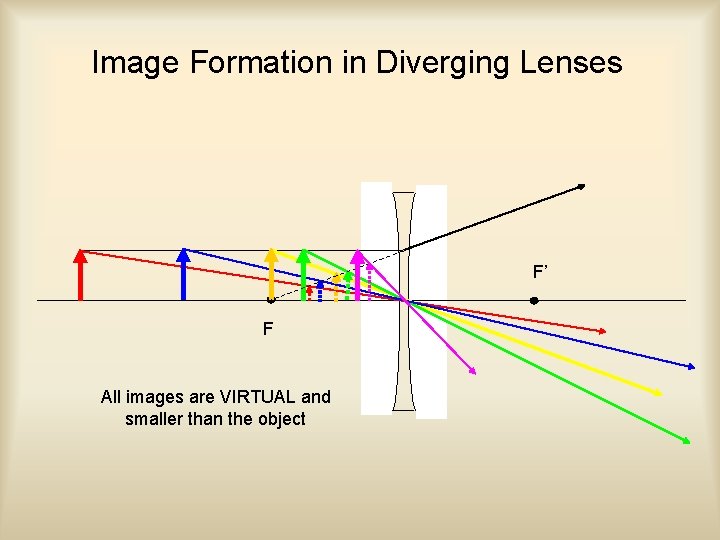
Image Formation in Diverging Lenses F’ F All images are VIRTUAL and smaller than the object
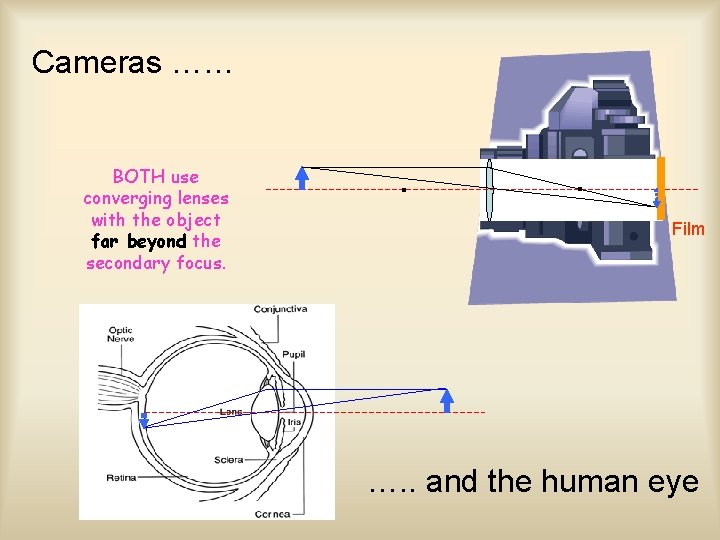
Cameras …… BOTH use converging lenses with the object far beyond the secondary focus. Film …. . and the human eye
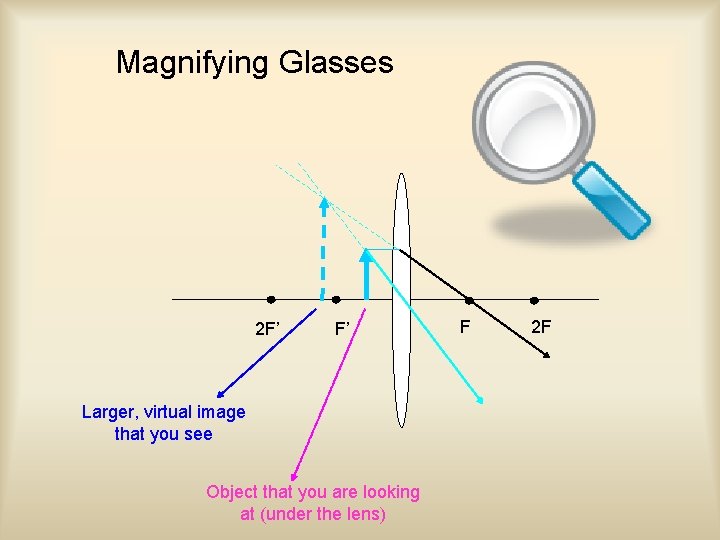
Magnifying Glasses 2 F’ F’ Larger, virtual image that you see Object that you are looking at (under the lens) F 2 F
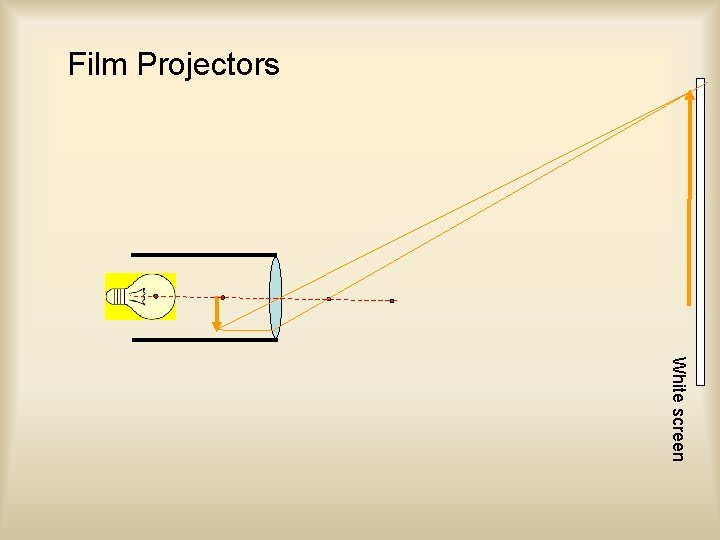
Film Projectors White screen
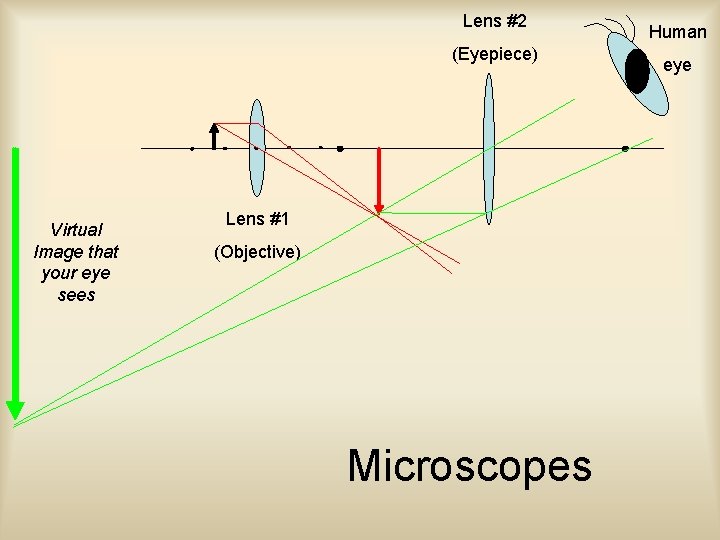
Lens #2 (Eyepiece) Virtual Image that your eye sees Lens #1 (Objective) Microscopes Human eye
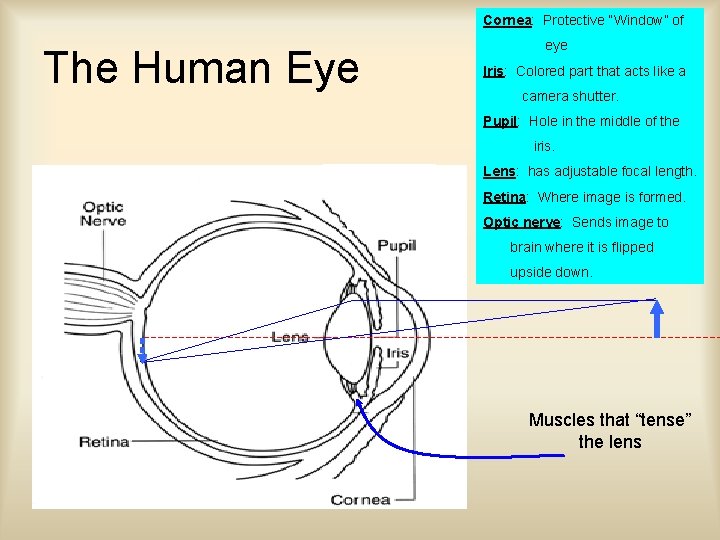
Cornea: Protective “Window” of The Human Eye eye Iris: Colored part that acts like a camera shutter. Pupil: Hole in the middle of the iris. Lens: has adjustable focal length. Retina: Where image is formed. Optic nerve: Sends image to brain where it is flipped upside down. Muscles that “tense” the lens
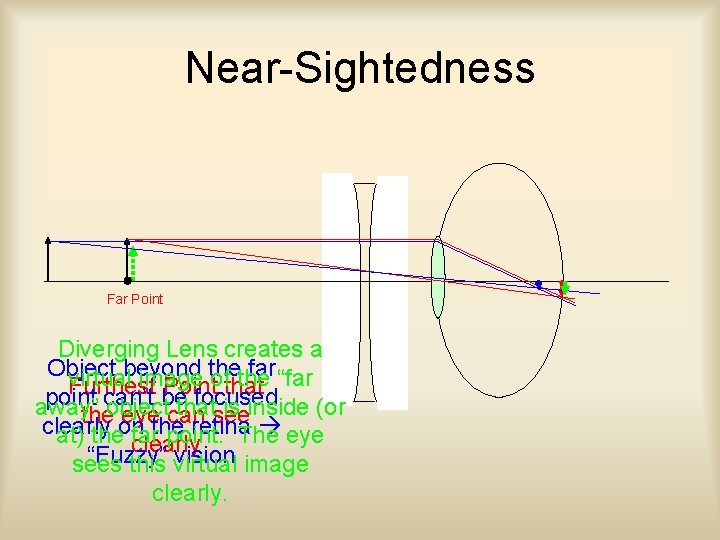
Near-Sightedness Far Point Diverging Lens creates a Object beyond the far “far virtual image of the Furthest Point that point can’t be focused away” object thatsee is inside (or the eye can clearly the retina eye at) theon far point. The clearly “Fuzzy” vision image sees this virtual clearly.
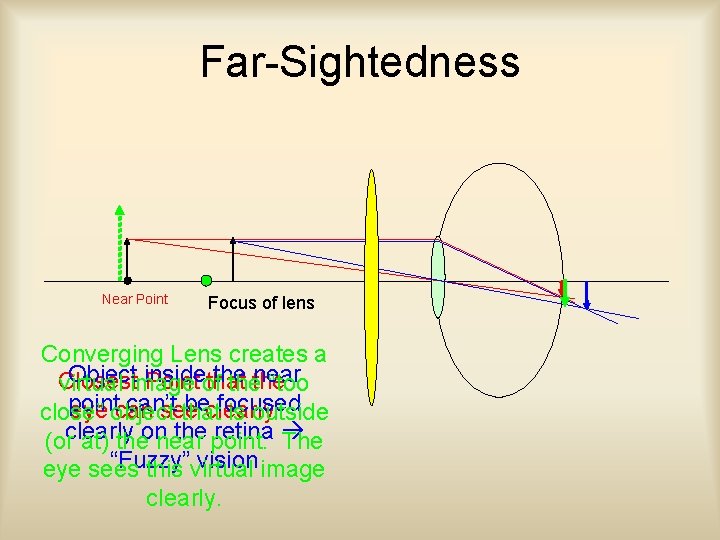
Far-Sightedness Near Point Focus of lens Converging Lens creates a Objectimage inside the near Closest Point of that virtual thethe “too point can’t beclearly focused eye object can see close” that is outside the point. retina (orclearly at) theonnear The “Fuzzy” vision image eye sees this virtual clearly.