
Lenses Lesson 5 Anatomy of a Lens Transparent


- Slides: 13
Lenses Lesson 5
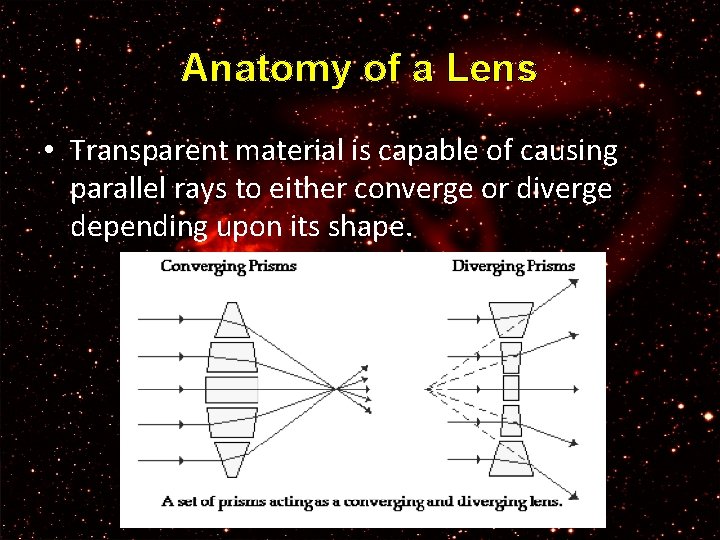
Anatomy of a Lens • Transparent material is capable of causing parallel rays to either converge or diverge depending upon its shape.
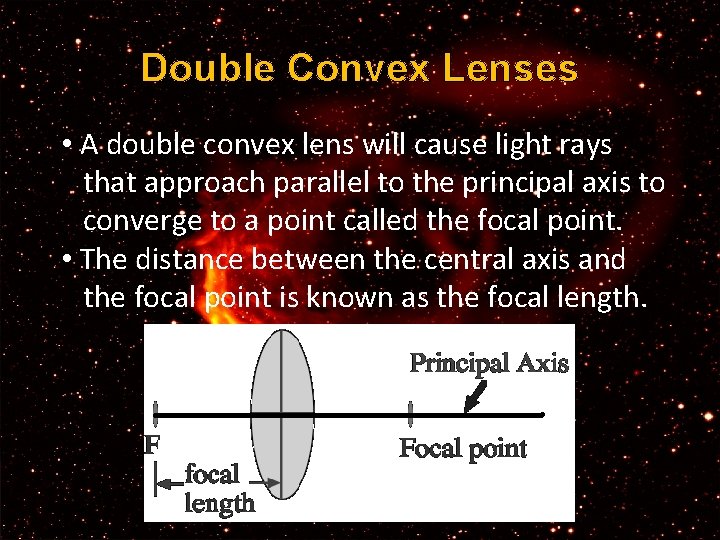
Double Convex Lenses • A double convex lens will cause light rays that approach parallel to the principal axis to converge to a point called the focal point. • The distance between the central axis and the focal point is known as the focal length.
Case 1 • Object is located beyond 2 F • The image is inverted, smaller, real and closer to the lens than the object.
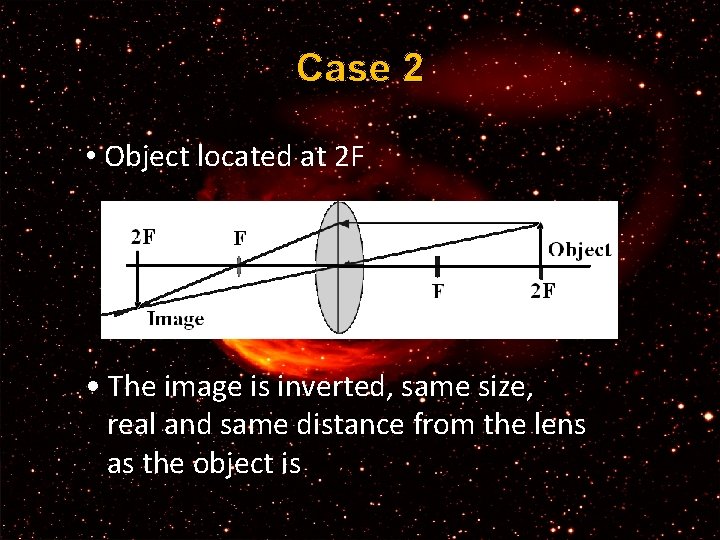
Case 2 • Object located at 2 F • The image is inverted, same size, real and same distance from the lens as the object is.
Case 3 • Object between F and 2 F • The image is inverted, larger, real and further away than the object is from the lens.
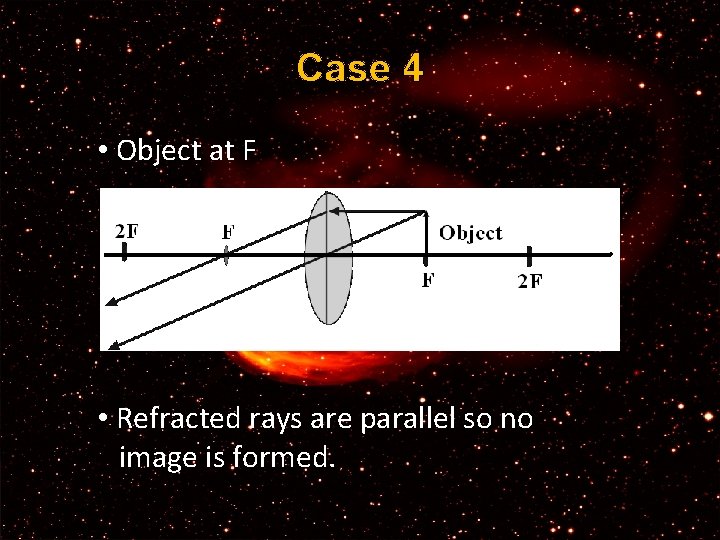
Case 4 • Object at F • Refracted rays are parallel so no image is formed.
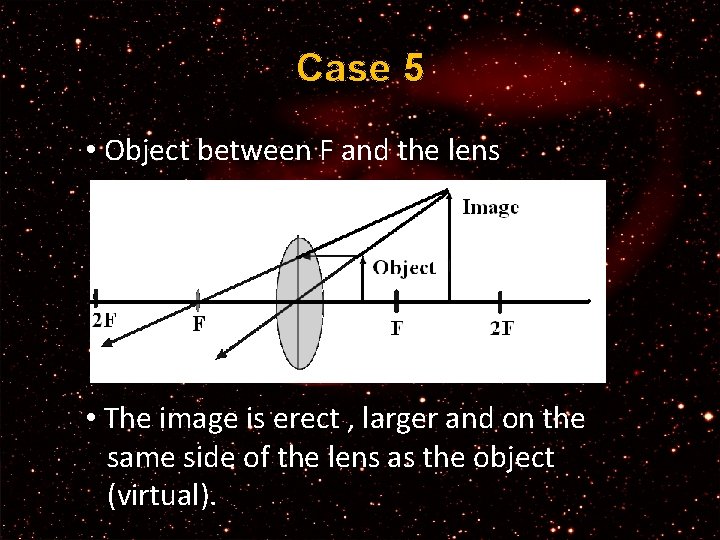
Case 5 • Object between F and the lens • The image is erect , larger and on the same side of the lens as the object (virtual).
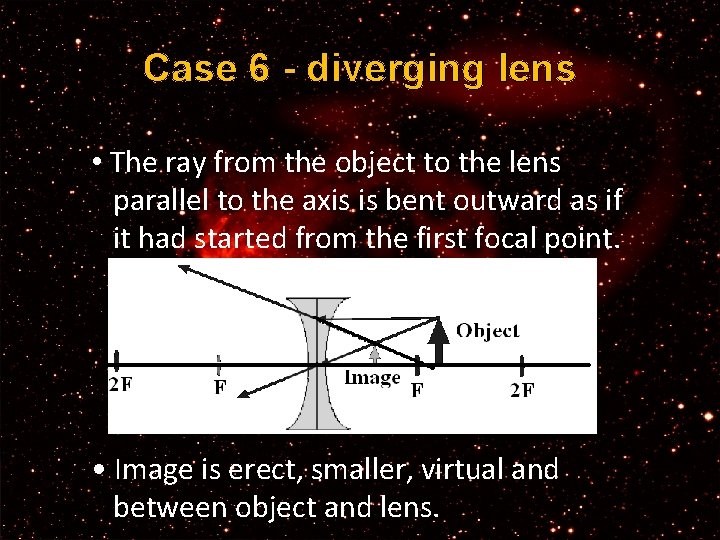
Case 6 - diverging lens • The ray from the object to the lens parallel to the axis is bent outward as if it had started from the first focal point. • Image is erect, smaller, virtual and between object and lens.
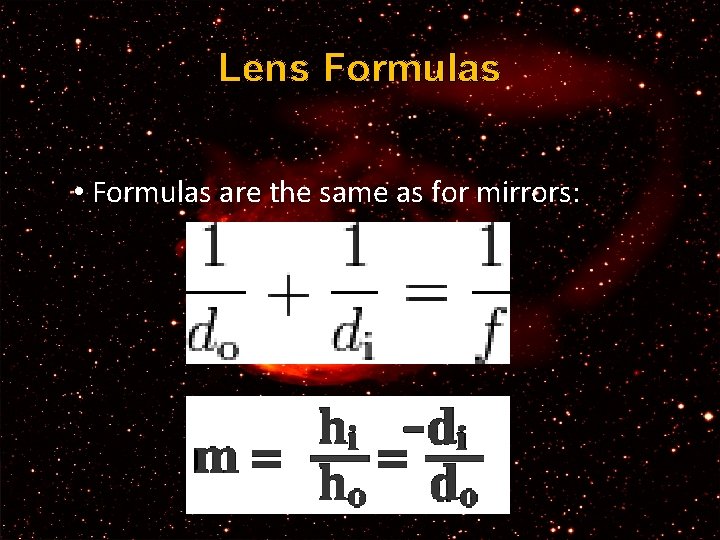
Lens Formulas • Formulas are the same as for mirrors:
Example • A 4. 0 -cm tall light bulb is placed a distance of 45. 7 cm from a double convex lens having a focal length of 15. 2 cm. Determine the image distance and the image size.
Sign conventions • f is + if the lens is a double convex lens (converging lens) • f is - if the lens is a double concave lens (diverging lens) • di is + if the image is a real image and located on the opposite side of the lens. • di is - if the image is a virtual image and located on the object's side of the lens. • hi is + if the image is an upright image (and therefore, also virtual) • hi is - if the image an inverted image (and therefore, also real)
Solution • The image will be inverted, 1. 99 -cm tall and located 22. 8 cm from the lens. The results of this calculation agree with the principles discussed earlier in this lesson. In this case, the object is located beyond the center of curvature (which would be two focal lengths from the lens), and the image is located between the center of curvature and the focal point. • The negative values for image height indicate that the image is an inverted image. In the case of the image height, a negative value always indicates an inverted image