
Lens Design I Lecture 7 Aberrations II 2018
Lens Design I Lecture 7: Aberrations II 2018 -05 -31 Herbert Gross Summer term 2018 www. iap. uni-jena. de
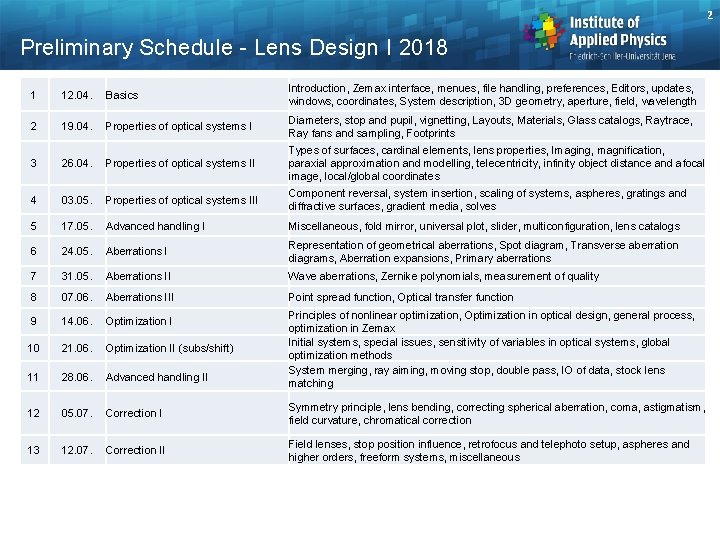
2 Preliminary Schedule - Lens Design I 2018 1 12. 04. Basics Introduction, Zemax interface, menues, file handling, preferences, Editors, updates, windows, coordinates, System description, 3 D geometry, aperture, field, wavelength 2 19. 04. Properties of optical systems I Diameters, stop and pupil, vignetting, Layouts, Materials, Glass catalogs, Raytrace, Ray fans and sampling, Footprints 3 26. 04. Properties of optical systems II Types of surfaces, cardinal elements, lens properties, Imaging, magnification, paraxial approximation and modelling, telecentricity, infinity object distance and afocal image, local/global coordinates 4 03. 05. Properties of optical systems III Component reversal, system insertion, scaling of systems, aspheres, gratings and diffractive surfaces, gradient media, solves 5 17. 05. Advanced handling I Miscellaneous, fold mirror, universal plot, slider, multiconfiguration, lens catalogs 6 24. 05. Aberrations I Representation of geometrical aberrations, Spot diagram, Transverse aberration diagrams, Aberration expansions, Primary aberrations 7 31. 05. Aberrations II Wave aberrations, Zernike polynomials, measurement of quality 8 07. 06. Aberrations III Point spread function, Optical transfer function 9 14. 06. Optimization I 10 21. 06. Optimization II (subs/shift) 11 28. 06. Advanced handling II 12 05. 07. Correction I Symmetry principle, lens bending, correcting spherical aberration, coma, astigmatism, field curvature, chromatical correction 13 12. 07. Correction II Field lenses, stop position influence, retrofocus and telephoto setup, aspheres and higher orders, freeform systems, miscellaneous Principles of nonlinear optimization, Optimization in optical design, general process, optimization in Zemax Initial systems, special issues, sensitivity of variables in optical systems, global optimization methods System merging, ray aiming, moving stop, double pass, IO of data, stock lens matching
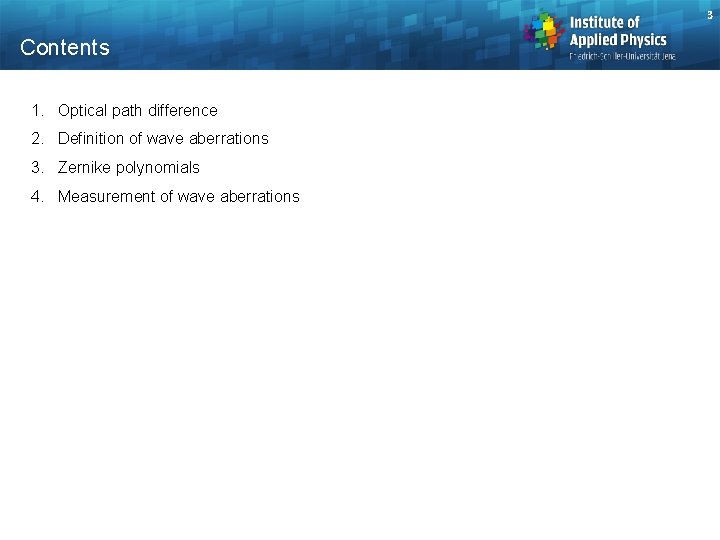
3 Contents 1. Optical path difference 2. Definition of wave aberrations 3. Zernike polynomials 4. Measurement of wave aberrations
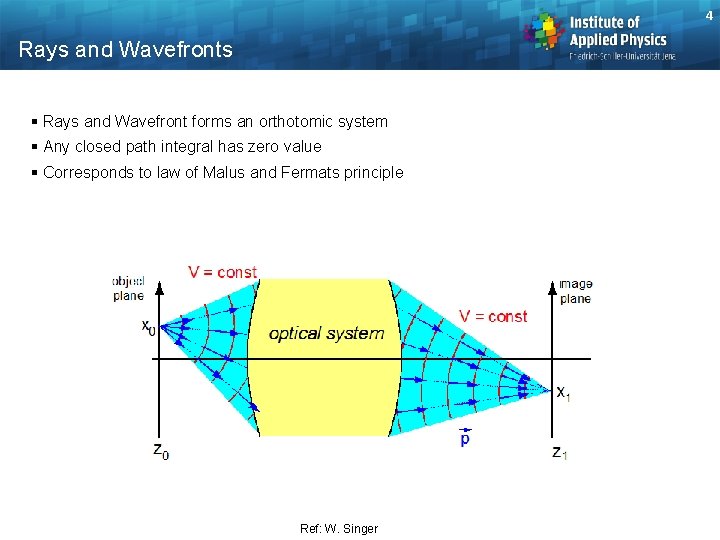
4 Rays and Wavefronts § Rays and Wavefront forms an orthotomic system § Any closed path integral has zero value § Corresponds to law of Malus and Fermats principle Ref: W. Singer
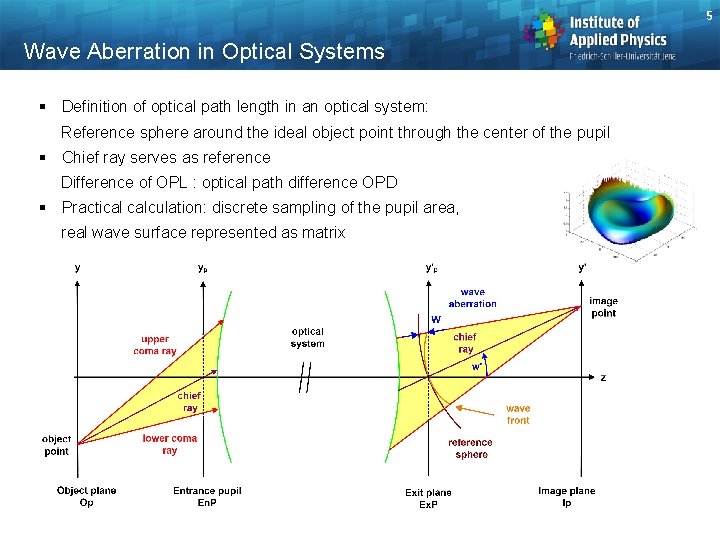
5 Wave Aberration in Optical Systems § Definition of optical path length in an optical system: Reference sphere around the ideal object point through the center of the pupil § Chief ray serves as reference Difference of OPL : optical path difference OPD § Practical calculation: discrete sampling of the pupil area, real wave surface represented as matrix
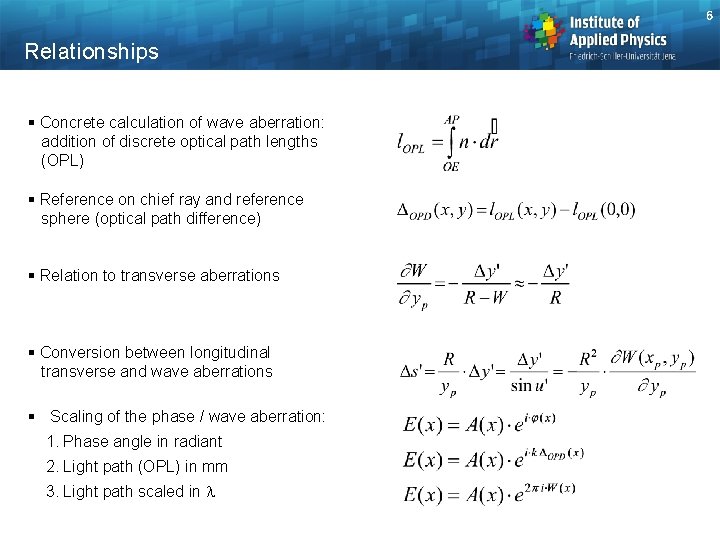
6 Relationships § Concrete calculation of wave aberration: addition of discrete optical path lengths (OPL) § Reference on chief ray and reference sphere (optical path difference) § Relation to transverse aberrations § Conversion between longitudinal transverse and wave aberrations § Scaling of the phase / wave aberration: 1. Phase angle in radiant 2. Light path (OPL) in mm 3. Light path scaled in l

7 Wave Aberration § Definition of the peak valley value
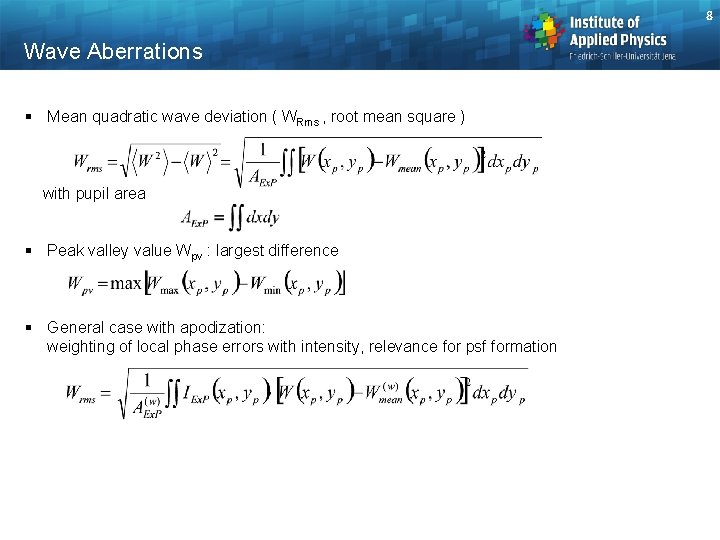
8 Wave Aberrations § Mean quadratic wave deviation ( WRms , root mean square ) with pupil area § Peak valley value Wpv : largest difference § General case with apodization: weighting of local phase errors with intensity, relevance for psf formation
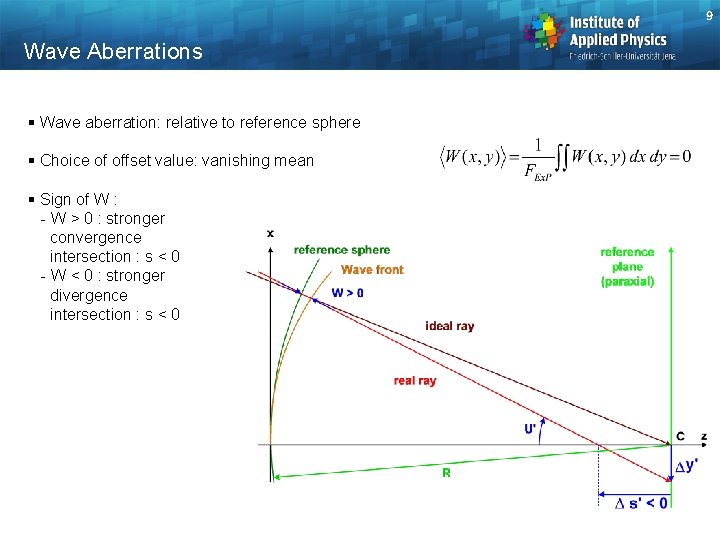
9 Wave Aberrations § Wave aberration: relative to reference sphere § Choice of offset value: vanishing mean § Sign of W : - W > 0 : stronger convergence intersection : s < 0 - W < 0 : stronger divergence intersection : s < 0
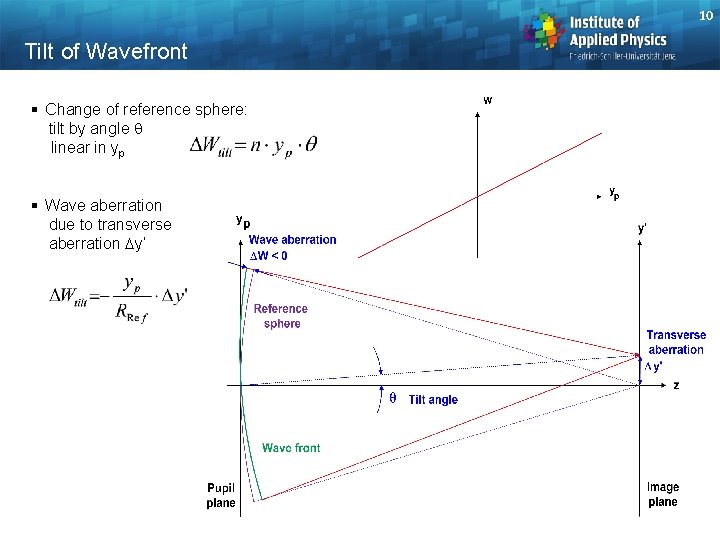
10 Tilt of Wavefront § Change of reference sphere: tilt by angle q linear in yp § Wave aberration due to transverse aberration Dy‘
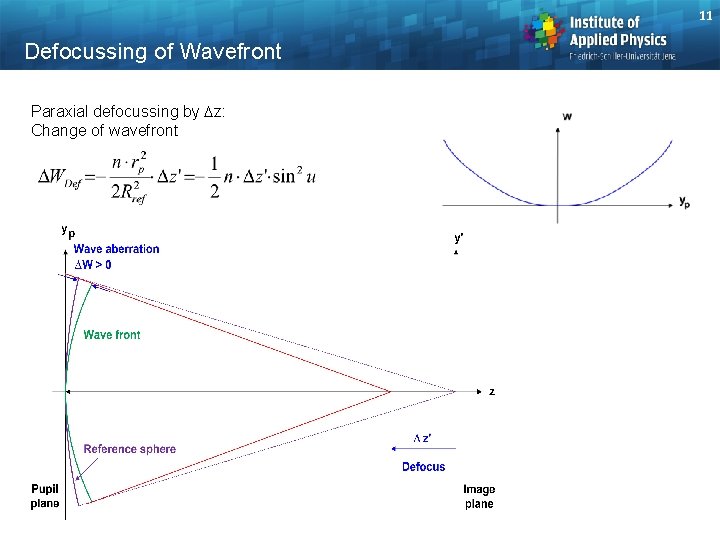
11 Defocussing of Wavefront Paraxial defocussing by Dz: Change of wavefront
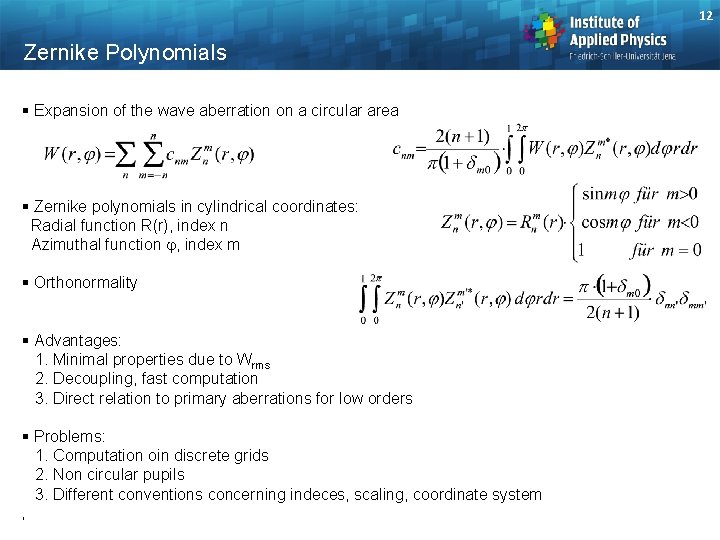
12 Zernike Polynomials § Expansion of the wave aberration on a circular area § Zernike polynomials in cylindrical coordinates: Radial function R(r), index n Azimuthal function j, index m § Orthonormality § Advantages: 1. Minimal properties due to Wrms 2. Decoupling, fast computation 3. Direct relation to primary aberrations for low orders § Problems: 1. Computation oin discrete grids 2. Non circular pupils 3. Different conventions concerning indeces, scaling, coordinate system ,
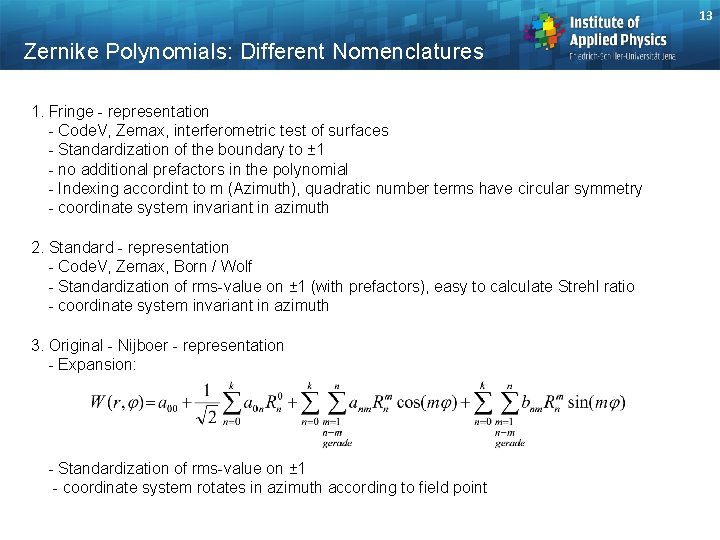
13 Zernike Polynomials: Different Nomenclatures 1. Fringe - representation - Code. V, Zemax, interferometric test of surfaces - Standardization of the boundary to ± 1 - no additional prefactors in the polynomial - Indexing accordint to m (Azimuth), quadratic number terms have circular symmetry - coordinate system invariant in azimuth 2. Standard - representation - Code. V, Zemax, Born / Wolf - Standardization of rms-value on ± 1 (with prefactors), easy to calculate Strehl ratio - coordinate system invariant in azimuth 3. Original - Nijboer - representation - Expansion: - Standardization of rms-value on ± 1 - coordinate system rotates in azimuth according to field point
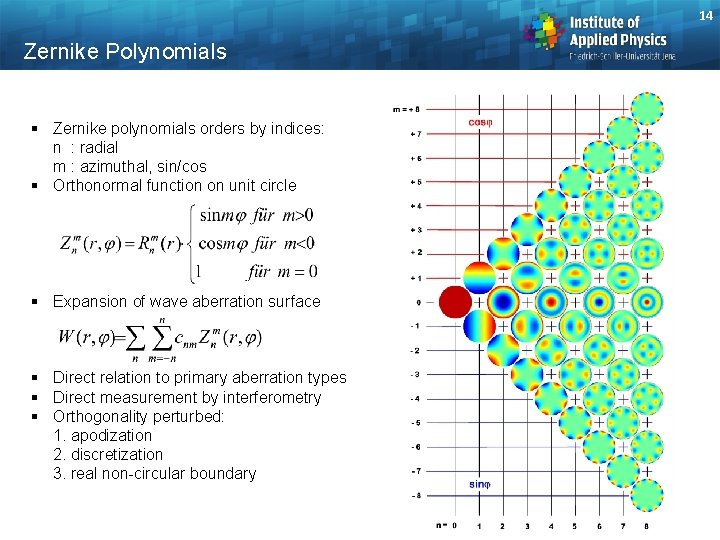
14 Zernike Polynomials § Zernike polynomials orders by indices: n : radial m : azimuthal, sin/cos § Orthonormal function on unit circle § Expansion of wave aberration surface § Direct relation to primary aberration types § Direct measurement by interferometry § Orthogonality perturbed: 1. apodization 2. discretization 3. real non-circular boundary
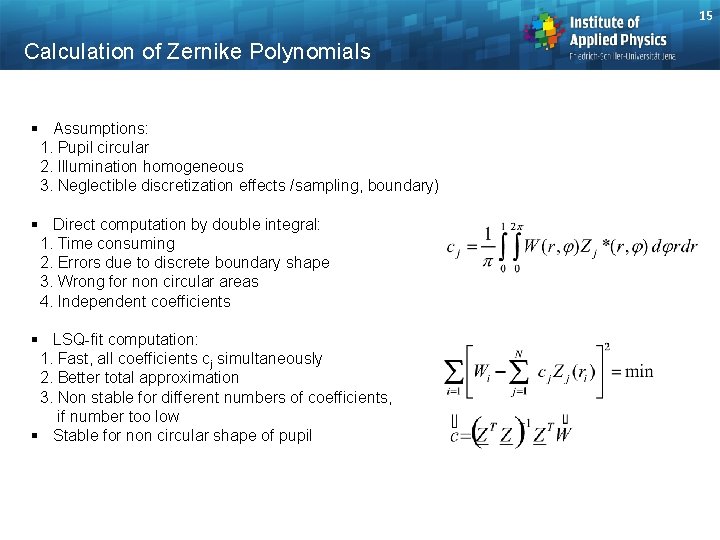
15 Calculation of Zernike Polynomials § Assumptions: 1. Pupil circular 2. Illumination homogeneous 3. Neglectible discretization effects /sampling, boundary) § Direct computation by double integral: 1. Time consuming 2. Errors due to discrete boundary shape 3. Wrong for non circular areas 4. Independent coefficients § LSQ-fit computation: 1. Fast, all coefficients cj simultaneously 2. Better total approximation 3. Non stable for different numbers of coefficients, if number too low § Stable for non circular shape of pupil
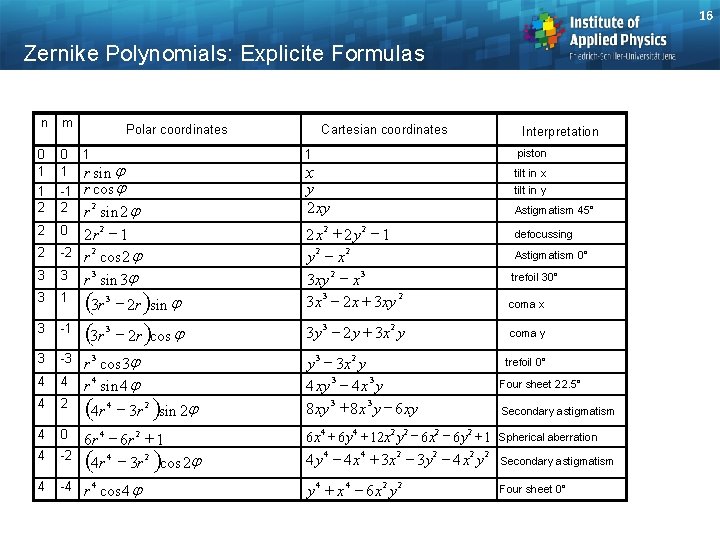
16 Zernike Polynomials: Explicite Formulas n m Polar coordinates Cartesian coordinates Interpretation 0 0 1 1 1 r sin j 1 -1 r cos j 2 2 r 2 sin 2 j 1 piston x tilt in x tilt in y 2 2 r - 1 2 -2 r 2 cos 2 j 3 3 r 3 sin 3 j 3 3 1 3 r - 2 r sin j 2 2 2 x + 2 y - 1 2 2 y -x 2 3 3 xy - x 3 2 3 x - 2 x + 3 xy coma x 3 -1 3 2 3 y - 2 y + 3 x y coma y y 2 xy 2 0 ( (3 r 3 ) - 2 r )cos j Astigmatism 45° defocussing Astigmatism 0° trefoil 30° r cos 3 j 4 4 r 4 sin 4 j 4 2 4 r - 3 r sin 2 j 3 2 y - 3 x y 3 3 4 xy - 4 x y 3 3 8 xy + 8 x y - 6 xy Four sheet 22. 5° 6 r - 6 r + 1 4 2 4 -2 4 r - 3 r cos 2 j 6 x 4 + 6 y 4 + 12 x 2 y 2 - 6 x 2 - 6 y 2 + 1 Spherical aberration 4 4 2 2 4 y - 4 x + 3 x - 3 y - 4 x y Secondary astigmatism 4 4 2 2 y + x - 6 x y Four sheet 0° 3 -3 3 ( 4 0 ) 4 2 ( 4 -4 r cos 4 j 4 ) trefoil 0° Secondary astigmatism
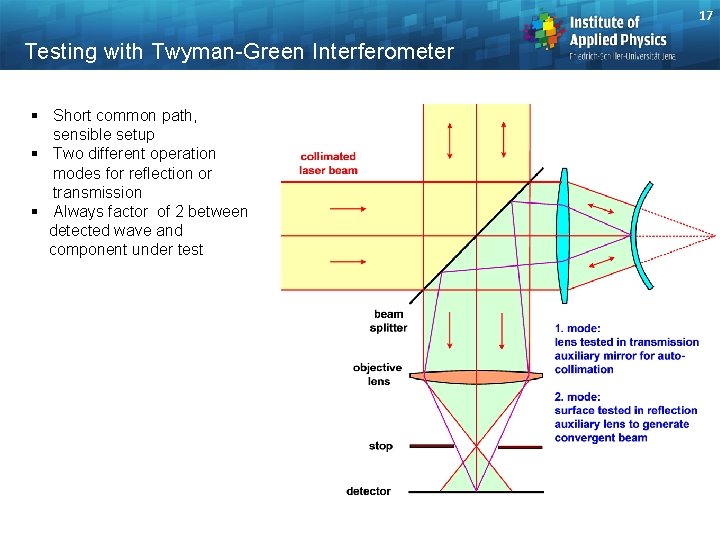
17 Testing with Twyman-Green Interferometer § Short common path, sensible setup § Two different operation modes for reflection or transmission § Always factor of 2 between detected wave and component under test
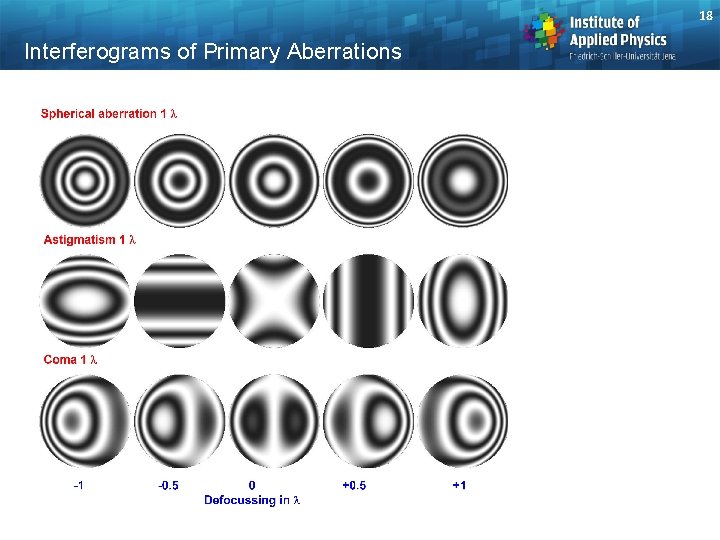
18 Interferograms of Primary Aberrations
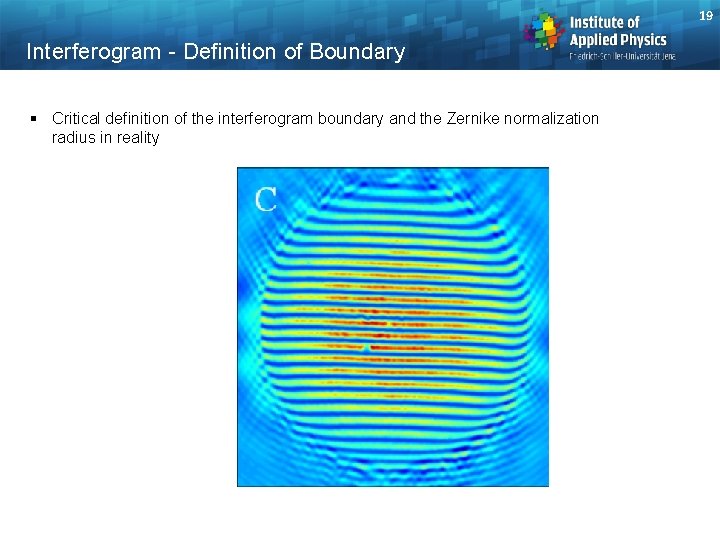
19 Interferogram - Definition of Boundary § Critical definition of the interferogram boundary and the Zernike normalization radius in reality
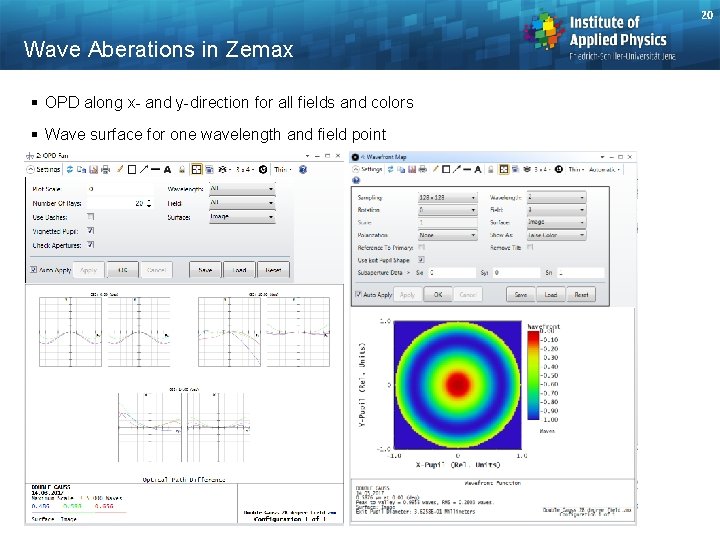
20 Wave Aberations in Zemax § OPD along x- and y-direction for all fields and colors § Wave surface for one wavelength and field point
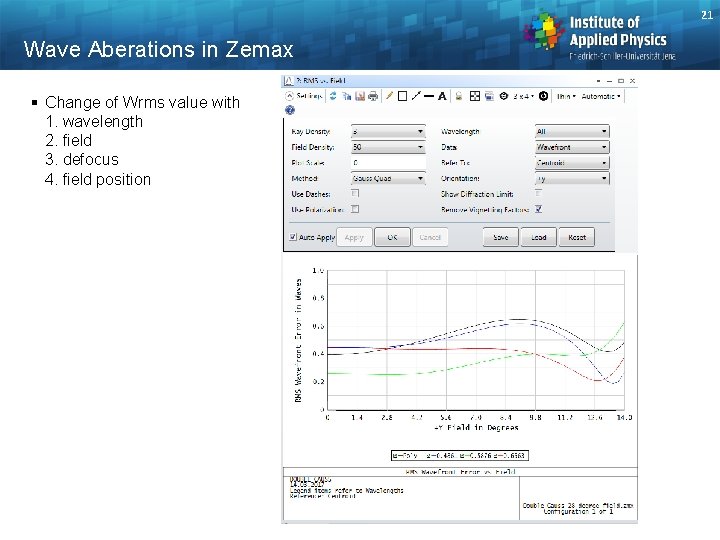
21 Wave Aberations in Zemax § Change of Wrms value with 1. wavelength 2. field 3. defocus 4. field position
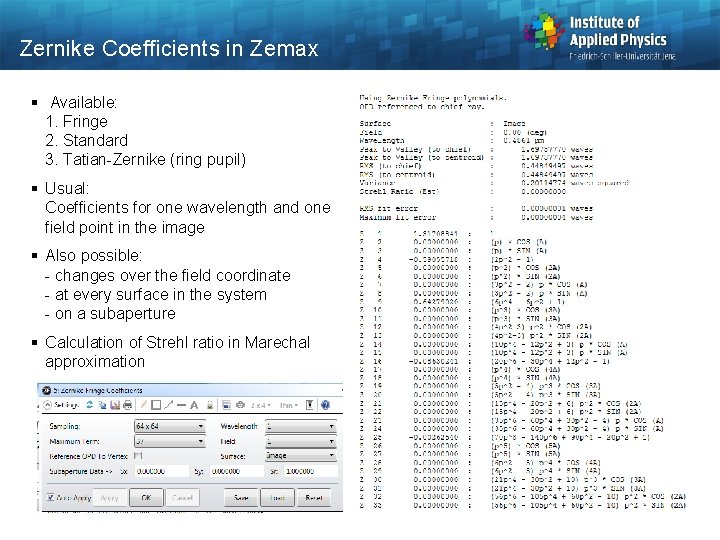
Zernike Coefficients in Zemax § Available: 1. Fringe 2. Standard 3. Tatian-Zernike (ring pupil) § Usual: Coefficients for one wavelength and one field point in the image § Also possible: - changes over the field coordinate - at every surface in the system - on a subaperture § Calculation of Strehl ratio in Marechal approximation 22
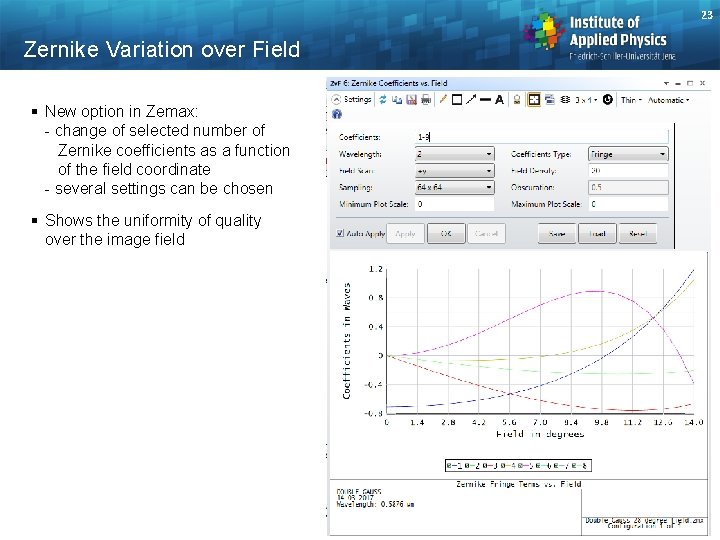
23 Zernike Variation over Field § New option in Zemax: - change of selected number of Zernike coefficients as a function of the field coordinate - several settings can be chosen § Shows the uniformity of quality over the image field
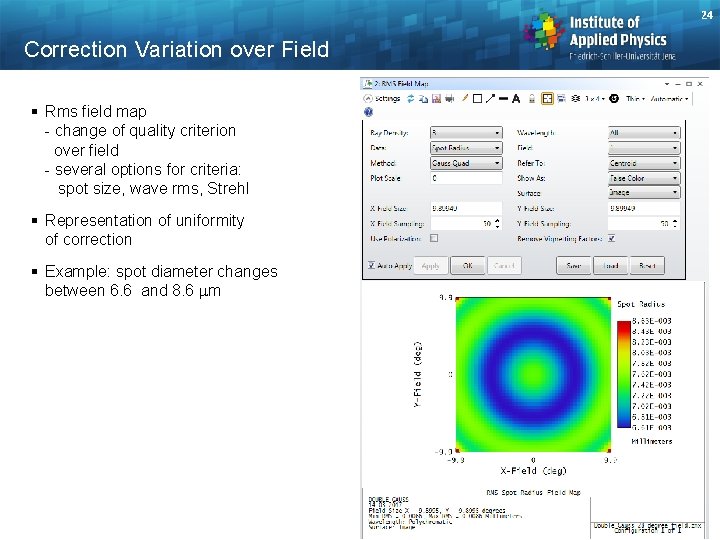
24 Correction Variation over Field § Rms field map - change of quality criterion over field - several options for criteria: spot size, wave rms, Strehl § Representation of uniformity of correction § Example: spot diameter changes between 6. 6 and 8. 6 mm
- Slides: 24