
Lennart Bosman Benefits of Humidity Control in Low
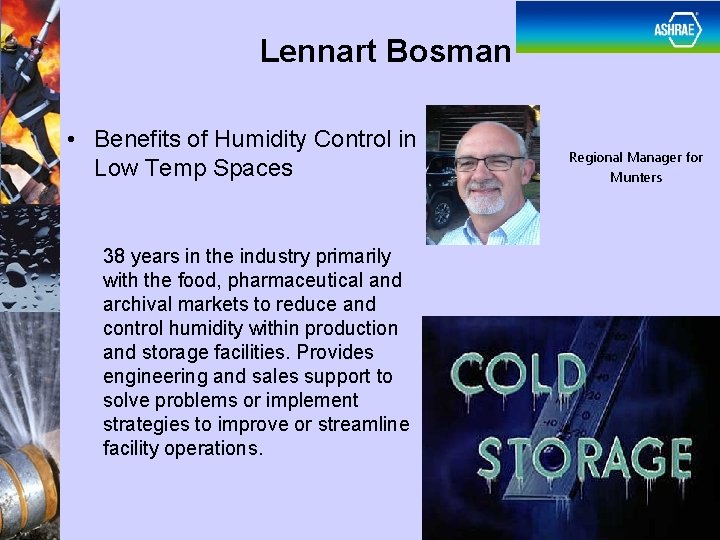
Lennart Bosman • Benefits of Humidity Control in Low Temp Spaces 38 years in the industry primarily with the food, pharmaceutical and archival markets to reduce and control humidity within production and storage facilities. Provides engineering and sales support to solve problems or implement strategies to improve or streamline facility operations. Regional Manager for Munters
Lets start by defining low temperature spaces, separating them into three zones: Cool ~ 60 F and up (30 to 60%RH, 29 to 46 dew point) Labs, operating rooms, surgical suites Cold ~ 33 F to 59 F Storage, loading docks, processing rooms Frozen – below 32 F Long term storage
Cool, Cold or frozen rooms? • Cool/Cold rooms – Loading docks – Meat processing rooms – Meal assembly rooms – Laboratories – Lasik and other surgery suites • In all the above if the dew point delivered is above 40 F, the use of refrigeration is most likely the best solution. • Frozen rooms, below 32 F… – Process Freezers – Hardening tunnels – Cold storage • In all frozen rooms or if the dew point desired is below 40 F, you should use desiccant.
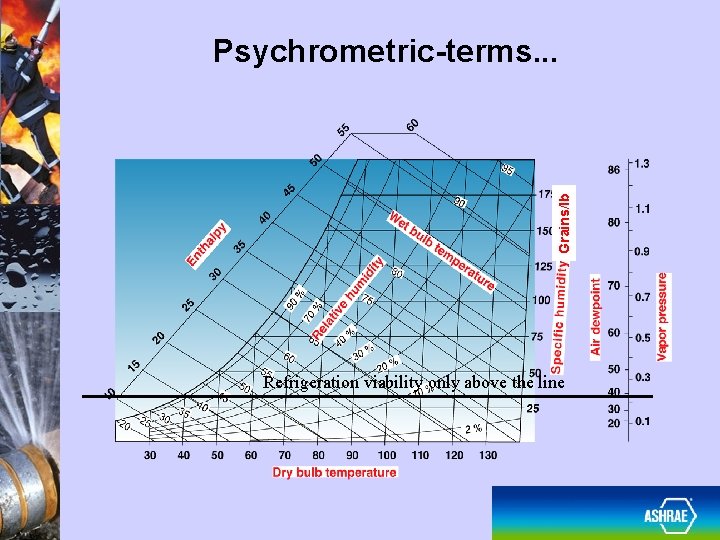
Grains/lb Psychrometric-terms. . . Refrigeration viability only above the line 4

Methods of dehumidification. . . • Cooling based (condensing) – – DX refrigeration, sub-cool and reheat Chilled brine Ammonia Co 2 • Desiccant based (adsorbtion) – Stacked tower – Liquid spray systems – Wheel systems 5
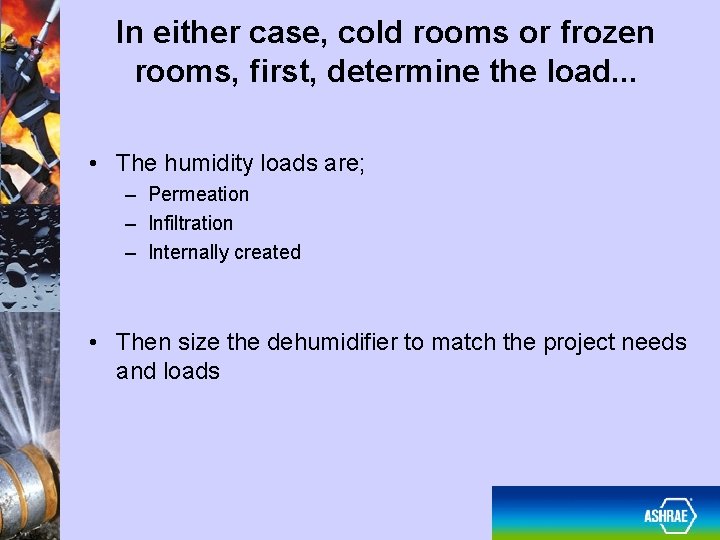
In either case, cold rooms or frozen rooms, first, determine the load. . . • The humidity loads are; – Permeation – Infiltration – Internally created • Then size the dehumidifier to match the project needs and loads 6
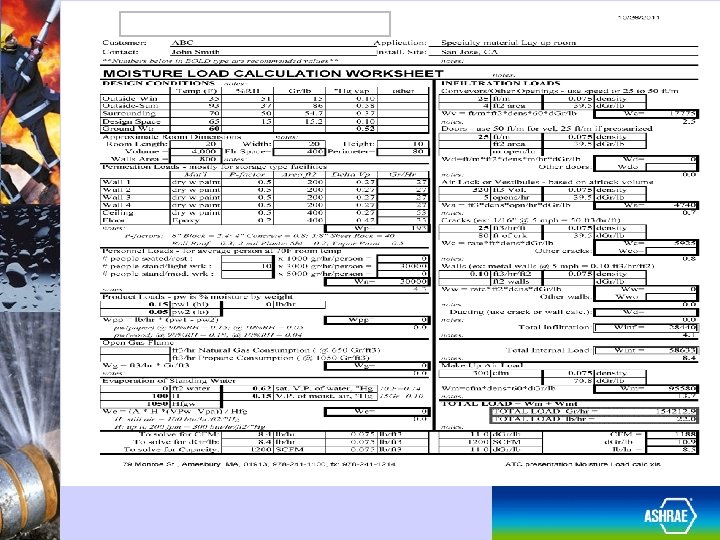
7
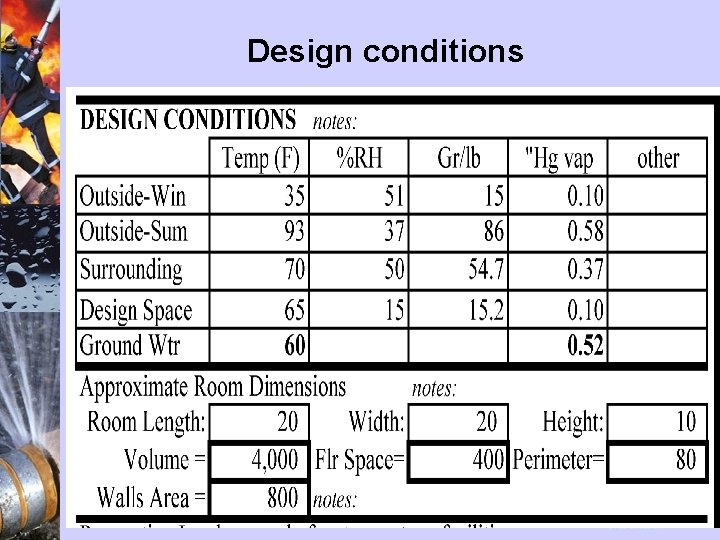
Design conditions November 30, 2020 no. 8 Munters company presentation
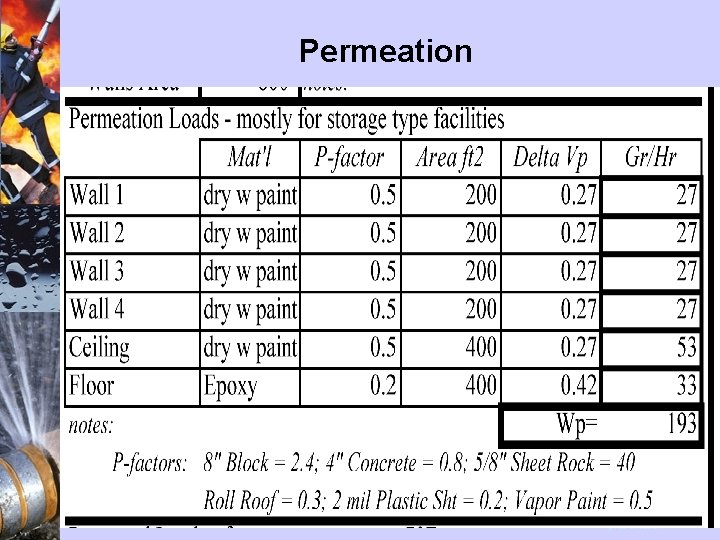
Permeation November 30, 2020 no. 9 Munters company presentation
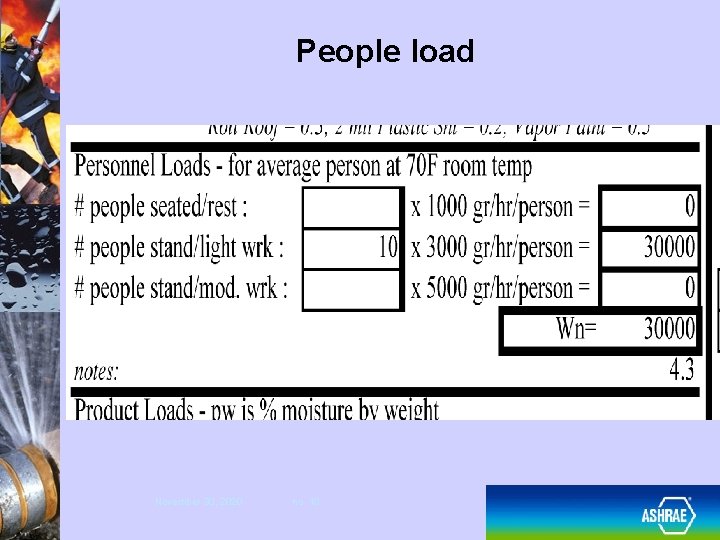
People load November 30, 2020 no. 10 Munters company presentation
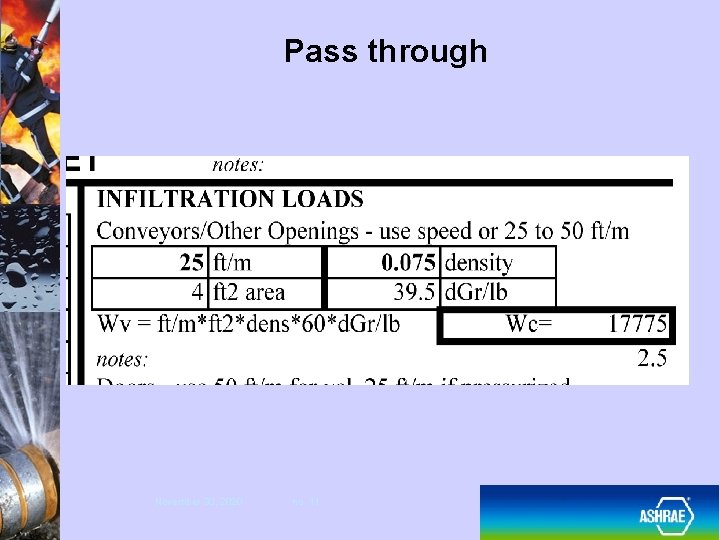
Pass through November 30, 2020 no. 11 Munters company presentation
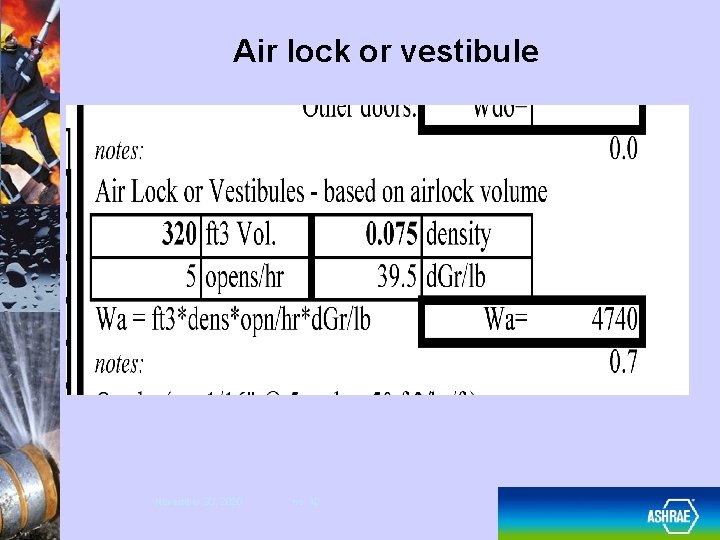
Air lock or vestibule November 30, 2020 no. 12 Munters company presentation
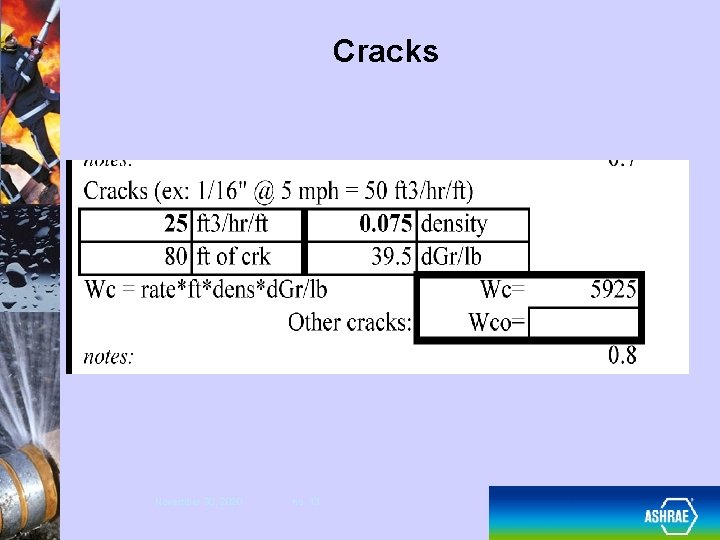
Cracks November 30, 2020 no. 13 Munters company presentation

Total Internal load November 30, 2020 no. 14 Munters company presentation
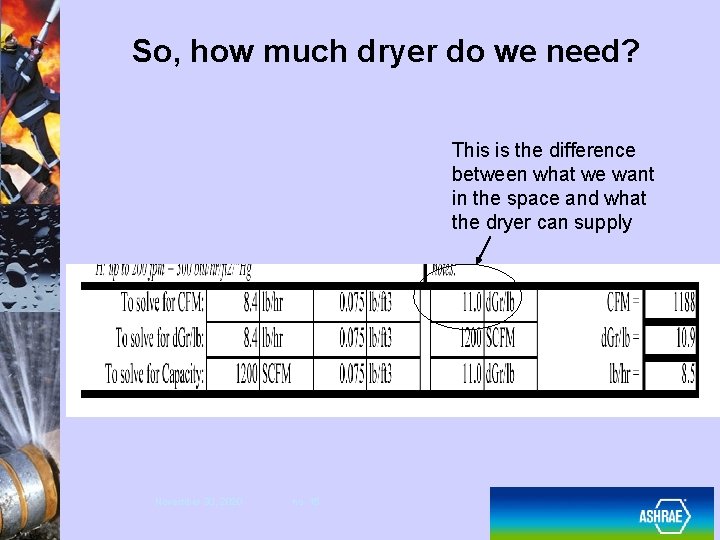
So, how much dryer do we need? This is the difference between what we want in the space and what the dryer can supply November 30, 2020 no. 15 Munters company presentation
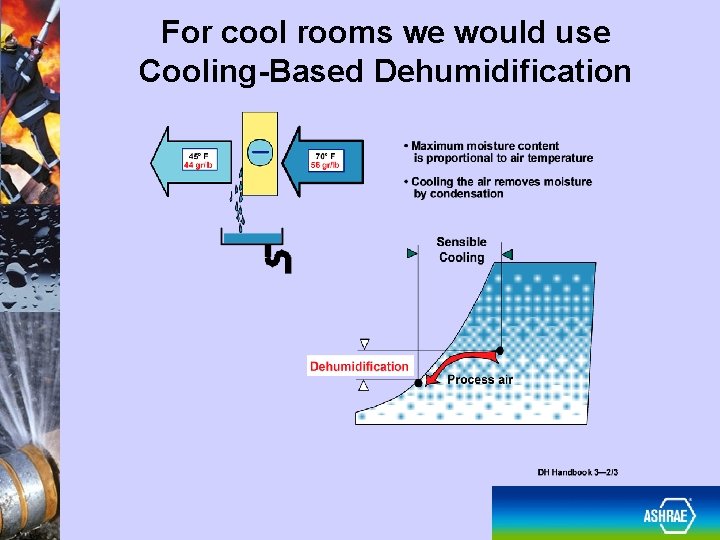
For cool rooms we would use Cooling-Based Dehumidification 16
Reducing humidity or Eliminating Ice • To reduce or eliminate ice accumulation the moisture level (dew point) must be low enough to prevent condensation on cold surfaces, so dehumidification is required. • To understand the limitations of condensation control in low temperature spaces one must first recognize the differences between the two methods of dehumidification – cooling versus desiccant. • Both technologies remove moisture from air. The primary difference is the dew point of the air that each can effectively deliver. 17
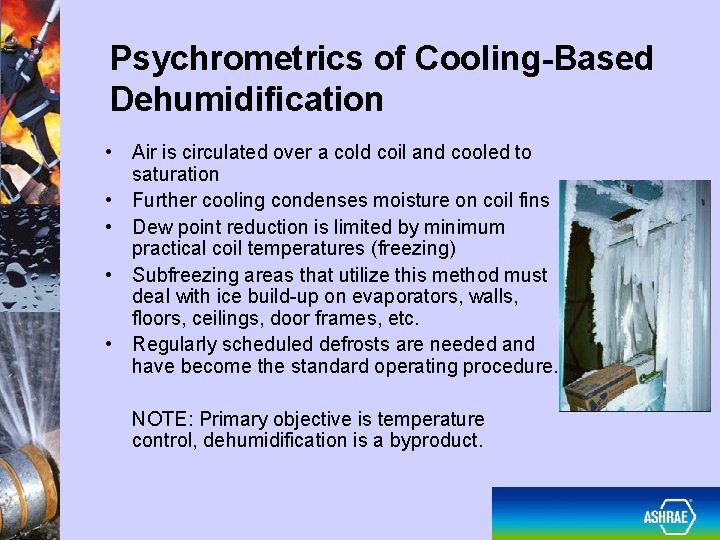
Psychrometrics of Cooling-Based Dehumidification • Air is circulated over a cold coil and cooled to saturation • Further cooling condenses moisture on coil fins • Dew point reduction is limited by minimum practical coil temperatures (freezing) • Subfreezing areas that utilize this method must deal with ice build-up on evaporators, walls, floors, ceilings, door frames, etc. • Regularly scheduled defrosts are needed and have become the standard operating procedure. NOTE: Primary objective is temperature control, dehumidification is a byproduct.
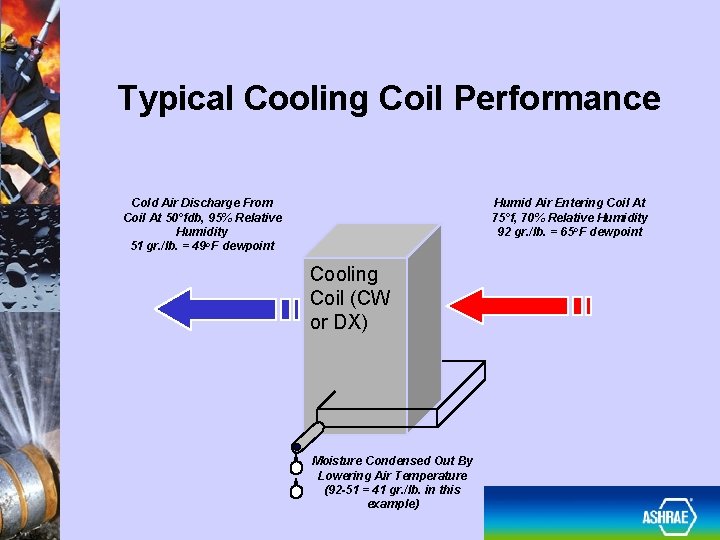
Typical Cooling Coil Performance Cold Air Discharge From Coil At 50°fdb, 95% Relative Humidity 51 gr. /lb. = 49 o. F dewpoint Humid Air Entering Coil At 75°f, 70% Relative Humidity 92 gr. /lb. = 65 o. F dewpoint Cooling Coil (CW or DX) Moisture Condensed Out By Lowering Air Temperature (92 -51 = 41 gr. /lb. in this example)
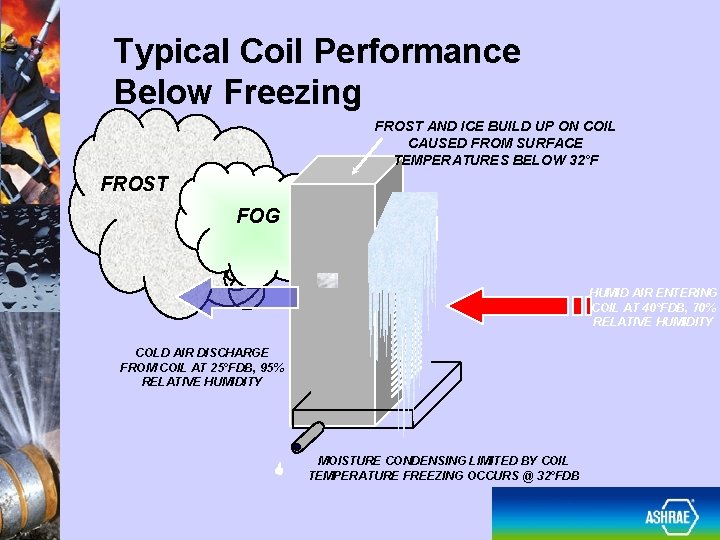
Typical Coil Performance Below Freezing FROST AND ICE BUILD UP ON COIL CAUSED FROM SURFACE TEMPERATURES BELOW 32°F FROST FOG HUMID AIR ENTERING COIL AT 40°FDB, 70% RELATIVE HUMIDITY COLD AIR DISCHARGE FROM COIL AT 25°FDB, 95% RELATIVE HUMIDITY MOISTURE CONDENSING LIMITED BY COIL TEMPERATURE FREEZING OCCURS @ 32°FDB
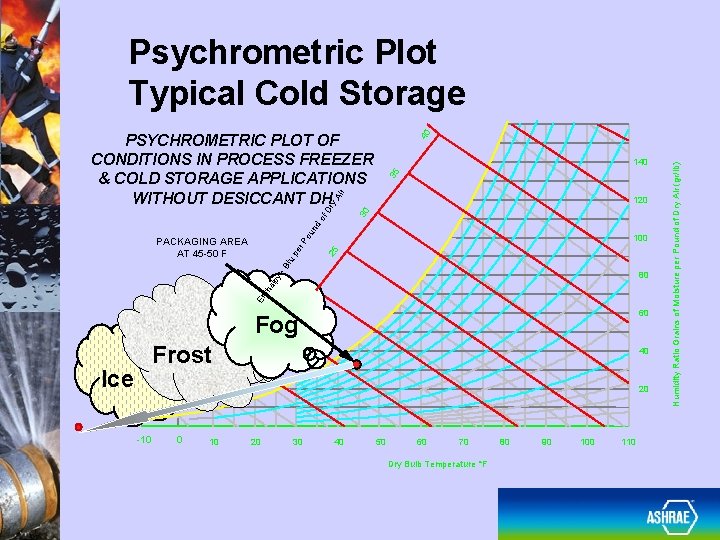
Psychrometric Plot Typical Cold Storage ir 35 140 30 ou nd of Dr y. A 120 25 100 Bt u pe r. P PACKAGING AREA AT 45 -50 F 20 En th alp y- 80 60 15 Fog Ice 40 10 Frost 20 -10 0 10 20 30 40 50 60 70 Dry Bulb Temperature °F 80 90 100 110 Humidity Ratio Grains of Moisture per Pound of Dry Air (gr/lb) 40 PSYCHROMETRIC PLOT OF CONDITIONS IN PROCESS FREEZER & COLD STORAGE APPLICATIONS WITHOUT DESICCANT DH
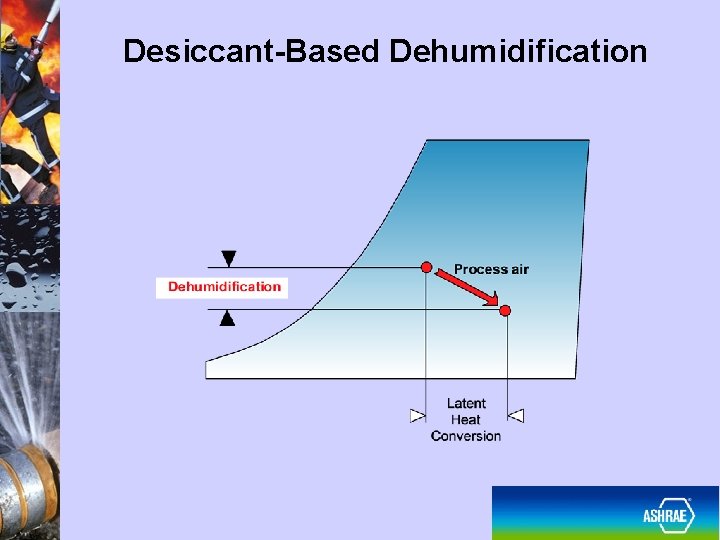
Desiccant-Based Dehumidification 22
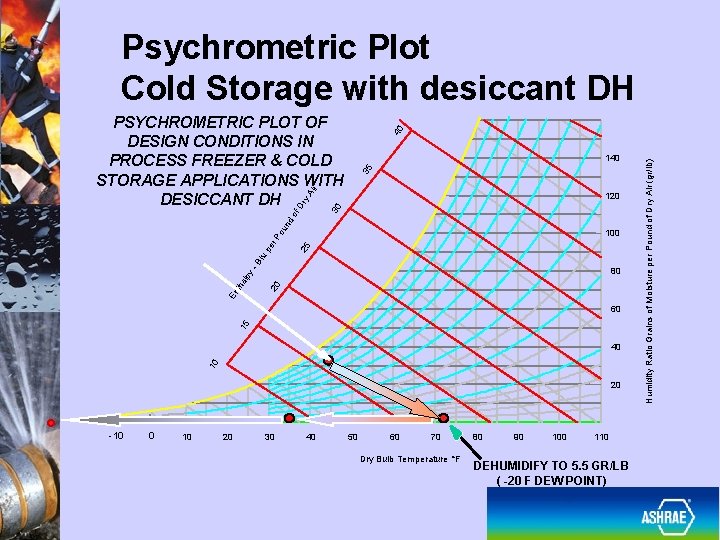
Psychrometric Plot Cold Storage with desiccant DH ir 35 140 30 25 100 Bt u pe r. P ou nd of Dr y. A 120 20 En th alp y- 80 15 60 10 40 20 -10 0 10 20 30 40 50 60 70 Dry Bulb Temperature °F 80 90 100 110 DEHUMIDIFY TO 5. 5 GR/LB ( -20 F DEW POINT) Humidity Ratio Grains of Moisture per Pound of Dry Air (gr/lb) 40 PSYCHROMETRIC PLOT OF DESIGN CONDITIONS IN PROCESS FREEZER & COLD STORAGE APPLICATIONS WITH DESICCANT DH
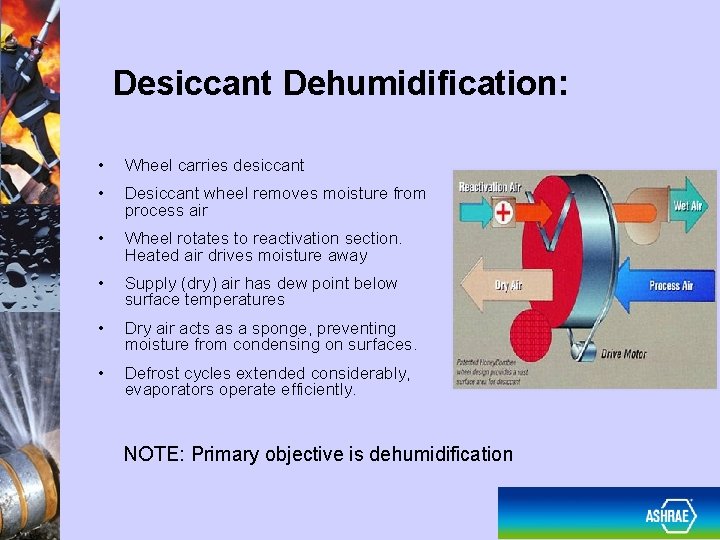
Desiccant Dehumidification: • Wheel carries desiccant • Desiccant wheel removes moisture from process air • Wheel rotates to reactivation section. Heated air drives moisture away • Supply (dry) air has dew point below surface temperatures • Dry air acts as a sponge, preventing moisture from condensing on surfaces. • Defrost cycles extended considerably, evaporators operate efficiently. NOTE: Primary objective is dehumidification
Working in cold storage… is not always easy 25
Applications in cold environments… • Loading docks - large infiltration loads from truck doors • Cold storage freezers - moisture from loading dock and process area • Spiral freezers – moisture from product and the environment • Plate freezers – moisture from environment • Process freezers – moisture from product and environment • Meat processing - moisture from various sources causing overhead condensation 26
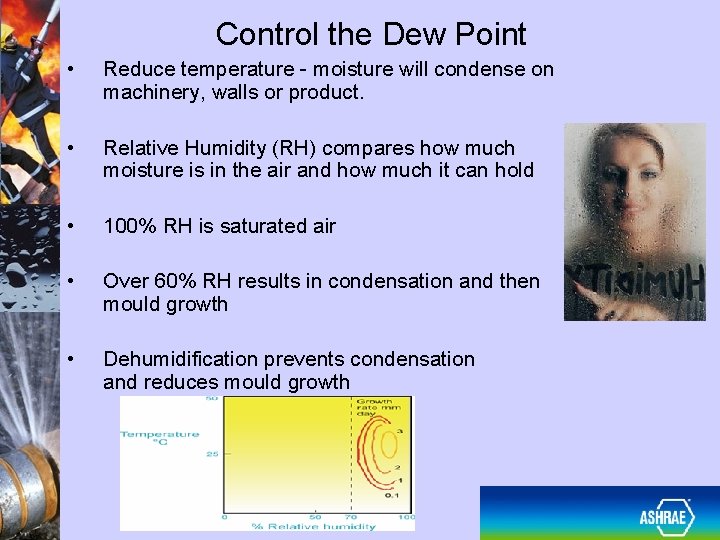
Control the Dew Point • Reduce temperature - moisture will condense on machinery, walls or product. • Relative Humidity (RH) compares how much moisture is in the air and how much it can hold • 100% RH is saturated air • Over 60% RH results in condensation and then mould growth • Dehumidification prevents condensation and reduces mould growth 27
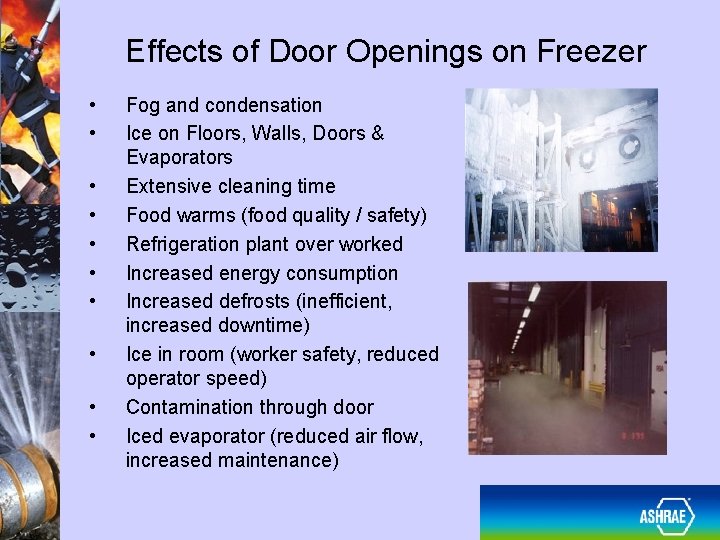
Effects of Door Openings on Freezer • • • Fog and condensation Ice on Floors, Walls, Doors & Evaporators Extensive cleaning time Food warms (food quality / safety) Refrigeration plant over worked Increased energy consumption Increased defrosts (inefficient, increased downtime) Ice in room (worker safety, reduced operator speed) Contamination through door Iced evaporator (reduced air flow, increased maintenance) 28
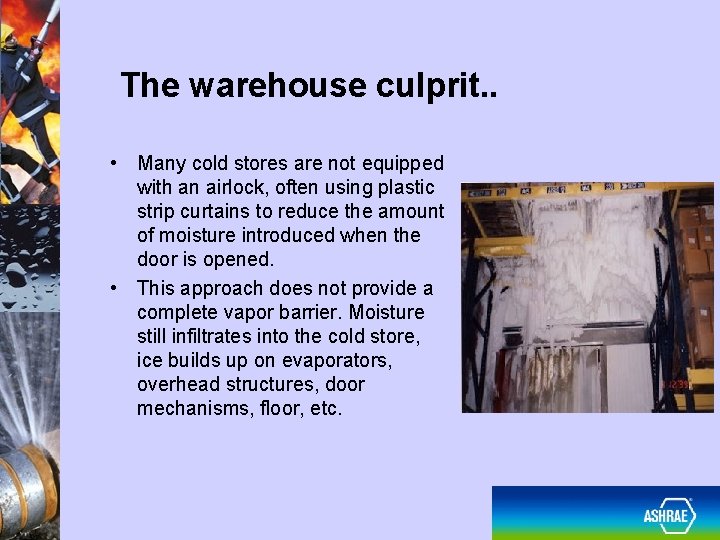
The warehouse culprit. . • Many cold stores are not equipped with an airlock, often using plastic strip curtains to reduce the amount of moisture introduced when the door is opened. • This approach does not provide a complete vapor barrier. Moisture still infiltrates into the cold store, ice builds up on evaporators, overhead structures, door mechanisms, floor, etc. 29
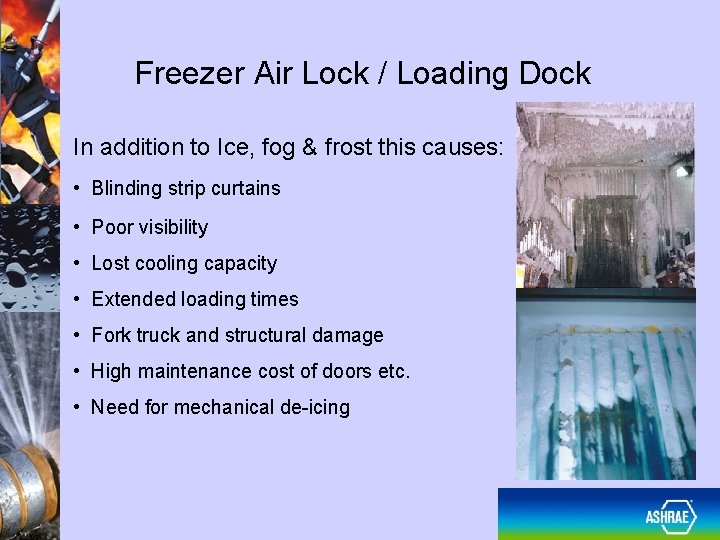
Freezer Air Lock / Loading Dock In addition to Ice, fog & frost this causes: • Blinding strip curtains • Poor visibility • Lost cooling capacity • Extended loading times • Fork truck and structural damage • High maintenance cost of doors etc. • Need for mechanical de-icing 30

Problem: SAFETY Unsafe environment risk of accidents caused by slippery floors Can be very costly $$$ 31
In some cases the problem has to be attacked from inside the freezer, there are units on the market that can do this, delivering -40 to -57 F dew point 32
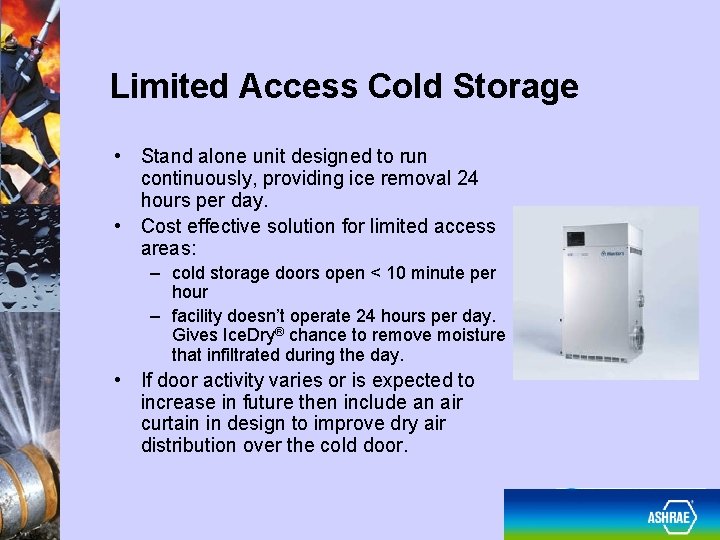
Limited Access Cold Storage • Stand alone unit designed to run continuously, providing ice removal 24 hours per day. • Cost effective solution for limited access areas: – cold storage doors open < 10 minute per hour – facility doesn’t operate 24 hours per day. Gives Ice. Dry® chance to remove moisture that infiltrated during the day. • If door activity varies or is expected to increase in future then include an air curtain in design to improve dry air distribution over the cold door. 33
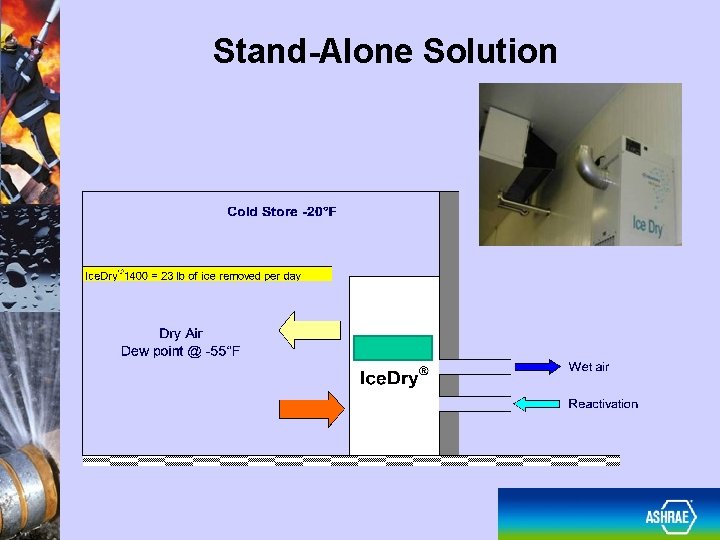
Stand-Alone Solution 34
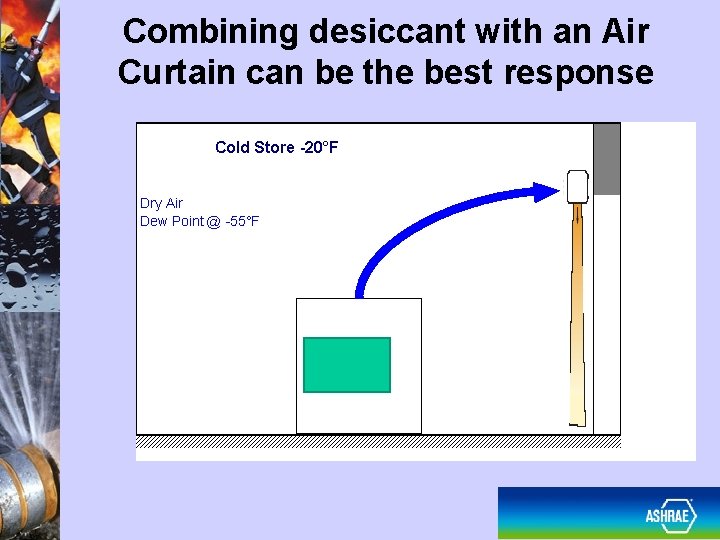
Combining desiccant with an Air Curtain can be the best response Cold Store -20°F Dry Air Dew Point @ -55°F Munters ® Ice. Dry 35
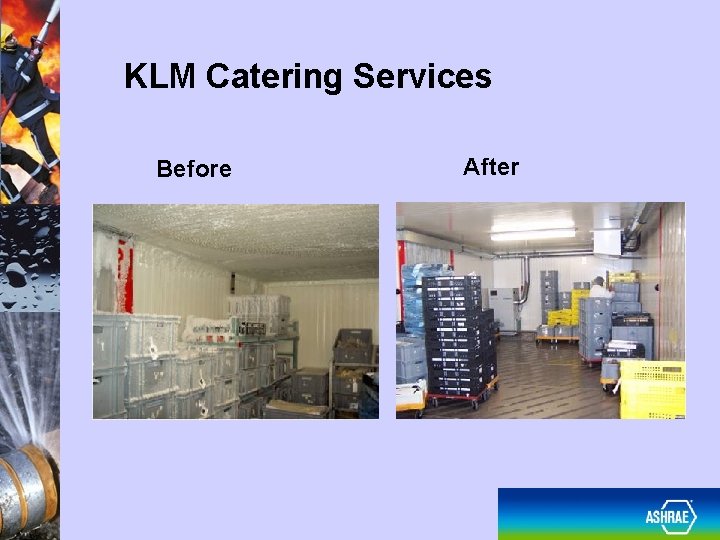
KLM Catering Services Before After 36
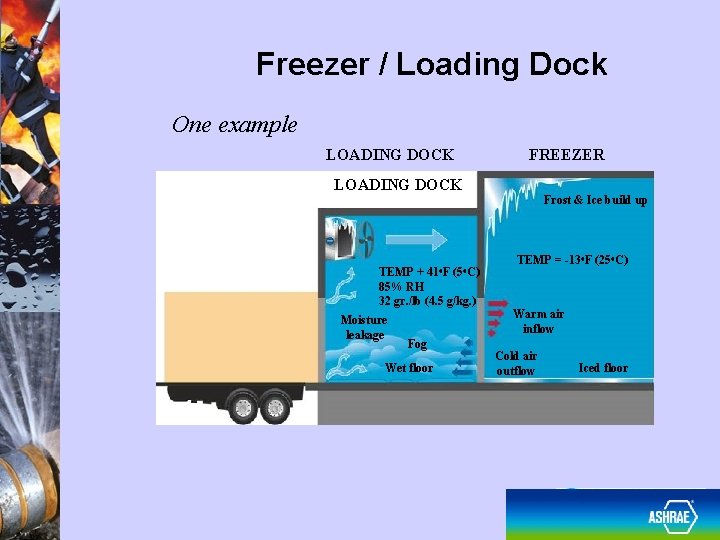
Freezer / Loading Dock One example LOADING DOCK FREEZER LOADING DOCK 41 o. F TEMP + 85% RH 32 gr. /lb (4. 5 g/kg. ) Moisture leakage Fog Wet floor (5 o. C) Frost & Ice build up TEMP = -13 o. F (25 o. C) Warm air inflow Cold air outflow Iced floor 37

With Dehumidifier Installed Desiccant dehumidifier keeps the Loading Dock dry, reducing the moisture load to the Freezer Dehumidifier Moist air from Loading Dock Dry air Frost free Cold Storage Area Moisture infiltration Dry floors 38
Dehumidification & Defrosts • Defrosting is an expensive business • One open door (8’ x 10’) can allow 1 gallon of water to enter a cold Freezer every minute • When ice settles on a cooler, the refrigeration system has to cool through a layer of insulating ice • Defrosts can represent 15% of energy consumption in Freezers 39

Benefits of Dehumidification • Floors/doors kept dry and ice-free • Speed up loading and unloading • Fork trucks operate at normal speed • Reduced occupational injuries from slips, falls and pallet mover accidents • No ice on strip curtains or fog around door, visibility is improved • Trouble-free pulldown after washdown • Coils run more efficiently and run longer between defrosts • One customer saved $20 K in 8 mos. 40
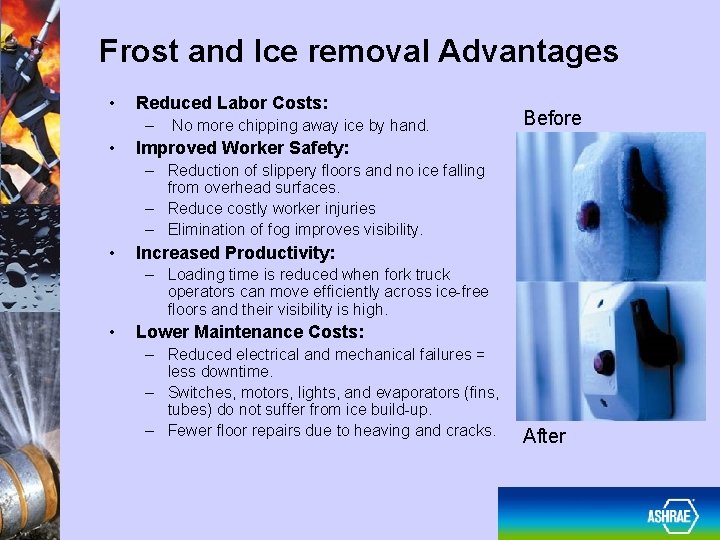
Frost and Ice removal Advantages • Reduced Labor Costs: – • No more chipping away ice by hand. Before Improved Worker Safety: – Reduction of slippery floors and no ice falling from overhead surfaces. – Reduce costly worker injuries – Elimination of fog improves visibility. • Increased Productivity: – Loading time is reduced when fork truck operators can move efficiently across ice-free floors and their visibility is high. • Lower Maintenance Costs: – Reduced electrical and mechanical failures = less downtime. – Switches, motors, lights, and evaporators (fins, tubes) do not suffer from ice build-up. – Fewer floor repairs due to heaving and cracks. After 41
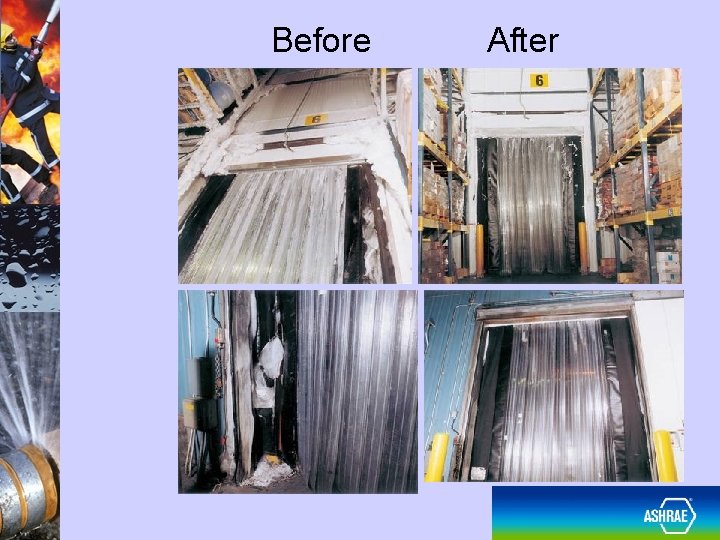
Before After 42
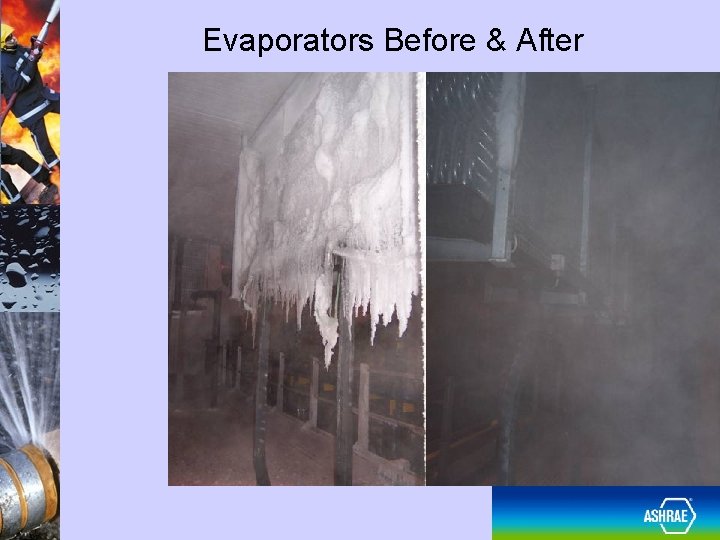
Evaporators Before & After 43
44
15 days later 45
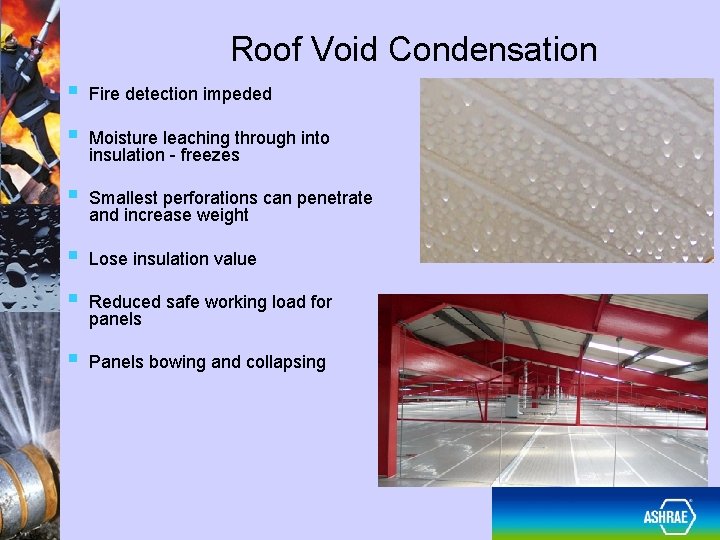
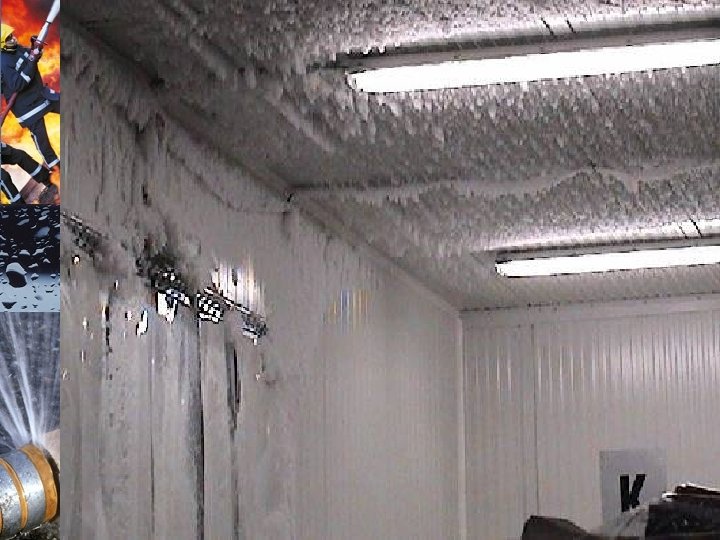
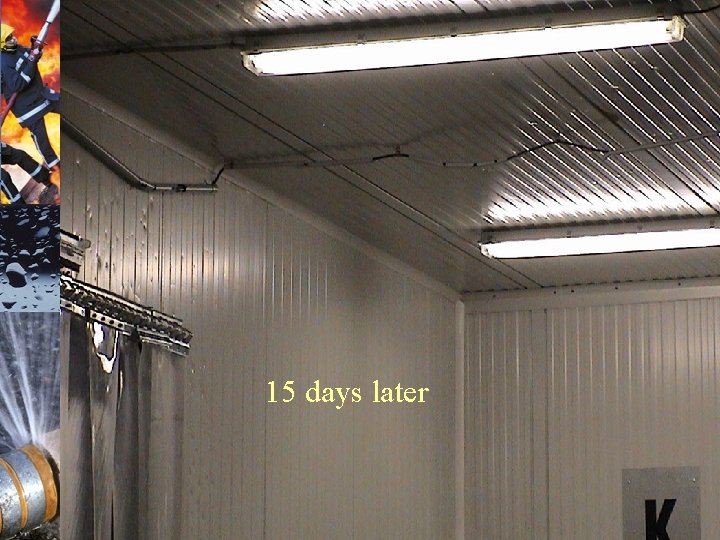
Roof Void Condensation § Fire detection impeded § Moisture leaching through into insulation - freezes § Smallest perforations can penetrate and increase weight § Lose insulation value § Reduced safe working load for panels § Panels bowing and collapsing 46

Dehumidification for Process Freezing 47
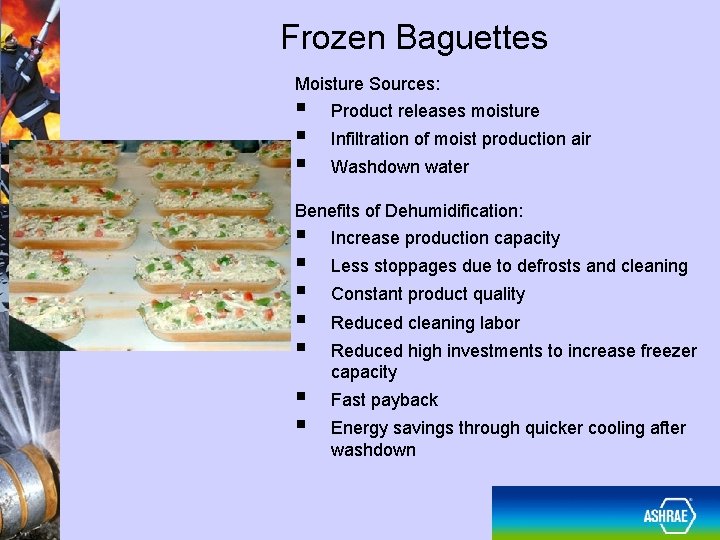
Frozen Baguettes Moisture Sources: § § § Product releases moisture Infiltration of moist production air Washdown water Benefits of Dehumidification: § § § Increase production capacity § § Fast payback Less stoppages due to defrosts and cleaning Constant product quality Reduced cleaning labor Reduced high investments to increase freezer capacity Energy savings through quicker cooling after washdown 48
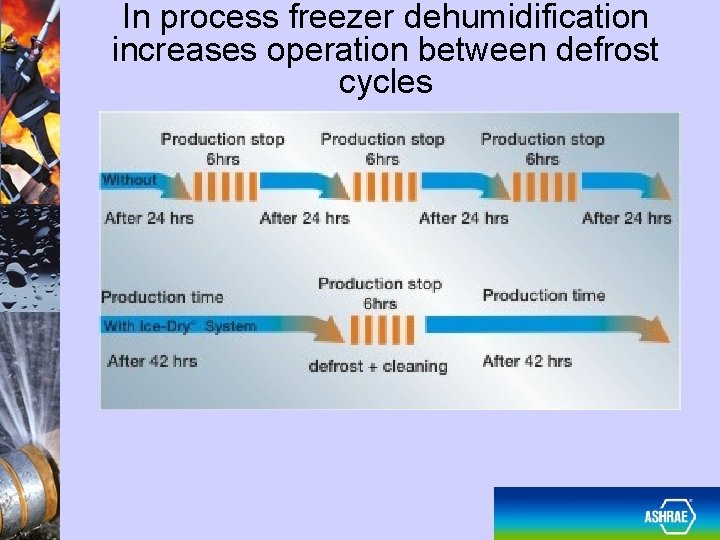
In process freezer dehumidification increases operation between defrost cycles 49
Ice Cream Plant Problem: Electronic Sensors In Carousel Freezer Coating With Ice Requires Manual Cleaning Every Two Hours Freezer Maintained at -35°F Solution: Dehumidify Ante-Room Surrounding The Carousel Freezer With Dry Air Force All Air Being Drawn Into The Freezer To Be Dehumidified. 50

Ice Cream Plant Before Installation of Dehumidifier 51

Ice Cream Plant After Installation of Dehumidifier 52
Summary • • Desiccant dehumidification reduces or eliminates moisture problem in PRW’s and food processing areas Evaluate benefits of controlling 3 phases of moisture: – – – Vapor – fog, mist. Eliminating fog will improve visibility, increase worker safety, and raise productivity. Liquid – water, condensation. Eliminating condensation will maintain dry floors (improve worker safety and productivity), dry packaging materials (enhance product quality and shelf life), and prevent product adulteration (improve food safety and reduce scrap). Dry coils will also pay efficiency dividends. Solid – ice. Reducing / eliminating ice will extend time between defrost cycles (saving energy and increasing productivity), reduce maintenance costs, and improve worker safety. 53

• Questions? Any questions? Thank you! 54
- Slides: 54