
Lenin THE USSR 1917 1924 History 12 Mr
- Slides: 18
Lenin &THE USSR 1917 -1924 History 12 Mr. D. Smith/MBSS
Lenin & THE USSR 1917 -1924 11 Slides: 1. 2. 3. 4. 5. 6. 7. Land Decree Constituent Assembly Cheka & Red Terror 1918 Treaty of Brest Litovsk Comintern 1918 -1921 Civil War Communism 1918 -1921 8. Civil War: Intrnl Involvement 9. Civil War: Red Victory 10. Aftermath: The USSR in 1921 11. The NEP 1921 -1928 12. Post Civil War Foreign Policy 13. The Death of Lenin 1924 14. Lenin’s Will
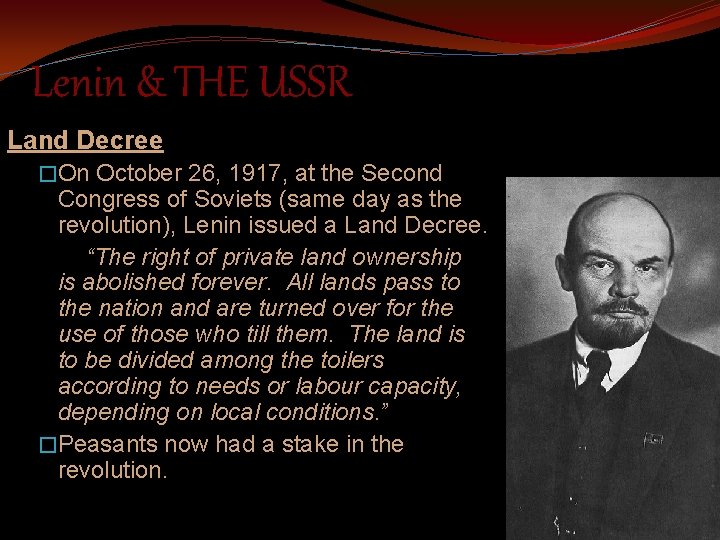
Lenin & THE USSR Land Decree �On October 26, 1917, at the Second Congress of Soviets (same day as the revolution), Lenin issued a Land Decree. “The right of private land ownership is abolished forever. All lands pass to the nation and are turned over for the use of those who till them. The land is to be divided among the toilers according to needs or labour capacity, depending on local conditions. ” �Peasants now had a stake in the revolution.
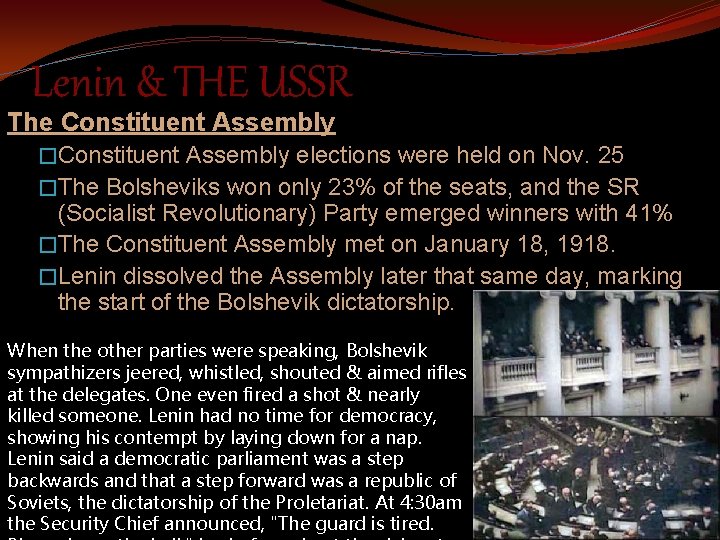
Lenin & THE USSR The Constituent Assembly �Constituent Assembly elections were held on Nov. 25 �The Bolsheviks won only 23% of the seats, and the SR (Socialist Revolutionary) Party emerged winners with 41% �The Constituent Assembly met on January 18, 1918. �Lenin dissolved the Assembly later that same day, marking the start of the Bolshevik dictatorship. When the other parties were speaking, Bolshevik sympathizers jeered, whistled, shouted & aimed rifles at the delegates. One even fired a shot & nearly killed someone. Lenin had no time for democracy, showing his contempt by laying down for a nap. Lenin said a democratic parliament was a step backwards and that a step forward was a republic of Soviets, the dictatorship of the Proletariat. At 4: 30 am the Security Chief announced, "The guard is tired.
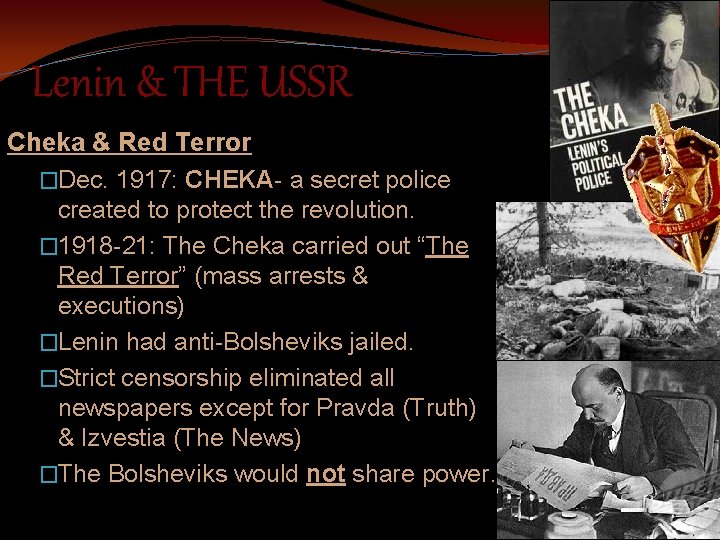
Lenin & THE USSR Cheka & Red Terror �Dec. 1917: CHEKA- a secret police created to protect the revolution. � 1918 -21: The Cheka carried out “The Red Terror” (mass arrests & executions) �Lenin had anti-Bolsheviks jailed. �Strict censorship eliminated all newspapers except for Pravda (Truth) & Izvestia (The News) �The Bolsheviks would not share power.
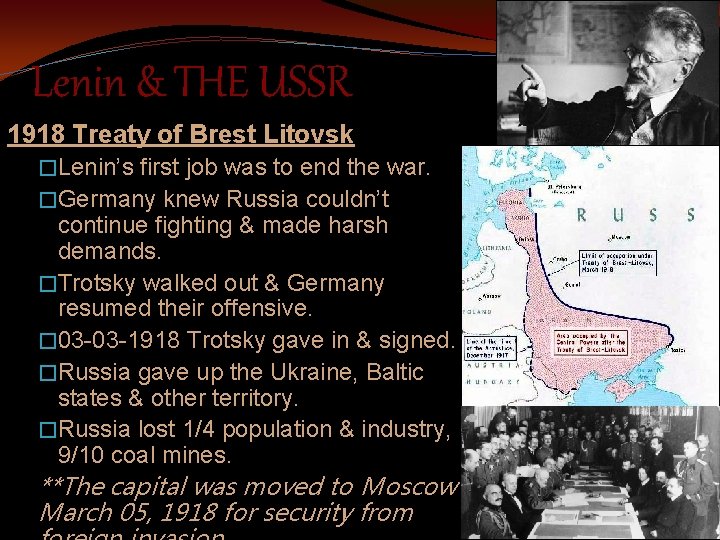
Lenin & THE USSR 1918 Treaty of Brest Litovsk �Lenin’s first job was to end the war. �Germany knew Russia couldn’t continue fighting & made harsh demands. �Trotsky walked out & Germany resumed their offensive. � 03 -03 -1918 Trotsky gave in & signed. �Russia gave up the Ukraine, Baltic states & other territory. �Russia lost 1/4 population & industry, 9/10 coal mines. **The capital was moved to Moscow March 05, 1918 for security from
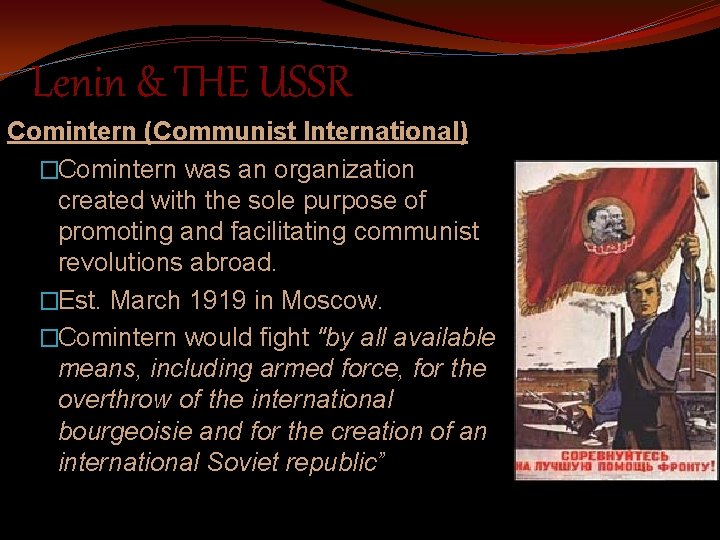
Lenin & THE USSR Comintern (Communist International) �Comintern was an organization created with the sole purpose of promoting and facilitating communist revolutions abroad. �Est. March 1919 in Moscow. �Comintern would fight "by all available means, including armed force, for the overthrow of the international bourgeoisie and for the creation of an international Soviet republic”
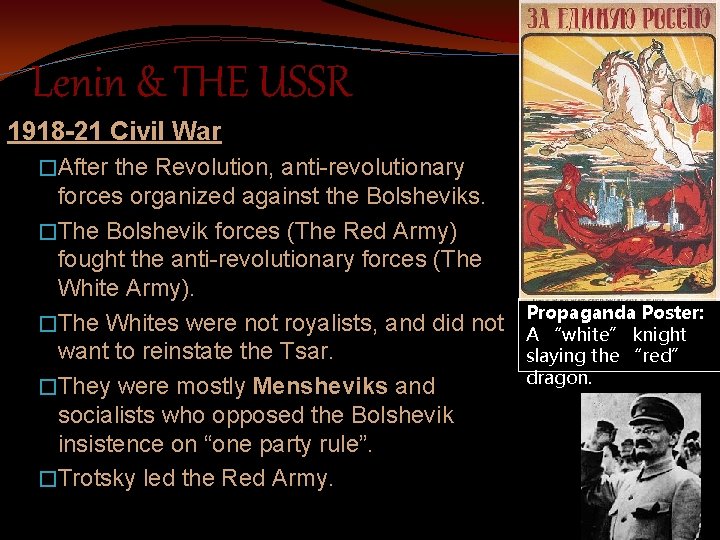
Lenin & THE USSR 1918 -21 Civil War �After the Revolution, anti-revolutionary forces organized against the Bolsheviks. �The Bolshevik forces (The Red Army) fought the anti-revolutionary forces (The White Army). �The Whites were not royalists, and did not want to reinstate the Tsar. �They were mostly Mensheviks and socialists who opposed the Bolshevik insistence on “one party rule”. �Trotsky led the Red Army. Propaganda Poster: A “white” knight slaying the “red” dragon.
Lenin & THE USSR War Communism 1918 -1921 �This is the economic policy followed during the Civil War. �These were strict controls and central planning to ensure the Red Army was well supplied. �Conditions included: � National control of railways � Strikes were outlawed � Private enterprise was outlawed �Peasants resisted, and local rebellions occurred. �A rebellion at a naval base shocked Lenin and convinced him of the need to change policies after the civil war.
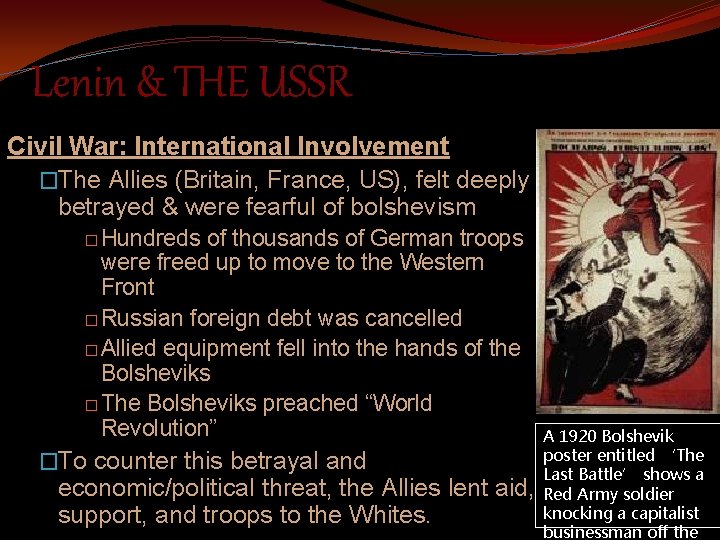
Lenin & THE USSR Civil War: International Involvement �The Allies (Britain, France, US), felt deeply betrayed & were fearful of bolshevism � Hundreds of thousands of German troops were freed up to move to the Western Front � Russian foreign debt was cancelled � Allied equipment fell into the hands of the Bolsheviks � The Bolsheviks preached “World Revolution” �To counter this betrayal and economic/political threat, the Allies lent aid, support, and troops to the Whites. A 1920 Bolshevik poster entitled ‘The Last Battle’ shows a Red Army soldier knocking a capitalist businessman off the
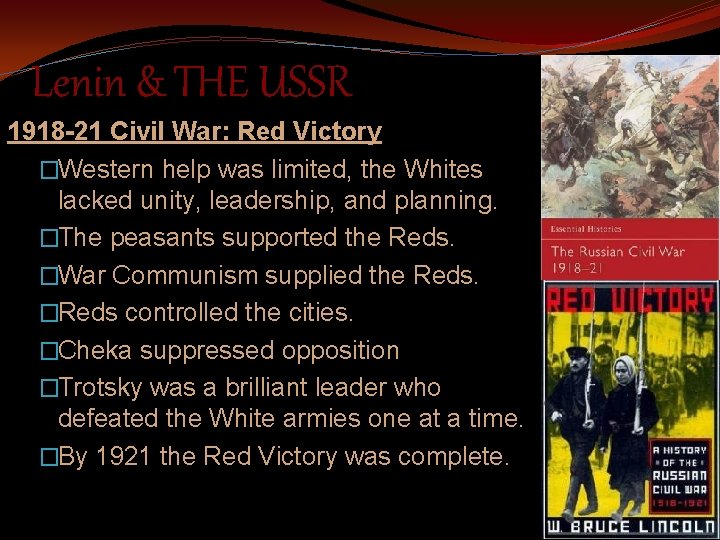
Lenin & THE USSR 1918 -21 Civil War: Red Victory �Western help was limited, the Whites lacked unity, leadership, and planning. �The peasants supported the Reds. �War Communism supplied the Reds. �Reds controlled the cities. �Cheka suppressed opposition �Trotsky was a brilliant leader who defeated the White armies one at a time. �By 1921 the Red Victory was complete.
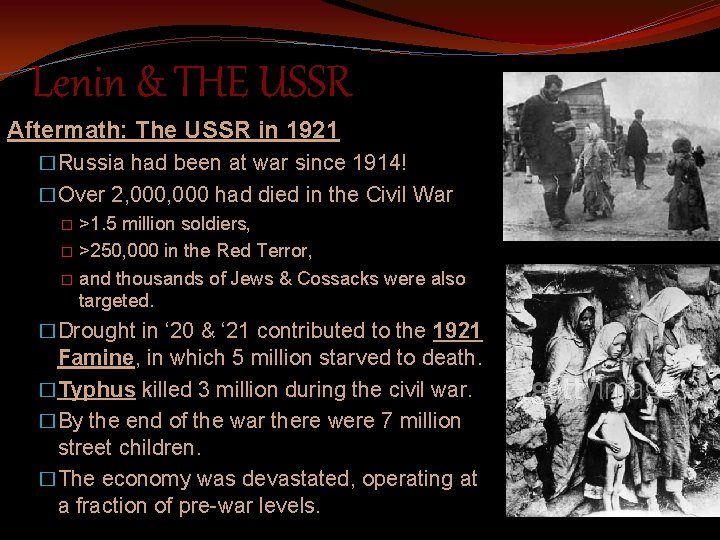
Lenin & THE USSR Aftermath: The USSR in 1921 �Russia had been at war since 1914! �Over 2, 000 had died in the Civil War � >1. 5 million soldiers, � >250, 000 in the Red Terror, � and thousands of Jews & Cossacks were also targeted. �Drought in ‘ 20 & ‘ 21 contributed to the 1921 Famine, in which 5 million starved to death. �Typhus killed 3 million during the civil war. �By the end of the war there were 7 million street children. �The economy was devastated, operating at a fraction of pre-war levels.
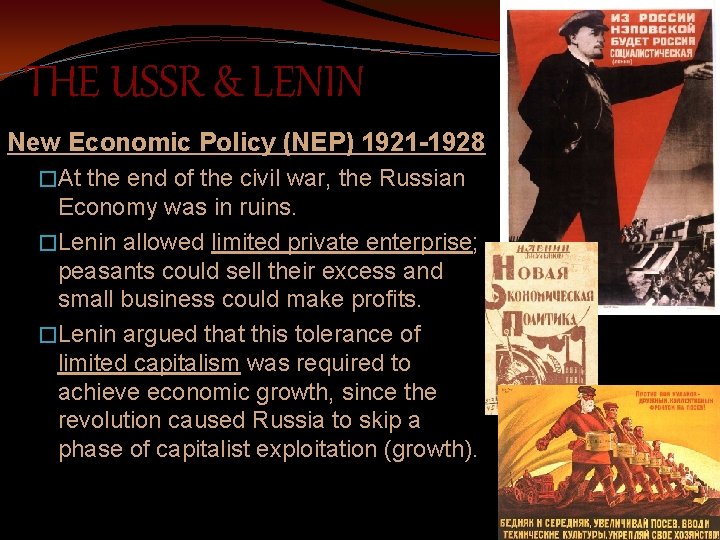
THE USSR & LENIN New Economic Policy (NEP) 1921 -1928 �At the end of the civil war, the Russian Economy was in ruins. �Lenin allowed limited private enterprise; peasants could sell their excess and small business could make profits. �Lenin argued that this tolerance of limited capitalism was required to achieve economic growth, since the revolution caused Russia to skip a phase of capitalist exploitation (growth).
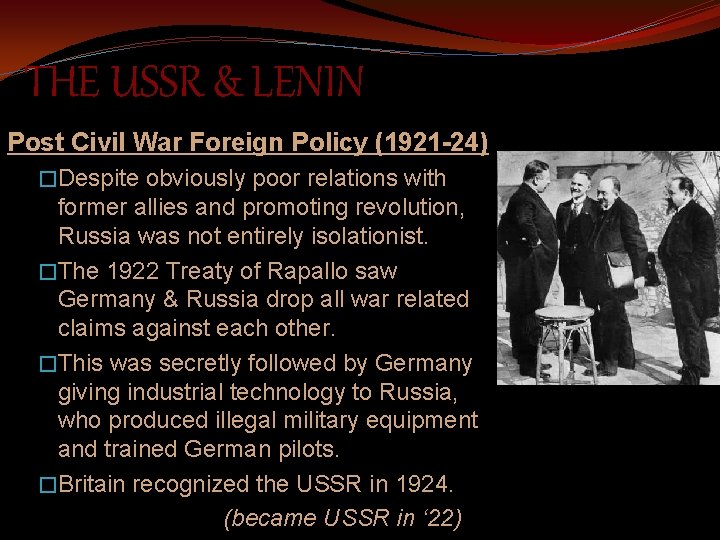
THE USSR & LENIN Post Civil War Foreign Policy (1921 -24) �Despite obviously poor relations with former allies and promoting revolution, Russia was not entirely isolationist. �The 1922 Treaty of Rapallo saw Germany & Russia drop all war related claims against each other. �This was secretly followed by Germany giving industrial technology to Russia, who produced illegal military equipment and trained German pilots. �Britain recognized the USSR in 1924. (became USSR in ‘ 22)
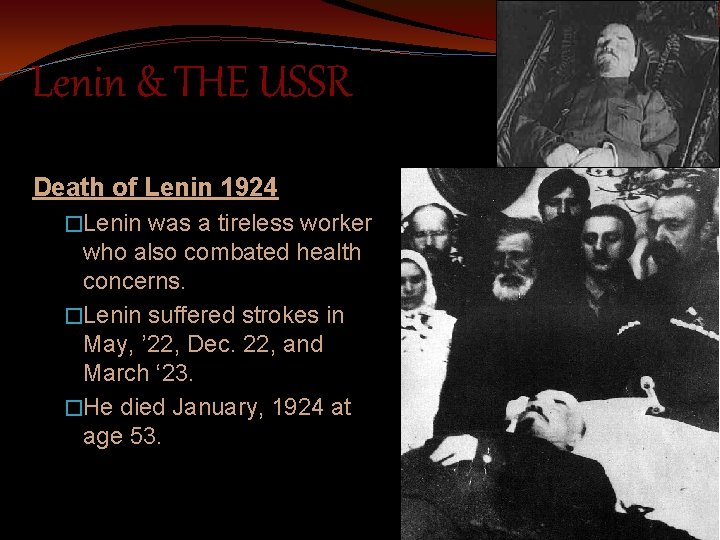
Lenin & THE USSR Death of Lenin 1924 �Lenin was a tireless worker who also combated health concerns. �Lenin suffered strokes in May, ’ 22, Dec. 22, and March ‘ 23. �He died January, 1924 at age 53.
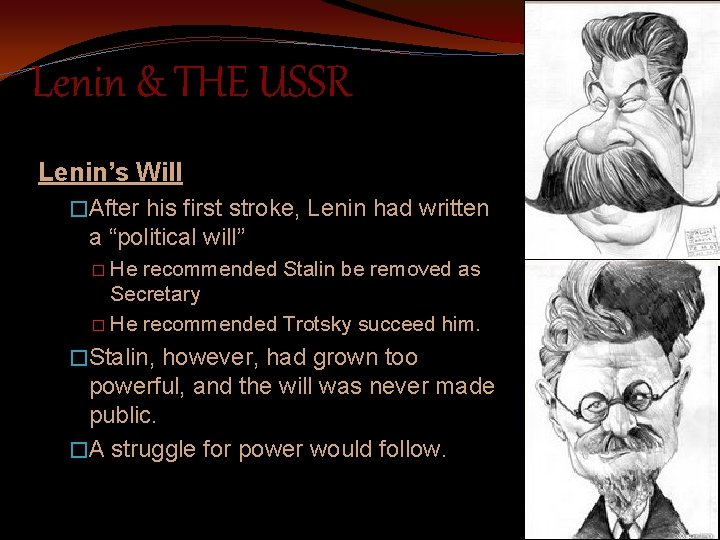
Lenin & THE USSR Lenin’s Will �After his first stroke, Lenin had written a “political will” � He recommended Stalin be removed as Secretary � He recommended Trotsky succeed him. �Stalin, however, had grown too powerful, and the will was never made public. �A struggle for power would follow.
Lenin & THE USSR WRITTEN RESPONSE Assess the impact of the Bolshevik Revolution on Russia/U. S. S. R. between November 1917 and the death of Lenin in 1924.
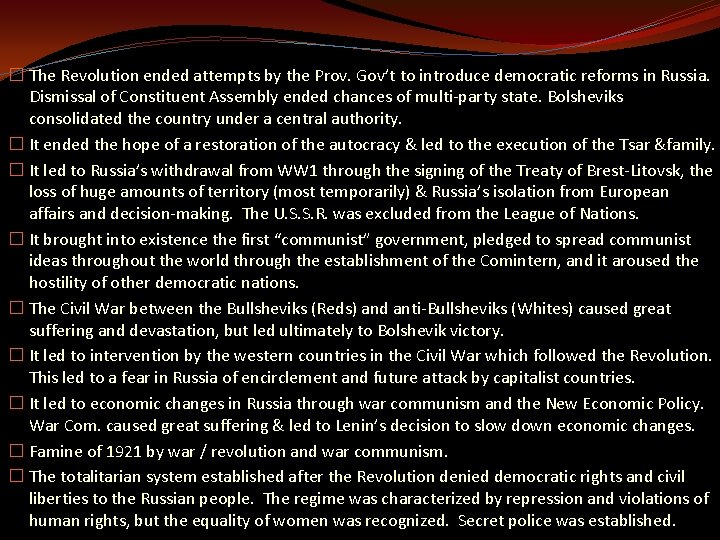
� The Revolution ended attempts by the Prov. Gov’t to introduce democratic reforms in Russia. Dismissal of Constituent Assembly ended chances of multi-party state. Bolsheviks consolidated the country under a central authority. � It ended the hope of a restoration of the autocracy & led to the execution of the Tsar &family. � It led to Russia’s withdrawal from WW 1 through the signing of the Treaty of Brest-Litovsk, the loss of huge amounts of territory (most temporarily) & Russia’s isolation from European affairs and decision-making. The U. S. S. R. was excluded from the League of Nations. � It brought into existence the first “communist” government, pledged to spread communist ideas throughout the world through the establishment of the Comintern, and it aroused the hostility of other democratic nations. � The Civil War between the Bullsheviks (Reds) and anti-Bullsheviks (Whites) caused great suffering and devastation, but led ultimately to Bolshevik victory. � It led to intervention by the western countries in the Civil War which followed the Revolution. This led to a fear in Russia of encirclement and future attack by capitalist countries. � It led to economic changes in Russia through war communism and the New Economic Policy. War Com. caused great suffering & led to Lenin’s decision to slow down economic changes. � Famine of 1921 by war / revolution and war communism. � The totalitarian system established after the Revolution denied democratic rights and civil liberties to the Russian people. The regime was characterized by repression and violations of human rights, but the equality of women was recognized. Secret police was established.