
LELA 10082 Varieties of English Harold Somers Professor
- Slides: 18
LELA 10082 Varieties of English Harold Somers Professor of Language Engineering Office: Lamb 1. 15 1
Varieties of English • The aim of this course is to show you how English varies regionally and socially, and to introduce you to the basic methods and concepts required for the study of language variation and change in progress. • Accents and dialects • Style and “register” • Case studies, but also methods and concepts 2
Topics • Language, dialect, “idiolect” • Languages in contact: – – speech communities regional and social variation language change language and society • Describing language/dialect differences – phonology, lexis, grammar • Studying dialects: how is data gathered analysed? 3
Topics (cont. ) • Style and “register” – Language use is defined by purpose as well as region – Language codes marked by lexis and grammar – LSP, “sublanguage” • Can we measure style? – Literary stylistics; authorship studies – Forensic linguistics 4
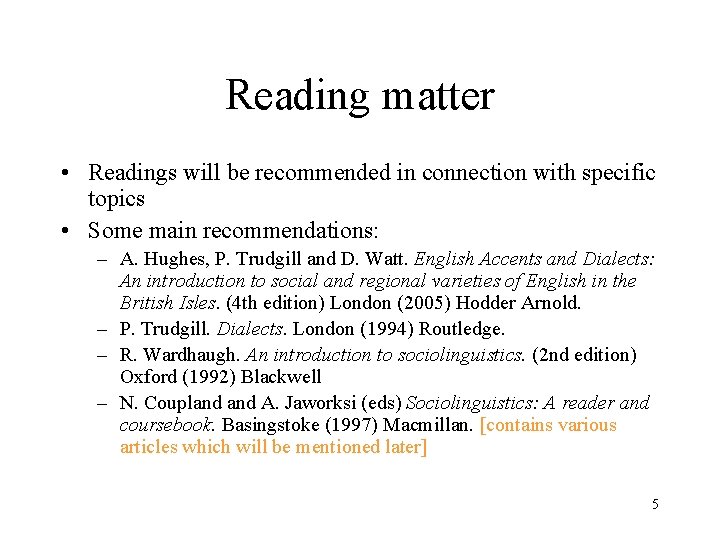
Reading matter • Readings will be recommended in connection with specific topics • Some main recommendations: – A. Hughes, P. Trudgill and D. Watt. English Accents and Dialects: An introduction to social and regional varieties of English in the British Isles. (4 th edition) London (2005) Hodder Arnold. – P. Trudgill. Dialects. London (1994) Routledge. – R. Wardhaugh. An introduction to sociolinguistics. (2 nd edition) Oxford (1992) Blackwell – N. Coupland A. Jaworksi (eds) Sociolinguistics: A reader and coursebook. Basingstoke (1997) Macmillan. [contains various articles which will be mentioned later] 5
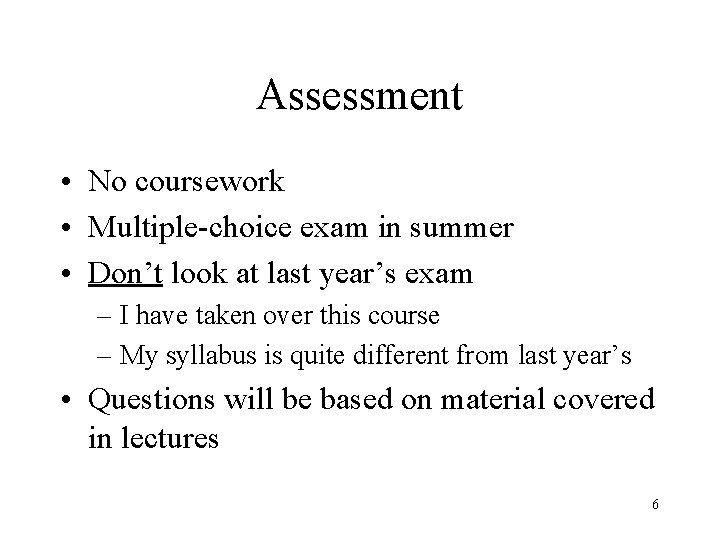
Assessment • No coursework • Multiple-choice exam in summer • Don’t look at last year’s exam – I have taken over this course – My syllabus is quite different from last year’s • Questions will be based on material covered in lectures 6
Lecture notes • Lecture notes will be available on website • http: //personalpages. manchester. ac. uk/staff/harold. somers/ LELA 10082/ • Alternatively: – Go via School home page – Or via search engine 7
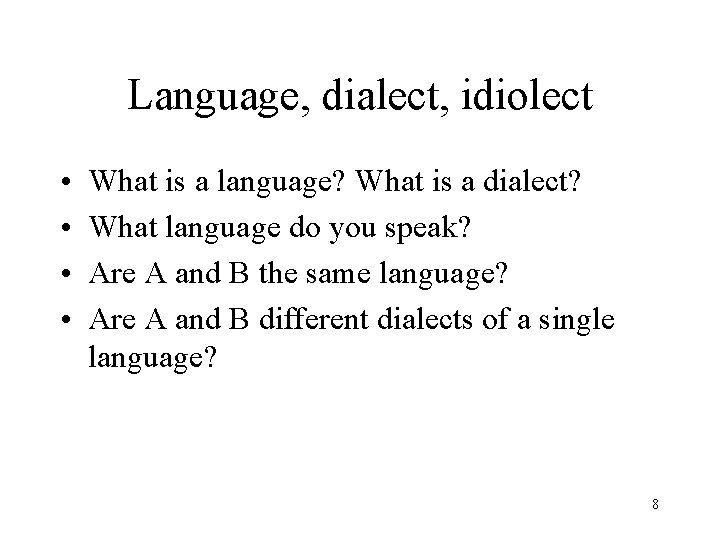
Language, dialect, idiolect • • What is a language? What is a dialect? What language do you speak? Are A and B the same language? Are A and B different dialects of a single language? 8
Language, dialect, idiolect • Everyone speaks differently, in their own individual way: “idiolect” • In fact the way you use language differs from moment to moment (more on that later in the course) • Your idiolect will be characterized by phonetic, lexical and grammatical features 9
Language, dialect, idiolect • Some phonetic features (and to a lesser extent lexical and grammatical) will be wholly idiosyncratic (eg voice quality) • Others will identify your accent and dialect, which may be sufficiently similar to other people’s idiolects that you say you speak the “same” dialect (or with the same accent) • Similarly, various accents/dialects are identified as being the same language 10
Accent vs dialect • “Accent” generally refers only to phonetic differences • “Dialect” usually means differences on all linguistic levels: – Phonetic – Lexical – Grammatical – Pragmatic 11
Standard vs non-standard • For many languages, one or another variety is recognised as “standard” • Other varieties may be referred to as “dialects”, or just “non-standard varieties” • Often, non-standard varieties are more or less stigmatised • As linguists, we should not make value judgments, though as sociolinguists we may report other people’s value judgments 12
Standard vs non-standard • Everyone has an accent • Why are some varieties of English perceived to be better, or more correct? • Likewise, why are some accents believed to be uglier than others? • Important to distinguish objective facts about accents and dialects, and subjective opinions • And notice how perceptions about accents impinge on their use: features of prestigious accents spread to other accents 13
Standard vs non-standard • For many languages, the standard is the local dialect of some prestigious region, typically (though not always) the capital • Not the case for English, which has a non-regional standard, called “RP” (received pronunciation) – RP is a variety of southern English, but is not the local accent of London, nor Oxford or Cambridge (or anywhere else) – More on RP later 14
Language and dialect • Whether two varieties are dialects, or separate languages is never clear-cut: • Criteria for “same language” may include – Mutual intelligibility – Political, geographical or racial identity – Historical identity – Measurable similarities in lexis and grammar 15
Some borderline examples • Swedish, Norwegian x 2, Danish: linguistically and politically distinct but mutually comprehensible • Serbian, Croatian (erstwhile “Serbo-Croat”) • Hindi, Urdu: writing system and some vocab differences, poltical and religious divide since 1947 • English(es) of England, Scotland, America: written form m. i. , some accent and dialect differences make understanding difficult • Dutch, Flemish: as (dis)similar as Br. E and Am. E but seen as different languages • Chinese: actually quite distinct languages described as dialects due to western bias and ignorance 16
Language and dialect • • • Geographical and social factors Changing attitudes to accents and dialects Languages/dialects influence each other How to describe differences? How to observe and measure differences? 17
The next few lectures… • RP – What is it? Who speaks it? How has its status changed? • Accents of English – How do they differ? – How do we characterise them? – What’s special about your accent? – How do specialists recognise accents? – How can you learn to do a good X accent? 18