
Leicester Castle tells its story i Beaconbased mobile
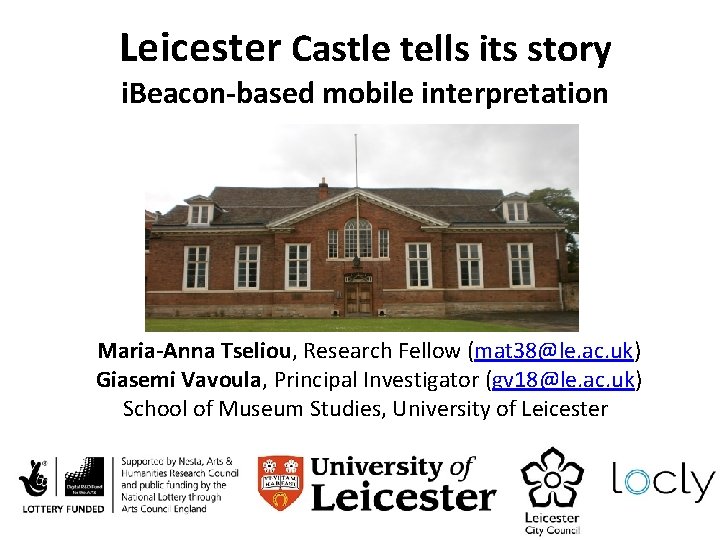
Leicester Castle tells its story i. Beacon-based mobile interpretation Maria-Anna Tseliou, Research Fellow (mat 38@le. ac. uk) Giasemi Vavoula, Principal Investigator (gv 18@le. ac. uk) School of Museum Studies, University of Leicester
NESTA R&D Fund for the Arts • £ 125 k R&D grant to develop ibeacons-based app to improve heritage interpretation • Technology currently used in retail sector. Grant was to develop it for heritage interpretation • Requirement: replicability (many heritage venues experience similar interpretation challenges) • Project partners: School of Museum Studies, University of Leicester (academic partner), Locly (technology partner) , Leicester City Council, Arts & Museums Service (arts partner), Metro-Boulot-Dodo (content developer)
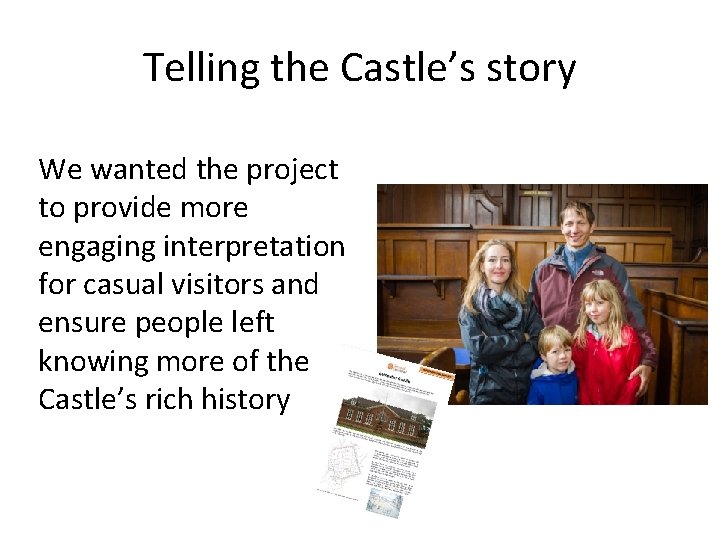
Telling the Castle’s story We wanted the project to provide more engaging interpretation for casual visitors and ensure people left knowing more of the Castle’s rich history
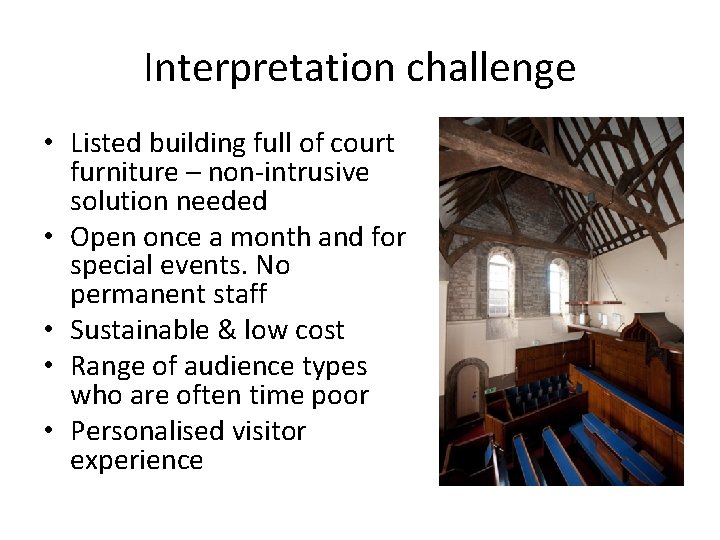
Interpretation challenge • Listed building full of court furniture – non-intrusive solution needed • Open once a month and for special events. No permanent staff • Sustainable & low cost • Range of audience types who are often time poor • Personalised visitor experience
Why i. Beacons? • • Low cost Low maintenance Invisible (c. f. QR codes) Accurate Easy to re-programme Require no user action (c. f. QR codes) Require no specialist equipment Can capture data
What are i. Beacons? • In essence, i. Beacon technology allows Mobile Apps to understand their position on a microlocal scale, and deliver hyper-contextual content to users based on location. • Accurate location sensing, indoors and outdoors. • The underlying communication technology is Bluetooth Low Energy
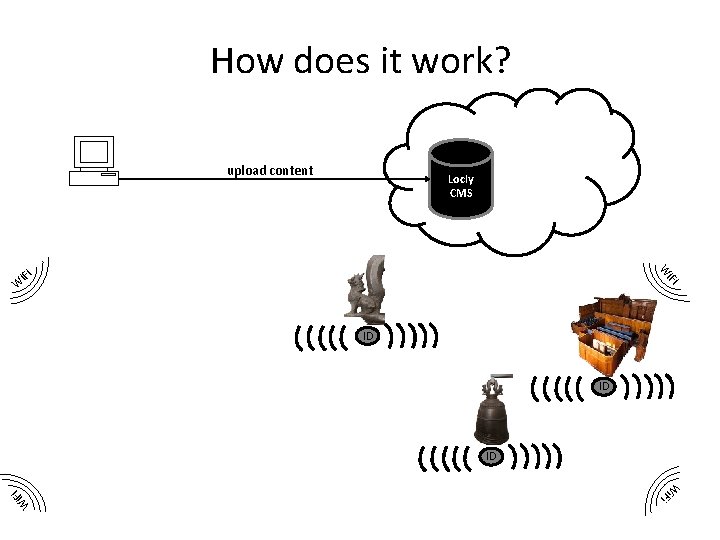
How does it work? upload content i. Fi W W Locly CMS ID ID W i. Fi ID
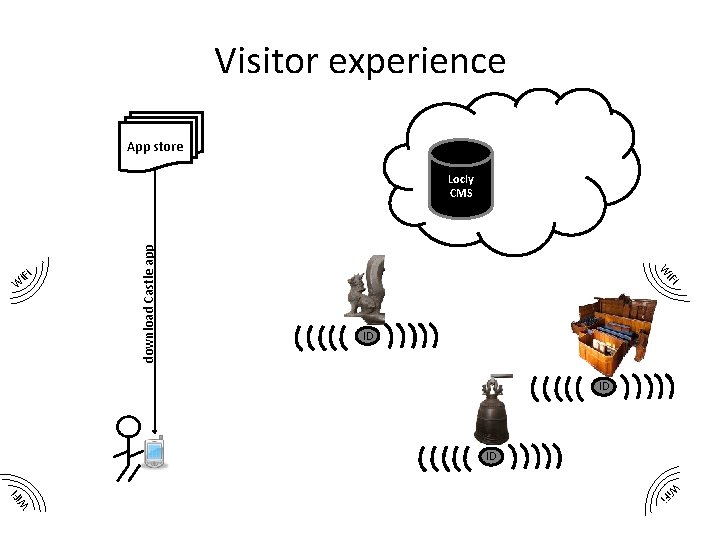
Visitor experience App store i. Fi W W i. Fi download Castle app Locly CMS ID ID W i. Fi ID
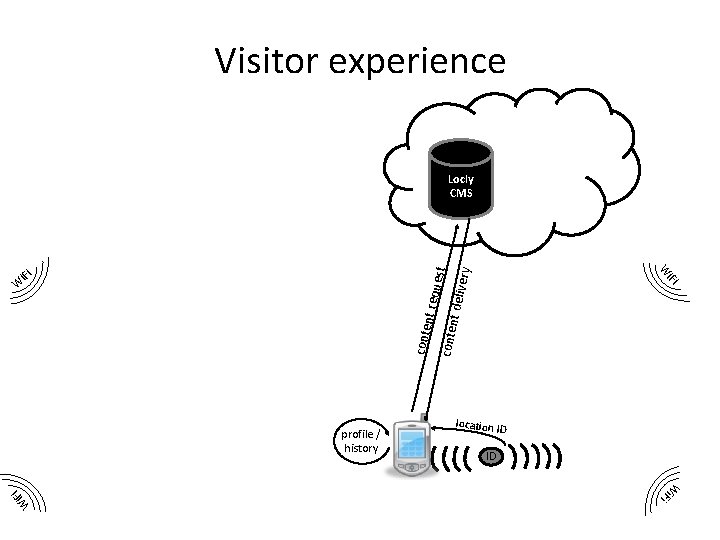
Visitor experience Locly CMS nt req uest conte nt del ivery conte i. Fi W W i. Fi ID i. Fi W location ID W i. Fi profile / history
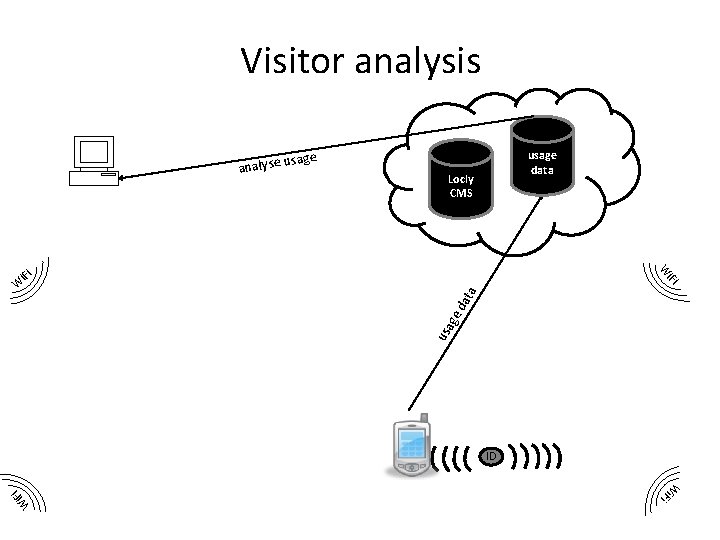
Visitor analysis s analyse u Locly CMS i. Fi usa ge da ta i. Fi W W usage data age W i. Fi ID
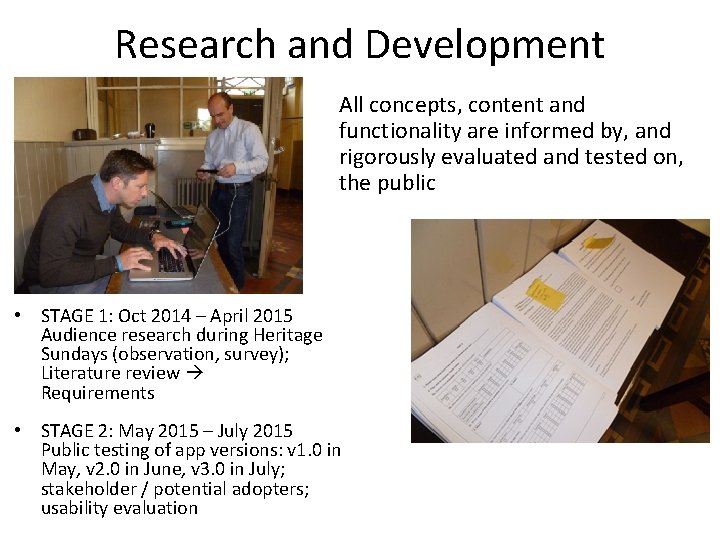
Research and Development All concepts, content and functionality are informed by, and rigorously evaluated and tested on, the public • STAGE 1: Oct 2014 – April 2015 Audience research during Heritage Sundays (observation, survey); Literature review Requirements • STAGE 2: May 2015 – July 2015 Public testing of app versions: v 1. 0 in May, v 2. 0 in June, v 3. 0 in July; stakeholder / potential adopters; usability evaluation
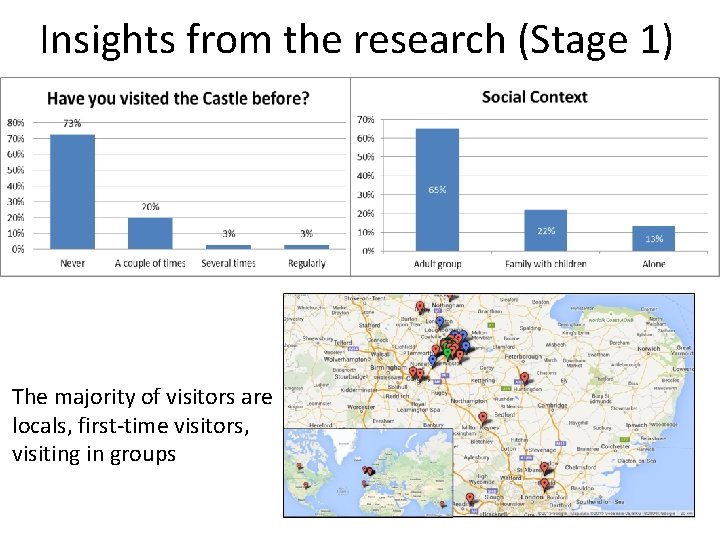
Insights from the research (Stage 1) The majority of visitors are locals, first-time visitors, visiting in groups
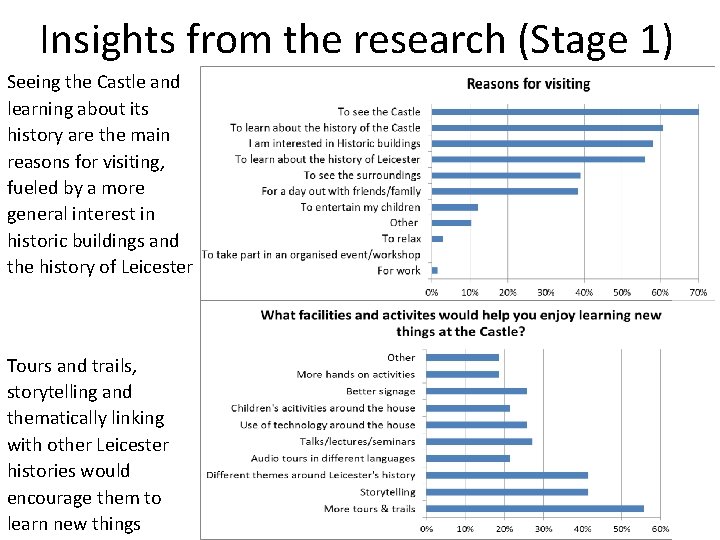
Insights from the research (Stage 1) Seeing the Castle and learning about its history are the main reasons for visiting, fueled by a more general interest in historic buildings and the history of Leicester Tours and trails, storytelling and thematically linking with other Leicester histories would encourage them to learn new things
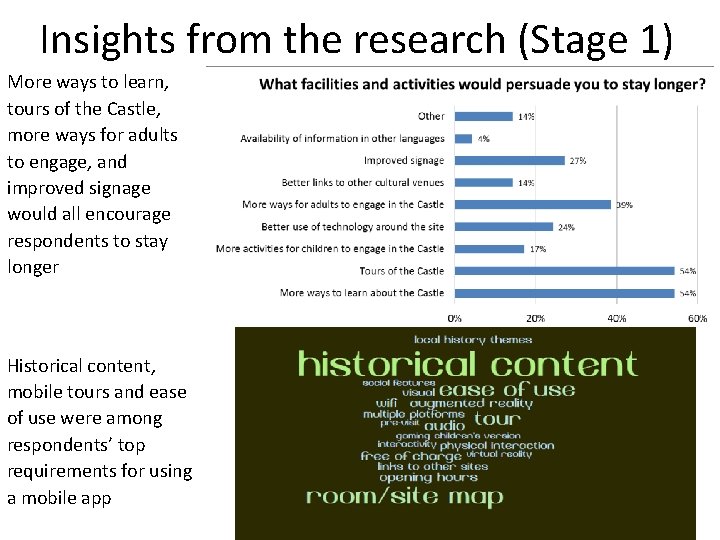
Insights from the research (Stage 1) More ways to learn, tours of the Castle, more ways for adults to engage, and improved signage would all encourage respondents to stay longer Historical content, mobile tours and ease of use were among respondents’ top requirements for using a mobile app
Insights from the research (Stage 1)
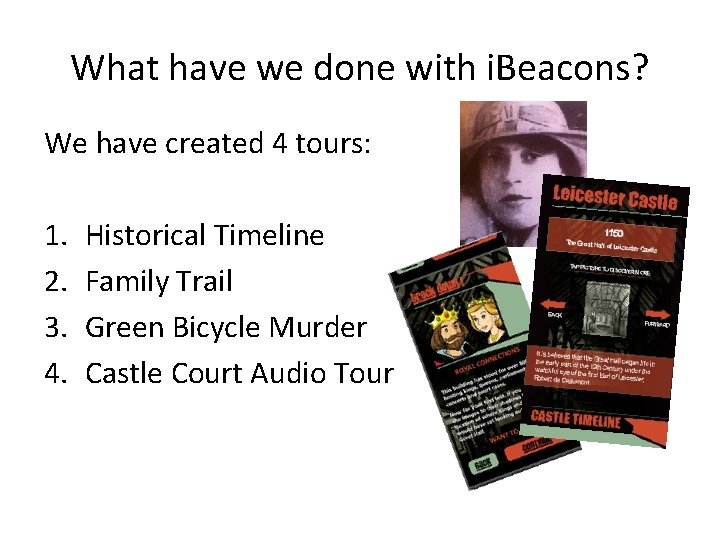
What have we done with i. Beacons? We have created 4 tours: 1. 2. 3. 4. Historical Timeline Family Trail Green Bicycle Murder Castle Court Audio Tour
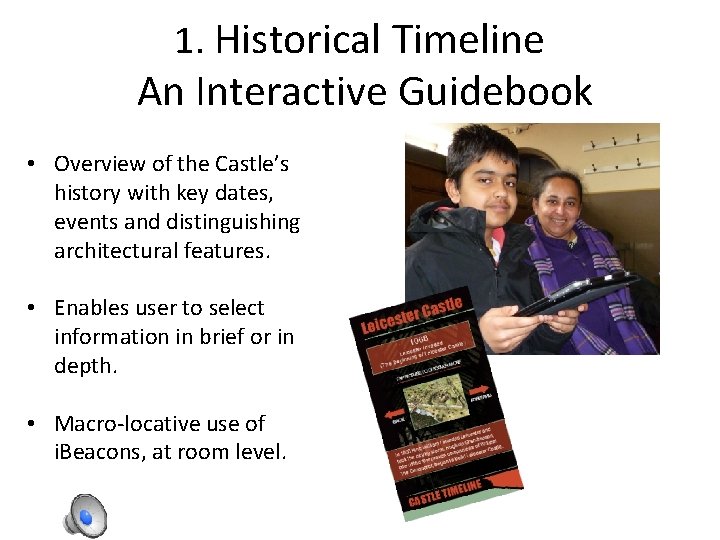
1. Historical Timeline An Interactive Guidebook • Overview of the Castle’s history with key dates, events and distinguishing architectural features. • Enables user to select information in brief or in depth. • Macro-locative use of i. Beacons, at room level.
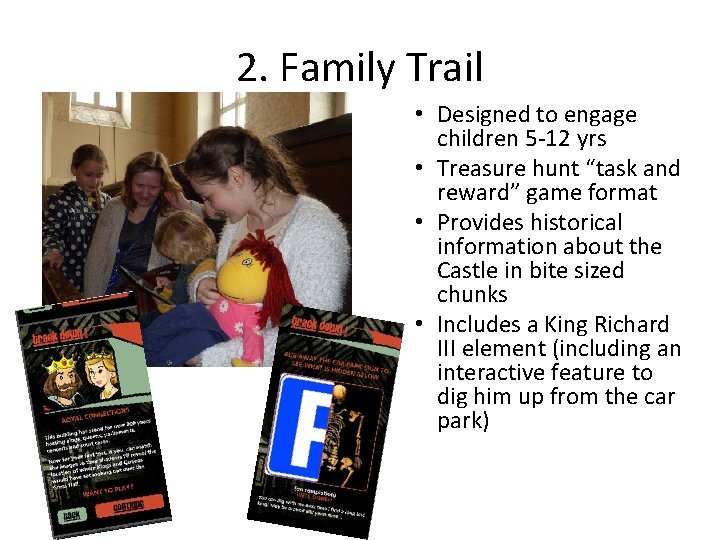
2. Family Trail • Designed to engage children 5 -12 yrs • Treasure hunt “task and reward” game format • Provides historical information about the Castle in bite sized chunks • Includes a King Richard III element (including an interactive feature to dig him up from the car park)
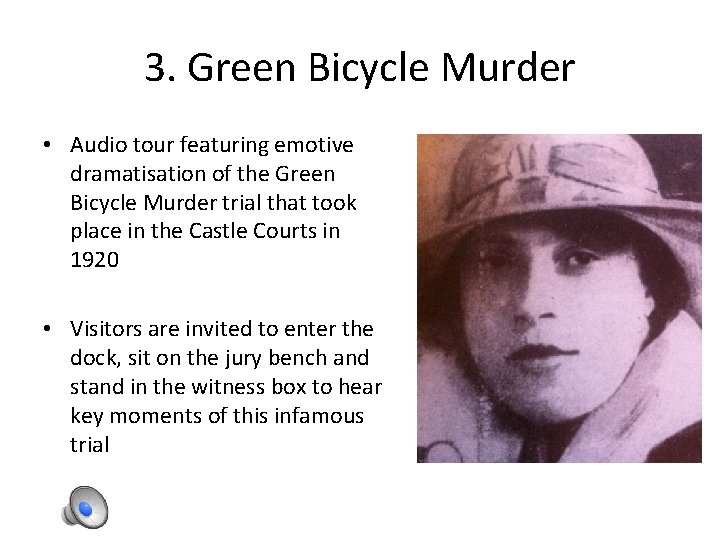
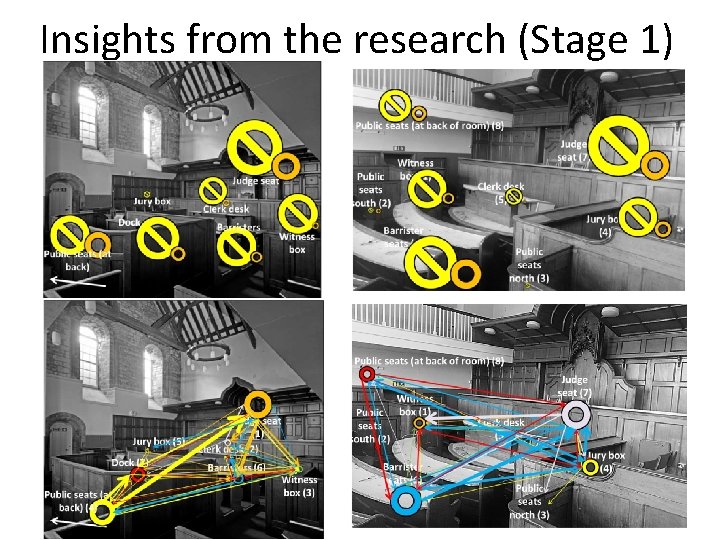
3. Green Bicycle Murder • Audio tour featuring emotive dramatisation of the Green Bicycle Murder trial that took place in the Castle Courts in 1920 • Visitors are invited to enter the dock, sit on the jury bench and stand in the witness box to hear key moments of this infamous trial
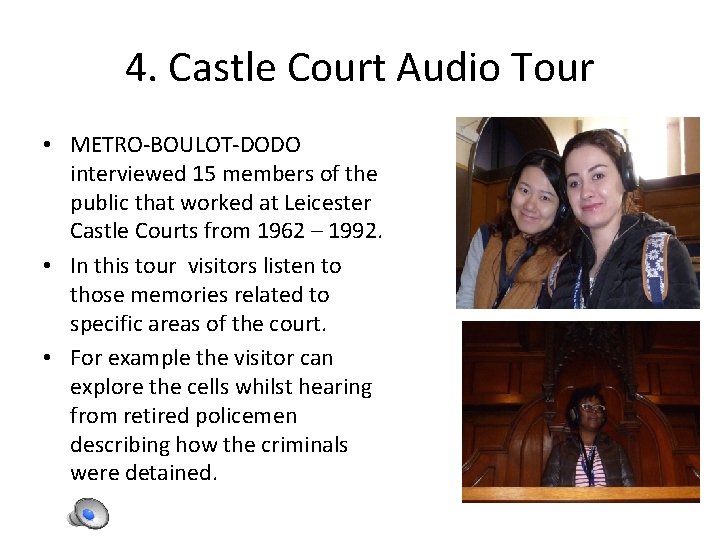
4. Castle Court Audio Tour • METRO-BOULOT-DODO interviewed 15 members of the public that worked at Leicester Castle Courts from 1962 – 1992. • In this tour visitors listen to those memories related to specific areas of the court. • For example the visitor can explore the cells whilst hearing from retired policemen describing how the criminals were detained.
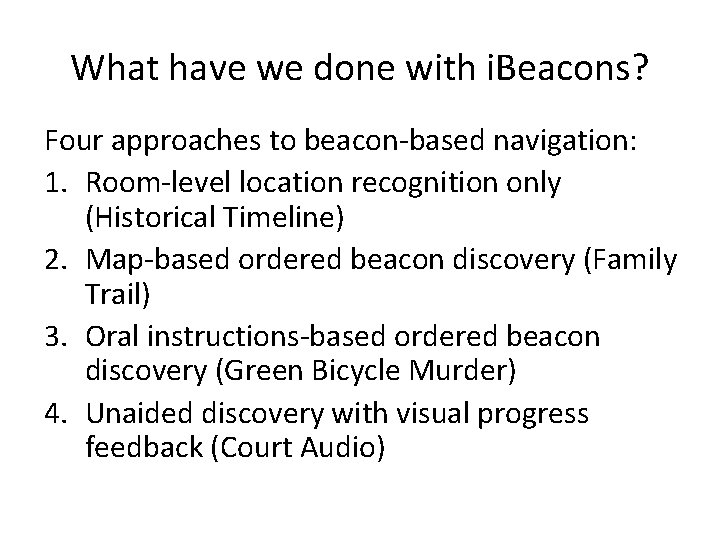
What have we done with i. Beacons? Four approaches to beacon-based navigation: 1. Room-level location recognition only (Historical Timeline) 2. Map-based ordered beacon discovery (Family Trail) 3. Oral instructions-based ordered beacon discovery (Green Bicycle Murder) 4. Unaided discovery with visual progress feedback (Court Audio)
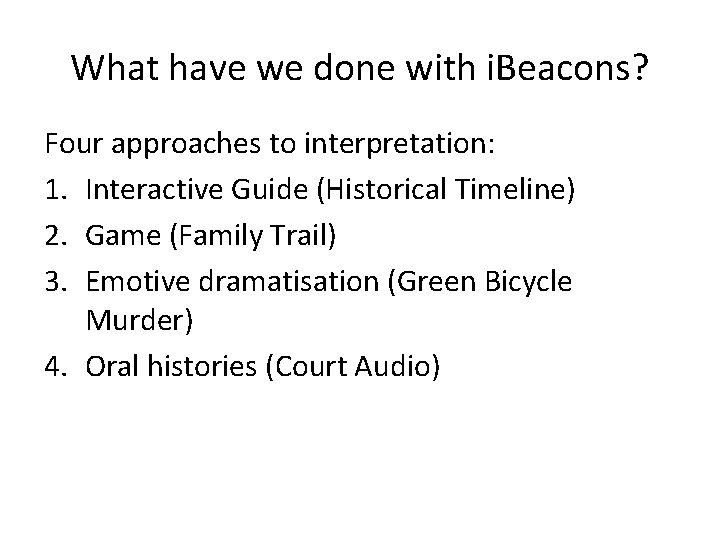
What have we done with i. Beacons? Four approaches to interpretation: 1. Interactive Guide (Historical Timeline) 2. Game (Family Trail) 3. Emotive dramatisation (Green Bicycle Murder) 4. Oral histories (Court Audio)
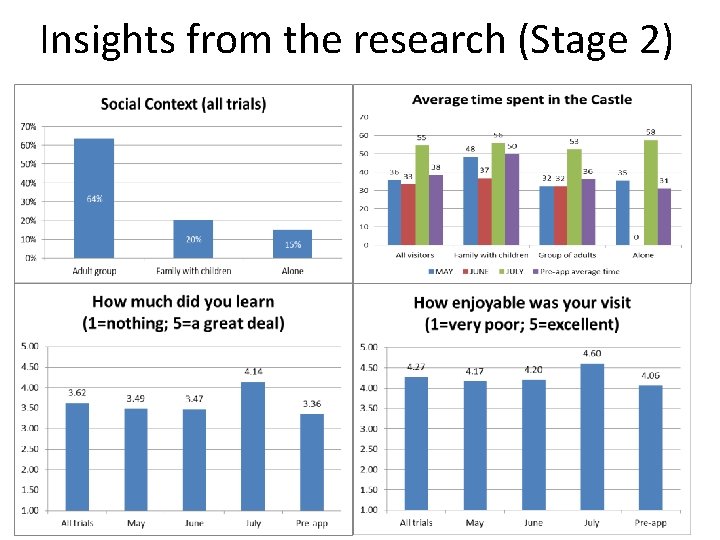
Insights from the research (Stage 2)
Replicability Interviews and focus groups with potential adopters from the heritage, cultural and arts sector revealed the further potential of adopting such a digital system: • Available information through Beacons technology both indoors and outdoors 24/7 • Available interpretation and learning activities in multiple languages • Layered interpretation and diverse learning opportunities responding to different visitors’ preferences and interests. Next potential adopter workshop: 26 August 2015, Newarke Houses Museum Leicester To book, email gv 18@le. ac. uk or mat 38@le. ac. uk
Conclusions so far • A half-finished app is not better than no app. • i. Beacon technology can successfully support different approaches to interpretation and different approaches to navigation guidance and support. • Stay tuned for more findings soon
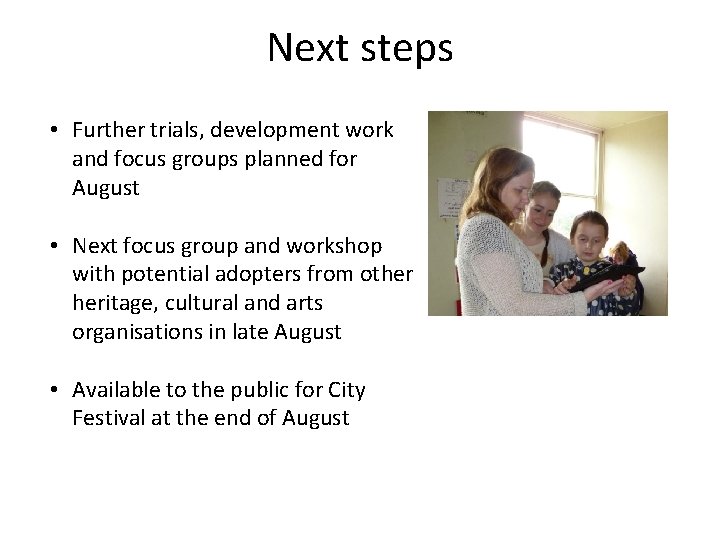
Next steps • Further trials, development work and focus groups planned for August • Next focus group and workshop with potential adopters from other heritage, cultural and arts organisations in late August • Available to the public for City Festival at the end of August
Questions? For more information contact: Giasemi Vavoula, gv 18@le. ac. uk (Research Lead) Sally Coleman, Sally. Coleman@leicester. gov. uk (Arts Lead) Paul Long, paul@metro-boulot-dodo. com (Content Lead) Rheinallt Ffoster-Jones, Rheinallt. Ffoster-Jones@museumwales. ac. uk (Technical Lead)
- Slides: 27