
Leibniz Universitt Hannover COLD MOLECULES AND SPECTROSCOPY A
Leibniz Universität Hannover COLD MOLECULES AND SPECTROSCOPY: A CHALLENGE AND NEW CHANCES E. TIEMANN, H. KNÖCKEL, and C. LISDAT, Hannover A. PASHOV, Sofia M. TAMANIS, R. FERBER, Riga DFG
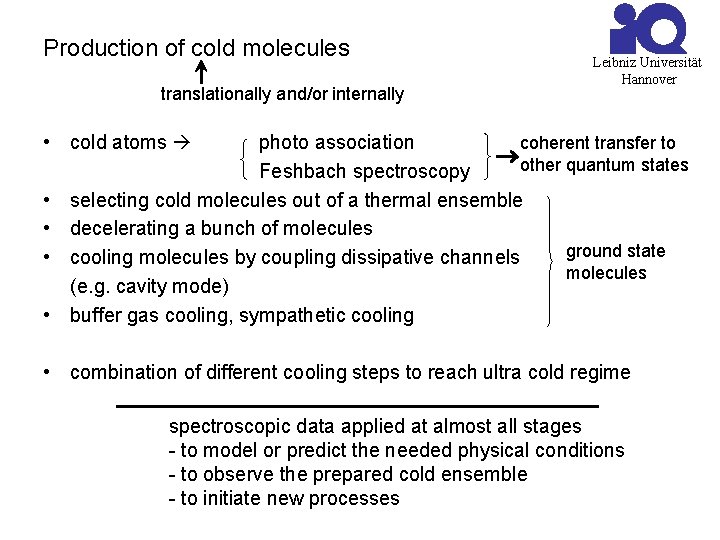
Production of cold molecules translationally and/or internally Leibniz Universität Hannover • cold atoms • • photo association coherent transfer to other quantum states Feshbach spectroscopy selecting cold molecules out of a thermal ensemble decelerating a bunch of molecules ground state cooling molecules by coupling dissipative channels molecules (e. g. cavity mode) buffer gas cooling, sympathetic cooling • combination of different cooling steps to reach ultra cold regime spectroscopic data applied at almost all stages - to model or predict the needed physical conditions - to observe the prepared cold ensemble - to initiate new processes
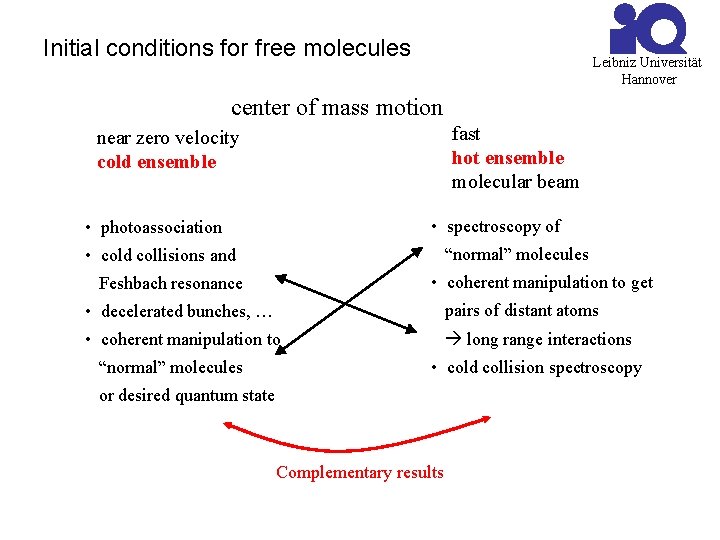
Initial conditions for free molecules Leibniz Universität Hannover center of mass motion fast hot ensemble molecular beam near zero velocity cold ensemble • spectroscopy of • photoassociation • cold collisions and “normal” molecules • coherent manipulation to get Feshbach resonance • decelerated bunches, … pairs of distant atoms • coherent manipulation to long range interactions “normal” molecules • cold collision spectroscopy or desired quantum state Complementary results
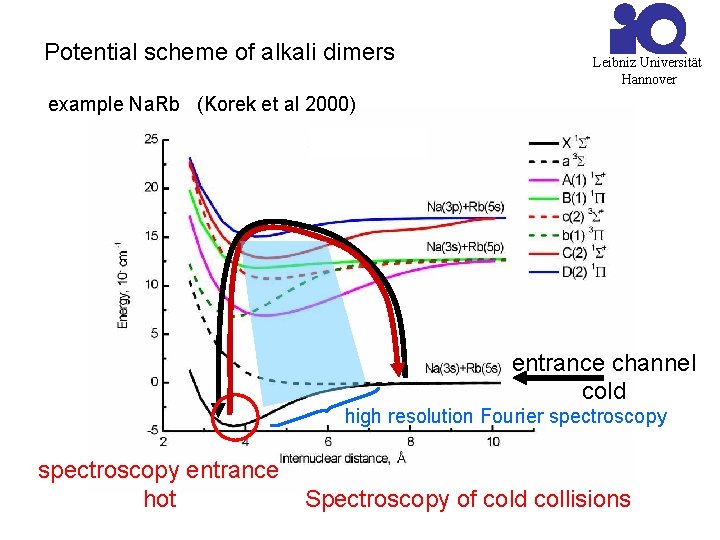
Potential scheme of alkali dimers Leibniz Universität Hannover example Na. Rb (Korek et al 2000) entrance channel cold high resolution Fourier spectroscopy entrance hot Spectroscopy of cold collisions
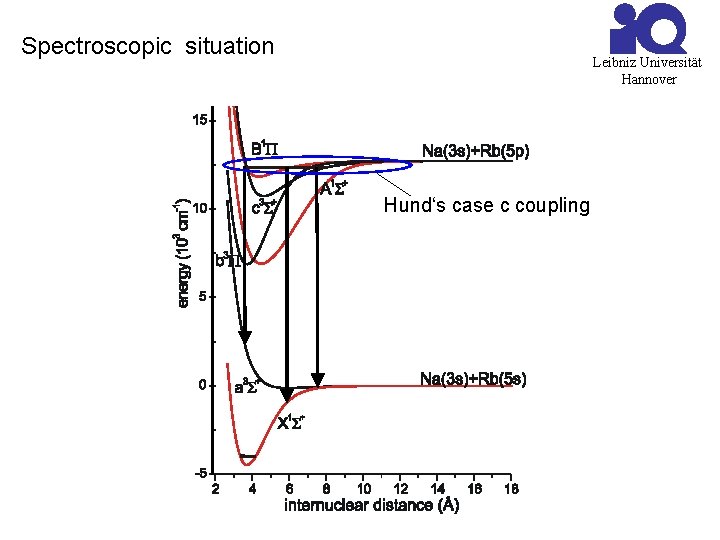
Spectroscopic situation Leibniz Universität Hannover Hund‘s case c coupling
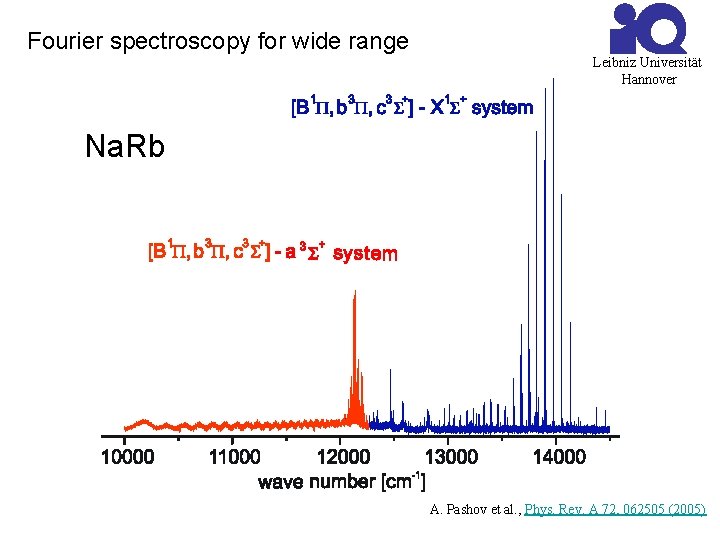
Fourier spectroscopy for wide range Leibniz Universität Hannover Na. Rb A. Pashov et al. , Phys. Rev. A 72, 062505 (2005)
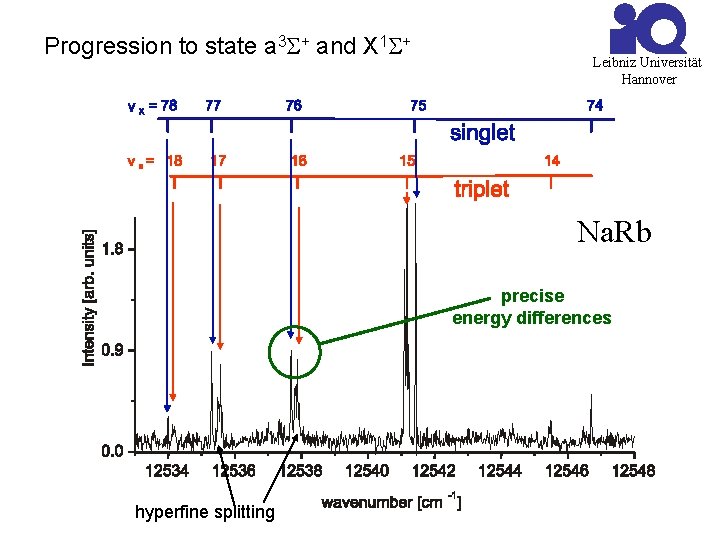
Progression to state a 3 S+ and X 1 S+ Leibniz Universität Hannover Na. Rb precise energy differences hyperfine splitting
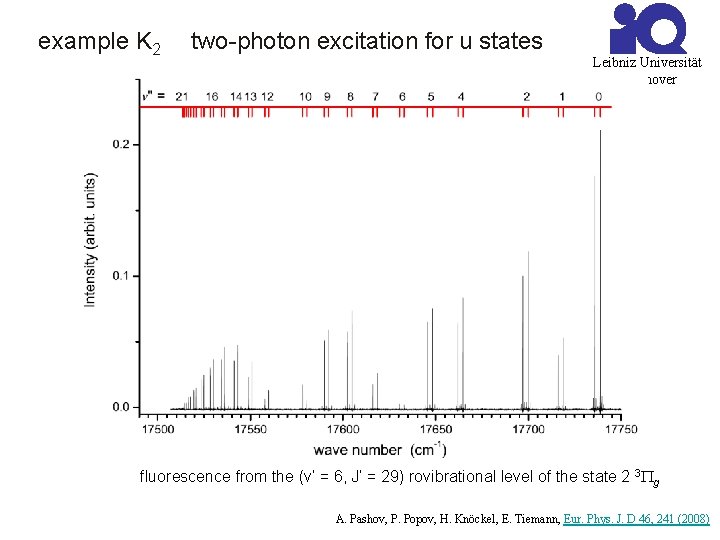
example K 2 two-photon excitation for u states Leibniz Universität Hannover fluorescence from the (v‘ = 6, J‘ = 29) rovibrational level of the state 2 3 Pg A. Pashov, P. Popov, H. Knöckel, E. Tiemann, Eur. Phys. J. D 46, 241 (2008)
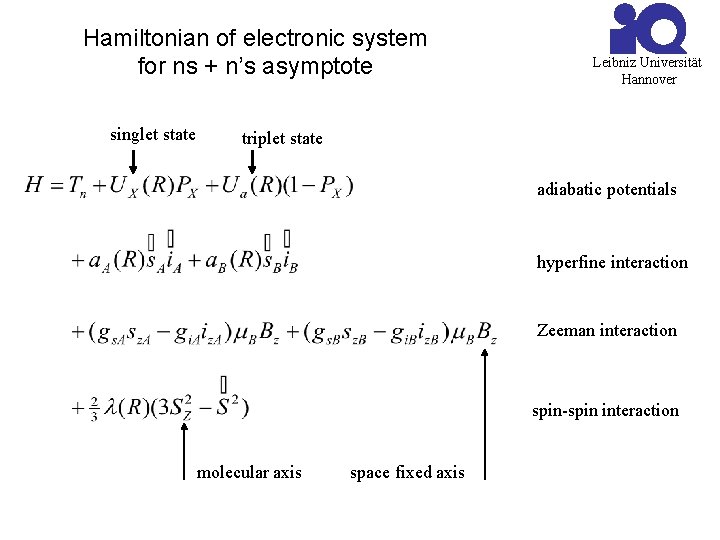
Hamiltonian of electronic system for ns + n’s asymptote singlet state Leibniz Universität Hannover triplet state adiabatic potentials hyperfine interaction Zeeman interaction spin-spin interaction molecular axis space fixed axis
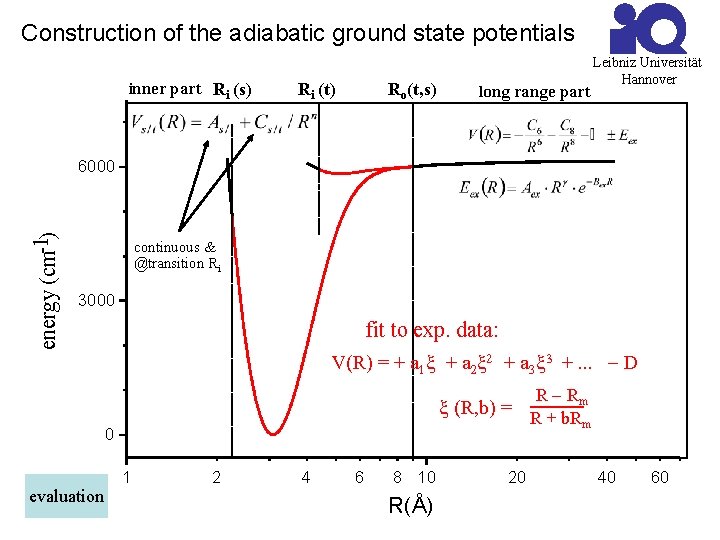
Construction of the adiabatic ground state potentials inner part Ri (s) Ri (t) Ro(t, s) long range part Leibniz Universität Hannover energy (cm-1) 6000 continuous & @transition Ri 3000 fit to exp. data: V(R) = + a 1 x + a 2 x 2 + a 3 x 3 +. . . - D R-R x (R, b) = R + b. Rm m 0 evaluation 1 2 4 6 8 10 R(Å) 20 40 60
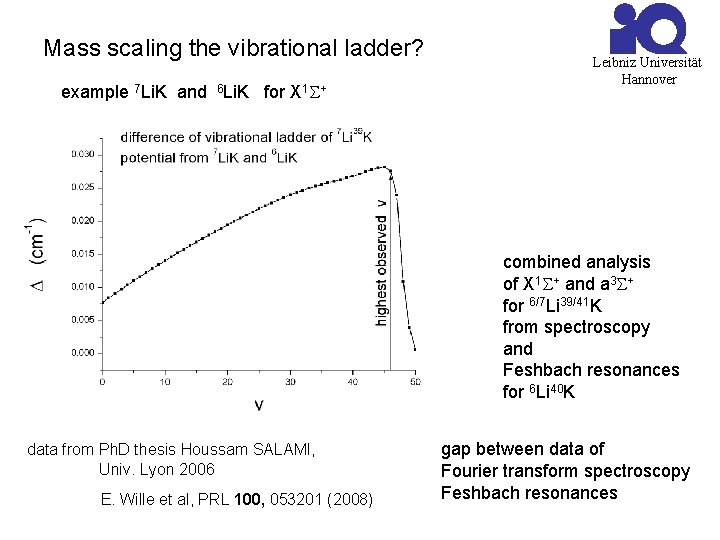
Mass scaling the vibrational ladder? example 7 Li. K and 6 Li. K for X 1 S+ Leibniz Universität Hannover combined analysis of X 1 S+ and a 3 S+ for 6/7 Li 39/41 K from spectroscopy and Feshbach resonances for 6 Li 40 K data from Ph. D thesis Houssam SALAMI, Univ. Lyon 2006 E. Wille et al, PRL 100, 053201 (2008) gap between data of Fourier transform spectroscopy Feshbach resonances
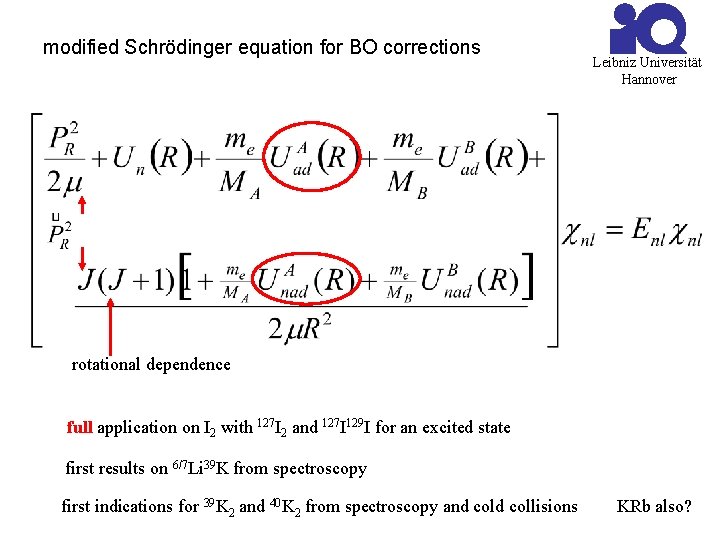
modified Schrödinger equation for BO corrections Leibniz Universität Hannover rotational dependence full application on I 2 with 127 I 2 and 127 I 129 I for an excited state first results on 6/7 Li 39 K from spectroscopy first indications for 39 K 2 and 40 K 2 from spectroscopy and collisions KRb also?
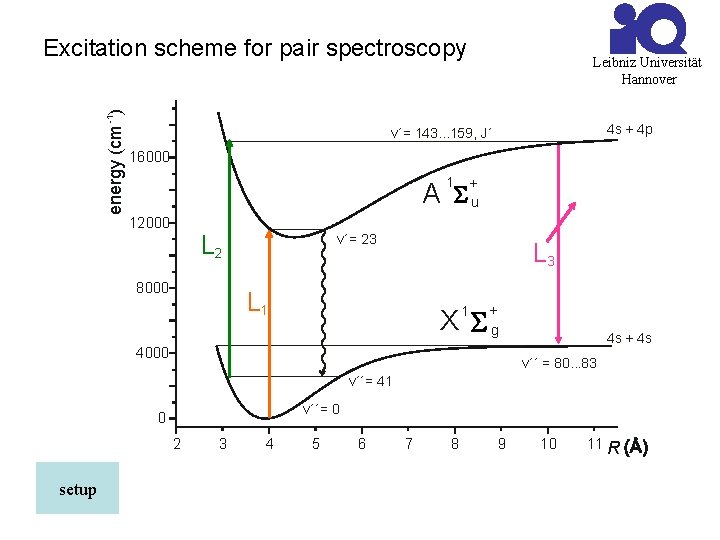
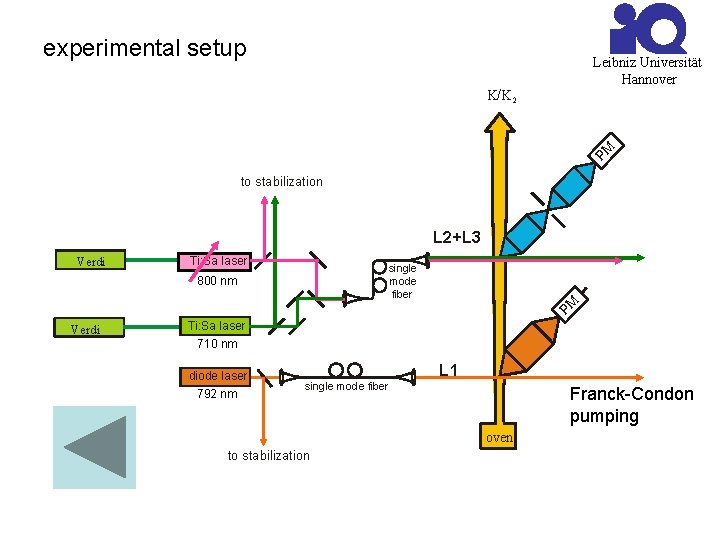
energy (cm -1) Excitation scheme for pair spectroscopy Leibniz Universität Hannover 4 s + 4 p v´= 143. . . 159, J´ 16000 1 A S +u 12000 L 2 8000 v´= 23 L 1 X S +g 1 4000 4 s + 4 s v´´ = 80. . . 83 v´´= 41 v´´= 0 0 2 setup 3 4 5 6 7 8 9 10 11 R
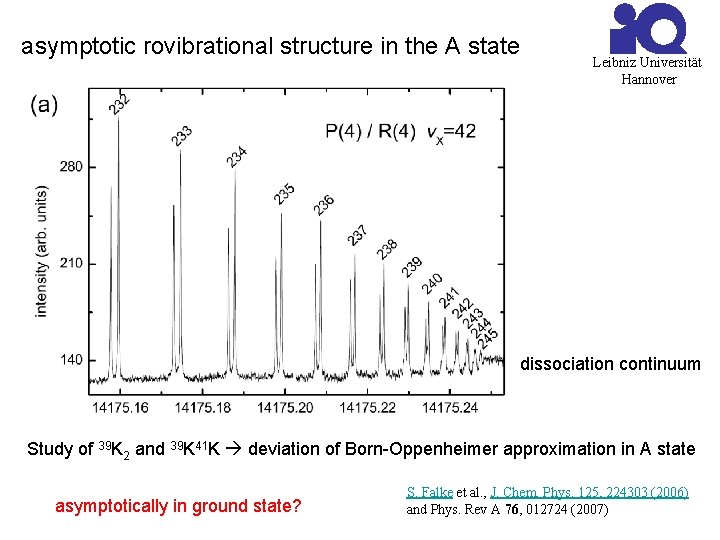
asymptotic rovibrational structure in the A state Leibniz Universität Hannover dissociation continuum Study of 39 K 2 and 39 K 41 K deviation of Born-Oppenheimer approximation in A state asymptotically in ground state? S. Falke et al. , J. Chem. Phys. 125, 224303 (2006) and Phys. Rev A 76, 012724 (2007)
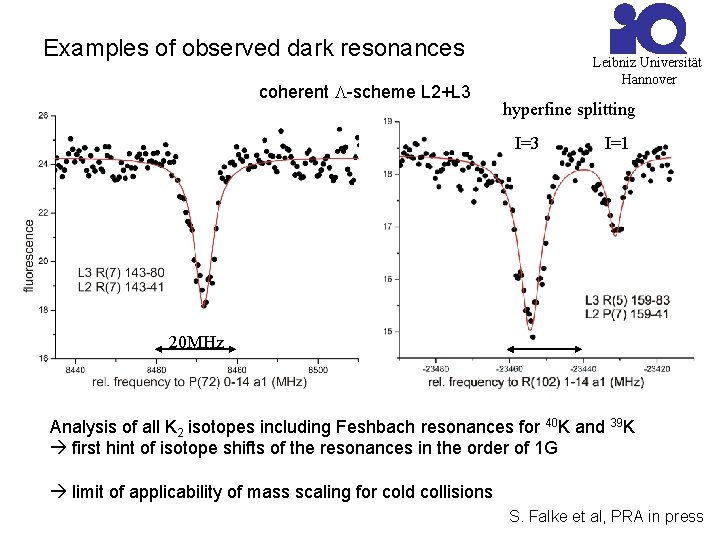
Examples of observed dark resonances coherent L-scheme L 2+L 3 Leibniz Universität Hannover hyperfine splitting I=3 I=1 20 MHz Analysis of all K 2 isotopes including Feshbach resonances for 40 K and 39 K first hint of isotope shifts of the resonances in the order of 1 G limit of applicability of mass scaling for cold collisions S. Falke et al, PRA in press
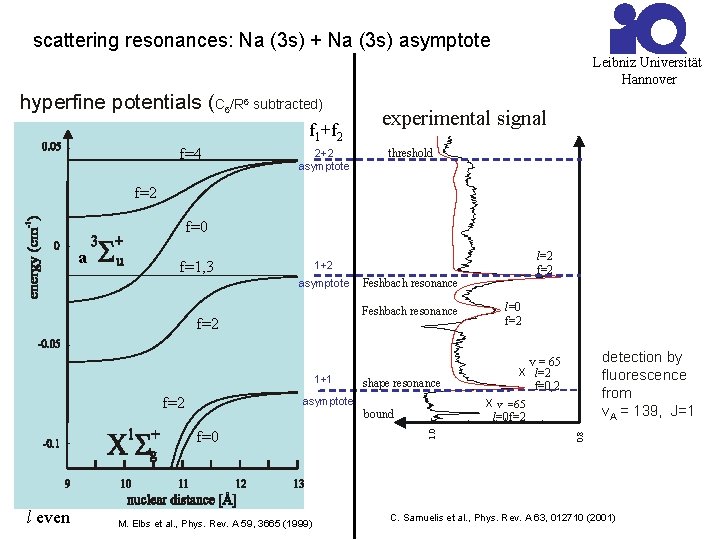
scattering resonances: Na (3 s) + Na (3 s) asymptote Leibniz Universität Hannover hyperfine potentials (C 6/R 6 subtracted) f 1+f 2 f=4 2+2 asymptote experimental signal threshold f=2 f=0 asymptote 1+1 shape resonance asymptote M. Elbs et al. , Phys. Rev. A 59, 3665 (1999) l=0 f=2 detection by fluorescence from v. A = 139, J=1 v = 65 X l=2 f=0, 2 X v =65 bound f=0 l even Feshbach resonance f=2 l=2 f=2 1+2 l, =0 f=2 0. 8 f=1, 3 1. 0 a C. Samuelis et al. , Phys. Rev. A 63, 012710 (2001)
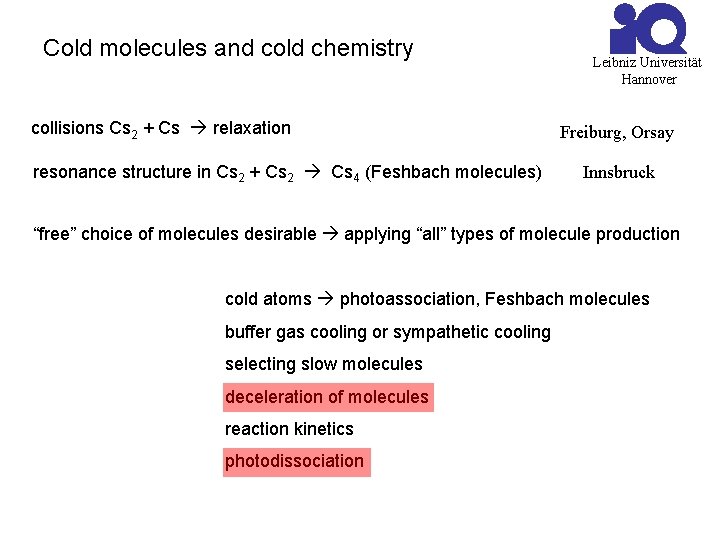
Cold molecules and cold chemistry collisions Cs 2 + Cs relaxation resonance structure in Cs 2 + Cs 2 Cs 4 (Feshbach molecules) Leibniz Universität Hannover Freiburg, Orsay Innsbruck “free” choice of molecules desirable applying “all” types of molecule production cold atoms photoassociation, Feshbach molecules buffer gas cooling or sympathetic cooling selecting slow molecules deceleration of molecules reaction kinetics photodissociation
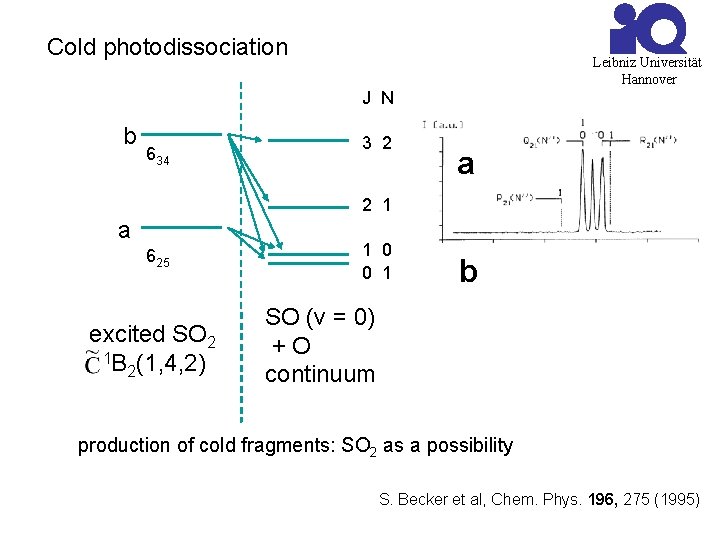
Cold photodissociation Leibniz Universität Hannover J N b 634 3 2 a 2 1 a 625 excited SO 2 1 B (1, 4, 2) 2 1 0 0 1 b SO (v = 0) +O continuum production of cold fragments: SO 2 as a possibility S. Becker et al, Chem. Phys. 196, 275 (1995)
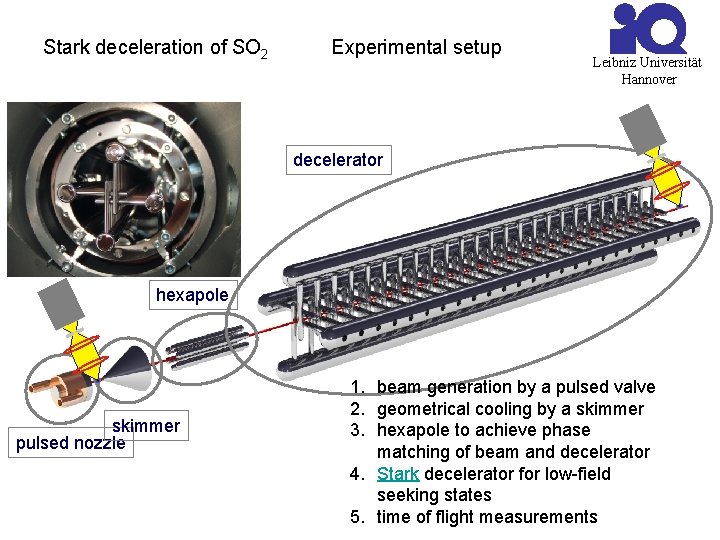
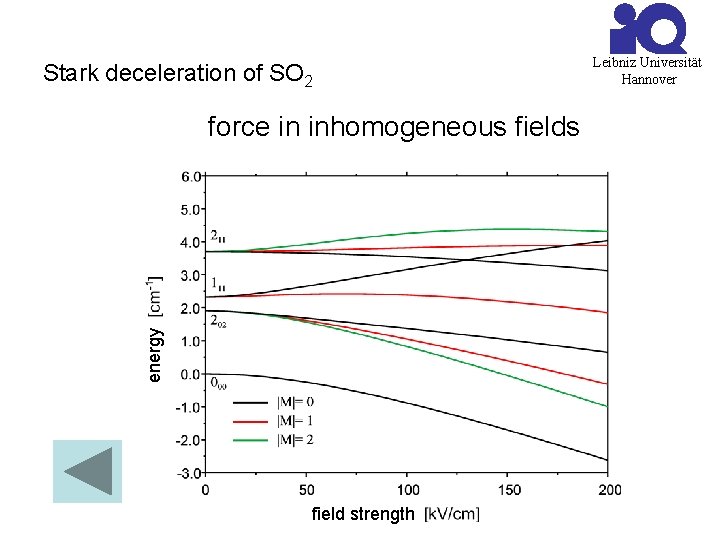
Stark deceleration of SO 2 Experimental setup Leibniz Universität Hannover decelerator hexapole skimmer pulsed nozzle 1. beam generation by a pulsed valve 2. geometrical cooling by a skimmer 3. hexapole to achieve phase matching of beam and decelerator 4. Stark decelerator for low-field seeking states 5. time of flight measurements
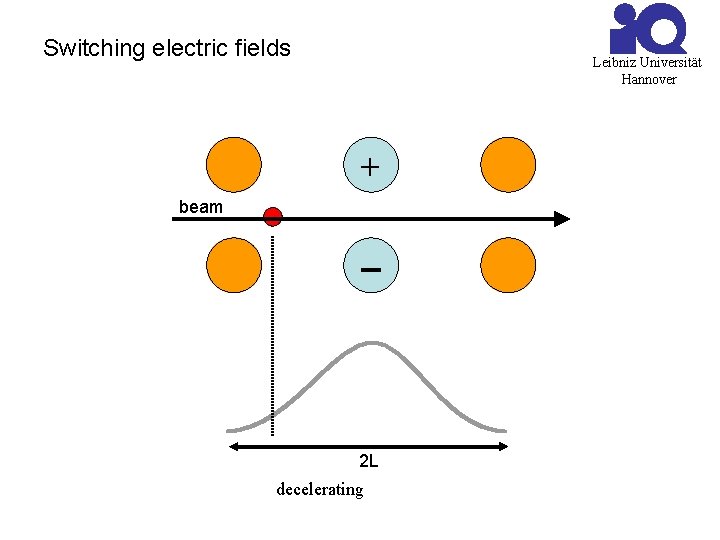
Switching electric fields Leibniz Universität Hannover + beam - 2 L decelerating
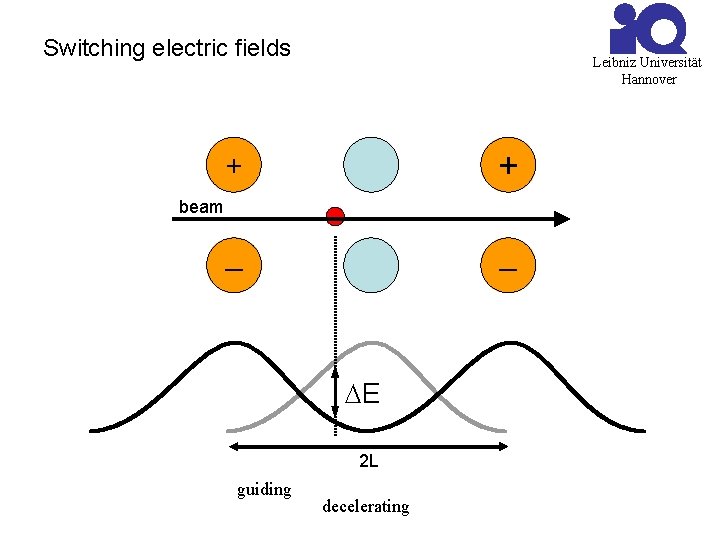
Switching electric fields Leibniz Universität Hannover + + - - beam DE 2 L guiding decelerating
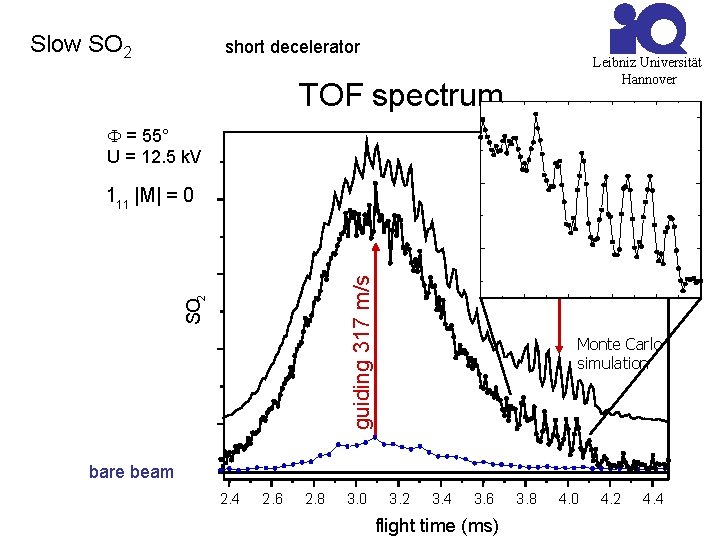
Slow SO 2 short decelerator Leibniz Universität Hannover TOF spectrum F = 55° U = 12. 5 k. V deceleration from 285 m/s to 217 m/s 42% of kin. energy SO 2 guiding 317 m/s 111 |M| = 0 Monte Carlo simulation bare beam 2. 4 2. 6 2. 8 3. 0 3. 2 3. 4 3. 6 flight time (ms) 3. 8 4. 0 4. 2 4. 4
Decelerator with 326 stages Leibniz Universität Hannover low velocity 53 m/s trappable bunch of SO 2 O. Bucicov et al, EPJD DOI: 10. 1140/epjd/e 2008 -00001 -y
“pure” internal quantum state populated v=(0, 0, 0) 111 exit of decelerator entrance of decelerator Leibniz Universität Hannover
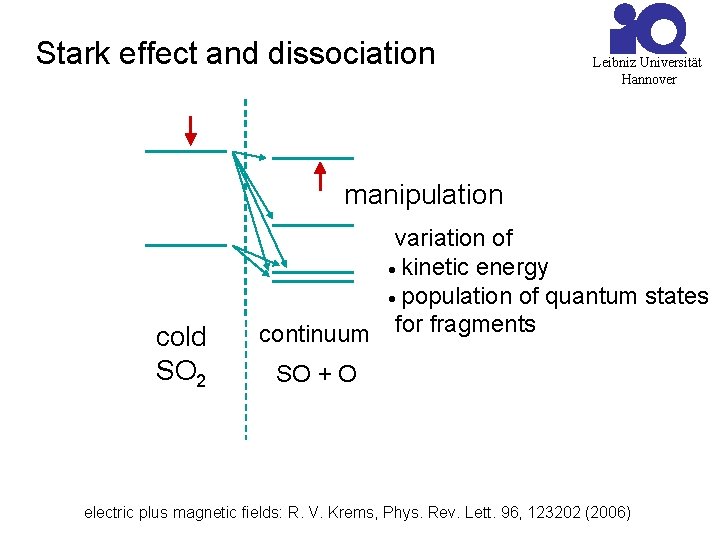
Stark effect and dissociation Leibniz Universität Hannover manipulation cold SO 2 variation of kinetic energy population of quantum states continuum for fragments SO + O electric plus magnetic fields: R. V. Krems, Phys. Rev. Lett. 96, 123202 (2006)
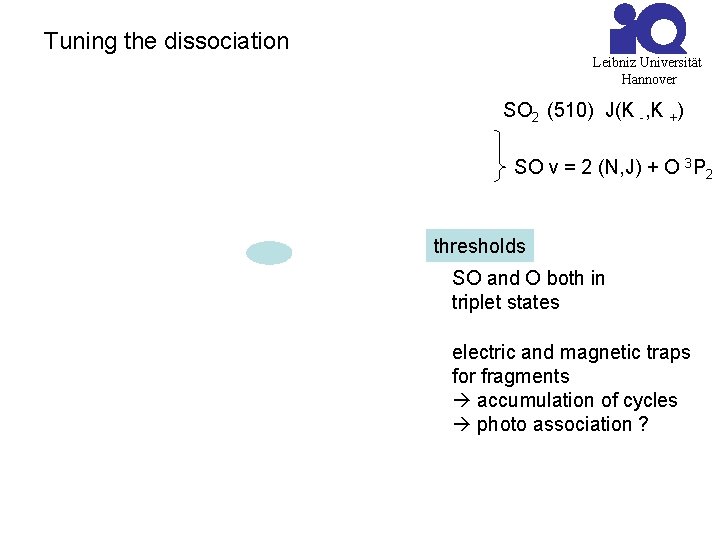
Tuning the dissociation Leibniz Universität Hannover SO 2 (510) J(K -, K +) SO v = 2 (N, J) + O 3 P 2 thresholds SO and O both in triplet states electric and magnetic traps for fragments accumulation of cycles photo association ?
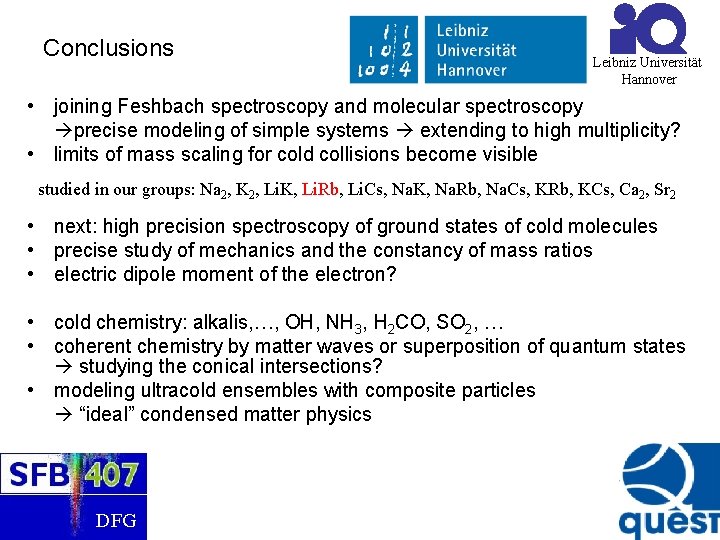
Conclusions Leibniz Universität Hannover • joining Feshbach spectroscopy and molecular spectroscopy precise modeling of simple systems extending to high multiplicity? • limits of mass scaling for cold collisions become visible studied in our groups: Na 2, K 2, Li. K, Li. Rb, Li. Cs, Na. K, Na. Rb, Na. Cs, KRb, KCs, Ca 2, Sr 2 • next: high precision spectroscopy of ground states of cold molecules • precise study of mechanics and the constancy of mass ratios • electric dipole moment of the electron? • cold chemistry: alkalis, …, OH, NH 3, H 2 CO, SO 2, … • coherent chemistry by matter waves or superposition of quantum states studying the conical intersections? • modeling ultracold ensembles with composite particles “ideal” condensed matter physics DFG
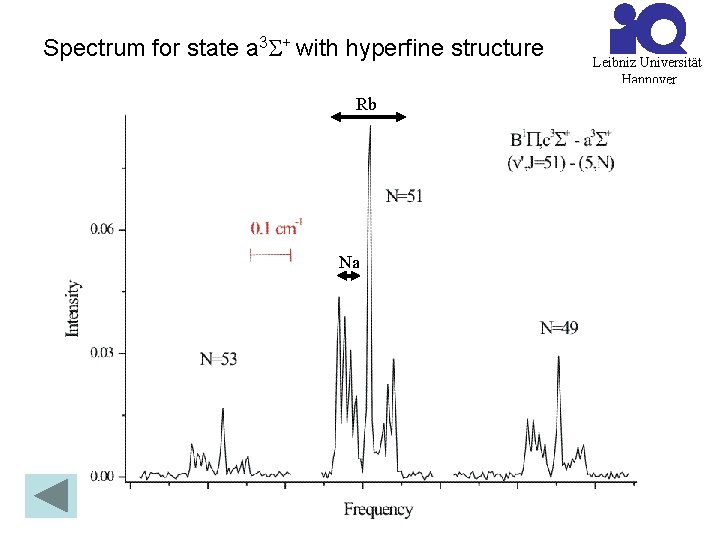
Spectrum for state a 3 S+ with hyperfine structure Rb Na Leibniz Universität Hannover
experimental setup Leibniz Universität Hannover PM K/K 2 to stabilization L 2+L 3 Verdi Ti: Sa laser single mode fiber PM 800 nm Verdi Ti: Sa laser 710 nm diode laser 792 nm L 1 single mode fiber Franck-Condon pumping oven to stabilization
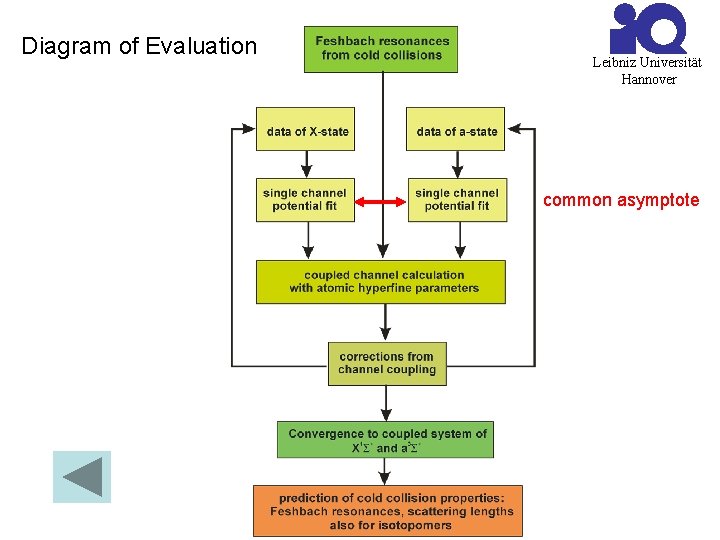
Diagram of Evaluation Leibniz Universität Hannover common asymptote
Stark deceleration of SO 2 energy force in inhomogeneous field strength Leibniz Universität Hannover
- Slides: 31