
Legislation Ordinances Energy Codes the Future for Outdoor


- Slides: 35
Legislation, Ordinances & Energy Codes: the Future for Outdoor Lighting David M. Keith, FIES IEEE Denver March 2003
Overview • Legislation – Colorado and six other states • Ordinances – county, city and town jurisdictions • Energy Codes – states’ level, and may become national • Implications for the lighting industry – more work, deliverables and responsibilities
Colorado Legislation • Colorado HB 01 -1160 passed in 2001 • “It is declared policy of the state of Colorado to conserve energy, reduce glare, and minimize light trespass and pollution, and requiring state agencies and encourage local. . entities. . to use certain types of outdoor lighting fixtures …” • no provisions for enforcement
Colorado Legislation • “Full cutoff luminaire” allows no direct light emissions above horizontal plane through luminaire’s lowest light-emitting part • On or after July , 2002 any new fixture. . using state funds. . [must be] a full cutoff luminaire • Full consideration given to costs, energy conservation, glare reduction, minimization of light pollution, preserve night environment
California Energy Code • working to extend the current Title 24 Energy Code to outdoor lighting • establish lighting zones across state • establish lighting power density allowances for all zones and tasks • establish restrictions on luminaire lighting distributions, time of day uses
California Energy Code • Based technically on the Eley Associates’ Outdoor Lighting Research: California Outdoor Lighting Standards, presented at the June 18, 2002 workshop • in some discussions in this report the technical basis is … questionable – LZ assignment & LPD value “classify” roadways – the calculations for parking lots
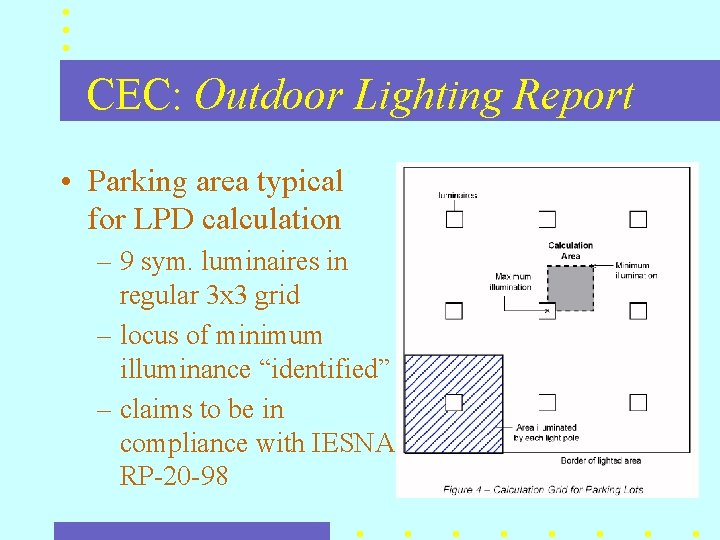
CEC: Outdoor Lighting Report • Parking area typical for LPD calculation – 9 sym. luminaires in regular 3 x 3 grid – locus of minimum illuminance “identified” – claims to be in compliance with IESNA RP-20 -98
CEC Lighting Zones • lighting zones imposed across entire state – defaults defined in legislation – jurisdictions may change an areas designation through a public process – CEC is to be informed of any proposed changes to zone designations – CEC may overrule any change proposed by a local jurisdiction
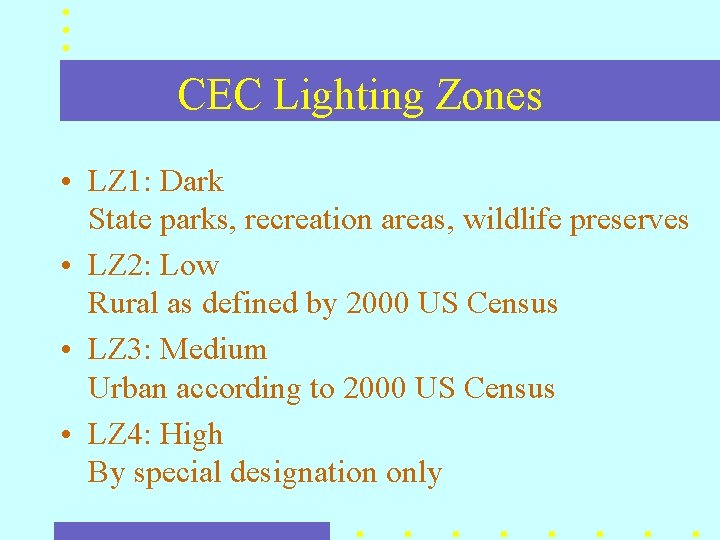
CEC Lighting Zones • LZ 1: Dark State parks, recreation areas, wildlife preserves • LZ 2: Low Rural as defined by 2000 US Census • LZ 3: Medium Urban according to 2000 US Census • LZ 4: High By special designation only
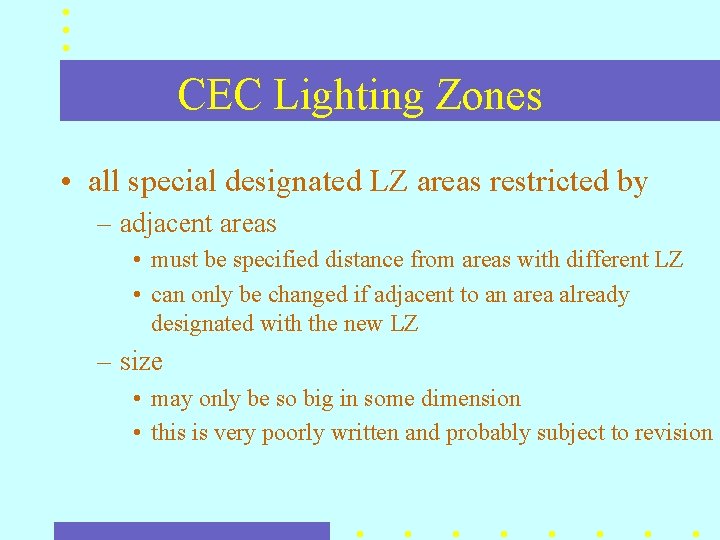
CEC Lighting Zones • all special designated LZ areas restricted by – adjacent areas • must be specified distance from areas with different LZ • can only be changed if adjacent to an area already designated with the new LZ – size • may only be so big in some dimension • this is very poorly written and probably subject to revision
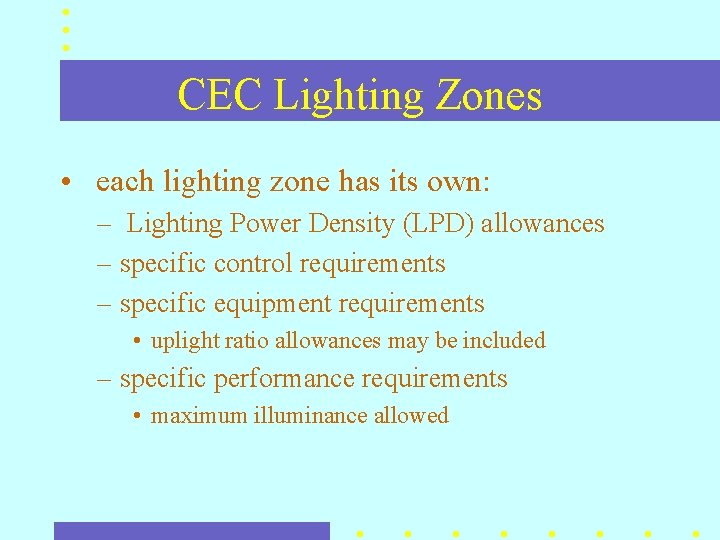
CEC Lighting Zones • each lighting zone has its own: – Lighting Power Density (LPD) allowances – specific control requirements – specific equipment requirements • uplight ratio allowances may be included – specific performance requirements • maximum illuminance allowed
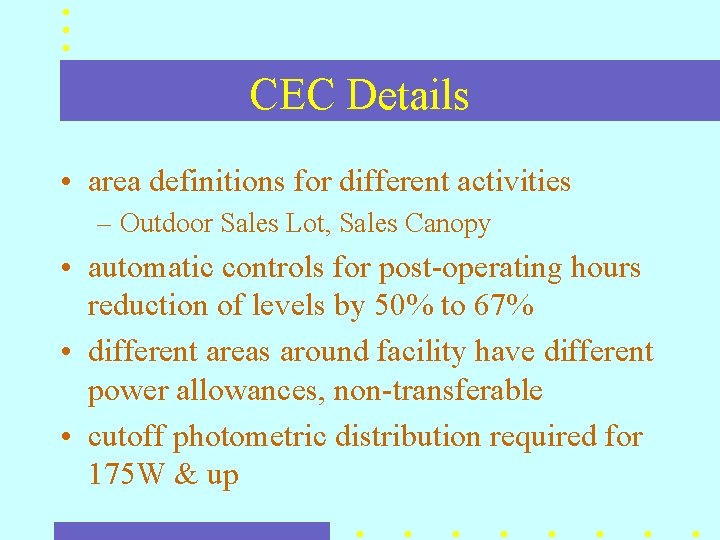
CEC Details • area definitions for different activities – Outdoor Sales Lot, Sales Canopy • automatic controls for post-operating hours reduction of levels by 50% to 67% • different areas around facility have different power allowances, non-transferable • cutoff photometric distribution required for 175 W & up
Model Lighting Ordinance • organized by the International Darksky Association (IDA) • working with national assortment of people • considering a nation-wide set of existing ordinances, mostly California’s Title 24 • trying to develop an ordinance that any jurisdiction can use as basis, then tweak to fit
Model Lighting Ordinance • working from the California Title 24 • will probably include – Lighting Zones 1 through 4 • corresponding LPD limits • corresponding photometric distribution limits – equipment & mounting restrictions – spill light and maximum illuminance limits – curfews and limits on security lighting
Local Lighting Ordinances • Planning Dept. , Zoning, Building, Land Use • can be very simple - one page – no lighting shall create a nuisance –. . concentrated rays of light shall not shine onto other properties. . • can be extremely complicated (as we shall see) • can be technically confused or incorrect
Local Lighting Ordinances • Similar goals to state legislation: – conserve energy – reduce glare – minimize light trespass and pollution • provisions for enforcement – withholding permits and occupancy certificates – complaints leading to fines and imprisonment
Local Lighting Ordinances • Applies to: – future developments (& existing? ) – industrial & commercial – residential - at least multi-family • Exempts (typically): – one or two family dwellings – public roadways, sports facilities • Grandfathering: fixed period or at improvement
Local Lighting Ordinances • control light levels – within site – at or just beyond property boundary • • restrict equipment, photometric distributions restrict installed lumens restrict time of operation require more extensive submittal for approval
Ordinances: Limit levels • restrict the maximum illuminance level – typically measured horizontal at grade – this would be at the initial level (brand new) • when the system is new the levels will be the very highest for the entire life of the system • most lighting recommendations call for maintained values, at the low point of the maintenance cycle • overall maintenance factors can be as low as 0. 50 – can mean 2 or more calculations are necessary
Ordinances: Limit levels • restrict the maximum uniformity ratio – typically measured as the maximum: minimum – could be average: minimum • this is harder to verify at the site – uniformity will be related to the specific area over which it is calculated • check that the areas in the calculations conform to the definitions in the relevant ordinance – provide necessary statistics in submittals
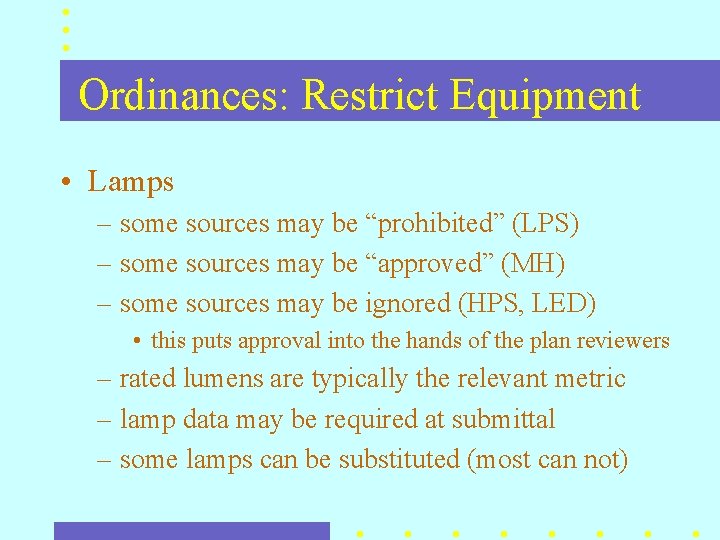
Ordinances: Restrict Equipment • Lamps – some sources may be “prohibited” (LPS) – some sources may be “approved” (MH) – some sources may be ignored (HPS, LED) • this puts approval into the hands of the plan reviewers – rated lumens are typically the relevant metric – lamp data may be required at submittal – some lamps can be substituted (most can not)
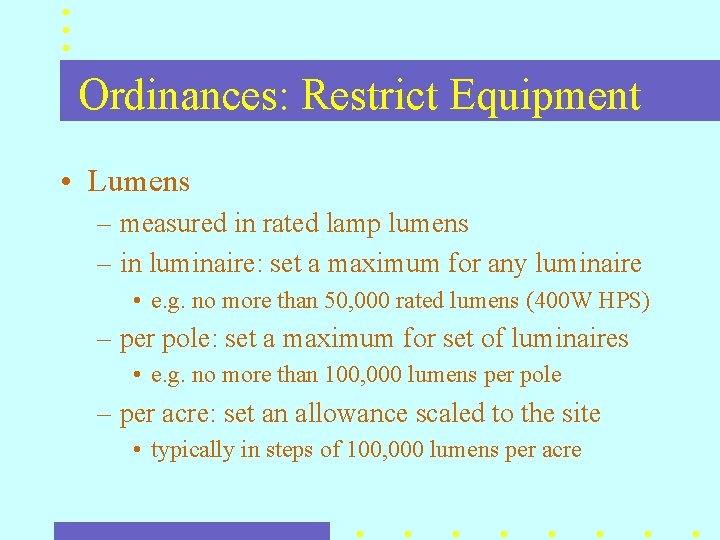
Ordinances: Restrict Equipment • Lumens – measured in rated lamp lumens – in luminaire: set a maximum for any luminaire • e. g. no more than 50, 000 rated lumens (400 W HPS) – per pole: set a maximum for set of luminaires • e. g. no more than 100, 000 lumens per pole – per acre: set an allowance scaled to the site • typically in steps of 100, 000 lumens per acre
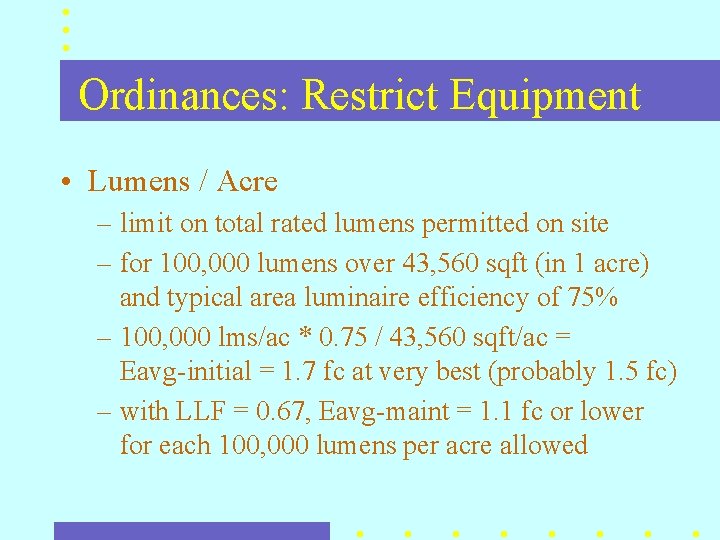
Ordinances: Restrict Equipment • Lumens / Acre – limit on total rated lumens permitted on site – for 100, 000 lumens over 43, 560 sqft (in 1 acre) and typical area luminaire efficiency of 75% – 100, 000 lms/ac * 0. 75 / 43, 560 sqft/ac = Eavg-initial = 1. 7 fc at very best (probably 1. 5 fc) – with LLF = 0. 67, Eavg-maint = 1. 1 fc or lower for each 100, 000 lumens per acre allowed
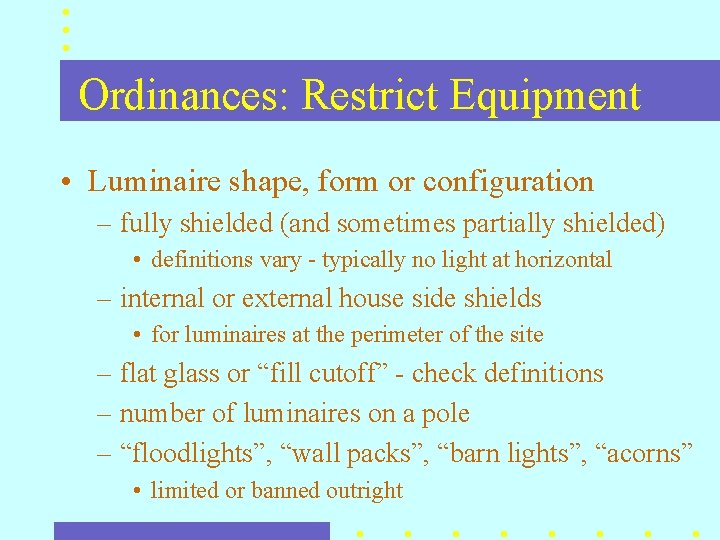
Ordinances: Restrict Equipment • Luminaire shape, form or configuration – fully shielded (and sometimes partially shielded) • definitions vary - typically no light at horizontal – internal or external house side shields • for luminaires at the perimeter of the site – flat glass or “fill cutoff” - check definitions – number of luminaires on a pole – “floodlights”, “wall packs”, “barn lights”, “acorns” • limited or banned outright
Ordinances: Restrict Equipment • Photometric distribution – definitions tend to differ substantially – “asymmetric” sometimes prohibited – most common definitions are based on IESNA Cutoff Classifications • • full cutoff, semi-cutoff or non-cutoff defined to describe control of glare used now to try to limit uplight this confuses intensity with lumens
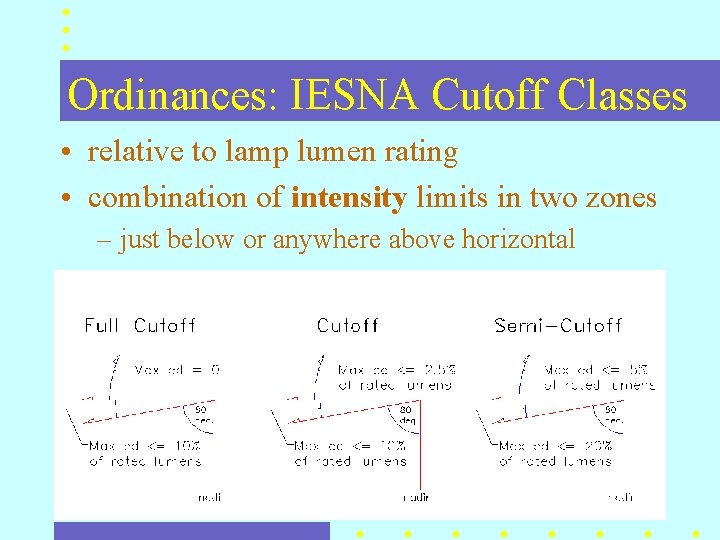
Ordinances: IESNA Cutoff Classes • relative to lamp lumen rating • combination of intensity limits in two zones – just below or anywhere above horizontal
Ordinances: Restrict Installation • Mounting heights – by specific limits or matching to buildings – by area designation • parking area, walkways, other – around site perimeter • setback requirements tend to use 2. 5 multiple • pole height may be 40% of the distance to the nearest boundary
Ordinances: Restrict Installation • Limits for light levels at or over property boundary (light trespass) – typically depends on the zoning of the land the light lands on: commercial or residential – measurement variations • horizontal at grade: at boundary, or set distance in • vertical at and perpendicular to property line • line-of-sight: any direction at all (hard to predict!)
Ordinances: Restrict Operation • Curfew periods – after “business closes” (or at a set time) until dawn – after curfew, only security lighting allowed • additional controls required for shut-off – photocontrols are not enough, need timeclocks – requires time of day, day of week, power backup to insure reduced light levels – additional controls for starting security lighting
Ordinances: Restrict Operation • Security Lighting (post-curfew lighting) – for walkways, entrances, outdoor retail sometimes – restriction on illuminance levels or percent of lighting equipment allowed to operate – may be required to be controlled by motion sensors • this rules out typical HID area lighting equipment • incandescent or fluorescent or ? for such systems – may result in a separate lighting system
Ordinances: Restrict Operation • Security (post-curfew) lighting system – different equipment (poles, wiring, controls)? – different luminaires (sources)? – different burn hours • different maintenance cycle • increased maintenance requirements and costs – in some cases the requirements can allow for control designs that minimize these problems
Developments for Industry • more work & responsibilities – find out what restrictions apply – establish definitions – extend control strategies – greater details in content of photometric plans – increase in deliverables for submittal & approval – more involvement in commissioning • more fees for “doing the same job”
Developments for Designs • restrictions and limits make it harder to: – focus on quality issues – respond to the context and surroundings – adopt the design to particular tasks • especially for unusual or undefined tasks – improve system performance • energy use will tend to increase • initial and operating costs increase – improvise or innovate in ways we are used to
Developments for Designs • restrictions and limits make it easier to: – control obtrusive and excessive lighting • rein in the worst offenders • obnoxious lighting forced to improve – advance the technology of outdoor lighting systems (by narrowing the “additional costs”) • multi-level or dimming ballasts for HID lamps • lumen maintenance control systems • new lamps and sources when feasible (e. g. LED’s)
for links to specific information from Colorado area jurisdictions: http: //www. rockymountainies. org for a copy: keithd@resodance. com David M. Keith, FIES IEEE Denver March 2003