
Legal Update Presented by Paula Barran March 8
Legal Update Presented by Paula Barran March 8, 2019 i 4 cp
Important Cases Before The Supreme Court
“It’s hard not to have a big year at the Supreme Court. ” -Ruth Bader Ginsburg Although this year might be a real snoozer.
Fort Bend County, Texas v. Davis: Title VII Exhaustion Requirement �Plaintiff wrote “religion” on an intake questionnaire, but never amended her charge of discrimination �The Fifth Circuit held that exhausting administrative remedies (filing with the EEOC) is a prerequisite to a Title VII lawsuit �The court will decide whether the exhaustion requirement is jurisdictional, or can be waived �Is this a hint? • “The short answer is that the Act contains no ‘wholly groundless’ exception, and we may not engraft our own exceptions onto the statutory text. ” Schein v. Archer & White, Kavanaugh opinion
Administrative Law Cases �Gray v. Wilkie: Can the court review an interpretive rule from the Department of Veterans Affairs? �Kisor v. Wilkie: Does the court have to defer to an agency? • Asks the court to overrule prior deference cases • This could be the big case of the term
The Current Status of LGBTQ Discrimination �These issues remain unsettled on a federal level • States have individual laws that apply locally �Petitions for Supreme Court review remain pending with no clear signals that the Court will hear the cases this term �Watch for news on: • Altitude Express v. Zarda • Bostock v. Clayton County Georgia • R. G. & G. R. Harris Funeral Homes v. EEOC
Importing Things Happening In Other Courts
Internships, Externships, & The ADA
Christ v. University of Findlay, Southern District of Ohio �Places of public accommodation are prohibited from discriminating on the basis of disability �They must allow full and equal enjoyment of the goods, services, facilities, privileges, advantages of accommodations �Those prohibitions apply to any person owning, leasing, or operating a place of public accommodations �Interns or externs who work for course credits are entitled to the protections of the law �Institutions who place students in externships or internships need to make sure the site follows ADA accommodation requirements.
Fit For Duty – Direct Threat – Can The ADA Get Any More Complicated?
EEOC v. Mc. Leod Health Inc. �Long term employee with postaxial hypoplasia (missing bones, causing mobility impairments and falling) �Supervisor had performance concerns AND concerns that impairment worsening �Following three falls, fit for duty exam followed by functional capacity exam �Accommodations identified (plaintiff did not want them) �Employer refused to return plaintiff to original job
What Was Wrong Here? �Was navigating (i. e. moving around) really an essential function of plaintiff’s job as an editor? • • She preferred to be on site for her newsletter work but that was not essential to her job and she could do her tasks mostly by phone Job description does not mention navigating A reasonable jury could reach the conclusion that the employer did not have a reasonable belief, based on objective evidence, that moving around the workplace would be a threat to employee’s safety Plaintiff had performed her job for 28 years § Recent fall had caused no injury
The Crux of the Issue? �Was this a real “qualified individual” and “essential functions” question or, instead, a manager making a lot of guesses and assumptions? �Remember the rules about medical examinations: • • Base the request on objective evidence that the employee cannot perform the essential functions of the job, with or without a reasonable accommodation, OR Cannot perform the job safely �Choose the right professionals to do the job • Make sure they have timely and accurate information
The Best of the ADA Blogs www. williamgoren. com/blog
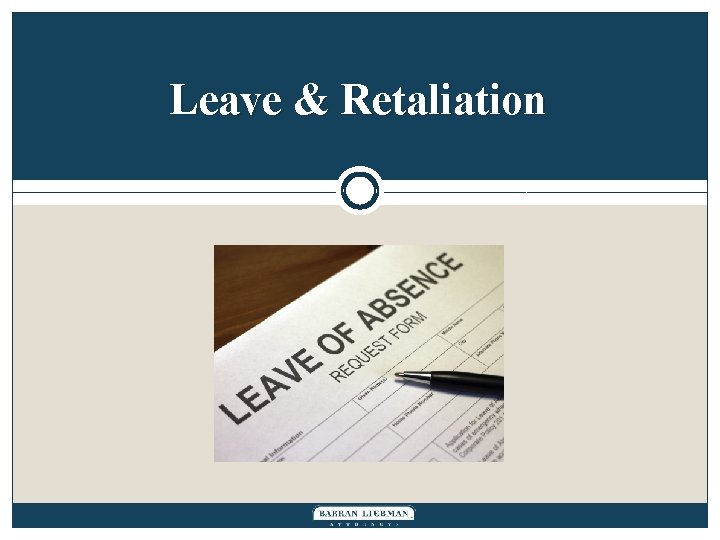
Leave & Retaliation
An Easy Way to Create an Inference of Causation �Reaves v. Nexstar Broadcasting: One tiny little chronology suffered from TMI
Evidence That OFLA Leave Factored into Termination �Plaintiff claimed PTSD, depression, anxiety, and alcoholism �After return from treatment his schedule was changed against his will �Plaintiff relapsed, attempted suicide, and requested medical leave • • He did not disclose an arrest for disorderly conduct Termination �Supervisor prepared chronology of “key events” which included periods of protected leave �While there may be a legitimate nondiscriminatory reason to include leave periods, doing so “raises an inference of causation”
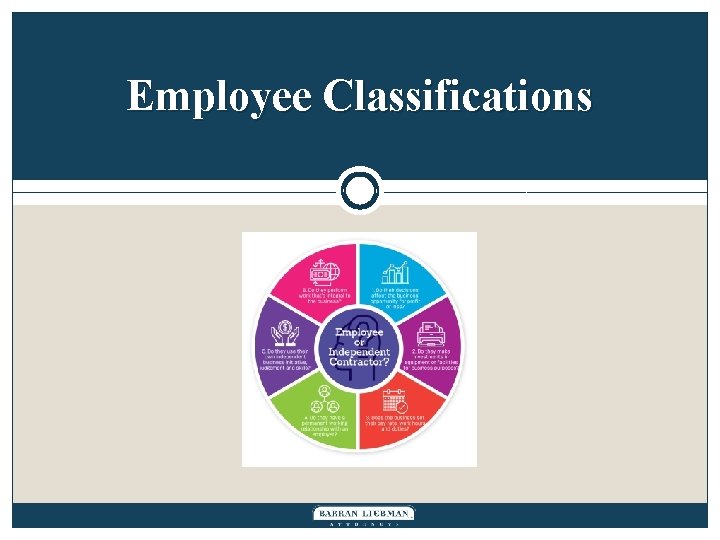
Employee Classifications
One More Reason to Worry About Independent Contractor Classification �NLRB overrules its 2014 guidelines on independent contractor classification • • Out with Fed. Ex In with Super. Shuttle DFW �Remember: This test applies only to the National Labor Relations Act
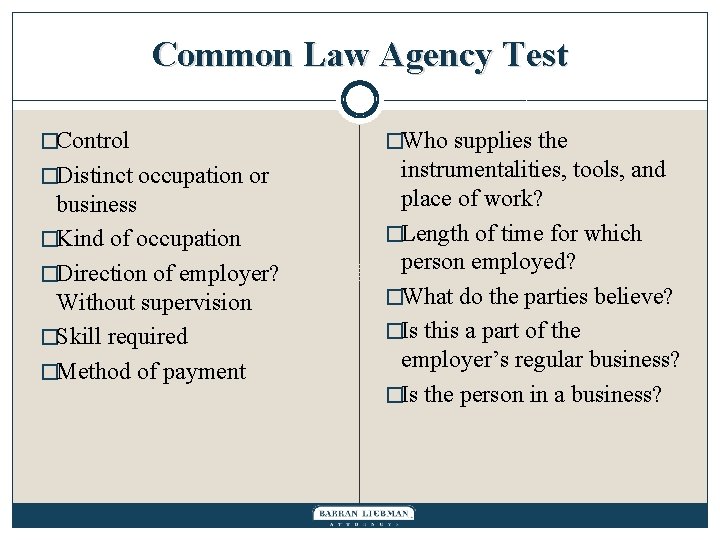
Common Law Agency Test �Control �Who supplies the �Distinct occupation or instrumentalities, tools, and place of work? �Length of time for which person employed? �What do the parties believe? �Is this a part of the employer’s regular business? �Is the person in a business? business �Kind of occupation �Direction of employer? Without supervision �Skill required �Method of payment
Importance of Being Entrepreneurial �Entrepreneurial opportunity has always been at the core of the common law test �Shuttle drivers were independent because: • They owned their vans • They received all the proceeds • They had full control over their schedules and working conditions • That agreed they were independent
Separations Worth Talking About
Cutliffe v. Wright State University (S. D. Ohio) �Wright State terminated Director of Center for Nursing Research �At hire, the [female] Dean told Cutliffe that collegiality was a strength of the college • A report by Equity and Inclusion said there was “rampant incivility and bullying” within the college �Plaintiff alleged the dean made anti-male comments: • She referred to a former processor as a psychopath who participated in a male-dominated and misogynistic church. • “We don’t have a good track record with the men we hire” • She “never met a man who can nurse as well as a women. �The dean also made a number of derogatory anti-English comments
Why Did the Plaintiff Lose? �Nursing college faculty and staff complained that plaintiff was an alienating and polarizing figure • He was repeatedly counseled about his behavior �His presentations were poorly received • “Rude, condescending, tried to embarrass people, he cut them off” • Left staff “angry and bewildered” �Gave his cv to a faculty member and told her to read it because he would quiz her the next day • • Gave course releases to faculty to work on a project but failed to get the project started No graduate research assistant candidates would accept a job where plaintiff was on the committee
Wait – There’s More… �Told Dean he was making progress in a submission for a major grant, but he had not checked with Office of Research and Wright State was not eligible for the grant anyway �He was directed to assist with a proposal spearheaded by an Engineering Professor, but took the project over resulting in a request to get plaintiff off the project �A female professor objected to his calling her “guys” which he characterized as “treading in dangerous territory”
What We Can Learn from Minnesota’s Very Expensive Lesson �Miller v. Bd. of Regents of the Univ. of Minnesota • Terminated female hockey coach prevailed in Title VII and Title IX lawsuit • Back pay and damages: $3, 750, 000 • Front pay (since reinstatement was not feasible): $461, 278
What Happened in All That Ice & Snow? �Reasons the university gave for termination (nonrenewal) • Series of disappointing seasons �Reasons plaintiff(s) claimed • Sex, sexual orientation, retaliation for accusing of violating Title IX AND hostile work environment AND Equal Pay Act violations �From what could a jury infer discrimination • Male coach was renewed despite comparable or arguably worse performance • Administrators offered inconsistent explanations for decision (first citing just financial considerations, later citing performance) • Could have offered a pay cut in lieu of termination • Could have talked to donors who wanted to fund her salary �Miller got to try her case to a jury
A Few More Details �Under Miller’s coaching the women’s team won five NCAA championships �The initial reason was that her salary was too high to maintain because of the financial distress of the university • $215, 000 �There is a general history (or at least belief, or maybe a pattern) that male coaches don’t get terminated or nonrenewed because of size of salary
Observations from Title-IX Blog. Spot “UMD made a mistake not just in firing Miller but in providing a weak justification, which only serves to make people question the actual justification. They also made a mistake in doing it so close to the revelations about what is happening at Iowa. And they underestimated a general public that dislikes overt discrimination. It may be difficult to see and understand structures and systems of discrimination, but it is not hard to see that firing a female coach under the guise of being paid too much when there are other, less successful male coaches who are paid more. . . well that’s gender discrimination. ” http: //title-ix. blogspot. com/2014/12/what-should-we-take-frommillers-firing. html
The Title IX Piece �Miller regularly complained about perceived Title IX violations • • Disparate funding levels Complaints about athletic trainers �Court: Although the evidence supporting Miller’s Title IX retaliation claim is thin, Miller has sufficient evidence to avoid summary judgment
Sometimes There Are Nuggets in Any Bad Opinion �“Every employee at one time or another must endure the stupid decisions of bosses or the irritating behavior of co -workers. ” Miller v. Bd. of Regents of the Univ. of Minn. , No. 15 CV-3740 (PJS/LIB), 2018 U. S. Dist. LEXIS 17531, at *12 (D. Minn. Feb. 1, 2018)
Retaliation – The Law Goes On Forever
Oregon’s Expansion of Individual Retaliation to Post-Employment: Mc. Laughlin v. Wilson �Oregon law prohibits retaliatory employment actions by “any person” �Plaintiff accused defendant (supervisor) of sexual and religious harassment �Defendant resigned following investigation �Plaintiff resigned to attend graduate program �Defendant spoke badly about plaintiff to the program �Such conduct is retaliation even though it occurred outside the workplace after both employees resigned
The Many Flavors of Harassment
Washington Supreme Court Wants You to Protect the Public from Your Employees �Floeting v. Group Health Cooperative �In a workplace that is a place of public accommodation, a single act of harassment or discrimination could violate the Washington Law Against Discrimination �This is a strict liability with almost no defenses • The discrimination did not happen • The person who discriminated was not an agent or employee �It is NOT a defense that the employer did not know about the misconduct and/or did not authorize it
And Employees Want You to Protect Them from Members of the Public �EEOC v. Costco Wholesale Corp (7 th Cir) �Costco employee was stalked by a customer for over a year • • Personal questions and comments Aggressively pushing his business card into her hand offering phone number Videotaping with smartphone Touching § § § • Face, hand Attempt to hug Bumped with cart Customer was in store to see employee, not to shop
Who Won & Who Lost? �Customer’s come-ons were mild, but conduct need not be overtly sexual to be harassment �Costco responded to employee’s complaints, but its response was “unreasonably weak” �An employee can seek back pay for the period of unpaid leave that harassment forced her to take �But the back pay cannot extend past the termination • Costco terminated plaintiff because she did not return from leave • Not returning from leave is “the equivalent of walking off the job”
Slippery Stuff From Slippery Rock �Knight v. Slippery Rock �Plaintiff’s termination (Parking Manager) followed his having accessed employees’ personal computer files • • • College issued a litigation hold Plaintiff had computer access and used it to go beyond the instruction College alleged he violated the computer use policy There was no financial gain, but plaintiff had personal gain Court distinguished another employee (janitor) as not similarly situated to an administrative manager
Yup, It Really Is Wrong to Spread Rumors That a Woman Slept Her Way to a Promotion �Parker v. Reema Consulting Services (4 th Cir. 2019): �“It goes to the core of somebody’s merit as a human being to suggest they were promoted not on worth but for sexual favors” �“She plausibly invokes a deeply rooted perception – one that unfortunately still persists – that generally women, not men, use sex to achieve success” �“Traditional negative stereotypes regarding the relationship between the advancement of women in the workplace and their sexual behavior stubbornly persist in our society” �“With this double standard, women, but not men, are susceptible to being labelled as ‘sluts’ or worst, prostitutes selling their bodies for gain. ”

Preparing For Title IX Regulations As Applied To Employees

Watch The Oregon Legislature
What’s Pending in Salem? �SB 379: Would require employers to permit employees to use marijuana unless BFOQ or actual impairment at work �HB 2498: Would amend the independent contractor definition to require the contractor’s work to be something outside the usual court of the business �SB 726: Would introduce a major overhaul of sexual harassment law expanding personal liability, forbidding confidential settlements, extending the statute of limitations to seven years instead of one year �HB 2818: A new age discrimination law would allow disparate impact theories, add liquidated damages, define “because of age” to include length of service, higher cost , or other facts that look like proxies for age
Don’t Forget Your EEO-1 Reports This Year �Deadline was extended until May 31 �When do you need one? • 100 or more employees, or • Federal contractors of first tier subs with 50 or more AND a contract of $50, 000 or more �https: //www. eeoc. gov/employers/eeo 1 survey/index. cfm? utm_content=&utm_medium=email&utm_name=&utm _source=govdelivery&utm_term= �If you don’t want to type all that, go to EEOC website and search for EEO-1.
Judge Curiel (S. D. Cal. ) Should Have the Last Word Today: Proofread! �“Courts in this district have concluded that ‘a false advertising claim under the Lanham Act that is “grounded in” or “sounds in” fraud must meet the heightened pleading standards of Rule 9(b). ’ * * * Therefore, the plaintiff is required to ‘plead the time, place, and specific content of the false representations, the identities of the parties to the misrepresentation, and what about the statement is claimed to be misleading. ’ (Meh I need a better rule statement than this. )” GOLO, LLC v. Higher Health Network, LLC, No. 3: 18 -cv-2434 GPC-MSB, 2019 U. S. Dist. LEXIS 18506, at *15 -16 (S. D. Cal. Feb. 5, 2019)
Thank You! Paula A. Barran Liebman LLP (503) 276 -2143 pbarran@barran. com
- Slides: 45