
Legal Structures and business laws What are they
Legal Structures and business laws – What are they? As a manager, board member or business analyst you must understand your vendors, customers, competitors, and business connections thoroughly. It can cost you a lot of money not to do your homework. This presentation explains some of the entities you will meet in your management career and why it is crucial to understand their legal basis and generally KNOW THE LAW(S) affecting your organisation. 6/19/2021 Copyright Clarity Ltd, Denmark, 2015 1
Examples for what and when do I need that information ? Essentially it Ø Extending Credit Ø Ø Accept a new customer Outsource to a vendor Engaging e. g. use an IT-system Evaluate when to stop delivering Ø Evaluate competition Ø Competitor analysis when doing market research Ø Evaluate significant product and market players Ø Accounts Ø Estimate losses on accounts / contracts Ø Engage in Deeper Relationship Ø Outsourcing significant parts of your processes Ø Cloud computing and ANY significant IT-system you use Ø Base your business on a specific product line demanding long-term support and development Ø Buying Ø Evaluate economic muscle behind product ( are guarantees worth the paper they’re written on? ) Ø Know the laws affecting your organisation Ø Ø Business laws Tax laws Criminal laws Labour laws Essentially it is all about understanding the business risks you engage in 19/06/2021 Copyright Clarity Ltd, Denmark, 2015 2
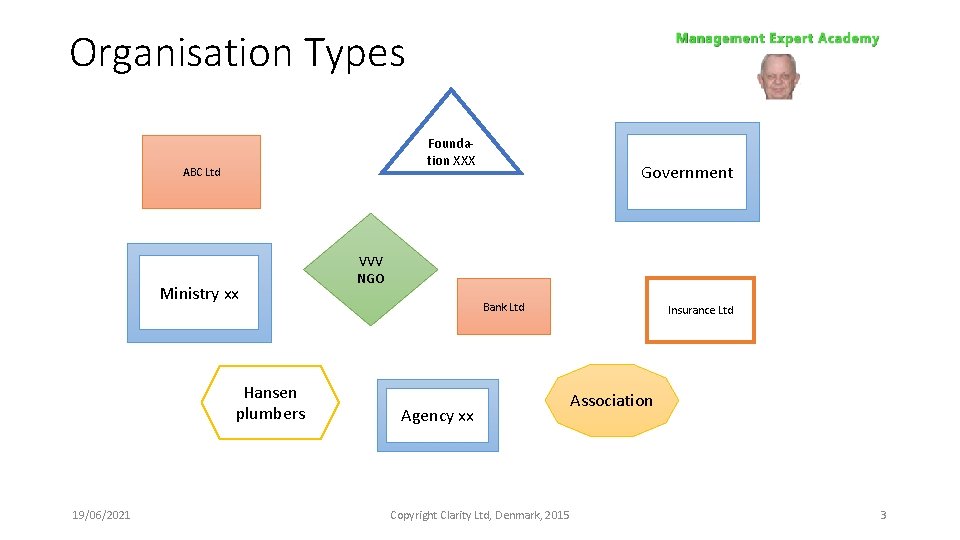
Organisation Types Foundation XXX ABC Ltd Ministry xx Hansen plumbers 19/06/2021 Government VVV NGO Bank Ltd Agency xx Copyright Clarity Ltd, Denmark, 2015 Insurance Ltd Association 3

Organisation structure – legal basis Type of structure Foundation Limited company Bank Profit type nonprofit Employ ee Public Specific Has Insuran Other Employ registratio Start Book- Legislatio Has Director(s Money Labour Tax Liabilities ce Insurance tax n Capital keeping n BOD ) Laundring Laws No for-profit Yes Limited y y y y y Regulated y y y/n y y Regulated y y y Insurance company for-profit Yes Limited y y Regulated NGO / NPO nonprofit No Unlimited y y no y y/n y y Private company for-profit Yes Unlimited y y y partly no y Y/n n y y y Ministry nonprofit No Unlimited y y no y Y n n y y Association nonprofit No Unlimited y y y partly no y y/n y y 6/19/2021 Copyright Clarity Ltd, Denmark, 2015 4
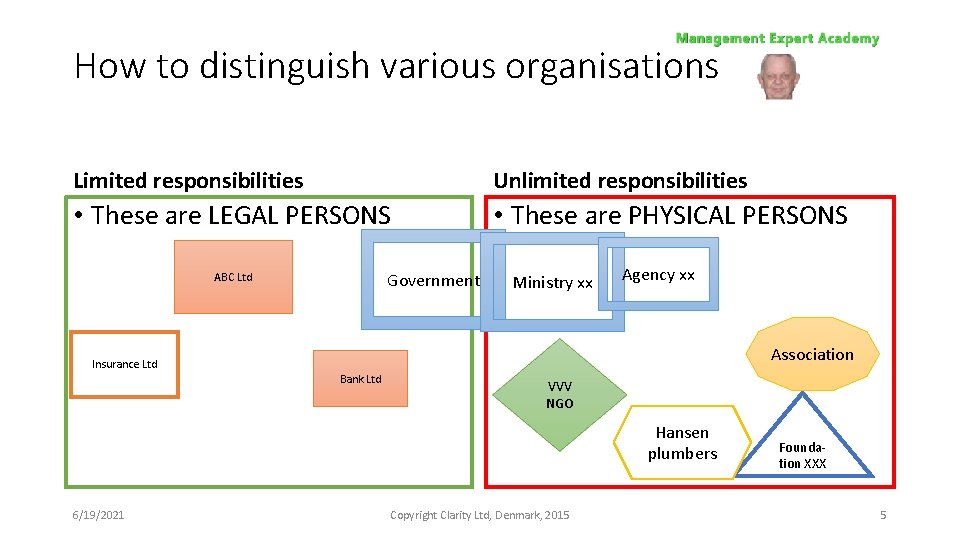
How to distinguish various organisations Limited responsibilities Unlimited responsibilities • These are LEGAL PERSONS • These are PHYSICAL PERSONS Government ABC Ltd Insurance Ltd Ministry xx Agency xx Association Bank Ltd VVV NGO Hansen plumbers 6/19/2021 Copyright Clarity Ltd, Denmark, 2015 Foundation XXX 5

Capital structures – where to find information What can you find Legal Persons Physical Persons Articles of association Y N Registered filings (public) Y N Annual accounts (public in most cases) Y N Structured management team, and perhaps Board of Directors Y Maybe People associated, e. g. Advisory Board Y Maybe Founders (owners) Y Maybe Bank connections Y Maybe Etc. . Y Maybe 6/19/2021 Copyright Clarity Ltd, Denmark, 2015 6
What is a Legal Person? Ø It’s a CAPITAL Structure allowed by the national laws – Ø It must have a responsible management team differ very much between countries Ø How many in the management team and whether it has a Ø It has a fixed start capital Ø It often has regulations on how to use its surplus / deficit Ø It has owners often referred to as SHARE holders Ø Shares can be transferred from one person to another Ø It has obligations to: Ø Ø Ø File articles of association File annual accounts Can be registered in a stock market, in which case it needs to file important events of importance to shareholders Board is regulated by law Ø It is subject to: Ø Ø Ø Current business laws Current accounting laws Bankruptcy laws Rules for defaulting on payments Registration with names, tax authorities, vat authorities etc. Major conclusion: As a manager you must know who you’re dealing with – no excuses for that! 6/19/2021 Copyright Clarity Ltd, Denmark, 2015 7
What is a Physical Person(s)? Ø It has no capital structure so the person(s) are PERSONAL responsible Ø No fixed capital but the owners are responsible personally (with all their wealth!) Ø You can go to ANY of the owners and claim ANY outstanding amount Ø It has internal regulations of sorts but they’re not limiting how they deal with others outside their “business” construction Ø You never know if it exist tomorrow – anything can happen! Ø It has NO obligations to file ANYTHING so it can be difficult to find any information at all ! Ø Management team is something they decide themselves Ø It is subject to: Ø Ø Ø Current business laws Current accounting laws Bankruptcy laws Rules for defaulting on payments Registration with names, tax authorities, vat authorities etc. – only sometimes Major conclusion: As a manager you must know who you’re dealing with – no excuses for that! 6/19/2021 Copyright Clarity Ltd, Denmark, 2015 8
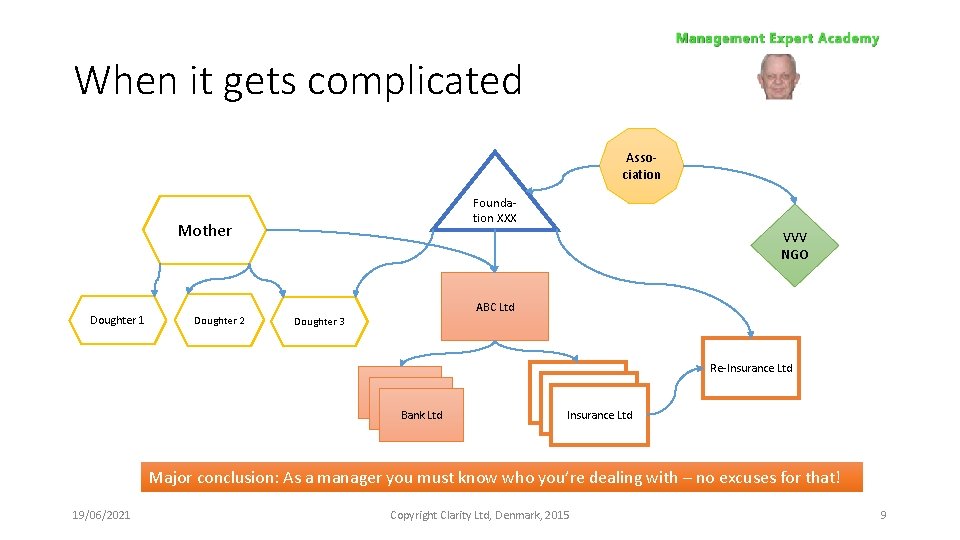
When it gets complicated Association Foundation XXX Mother Doughter 1 Doughter 2 VVV NGO ABC Ltd Doughter 3 Re-Insurance Ltd Bank Ltd Insurance Ltd Major conclusion: As a manager you must know who you’re dealing with – no excuses for that! 19/06/2021 Copyright Clarity Ltd, Denmark, 2015 9
Conclusions – know the basics 1. There is no excuse for not knowing regulations in your society and in your organisation 2. You should READ as a minimum 1. 2. 3. 4. The Business Law(s), if in doubt consult your auditor Trade law (how you make agreements and how to uphold those agreements), if in doubt consult your lawyer Accounting laws – what is needed and what type of reporting system you need, if in doubt consult your auditor Tax system including VAT and others – you need to know how this affects your organisation. Tax systems vary a lot and are often very complex but if you have doubts ask your accountant / auditor 5. Criminal law – you must be aware of criminal activities, what is lawful and what is not, if in doubt consult a lawyer 6. Labour Laws 3. There is NO EXCUSE for not knowing the law – when the law is published then it is automatically known by everybody in the country (normally through the Government Gazette system) So again – please take the time to just read the laws – very few people do but you should at least have an idea of where to find the information you need 6/19/2021 Copyright Clarity Ltd, Denmark, 2015 10
- Slides: 10