
Legal Responsibilities in Health Care Introduction Every aspect
Legal Responsibilities in Health Care
Introduction • Every aspect of our life is governed by certain laws or legal responsibilities. • Ex: traffic laws • It is important for the health care worker to be aware of and follow legal regulations • Protects worker, employer and safety and well-being of the patient 9/10/2020 Legal Responsibilities in Health Care 2
Confidential Information • All information given to health personnel by a patient is considered privileged communication, and by law must be kept confidential • Discuss patient information only with those involved in medical care. 9/10/2020 Legal Responsibilities in Health Care 5
Confidential Information (cont) • Do not discuss with: – Other patients – Relatives and friends of the patient – Visitors – News media – Fellow workers, except when in conference – Your own relatives and friends • You can be fined, sued, or lose their job for sharing any information about patients 9/10/2020 with others Legal Responsibilities in Health Care 6
Confidential Information • Information cannot be told without written consent of the patient • The consent must state: – What information is to be released – To whom the information is to be given – Any time limits 9/10/2020 Legal Responsibilities in Health Care 7
HIPAA • Health Insurance Portability & Accountability Act of 1996 (HIPAA) • Enacted August 21, 1996 • The goal was to protect personal information while still allowing information to reach those needed to properly provide treatment to the patient 9/10/2020 Legal Responsibilities in Health Care 8
HIPAA (continued) • All health care providers must comply • Each facility must make written policies available to all employees and patients. 9/10/2020 Legal Responsibilities in Health Care 9
Safeguards • Basic HIPAA Guidelines: – Protect the patient from exposure of the body – Knock and pause before entering a room – Close curtains or door when providing care – Leave while visitors are with the patient 9/10/2020 Legal Responsibilities in Health Care 10
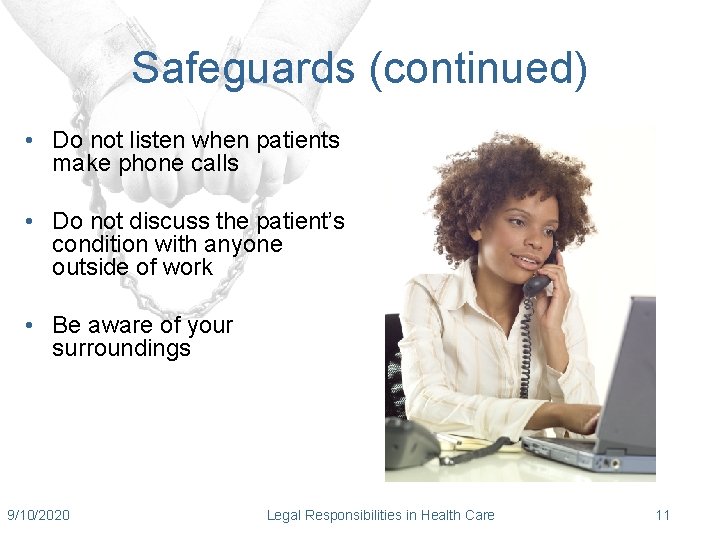
Safeguards (continued) • Do not listen when patients make phone calls • Do not discuss the patient’s condition with anyone outside of work • Be aware of your surroundings 9/10/2020 Legal Responsibilities in Health Care 11
Civil Law • Deals with legal relationships between people and protection of rights 9/10/2020 Legal Responsibilities in Health Care 12
Torts • Many of the wrong doings in health care civil wrongs instead of crimes • They can lead to legal action if results in injury, loss or damage to the patient 9/10/2020 Legal Responsibilities in Health Care 13
Negligence • Failure to provide care that is normally expected of a person equally trained in that particular situation, resulting in injury to the patient • EX: • Ordered side rails left down and patient falls from bed • Using or not reporting defective equipment that injures patient • Patient develops infection from poor sterile technique by the nurse • Patient burned from bath water that was too hot 9/10/2020 Legal Responsibilities in Health Care 14
Malpractice • Providing improper or unprofessional treatment or care • Ex: doctor amputating the wrong limb in surgery • Nurse prescribing medication or performing minor surgery 9/10/2020 Legal Responsibilities in Health Care 15
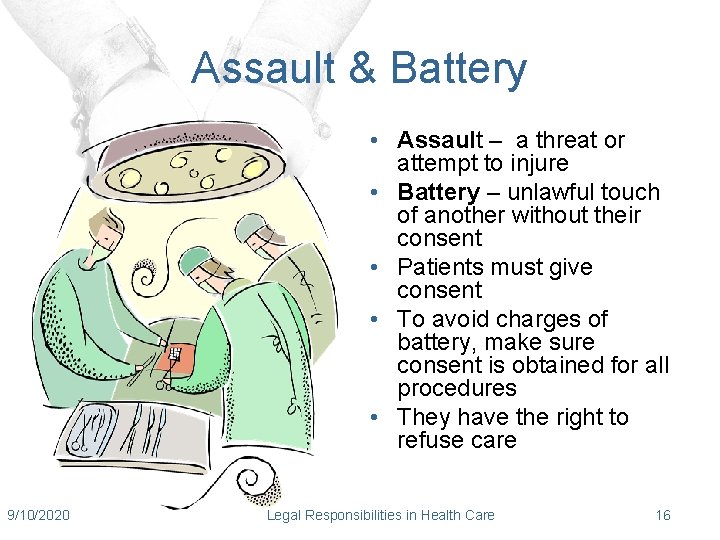
Assault & Battery • Assault – a threat or attempt to injure • Battery – unlawful touch of another without their consent • Patients must give consent • To avoid charges of battery, make sure consent is obtained for all procedures • They have the right to refuse care 9/10/2020 Legal Responsibilities in Health Care 16
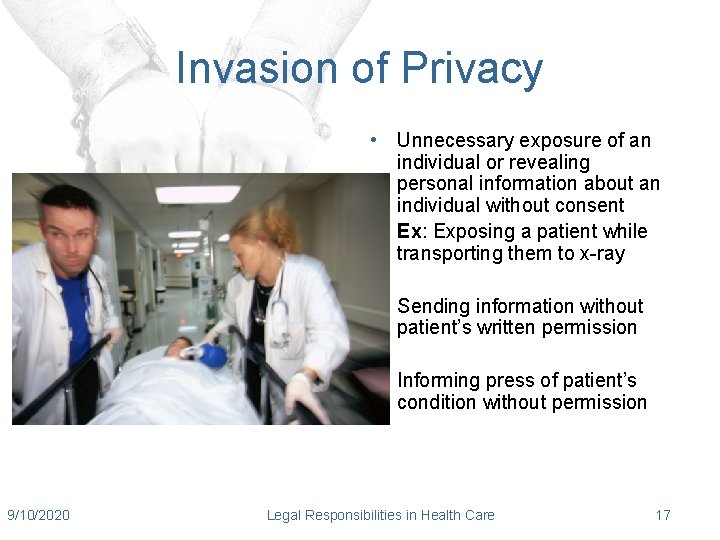
Invasion of Privacy • Unnecessary exposure of an individual or revealing personal information about an individual without consent • Ex: Exposing a patient while transporting them to x-ray • Sending information without patient’s written permission • Informing press of patient’s condition without permission 9/10/2020 Legal Responsibilities in Health Care 17
False Imprisonment • Restraining a patient or restricting their freedom • Ex: side rails without a doctor’s order and a patient’s permission • Placing resident in restraints without order or permission • Keeping patient hospitalized against their will 9/10/2020 Legal Responsibilities in Health Care 18
Abuse • Any care that results in physical harm, pain, or mental anguish • Types: • Physical – hitting, forcing persons against their will, restraining movements, depriving food or water • Verbal – speaking harshly, swearing or shouting, writing threats or abusive statements 9/10/2020 Legal Responsibilities in Health Care 19
Abuse - continued • Psychological – threatening harm, denying rights, intimidating • Sexual – any unwanted sexual touching or act, sexual gestures or suggested sexual behavior 9/10/2020 Legal Responsibilities in Health Care 20
Abuse Outside of Facility • Domestic – intimate partner uses threatening, manipulative, aggressive, or violent behavior • Child – abuse of a child • Elder – abuse directed toward an older person (may be financial in nature) • Health care worker is required by law to report any type of abuse 9/10/2020 Legal Responsibilities in Health Care 21
Defamation • False statements which may damage a person’s reputation • Two types: • Slander – information is spoken • Ex: stating a person has a drug problem when another medical problem exists • Libel – information is written • Ex: sending inaccurate lab results to a government agency 9/10/2020 Legal Responsibilities in Health Care 22
Ethics • Set principles dealing with what is morally right or wrong • Provide a standard of conduct or code of behavior Copyright © 2004 by Thomson Delmar 23
Ethical Dilemmas • • • Frequently created by modern medicine Euthanasia ~ AKA: mercy killing Confidentiality of AIDS diagnosis Aborted fetuses and research Continuing life support Expensive treatments and payment Copyright © 2004 by Thomson Delmar 24
Ethical Dilemmas (continued) • • • Transplant decisions Legal issues and marijuana Animals and research Genetic research Cloning Stem cell research Copyright © 2004 by Thomson Delmar 25
Basic Rules of Ethics • Save lives and promote health • Keep patients comfortable • Respect the patient’s right to die peacefully and with dignity • Treat all patients equally • Provide the best care possible Copyright © 2004 by Thomson Delmar 26
Basic Rules of Ethics (continued) • Maintain competent skills and knowledge • Maintain confidentiality • Refrain from immoral, unethical, and illegal practices • Show loyalty to patients, co-workers, and employers • Be sincere, honest, and caring Copyright © 2004 by Thomson Delmar 27

Top 10 Questions to Ask Yourself When Making an Ethical Decision 10. Could this decision become habit forming? If so don’t do it 9. Is it legal? If not don’t do it 8. Is it safe? If it isn’t do it 7. Is it the right thing to do? If not, don’t do it 6. Will this stand the test of public scrutiny? If it won’t do it 5. If something terrible were to happen, could I defend myself? If not, don’t do it Copyright © 2004 by Thomson Delmar 28

Top 10 Questions to Ask Yourself When Making an Ethical Decision 4. Is it just, balanced, and fair? If not, don’t do it 3. How will it make me feel about myself? If it’s lousy, don’t do it 2. Does this choice lead to the greatest good for the greatest number? If not, don’t do it 1. Would I do this in front of my mother? If you wouldn’t do it Copyright © 2004 by Thomson Delmar 29
Advanced Directives • Living Wills- Documents that allow individuals to state what measures should or should not be taken to prolong life when their conditions are terminal • Durable Power of Attorney- Document which allows another individual to make their medical decisions for them if they become unable to
Advanced Directives • DNR: Do Not Resuscitate • Must be a doctors order and paper signed • No CPR will be performed if patient heart stops or breathing stops
• stop 9/10/2020 Legal Responsibilities in Health Care 32
- Slides: 30