
Legal Research Review How Cases are Published Court
Legal Research Review
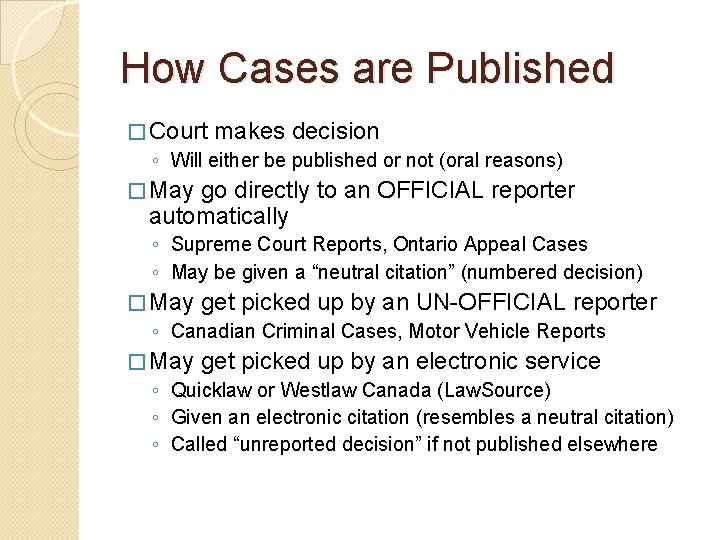
How Cases are Published � Court makes decision ◦ Will either be published or not (oral reasons) � May go directly to an OFFICIAL reporter automatically ◦ Supreme Court Reports, Ontario Appeal Cases ◦ May be given a “neutral citation” (numbered decision) � May get picked up by an UN-OFFICIAL reporter ◦ Canadian Criminal Cases, Motor Vehicle Reports � May get picked up by an electronic service ◦ Quicklaw or Westlaw Canada (Law. Source) ◦ Given an electronic citation (resembles a neutral citation) ◦ Called “unreported decision” if not published elsewhere
![Reported Decisions (print reporters) style of cause, (year of [year of decision), reporter] R.](http://slidetodoc.com/presentation_image_h2/51c9d5692471f4de388c89bec0bcfa50/image-3.jpg "Reported Decisions (print reporters) style of cause, (year of [year of decision), reporter] R.")
Reported Decisions (print reporters) style of cause, (year of [year of decision), reporter] R. v. Askov, R. v. Askov [1990] (1990), Volume reporter 2 S. C. R. 59 C. C. C. (series) if any page 1199. (3 d) 449.
Reporter Abbreviations �http: //www. library. brocku. ca/research/ politic/lrchart. htm
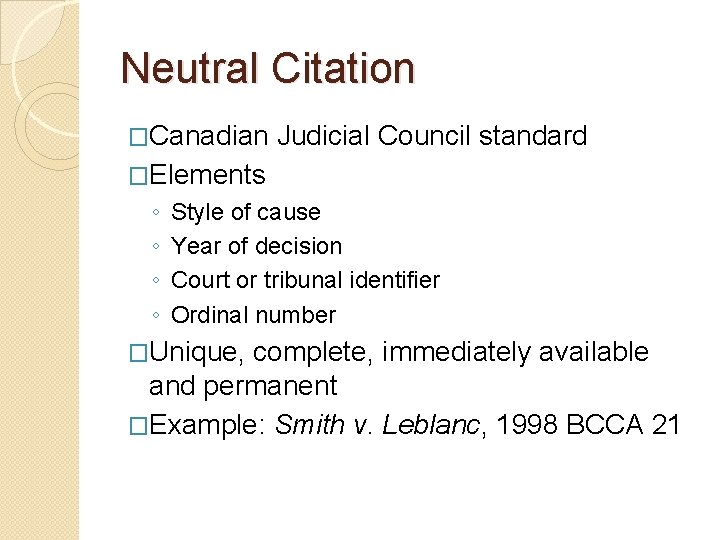
Neutral Citation �Canadian Judicial Council standard �Elements ◦ ◦ Style of cause Year of decision Court or tribunal identifier Ordinal number �Unique, complete, immediately available and permanent �Example: Smith v. Leblanc, 1998 BCCA 21

Jurisprudence: Neutral Citation style of cause, R. v. Law, core of neutral citation year tribunal/court identifier ordinal number of decision. 2002 SCC 10.
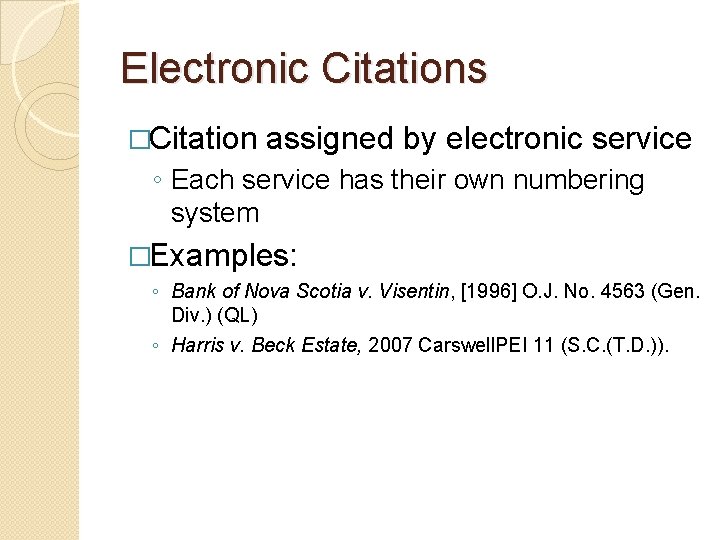
Electronic Citations �Citation assigned by electronic service ◦ Each service has their own numbering system �Examples: ◦ Bank of Nova Scotia v. Visentin, [1996] O. J. No. 4563 (Gen. Div. ) (QL) ◦ Harris v. Beck Estate, 2007 Carswell. PEI 11 (S. C. (T. D. )).
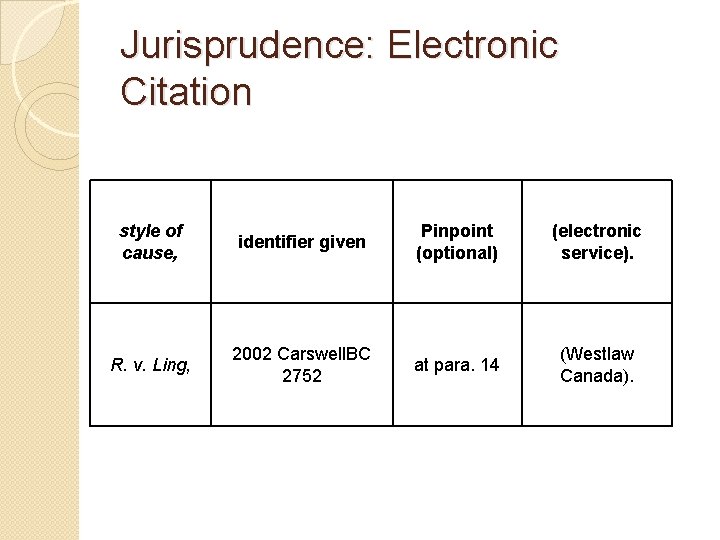
Jurisprudence: Electronic Citation style of cause, identifier given Pinpoint (optional) (electronic service). R. v. Ling, 2002 Carswell. BC 2752 at para. 14 (Westlaw Canada).
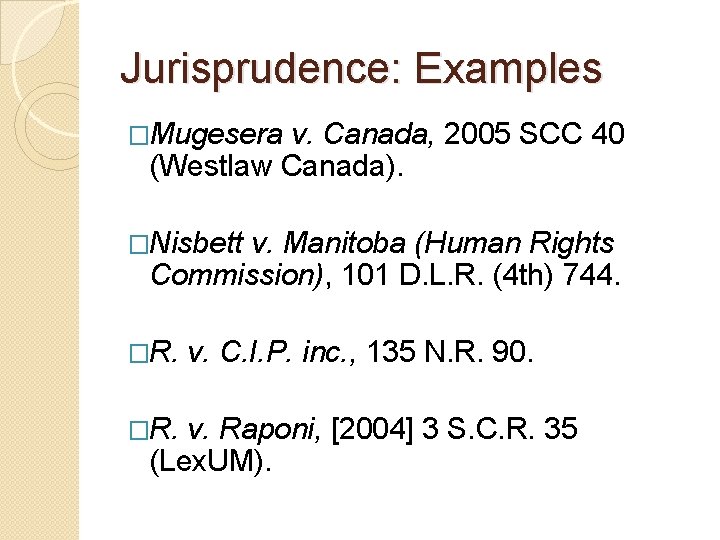
Jurisprudence: Examples �Mugesera v. Canada, 2005 SCC 40 (Westlaw Canada). �Nisbett v. Manitoba (Human Rights Commission), 101 D. L. R. (4 th) 744. �R. v. C. I. P. inc. , 135 N. R. 90. v. Raponi, [2004] 3 S. C. R. 35 (Lex. UM).
Excellent Website Describing Legal Citation �http: //library. queensu. ca/law/lederman /legalcit. htm
Parallel Citations �Citations that refer to the EXACT SAME case �Same parties �Same hearing �Reported by different sources �Just like one event happens, several newspapers may report on it. Stories cover the same situation, but publish in different places.

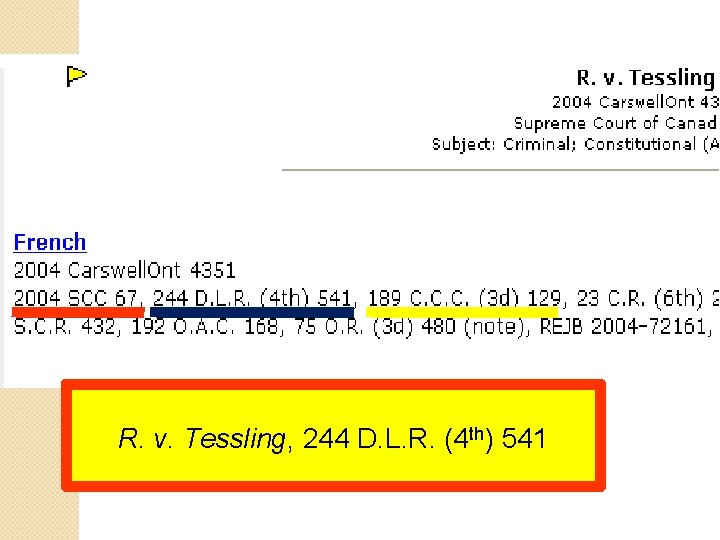
R. v. Tessling, 244 D. L. R. (4 th) 541
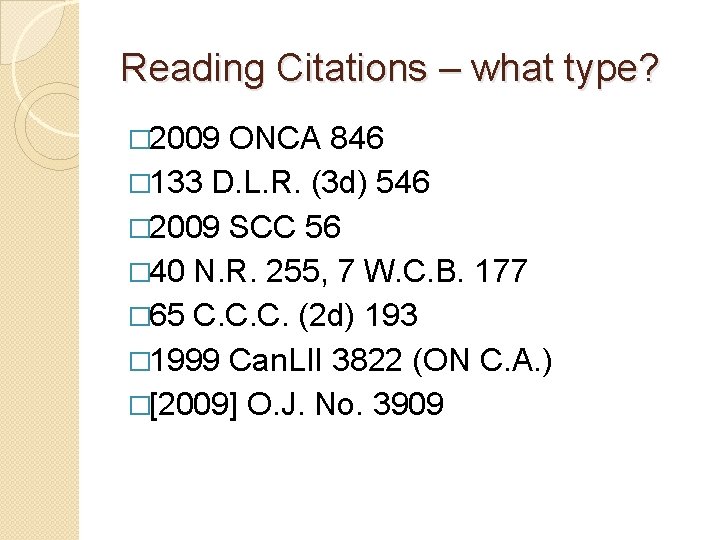
Reading Citations – what type? � 2009 ONCA 846 � 133 D. L. R. (3 d) 546 � 2009 SCC 56 � 40 N. R. 255, 7 W. C. B. 177 � 65 C. C. C. (2 d) 193 � 1999 Can. LII 3822 (ON C. A. ) �[2009] O. J. No. 3909
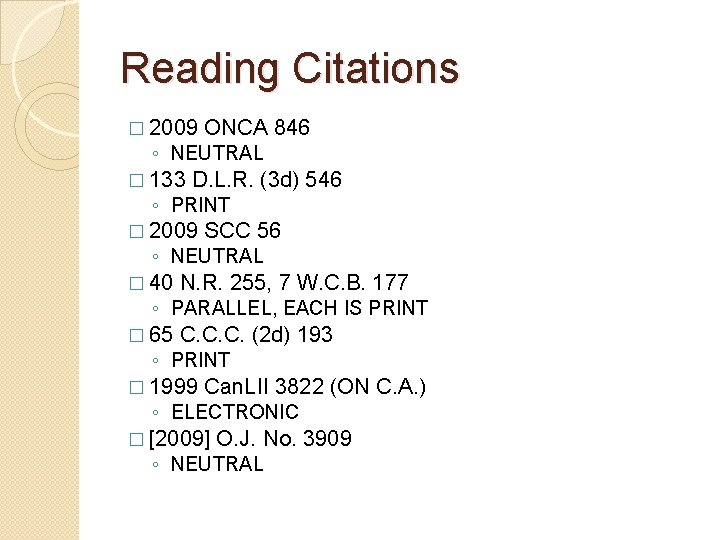
Reading Citations � 2009 ONCA 846 ◦ NEUTRAL � 133 D. L. R. (3 d) 546 ◦ PRINT � 2009 SCC 56 ◦ NEUTRAL � 40 N. R. 255, 7 W. C. B. 177 � 65 C. C. C. (2 d) 193 ◦ PARALLEL, EACH IS PRINT ◦ PRINT � 1999 Can. LII 3822 (ON C. A. ) ◦ ELECTRONIC � [2009] O. J. No. 3909 ◦ NEUTRAL
Looking up Cases by Citation �Use shortest possible route �Citation is the UNIQUE identifier for the case ◦ Note that we include years in SQUARE brackets, but not those in ROUND brackets! �Name is helpful, but could be applied to more than one case ◦ If you have the citation, use it without the name �Many databases offer shortcuts ◦ E. g. don’t need to enter punctuation or spaces
![Locating by citation – what do you type? ? �R. v. Harper, [1982] A.](http://slidetodoc.com/presentation_image_h2/51c9d5692471f4de388c89bec0bcfa50/image-17.jpg "Locating by citation – what do you type? ? �R. v. Harper, [1982] A.")
Locating by citation – what do you type? ? �R. v. Harper, [1982] A. C. S. no 108 �R. v. Harper, 133 D. L. R. (3 d) 546 �R. v. Harper, (1982), 40 N. R. 255 �R. v. Harper, 65 C. C. C. (2 d) 193 �R. v. Harper, 7 W. C. B. 177 (SCC)
Locating by citation – answers � 1982 acsno 108 � 133 dlr 3 d 546 � 40 nr 255 � 65 ccc 2 d 193 � 7 wcb 177 �And, incidentally, 5 D. L. R. (4 th) 255 would be: 5 dlr 4 th 255
Relationships Between Cases �A story….
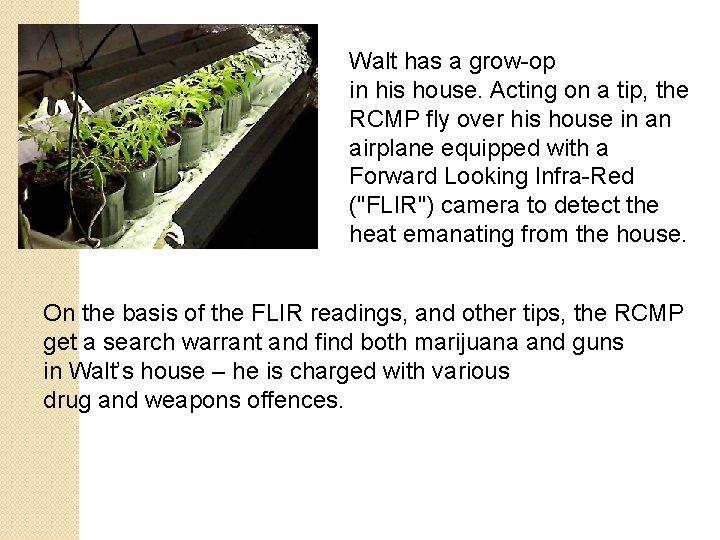
Walt has a grow-op in his house. Acting on a tip, the RCMP fly over his house in an airplane equipped with a Forward Looking Infra-Red ("FLIR") camera to detect the heat emanating from the house. On the basis of the FLIR readings, and other tips, the RCMP get a search warrant and find both marijuana and guns in Walt’s house – he is charged with various drug and weapons offences.
Trial A: Walt is found guilty and convicted. Ontario Superior Court, Thomson J (oral reasons only – no case report)
Trial B: Walt appeals �Fly-over with FLIR camera violated his right to be free from unreasonable search and seizure guaranteed by s. 8 of the Canadian Charter of Rights and Freedoms. �The court agrees and Walt is released. �R. v. Tessling, 63 O. R. (3 d) 1.
Trial C: The Crown isn’t going to give up � Case moves to Supreme Court. � Walt’s right to privacy does not extend to patterns of heat distribution on the external surfaces of his house. FLIR heat profile did not expose any intimate details of Walt’s life, information about his core biographical data, and therefore his constitutional rights were not violated, and he is guilty as originally charged. R. v. Tessling, [2004] 3 S. C. R. 432.
Consider… �What is the relationship between these two cases? ◦ R. v. Tessling, 63 O. R. (3 d) 1. ◦ R. v. Tessling, [2004] 3 S. C. R. 432.
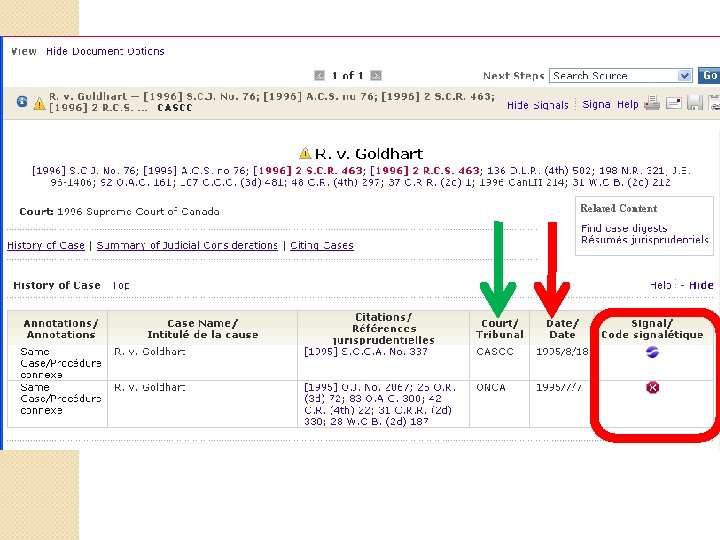
Judicial History �First step in “Noting Up” �Tells the “story” of how the case proceeded through the court system �Each decision is UNIQUE and represents a DIFFERENT HEARING but includes the same parties �If you don’t find out judicial history, the “story” of your case is incomplete!
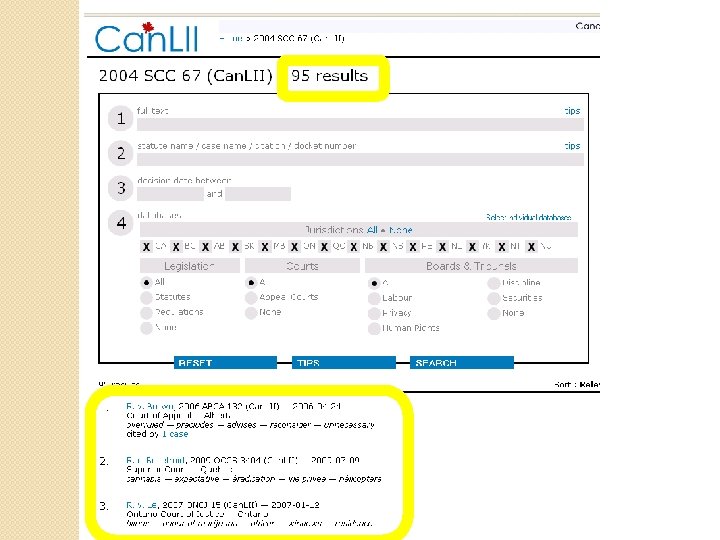
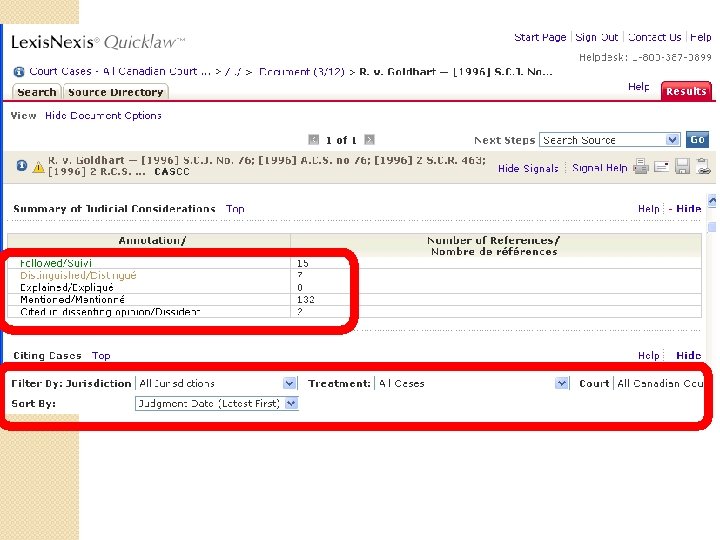
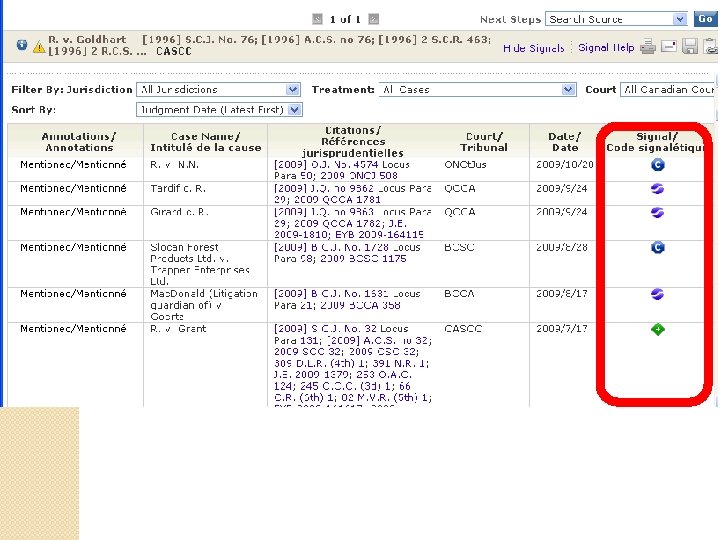
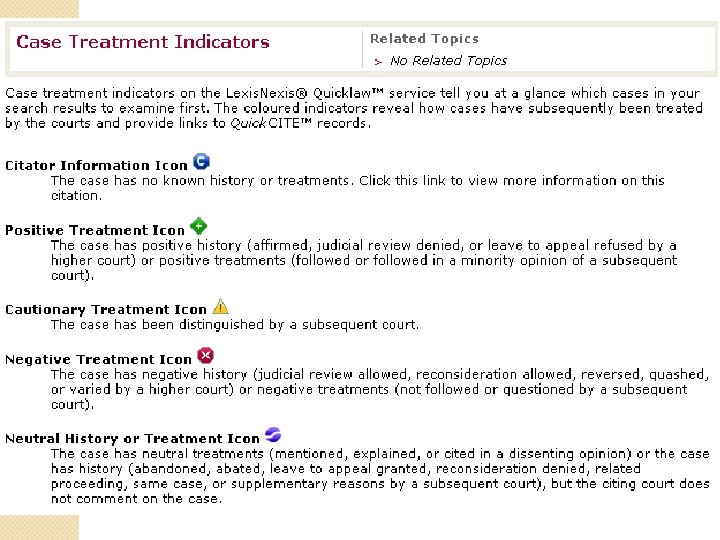
Judicial Consideration �Second step in “Noting Up” �Tells how courts have treated your judge’s decision �Often referred to as ◦ Citing references (n) ◦ Cases citing (n) �Some sources will offer not only a list of cases, but HOW each case treated your decision
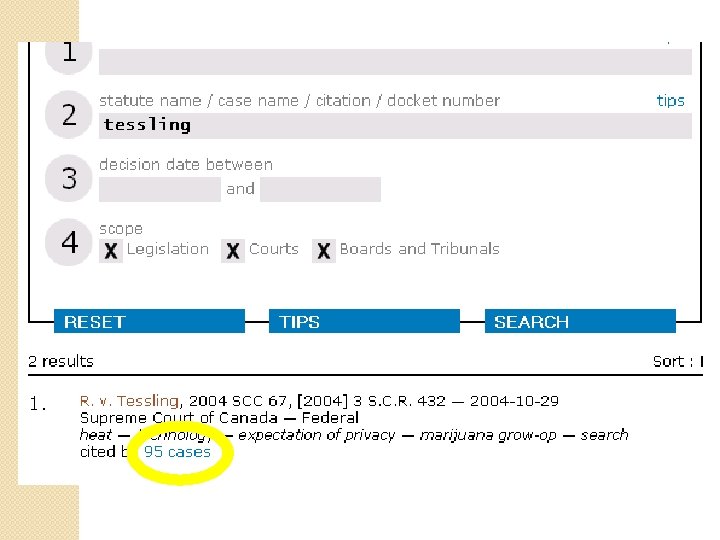
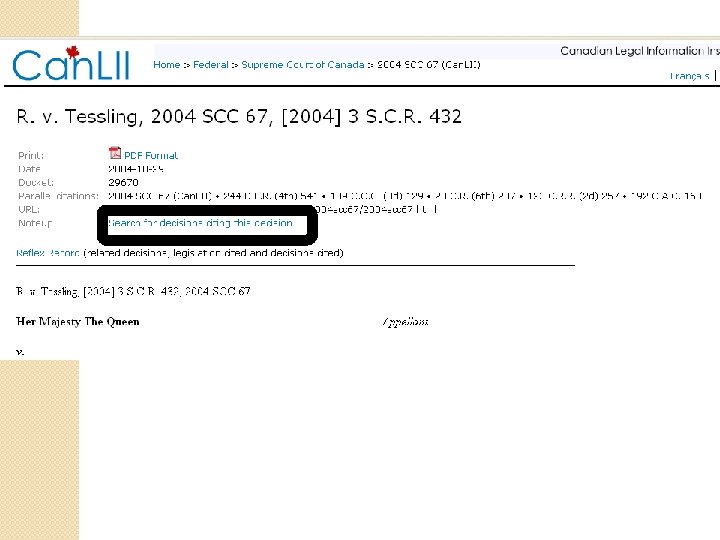
Let’s Note up Together… �Use Quicklaw, Law. Source or Can. Lii (your choice) �Find this case: ◦ R. v. Tessling, [2004] 3 S. C. R. 432 �Note it up ◦ Key. Cite (Law. Source) ◦ Quick. Cite (Quicklaw) ◦ “Cited by” (Can. Lii)
Analyzing the Law �Case Brief �Legal Memorandum
Legal Memorandum, Case Brief �Legal Memo ◦ Identify facts, issues of client situation ◦ Find relevant law ◦ Apply law and determine conclusion �Case Brief ◦ Identify key elements of a case ◦ Succinct ◦ All information comes from the case itself
Situation to follow through
Case Situation �First thing we do: ◦ Facts – relevant ones ◦ Issues – question or “whether” statement �Second thing we do: ◦ Background – secondary sources �Textbooks �Journal Articles �Commentary �Words and Phrases, Dictionaries
Next, we look for Statutes �Statutes take precedence �Cases interpret statutes �Parliamentary authority
Then, we look for Cases �How law has been interpreted �Look for similar fact patters �Look for similar legal issues
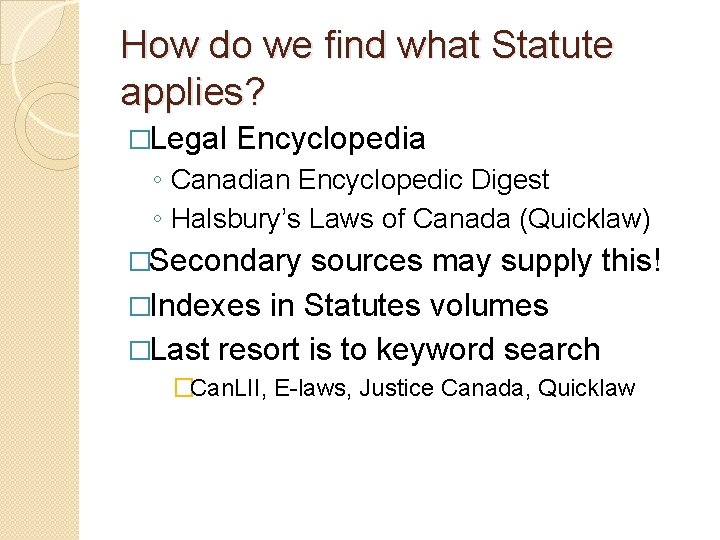
How do we find what Statute applies? �Legal Encyclopedia ◦ Canadian Encyclopedic Digest ◦ Halsbury’s Laws of Canada (Quicklaw) �Secondary sources may supply this! �Indexes in Statutes volumes �Last resort is to keyword search �Can. LII, E-laws, Justice Canada, Quicklaw
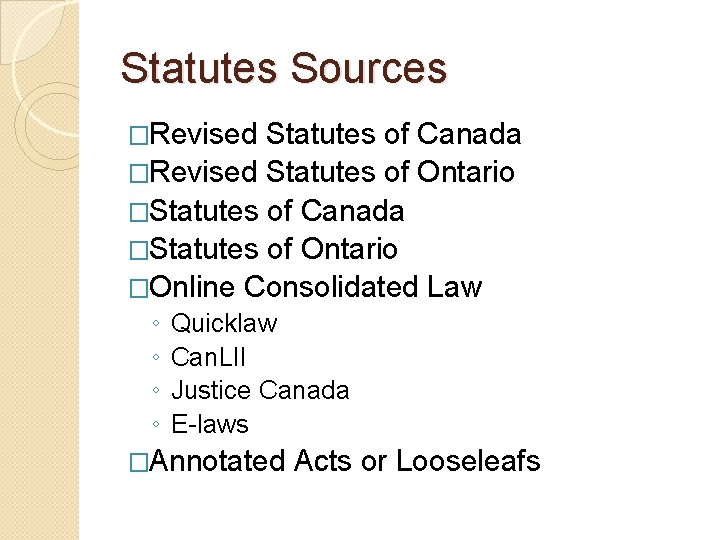
Statutes Sources �Revised Statutes of Canada �Revised Statutes of Ontario �Statutes of Canada �Statutes of Ontario �Online Consolidated Law ◦ ◦ Quicklaw Can. LII Justice Canada E-laws �Annotated Acts or Looseleafs
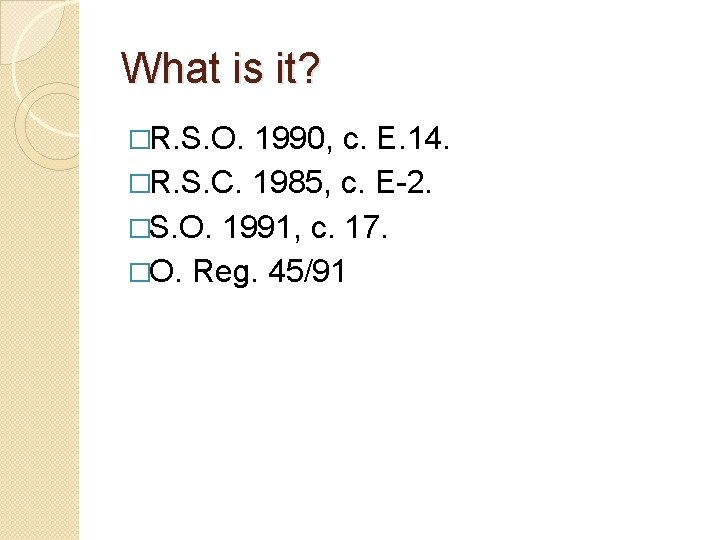
What is it? �R. S. O. 1990, c. E. 14. �R. S. C. 1985, c. E-2. �S. O. 1991, c. 17. �O. Reg. 45/91
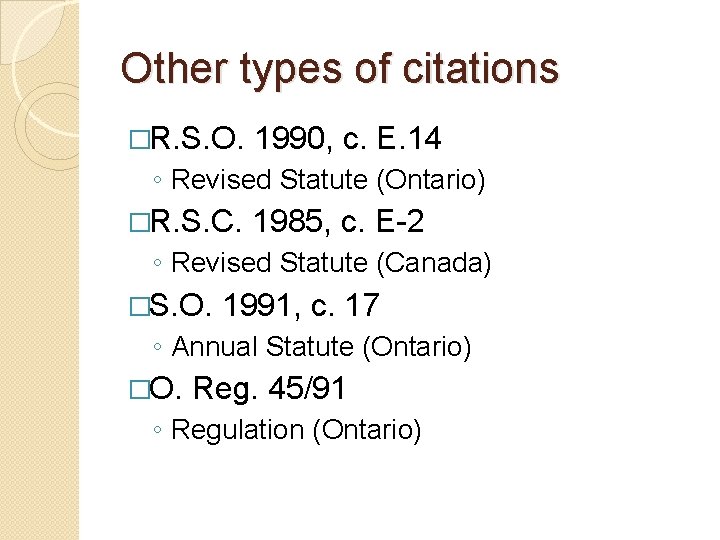
Other types of citations �R. S. O. 1990, c. E. 14 ◦ Revised Statute (Ontario) �R. S. C. 1985, c. E-2 ◦ Revised Statute (Canada) �S. O. 1991, c. 17 ◦ Annual Statute (Ontario) �O. Reg. 45/91 ◦ Regulation (Ontario)
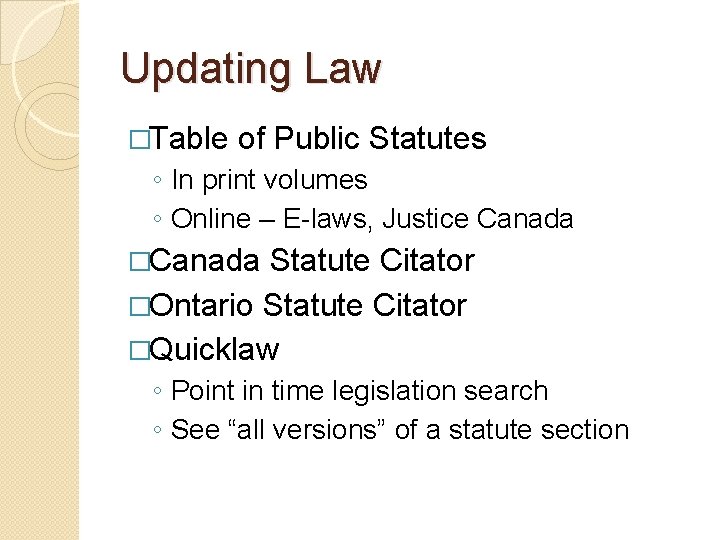
Updating Law �Table of Public Statutes ◦ In print volumes ◦ Online – E-laws, Justice Canada �Canada Statute Citator �Ontario Statute Citator �Quicklaw ◦ Point in time legislation search ◦ See “all versions” of a statute section
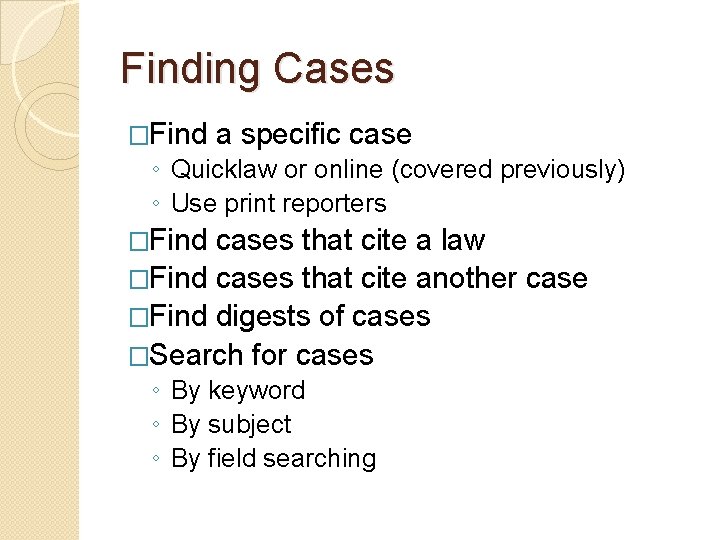
Finding Cases �Find a specific case ◦ Quicklaw or online (covered previously) ◦ Use print reporters �Find cases that cite a law �Find cases that cite another case �Find digests of cases �Search for cases ◦ By keyword ◦ By subject ◦ By field searching
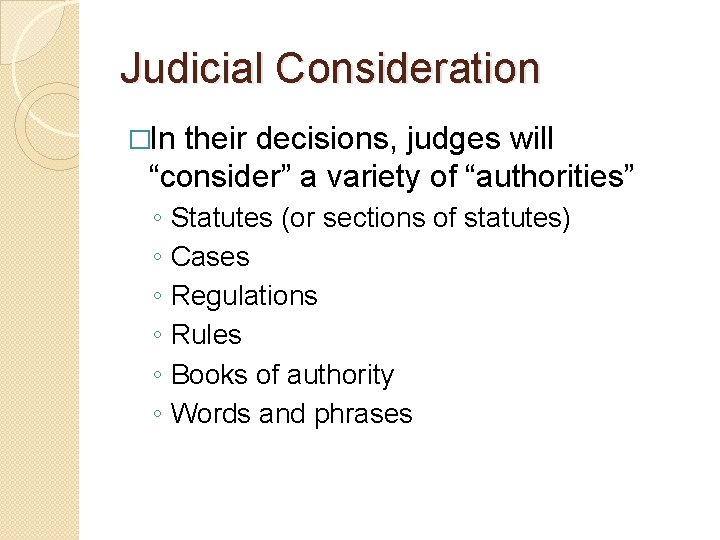
Judicial Consideration �In their decisions, judges will “consider” a variety of “authorities” ◦ ◦ ◦ Statutes (or sections of statutes) Cases Regulations Rules Books of authority Words and phrases
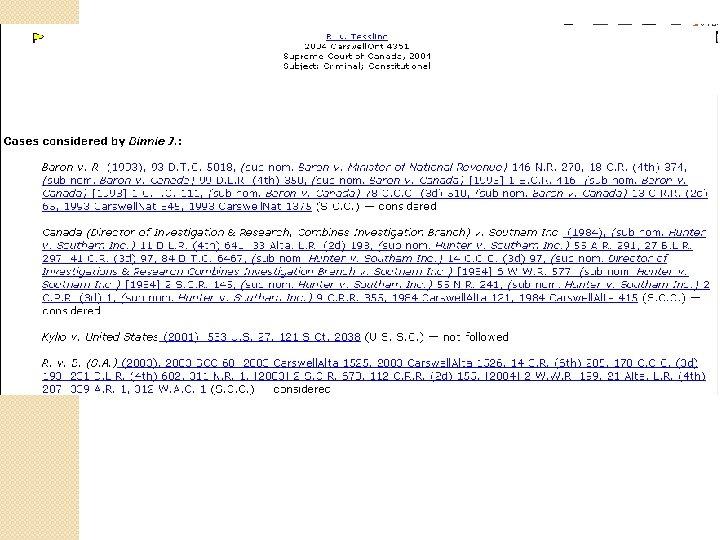
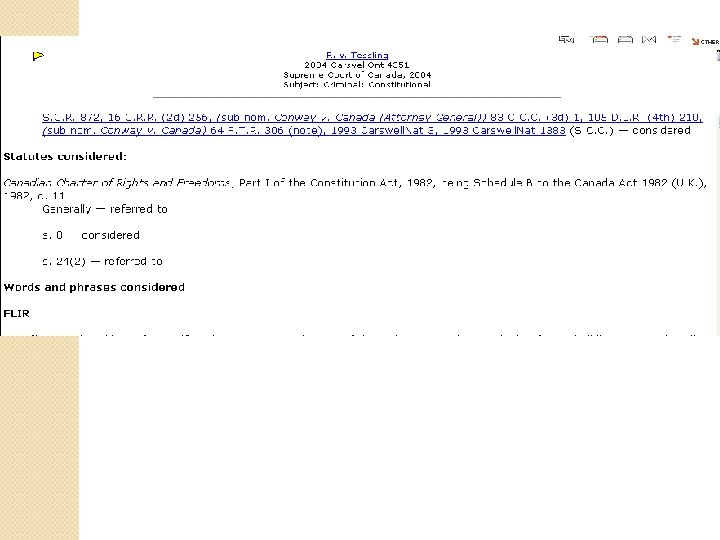
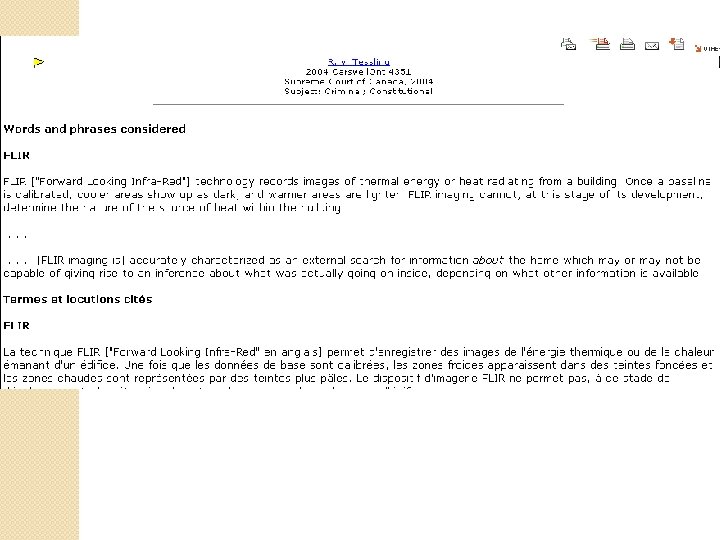
Citator Sources �Track all the cases that have considered a particular case, law, section of a law, word/phrase, etc. �So, now for a particular primary source or particular word/phrase, we can find cases where it has been “considered”.
Citator Sources (Print) �Canada and Ontario Statute Citators ◦ Cases that cite statutes �Canadian Statute Citations (Abridgement) ◦ Cases that cite statutes �Annotated Acts ◦ Cases that cite statutes �Canadian Case Citations (Abridgement) ◦ Cases that cite other cases
Electronic Databases �Can. LII Noteup feature ◦ Cases that cite other cases �Quicklaw “Quickcite” feature ◦ Cases that cite statutes, or cases depending on when it’s used ◦ Cases that interpret Words and phrases �Westlaw Canada “Keycite” feature ◦ Cases that cite statutes, or cases depending on when it’s used ◦ Cases that interpret Words and phrases
What are digests? � Short summary of case with respect to a particular point of law � May be more than one digest for a case � Gives the outcome and a citation for the case � Often grouped by subject area and can be browsed � Sources: ◦ Canadian Abridgement Case Digests ◦ The Canada Digest (Quicklaw) � Advantages ◦ Shorter than whole case ◦ Include only relevant information ◦ Often grouped so that it’s easy to find similar cases
Electronic Database Searching
Finding Case Reports �Keyword searching vs. summary searching �“Search by area of law” in Quicklaw �Field searching ◦ ◦ Dates Jurisdictions Summaries/Headnotes Judges �Law. Source CED and Abridgement browsing (Tables of Contents)
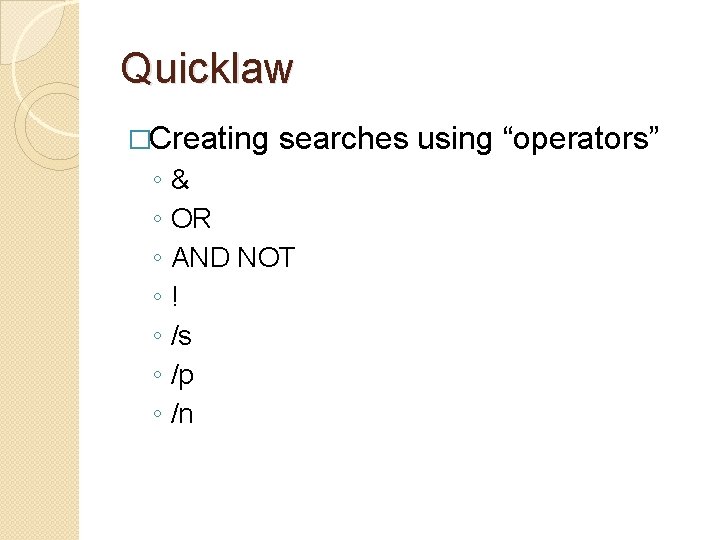
Quicklaw �Creating ◦ ◦ ◦ ◦ searches using “operators” & OR AND NOT ! /s /p /n
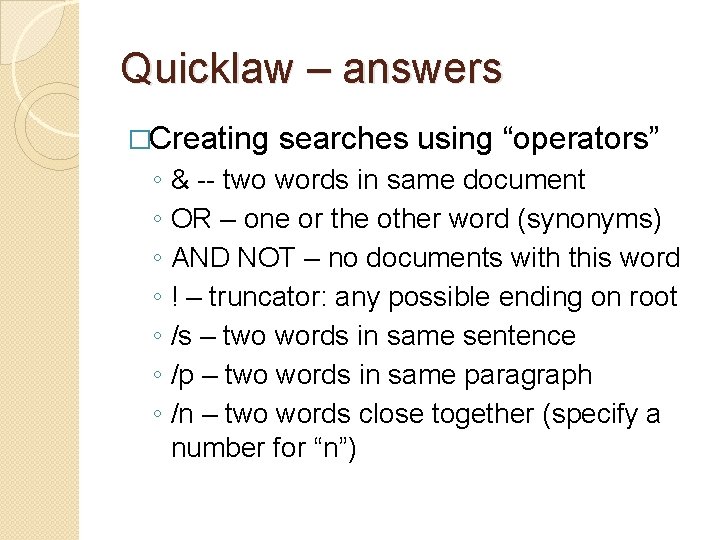
Quicklaw – answers �Creating ◦ ◦ ◦ ◦ searches using “operators” & -- two words in same document OR – one or the other word (synonyms) AND NOT – no documents with this word ! – truncator: any possible ending on root /s – two words in same sentence /p – two words in same paragraph /n – two words close together (specify a number for “n”)
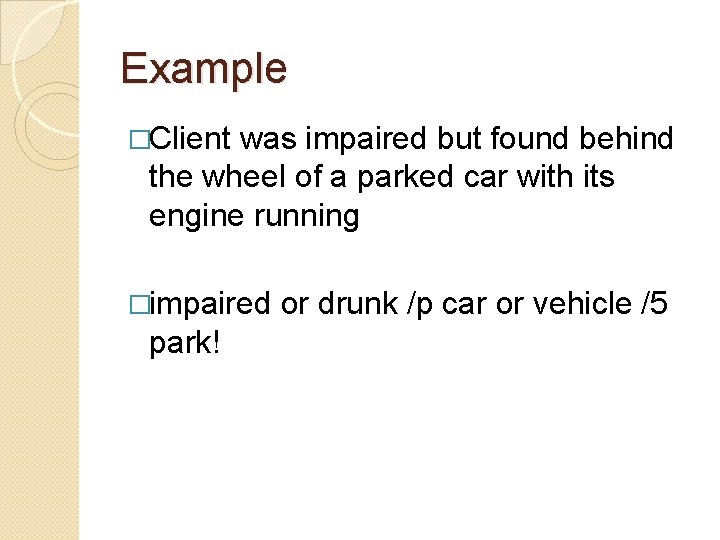
Example �Client was impaired but found behind the wheel of a parked car with its engine running �impaired park! or drunk /p car or vehicle /5
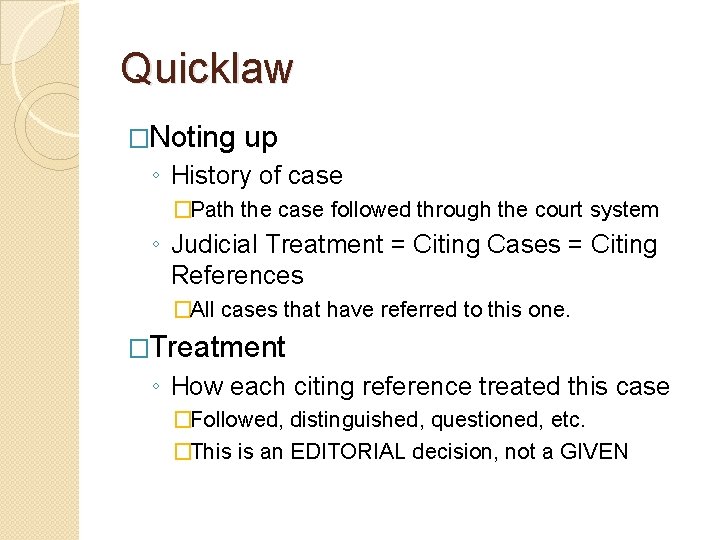
Quicklaw �Noting up ◦ History of case �Path the case followed through the court system ◦ Judicial Treatment = Citing Cases = Citing References �All cases that have referred to this one. �Treatment ◦ How each citing reference treated this case �Followed, distinguished, questioned, etc. �This is an EDITORIAL decision, not a GIVEN
Westlaw Canada �Law. Source

ANYTHING ELSE? ?
- Slides: 62