
Legal relations Legal relation definition l l l





- Slides: 13
Legal relations
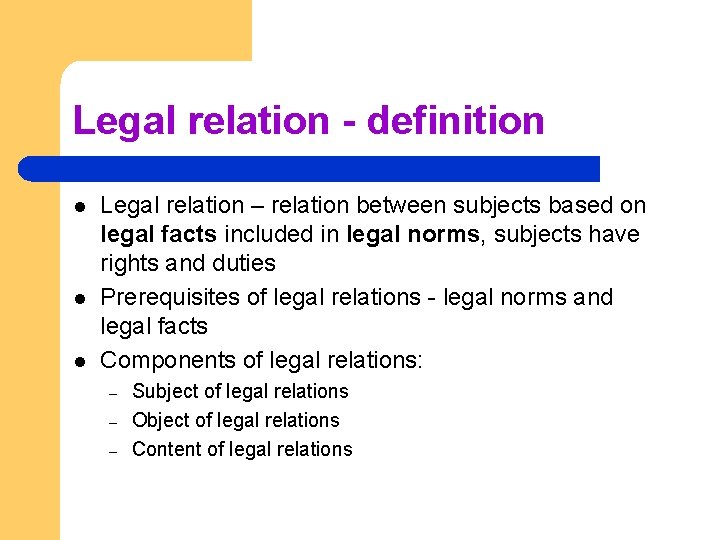
Legal relation - definition l l l Legal relation – relation between subjects based on legal facts included in legal norms, subjects have rights and duties Prerequisites of legal relations - legal norms and legal facts Components of legal relations: – – – Subject of legal relations Object of legal relations Content of legal relations
Legal facts l l Life circumstances which can create, change or repeal legal relation Subjective legal facts – can be influenced by human will – – l legal action illegal action Objective legal facts – cannot be influenced by human will – – legal event illegal state
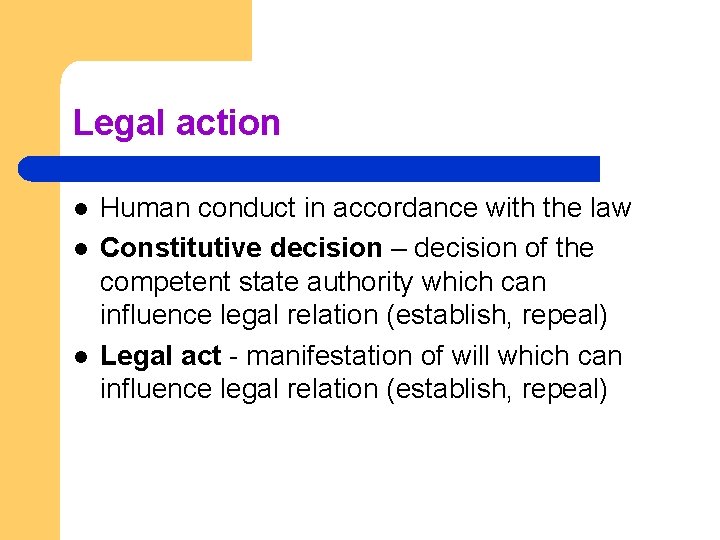
Legal action l l l Human conduct in accordance with the law Constitutive decision – decision of the competent state authority which can influence legal relation (establish, repeal) Legal act - manifestation of will which can influence legal relation (establish, repeal)
Illegal action l Human conduct contrary to the law: – – Criminal act – most dangerous illegal act punished by courts (murder, theft, robbery) Administrative offence – harmful illegal act punished by administrative authorities Disciplinary offence – breach of discipline inside some organization or institution Civil delict – breach of norm inside private law (property damage, damage to person, debtor‘s delay)
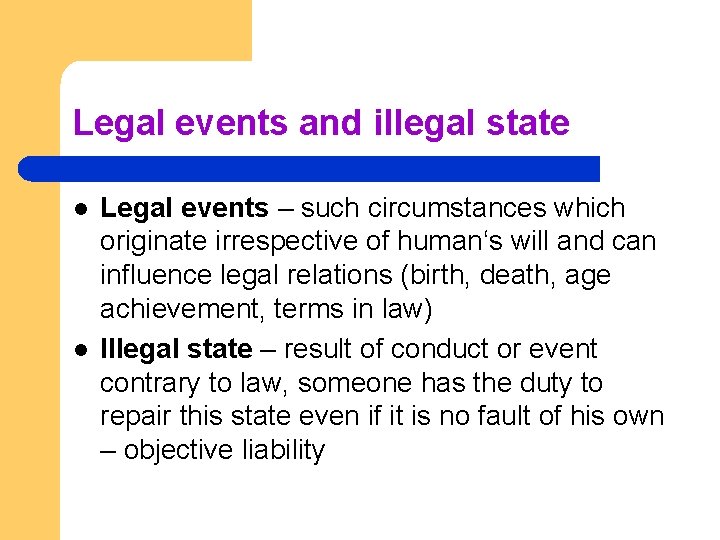
Legal events and illegal state l l Legal events – such circumstances which originate irrespective of human‘s will and can influence legal relations (birth, death, age achievement, terms in law) Illegal state – result of conduct or event contrary to law, someone has the duty to repair this state even if it is no fault of his own – objective liability
Subjects of legal relations l l Natural persons, juridical persons, state Capacity to rights and duties – capacity to be the subject of law, to have rights and duties Capacity to legal action – capacity to establish legal relations (change, repeal) Capacity to illegal action – capacity to bear liability for illegal act
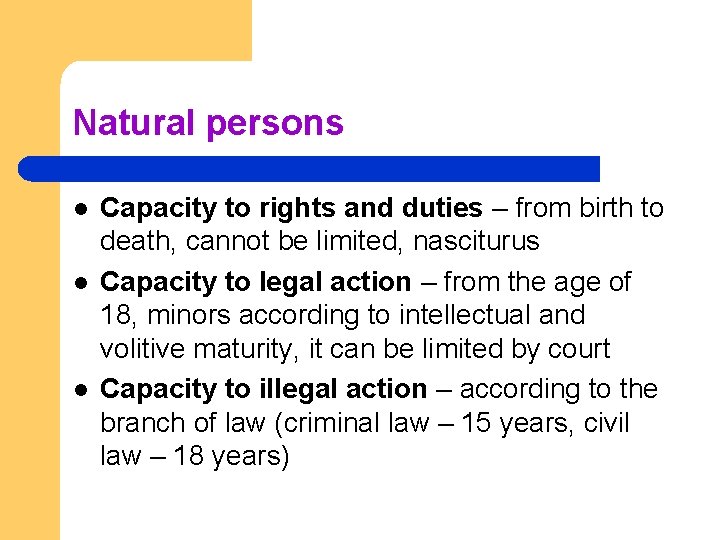
Natural persons l l l Capacity to rights and duties – from birth to death, cannot be limited, nasciturus Capacity to legal action – from the age of 18, minors according to intellectual and volitive maturity, it can be limited by court Capacity to illegal action – according to the branch of law (criminal law – 15 years, civil law – 18 years)
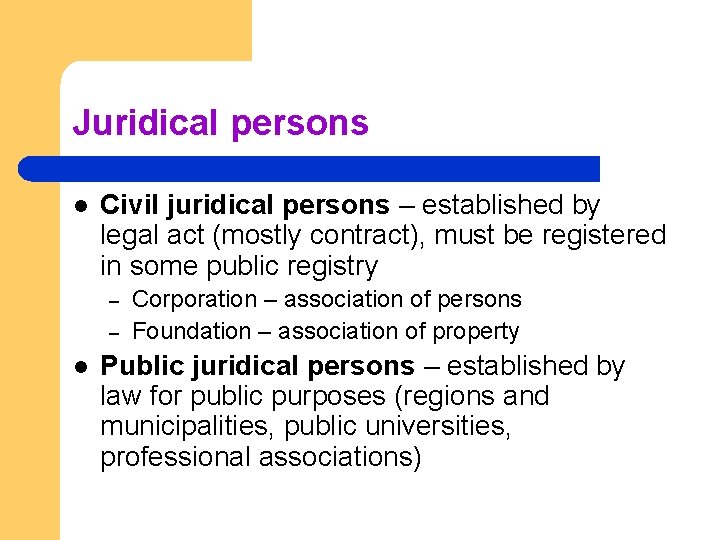
Juridical persons l Civil juridical persons – established by legal act (mostly contract), must be registered in some public registry – – l Corporation – association of persons Foundation – association of property Public juridical persons – established by law for public purposes (regions and municipalities, public universities, professional associations)
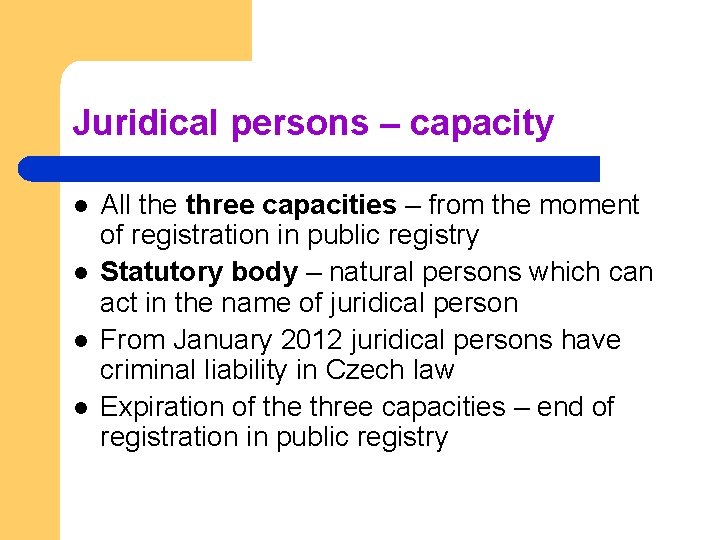
Juridical persons – capacity l l All the three capacities – from the moment of registration in public registry Statutory body – natural persons which can act in the name of juridical person From January 2012 juridical persons have criminal liability in Czech law Expiration of the three capacities – end of registration in public registry
State l l In civil law it is considered as special type of juridical person Statutory body – different state authorities according to their competence State can bear liability only in private law Special aspect – state creates the law and it is binding for him, has some special rights
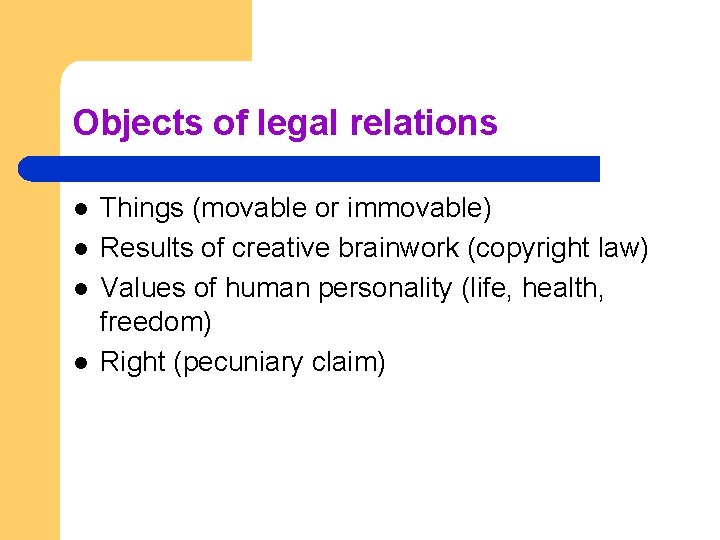
Objects of legal relations l l Things (movable or immovable) Results of creative brainwork (copyright law) Values of human personality (life, health, freedom) Right (pecuniary claim)
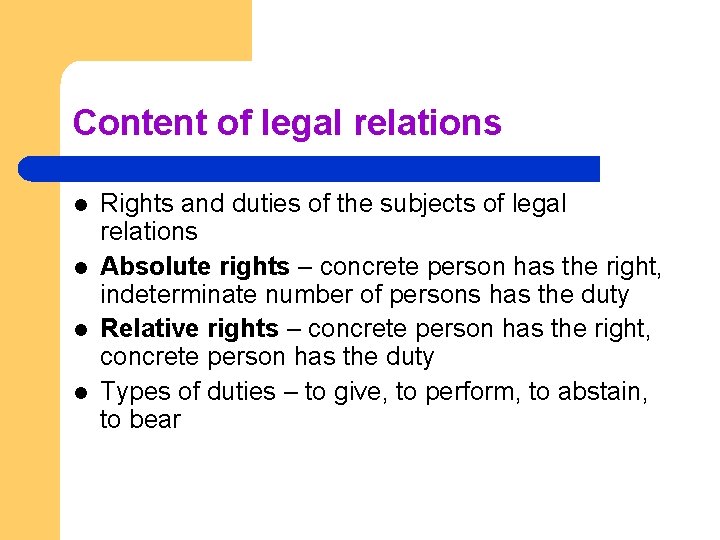
Content of legal relations l l Rights and duties of the subjects of legal relations Absolute rights – concrete person has the right, indeterminate number of persons has the duty Relative rights – concrete person has the right, concrete person has the duty Types of duties – to give, to perform, to abstain, to bear