
LEGAL ISSUES OF HUMAN CLONING AND THERAPUTIC CLONING
- Slides: 41
LEGAL ISSUES OF HUMAN CLONING AND THERAPUTIC CLONING
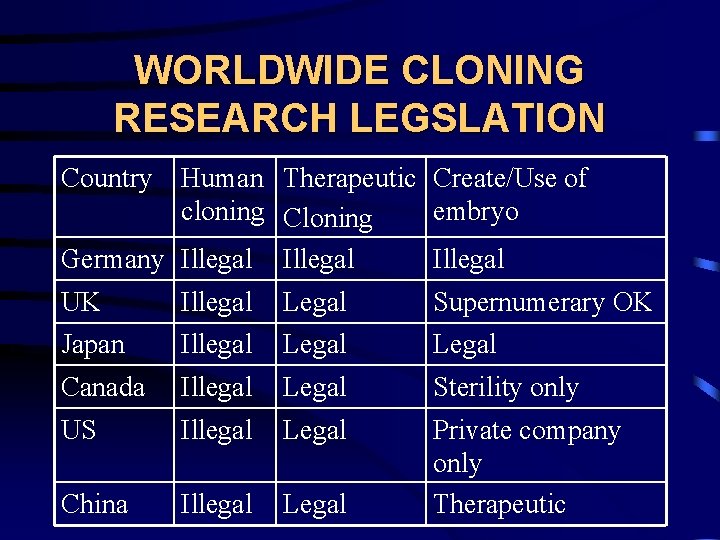
WORLDWIDE CLONING RESEARCH LEGSLATION Country Human Therapeutic Create/Use of cloning Cloning embryo Germany Illegal UK Illegal Legal Supernumerary OK Japan Illegal Legal Canada Illegal Legal Sterility only US Illegal Legal China Illegal Legal Private company only Therapeutic
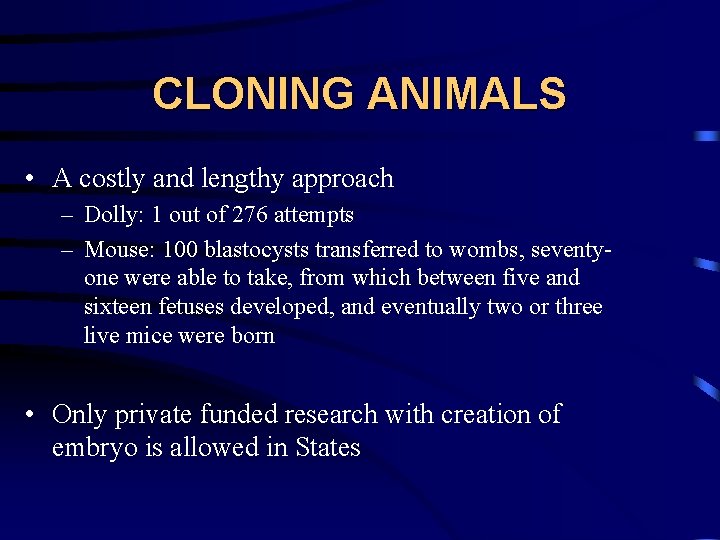
CLONING ANIMALS • A costly and lengthy approach – Dolly: 1 out of 276 attempts – Mouse: 100 blastocysts transferred to wombs, seventyone were able to take, from which between five and sixteen fetuses developed, and eventually two or three live mice were born • Only private funded research with creation of embryo is allowed in States
PRIVATIZED CLONING RESEARCH • Research carried out in commercial labs is not as accessible and amenable to being judged and criticized by other scientists. • High demand of human ova can result in uncontrollable coercion or exploitation of ova donors • The absence of transparency and scrutiny not only hinders scientific advance but also can make the public, and lawmakers, nervous. • Legislation of identity, rights and status of clones must be established before any human cloning research is permitted
CLONE IDENTITY • The most accurate human identity diagnosis will fail (e. g. DNA profile, fingerprints) • Difficulties of enforcing laws: – Criminal identity – Inherited properties between donor and clone – Kinship of offsprings – Relatives approval immigration, etc.
TREATING CLONES AS NORMAL INDIVIDUALS • Will citizenship granted for clones? • Clones carried with mutations from donors – Should our current health care system support a multiplying clone population with inherited diseases? – Will handicapped clones receive public support by providing with extra privileges?
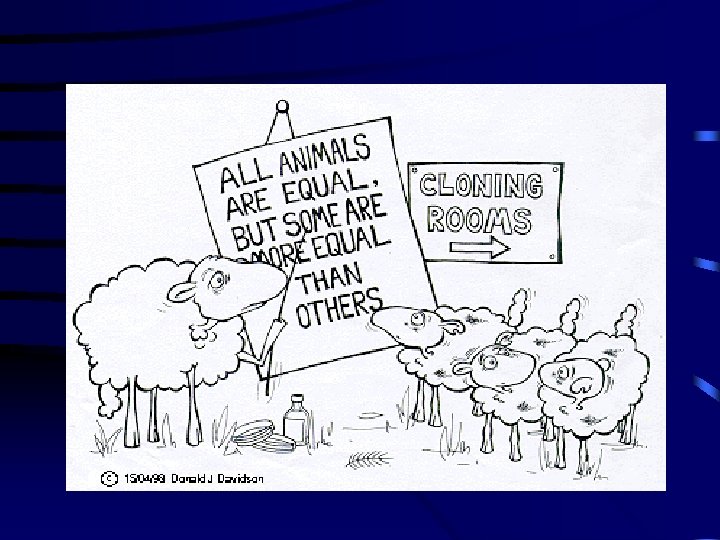
TREATING CLONES AS “SUB-HUMANS” • How can we treat sub-humans? • Will we have right to destroy clones at certain physical state and age to save medical care? • Will the discrimination of legislation between human and clone become slavery? • What if clones have significant support of the society?
ANTI-CLONING Ethics
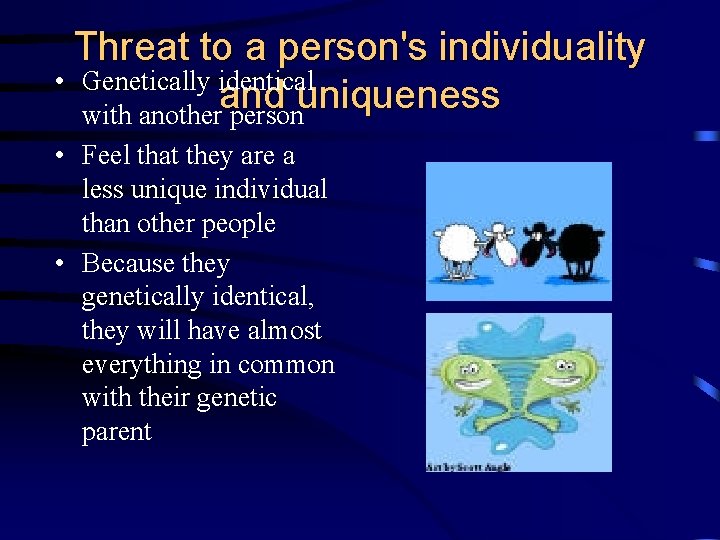
Threat to a person's individuality • Genetically identical and uniqueness with another person • Feel that they are a less unique individual than other people • Because they genetically identical, they will have almost everything in common with their genetic parent
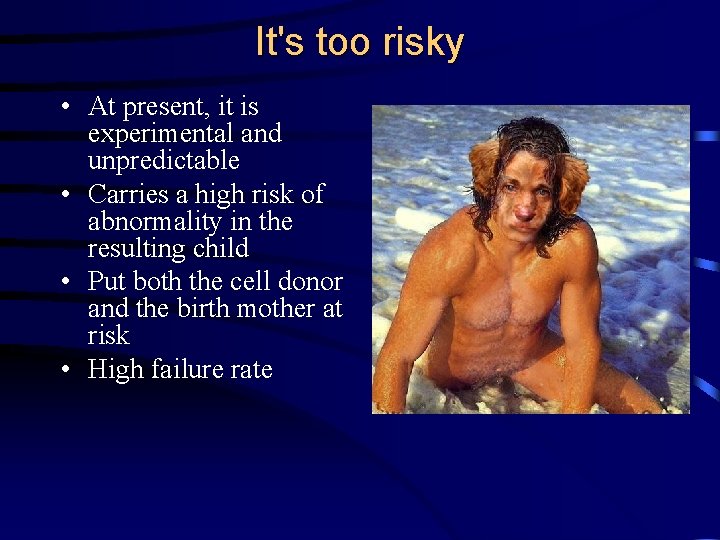
It's too risky • At present, it is experimental and unpredictable • Carries a high risk of abnormality in the resulting child • Put both the cell donor and the birth mother at risk • High failure rate
Eugenics – Start of a Brave New World • Encourages selective breeding • Discriminate against people • Genocide is an extreme form of eugenics • Could be used to produce an superior master race and underclass of slaves
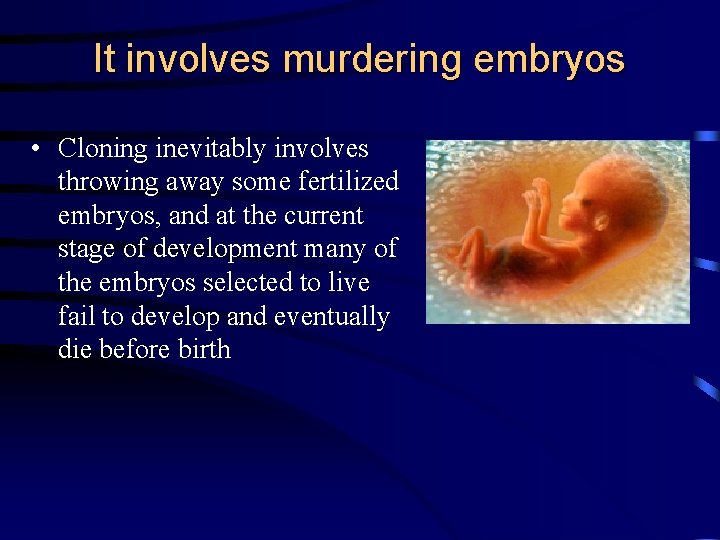
It involves murdering embryos • Cloning inevitably involves throwing away some fertilized embryos, and at the current stage of development many of the embryos selected to live fail to develop and eventually die before birth
Cloning reduces human beings to manufactured products • The way a person comes into being affects their value - or their dignity • People should be made by an act of love between their parents, not by a laboratory process • Supposing a particular embryo turns out to be very good - someone could patent its genes and use it to manufacture lots of similar clones for profit. That would degrade people
Problems of power • Invokes a degree of power and control over the physical identity of other persons
Take-home Message
Issues In Cloning: Loss of Biodiversity
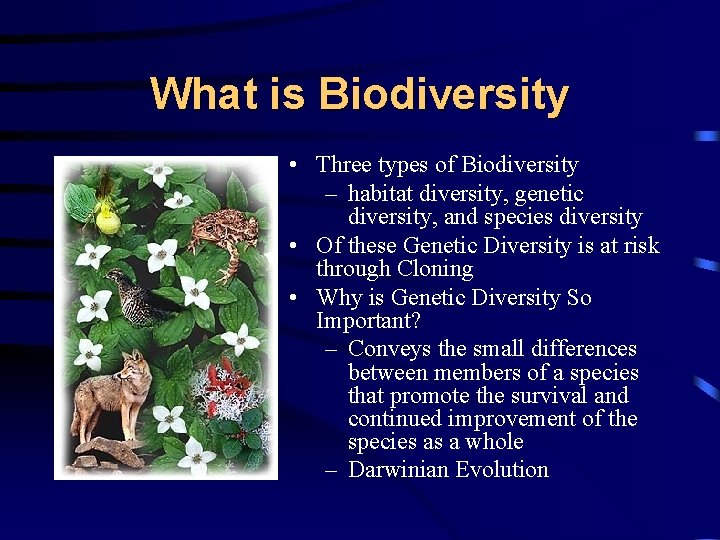
What is Biodiversity • Three types of Biodiversity – habitat diversity, genetic diversity, and species diversity • Of these Genetic Diversity is at risk through Cloning • Why is Genetic Diversity So Important? – Conveys the small differences between members of a species that promote the survival and continued improvement of the species as a whole – Darwinian Evolution
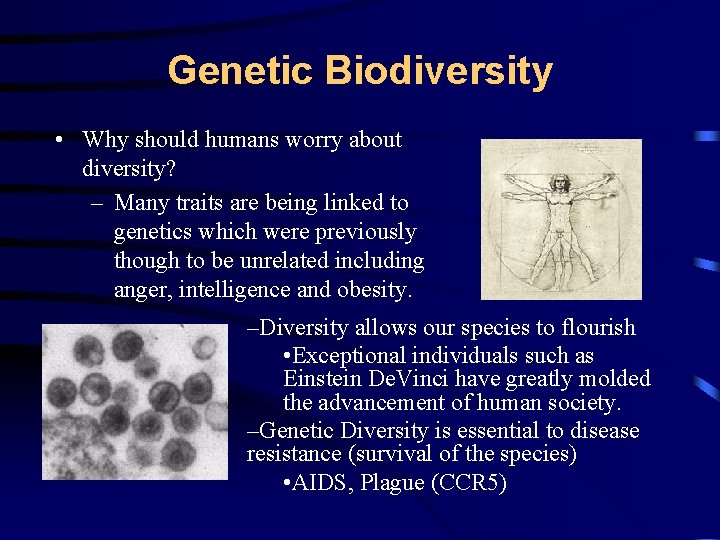
Genetic Biodiversity • Why should humans worry about diversity? – Many traits are being linked to genetics which were previously though to be unrelated including anger, intelligence and obesity. –Diversity allows our species to flourish • Exceptional individuals such as Einstein De. Vinci have greatly molded the advancement of human society. –Genetic Diversity is essential to disease resistance (survival of the species) • AIDS, Plague (CCR 5)
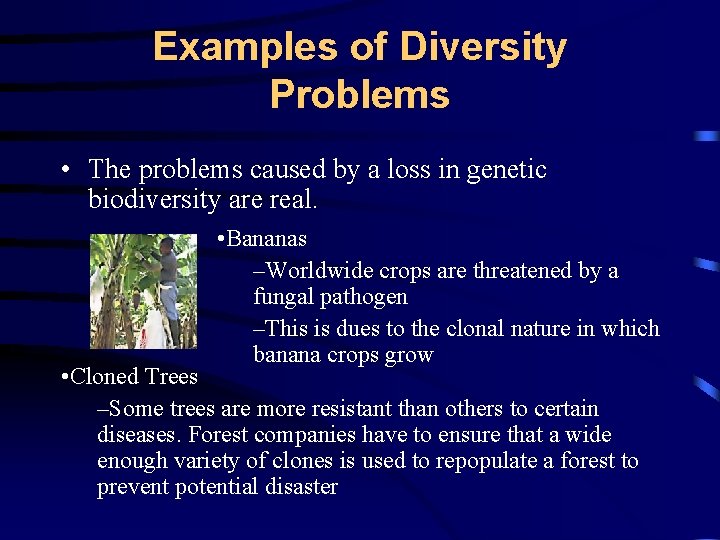
Examples of Diversity Problems • The problems caused by a loss in genetic biodiversity are real. • Bananas –Worldwide crops are threatened by a fungal pathogen –This is dues to the clonal nature in which banana crops grow • Cloned Trees –Some trees are more resistant than others to certain diseases. Forest companies have to ensure that a wide enough variety of clones is used to repopulate a forest to prevent potential disaster
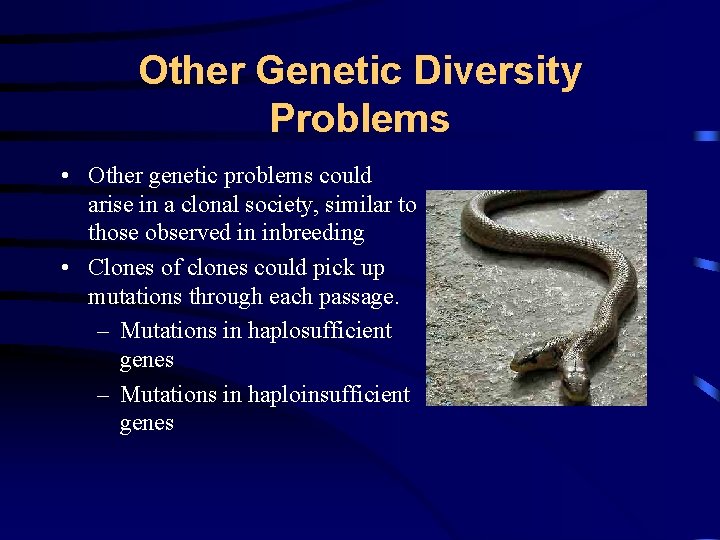
Other Genetic Diversity Problems • Other genetic problems could arise in a clonal society, similar to those observed in inbreeding • Clones of clones could pick up mutations through each passage. – Mutations in haplosufficient genes – Mutations in haploinsufficient genes
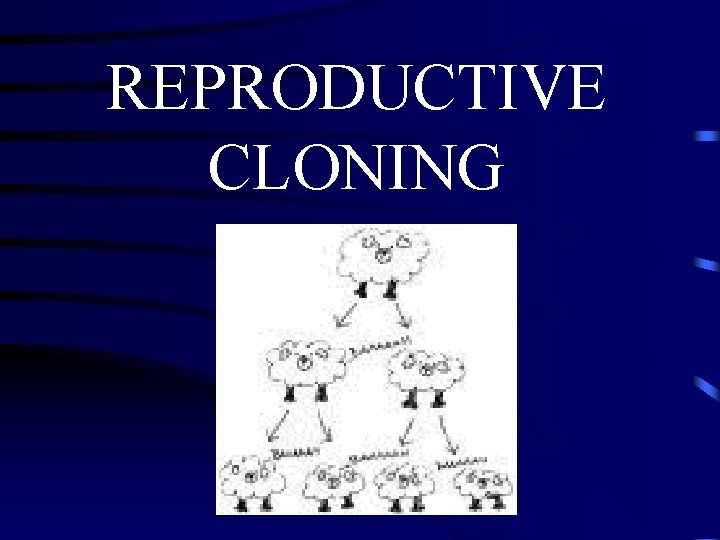
REPRODUCTIVE CLONING
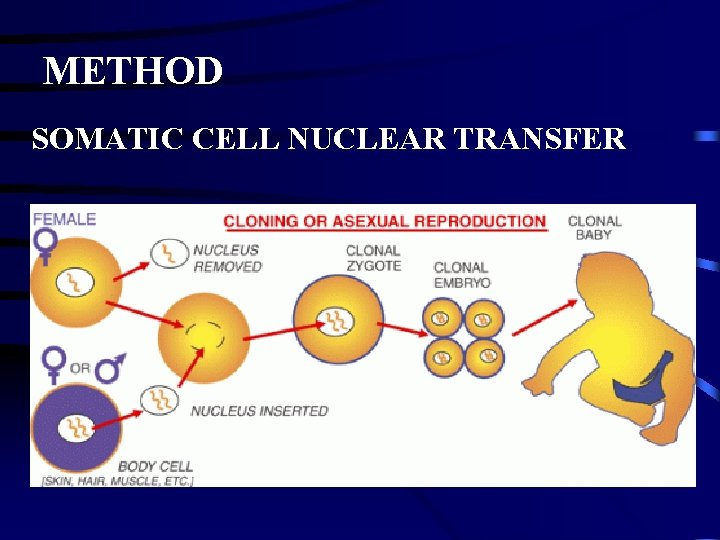
METHOD SOMATIC CELL NUCLEAR TRANSFER
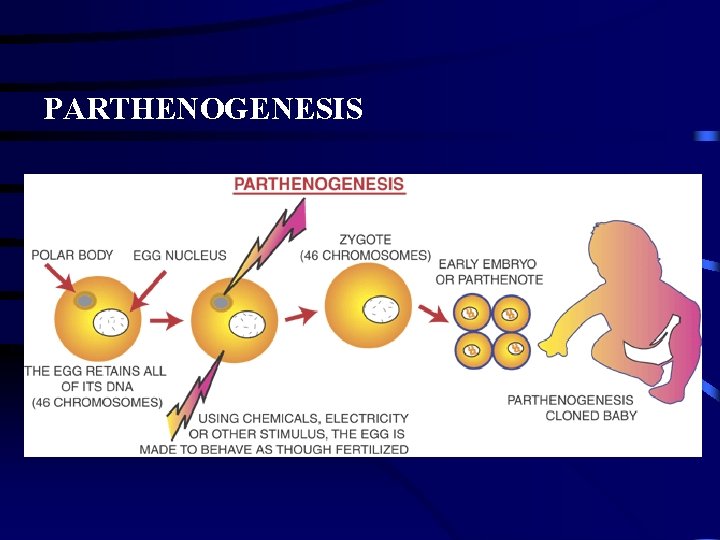
PARTHENOGENESIS
INSTABILITY AND UNPREDICTABILITY • DNA TRANSFERRED IS ALREADY DIFFERENTIATED • DIFFERENTIATED SOMATIC CELLS FORMATTED DIFFERENTLY FROM GERM CELLS • DIFFERENTIATED DNA MUST BE REPROGRAMMED TO ALLOW EMBRYOGENESIS • BUT HOW? ?
NUCLEAR REPROGRAMMING • REQUIRES REMOVAL OF EPIGENIC MODIFICATIONS IMPOSED ON DIFFERENTIATED CHROMATIN • OOCYTE CAN REVERSE THESE ALTERATIONS TO A STATE OF “TOTIPOTENCY” • HOW THIS IS DONE IS CURRENTLY UNKNOWN • HOW EFFICIENT IS THIS? ? FOR EVERY ANIMAL CLONED, HUNDREDS FAIL!!
MORE ON EFFICACY: • MANY FAILURES AND DEFECTS • NO DEFINED ASPECTS OF FAULTY DEVELOPMENT • RATHER, CLONING PROCESS CREATES RANDOM ERRORS IN INDIVIDUAL GENE EXPRESSION • MAY PRODUCE A MANY NUMBER OF UNPREDICTIBLE PROBLEMS • DOES NOT INVOLVE CHROMOSOMAL ABERRATION • DEFECTS CANNOT BE DETECTED BEFORE BIRTH
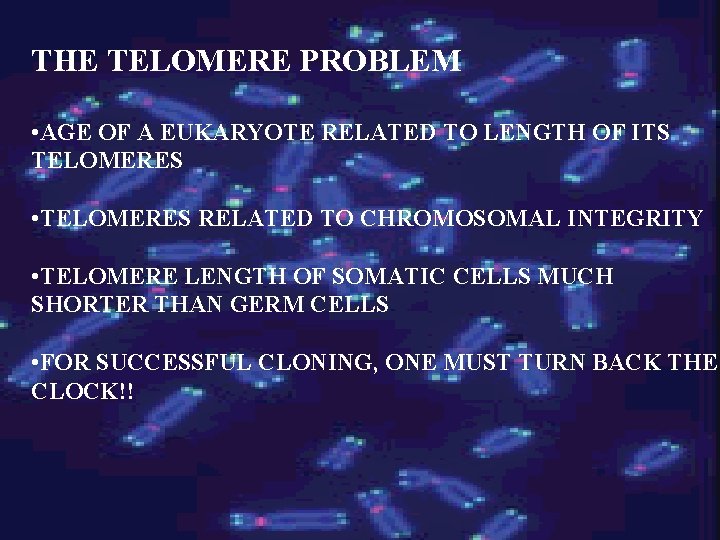
THE TELOMERE PROBLEM • AGE OF A EUKARYOTE RELATED TO LENGTH OF ITS TELOMERES • TELOMERES RELATED TO CHROMOSOMAL INTEGRITY • TELOMERE LENGTH OF SOMATIC CELLS MUCH SHORTER THAN GERM CELLS • FOR SUCCESSFUL CLONING, ONE MUST TURN BACK THE CLOCK!!
REJUVINATION • THE ENZYME RESPONSIBLE FOR EXTENDING THE TELOMERES IS “TELOMERASE” • THIS ENZYME IS NOT NORMALLY PRESENT IN SOMATIC CELLS, BUT SOME HAVE SHOWN ITS ACTIVITY IN CLONED EMBRYONIC CELLS • THIS MAY SUGGEST THAT THE OOCYTE CAN TURN BACK THE CLOCK HOWEVER!!
NEW EVIDENCE SUGGESTS SENESCENCE OF DONOR CELLS IS NOT RESTORED • 14 CATTLE CLONED USING DONOR CELLS FROM MUSCLE, OVIDUCT, MAMMARY, AND EAR SKIN • SHOW REMARKABLE VARIATION IN TELOMERE LENGHTS • SOME MUCH LONGER OR MUCH SHORTER THAN DONOR • SUGGESTS THAT CLONING DOES NOT NECESSARILY RESTORE TELOMERE CLOCK • NUCLEAR TRANSFER ITSELF MAY COMMONLY TRIGGER AN ELONGATION OF TELOMERES, MORE OR LESS ACCORDING TO DONOR TYPE • Myashita et. Al: Biol Reprod 2002 Jun; 66(6): 1649 -55
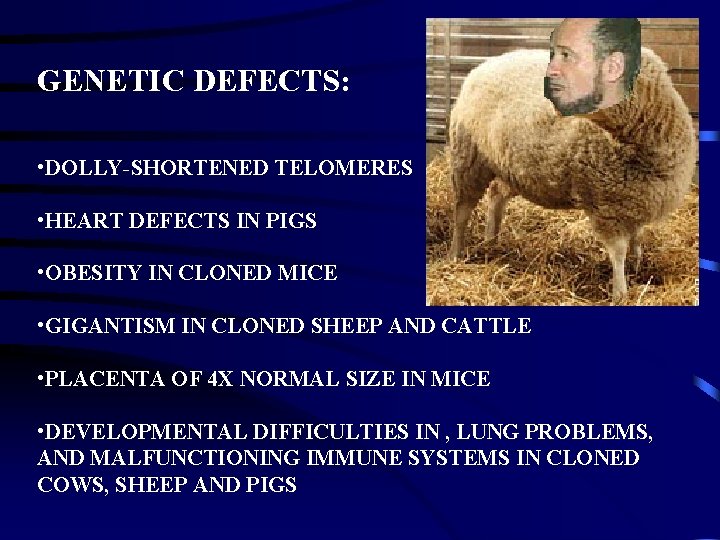
GENETIC DEFECTS: • DOLLY-SHORTENED TELOMERES • HEART DEFECTS IN PIGS • OBESITY IN CLONED MICE • GIGANTISM IN CLONED SHEEP AND CATTLE • PLACENTA OF 4 X NORMAL SIZE IN MICE • DEVELOPMENTAL DIFFICULTIES IN , LUNG PROBLEMS, AND MALFUNCTIONING IMMUNE SYSTEMS IN CLONED COWS, SHEEP AND PIGS
EVIDENCE THUS FAR: • CLONING IS STILL POORLY UNDERSTOOD • CLONING IS FAR TOO INEFFICIENT • GIVEN THESE FACTORS, IT WOULD BE DANGEROUS AND IRRESPONSIBLE TO ATTEMPT TO CLONE HUMAN BEINGS • CLONING OF ANIMALS SHOULD NOT CONTINUE GIVEN THE ABNORMALITIES THAT RENDER THESE PRACTICES UNETHICAL
MISCONCEPTIONS BORDERING ON IDIOCY • CLONED INDIVIDUALS DO NOT IN FACT APPEAR ADULT SIZE FROM TANKS FILLED WITH EMBRYONIC FLUID • CLONED INDIVIDUALS WILL NOT HAVE ALL THE CHARACTERISTICS OF THE DONOR: ALTHOUGH THE TWO WILL BE GENETICALLY EQUIVALENT (GIVEN NO SEVERE ABNORMAITIES) PERSONALITY AND CHARACTER DEVELOP IN CONTEXT OF EXPERIENCE AND ENVIRONMENT
Why Clone ?
Organ Harvesting • The ability to create individuals with nearidentical genetics would allow for easier organ transplantation • This is fraught with perils as killing someone is illegal and organ removal greatly weakens the donor • Cloning is horribly inefficient as it is quite difficult to even create a clone let alone waiting for one to develop to an appropriate age for adult organ transplantation
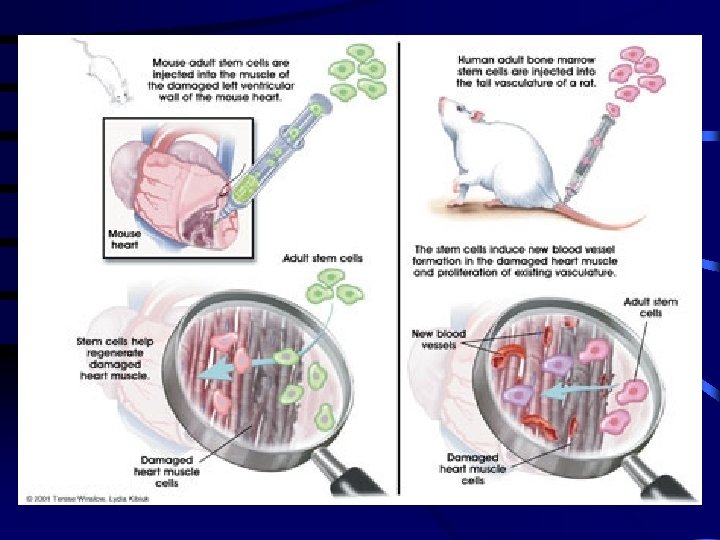
Embryonic vs. Adult Stem Cells • Only embryonically harvested stem cells are created through cloning • The conversion of adult cells into cells with stem cell like features does not require cloning • All that is required to create adult stem cells is extraction of cells and treatment with media to stimulate differentiated cells to undifferentiate and adopt a stem cell like phenotype
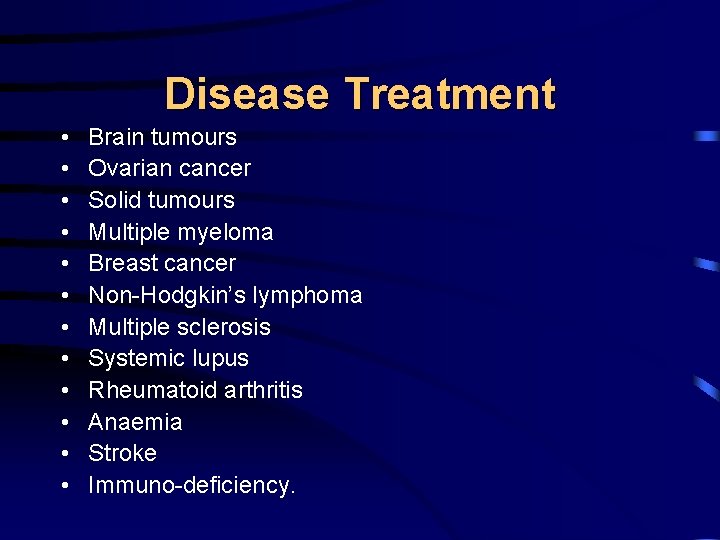
Disease Treatment • • • Brain tumours Ovarian cancer Solid tumours Multiple myeloma Breast cancer Non-Hodgkin’s lymphoma Multiple sclerosis Systemic lupus Rheumatoid arthritis Anaemia Stroke Immuno-deficiency.
Therapeutic Cloning • At this time there are no practical roles for cloning in therapeutics • Organ harvesting is unethical and suffers from both inefficiency and a long gestation period • Stem cell transplantation while a viable therapy has been shown to be effective using adult stem cells removing the need to use cloning to produce embryonic stem cells
Where have all the bananas gone? • The banana, discovered in South East Asia 10, 000 years ago, faces extinction due to parasites that resist drugs. • Bananas can only reproduce clonally making it difficult to breed new, improved varieties and therefore impossible for them to adapt to drug resistant pathogens
Don’t let this happen to us