
Legal Environment Introduction to Business The Meaning and
Legal Environment Introduction to Business
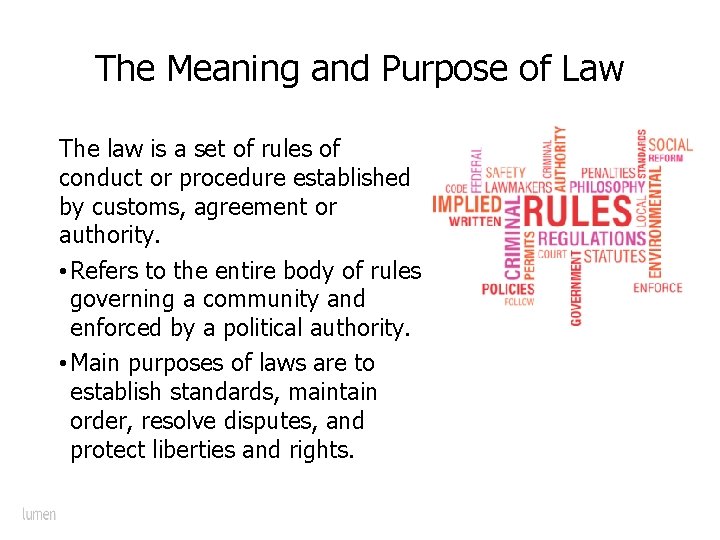
The Meaning and Purpose of Law The law is a set of rules of conduct or procedure established by customs, agreement or authority. • Refers to the entire body of rules governing a community and enforced by a political authority. • Main purposes of laws are to establish standards, maintain order, resolve disputes, and protect liberties and rights.
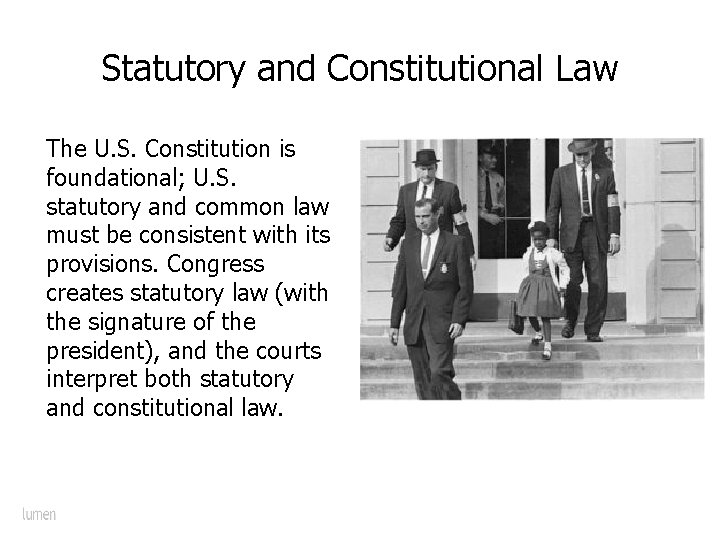
Statutory and Constitutional Law The U. S. Constitution is foundational; U. S. statutory and common law must be consistent with its provisions. Congress creates statutory law (with the signature of the president), and the courts interpret both statutory and constitutional law.
Common Law and Case Law When there is neither constitutional law nor statutory law, the courts function in the realm of common law. Common law is a law developed by judges, courts, and similar tribunals. Over time, the decisions in individual cases establish precedents for future cases. In common law systems, this principle is known as stare decisis. Stare decisis holds that cases should be decided according to consistent principled rules so that similar facts will yield similar results.
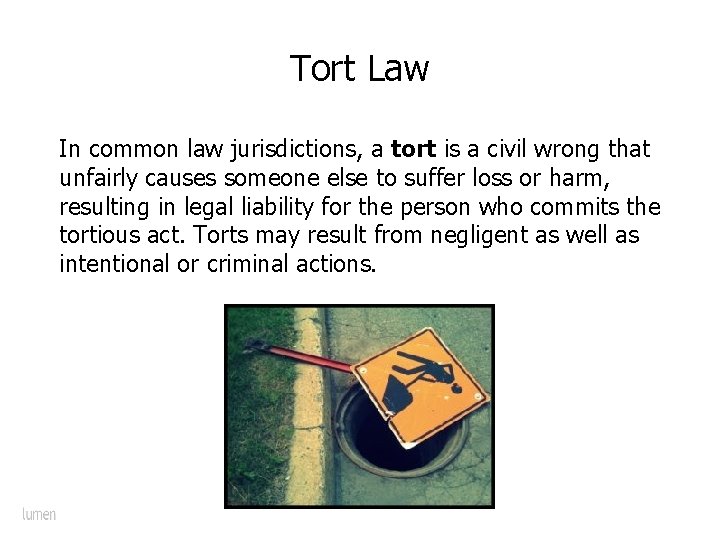
Tort Law In common law jurisdictions, a tort is a civil wrong that unfairly causes someone else to suffer loss or harm, resulting in legal liability for the person who commits the tortious act. Torts may result from negligent as well as intentional or criminal actions.
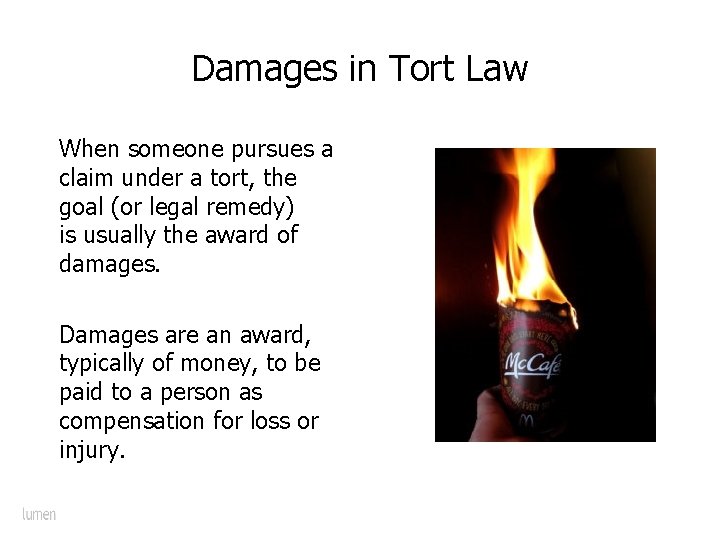
Damages in Tort Law When someone pursues a claim under a tort, the goal (or legal remedy) is usually the award of damages. Damages are an award, typically of money, to be paid to a person as compensation for loss or injury.
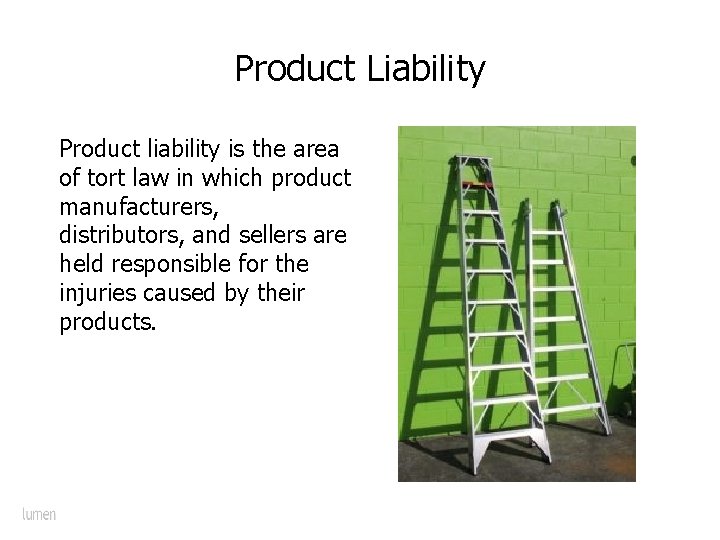
Product Liability Product liability is the area of tort law in which product manufacturers, distributors, and sellers are held responsible for the injuries caused by their products.
Intellectual Property Intellectual property refers to creative works or ideas embodied in a form that can be shared or enable others to recreate, emulate, or manufacture them. There are three main ways to protect intellectual property: 1. Patents 2. Trademarks 3. Copyrights
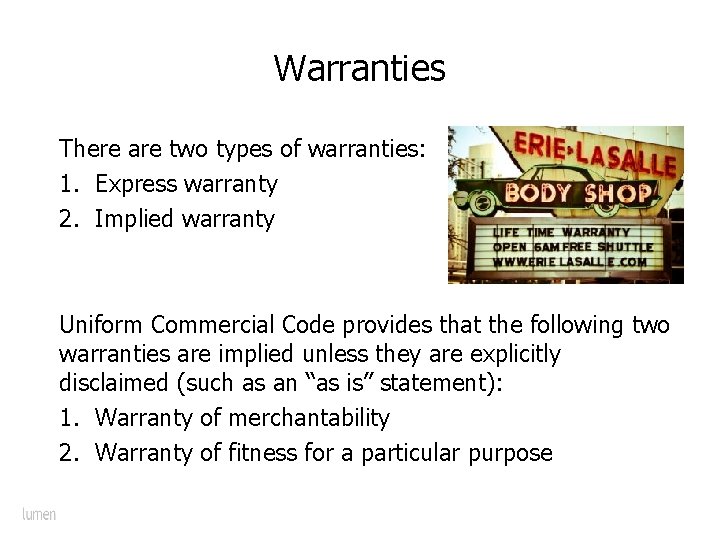
Warranties There are two types of warranties: 1. Express warranty 2. Implied warranty Uniform Commercial Code provides that the following two warranties are implied unless they are explicitly disclaimed (such as an “as is” statement): 1. Warranty of merchantability 2. Warranty of fitness for a particular purpose
Contract Law Every transaction in business creates a contract (agreement) between the parties. To determine whether a valid, enforceable contract exists, the following questions must be answered: 1. Did the parties reach an agreement? 2. Was consideration present? 3. Was the agreement legal? 4. Did the parties have the capacity to make a contract? 5. Was the agreement in the proper form?
Remedies for Breach of Contract There are several remedies for when a party fails to live up to its obligations under a contract: • Specific performance • Damages: general and consequential • Discharge of duties
Consumer Protection Law A range of laws regulate consumer affairs with the aim to protect consumers from unscrupulous business practices or potentially dangerous products. Some of the most far-reaching consumer protection laws include: • Fair Credit Reporting Act • Fair Debt Collection Practices Act • Federal Food, Drug, and Cosmetics Act • Uniform Deceptive Trade Practices Act
Antitrust Law Antitrust legislation is a kind of consumer protection that aims to prevent unfair business practices that limit competition or control prices. The three core federal antitrust laws are: 1. The Sherman Act 2. The Federal Trade Commission Act 3. The Clayton Act
Practice Question How does the role of precedent and stare decisis contribute to the business climate?
Quick Review • What is the meaning and purpose of law? • What is the difference between statutory and common law? • What is tort law? What is the role of product liability in tort law? • What is the purpose and characteristics of intellectual property law? • What are warranties? • What are the elements of a legally enforceable contract and the consequences of breach of contract? • What do consumer protection and antitrust laws do?
- Slides: 15