
Legal Current Events Maree Sneed AASA Governing Board

Legal Current Events Maree Sneed AASA Governing Board March 1, 2017
Today’s presenter Maree Sneed Partner, Washington, D. C. T 202 637 6416 maree. sneed@hoganlovells. com Hogan Lovells | 2
Agenda q. Education cases before the U. S. Supreme Court this term q. Fry v. Napoleon Community Schools q. Endrew F. v. Douglas County School District q. Gloucester County School Board v. G. G. q. ED regulations under the Trump Administration q. Wrap up/Questions Hogan Lovells | 3
Educations cases before the U. S. Supreme Court this term
Fry v. Napoleon Community Schools
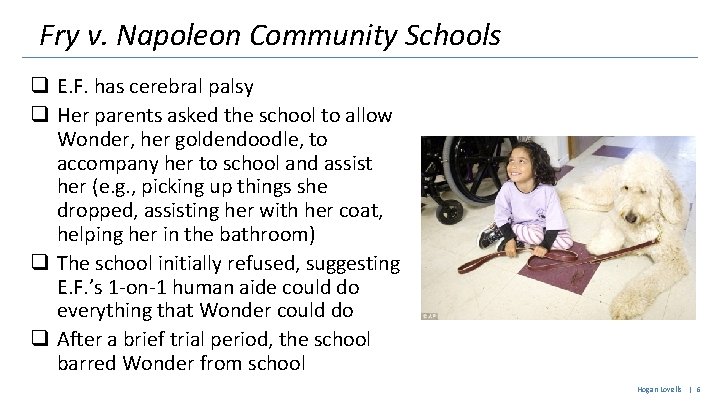
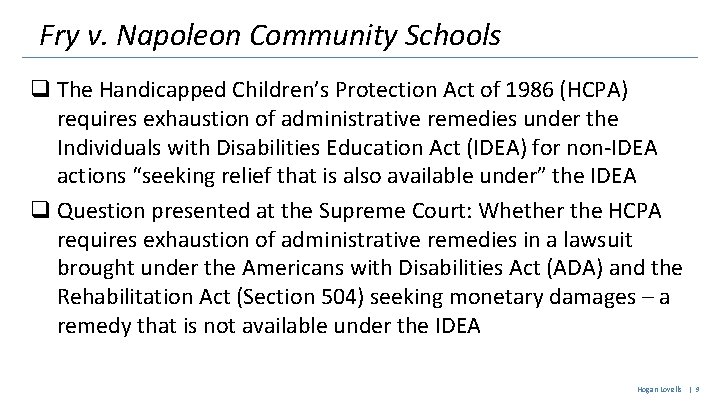
Fry v. Napoleon Community Schools q E. F. has cerebral palsy q Her parents asked the school to allow Wonder, her goldendoodle, to accompany her to school and assist her (e. g. , picking up things she dropped, assisting her with her coat, helping her in the bathroom) q The school initially refused, suggesting E. F. ’s 1 -on-1 human aide could do everything that Wonder could do q After a brief trial period, the school barred Wonder from school Hogan Lovells | 6
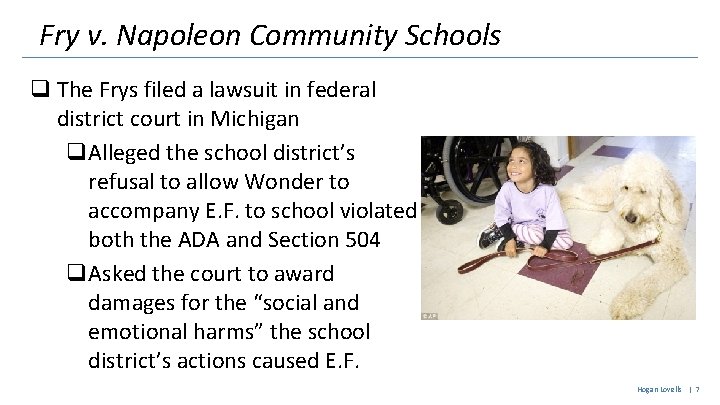
Fry v. Napoleon Community Schools q The Frys filed a lawsuit in federal district court in Michigan q. Alleged the school district’s refusal to allow Wonder to accompany E. F. to school violated both the ADA and Section 504 q. Asked the court to award damages for the “social and emotional harms” the school district’s actions caused E. F. Hogan Lovells | 7
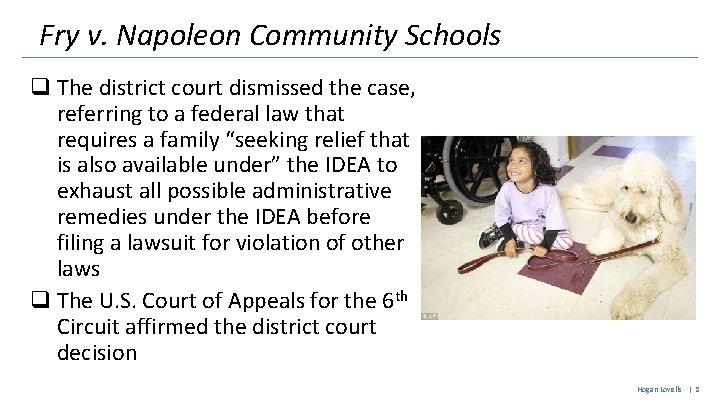
Fry v. Napoleon Community Schools q The district court dismissed the case, referring to a federal law that requires a family “seeking relief that is also available under” the IDEA to exhaust all possible administrative remedies under the IDEA before filing a lawsuit for violation of other laws q The U. S. Court of Appeals for the 6 th Circuit affirmed the district court decision Hogan Lovells | 8
Fry v. Napoleon Community Schools q The Handicapped Children’s Protection Act of 1986 (HCPA) requires exhaustion of administrative remedies under the Individuals with Disabilities Education Act (IDEA) for non-IDEA actions “seeking relief that is also available under” the IDEA q Question presented at the Supreme Court: Whether the HCPA requires exhaustion of administrative remedies in a lawsuit brought under the Americans with Disabilities Act (ADA) and the Rehabilitation Act (Section 504) seeking monetary damages – a remedy that is not available under the IDEA Hogan Lovells | 9
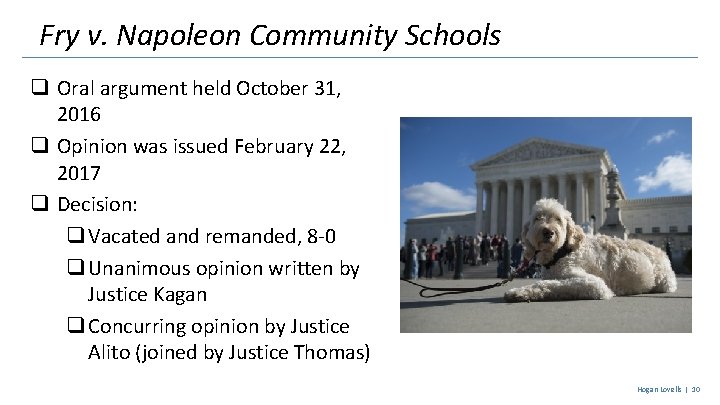
Fry v. Napoleon Community Schools q Oral argument held October 31, 2016 q Opinion was issued February 22, 2017 q Decision: q Vacated and remanded, 8 -0 q Unanimous opinion written by Justice Kagan q Concurring opinion by Justice Alito (joined by Justice Thomas) Hogan Lovells | 10
Fry v. Napoleon Community Schools q Holding of the Court: q Exhaustion of the administrative procedures established by IDEA is unnecessary when the “gravamen” of the plaintiff’s suit is something other than the denial of FAPE q Case remanded to 6 th Circuit for analysis of whether the gravamen of E. F. ’s complaint is denial of FAPE (or something else) Hogan Lovells | 11
Fry v. Napoleon Community Schools q Court’s reasoning: q HCPA requires a plaintiff to begin with IDEA’s administrative proceedings if she is seeking “relief” that is “available” under the IDEA q Under the IDEA, only “relief” that is “available” is FAPE q A plaintiff must first use the IDEA’s administrative proceedings only if she contends she has been denied FAPE q IDEA hearing officer cannot provide relief other than FAPE Hogan Lovells | 12
Fry v. Napoleon Community Schools q Court’s proposed test to decide when the plaintiff is seeking relief for denial of FAPE: q. Look to the “gravamen” or “essentials” of the complaint q. Don’t make decision based on any “magic words” in the complaint Hogan Lovells | 13
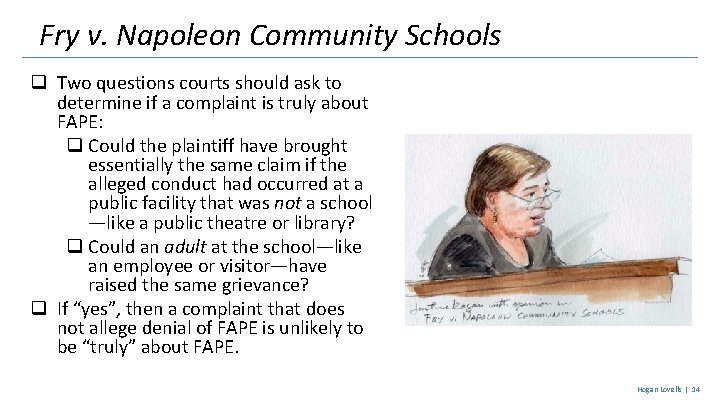
Fry v. Napoleon Community Schools q Two questions courts should ask to determine if a complaint is truly about FAPE: q Could the plaintiff have brought essentially the same claim if the alleged conduct had occurred at a public facility that was not a school —like a public theatre or library? q Could an adult at the school—like an employee or visitor—have raised the same grievance? q If “yes”, then a complaint that does not allege denial of FAPE is unlikely to be “truly” about FAPE. Hogan Lovells | 14
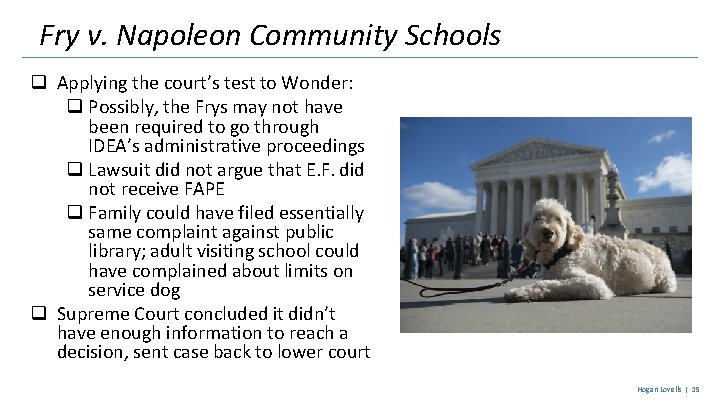
Fry v. Napoleon Community Schools q Applying the court’s test to Wonder: q Possibly, the Frys may not have been required to go through IDEA’s administrative proceedings q Lawsuit did not argue that E. F. did not receive FAPE q Family could have filed essentially same complaint against public library; adult visiting school could have complained about limits on service dog q Supreme Court concluded it didn’t have enough information to reach a decision, sent case back to lower court Hogan Lovells | 15
Endrew F. v. Douglas County School District
Endrew F. v. Douglas County School District q Background q IDEA gives federal funds to states that agree to offer a “free and appropriate public education” (FAPE) to students with disabilities q The student’s IEP must set forth a plan that is tailored to the unique needs of each child q In 1982, the Supreme Court ruled in Board of Education v. Rowley that an IEP must be “reasonably calculated to enable the child to receive educational benefits” Hogan Lovells | 17
Endrew F. v. Douglas County School District q Endrew (Drew), a student with autism, was enrolled in Douglas County School District from preschool – 4 th grade q In each year, he had an IEP q Drew did not return to public school for 5 th grade; his parents disagreed with school officials about IEP proposed for that year q Parents enrolled Drew in private school Hogan Lovells | 18
Endrew F. v. Douglas County School District q Drew and parents filed a complaint with the state’s department of education, claiming he had been denied FAPE and seeking reimbursement for private school tuition q Hearing offer ruled for school district, finding that Drew had made “some academic progress” while in public school Hogan Lovells | 19
Endrew F. v. Douglas County School District q Drew and his parents filed a lawsuit in federal district court; the court agreed with the school district q U. S. Court of Appeals for the 10 th Circuit upheld that ruling q School district needed to try to provide Drew with educational benefit that was “merely more than de minimis” q Under that test, Drew’s IEP was “substantially adequate” q Drew and his parents asked the U. S. Supreme Court to take the case Hogan Lovells | 20
Endrew F. v. Douglas County School District q Question presented: What is the level of educational benefit that school districts must confer on children with disabilities to provide them with FAPE as guaranteed by the IDEA? q U. S. Supreme Court heard oral argument on January 11, 2017 Hogan Lovells | 21
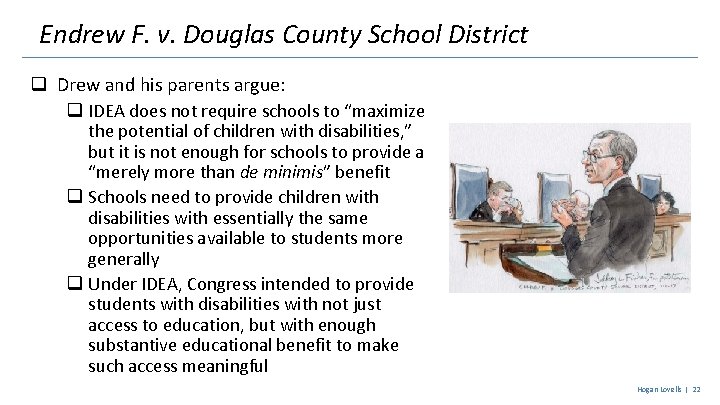
Endrew F. v. Douglas County School District q Drew and his parents argue: q IDEA does not require schools to “maximize the potential of children with disabilities, ” but it is not enough for schools to provide a “merely more than de minimis” benefit q Schools need to provide children with disabilities with essentially the same opportunities available to students more generally q Under IDEA, Congress intended to provide students with disabilities with not just access to education, but with enough substantive educational benefit to make such access meaningful Hogan Lovells | 22
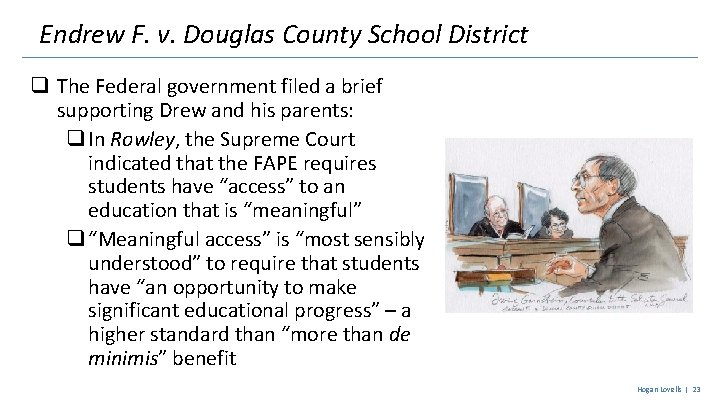
Endrew F. v. Douglas County School District q The Federal government filed a brief supporting Drew and his parents: q In Rowley, the Supreme Court indicated that the FAPE requires students have “access” to an education that is “meaningful” q “Meaningful access” is “most sensibly understood” to require that students have “an opportunity to make significant educational progress” – a higher standard than “more than de minimis” benefit Hogan Lovells | 23
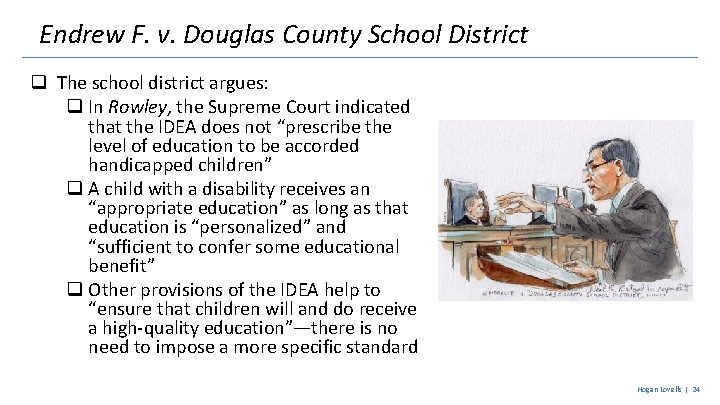
Endrew F. v. Douglas County School District q The school district argues: q In Rowley, the Supreme Court indicated that the IDEA does not “prescribe the level of education to be accorded handicapped children” q A child with a disability receives an “appropriate education” as long as that education is “personalized” and “sufficient to confer some educational benefit” q Other provisions of the IDEA help to “ensure that children will and do receive a high-quality education”—there is no need to impose a more specific standard Hogan Lovells | 24
Endrew F. v. Douglas County School District q The school district argues a more specific standard would have undesirable consequences: q It would require courts to become involved in education policy disputes, and courts lack specialized knowledge and experience to resolve such disputes q It would unfairly change the rules in the middle of the game—states and school districts couldn’t anticipate a more specific standard Hogan Lovells | 25
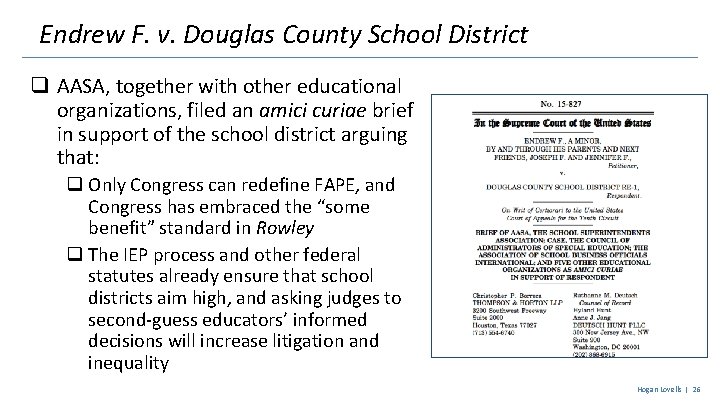
Endrew F. v. Douglas County School District q AASA, together with other educational organizations, filed an amici curiae brief in support of the school district arguing that: q Only Congress can redefine FAPE, and Congress has embraced the “some benefit” standard in Rowley q The IEP process and other federal statutes already ensure that school districts aim high, and asking judges to second-guess educators’ informed decisions will increase litigation and inequality Hogan Lovells | 26
Gloucester County School Board v. G. G.
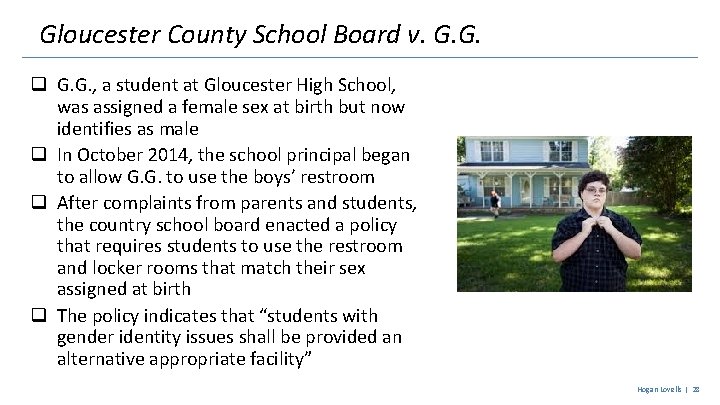
Gloucester County School Board v. G. G. q G. G. , a student at Gloucester High School, was assigned a female sex at birth but now identifies as male q In October 2014, the school principal began to allow G. G. to use the boys’ restroom q After complaints from parents and students, the country school board enacted a policy that requires students to use the restroom and locker rooms that match their sex assigned at birth q The policy indicates that “students with gender identity issues shall be provided an alternative appropriate facility” Hogan Lovells | 28
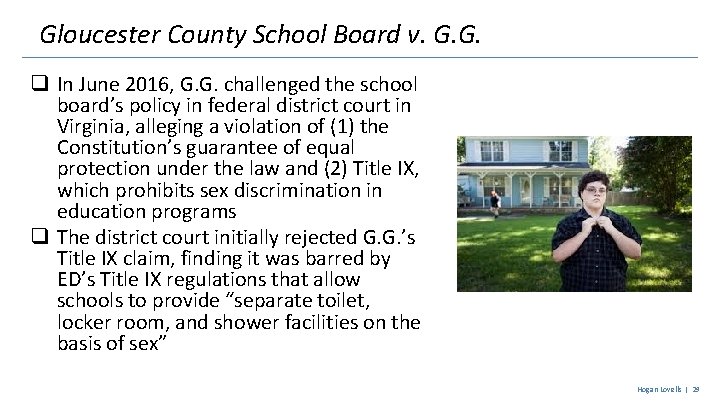
Gloucester County School Board v. G. G. q In June 2016, G. G. challenged the school board’s policy in federal district court in Virginia, alleging a violation of (1) the Constitution’s guarantee of equal protection under the law and (2) Title IX, which prohibits sex discrimination in education programs q The district court initially rejected G. G. ’s Title IX claim, finding it was barred by ED’s Title IX regulations that allow schools to provide “separate toilet, locker room, and shower facilities on the basis of sex” Hogan Lovells | 29
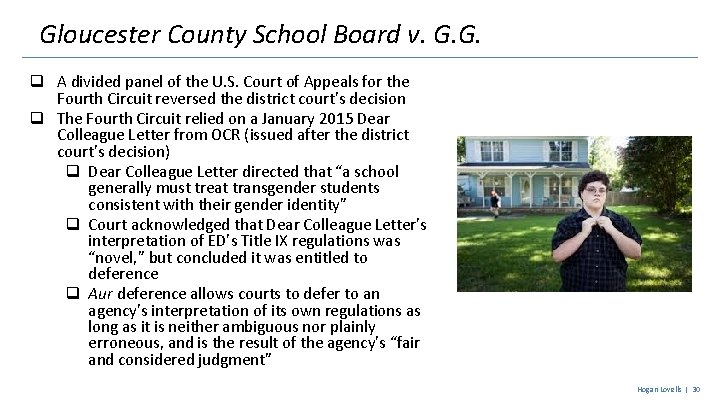
Gloucester County School Board v. G. G. q A divided panel of the U. S. Court of Appeals for the Fourth Circuit reversed the district court’s decision q The Fourth Circuit relied on a January 2015 Dear Colleague Letter from OCR (issued after the district court’s decision) q Dear Colleague Letter directed that “a school generally must treat transgender students consistent with their gender identity” q Court acknowledged that Dear Colleague Letter’s interpretation of ED’s Title IX regulations was “novel, ” but concluded it was entitled to deference q Aur deference allows courts to defer to an agency’s interpretation of its own regulations as long as it is neither ambiguous nor plainly erroneous, and is the result of the agency’s “fair and considered judgment” Hogan Lovells | 30
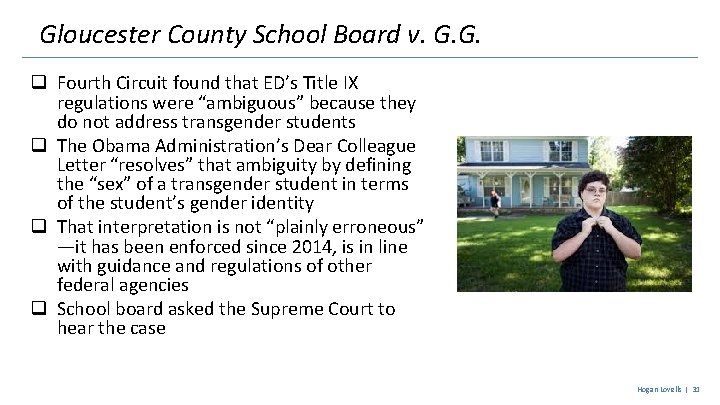
Gloucester County School Board v. G. G. q Fourth Circuit found that ED’s Title IX regulations were “ambiguous” because they do not address transgender students q The Obama Administration’s Dear Colleague Letter “resolves” that ambiguity by defining the “sex” of a transgender student in terms of the student’s gender identity q That interpretation is not “plainly erroneous” —it has been enforced since 2014, is in line with guidance and regulations of other federal agencies q School board asked the Supreme Court to hear the case Hogan Lovells | 31
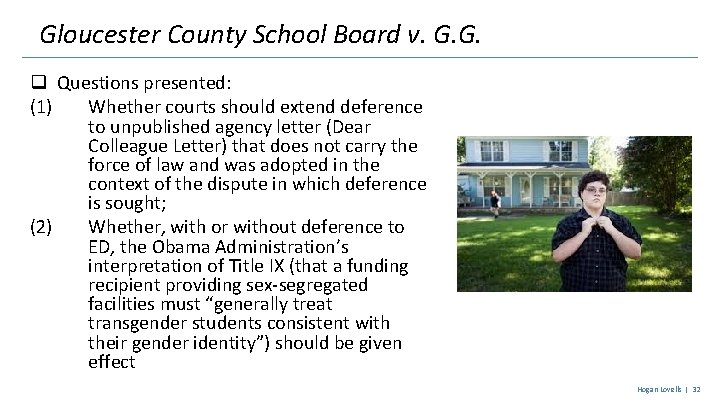
Gloucester County School Board v. G. G. q Questions presented: (1) Whether courts should extend deference to unpublished agency letter (Dear Colleague Letter) that does not carry the force of law and was adopted in the context of the dispute in which deference is sought; (2) Whether, with or without deference to ED, the Obama Administration’s interpretation of Title IX (that a funding recipient providing sex-segregated facilities must “generally treat transgender students consistent with their gender identity”) should be given effect Hogan Lovells | 32
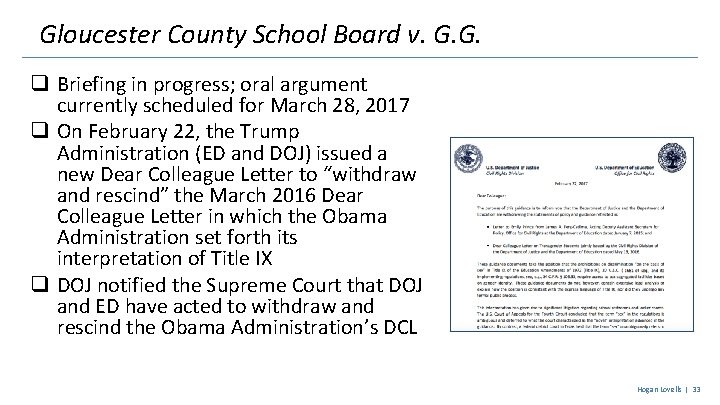
Gloucester County School Board v. G. G. q Briefing in progress; oral argument currently scheduled for March 28, 2017 q On February 22, the Trump Administration (ED and DOJ) issued a new Dear Colleague Letter to “withdraw and rescind” the March 2016 Dear Colleague Letter in which the Obama Administration set forth its interpretation of Title IX q DOJ notified the Supreme Court that DOJ and ED have acted to withdraw and rescind the Obama Administration’s DCL Hogan Lovells | 33
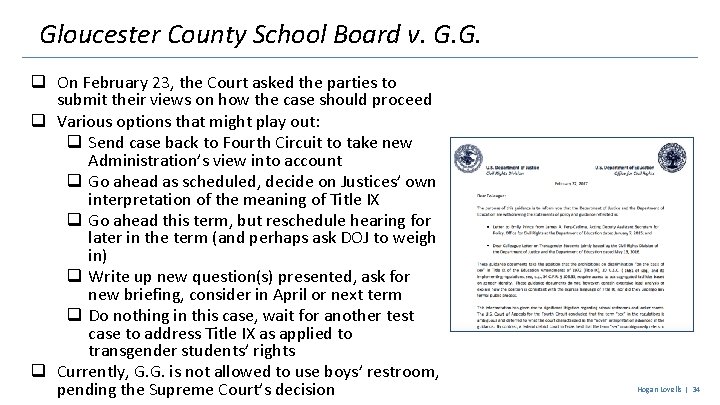
Gloucester County School Board v. G. G. q On February 23, the Court asked the parties to submit their views on how the case should proceed q Various options that might play out: q Send case back to Fourth Circuit to take new Administration’s view into account q Go ahead as scheduled, decide on Justices’ own interpretation of the meaning of Title IX q Go ahead this term, but reschedule hearing for later in the term (and perhaps ask DOJ to weigh in) q Write up new question(s) presented, ask for new briefing, consider in April or next term q Do nothing in this case, wait for another test case to address Title IX as applied to transgender students’ rights q Currently, G. G. is not allowed to use boys’ restroom, pending the Supreme Court’s decision Hogan Lovells | 34
ED regulations under the Trump Administration
ED regulations under the Trump Admin. q Some planned regulations were not finalized by the Obama Administration, which ran out of time to issue a final rule q Title I supplement, not supplant q The implementation of some regulations has been delayed q ESSA Accountability and State Plans (orig. effective date: Jan. 30, 2017) – new, delayed effective date: March 21, 2017 Hogan Lovells | 36
ED regulations under the Trump Admin. q The Trump Administration acted on Feb. 22 to withdraw and rescind the Obama Administration’s Dear Colleague Letter on transgender students under Title IX q The Administration may make additional changes to interpretation of other regulations, or may signal changes to enforcement methods Hogan Lovells | 37
Wrap Up/Questions
Questions? Reach out to us. Maree Sneed Partner, Washington, D. C. T 202 637 6416 maree. sneed@hoganlovells. com Hogan Lovells | 39
Our global presence Hogan Lovells | 40

www. hoganlovells. com "Hogan Lovells" or the "firm" is an international legal practice that includes Hogan Lovells International LLP, Hogan Lovells US LLP and their affiliated businesses. The word “partner” is used to describe a partner or member of Hogan Lovells International LLP, Hogan Lovells US LLP or any of their affiliated entities or any employee or consultant with equivalent standing. . Certain individuals, who are designated as partners, but who are not members of Hogan Lovells International LLP, do not hold qualifications equivalent to members. For more information about Hogan Lovells, the partners and their qualifications, see www. hoganlovells. com. Where case studies are included, results achieved do not guarantee similar outcomes for other clients. Attorney advertising. Images of people may feature current or former lawyers and employees at Hogan Lovells or models not connected with the firm. © Hogan Lovells 2017. All rights reserved
- Slides: 41