
LEGAL CERTAINTY AND PUBLIC SAFETY BY DESIGN Mireille

LEGAL CERTAINTY AND PUBLIC SAFETY BY DESIGN Mireille Hildebrandt Science Faculty, Radboud University Nijmegen Faculty Law & Criminology, Vrije Universiteit Brussel 17 May 2016 Public Safety & Legal Certainty by Design 1

17 May 2016 Public Safety & Legal Certainty by Design 2

safety, security, certainty ■ safety: against natural causes (physical) – resilience, vulnerability ■ security: against attacks (physical, cyber) – malware, vulerability, terrorist attacks ■ certainty: level of foresight (expectations) – foreseeability, monitoring, analysis 17 May 2016 Public Safety & Legal Certainty by Design 3

public safety & security, legal certainty public safety & security: ■ safeguarding against major disruptions that affect everyone’s expectations, that create uncertainty, thus reducing capabilities to plan ahead ■ generating societal trust & resilience legal certainty: ■ having a fair idea of the legal effect of one’s actions (duty to compensate, being subject to fines or punishment, being subject to investigations) ■ knowing how one can create obligations and hold others to account, and how one is protected against violations of one’s fundamental rights ■ strong relationship with trust 17 May 2016 Public Safety & Legal Certainty by Design 4

‘by design’ in a data-driven environment public safety & security by design: ■ integrating requirements into data-driven applications and infrastructure that enables 1. to foresee disasters 2. develop effective responses to reduce impact, to provide emergency relief, follow up and to develop learning mechanisms to confront future disasters legal certainty by design? ■ confidentiality, integrity (& availability) of cyberphysical infrastructures ■ integration of data protection into data-driven applications and infrastructures involved in public safety operations 17 May 2016 Public Safety & Legal Certainty by Design 5
A. emergency relief B. follow up C. post-hoc analysis, accountability, learning 17 May 2016 Public Safety & Legal Certainty by Design 6
1. ‘social’ (what’s up? ) 2. ethical (what should be done? justice without legal certainty) Ø ethics is more and less than law 3. legal (enforceable standards, norms, legitimate expectations) Ø law is more and less than ethics 17 May 2016 Public Safety & Legal Certainty by Design 7
A. emergency relief (vital interests of individuals and groups) B. follow up (vital interests, public interest task or official authority) C. post-hoc analysis, accountability, learning 17 May 2016 Public Safety & Legal Certainty by Design 8
post-hoc analysis Developing a framework of analysis, reconfiguring risk-analyses, predicting and/or pre-empting similar disasters ■ social: developing sustainable and resilient response mechanisms to prevent of cope with future disasters; long term follow-up of victims, failing infrastructure ■ ethical: connect with the victims, respect them as persons, enable to restore dignity and enable them to develop a new life, assess potential discrimination and lack of due process, false accusations (scapegoat mechanisms) ■ legal: shift towards other legal grounds, further purposes, make sure data is deleted, anonymised or properly pseudonymised (the latter requires ground & purpose) 17 May 2016 Public Safety & Legal Certainty by Design 9
legal certainty ■ Three critical data protection issues: – purpose limitation = trust that data will not be used against one in another context – data minimisation (pseudonymisation) = trust that no unnecessary risks are taken – profile transparency for analytics 1. a fair idea of how one may be targeted 2. detection of potential bias 3. empowering constructive distrust and contestation 17 May 2016 Public Safety & Legal Certainty by Design 10
posthoc analysis: legal Legal conditions for fair and lawful processing of personal data: ■ Purpose (repurposing of emergengy & follow-up and other data, to predict e. g. crowd behaviours) ■ Data minimisation (select before and while you collect; pseudonymise; restrict access; separate research access from operational access; develop and implement data life-cycle management also for this phase) 17 May 2016 Public Safety & Legal Certainty by Design 11
posthoc analysis: legal lean and agile computing in Machine Learning (ML): ■ – – ■ – volume, accuracy, correctness, completeness, relevance of dataset be aware of ‘low hanging fruit’, big but irrelevant data, bad cleansing bias in the dataset will return in the output: no free lunch (Wolpert) accuracy, correctness and relevance of the algorithms always check different types of algorithms to prevent spurious correlations bias in the algorithms will return in the output: no free lunch (Wolpert) accuracy, correctness and relevance of the output mathematical & empirical software verification 17 May 2016 Public Safety & Legal Certainty by Design 12
posthoc analysis: legal lean and agile computing in Machine Learning: ■ check the trade-offs between speed, accuracy, relevance ■ a data is a trace of or a representation of the ‘real’, it is not the ‘real’ ■ select before and while you collect ■ configure the purpose between data scientist and domain expert – from ‘predict crowd behaviours’ to ‘predict behaviour of surgeons after power cut in hospital’ 17 May 2016 Public Safety & Legal Certainty by Design 13
post-hoc analysis: legal ■ – – – profile transparency: existence of automated decisions based on profiling comprehensible information about the logic of processing envisaged consequences of application of profiling ■ make ML applications testable and contestable: – requirement of methodological integrity – requirement of the Rule of Law 17 May 2016 Public Safety & Legal Certainty by Design 14
the legal and the ethical? ■ the legal after the ethical: – people do not agree on what is right or just – law enables to provide agreed-upon standards, especially when we do not agree ■ – – – the ethical after the legal: law should create the level playing field that allows actors to act ethically without fear of being pushed out of the market ethical concern cannot be enforced but must be enabled 17 May 2016 Public Safety & Legal Certainty by Design 15

the end 17 May 2016 Public Safety & Legal Certainty by Design 16
legal certainty by design ■ Data Protection Impact Assessment (what risks for fundamental rights? ) ■ Data Protection by Design (requirements for compliant data collection and analytics) – ensure having a valid legal ground – purpose limitation – data minimisation (pseudonymisation) – profile transparency for analytics 17 May 2016 Public Safety & Legal Certainty by Design 17
Data Protection Impact Assessement ■ which personal data? – – – – location data time stamps health data victims (data on harm suffered) health data victims (electronic patient files) identification data victims identification data family & others social graphs (twitter, FB, etc. ) Io. T data (smart car, smart home, smart office, clothing, fitness) 17 May 2016 Public Safety & Legal Certainty by Design 18
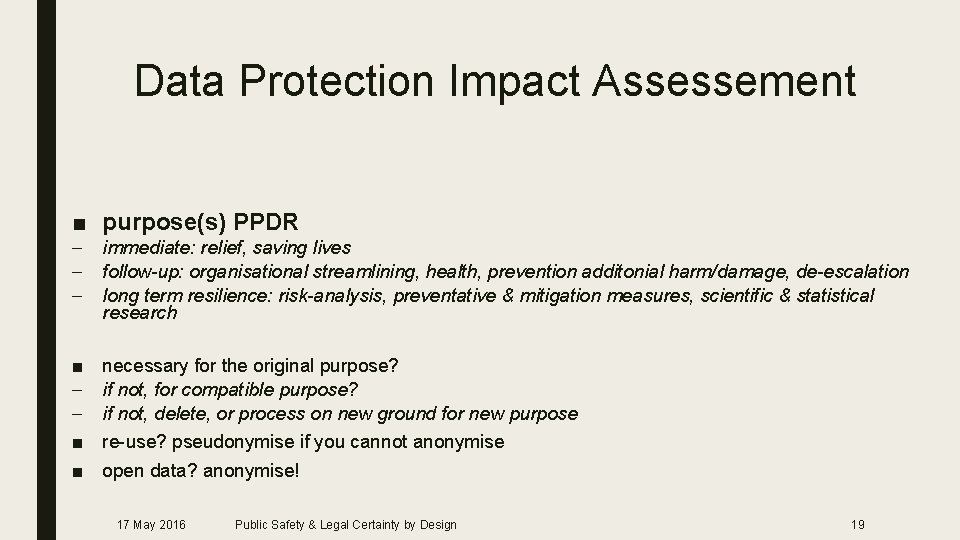
Data Protection Impact Assessement ■ purpose(s) PPDR – – – immediate: relief, saving lives follow-up: organisational streamlining, health, prevention additonial harm/damage, de-escalation long term resilience: risk-analysis, preventative & mitigation measures, scientific & statistical research ■ – – ■ ■ necessary for the original purpose? if not, for compatible purpose? if not, delete, or process on new ground for new purpose re-use? pseudonymise if you cannot anonymise open data? anonymise! 17 May 2016 Public Safety & Legal Certainty by Design 19
- Slides: 19