
Legal Background Law and EconomicsCharles W Upton AntiTrust
Legal Background Law and Economics-Charles W. Upton
Anti-Trust History • The Sherman Act (1890) – The grandfather of US anti-trust legislation. Legal Background
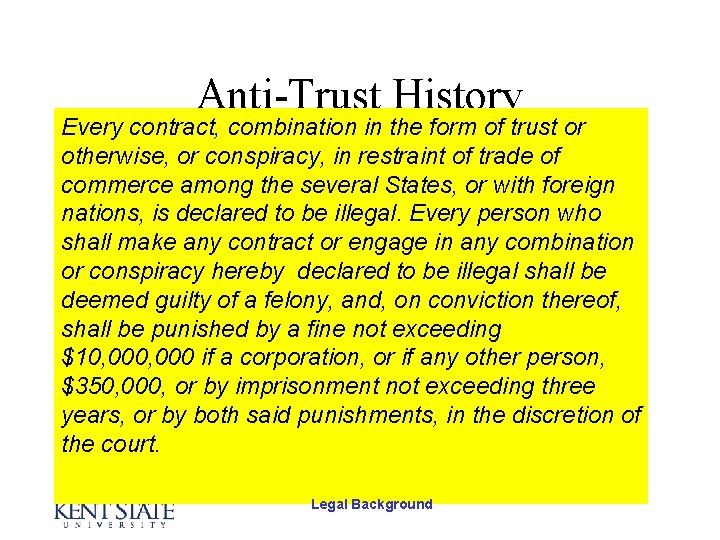
Anti-Trust History Every contract, combination in the form of trust or otherwise, or conspiracy, in restraint of trade of • commerce The Sherman Act (1890) among the several States, or with foreign nations, declared to be Every person who in – Theis grandfather of illegal. US anti-trust legislation shall make any contract or engage in any combination this country. or conspiracy hereby declared to be illegal shall be deemed guilty of a felony, and, on conviction thereof, shall be punished by a fine not exceeding $10, 000 if a corporation, or if any other person, $350, 000, or by imprisonment not exceeding three years, or by both said punishments, in the discretion of the court. Legal Background
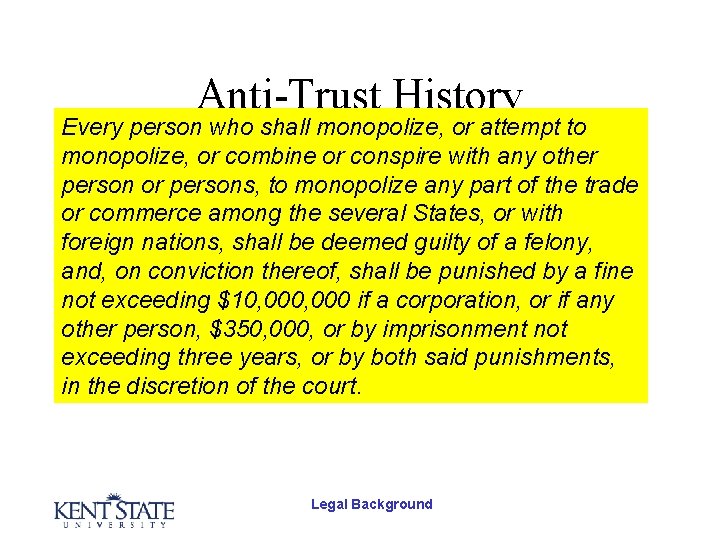
Anti-Trust History Every person who shall monopolize, or attempt to monopolize, or combine or conspire with any other • person The or. Sherman (1890) any part of the trade persons, to. Act monopolize or commerce among the States, legislation or with – The grandfather ofseveral US anti-trust in foreign nations, shall be deemed guilty of a felony, this country. and, on conviction thereof, shall be punished by a fine not exceeding $10, 000 if a corporation, or if any other person, $350, 000, or by imprisonment not exceeding three years, or by both said punishments, in the discretion of the court. Legal Background

Anti-Trust History • The Sherman Act (1890) – The grandfather of US anti-trust legislation. • Broad and vague language. • It applies to both individual acts and acts in concert with others. Thus acts by Acme Widgets on its own part can create an illegal monopoly, as can acts by Acme Widgets in combination with others. • It refers to monopolizing an industry. Merely being a monopoly is not a crime. Legal Background
Anti-Trust History • The Sherman Act (1890) – The grandfather of US anti-trust legislation. – There earliest wave of merger activity in the US, periods was in the late 19 th century, when people like JP Morgan and John D Rockefeller (of Lakewood Cemetery fame) came to the forefront. One of the consequences of the first movement was a desire by Congress to "do something" about trusts (hence the name anti-trust legislation). Legal Background
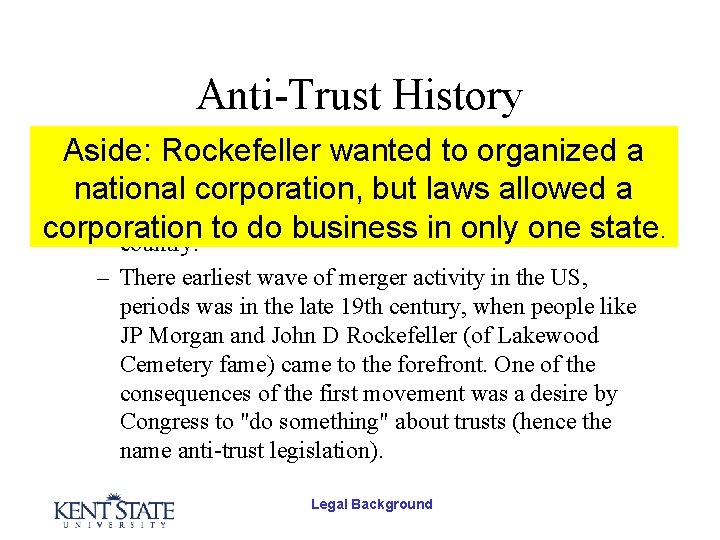
Anti-Trust History Aside: Rockefeller wanted to organized a • national The Sherman Act (1890)but laws allowed a corporation, – The grandfather of US anti-trust legislation in this corporation to do business in only one state. country. – There earliest wave of merger activity in the US, periods was in the late 19 th century, when people like JP Morgan and John D Rockefeller (of Lakewood Cemetery fame) came to the forefront. One of the consequences of the first movement was a desire by Congress to "do something" about trusts (hence the name anti-trust legislation). Legal Background
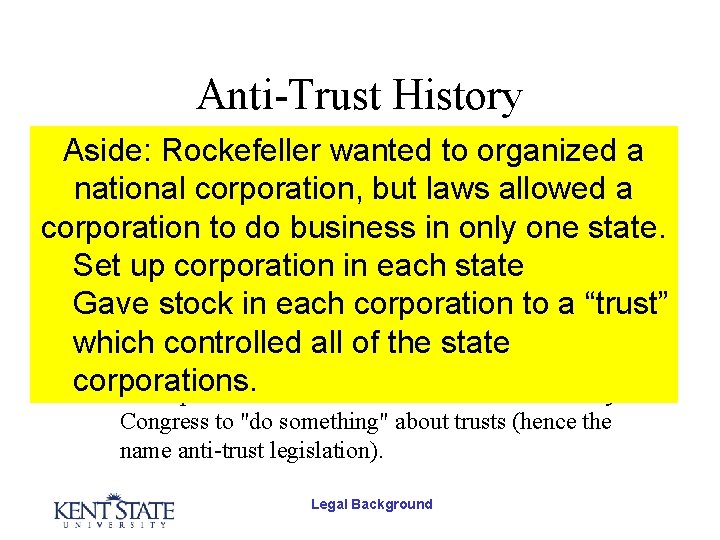
Anti-Trust History Aside: Rockefeller wanted to organized a • national The Sherman Act (1890)but laws allowed a corporation, – The grandfather of US anti-trust legislation in this corporation to do business in only one state. country. Set up corporation in each state – There earliest wave of merger activity in the US, periods was in late 19 th century, whento people like Gave stock inthe each corporation a “trust” JP Morgan and Johnall D Rockefeller (of Lakewood which controlled of the state Cemetery fame) came to the forefront. One of the corporations. consequences of the first movement was a desire by Congress to "do something" about trusts (hence the name anti-trust legislation). Legal Background
Anti-Trust History • The Sherman Act (1890) – Senator Sherman assured Congress that the statue "does not recognize a new principle of law, but applies old and well recognized principles of the common law". – According to Sherman, the statue said the Act was setting forth "the rule of the common law which prevails in England in this country". Legal Background
Anti-Trust History • The Sherman Act (1890) – Senator Sherman assured Congress that the statue "does not recognize a new principle of law, but applies old and well recognized seemslaw". an principles This of the common oversimplification – According to Sherman, the statue said the Act was setting forth "the rule of the common law which prevails in England in this country". Legal Background
Common Law Antecedents • Dyer’s Case (1411) • Mitchell vs. Reynolds (1732) Legal Background
Dyer’s Case (1411) • John Dyer promised not to "use his art of a dyer's craft within the town…for half a year". He broke that agreement, and was sued. Legal Background
Dyer’s Case (1411) • John Dyer promised not to "use his art of a dyer's craft within the town…for half a year". He broke that agreement, and was sued. • The court refused to enforce the agreement, on the grounds that the court would not interfere with freedom of trade or one's right to earn a living. The decision left Dyer free to practice his trade. Legal Background
Dyer’s Case (1411) • John Dyer promised not to "use his art of a dyer's craft within the town…for half a year". He broke that agreement, and was sued. On its face, this decision seems • The court refused to enforce the agreement, Hicks-Kaldor Efficient, for it on the keeps groundsathat the court would not skilled worker in the interfere with freedom of trade or one's right labor force. left Dyer free to earn a living. The decision to practice his trade. Legal Background
Mitchell vs. Reynolds (1732) • Mitchell leased a bakeshop for five years on the condition that Reynolds, a baker himself, would not practice his baker's art in the parish during the term of the lease. Legal Background
Mitchell vs. Reynolds (1732) • Mitchell leased a bakeshop for five Mitchell was purchasing years on the condition that not only the rights to use Reynolds, a baker himself, would the shop, but also the trade not itself. practice his baker's art in the Reynolds went parish the on term of the lease. aheadduring and kept baking. Legal Background
Mitchell vs. Reynolds (1732) • Mitchell leased a bakeshop for five Mitchell was purchasing Mitchell sued. years on the condition that. Reynolds not only the rights to use argued Dyer’s case. Reynolds, a baker himself, would the shop, but also the trade not itself. practice his baker's art in the Reynolds went parish the on term of the lease. aheadduring and kept baking. Legal Background
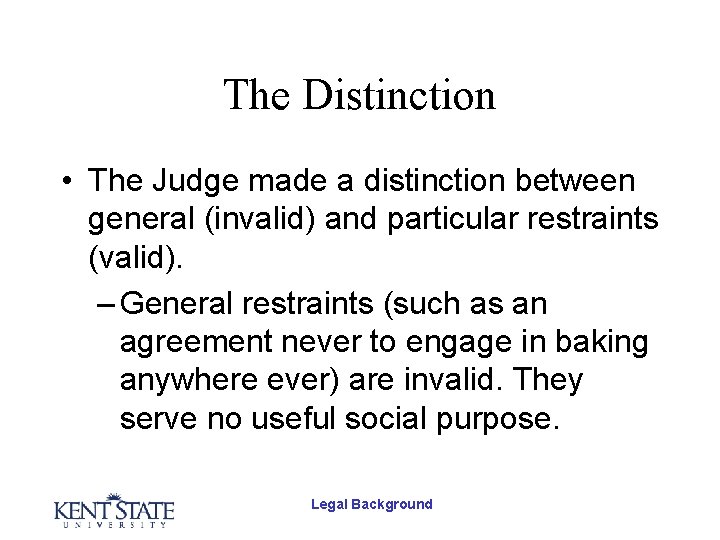
The Distinction • The Judge made a distinction between general (invalid) and particular restraints (valid). – General restraints (such as an agreement never to engage in baking anywhere ever) are invalid. They serve no useful social purpose. Legal Background
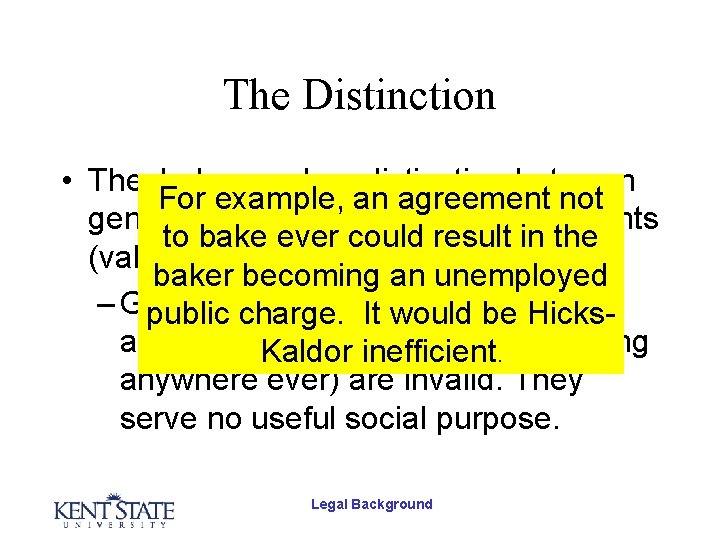
The Distinction • The Judge made a distinction between For example, an agreement not general (invalid) and particular restraints to bake ever could result in the (valid). baker becoming an unemployed – General restraints. It (such public charge. wouldas bean Hicksagreement. Kaldor neverinefficient to engage. in baking anywhere ever) are invalid. They serve no useful social purpose. Legal Background
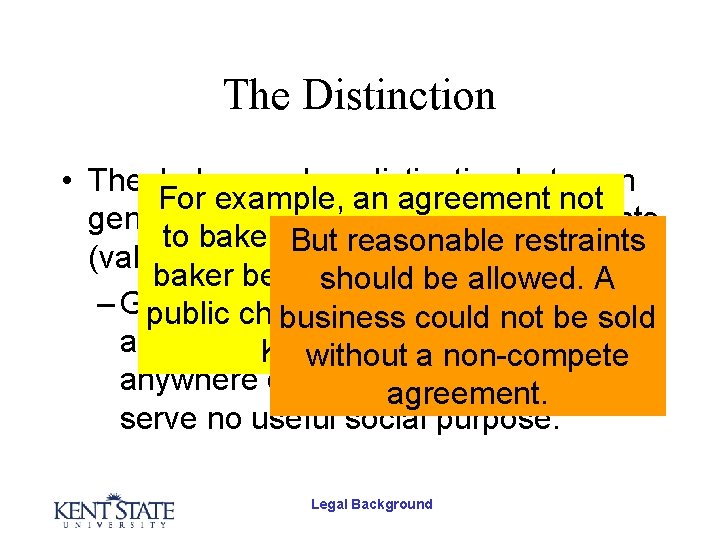
The Distinction • The Judge made a distinction between For example, an agreement not general (invalid) and particular restraints to bake ever could result restraints in the But reasonable (valid). baker becoming anbe unemployed should allowed. A – General restraints as an public charge. It (such would be Hicksbusiness could not be sold agreement. Kaldor never to engage in baking inefficient. without a non-compete anywhere ever) areagreement. invalid. They serve no useful social purpose. Legal Background
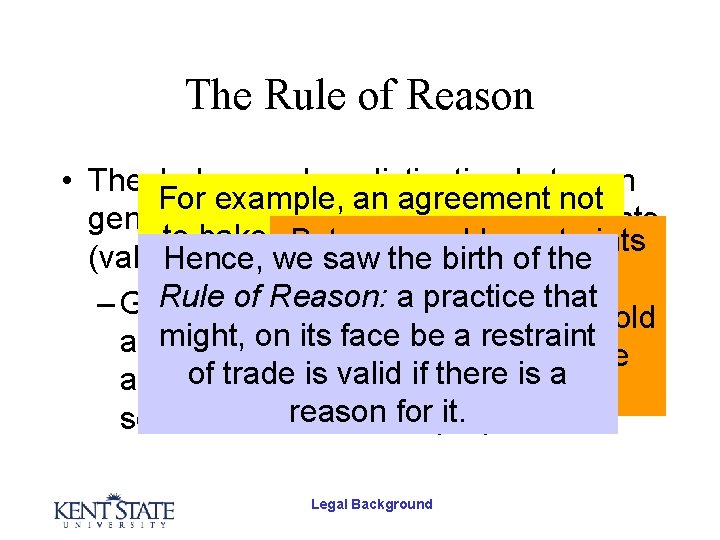
The Rule of Reason • The Judge made a distinction between For example, an agreement not general (invalid) and particular restraints to bake ever could result restraints in the But reasonable (valid). Hence, we saw the birth of the baker becoming anbe unemployed should allowed. A Rule of Reason: (such a practice that – General restraints as an public charge. It would Hicksbusiness couldbe not be sold might, onnever its face be a restraint agreement to engage in baking Kaldor inefficient. without a non-compete of trade is valid if there They is a anywhere ever) areagreement. . invalid. reason for purpose. it. serve no useful social Legal Background
An Extension • A sells B a weeks supply of a good. Legal Background
An Extension • A sells B a weeks supply of a good. • This excludes competitors like C from the market. – Hence the sale is in restraint of trade. Legal Background
An Extension • A sells B a weeks supply of a good. • This excludes competitors like C from the market. – Hence the sale is in restraint of trade. • But reason says the law should not prohibit this sale Legal Background
Getting Greedy • What if B agrees to buy from A not just a one week supply but all of B's requirements of these goods for the next 20 years? Legal Background
Getting Greedy • What if B agrees to buy from A not just a one week supply but all of B's requirements of these goods for the next 20 years? • Generally this seems to have no basis in economic reason and thus violates anti-trust law. Legal Background
The Patent • A has a patent on a product, which has 10 years to run. A requires that B purchase the product exclusively from him for the next 20 years. Legal Background
The Patent • A has a patent on a product, which has 10 years to run. A requires that B purchase the product exclusively from him for the next 20 years. • Restraint of trade. Legal Background
The Railroad • A proposes to build a railroad branch line to service B's mine. The line has no other useful purpose. Legal Background
The Railroad • A proposes to build a railroad branch line to service B's mine. The line has no other useful purpose. – A wants a 20 year contract to protect his investment. – B wants a 20 year contract to protect against gouging Legal Background
The Railroad • A proposes to build a railroad branch line to service B's mine. The line has no other A 20 year old agreement makes useful purpose. economic sense, and thus would his – A wants a 20 year contract to protect seem to meet a rule of reason. investment. – B wants a 20 year contract to protect against gouging Legal Background
The Clayton Act • In 1914, the Clayton Act specifically declared four practices illegal, but not criminal: – Price Discrimination – Tying and Exclusive Dealing Contracts – Corporate Mergers – Interlocking Directors Legal Background
The Clayton Act • In 1914, the Clayton Act specifically declared four practices illegal, notsays However, the Clayton Actbut also criminal: that these actions are illegal only – Price Discrimination "where the effect…may be – Tying and Exclusive Dealing competition" Contracts substantially to lessen – Corporate or "tend. Mergers to create a monopoly in any – Interlocking Directors line of commerce". Legal Background
Federal Trade Commission Act • A second piece of legislation in 1914 gives the FTC power to enforce the Clayton Act. This law declares that "unfair methods of competition in or affecting commerce, and unfair or deceptive acts or practices in or affecting commerce are hereby declared unlawful”. Legal Background
Federal Trade Commission Act • A second piece of legislation in 1914 gives the FTC power to enforce the Clayton Act. This law declares that "unfair methods of competition in or affecting commerce, and unfair or deceptive acts or practices in or Whatever that means affecting commerce are hereby declared unlawful”. Legal Background
The Conclusion • Statues are vague. • Ergo court-made law. Legal Background
End © 2004 Charles W. Upton Legal Background
- Slides: 37