
Legal aspects Training Programme for Publishers from the
Legal aspects Training Programme for Publishers from the Arab World Legal aspects Thomas Glückstein Lausen Rechtsanwälte – Residenzstraße 25 – 80333 München – Germany www. lausen. com kanzlei@lausen. com Thomas Glückstein - Training Programme for Publishers from the Arab World - Cairo, 26 March 2009
Legal aspects Agenda – legal aspects Part I: Basic principles of Copyright law Part II: Publishing contract / author‘s agreement Part III: Discussion, questions 2 Thomas Glückstein - Training Programme for Publishers from the Arab World - Cairo, 26 March 2009
Legal aspects I. Basic principles of copyright law Why legal aspects are important for publishers? • Publishers not sell “paper”, but the story, the poem etc. , i. e. the content => the “work” • The “work” is protected by copyright law • Knowledge of basic principles of copyright law is crucial for publishers 3 Thomas Glückstein - Training Programme for Publishers from the Arab World - Cairo, 26 March 2009
Legal aspects I. Basic principles of copyright law 1. What is protected under copyright law? => „Work“ = all personal intellectual creation Art. 138 of Egyptian law on the protection of intellectual property rights: “Work: any created literary, artistic or scientific product, whatever its type, mode of expression, significance or purpose of its creation. ” 4 Thomas Glückstein - Training Programme for Publishers from the Arab World - Cairo, 26 March 2009
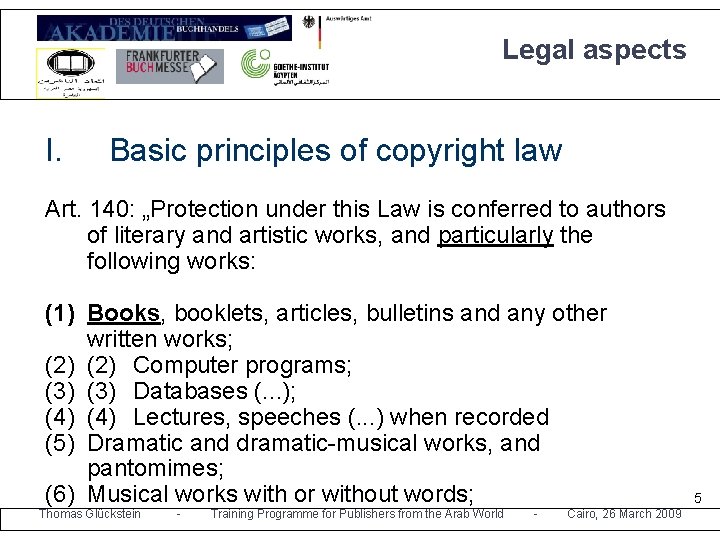
Legal aspects I. Basic principles of copyright law Art. 140: „Protection under this Law is conferred to authors of literary and artistic works, and particularly the following works: (1) Books, booklets, articles, bulletins and any other written works; (2) Computer programs; (3) Databases (. . . ); (4) Lectures, speeches (. . . ) when recorded (5) Dramatic and dramatic-musical works, and pantomimes; (6) Musical works with or without words; Thomas Glückstein - Training Programme for Publishers from the Arab World - Cairo, 26 March 2009 5
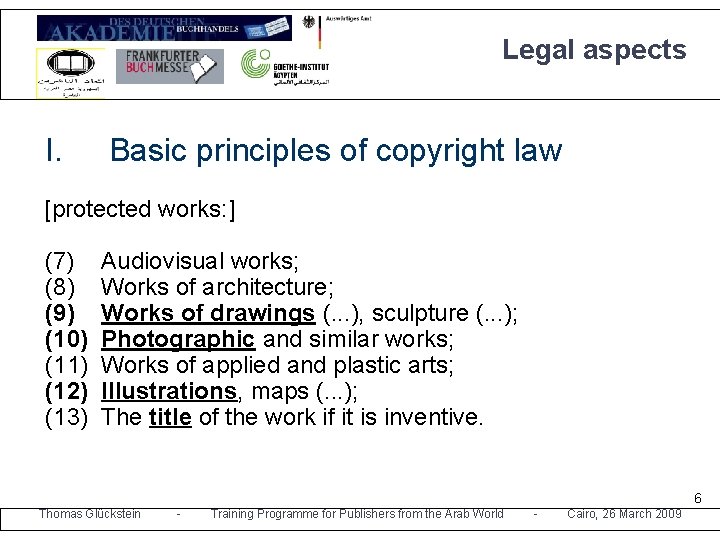
Legal aspects I. Basic principles of copyright law [protected works: ] (7) (8) (9) (10) (11) (12) (13) Audiovisual works; Works of architecture; Works of drawings (. . . ), sculpture (. . . ); Photographic and similar works; Works of applied and plastic arts; Illustrations, maps (. . . ); The title of the work if it is inventive. 6 Thomas Glückstein - Training Programme for Publishers from the Arab World - Cairo, 26 March 2009
Legal aspects I. Basic principles of copyright law Protected parts of a publication: • • the manuscript photos illustrations, drawings the title of the work 7 Thomas Glückstein - Training Programme for Publishers from the Arab World - Cairo, 26 March 2009
Legal aspects I. Basic principles of copyright law “Protected” means: • Only the author is entitled to decide, if and in what manner his work is used (published) • Author is entitled to prevent any use of his work other than he has agreed with 8 Thomas Glückstein - Training Programme for Publishers from the Arab World - Cairo, 26 March 2009
Legal aspects I. Basic principles of copyright law What is not protected? No protection of (Art. 141): • ideas; • concepts; • principles; • discoveries; • data. => No „creation“ 9 Thomas Glückstein - Training Programme for Publishers from the Arab World - Cairo, 26 March 2009
Legal aspects I. Basic principles of copyright law How long is a work protected? • throughout the life time of the author • and for 50 years from the date of his death (Art. 160) => copyrights are exercised by the heir / universal successor of the author 10 Thomas Glückstein - Training Programme for Publishers from the Arab World - Cairo, 26 March 2009
Legal aspects I. Basic principles of copyright law 2. How is the work protected by copyright law 3. => what rights has an author? a) Moral rights (Art. 143): b) perpetual, imprescriptible, inalienable (any disposal is null and void) b) Exploitation rights (= economic rights to use the work): c) can be transferred to a third party (e. g. by a “publishing contract”) 11 Thomas Glückstein - Training Programme for Publishers from the Arab World - Cairo, 26 March 2009
Legal aspects I. Basic principles of copyright law 2. What rights has an author? a) Moral rights include (Art. 143): • The right to make the work available to the public for the first time • The right to claim authorship => Author can decide whether the work bears an author's designation and what designation is to be used. • The right to prevent any modification considered by the author as distortion or mutilation of the work 12 Thomas Glückstein - Training Programme for Publishers from the Arab World - Cairo, 26 March 2009
Legal aspects I. Basic principles of copyright law 2. What rights has an author? b) Exploitation rights: Author has got the exclusive right to authorize (e. g. the publisher by a publishing contract) or prevent any form of exploitation of his work, particularly through: • • • reproduction translation adaptation making the work available to the public in any manner (including internet) etc. 13 Thomas Glückstein - Training Programme for Publishers from the Arab World - Cairo, 26 March 2009
Legal aspects I. Basic principles of copyright law How does the author deal with his copyright? • Economic rights (exploitation rights) can be transferred to a third party (e. g. to the publisher) => granting of “exploitation rights” to the publisher by a publishing contract • Moral rights are not transferable 14 Thomas Glückstein - Training Programme for Publishers from the Arab World - Cairo, 26 March 2009
Legal aspects I. Basic principles of copyright law 3. How to grant exploitation rights? The transfer shall (Art. 149): • be certified in writing => Publishing contract between author and publisher • contain an explicit and detailed indication of each right to be transferred with the extent and purpose of transfer and the duration and place of exploitation 15 Thomas Glückstein - Training Programme for Publishers from the Arab World - Cairo, 26 March 2009
Legal aspects I. Basic principles of copyright law 3. How to grant exploitation rights? • The author remains the owner of all economic rights other than what he has explicitly assigned („in dubio pro auctore”) • Authorization by the author to exploit any of the economic rights relating to work does not mean authorization to exploit other economic rights relating to the same work => the transfer of rights of the author by the publishing contract is the basis of publisher’s business! 16 Thomas Glückstein - Training Programme for Publishers from the Arab World - Cairo, 26 March 2009
Legal aspects I. Basic principles of copyright law 3. How to grant exploitation rights? Checklist for granting exploitation rights: a) What economic rights shall be transferred? b) In what extent the rights shall be transferred? 17 Thomas Glückstein - Training Programme for Publishers from the Arab World - Cairo, 26 March 2009
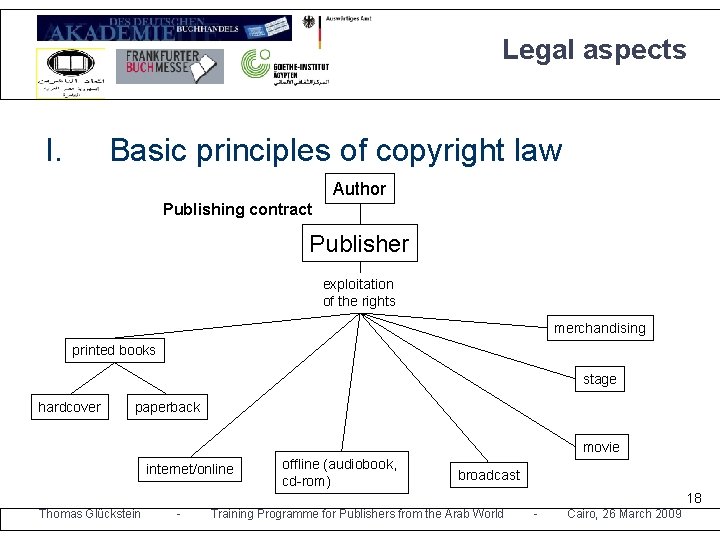
Legal aspects I. Basic principles of copyright law Author Publishing contract Publisher exploitation of the rights merchandising printed books stage hardcover paperback movie internet/online offline (audiobook, cd-rom) broadcast 18 Thomas Glückstein - Training Programme for Publishers from the Arab World - Cairo, 26 March 2009
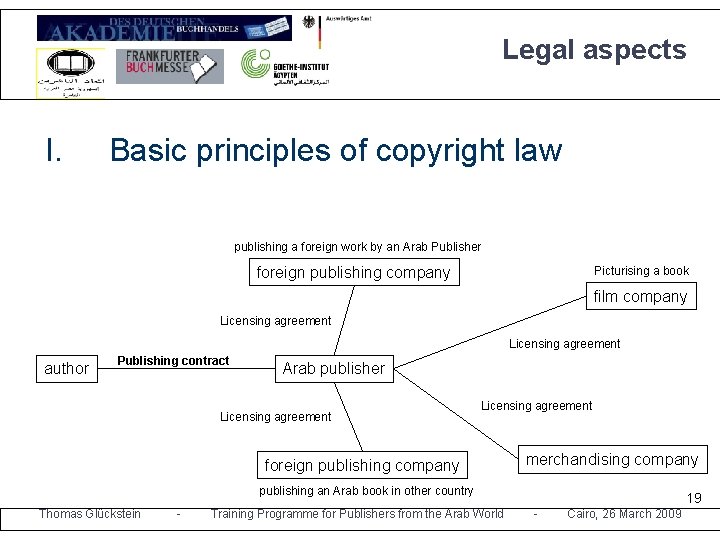
Legal aspects I. Basic principles of copyright law publishing a foreign work by an Arab Publisher foreign publishing company Picturising a book film company Licensing agreement author Publishing contract Arab publisher Licensing agreement foreign publishing company merchandising company publishing an Arab book in other country Thomas Glückstein - Training Programme for Publishers from the Arab World 19 - Cairo, 26 March 2009
Legal aspects I. Basic principles of copyright law 3. How to grant exploitation rights? a) Examples for economic rights: – – – right of reproduction right of distribution right of adaptation right of making available to the public (e. g. through computers, internet, networks) etc. right of recording on media (CD-Rom, DVD etc. ) right of translation 20 Thomas Glückstein - Training Programme for Publishers from the Arab World - Cairo, 26 March 2009
Legal aspects I. Basic principles of copyright law 3. How to grant exploitation rights? b) Checklist for extension of transfer of rights: 1. 2. 3. 4. exclusive or non exclusive? what territory? time limit? transferable to third / sub-licensable? 21 Thomas Glückstein - Training Programme for Publishers from the Arab World - Cairo, 26 March 2009
Legal aspects I. Basic principles of copyright law 4. Limitations of copyright In some cases the author‘s copyright is limited => The author may not prevent third parties (i. a. ): • make a single copy of the work for one‘s exclusive personal use; • make excerpts or quotations for purpose of criticism, discussion, information; • Reproduction of short extracts for teaching purposes. Þ provided that: - the author‘s name and the title of the work are mentioned - no violation of legitimate interests of the author 22 Thomas Glückstein - Training Programme for Publishers from the Arab World - Cairo, 26 March 2009
Legal aspects I. Basic principles of copyright law 5. Infringements of copyrights - legal consequences In case of infringement of any copyright the president of the competent court may order conservatory measures: – discontinuance of publication, reproduction of the work – Seizure of copies of the work – Seizure of the income made as a result of the exploitation of the work 23 Thomas Glückstein - Training Programme for Publishers from the Arab World - Cairo, 26 March 2009
Legal aspects I. Basic principles of copyright law 5. Infringements of copyrights - legal consequences Infringements of copyrights can be punishable: • selling, putting in circulation a work without a prior written authorization form the author • knowingly imitating or selling a work • infringing any of the moral or economic rights • etc. 24 Thomas Glückstein - Training Programme for Publishers from the Arab World - Cairo, 26 March 2009
Legal aspects I. Basic principles of copyright law 5. Infringements of copyrights - legal consequences • imprisonment for a period of not less than one month • fine of 5. 000 – 10. 000 pounds • confiscation of the infringing copies, those obtained as a result of infringement, equipment used to commit the infringement • closure of the establishment used by the convicted person 25 Thomas Glückstein - Training Programme for Publishers from the Arab World - Cairo, 26 March 2009
Legal aspects I. Publishing contract • Publishing contract = legal core of publishing business • Publisher is only entitled to exploit the work in the kind of use which he was granted 26 Thomas Glückstein - Training Programme for Publishers from the Arab World - Cairo, 26 March 2009
Legal aspects I. Publishing contract Form of the publishing contract: • written form of publishing contract is not required by the law (“shall be in writing”, Art. 149) • but written form is reasonable (even if you trust the author) 27 Thomas Glückstein - Training Programme for Publishers from the Arab World - Cairo, 26 March 2009
Legal aspects I. Publishing contract Reasons for a publishing contract in written form: • Art. 149: “transfer shall be certified in writing” • Written form enables publisher to prove his exploitation rights to third – licence agreements => “Chain of title” – violations of your exploitation rights by third • Avoidance of conflicts with the author 28 Thomas Glückstein - Training Programme for Publishers from the Arab World - Cairo, 26 March 2009
Legal aspects I. Publishing contract What would you draft? => Brain storming! 29 Thomas Glückstein - Training Programme for Publishers from the Arab World - Cairo, 26 March 2009
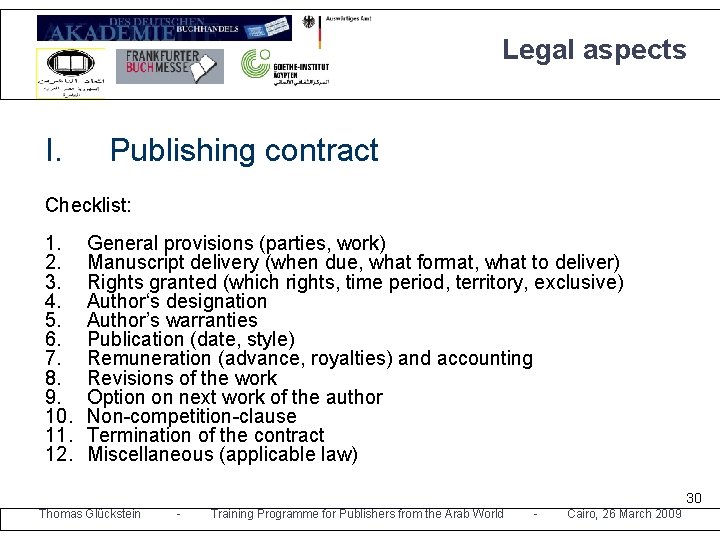
Legal aspects I. Publishing contract Checklist: 1. 2. 3. 4. 5. 6. 7. 8. 9. 10. 11. 12. General provisions (parties, work) Manuscript delivery (when due, what format, what to deliver) Rights granted (which rights, time period, territory, exclusive) Author‘s designation Author’s warranties Publication (date, style) Remuneration (advance, royalties) and accounting Revisions of the work Option on next work of the author Non-competition-clause Termination of the contract Miscellaneous (applicable law) 30 Thomas Glückstein - Training Programme for Publishers from the Arab World - Cairo, 26 March 2009
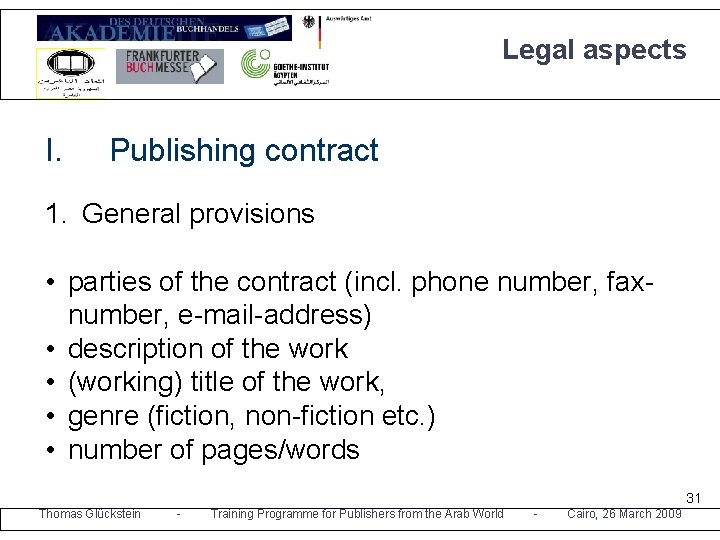
Legal aspects I. Publishing contract 1. General provisions • parties of the contract (incl. phone number, faxnumber, e-mail-address) • description of the work • (working) title of the work, • genre (fiction, non-fiction etc. ) • number of pages/words 31 Thomas Glückstein - Training Programme for Publishers from the Arab World - Cairo, 26 March 2009
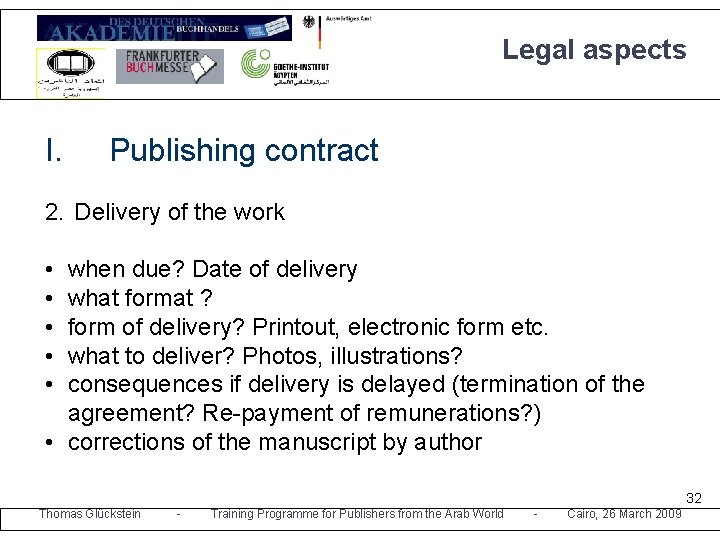
Legal aspects I. Publishing contract 2. Delivery of the work • • • when due? Date of delivery what format ? form of delivery? Printout, electronic form etc. what to deliver? Photos, illustrations? consequences if delivery is delayed (termination of the agreement? Re-payment of remunerations? ) • corrections of the manuscript by author 32 Thomas Glückstein - Training Programme for Publishers from the Arab World - Cairo, 26 March 2009
Legal aspects I. Publishing contract 3. Rights granted a) which rights are transferred? – – – – hardcover paperback CD-/DVD online/internet audio book adaptation as movie, drama translation merchandising 33 Thomas Glückstein - Training Programme for Publishers from the Arab World - Cairo, 26 March 2009
Legal aspects I. 3. Publishing contract Rights granted 1. b) (1) (2) (3) (4) (5) (6) (7) extent of the transfer of rights => “magic seven”: exclusive / non exclusive limit of territory / no limit of territory limit of time / no limit of time limit of scope / no limit of scope adaptable / non adaptable transferable / not transferable sub-licensable / not sub-licensable 34 Thomas Glückstein - Training Programme for Publishers from the Arab World - Cairo, 26 March 2009
Legal aspects I. Publishing contract 4. Furthermore, the publisher should reserve the rights to decide: – – – layout and book cover final title of the work number of copies retail sales price marketing, promotion 35 Thomas Glückstein - Training Programme for Publishers from the Arab World - Cairo, 26 March 2009
Legal aspects I. Publishing contract 5. Remuneration of the author • • lump sum? royalties on each copy of the work sold: – depending on type of publication (hardcover > paperback) – depending on number of copies sold => increasing percentage the more copies are sold royalties on exploitation in other ways (e. g. exploitation of electronic book rights, merchandising rights etc. ) advance (against and on account of all amounts due to author under the agreement)? combinations • • • 36 Thomas Glückstein - Training Programme for Publishers from the Arab World - Cairo, 26 March 2009
Legal aspects I. Publishing contract 1. 6. Further provisions 2. identification of the author 3. free copies for the author 4. revisions of the work by author further editions (important for non-fiction books) 5. non-competition clause 6. option on the next work of the author 7. applicable law 37 Thomas Glückstein - Training Programme for Publishers from the Arab World - Cairo, 26 March 2009
Legal aspects I. Publishing contract 1. 7. Example f) please see “author’s agreement” 38 Thomas Glückstein - Training Programme for Publishers from the Arab World - Cairo, 26 March 2009
Legal aspects I. Discussion 39 Thomas Glückstein - Training Programme for Publishers from the Arab World - Cairo, 26 March 2009
Legal aspects I. Contact for further questions: Thomas Glückstein Lausen Rechtsanwälte Residenzstraße 25 80333 München Germany E-mail: glueckstein@lausen. com Phone: 0049 / 89 -242096 -0 40 Thomas Glückstein - Training Programme for Publishers from the Arab World - Cairo, 26 March 2009
Legal aspects Thank you for your attention! Thomas Glückstein - Training Programme for Publishers from the Arab World - Cairo, 26 March 2009
- Slides: 41