
Legal and Ethical Issues in Healthcare Dr Israa

- Slides: 36
Legal and Ethical Issues in Healthcare Dr. Israa Al-Rawashdeh MD, MPH, Ph. D Faculty of Medicine Mutah University 2018
Importance for the healthcare professional to understand legal and ethical issues 1. Knowledge of legal responsibilities 2. Limitations of practice 3. Implications of their actions 2
Importance for the healthcare professional to understand legal and ethical issues 4. Protection of a. b. c. d. Healthcare professionals Patients Co-workers Facility 1. 04 Understand legal and ethical issues 3
Importance for the healthcare professional to understand legal and ethical issues 5. Ethical behavior ensures a. Quality patient care b. Positive work relationships c. Well-managed workplace 1. 04 Understand legal and ethical issues 4
Examples of current legal and ethical dilemmas 1. 2. 3. 4. 5. 6. 7. Abortion Euthanasia (mercy killing) Organ donation Research and Experimental Treatment Sex Determination & genetic counselling Patient Confidentiality Artificial Intelligence
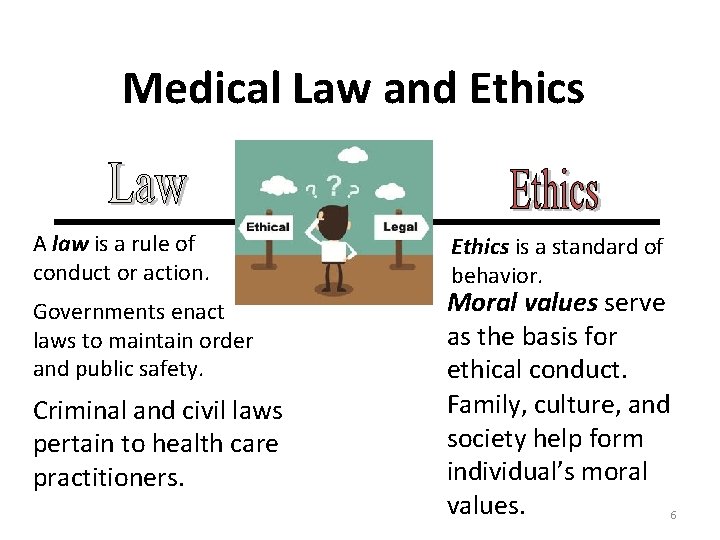
Medical Law and Ethics A law is a rule of conduct or action. Governments enact laws to maintain order and public safety. Criminal and civil laws pertain to health care practitioners. Ethics is a standard of behavior. Moral values serve as the basis for ethical conduct. Family, culture, and society help form individual’s moral values. 6
Ethical concepts • Ethics: Standards of behavior developed as a result of your moral values • The ability to distinguish right from wrong Involves a commitment to do what is right, good, and proper • Role of HA: Making decision of the right behaviour! Difficult in some cases!
Theoretical base of ethical decisions 1. Deontological decisions (Deon = duty): • Based on a duty or moral obligation motivated by oath or other circumstance. • Considers that it is the professional’s duty to do • everything possible for the patient, regardless of the possible outcomes. • Actions determined by rightness or wrongness ( virtue ethics)
• 2. Teleological decisions (Telos = goal): • Based on the considerations for the outcome of the action • “The end justifies the means. ” • Actions will vary depending on the situation ( situational ethics) • Greatest good for the greatest number • Views the consequences of the action as valuable as the ability to perform the procedure.
• Deontology – Values are not universally shared – Do not consequences matter? • Teleology – Greatest good for the greatest number does not protect minority rights – Not always possible to predict consequences accurately – Your values may conflict with the action needed
Ethical Principles • Autonomy: The state of being self-governing or essentially respecting an individual’s right to make decisions for themselves. This goes further than a patient’s constitutional right to refuse treatment. • Includes respect for the patients’ privacy and confidentiality • It includes each staff member’s right to decide what is the right thing for him or her to do. • Need to provide sufficient information for them to make informed choices • Truth telling • Protection of persons with diminished or impaired autonomy.
• Non-maleficence: The absence of harm or as it is attributed to the physician’s oath to “do no harm. ” Maleficence is an action that is considered harmful or evil.
Ethical principles q. Beneficence: Beneficence refers to the state of producing good acts. Acting always in the patients’ best interest to maximise benefits and minimise harm. This, of course, is affected by one’s personal definition of what is “good. ” However, there are general aspects of this principle that are common to most cultures and religions. In preparing to make an ethical decision, include the factors that focus on what will benefit the others involved in the situation.
• Justice: Society as a whole believes the principle of justice means that all people are treated fairly and equally. • This practice should be extended to identify a duty to help others in serious need and that the right to health care is a basic component of a just society (social justice).
Steps to Ethical Decision Making 1. Specifically describe the question or issue. 2. Outline the facts surrounding the question (social, economic, legal, cultural, and political influences ). 3. Identify all individuals involved or affected by this decision and evaluate the relationship with everyone involved in the ethical dilemma: • (a) to whom you made a promise or have some other type of loyalty; • (b) you have harmed and feel you owe some type of reparation; • (c) to whom you feel a debt of gratitude; • (d) you feel deserves more consideration than others involved in this situation (more protection, more needs) • The administrator must include the organization (facility) as an individual affected by this decision.
• 4. Research guidance from all applicable resources (law requirements, or contract guarantees). Consult with professional advisors (i. e. , attorneys) to assemble all the facts applicable to this situation.
Organizational ethics • Organizational ethics is an emerging area in health care management. • Health care organizations have tended to focus on the ethical issues faced by clinicians in the direct delivery of clinical care (i. e. , clinical ethics) or by researchers in the conduct of clinical research (i. e. , research ethics). • Organizational ethics is concerned with the ethical issues faced by managers and board members and the ethical implications of organizational decisions and practices on patients, staff, and the community.
What organizational ethics issues are health care administrators facing? 1. Resource allocation 2. Business development 3. Disagreement over treatment decisions 4. Access to care for the uninsured 5. Workplace ethics
Unethical practices (Ajlouni et al 2015) • Example from a study done in Jordan (Ajlouni et al 2015). Administrators highlighted the following concerns: • 1. Hiring of unqualified workers to care for patients with complex problems. • 2. The request for commission and “split-fees” • 3. Unethical practice by families. • 4. providing unnecessary services The study recommends “to minimize unethical practices and moral hazards in home health practice in Jordan, it is recommended that a code of ethics should be developed and indorsed by all home health care agencies, also MOH and other health professional associations should activate their role in monitoring and controlling health care practices in the country including home care” Ajlouni, M. T. , Dawani, H. and Diab, S. M. (2015) ‘Home Health Care (HHC) Managers Perceptions About Challenges and Obstacles that Hinder HHC Services in Jordan’, Global Journal of Health Science, 7(4), pp. 121– 129. doi: 10. 5539/gjhs. v 7 n 4 p 121.
Legal concepts • Law means body of rules to guide human action. • Law is a system of rights & obligations which the state enforces. • Law is the body of principles recognised by the state & the administration of justice.
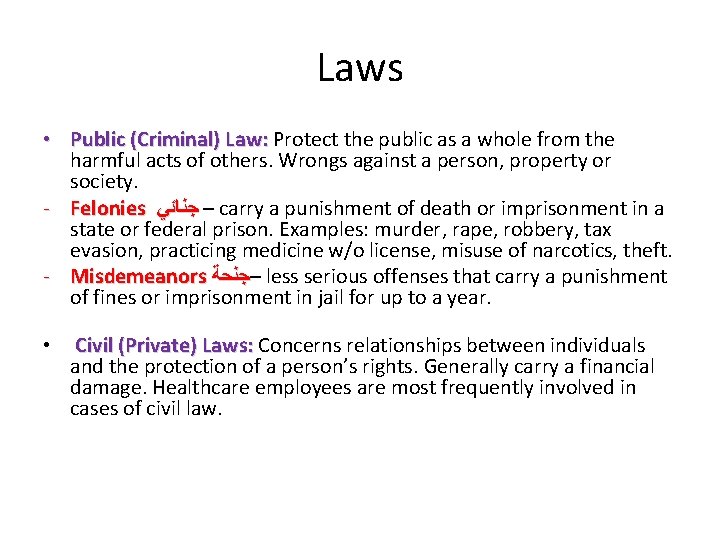
Laws • Public (Criminal) Law: Protect the public as a whole from the harmful acts of others. Wrongs against a person, property or society. - Felonies – ﺟﻨﺎﺋﻲ carry a punishment of death or imprisonment in a state or federal prison. Examples: murder, rape, robbery, tax evasion, practicing medicine w/o license, misuse of narcotics, theft. - Misdemeanors –ﺟﻨﺤﺔ less serious offenses that carry a punishment of fines or imprisonment in jail for up to a year. • Civil (Private) Laws: Concerns relationships between individuals and the protection of a person’s rights. Generally carry a financial damage. Healthcare employees are most frequently involved in cases of civil law.
Laws • Includes a general category of laws known as torts –Torts are either: • Intentional (willful) • Unintentional (accidental)
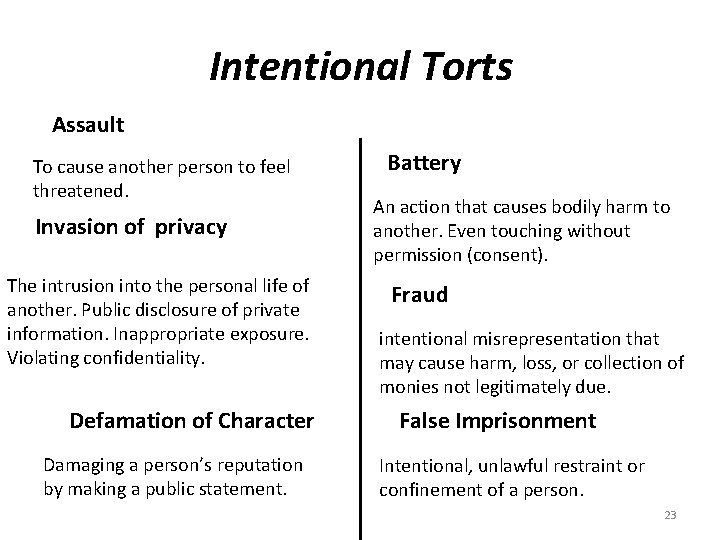
Intentional Torts Assault To cause another person to feel threatened. Invasion of privacy The intrusion into the personal life of another. Public disclosure of private information. Inappropriate exposure. Violating confidentiality. Defamation of Character Damaging a person’s reputation by making a public statement. Battery An action that causes bodily harm to another. Even touching without permission (consent). Fraud intentional misrepresentation that may cause harm, loss, or collection of monies not legitimately due. False Imprisonment Intentional, unlawful restraint or confinement of a person. 23
• Health care workers (Administrators) are required to report any signs or symptoms of intentional torts.
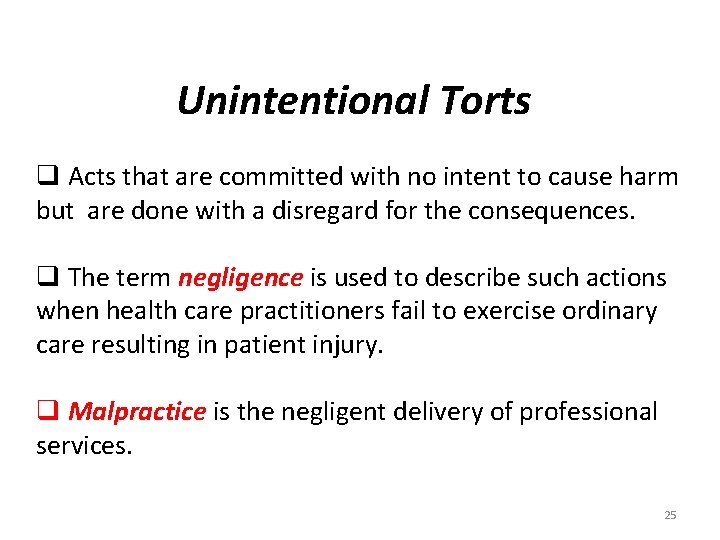
Unintentional Torts q Acts that are committed with no intent to cause harm but are done with a disregard for the consequences. q The term negligence is used to describe such actions when health care practitioners fail to exercise ordinary care resulting in patient injury. q Malpractice is the negligent delivery of professional services. 25
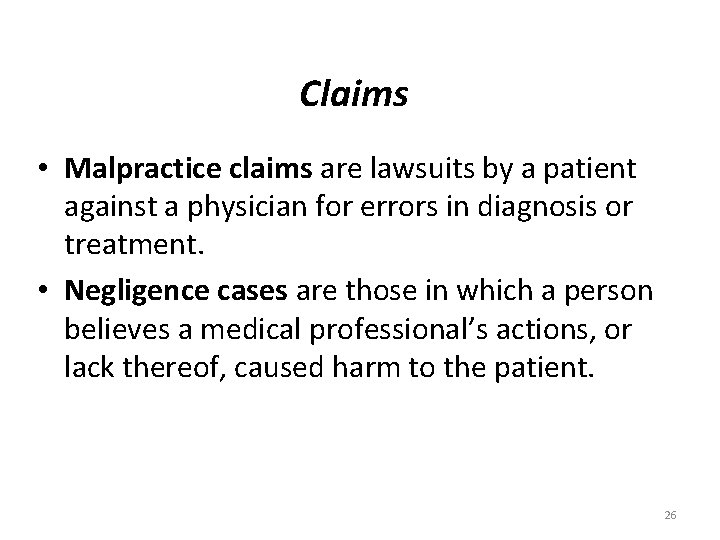
Claims • Malpractice claims are lawsuits by a patient against a physician for errors in diagnosis or treatment. • Negligence cases are those in which a person believes a medical professional’s actions, or lack thereof, caused harm to the patient. 26
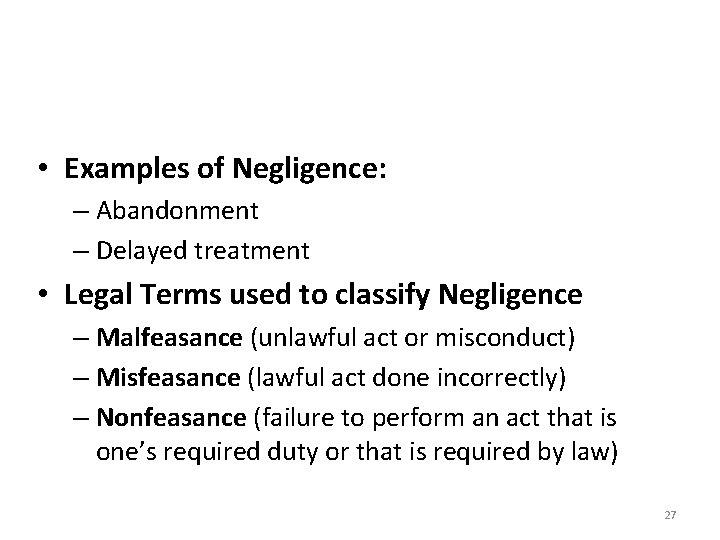
• Examples of Negligence: – Abandonment – Delayed treatment • Legal Terms used to classify Negligence – Malfeasance (unlawful act or misconduct) – Misfeasance (lawful act done incorrectly) – Nonfeasance (failure to perform an act that is one’s required duty or that is required by law) 27
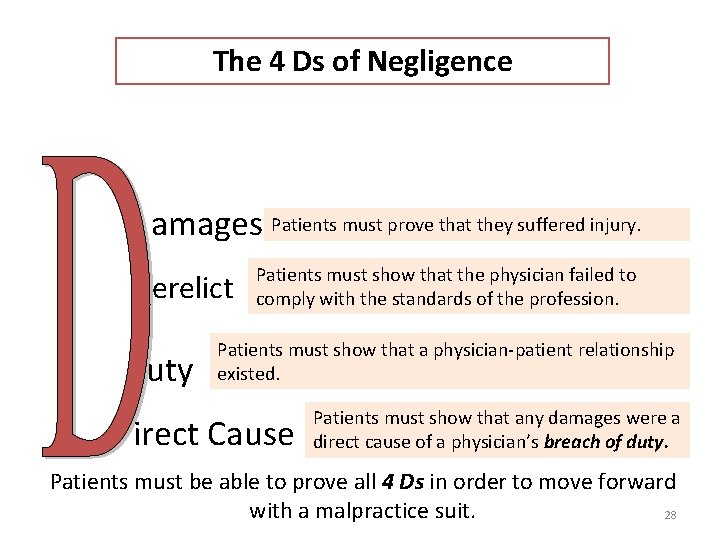
The 4 Ds of Negligence amages Patients must prove that they suffered injury. erelict uty Patients must show that the physician failed to comply with the standards of the profession. Patients must show that a physician-patient relationship existed. irect Cause Patients must show that any damages were a direct cause of a physician’s breach of duty. Patients must be able to prove all 4 Ds in order to move forward with a malpractice suit. 28
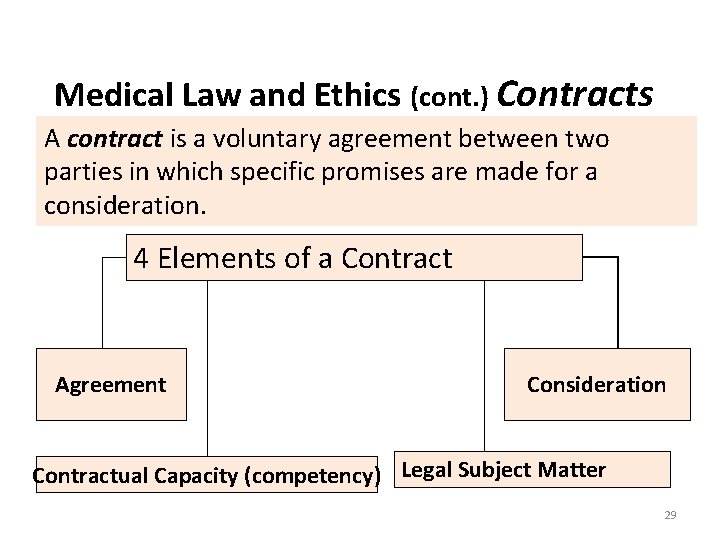
Medical Law and Ethics (cont. ) Contracts A contract is a voluntary agreement between two parties in which specific promises are made for a consideration. 4 Elements of a Contract Agreement Consideration Contractual Capacity (competency) Legal Subject Matter 29
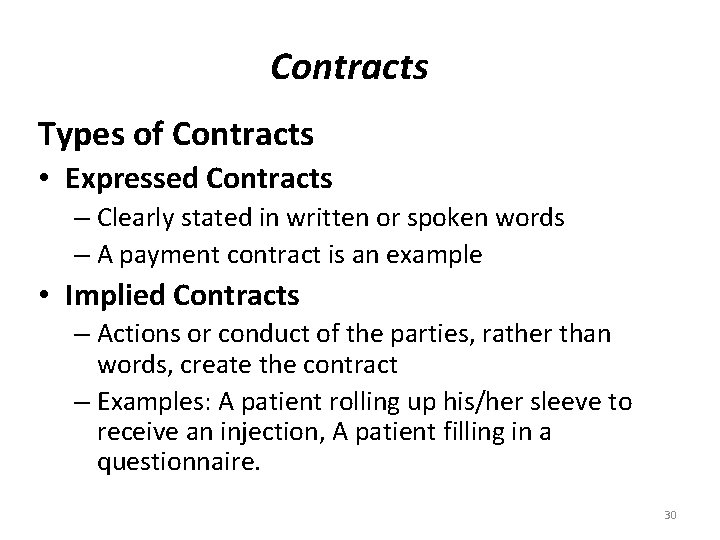
Contracts Types of Contracts • Expressed Contracts – Clearly stated in written or spoken words – A payment contract is an example • Implied Contracts – Actions or conduct of the parties, rather than words, create the contract – Examples: A patient rolling up his/her sleeve to receive an injection, A patient filling in a questionnaire. 30
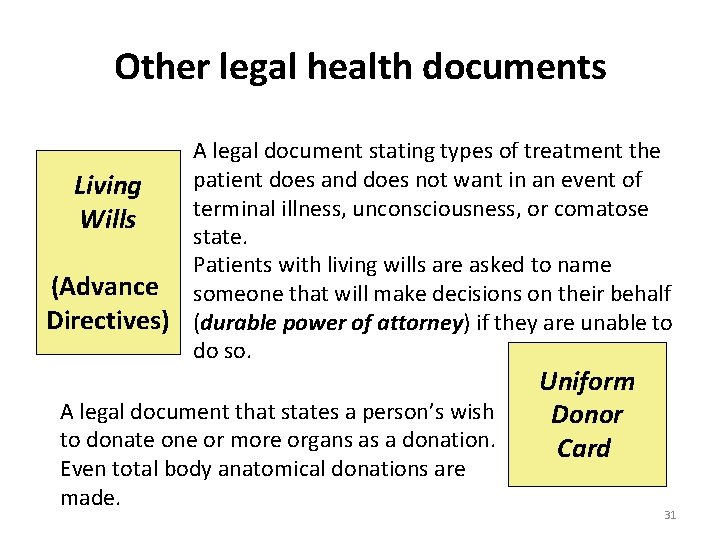
Other legal health documents A legal document stating types of treatment the patient does and does not want in an event of Living terminal illness, unconsciousness, or comatose Wills state. Patients with living wills are asked to name (Advance someone that will make decisions on their behalf Directives) (durable power of attorney) if they are unable to do so. A legal document that states a person’s wish to donate one or more organs as a donation. Even total body anatomical donations are made. Uniform Donor Card 31
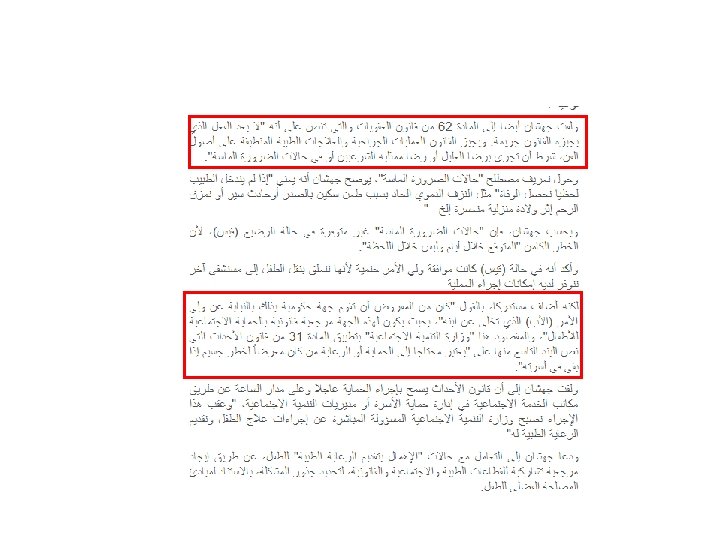
A case from Jordan • September 2017. • A new born with malformations needed operation • The operation required the father’s consent. • The father refused to give consent because of issues with the mother. • Operations could not be done (administrators decision) • The newborn passed away.
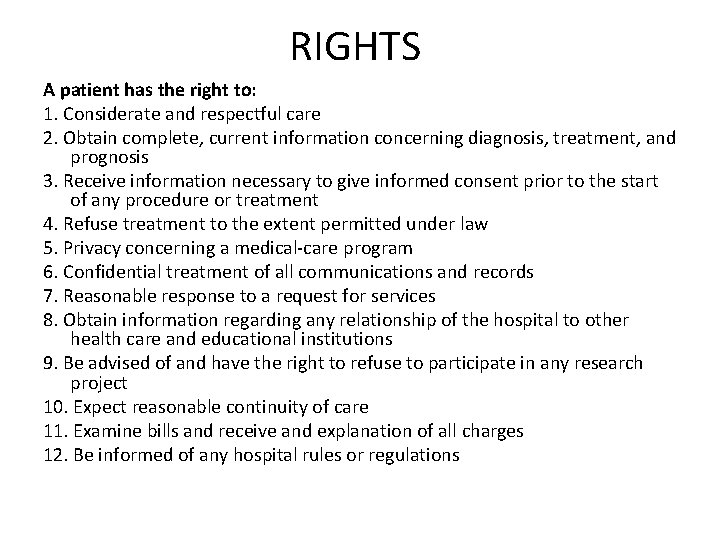
RIGHTS A patient has the right to: 1. Considerate and respectful care 2. Obtain complete, current information concerning diagnosis, treatment, and prognosis 3. Receive information necessary to give informed consent prior to the start of any procedure or treatment 4. Refuse treatment to the extent permitted under law 5. Privacy concerning a medical-care program 6. Confidential treatment of all communications and records 7. Reasonable response to a request for services 8. Obtain information regarding any relationship of the hospital to other health care and educational institutions 9. Be advised of and have the right to refuse to participate in any research project 10. Expect reasonable continuity of care 11. Examine bills and receive and explanation of all charges 12. Be informed of any hospital rules or regulations
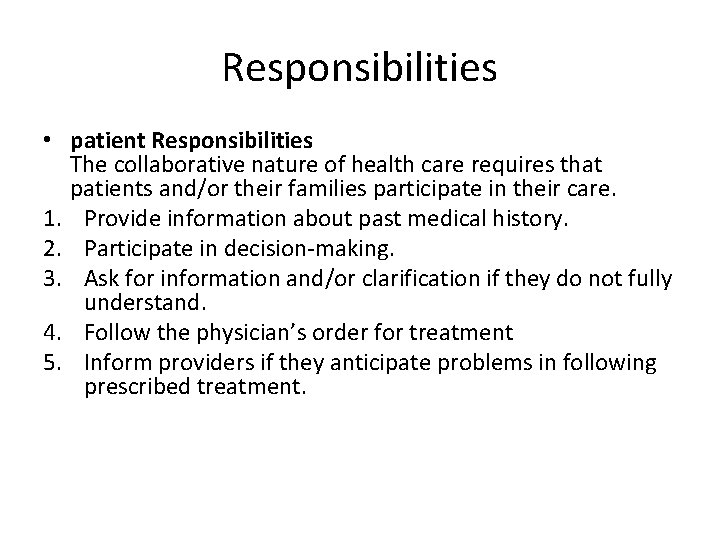
Responsibilities • patient Responsibilities The collaborative nature of health care requires that patients and/or their families participate in their care. 1. Provide information about past medical history. 2. Participate in decision-making. 3. Ask for information and/or clarification if they do not fully understand. 4. Follow the physician’s order for treatment 5. Inform providers if they anticipate problems in following prescribed treatment.
• THANK YOU