
Legal and Ethical Issues in Computer Science Information
- Slides: 40
Legal and Ethical Issues in Computer Science, Information Technology, and Software Engineering ZOOM LECTURE WITH AARON ATUHE
• As computer scientists and professional software engineers, you will inevitably be faced with making difficult decisions • re-use of source code • re-use of copyrighted material (images. . . ) • enforcing strength of passwords • knowledge of a flaw or bug in software about to be released • design of a software feature that is potentially dangerous • discovery of a security flaw that could be used to extract users' personal info • should a database be encrypted? what level of security is appropriate? • Thus we need to also understand what is ethical 2
Ethical Frameworks • Moral Principles as a framework • the reason we make a choice matters • most people have an intrinsic sense of what is the "right" thing to do • is breaking a law ever ethical? • even if you won't get caught? even if you can justify it? even if there is a benefit to others? 3
Utilitarian framework • cost analysis based on risks, costs, and probabilities of outcomes (popular with engineers) • includes consideration of legal violations (through liability, cost of fines, risk of jail) • historically, many horrible decisions have been justified based on cost analysis • example: illegally producing a generic version of a drug to treat diseases in a third-world country, if a pharmaceutical company that owns the patent charges an exorbitant amount for it 4
Ethical Frameworks • Framework of Individual Rights (or Respect for Persons) • can't put a price on life • people are entitled to certain rights: right to dignity, right to freedom, property rights • one's actions should not trample the rights of others • Golden Rule • treat others as you want to be treated • example: documenting known bugs or important assumptions in your code • example: downloading. mp 3's for free on Bit. Torrent because you don't want to pay 99¢ for it on i. Tunes 5
Intellectual Property 6
What is Intellectual Property? Intellectual property “is imagination made real. It is the ownership of dream, an idea, an improvement, an emotion that we can touch, see, hear, and feel. It is an asset just like your home, your car, or your bank account. “ Intellectual Property 7
Intellectual Property • types: patents, copyrights, trademarks, trade secrets • patents typically focuses on methods to do or make something (utility patents), or look-and-feel (design patents) • copyrights focus on expressions or implementations (books, songs, source code) 8
Reissue Patent • examples (some questionable): • everything inside your cell phone. . . • Windows look-and-feel (challenged by Apple in 1980’s) • spreadsheet (Visicalc, Lotus 1 -2 -3, Excel) • Amazon One-click check-out • point-of-sale device 9
Copyrights • Protect original works of authorship, that have been tangibly expressed • examples: writings, music, works of art, software. . . • Life of author plus 70 years (as of 1998), and 120 years after creation for corporate authorship Intellectual Property 10
The copyright example everybody knows. . . • Happy Birthday To You • published in 1935 by Jessica Hill • ownership transferred several times, held by Time Warner • was making ~$2 M/year in royalties • must pay for use in movies and restaurants • copyright finally overturned in 2016 • now in public domain 11
Fair Use • Copyrighted works have a “fair use” clause • Example: quoting a book in a book review • Example: the upcoming screen shots of a new web site • Can make copies (e. g. backups) of software for personal use • typically OK for nonprofit or educational purposes 12
Fair Use Depends on • The purpose and character of use • Nature of the copyrighted work • Amount and substantiality of portion used • Commercial benefit: Effect of re-used material on potential profits/revenues • If real money is at stake, infringement would be "determined in court by a jury of your peers" • Can you use an image you found on the web in a powerpoint presentation? (is everything fair game? ) • when in doubt, cite it (principle: Golden Rule) 13
What is software? Who owns it? • source code is a tangible expression of an idea (an implementation) • what if we translate it to new language? or change variable names? • not an artifact (like a widget) • but the compiled version is treated as a tool; licensed for limited use • can't resell software (no first-sale doctrine) • first-sale doctrine: if I buy a book, I can sell that copy to someone else, regardless of the copyright holder • software i. S more comparable to lending a book or renting a video • can make limited copies (e. g. for backup) 14
Should use of the Java programming language be restricted by copyright? • Java was developed by Sun Microsystems, which was bought by Oracle, who owns various copyrights related to Java • Oracle sued Google for infringement related to use of Java in Android • 2012: Jury finds that Google did infringe, but could not decide if it constitutes fair use, so damages were not determined • 2015: Appeal by Google is overturned, but there are still open questions about copyright status of APIs that will have to be decided in other court trials Intellectual Property 15
Software Quality 16
• What if there is a defect (bug) in a piece of software? • software is not quite like other tangible products (like a car) • what can consumers do? • what are developers responsible for? • Almost all software has bugs • this is why software licenses have a Disclaimer of Warranty and Limitation of Liability 17
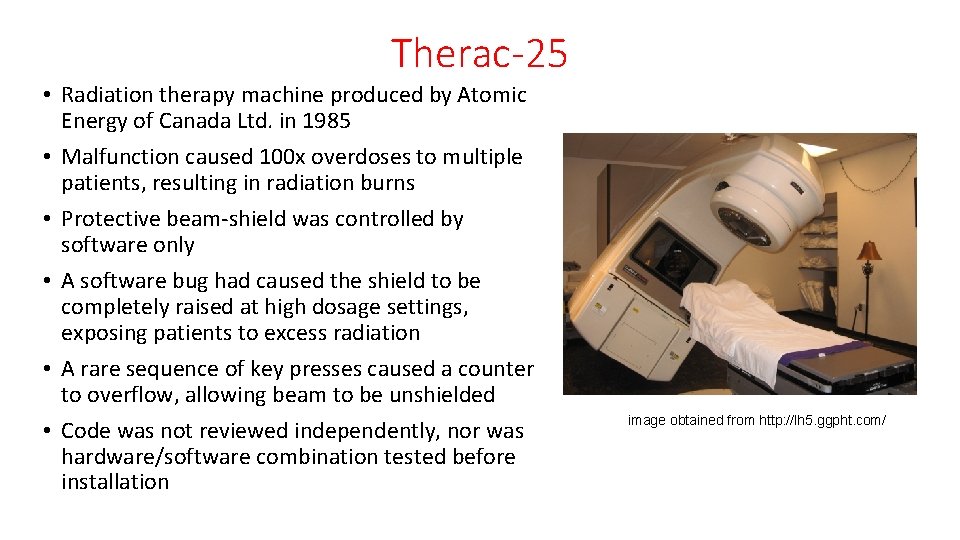
Therac-25 • Radiation therapy machine produced by Atomic Energy of Canada Ltd. in 1985 • Malfunction caused 100 x overdoses to multiple patients, resulting in radiation burns • Protective beam-shield was controlled by software only • A software bug had caused the shield to be completely raised at high dosage settings, exposing patients to excess radiation • A rare sequence of key presses caused a counter to overflow, allowing beam to be unshielded • Code was not reviewed independently, nor was hardware/software combination tested before installation image obtained from http: //lh 5. ggpht. com/
What are our responsibilities as software engineers? • good software engineering practices: test cases (e. g. regression testing) documentation, including assumptions and dependencies modular code design code reviews analysis tools (look for uninitialized variables, redundant code, software complexity metrics. . . ) • formal verification • user studies • beta tests • • • 20
• The amount of effort spent on debugging is always a tradeoff • balance with risks: cost, liability, loss of data, reputation, potential for harm/injury • you will have to make a choice about how much effort to invest in debugging • Ethical decision making requires reasoning about the magnitude and impact of software defects. • minor flaw versus critical bug? (i. e. cost analysis, though a utilitarian framework is not the only way to make decisions) • performance issue? potential for loss of data? injury with use? loss of life? or is it just an aesthetic flaw? 21
ACM Code of Ethics • Associate for Computing Machinery • http: //www. acm. org/about/code-of-ethics • ACM Co. E defines what it means to be a professional in the field of software engineering. • focuses more on what you should do, rather than not do (restrictions) • ACM code emphasizes safety of public over interests of the employer • members are obliged to take responsibility for their work, keep informed, to honor laws, copyrights, confidentiality, privacy, etc. 22
• 1. GENERAL MORAL IMPERATIVES. • 1. 1 Contribute to society and human well-being. • 1. 2 Avoid harm to others. • 1. 3 Be honest and trustworthy. • 1. 4 Be fair and take action not to discriminate. • 1. 5 Honor property rights including copyrights and patents. • 1. 6 Give proper credit for intellectual property. • 1. 7 Respect the privacy of others. • 1. 8 Honor confidentiality. 23
• 1. 1 Contribute to society and human well-being. • An essential aim of computing professionals is to minimize negative consequences of computing systems, including threats to health and safety. • When designing or implementing systems, computing professionals must attempt to ensure that the products of their efforts will be used in socially responsible ways, will meet social needs, and will avoid harmful effects to health and welfare. 24
• 1. 2 Avoid harm to others. • "Harm" means injury or negative consequences, such as undesirable loss of information, loss of property, property damage, or unwanted environmental impacts. . . • computing professional has the additional obligation to report any signs of system dangers that might result in serious personal or social damage. 25
• Furthermore, it is often necessary to assess the social consequences of systems to project the likelihood of any serious harm to others. • If system features are misrepresented to users, coworkers, or supervisors, the individual computing professional is responsible for any resulting injury. 26
Unethical Behavior • hacking • creating viruses • disassembly • circumventing DRM (Digital Rights Management; DVD player, i. Tunes) • spam • bots 27
Why do hackers hack? • money (theft) • principle: "liberating information" ( Wikileaks) • power, control • forcing social change or pushing a message • example: defacing a website whose ideology you disagree with • and. . . "to show that they can" (demonstration of capability) 28
Ethical question: Is hacking ever justified? • discovering security flaws can be important • some hackers view it as a responsibility • Black hats vs. white hats • how long should you wait to publicize a security flaw? • Google's policy: 90 days 29
Privacy and Security 31
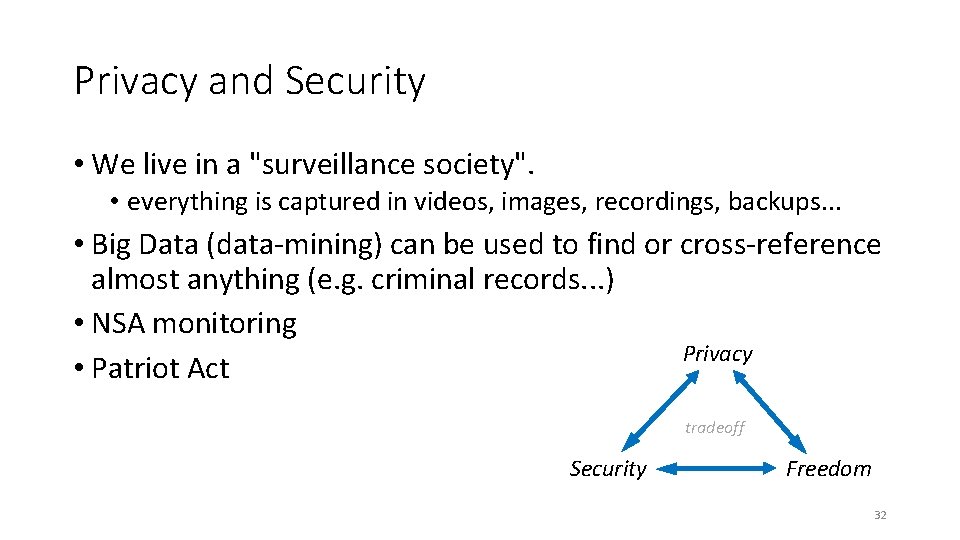
Privacy and Security • We live in a "surveillance society". • everything is captured in videos, images, recordings, backups. . . • Big Data (data-mining) can be used to find or cross-reference almost anything (e. g. criminal records. . . ) • NSA monitoring Privacy • Patriot Act tradeoff Security Freedom 32
Do we have a right to privacy? • Surprisingly, a right to privacy is not in the US Constitution, but the Supreme Court has interpreted it to be implied by other rights in the Bill of Rights. . . 33
Do we have a right to privacy? • 4 th Amendment, Bill of Rights: The right of the people to be secure in their persons, houses, papers, and effects, against unreasonable searches and seizures, shall not be violated, and no warrants shall issue, but upon probable cause, supported by oath or affirmation, and particularly describing the place to be searched, and the persons or things to be seized. 34
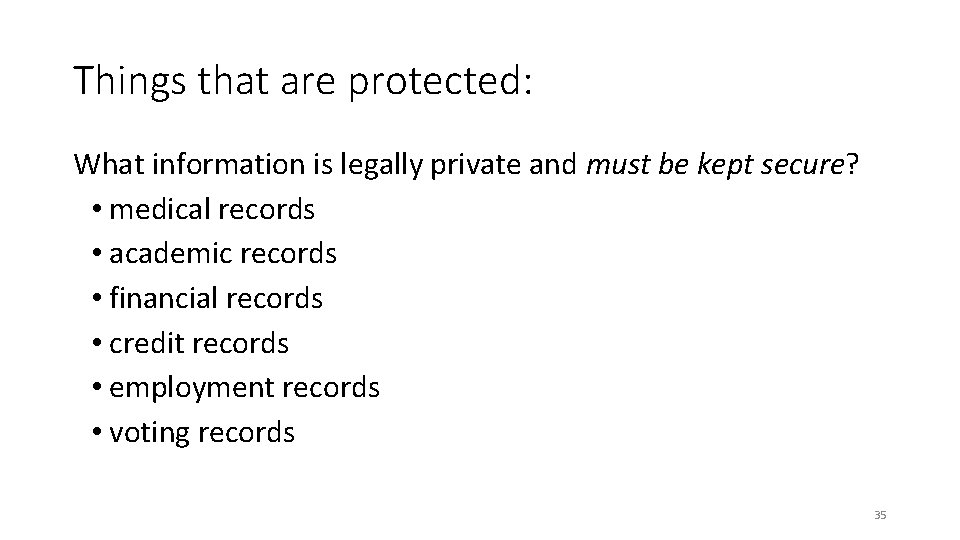
Things that are protected: What information is legally private and must be kept secure? • medical records • academic records • financial records • credit records • employment records • voting records 35
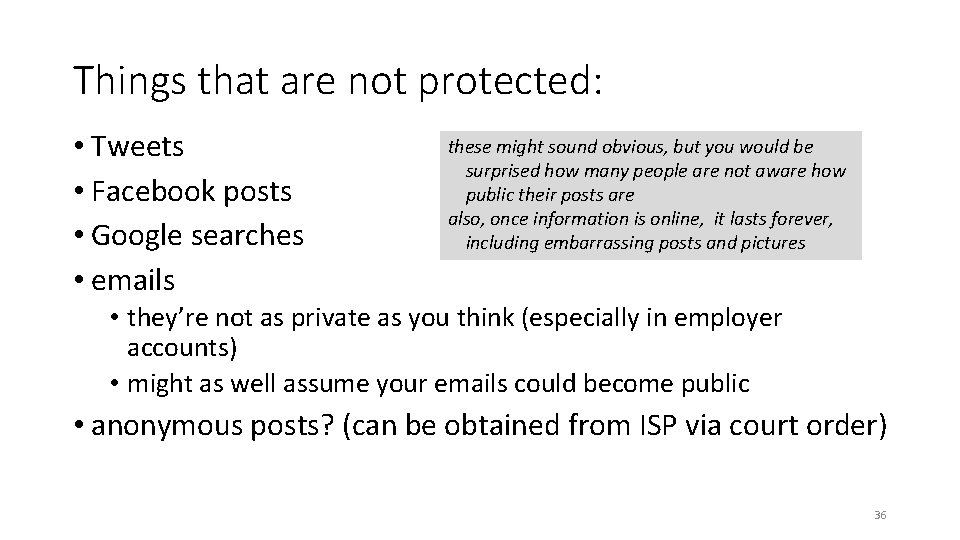
Things that are not protected: • Tweets • Facebook posts • Google searches • emails these might sound obvious, but you would be surprised how many people are not aware how public their posts are also, once information is online, it lasts forever, including embarrassing posts and pictures • they’re not as private as you think (especially in employer accounts) • might as well assume your emails could become public • anonymous posts? (can be obtained from ISP via court order) 36
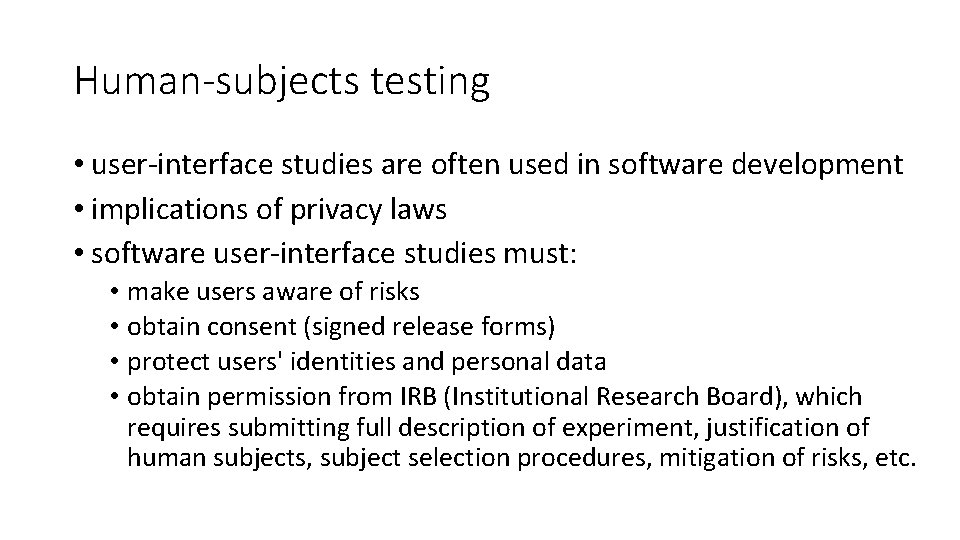
Human-subjects testing • user-interface studies are often used in software development • implications of privacy laws • software user-interface studies must: • make users aware of risks • obtain consent (signed release forms) • protect users' identities and personal data • obtain permission from IRB (Institutional Research Board), which requires submitting full description of experiment, justification of human subjects, subject selection procedures, mitigation of risks, etc.
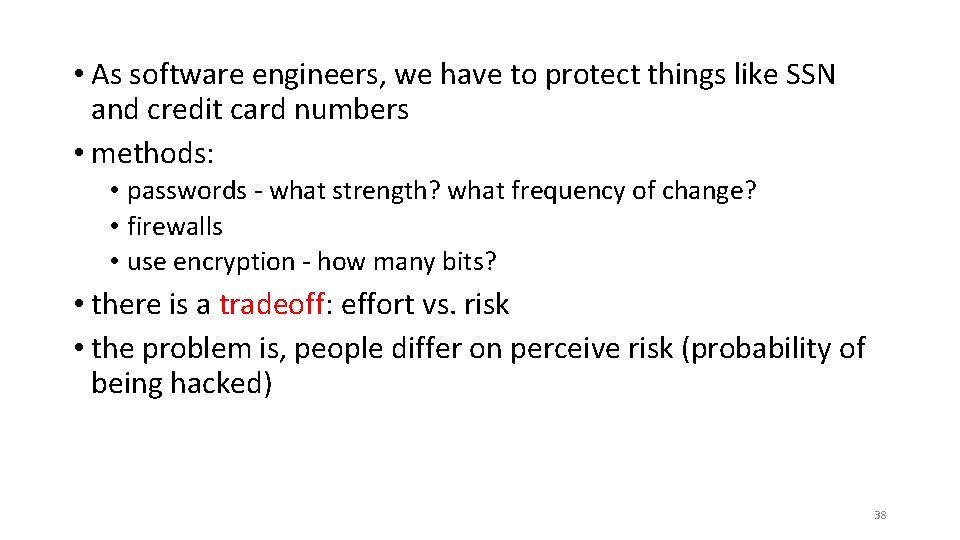
• As software engineers, we have to protect things like SSN and credit card numbers • methods: • passwords - what strength? what frequency of change? • firewalls • use encryption - how many bits? • there is a tradeoff: effort vs. risk • the problem is, people differ on perceive risk (probability of being hacked) 38
• We have the capability to manipulate technology to make it do amazing things • but just because you can do something doesn't mean you should • think about consequences/impact on others • . . . or as Google's corporate motto puts it. . . 39
• We have the capability to manipulate technology to make it do amazing things • but just because you can do something doesn't mean you should • think about consequences/impact on others • . . . or as Google's corporate motto puts it. . . Don't be evil. • (application to Google engineers: they have access to an incredible amount of information about people, and Google wants the public to trust that they won't exploit it) 40
In Summary • Software Engineers have the power to do amazing things. • Use good judgement • Take responsibility for the code you write (testing and debugging) • Respect copyrights • Protect users' personal data and private information • Don't be disruptive (Much of this is echoed in the ACM Code of Ethics) 41
The End for more information, case studies, news articles, etc. , see: http: //faculty. cs. tamu. edu/ioerger/ethics/links. html 42