
Leftmost Longest Regular Expression Matching in Reconfigurable Logic

Leftmost Longest Regular Expression Matching in Reconfigurable Logic Author: Kubilay Atasu Presenter: Yi-Hsien Wu Conference : 2015 International Conference on Field Programmable Technology (FPT) Date: 2018/1/10 Department of Computer Science and Information Engineering National Cheng Kung University, Taiwan R. O. C.
Outline l Introduction l Proposed Scheme l Results and Analysis National Cheng Kung University CSIE Computer & Internet Architecture Lab 2
Introduction Regular expression (regex) matching is an essential part of text analytics and network intrusion detection systems. The leftmost longest regex matching feature enables finding a leftmost derivation of an input text and helps resolve ambiguities that can arise in natural-language parsing. When several regex matches that end at the same offset position exist, typically only the span with the smallest start-offset value will be reported. This technique is called leftmost regex matching. National Cheng Kung University CSIE Computer & Internet Architecture Lab 3
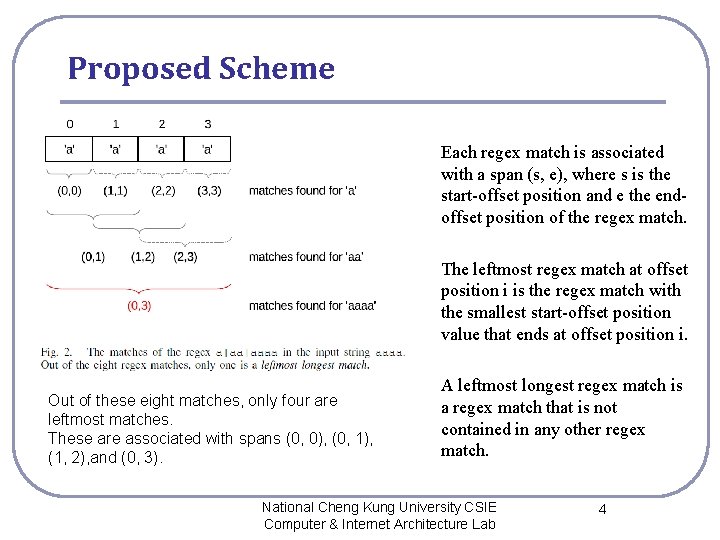
Proposed Scheme Each regex match is associated with a span (s, e), where s is the start-offset position and e the endoffset position of the regex match. The leftmost regex match at offset position i is the regex match with the smallest start-offset position value that ends at offset position i. Out of these eight matches, only four are leftmost matches. These are associated with spans (0, 0), (0, 1), (1, 2), and (0, 3). A leftmost longest regex match is a regex match that is not contained in any other regex match. National Cheng Kung University CSIE Computer & Internet Architecture Lab 4
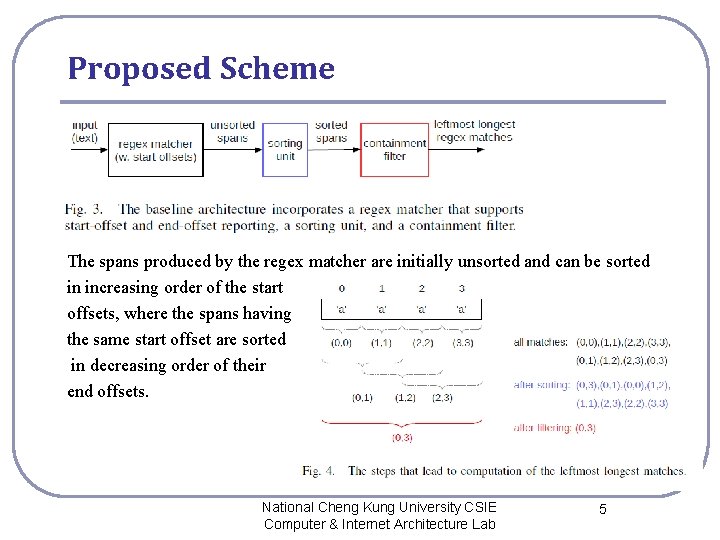
Proposed Scheme The spans produced by the regex matcher are initially unsorted and can be sorted in increasing order of the start offsets, where the spans having the same start offset are sorted in decreasing order of their end offsets. National Cheng Kung University CSIE Computer & Internet Architecture Lab 5
Proposed Scheme The containment filter processes the sorted spans in a streaming way, and stores only one span in its local registers. As an example, assume that spans (0, 1), (2, 3), (2, 4), and (1, 5) are produced by the regex matcher. After sorting, the spans are reordered as follows: (0, 1), (1, 5), (2, 4), and (2, 3). The containment filter stores the first span (0, 1) in its registers. When the second span (1, 5) arrives, (0, 1) is written to output and (1, 5) is written to the registers. (2, 4) and (2, 3) are not leftmost longest matches and are filtered out because they are contained in (1, 5). When the end-of-stream signal arrives, (1, 5) is written to the output. As a result, the two leftmost longest matches are computed, namely, (0, 1) and (1, 5). National Cheng Kung University CSIE Computer & Internet Architecture Lab 6
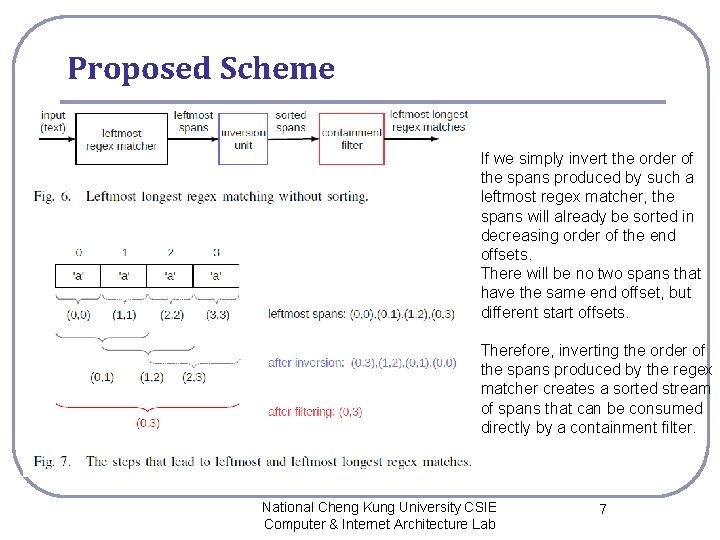
Proposed Scheme If we simply invert the order of the spans produced by such a leftmost regex matcher, the spans will already be sorted in decreasing order of the end offsets. There will be no two spans that have the same end offset, but different start offsets. Therefore, inverting the order of the spans produced by the regex matcher creates a sorted stream of spans that can be consumed directly by a containment filter. National Cheng Kung University CSIE Computer & Internet Architecture Lab 7
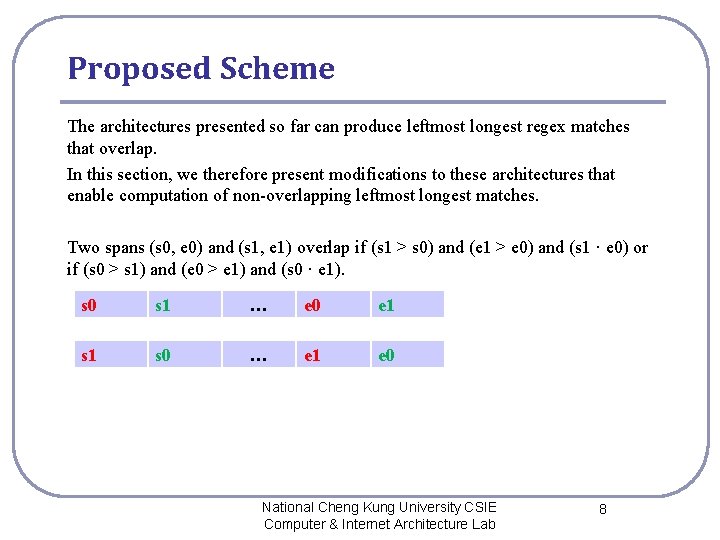
Proposed Scheme The architectures presented so far can produce leftmost longest regex matches that overlap. In this section, we therefore present modifications to these architectures that enable computation of non-overlapping leftmost longest matches. Two spans (s 0, e 0) and (s 1, e 1) overlap if (s 1 > s 0) and (e 1 > e 0) and (s 1 · e 0) or if (s 0 > s 1) and (e 0 > e 1) and (s 0 · e 1). s 0 s 1 … e 0 e 1 s 0 … e 1 e 0 National Cheng Kung University CSIE Computer & Internet Architecture Lab 8
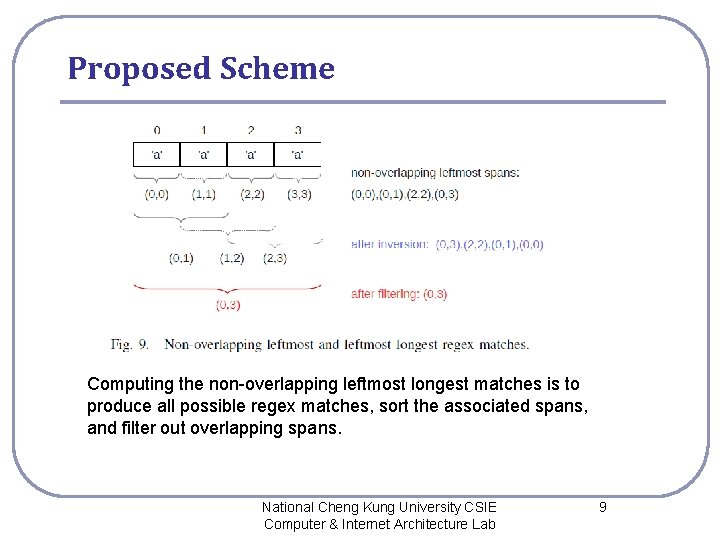
Proposed Scheme Computing the non-overlapping leftmost longest matches is to produce all possible regex matches, sort the associated spans, and filter out overlapping spans. National Cheng Kung University CSIE Computer & Internet Architecture Lab 9
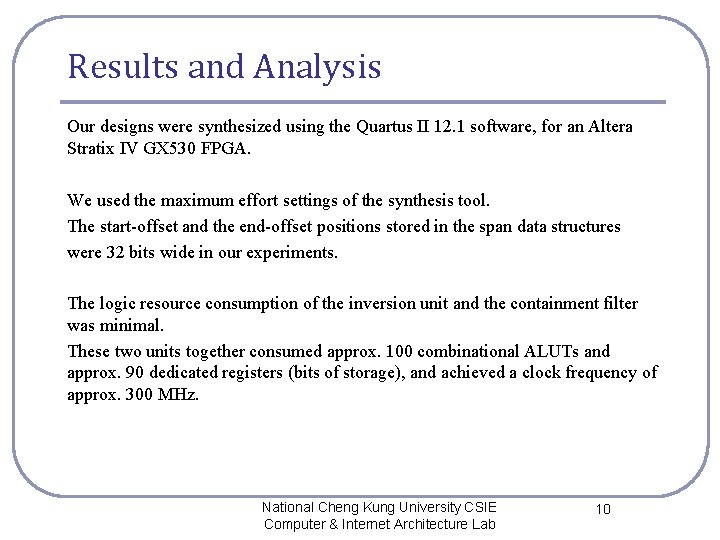
Results and Analysis Our designs were synthesized using the Quartus II 12. 1 software, for an Altera Stratix IV GX 530 FPGA. We used the maximum effort settings of the synthesis tool. The start-offset and the end-offset positions stored in the span data structures were 32 bits wide in our experiments. The logic resource consumption of the inversion unit and the containment filter was minimal. These two units together consumed approx. 100 combinational ALUTs and approx. 90 dedicated registers (bits of storage), and achieved a clock frequency of approx. 300 MHz. National Cheng Kung University CSIE Computer & Internet Architecture Lab 10
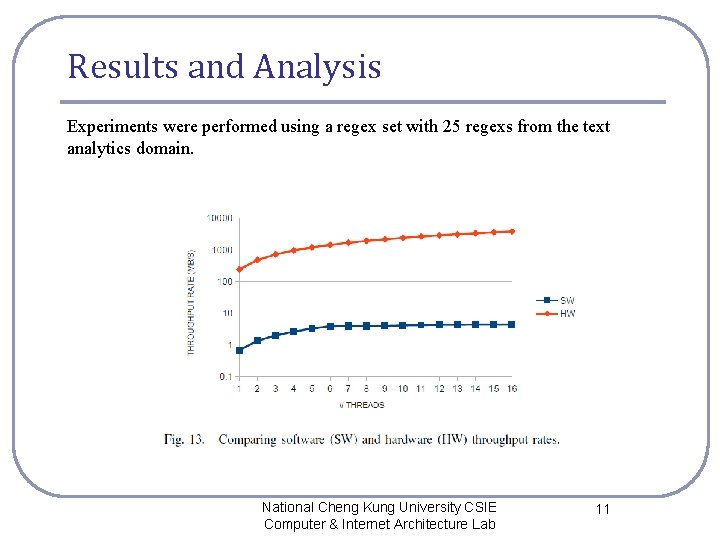
Results and Analysis Experiments were performed using a regex set with 25 regexs from the text analytics domain. National Cheng Kung University CSIE Computer & Internet Architecture Lab 11
- Slides: 11